
Every year, Jews around the world fast on Tisha B’Av, sit on the floor to read lamentations and, three times a day, turn toward Jerusalem. They mourn a building that disappeared nearly two thousand years ago: the Beit Hamikdash, the Temple. What exactly was it? What was it for, why was it destroyed, what remains of it, and why does the Jewish tradition still hope for its rebuilding? This article answers from the Torah, the books of Kings, the Mishna, the Talmud, Rashi, the Rambam (Maimonides), the Ramban (Nachmanides), archaeology and the lectures of Rav Raphaël Benizri, distinguishing what belongs to history, to halakha (practical law) and to spiritual reading.
In short: the Beit Hamikdash (“the House of Holiness”) is the central sanctuary of the Jewish people in Jerusalem, where sacrifices were offered, where people made pilgrimage three times a year and where G-d had promised to “dwell among” Israel. A First Temple was built by King Solomon (tenth century BCE, according to tradition) and destroyed by Babylon in 586 BCE; a second was dedicated around 516 BCE, embellished by Herod, then burned by the Romans in the year 70. No Temple exists today. Halakha teaches that the holiness of the place remains, which explains the cautious rules on ascending the Temple Mount. The tradition awaits the rebuilding, but readings differ on what it means and on how it will come.
What does “Beit Hamikdash” mean?
“Mikdash” comes from the root kadosh, “holy”: the Beit Hamikdash is the “house of the holy place.” The source is a verse of the Torah, spoken after Sinai:
“Let them make Me a sanctuary, and I will dwell among them.”
(Shemot 25:8) — וְעָשׂוּ לִי מִקְדָּשׁ וְשָׁכַנְתִּי בְּתוֹכָם
Note right away the end of the verse: “among them” (betocham), and not “in it.” The Torah does not say that G-d will inhabit the building, but that He will dwell within the people. Many commentators have drawn from this that the true sanctuary is in the person and in the community; the building is the place where this presence becomes visible. We will return to this.
For the Rambam, it is a positive commandment of the Torah: “It is a positive mitzvah to make a house for Hashem, prepared for sacrifices to be offered there and for pilgrimage to be made there three times a year” (Mishneh Torah, Hilchot Beit Habechira 1:1). The Sefer Ha-Chinuch (mitzvah 95) also counts it among the 613 commandments, including in it the utensils of the service (the menorah, the table, the altar; see The 613 Mitzvot).
The Temple has several names: Beit Hamikdash, Beit Hashem (“the House of Hashem”), Heichal (the great hall), Beit Habechira (“the Chosen House,” the title of the Rambam’s book on the subject). As for its predecessor, it was called the Mishkan, the “Tabernacle” or “Dwelling,” a portable tent carried through the desert (Shemot 25-40). This name too has a history: Rashi, commenting on the phrase “the Mishkan, the Mishkan of the Testimony” (Shemot 38:21), notes that the word is repeated twice to allude to the Temple “which was taken as a pledge (nitmashkein) in the two destructions, because of the sins of Israel”:
“‘The Mishkan, the Mishkan’: twice, an allusion to the Temple that was taken as a pledge by the two destructions, because of the sins of Israel.”
(Rashi on Shemot 38:21, after Midrash Tanchuma) — שְׁנֵי פְעָמִים, רֶמֶז לַמִּקְדָשׁ שֶׁנִּתְמַשְׁכֵּן בִּשְׁנֵי חֻרְבָּנִין עַל עֲוֺנוֹתֵיהֶן שֶׁל יִשְׂרָאֵל
The wordplay (mishkan, “dwelling,” and mashkon, “pledge”) is a teaching of the oral tradition; we will meet it again in Rav Benizri’s lecture.
From the Mishkan to Solomon’s Temple
The Mishkan, the desert sanctuary
The Tabernacle was built at the foot of Sinai, after the sin of the golden calf, with the voluntary gifts of the people. When it was completed, “the cloud covered the Tent of Meeting, and the glory of Hashem filled the Mishkan” (Shemot 40:34). Moshe himself “could not enter the Tent of Meeting” (Shemot 40:35). At the center stood the ark, with its two keruvim, from which G-d had promised to speak: “I will meet with you there, and I will speak with you from above the cover, from between the two keruvim” (Shemot 25:22).
Jerusalem, the chosen height
The choice of Jerusalem comes through King David. After a plague, he buys the threshing floor of Aravna the Jebusite in order to set up an altar there, and refuses to receive the land free of charge: “I will not offer to Hashem, my G-d, burnt offerings that cost me nothing” (Shmuel II 24:24). The book of Chronicles identifies this place with Mount Moriah, “where Hashem had appeared to David, his father” (Divrei Hayamim II 3:1). For the tradition, this Moriah is the one where Avraham was commanded to go up with Yitzchak (Bereshit 22:2), and of which he said: “On the mountain of Hashem, it shall be seen” (Bereshit 22:14).
The First Temple
It is Solomon, son of David, who builds the Temple, “in the four hundred and eightieth year after the children of Israel left Egypt” (Melachim I 6:1). The book of Kings gives its dimensions: “sixty cubits long, twenty wide and thirty high” (Melachim I 6:2). When the Temple is completed, the same scene as in the desert is replayed: the cloud fills the house and the kohanim can no longer stand there (Melachim I 8:10-11).
But the most remarkable thing is Solomon’s prayer on this occasion. Before the building he has just built, he dares to say:
“But will G-d truly dwell on the earth? Behold, the heavens and the heavens of the heavens cannot contain You, how much less this house that I have built!”
(Melachim I 8:27) — כִּי הַאֻמְנָם יֵשֵׁב אֱלֹקִים עַל־הָאָרֶץ הִנֵּה הַשָּׁמַיִם וּשְׁמֵי הַשָּׁמַיִם לֹא יְכַלְכְּלוּךָ אַף כִּי־הַבַּיִת הַזֶּה אֲשֶׁר בָּנִיתִי
And he adds a prayer for the foreigner: “Also for the foreigner who is not of Your people Israel, and who will come from a distant land for the sake of Your name… he will come and pray toward this house”; answer him, Solomon asks, “so that all the peoples of the earth may know Your name” (Melachim I 8:41-43). From the outset, the Temple is conceived as a place of meeting open to the nations.
A prophetic warning: the Temple is not insurance
The prophet Yirmeyahu has to remind us that the Temple is not a talisman: “Do not put your trust in deceptive words, saying: the Temple of Hashem, the Temple of Hashem, the Temple of Hashem, this is it!” (Yirmeyahu 7:4). G-d’s presence is not secured by the building; it depends on the conduct of the people.
The Second Temple and Herod’s Temple
From the return from Babylon to Herod’s embellishment
After the destruction of 586, the Persian king Cyrus authorizes the return and the rebuilding: “He commanded me to build Him a house in Jerusalem, in Judah” (Ezra 1:2). The Second Temple is completed “on the third day of the month of Adar, in the sixth year of the reign of Darius” (Ezra 6:15), around 516 BCE, and dedicated with joy (Ezra 6:16). The prophet Haggai had announced: “The glory of this latter house will be greater than that of the former” (Haggai 2:9).
In the second century BCE, the Temple was desecrated by the Seleucids, then purified and rededicated by the Hasmoneans in 164 BCE: this is the origin of the festival of Chanukah (see What is Chanukah?). Around 20-19 BCE, King Herod launched a vast enlargement of the esplanade and of the sanctuary, which continued for decades. The Talmud preserves the memory of it: “One who has not seen Herod’s building has never seen a beautiful building” (Bava Batra 4a).
What the Mishna describes
The Mishna (tractate Middot, “the measurements”) describes the Temple as it was at the end of the Second Temple period. “The Temple Mount (Har Habayit) was five hundred cubits by five hundred cubits” (Mishna Middot 2:1):
“The Temple Mount was five hundred cubits by five hundred cubits; its largest part was on the south, the second on the east, the third on the north, the smallest on the west.”
(Mishna Middot 2:1) — הַר הַבַּיִת הָיָה חֲמֵשׁ מֵאוֹת אַמָּה עַל חֲמֵשׁ מֵאוֹת אַמָּה, רֻבּוֹ מִן הַדָּרוֹם, שֵׁנִי לוֹ מִן הַמִּזְרָח, שְׁלִישִׁי לוֹ מִן הַצָּפוֹן, מִעוּטוֹ מִן הַמַּעֲרָב
These figures are those of the Mishnaic tradition; they do not coincide with the measurements of Herod’s monumental platform as uncovered by archaeology, which is larger. How to reconcile them is debated by scholars, and we do not decide.
At the center stood the sanctuary: a courtyard (azara) with the altar, a great hall (heichal) with the menorah, the table of the showbread and the golden incense altar (Shemot 25-30), and, beyond a curtain, the Holy of Holies (Kodesh Hakodashim), which only the high priest entered, on Yom Kippur: “let him not come at all times into the sanctuary, behind the curtain” (Vayikra 16:2). In the Second Temple, the Holy of Holies was empty: “After the ark was taken away, there was a stone there from the time of the earlier prophets, called the ‘foundation stone’ (even shetiya)” (Mishna Yoma 5:2). The Talmud lists what the Second Temple lacked: the ark with its cover and the keruvim, the fire (from heaven), the Divine Presence (Shechina), the holy spirit of prophecy (ruach hakodesh), the Urim and Tummim (Yoma 21b).
The service was performed by the kohanim and the Levites: the former kept watch over the Temple in three places, the latter in twenty-one (Mishna Middot 1:1). An anecdote in the Mishna expresses the pilgrims’ wonder: ten miracles are said to have taken place in the Temple, including this one: “they stood pressed together, and bowed down with room to spare” (Mishna Pirkei Avot 5:5). This is aggada, not law; it conveys the feeling of a place that welcomes the crowd without being overwhelmed by it.
What archaeology says
Archaeology confirms the Second Temple, with details, and leaves the First in the shadows.
- The warning inscription (Soreg). Discovered in 1871 by Charles Clermont-Ganneau near the Bab al-Atim gate, written in Greek, it forbids foreigners to pass the balustrade around the Temple on pain of death; it is kept in the Istanbul museum. A second fragment was found in 1936. Josephus describes these warnings, in Greek and in Latin.
- The “place of the trumpeting” inscription. Unearthed in 1968 by Benjamin Mazar at the foot of the southern wall, it reads in Hebrew “To the place of the trumpeting (beit hateki’a)” and dates from the first century; it probably marked the spot where the kohanim sounded the trumpet to announce Shabbat. It is in the Israel Museum.
- The Arch of Titus in Rome, which shows Roman soldiers carrying off the Temple menorah after the capture of Jerusalem.
- The Ketef Hinnom amulets. Two small silver scrolls, found in 1979 near Jerusalem and dated to about 650-587 BCE, bear a variant of the priestly blessing (Bamidbar 6:24-26): among the oldest known biblical texts.
For the First Temple, no excavation has been possible on the Temple Mount, for religious and political reasons, and no direct evidence has been found. Some historians, who dispute the biblical dating, propose lowering the date of the Temple’s construction by a few centuries; others rely on neighboring sanctuaries (Tel Arad, Tel Motza) to think that a royal sanctuary existed in Jerusalem. The Jewish tradition holds Solomon’s construction to be a fact; academic debates change nothing in halakha, and we mention them in the interest of honesty.
What took place there
The Temple was first of all a place of daily service: the tamid, the perpetual offering of morning and evening, offered in the name of the whole people (see Why Are There Sacrifices (Korbanot) in the Torah?). It was also the place of pilgrimage: “Three times a year all your males shall appear before Hashem, your G-d, in the place that He will choose: at the Festival of Matzot, at the Festival of Weeks and at the Festival of Booths” (Devarim 16:16). Pesach, Shavuot and Sukkot (see What is Pesach?, What is Shavuot? and What is Sukkot?) filled Jerusalem with people.
There was also Yom Kippur, the only day on which the high priest entered the Holy of Holies (Vayikra 16), the annual half-shekel contribution, equal for everyone (Shemot 30:11-16: “the rich shall not give more, and the poor shall not give less”), study, prayer. Isaiah announces its universal vocation: “My house shall be called a house of prayer for all peoples” (Yeshayahu 56:7). A foreigner could bring an offering there: Vayikra 22:25 assumes it, provided the animal is without blemish, and Bamidbar 15:14-16 establishes equality before the law.
Why a Temple?
The Torah does not explain everything, and the tradition has proposed several levels of reading.
“I will dwell among them”
The Temple does not contain G-d; it offers man a place in which to turn toward Him. Solomon says so (Melachim I 8:27, cited above); Yeshayahu too: “The heaven is My throne and the earth is My footstool: where is the house that you would build for Me?” (Yeshayahu 66:1). The Temple answers a human need, not a need of G-d (see also Tehilim 50:12-13, cited in the article on sacrifices).
The Ramban: Sinai continued
The Ramban (commentary on Shemot 25:1) reads the Tabernacle as the continuation of the revelation at Sinai. After G-d spoke face to face, He does not want that presence to recede:
“The secret of the Mishkan is that the Glory that had dwelt on Mount Sinai dwells there in a hidden manner; as it is said there: ‘the glory of Hashem rested on Mount Sinai,’ so it is written of the Mishkan: ‘the glory of Hashem filled the Mishkan.'”
(Ramban on Shemot 25:1) — וְסוֹד הַמִּשְׁכָּן הוּא, שֶׁיִּהְיֶה הַכָּבוֹד אֲשֶׁר שָׁכַן עַל הַר סִינַי שׁוֹכֵן עָלָיו בְּנִסְתָּר
This reading makes the Temple a kind of “permanent Sinai”: the Torah is there as at the origin, the place where heaven and earth touch.
Rashi: the sanctuary below, facing the throne above
Rashi, on Shemot 15:17 (“the place that You have prepared for Your dwelling, the sanctuary that Your hands have established”), cites the Mechilta: “The sanctuary below is set opposite the throne above.” He adds that the Temple is so dear to G-d that the world was created with a single hand (“My hand founded the earth,” Yeshayahu 48) whereas the Temple was created with two hands, and he asks when the two hands will build it: when “Hashem will reign forever”; at the end of days. This is an aggadic reading of the rebuilding to come.
Chassidim and Kabbalah
In Kabbalah and Chassidut, the Temple is also read as a reflection of the world and of man: each person is called to make an inner sanctuary for himself, relying on the verse “among them” (Shemot 25:8). These are spiritual readings, not rules of halakha.
The destructions and their meaning
Two destructions, one date
The tradition reports that both Temples were destroyed on the same day, the 9th of Av. There is, however, a difficulty: the book of Kings places the arrival of Nebuzaradan “on the seventh day of the fifth month” (Melachim II 25:8-9), and Yirmeyahu “on the tenth” (Yirmeyahu 52:12-13). The Talmud resolves it thus: “On the seventh, gentiles entered the Heichal, ate in it and desecrated it on the seventh and the eighth; and on the ninth, toward nightfall, they set it on fire, and it burned all the following day” (Ta’anit 29a). And Rabbi Yochanan says:
“Had I lived in that generation, I would have fixed the fast only on the tenth, because most of the Heichal burned on that day. But the Sages say: it is better to mark the beginning of the misfortune.”
(Ta’anit 29a) — אִלְמָלֵי הָיִיתִי בְּאוֹתוֹ הַדּוֹר לֹא קְבַעְתִּיו אֶלָּא בָּעֲשִׂירִי, מִפְּנֵי שֶׁרוּבּוֹ שֶׁל הֵיכָל בּוֹ נִשְׂרַף. וְרַבָּנַן — אַתְחַלְתָּא דְפוּרְעֲנוּתָא עֲדִיפָא
For the destruction of the year 70, Josephus writes that the Temple was set on fire “on the tenth day of the month of Loos,” which corresponds to Av, and notes that it was the same day on which it had once been burned by the king of Babylon (The Jewish War, VI, 4, 5). The dates differ by one day between the Talmud and him; the tradition retains the 9th of Av, a day of fasting (see Why do we fast on Tisha B’Av?).
Why? The causes according to the Sages
The Prophet Zechariah announces that the fasts linked to the destruction, of the fourth, fifth, seventh and tenth months, will one day be changed “into gladness and joy, into cheerful festivals” (Zechariah 8:19). On the cause of the ruin, the Talmud is clear:
“But the Second Temple, where people were engaged in Torah, mitzvot and acts of kindness, why was it destroyed? Because of the baseless hatred that prevailed there. This teaches you that baseless hatred weighs as much as the three sins: idolatry, forbidden relations and bloodshed.”
(Yoma 9b) — אֲבָל מִקְדָּשׁ שֵׁנִי שֶׁהָיוּ עוֹסְקִין בְּתוֹרָה וּבְמִצְוֹת וּגְמִילוּת חֲסָדִים, מִפְּנֵי מָה חָרַב? מִפְּנֵי שֶׁהָיְתָה בּוֹ שִׂנְאַת חִנָּם. לְלַמֶּדְךָ שֶׁשְּׁקוּלָה שִׂנְאַת חִנָּם כְּנֶגֶד שָׁלֹשׁ עֲבֵירוֹת: עֲבוֹדָה זָרָה, גִּלּוּי עֲרָיוֹת, וּשְׁפִיכוּת דָּמִים
The Talmud illustrates baseless hatred with the story of Kamtza and Bar Kamtza, a man invited by mistake to a banquet, humiliated before the sages who remained silent, who takes revenge by denouncing the people to the Romans. He has the emperor send an animal for sacrifice and inflicts a wound on its lip (or its eye), “a place that for us is a blemish, and for them is not”; the animal is not offered, and the emperor sends his army (Gittin 55b-56a).
Note the tone: the Temple is not destroyed because the people neglect the rites, but because its internal relationships have broken down. This is a constant idea of the tradition, which makes the bond between people the condition of the divine presence.
The holiness remains
What remains after the destruction? The Rambam answers that the holiness of the Temple Mount and of Jerusalem was not annulled: it rests on the Divine Presence, “and the Divine Presence is not annulled” (Hilchot Beit Habechira 6:16). A midrash expresses it in a famous way:
“Rav Acha said: the Shechina has never departed from the Western Wall.”
(Shemot Rabba 2:2) — אָמַר רַב אַחָא, לְעוֹלָם אֵין הַשְּׁכִינָה זָזָה מִכֹּתֶל מַעֲרָבִי
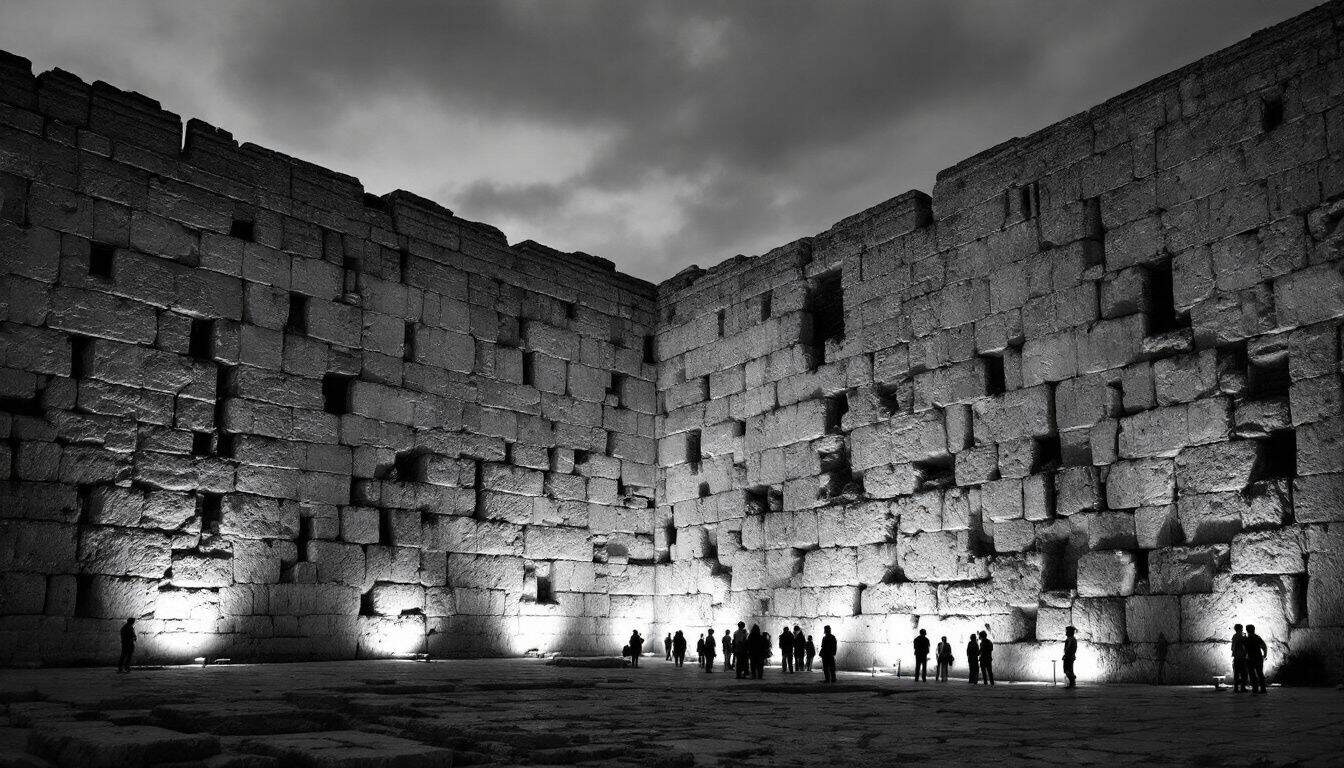
The expression “Western Wall” (kotel ma’aravi) refers, in this midrash, to a wall of the Temple or of its courtyard; the practice of applying it to today’s Kotel is later. The present wall, the Kotel, is a retaining wall of Herod’s platform, not the Temple itself (see below).
What Rav Raphaël Benizri teaches
Rav Benizri addressed the Temple in several published lectures, above all in his series on the fast days and in his lectures on the Tabernacle. We report his words without adding anything.
- The Mishkan, a name that foretells its fragility. In his lecture on Pekudei, the Rav notes that, according to the Sages, the sanctuary was destined for destruction because the Torah does not call it mikdash: the word used evokes “a pledge.” Why build, then? Because everything depends on what man will make of it. The sanctuary stands only if it remains a living, moving place of encounter; as soon as man regards holiness as static, there is saturation, and the death that man imposes on himself. He also recalls that the holiness of Jerusalem is to extend, according to the Sages, as far as Damascus, and that of the land of Israel to the universe: what is built is a starting point, not a possession. See the lecture: Pekudei: the inner Tabernacle.
- Space and time. In his lecture on Vayakhel, he presents the sanctuary and Shabbat as the two forms of one and the same device: a place of encounter and a time of encounter. The sanctuary is “the model of the created universe, reproduced in miniature.” It cannot replace Shabbat: service labors (avodot) may be performed there, but not melacha. And when King Solomon built the Temple, he left room for any foreigner wishing to bring a sacrifice and to attest G-d’s sovereignty. See the lecture: Vayakhel: the Tabernacle beyond space.
- A place of elevation. In his lecture on Tetzaveh, he affirms that the sanctuary is above all a place of self-elevation (terumah), and not a place where one “sheds one’s sins.” There he describes the equality of the gifts (the half-shekel, identical for rich and poor), the menorah for which the kohen had to climb three steps to light lamps that were nevertheless within his reach, a sign of a humility that makes it possible to interpret the oral law without betraying it, and the exclusion of iron in the construction: one could bring the gold of Babylon, the silver of Persia, the bronze of Greece, but not steel, because the Temple embodies serenity and not war. See the lecture: Tetzaveh: elevating oneself.
- Mem, Shin, Kaf, Nun: the four pillars. In the lecture on the destruction of the First Temple, the Rav reads the four letters of the word mishkan as the four functions that make up the life of the people: the king (melech), the judge (shofet), the kohen and the prophet (navi). When one is missing, the people’s history goes lame. He adds, in answer to a question, that this mishkan was given to every person: one must be one’s own king, one’s own judge, one’s own kohen, one’s own prophet. He also explains that the First Temple reached its term after seventy years, whereas the second did not, because baseless hatred has not reached its term, and that, if the people cannot meet the demands of holiness, it is better for the sanctuary to be destroyed than the people. See the lecture: Tisha B’Av: the destruction of the First Temple.
- The Temple was not a slaughterhouse. In the lecture on the origin of the destruction, answering a listener who asked whether one could say that the Temple was symbolically rebuilt with the State of Israel, the Rav begins by asking what the sanctuary was: certainly not “a slaughterhouse dedicated to G-d.” What mattered was the presence of G-d, “the point of reference and point of convergence of the entire assembly of Israel,” the unity rediscovered at the three pilgrimage festivals, where Israel’s identity was renewed. That is why, he says, we aspire to its rebuilding as a place that could bring together not only Jewish consciences but all universal consciences: in the future, the nations will go up to the house of Yaakov. He adds that we will not again become people attached solely to practices in their smallest details; that whoever wishes to observe them, good for him, but that the essential is the spirit of the law: a law, like a human being, has a body and a soul. The Rav further explains that, in the Second Temple, the ark of the law did not exist, so as to let the oral law develop out of the written law, without remaining at the letter. See the lecture: Tisha B’Av: the origin of the destruction.
- Exile as therapy. In the same lecture, he teaches that exile is not a punishment but a therapy: a punishment with no educational purpose would be inconceivable.
The Temple Mount today
One holy place, three religions
The Temple Mount (Har Habayit) is today an esplanade occupied by two Muslim shrines: the Dome of the Rock, completed in 692 by the caliph Abd al-Malik, and the Al-Aqsa Mosque. Since 1967, a de facto arrangement (the “status quo”) entrusts management of the site to the Muslim Waqf, with Israel retaining security control and forbidding prayer by non-Muslims. The Western Wall (the Kotel), where Jews pray, is not the Temple: it is a retaining wall of Herod’s platform, one of the outer remains closest to the Temple and the nearest place of prayer accessible to Jews.
What does halakha say about ascending?
The Rambam teaches that it is forbidden to enter the sanctified parts. Even destroyed, the Temple must be revered, according to the verse “You shall revere My sanctuary” (Vayikra 19:30):
“Although the Temple is today in ruins because of our sins, one must revere it as one did when it stood: one enters only the places where entry is permitted, one does not sit in the courtyard (azara), one does not behave lightly before the Eastern Gate.”
(Rambam, Hilchot Beit Habechira 7:7) — אַף עַל פִּי שֶׁהַמִּקְדָּשׁ הַיּוֹם חָרֵב בַּעֲוֹנוֹתֵינוּ חַיָּב אָדָם בְּמוֹרָאוֹ כְּמוֹ שֶׁהָיָה נוֹהֵג בּוֹ בְּבִנְיָנוֹ. לֹא יִכָּנֵס אֶלָּא לְמָקוֹם שֶׁמֻּתָּר לְהִכָּנֵס לְשָׁם וְלֹא יֵשֵׁב בָּעֲזָרָה וְלֹא יָקֵל רֹאשׁוֹ כְּנֶגֶד שַׁעַר הַמִּזְרָח
On this basis, the majority position of rabbinic authorities is not to ascend the Mount. The reasons given are impurity from contact with the dead (the ashes of the red heifer, which allowed one to be purified from it, are no longer available) and uncertainty about the exact location of the forbidden zones, notably the Holy of Holies. As early as 1967 the Rabbinate of Israel posted at the entrance to the Mount a notice stating that, according to the law of the Torah, entry into the Mount’s precinct is strictly forbidden because of the holiness of the place; this position is also that of the Haredi authorities. A minority of rabbis, often close to religious Zionism, holds that one may ascend to certain areas after immersion in a mikveh (see What is a mikveh?); they are criticized by those who uphold the prohibition. Rav Shlomo Goren, a former chief rabbi, led prayers on the Mount after 1967. We do not decide: for any concrete question, consult a rabbi.
Will the Temple be rebuilt?
For the Rambam, rebuilding is part of the Messiah’s mission: “The King Messiah will arise… he will build the Temple and gather the dispersed of Israel” (Hilchot Melachim 11:1). It is also the daily prayer: “May it be Your will… that the Temple be rebuilt speedily in our days.”
Opinions differ on how. On one side, a tradition makes the rebuilding a divine or messianic work: Rashi (on Shemot 15:17) evokes a sanctuary built by “two hands,” the moment when “Hashem will reign forever.” The prophet Yechezkel describes, in his vision (Yechezkel 40-48), a future Temple of precise dimensions, “on a very high mountain” (Yechezkel 40:2). Chassidic and Haredi currents generally await the coming of the Messiah before any initiative. On the other side, some religious Zionist circles are already preparing objects of the service and practical studies, believing that practical reflection is part of the hope. Both appeal to the Torah; we set out the positions without deciding.
A third line, represented by Rav Benizri (see above), insists on what the Temple brought: presence, unity, universality. It is this spirit that the rebuilding must serve, before its form.
Common misconceptions about the Temple
“The Wailing Wall is the Temple”
No. It is a retaining wall of Herod’s platform, which supported the Temple Mount. The Temple itself, at the center of the esplanade, has disappeared.
“The Temple was just a slaughterhouse”
That is a caricature. Sacrifices were performed in the courtyard, but the Temple was also a place of pilgrimage, of prayer (“a house of prayer for all peoples,” Yeshayahu 56:7), of encounter.
“The Ark of the Covenant is hidden in the Temple and will be found”
The Second Temple no longer had an ark: the Holy of Holies was empty (Mishna Yoma 5:2; Yoma 21b). According to the Talmud, King Yoshiyahu hid it before the exile (Yoma 52b); it has never been found.
“Archaeology has proved Solomon’s Temple”
Not directly. We possess inscriptions from the Second Temple, remains of Herod’s platform, texts such as the Ketef Hinnom amulets, but no direct evidence of the First Temple, for lack of excavation. The tradition believes it; historians debate.
Frequently asked questions about the Beit Hamikdash
What does “Beit Hamikdash” mean?
“The house of the sanctuary” (from kadosh, “holy”). The Temple is the central sanctuary of the Jewish people in Jerusalem (Shemot 25:8).
Why do Jews fast on Tisha B’Av?
They commemorate the destruction of the two Temples (Ta’anit 29a) and the misfortunes that followed; see Why do we fast on Tisha B’Av?.
Where was the Temple located?
On Mount Moriah in Jerusalem (Divrei Hayamim II 3:1), on the esplanade now occupied by the Dome of the Rock and the Al-Aqsa Mosque. The exact location of the Holy of Holies is debated.
Can one ascend the Temple Mount today?
It is a subject of disagreement among rabbis. The majority position forbids it; a minority permits it in certain areas (Rambam, Hilchot Beit Habechira 7:7). Consult a rabbi.
Will the Temple be rebuilt?
The tradition hopes so (Rambam, Hilchot Melachim 11:1). Opinions differ on the manner: through the Messiah, through a divine work, through human initiative.
Further reading
The Temple is an absence that still structures the calendar and prayer. To continue, here are some readings on the site.
- Why Are There Sacrifices (Korbanot) in the Torah?
- Why do we fast on Tisha B’Av? The destructions of the Temple
- What is Chanukah and why do we light candles for eight days?
- Who are the kohanim, the Levites and the Israelites?
- The 613 Mitzvot
- Tisha B’Av: why the 9th of Av is a day of mourning
- The fast days: fasting, a weapon of remembrance
- Glossary of Hebrew words in Judaism
Sources and references (34)
- Bereshit (Genesis) 22:2; 22:14
- Shemot (Exodus) 25:8; 25:22; 30:11-16; 38:21; 40:34-35
- Vayikra (Leviticus) 16:2; 19:30; 22:25
- Bamidbar (Numbers) 6:24-26; 15:14-16
- Devarim (Deuteronomy) 16:16
- Shmuel II (II Samuel) 24:24
- Melachim I (I Kings) 6:1-2; 8:10-11; 8:27; 8:41-43
- Melachim II (II Kings) 25:8-9
- Yeshayahu (Isaiah) 56:7; 66:1
- Yirmeyahu (Jeremiah) 7:4; 52:12-13
- Yechezkel (Ezekiel) 40:1-2
- Haggai 2:9
- Zechariah 8:19
- Tehilim (Psalms) 50:12-13
- Ezra 1:2; 6:15-16
- Divrei Hayamim II (II Chronicles) 3:1
- Mishna Middot 1:1; 2:1
- Mishna Yoma 5:2
- Mishna Pirkei Avot 5:5
- Babylonian Talmud, Yoma 9b; 21b; 52b
- Babylonian Talmud, Ta’anit 29a
- Babylonian Talmud, Bava Batra 4a
- Babylonian Talmud, Gittin 55b-56a
- Shemot Rabba 2:2
- Rashi on Shemot 15:17; 38:21
- Ramban on Shemot 25:1
- Rambam, Mishneh Torah, Hilchot Beit Habechira 1:1; 6:16; 7:7
- Rambam, Mishneh Torah, Hilchot Melachim 11:1
- Sefer Ha-Chinuch, mitzvah 95
- Josephus, The Jewish War, VI, 4, 5
- Charles Clermont-Ganneau and the discovery of the Temple warning inscription (1871); fragment found in 1936; Istanbul and Israel museums
- Benjamin Mazar, excavations of the southern wall of the Temple Mount, “place of the trumpeting” inscription (1968), Israel Museum
- Gabriel Barkay, excavations at Ketef Hinnom (1979)
- Lectures by Rav Raphaël Benizri: Pekudei: the inner Tabernacle; Vayakhel: the Tabernacle beyond space; Tetzaveh: elevating oneself; Tisha B’Av: the destruction of the First Temple; Tisha B’Av: the origin of the destruction
Article by the Pensées Juives editorial team. Passages attributed to Rav Raphaël Benizri are taken from his lectures published on this site.