
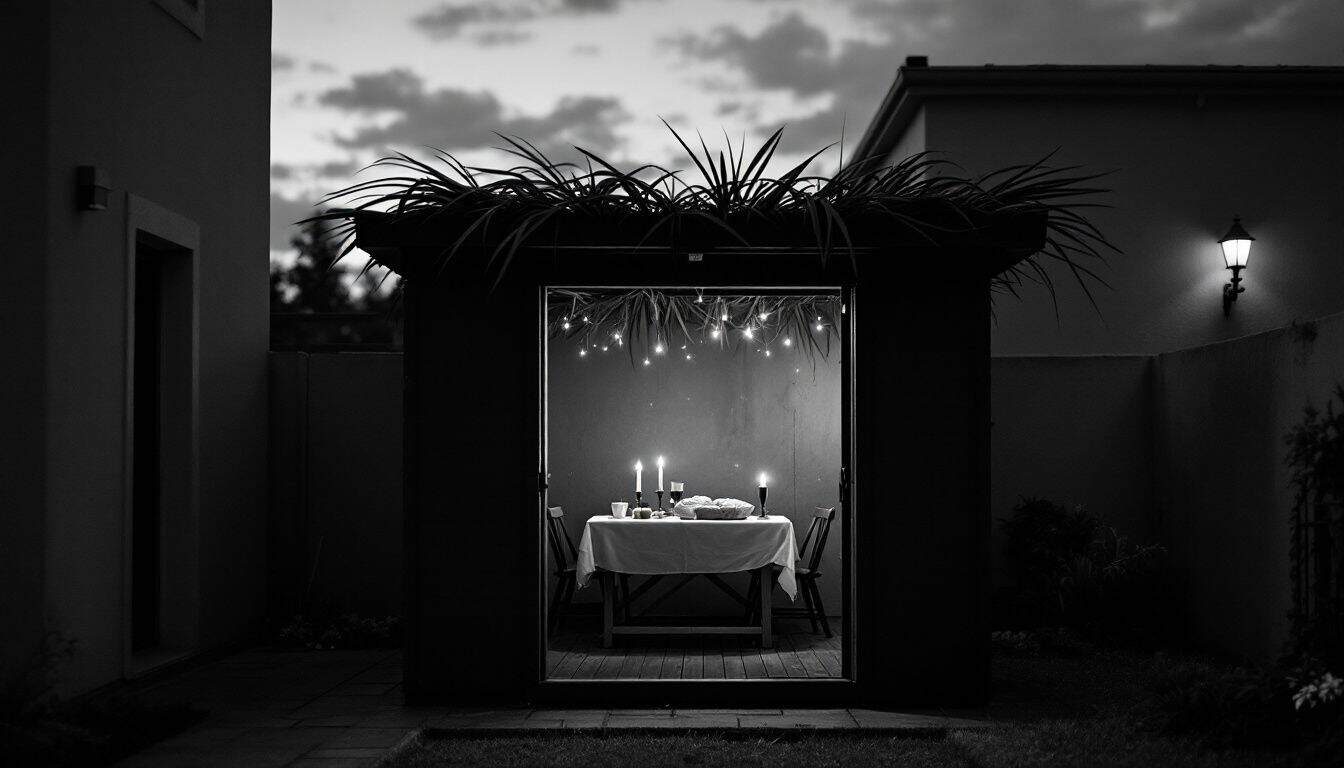
A few days after Yom Kippur, whole families leave their living rooms to eat under a roof of branches, and men wave in every direction a bouquet of citron, palm, myrtle and willow. Sukkot, the festival of booths, is one of the most visible in the Jewish calendar, and one of the most misunderstood. This article explains it from the Torah, the Mishna, the Talmud, Maimonides and the Shulchan Aruch, distinguishing halakha (the law that is practiced) from moral or mystical readings, and placing it back within the history of the Temple.
In short: Sukkot begins on the 15th of the month of Tishrei and lasts seven days, followed by Shemini Atzeret, the “eighth day of assembly.” The Torah prescribes two mitzvot (commandments) specific to the festival: to “dwell” for seven days in a sukkah (a booth with a roof of branches, sechach), “so that your generations may know that I made the children of Israel dwell in booths” (Vayikra [Leviticus] 23:42-43), and to take “on the first day” four plant species, the lulav (palm), the etrog (citron), the hadassim (myrtle) and the aravot (willow) (Vayikra 23:40). The Torah also commands joy: “you shall be only joyful” (Devarim [Deuteronomy] 16:15). In the Temple, seventy bulls were offered, which the Sages connect to the nations of the world: Sukkot has a universal dimension.
Sukkot in the calendar: harvest festival, pilgrimage festival
Sukkot is one of the three pilgrimage festivals (shalosh regalim), with Pesach and Shavuot: three times a year, all Israel went up to the Temple in Jerusalem. The Torah calls it the “Festival of Booths” (Chag HaSukkot, Vayikra 23:34) and also the “Festival of the Ingathering” (Chag HaAsif): “when you gather in the fruit of your labor” (Shemot [Exodus] 23:16; 34:22). The Rambam (Maimonides) draws from this the reason for the date: it is a season of rest, when one is freed from pressing labors and can live in a booth without suffering too much from heat or rain (Guide for the Perplexed III:43).
Leviticus fixes the festival on the fifteenth day of the seventh month; the first day is a complete rest (shabbaton), as is the eighth (Vayikra 23:34-36; 23:39). This “eighth day” is a separate assembly, the atzeret (Vayikra 23:36): it is Shemini Atzeret, celebrated as a continuation of Sukkot but as a distinct festival. Outside Israel, Simchat Torah is added the following day.
In the Bible, Sukkot is also “the festival” par excellence. Solomon inaugurates the Temple when “all Israel assembled before him at the festival, in the month of Etanim, which is the seventh month” (I Melakhim [I Kings] 8:2). When Yarovam (Jeroboam) wants to turn his kingdom away from the pilgrimage to Jerusalem, he creates a substitute festival a month later, “like the festival in Judah” (I Melakhim 12:32): imitating it was a political act.
What the Torah says, and what it leaves to the oral tradition
The main passage of Leviticus describes the two mitzvot specific to the festival. The first is the sukkah:
“You shall dwell in booths for seven days; every native in Israel shall dwell in booths, so that your generations may know that I made the children of Israel dwell in booths when I brought them out of the land of Egypt.”
(Vayikra 23:42-43) — בַּסֻּכֹּ֥ת תֵּשְׁב֖וּ שִׁבְעַ֣ת יָמִ֑ים כׇּל־הָֽאֶזְרָח֙ בְּיִשְׂרָאֵ֔ל יֵשְׁב֖וּ בַּסֻּכֹּֽת׃
The second is the taking of the four species:
“You shall take for yourselves, on the first day, the fruit of a beautiful tree (peri etz hadar), branches of palm trees, a bough of a leafy tree and willows of the brook, and you shall rejoice before the L-rd your G-d for seven days.”
(Vayikra 23:40) — וּלְקַחְתֶּ֨ם לָכֶ֜ם בַּיּ֣וֹם הָרִאשׁ֗וֹן פְּרִ֨י עֵ֤ץ הָדָר֙ כַּפֹּ֣ת תְּמָרִ֔ים וַעֲנַ֥ף עֵץ־עָבֹ֖ת וְעַרְבֵי־נָ֑חַל
The written Torah is very brief here. It does not say what “the fruit of a beautiful tree” is, nor “a bough of a leafy tree,” nor how many to take, nor how to build a sukkah. All of this comes from the oral tradition, recorded in the Mishna and the Talmud (tractate Sukkah) and codified by the Rambam in Hilkhot Shofar, Sukkah veLulav (Mishneh Torah). The Talmud reads “beautiful tree” (hadar) in several ways: the tree whose wood and fruit taste alike, the one that “dwells” (dar) on its tree from one year to the next, or, by a Greek wordplay, the one that grows near water (Sukkah 35a). All conclude: it is the etrog.
Other verses surround the festival. Deuteronomy associates it with joy and hospitality: “You shall rejoice during your festival, you, your son and your daughter, your male and female servants, the Levite, the stranger, the orphan and the widow” (Devarim 16:14), and concludes: “you shall be only joyful” (Devarim 16:15). Every seven years, at Sukkot, at the beginning of the year following the shemitah (the Sabbatical year), the whole people, “men, women, children and the stranger,” gathers to hear the Torah: this is the hakhel (Devarim 31:10-13; Mishna Sotah 7:8 describes the king reading from a platform in the Temple courtyard). Finally, the prophet Zechariah announces that one day “all the survivors of all the nations” will go up year after year to Jerusalem “to celebrate the festival of booths” (Zechariah 14:16), failing which rain will be withheld from them (14:17).
The sukkah: a booth, and its rules
The booth and its rules
The Mishna opens the tractate Sukkah with the conditions of validity. A sukkah is invalid if it is more than twenty cubits high (Rabbi Yehudah declares it valid), if it is not ten handbreadths high, if it does not have three walls, or if the sun coming through the roof outweighs the shade (Mishna Sukkah 1:1). Rabbah derives the limit of twenty cubits from the verse “so that your generations may know”: a booth that is too high is no longer noticed as a booth (Sukkah 2a-2b). The roof, the sechach, must come from what has grown from the earth, be detached from the ground, and be incapable of contracting ritual impurity (Shulchan Aruch, Orach Chayim 629:1); one does not build under a tree or under a roof (Orach Chayim 626:1). The custom is to begin building it right after Yom Kippur ends, for a mitzvah that presents itself is not delayed (Orach Chayim 625:1, in the name of the Maharil). A booth made more than thirty days before the festival is valid only if it was made “for the festival” or modified for that purpose (Mishna Sukkah 1:1; Orach Chayim 636:1): the mitzvah presupposes an intention, not a shelter left lying around.
How does one live in it? The Rambam sums up: one eats, drinks and lives there for the seven days, day and night, as one lives in one’s home the rest of the year (Hilkhot Sukkah 6:5; Orach Chayim 639:1). The Talmud reads the verse thus: “you shall dwell” means “as you live” (Sukkah 26a). The Mishna states in a single sentence the reversal that is the essence of the mitzvah:
“Throughout the seven days of the festival, a person makes his sukkah his permanent home (keva) and his house a temporary dwelling (arai).”
(Mishna Sukkah 2:9) — כָּל שִׁבְעַת הַיָּמִים אָדָם עוֹשֶׂה סֻכָּתוֹ קֶבַע וּבֵיתוֹ עֲרַאי
One therefore brings in the dishes and furniture that are suitable, and the sukkah replaces the house for meals and rest. A meal with bread is eaten in the sukkah; drinking water, eating fruit or a light snack outside is permitted, and whoever refrains is praised (Rambam, Hilkhot Sukkah 6:6; Orach Chayim 639:2).
Who is obligated, and when one may leave
The Mishna teaches that “women, slaves and minors are exempt from the sukkah” (Mishna Sukkah 2:8; Rambam, Hilkhot Sukkah 6:1; Orach Chayim 640:1). As with every time-bound mitzvah, the exemption of women is not a prohibition. A child who no longer needs his mother is obligated, for his education; when the daughter-in-law of Shammai the Elder gave birth just before the festival, he had the plaster removed from the ceiling of the room and covered the newborn’s bed with sechach (Mishna Sukkah 2:8).
One who is occupied with another mitzvah is exempt (Sukkah 25a). One who suffers in the sukkah (wind, flies, smell) is exempt, except on the first night for a piece of bread the size of an olive (Orach Chayim 640:4). As for rain, the Mishna draws a parable from it: if it is heavy enough to spoil the dish, one may leave the sukkah, for it is “like a servant who comes to pour wine for his master and the master throws the pitcher in his face” (Mishna Sukkah 2:9): Heaven signals that the guest is not wanted. A man awakened by rain is not required to return to sleep in the sukkah that night (Orach Chayim 639:7).
Sleeping in the sukkah: a nuance between customs
The Shulchan Aruch (Maran Yosef Karo) rules: one eats, drinks and sleeps in the sukkah all seven days, and one does not sleep outside it, “even a light sleep” (Orach Chayim 639:2). The gloss of the Rema (Rabbi Moshe Isserles), which expresses Ashkenazic practice, notes a relaxation and explains it:
“As for the present-day leniency of not sleeping in the sukkah, except for those who are scrupulous in the mitzvot, some say it is because of the cold, which makes sleeping painful in cold countries [Mordechai]; and it seems to me that it is because the mitzvah of sukkah is that of a man and his household, a man and his wife, as he lives all year, and where he cannot sleep with his wife, for lack of a private sukkah, he is exempt. But it is good to be strict and to be there with his wife, if possible.”
(Rema, Orach Chayim 639:2) — ומה שנוהגין להקל עכשיו בשינה שאין ישנים בסוכה רק המדקדקין במצות יש אומרים משום צינה דיש צער לישן במקומות הקרים [מרדכי פ’ הישן] ולי נראה משום דמצות סוכה איש וביתו איש ואשתו כדרך שהוא דר כל השנה ובמקום שלא יכול לישן עם אשתו שאין לו סוכה מיוחדת פטור וטוב להחמיר ולהיות שם עם אשתו
The underlying law is the same (one must sleep in the sukkah), but the Rema describes a more flexible custom in cold countries. We see here, on one specific point, how an Ashkenazic gloss nuances the text of the Shulchan Aruch without setting it aside.
Why a booth? Clouds of glory or real booths
The verse gives the reason: “so that your generations may know that I made the children of Israel dwell in booths when I brought them out of Egypt” (Vayikra 23:43). But which booths are meant? The Talmud reports a Tannaitic controversy:
“‘For in booths I made the children of Israel dwell’: they were the clouds of glory (ananei kavod), according to Rabbi Eliezer. Rabbi Akiva says: they made themselves actual booths.”
(Sukkah 11b) — ״כִּי בַסּוּכּוֹת הוֹשַׁבְתִּי אֶת בְּנֵי יִשְׂרָאֵל״, עַנְנֵי כָבוֹד הָיוּ, דִּבְרֵי רַבִּי אֱלִיעֶזֶר. רַבִּי עֲקִיבָא אוֹמֵר: סוּכּוֹת מַמָּשׁ עָשׂוּ לָהֶם
Both readings are accepted by the tradition. For Rabbi Eliezer, the sukkah recalls the miraculous protection that surrounded Israel in the desert, and the Shulchan Aruch adopts this reading in its first paragraph on the festival (Orach Chayim 625:1). For Rabbi Akiva, it recalls the makeshift shelters of people on the march. In both cases, what is commemorated is protected fragility.
The Rambam sees in it a lesson in modesty: after the matzah of poverty on Pesach, one leaves one’s house for a booth, as do those who live in the deserts, in order to remember our past condition while we live today in comfortable houses thanks to G-d’s kindnesses (Guide for the Perplexed III:43). He adds that the festival of the sukkah is a festival of joy, and that the eighth day is joined to it in order to “complete the rejoicing, which cannot be perfect in booths but only in well-built houses” (ibid.). The moral reading (mussar) is well known: whoever knows how to live in a booth knows that security does not come from his walls. The mystical tradition adds that the sukkah is the shade of faith (tzila dimheimenuta), a theme the Zohar develops (see below).
The four species: lulav, etrog, hadas and aravah
What one takes
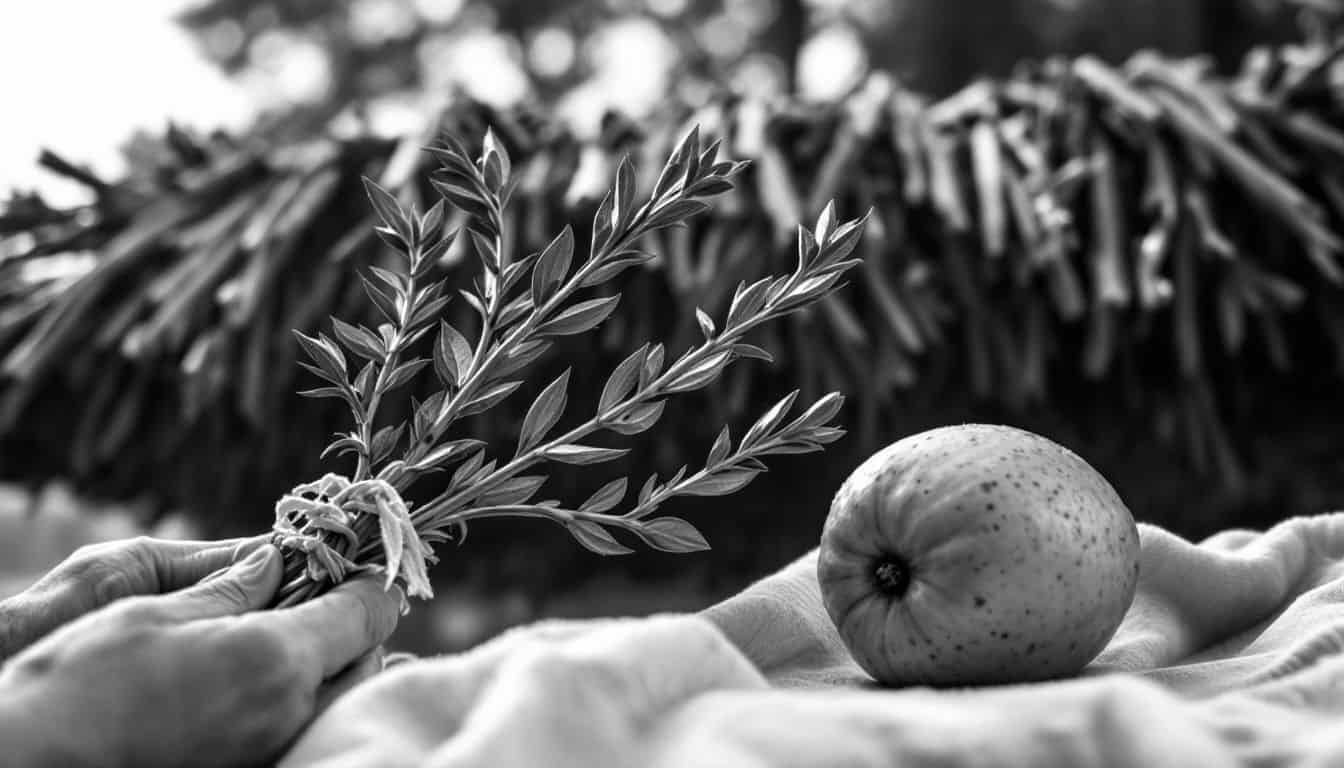
The oral tradition identifies the “fruit of a beautiful tree” with the etrog (citron), the “branches of palm trees” with the lulav, a still-closed palm frond (Rambam, Hilkhot Lulav 7:1), the “bough of a leafy tree” with the hadas (myrtle) and the “willows of the brook” with the aravah. One takes one lulav, one etrog, two branches of aravah and three of hadas (Rambam, Hilkhot Lulav 7:7). Rabbi Yishmael fixes these numbers (Mishna Sukkah 3:4); Rabbi Akiva held that a single branch of each suffices, but halakha follows Rabbi Yishmael (Sukkah 34b). The word “kapot” is written without a vav, which, according to the Talmud, indicates a single lulav (Sukkah 34b).
The rules of validity are numerous: a dried-up or stolen etrog is invalid (Mishna Sukkah 3:5; Rambam, Hilkhot Lulav 8:1; Orach Chayim 648:1), as is one from a tree devoted to idolatry or from the first three years of planting (orlah) (Mishna Sukkah 3:5). Most of these disqualifications apply only on the first day of the festival (Orach Chayim 649:5). This explains the care, and sometimes the price, of a beautiful etrog.
How one takes them
The lulav, the hadas and the aravah are bound together; the etrog is held separately. One says the blessing “al netilat lulav” and “Shehecheyanu” before taking the etrog, so that the blessing precedes the act (Orach Chayim 651:5). Then one shakes: one extends the hand, shakes three times forward and three times back, then does the same in each direction (651:9), in the order east, south, west, north, then up and down (651:10). One also shakes during Hallel, at “Hodu laHashem” and at “Ana Hashem hoshi’ah na” (651:8). The Talmud gives the reason for these movements:
“Rabbi Yochanan said: one extends and draws back toward Him to whom the four winds belong; one raises and lowers toward Him to whom heaven and earth belong.”
(Sukkah 37b) — אָמַר רַבִּי יוֹחָנָן: מוֹלִיךְ וּמֵבִיא לְמִי שֶׁהָאַרְבַּע רוּחוֹת שֶׁלּוֹ, מַעֲלֶה וּמוֹרִיד לְמִי שֶׁהַשָּׁמַיִם וְהָאָרֶץ שֶׁלּוֹ
The Rema notes a difference in custom: some scrupulous people, including the writings of the Ari, prefer not to turn the lulav over when shaking downward, but the accepted custom is to turn it over (Orach Chayim 651:9, gloss).
In the Temple, the lulav was taken for seven days; elsewhere, the Torah requires it only on the first day, but the Sages decided that it would be taken everywhere for all seven days (Mishna Sukkah 4:1; Orach Chayim 658:1). It is taken by day (652:1), never on Shabbat, even on the first day (658:2). A child who knows how to shake is obligated to take it, for education (Mishna Sukkah 3:15).
What do they symbolize?
The Midrash offers a famous reading, which the Rambam classes among the Sages’ “poetic games,” which illustrate the verse without claiming to explain it (Guide for the Perplexed III:43). The etrog has taste and fragrance: the Jew who has Torah and good deeds. The date palm has taste without fragrance: Torah without good deeds. The myrtle has fragrance without taste: good deeds without Torah. The willow has neither. What does the Holy One, blessed be He, do? He cannot destroy them:
“Let them all be bound in a single bundle, and they will atone for one another.”
(Vayikra Rabbah 30:12) — אֶלָּא אָמַר הַקָּדוֹשׁ בָּרוּךְ הוּא יֻקְשְׁרוּ כֻלָּם אֲגֻדָּה אַחַת וְהֵן מְכַפְּרִין אֵלּוּ עַל אֵלּוּ
For his part, the Rambam proposes a simpler explanation (“what seems to me,” he says): the four species express the joy of having passed from the desert, “a place with no seed, no fig, no vine, no pomegranate and no water to drink” (Bamidbar [Numbers] 20:5), to a land of fruit trees and rivers; one therefore takes the most beautiful fruit, the most fragrant branch, the most beautiful leaves and the most beautiful herb (Guide III:43). Kabbalah reads other correspondences into it, but halakha does not depend on them.
The Temple at Sukkot: the joy of the Beit HaShoevah
The seventy bulls
Sukkot was, in the Temple, the festival with the most numerous offerings. The Torah prescribes a decreasing number of bulls: thirteen on the first day, twelve on the second (Bamidbar 29:13 and 29:17), and so on down to seven on the seventh day, seventy in all; only one on the eighth (Bamidbar 29:36). The Talmud connects this number to the nations:
“Rabbi Elazar said: these seventy bulls, what do they correspond to? To the seventy nations. And why a single bull on the eighth day? It corresponds to the unique nation.”
(Sukkah 55b) — אָמַר רַבִּי (אֶלְעָזָר): הָנֵי שִׁבְעִים פָּרִים כְּנֶגֶד מִי — כְּנֶגֶד שִׁבְעִים אוּמּוֹת. פַּר יְחִידִי לָמָּה — כְּנֶגֶד אוּמָּה יְחִידָה
Seventy is the traditional number of the nations descended from the sons of Noach (Bereshit [Genesis] 10). The Temple thus offered sacrifices for all humanity, and Sukkot is the only festival that the Bible announces as one day to be celebrated by the nations (Zechariah 14:16).
Simchat Beit HaShoevah
The Mishna has preserved the memory of the “joy of the house of the water-drawing” (Simchat Beit HaShoevah), linked to the water libation on the altar. A golden flask of three log was filled at Siloam and carried to the Water Gate, where the trumpet was sounded; then the priest went up the ramp of the altar and poured the water into one of the two silver bowls there, the wine into the other (Mishna Sukkah 4:9). The connection with the judgment on water is given by the Mishna: “on Sukkot, the world is judged for water,” that is, for the year’s rains (Mishna Rosh Hashanah 1:2; Rosh Hashanah 16a). In the Women’s Court, great golden candelabra lit up all the courtyards of Jerusalem (Mishna Sukkah 5:2-3), and “the pious and the men of deeds danced before the people with flaming torches” while the Levites played on the fifteen steps that descend toward the Women’s Court (Mishna Sukkah 5:4). The Mishna sums up:
“They said: whoever has not seen the joy of the Beit HaShoevah has never seen joy in his life.”
(Mishna Sukkah 5:1) — אָמְרוּ, כָּל מִי שֶׁלֹּא רָאָה שִׂמְחַת בֵּית הַשּׁוֹאֵבָה, לֹא רָאָה שִׂמְחָה מִיָּמָיו
The baraita in Sukkah 51b adds: “whoever has not seen Jerusalem in its splendor has never seen a beautiful city; whoever has not seen the Temple built has never seen a beautiful building.” The joy of Sukkot is here a nostalgia: that of what one has known and hopes to find again.
The history behind the texts
Josephus reports (Antiquities of the Jews XIII, 372) that at a festival of booths, as the Hasmonean king Alexander Jannaeus stood near the altar to sacrifice, the crowd pelted him with citrons, the very ones that the law of the Jews required each person to hold at the festival. The Mishna perhaps preserves the memory of a related incident: an officiant who poured the water on his feet was pelted by the people “with their etrogim” (Mishna Sukkah 4:9). The Mishna does not name the officiant and scholars debate the exact relationship between the two accounts; in both cases, the crowd turns against the priest-king the very objects of the festival, in the climate of the civil war then tearing Judea apart.
On the ground, in 2004, sewer work in the City of David led Ronny Reich and Eli Shukron to uncover the large stepped pool of the Second Temple period identified as the Pool of Siloam, where, scholars think, pilgrims purified themselves before going up to the Temple. It is from Siloam that the Mishna says the water of the libation was drawn (Mishna Sukkah 4:9). Finally, after the Babylonian exile, Nechemiah reports that the returnees “made booths and dwelt in them” as the children of Israel had not done “since the days of Yehoshua son of Nun,” and that there was “very great joy” (Nechemiah 8:14-17); branches of olive, oil tree, myrtle, palm and leafy trees were fetched from the hills to build booths on rooftops, in courtyards and in the squares.
Hoshana Rabbah, Shemini Atzeret and Simchat Torah
The seventh day of Sukkot, called Hoshana Rabbah, has a special status. The Mishna describes, in the Temple, a procession around the altar, once each day and seven times on the seventh day, with willow branches stood against the altar (Mishna Sukkah 4:5). Today, a Torah scroll is taken out and carried around the bimah, once a day and seven times on the seventh day, in memory of the Temple (Orach Chayim 660:1); the hoshanot, prayers of supplication, are recited. On that day one takes an additional bundle of aravot, without a blessing (Orach Chayim 664:2), which is beaten on the ground or on an object (Orach Chayim 664:4), a reminder of the “day of the beating of the palm branches” mentioned by the Mishna (Sukkah 4:6). According to the Mishna Berurah, “the custom of Israel is to stay awake on the night of Hoshana Rabbah” (Orach Chayim 664:1); psalms are read, and the cantor sometimes wears the kittel, as on Yom Kippur (Mishna Berurah 664:9). The Mishna Berurah gives the reason: on Sukkot “the world is judged for water,” and this day is “the end of the sealing” (gmar hachatimah) of the verdict (Orach Chayim 664:2). This is a mystical reading, drawn from the Kabbalistic tradition; the law, for its part, does not make the seventh day a new judgment.
Then comes Shemini Atzeret, the eighth day (Vayikra 23:36). The lulav is no longer taken. Outside Israel, one still eats in the sukkah at night and by day, without a blessing, because this day could be the seventh of the festival (gloss of the Rema, Orach Chayim 668:1). On this day, the annual reading of the Torah is completed (“Vezot haberachah”) and “Bereshit” is begun again at once (Orach Chayim 668:2): this is Simchat Torah, which has its own article. Outside Israel, it is celebrated on the second day of Shemini Atzeret; in Israel, it coincides with it. On Sukkot, on the Shabbat of the festival (or on Shemini Atzeret), the book of Kohelet (Ecclesiastes) is read, “Vanity of vanities” (Kohelet 1:2), a custom reported by the Rema (Orach Chayim 663:2; see also 490:9): after the harvest and abundance, a book of wisdom that teaches how to keep a sense of proportion.
What Kabbalah says: the ushpizin, the shade of faith
The Kabbalistic tradition has enriched the festival with a well-known custom: the invitation, at each meal in the sukkah, of seven honored guests, the ushpizin (from the Aramaic, “guests”). The Zohar (parashat Emor) tells that Rav Hamnuna Saba, on entering the sukkah, rejoiced and, standing at the door, said:
“Be seated, exalted guests, be seated; be seated, guests of faith, be seated.”
(Zohar, Emor; Sefaria: Zohar, Emor 43) — תִּיבוּ אוּשְׁפִּיזִין עִלָּאִין, תִּיבוּ. תִּיבוּ אוּשְׁפִּיזֵי מְהֵימְנוּתָא, תִּיבוּ
The Zohar specifies that when a man sits under “the shade of faith,” the Divine Presence spreads its wings over him, and Avraham and other righteous men (according to one of the masters, Rabbi Abba, five righteous men and then King David) come to dwell with him. It adds a precise moral condition: one cannot invite these guests from above without also inviting the poor, for “their portion is that of the poor,” and whoever sits at his table without giving the needy their share sees the heavenly guests rise from the table and leave (Zohar, Emor 43). In the tradition that spread afterward, one invites a patriarch each day (Avraham, Yitzchak, Yaakov, Moshe, Aharon, Yosef, David). This custom is mystical, not an obligation of the law; the usual order of the seven guests belongs to the later Kabbalistic tradition. In the same chapter, the Zohar links the “clouds of glory” to Aharon, a theme that Rav Benizri takes up (see below).
What Rav Raphaël Benizri teaches
Rav Raphaël Benizri has devoted two lectures to Sukkot. Here is the essence, with nothing added.
- In “From Yom Kippur to the sukkah of peace,” he starts from an observation about language: Jewish festivals are named in the plural (Shavuot, Sukkot, Kippurim), except Pesach and Chanukah. Kippur, he says, is not first of all “forgiveness” but kaparah, mutual “covering,” each person’s solidarity with the other; on leaving Kippur, one must give proof of it, and this is the meaning of the sukkah, where one comes out of one’s cocoon and places oneself in the shade of G-d, under the clouds of glory. The four species “are worth nothing, and are worth everything”: the aravah with neither fragrance nor taste, the etrog tempted by a separate life, the lulav bearing fruit but without fragrance, each called to share what it has. He also links the clouds of glory to Aharon, man of peace and bearer of majesty (hod), and the “sukkah of peace” requested every evening in Hashkivenu to the protection that accompanies Israel’s deliverance. He cites the Maharal of Prague: one says “sukkat David” and not “beit David,” because a house in ruins is rebuilt on other plans, whereas a fallen booth is raised again identically; it is fragile on the outside, very solid within. See the lecture: Sukkot: from Yom Kippur to the sukkah of peace.
- In “Sukkot: the festival of joy,” he distinguishes the practice of mitzvot from intimacy with the divine: one can perform the mitzvot without being imbued with them, and joy is the proof that something has been understood. It is not pleasure but the fullness of “contradictions that complete one another harmoniously.” Sukkot is the festival of the universal, on which the Jewish people offers seventy sacrifices in the name of the seventy nations, and the only one that the nations are called to celebrate. He evokes the water libation of Simchat Beit HaShoevah, the hakafot around the Torah as one circled the altar, and the “sukkat David”: not an empire, but an open house, fragile on the outside and solid on the inside. See the lecture: Sukkot: the festival of joy.
These readings belong to the Rav’s aggadah; they do not change the rules of the sukkah or of the four species.
Practice today: landmarks
- Build the sukkah right after Kippur, open to the sky, with a plant-based, detached sechach (Orach Chayim 625:1; 629:1).
- The first night: Kiddush, the blessing over the sukkah, then “Shehecheyanu” (Orach Chayim 643:1); one does not bless the construction (641:1).
- Take the four species in the morning, preferably at the time of Hallel (Orach Chayim 652:1); not on Shabbat (658:2).
- Have the etrog and the lulav checked by a knowledgeable person (Orach Chayim 645 to 650).
- For rain, travel, a shared balcony or a doubtful etrog: consult a rabbi.
Common misconceptions about Sukkot
“The sukkah is religious camping.” It is a precise mitzvah, with conditions of validity and an intention: “so that your generations may know” (Vayikra 23:43). The Mishna says that the sukkah becomes the permanent home and the house the temporary dwelling (Mishna Sukkah 2:9).
“The four species are a rain or fertility rite.” The Talmud links the festival to the judgment on water (Mishna Rosh Hashanah 1:2), but the tradition gives other readings: the joy of having left the desert (Rambam, Guide III:43), the unity of Israel (Vayikra Rabbah 30:12). The mitzvah is fulfilled out of obedience, not for any supposed efficacy.
Frequently asked questions about Sukkot
When does Sukkot take place, and how long does it last?
It begins on the 15th of Tishrei, five days after Yom Kippur, and lasts seven days (Vayikra 23:34), followed by Shemini Atzeret (Vayikra 23:36); outside Israel, Simchat Torah is added the next day. The intermediate days are called Chol HaMoed.
Why does one leave one’s house for the sukkah?
To remember, according to the verse, that G-d made the children of Israel dwell in booths when they left Egypt (Vayikra 23:43). Whether those booths were the clouds of glory or real shelters (Sukkah 11b), halakha draws from it an act: making one’s sukkah one’s home for seven days (Mishna Sukkah 2:9).
What are the four species?
The lulav (palm), the etrog (citron), three hadassim (myrtle) and two aravot (willow) (Vayikra 23:40; Mishna Sukkah 3:4; Rambam, Hilkhot Lulav 7:7). The lulav, the hadas and the aravah are bound together; the etrog is held separately, then they are brought together for the shaking (Orach Chayim 651).
Must one sleep in the sukkah?
According to the Shulchan Aruch, yes (Orach Chayim 639:2). The Rema notes that in practice many Ashkenazim do not, because of the cold or the lack of a sukkah where a couple can sleep, but he recommends strictness for whoever can. One who suffers is exempt (Orach Chayim 640:4).
Must women sit in the sukkah?
The Mishna exempts women (Mishna Sukkah 2:8; Rambam, Hilkhot Sukkah 6:1): it is a time-bound mitzvah. This exemption is not a prohibition. Community customs vary on the blessings; consult your rabbi.
Further reading
Sukkot opens a path of festivals, from Rosh Hashanah to Simchat Torah. To continue, here are some readings on the site.
- What does Rosh Hashanah mean and why is the shofar blown?
- What is Simchat Torah and why do people dance with the scrolls?
- What is Passover (Pesach) and how does the Seder work?
- What is Shavuot and why do people stay up all night?
- How does the Jewish calendar work?
- What is the Torah?
- What is a synagogue?
- Why do we live in the sukkah? Meaning and rules of Sukkot
- Lulav and etrog: the meaning of the four species of Sukkot
- Shemini Atzeret and Simchat Torah: meaning and customs
- Yom Kippur: the meaning of the Day of Atonement
- Sukkot: the festival of booths explained in video
- Glossary of Hebrew terms in Judaism
Sources and references (22)
- Shemot (Exodus) 23:16; 34:22
- Vayikra (Leviticus) 23:34-36; 23:39-43
- Bamidbar (Numbers) 20:5; 29:13; 29:17; 29:36
- Devarim (Deuteronomy) 16:13-15; 31:10-13
- I Melakhim (I Kings) 8:2; 12:32
- Nechemiah (Nehemiah) 8:14-17
- Zechariah 14:16-17
- Kohelet (Ecclesiastes) 1:2
- Mishna Sukkah 1:1; 2:8; 2:9; 3:4; 3:5; 3:15; 4:1; 4:5; 4:6; 4:9; 5:1-4
- Mishna Sotah 7:8
- Mishna Rosh Hashanah 1:2
- Babylonian Talmud, Sukkah 2a-2b; 11b; 25a; 26a; 34b; 35a; 37b; 51b; 55b
- Babylonian Talmud, Rosh Hashanah 16a
- Vayikra Rabbah 30:12
- Zohar, Emor (Sefaria: Zohar, Emor 43)
- Rambam, Mishneh Torah, Hilkhot Shofar, Sukkah veLulav 6:1; 6:5-6; 7:1; 7:7; 8:1; 8:15
- Rambam, Guide for the Perplexed III:43
- Shulchan Aruch, Orach Chayim 625:1; 626:1; 629:1; 636:1; 639:1-2; 639:7; 640:1; 640:4; 641:1; 643:1; 648:1; 649:5; 651:5; 651:8-10; 652:1; 658:1-2; 660:1; 663:2; 664:2; 664:4; 668:1-2; 490:9
- Mishna Berurah, Orach Chayim 664:1-2
- Flavius Josephus, Antiquities of the Jews XIII, 372
- Ronny Reich and Eli Shukron, excavations of the Pool of Siloam, City of David, Jerusalem (2004)
- Lectures by Rav Raphaël Benizri: Sukkot: from Yom Kippur to the sukkah of peace; Sukkot: the festival of joy
Article by the Pensées Juives editorial team. Passages attributed to Rav Raphaël Benizri are taken from his lectures published on this site.