
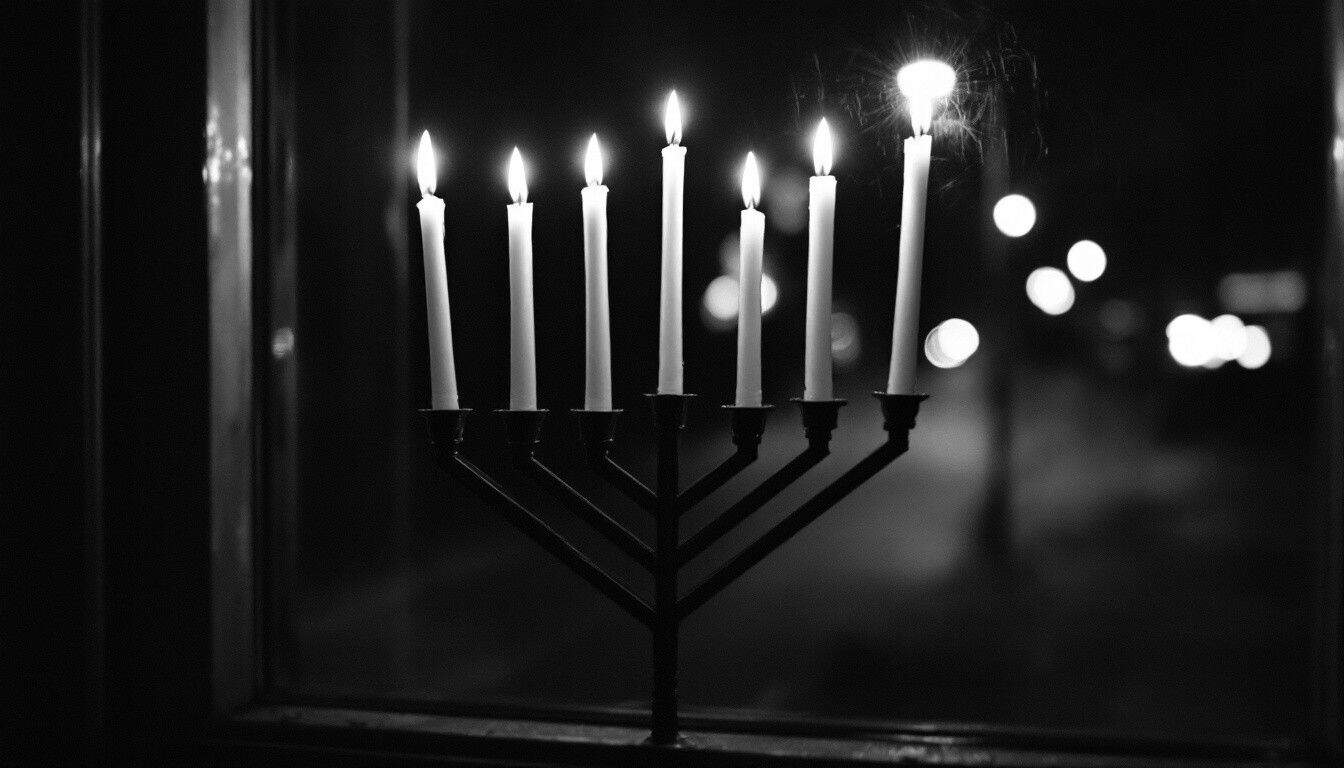
Every winter, in the heart of the longest nights, lights appear in the windows of Jewish homes: one, then two, then three, up to eight. This is Chanukah (also spelled Hanukkah; in Hebrew, “inauguration,” “dedication”), the festival that begins on the 25th of the month of Kislev. Why eight days? Why light, and why at the threshold of the house? What happened, and what does the Talmud really say? This article answers from the books of the Maccabees, the Mishnah, the Talmud, Maimonides and the Shulchan Aruch, distinguishing history, halakha (the law that is practiced) and moral or spiritual readings.
In short: Chanukah is a festival instituted by the Sages, not by the Torah. It commemorates the recapture and purification of the Temple in Jerusalem, and then its rededication, after the religious persecution imposed by the Seleucid power (around 167-164 BCE); the Talmudic tradition retains above all the episode of the flask of oil that burned for eight days. The central mitzvah is the lighting, each evening, of the Chanukah lights, which are placed so as to publicize the miracle (pirsumei nissa), with three blessings on the first evening. On these days the full Hallel is recited, “Al HaNissim” is added to the prayers, and one neither fasts nor delivers eulogies. The legal minimum is one light per evening and per household; the widespread custom is to add one each evening, following the opinion of Beit Hillel.
A festival of the Sages, not in the Torah
Chanukah is prescribed nowhere in the written Torah. The events it recalls took place several centuries after the close of the Prophets; their detailed account has come down to us in the books of the Maccabees (in Greek, outside the Jewish canon), not in the Tanakh. Maimonides, moreover, classes the lighting among the mitzvot “of our Sages”:
“And the lighting of the lamps is a mitzvah of our Sages, like the reading of the Megillah.”
(Rambam, Mishneh Torah, Hilchot Megillah VeChanukah 3:3) — וְהַדְלָקַת הַנֵּרוֹת בָּהֶן מִצְוָה מִדִּבְרֵי סוֹפְרִים כִּקְרִיאַת הַמְּגִלָּה
This does not diminish the festival. One blesses this mitzvah as a mitzvah of the Torah: “…who has sanctified us with His commandments and commanded us to light the Chanukah light.” The Talmud then asks where G-d commanded us, and gives two answers: the prohibition against deviating from the teaching of the Sages (“lo tasur,” Devarim 17:11) or the verse “Ask your father and he will tell you, your elders and they will say to you” (Devarim 32:7) (Shabbat 23a). The Sages’ authority to institute is therefore itself rooted in the Torah.
Rav Raphaël Benizri, for his part, stresses that the absence of the story from the canon is no accident: what was retained is not the chronicle but the blessing (see the section on his lectures below).
The story: from Hellenization to the dedication of the altar
The context
After the conquest of Alexander the Great, Judea passed under the domination of the Hellenistic kingdoms, then under that of the Seleucids of Syria. In Jerusalem, part of the elite adopted Greek ways: the first book of Maccabees speaks of “renegades” who came out of Israel and led many astray, saying: “Let us go and make a covenant with the nations around us”; a gymnasium was built in Jerusalem according to the customs of the nations, and some abandoned the holy covenant (1 Maccabees 1:11-15). Rav Benizri calls these Hellenizers, in his lectures, the mityavnim, and he insists that the Maccabean war was first of all an internal war.
Around 167 BCE, King Antiochus IV Epiphanes forbade the practice of Judaism. The reference text, 1 Maccabees, relates that an “abomination of desolation” was erected on the altar on the 15th of Kislev in the year 145 of the Seleucid era, that the books of the Law were torn up and burned, and that those who possessed the book of the covenant or had their children circumcised were put to death; on the 25th of the month, a pagan sacrifice was offered on the altar (1 Maccabees 1:54-61). The prophet Daniel had already announced that they would “desecrate the Sanctuary, the fortress, abolish the perpetual sacrifice and set up the abomination that causes desolation” (Daniel 11:31).
Maimonides summarizes the whole, in terms of halakha:
“In the days of the Second Temple, when the kings of Yavan (Greece) issued decrees against Israel, abolished their religion, did not let them occupy themselves with Torah and mitzvot, stretched out their hand against their property and their daughters, entered the Sanctuary, made breaches in it and defiled what was pure…”
(Rambam, Hilchot Megillah VeChanukah 3:1) — בְבַיִת שֵׁנִי כְּשֶׁמַּלְכֵי יָוָן גָּזְרוּ גְּזֵרוֹת עַל יִשְׂרָאֵל וּבִטְּלוּ דָּתָם וְלֹא הֵנִיחוּ אוֹתָם לַעֲסֹק בְּתוֹרָה וּבְמִצְוֹת
The revolt and the dedication
A priestly family of Modiin, that of Mattathias, took the lead of the revolt (1 Maccabees 2:1). His son Judah, nicknamed Maccabee, won several victories, and the Temple was retaken. The author of 1 Maccabees reports that it was decided to purify the Sanctuary, that a new altar was built, and that it was consecrated:
“Early in the morning on the twenty-fifth day of the ninth month, which is the month of Kislev, in the one hundred forty-eighth year, they rose and offered a sacrifice according to the Law on the new altar of burnt offering that they had built. At the very season and on the very day that the nations had profaned it, it was dedicated with songs, harps, lutes and cymbals.”
(1 Maccabees 4:52-54, NRSVUE translation)
The year 148 of the Seleucid era corresponds to 164 BCE. The same book adds that the dedication of the altar was celebrated for eight days, and that “Judah, his brothers and the whole assembly of Israel decided that every year, at this season, the days of the dedication of the altar would be observed with joy and gladness for eight days, beginning with the twenty-fifth day of the month of Kislev” (1 Maccabees 4:56 and 59).
The second book of Maccabees, written independently, presents the same festival and explicitly links it to Sukkot: “They celebrated it for eight days with joy, in the manner of the festival of Booths, remembering that not long before, during the festival of Booths, they had wandered in the mountains and in the caves like wild animals. Therefore, carrying wands wreathed with ivy, beautiful branches and also palms, they offered hymns of thanksgiving” (2 Maccabees 10:6-7, after the NRSVUE version). The historian Josephus writes likewise that “from that time until today we celebrate this festival, and we call it Lights” (Jewish Antiquities XII, 325).
These sources, independent of the Talmud, show that already in the 2nd century BCE an eight-day festival beginning on the 25th of Kislev was being celebrated, modeled on Sukkot. In this account, the founding event is the dedication of the altar (the word “Chanukah” comes from the root chanoch, “to inaugurate”); the episode of the flask of oil, for its part, comes to us from the Talmud (see below). Rav Benizri notes that Chanukah was at first celebrated mainly through Hallel and gratitude, and that the story of the flask came from the people themselves.
The Hasmoneans, the family of Mattathias, then founded a dynasty. Maimonides mentions it in a few words: “They established a king from among the priests, and kingship returned to Israel for more than two hundred years, until the destruction of the Second Temple” (Hilchot Megillah VeChanukah 3:1). The festival, as we can see, is not reduced to a fine story of military victory.
The founding text of the Talmud: “What is Chanukah?”
The Talmud does not tell of the war. In tractate Shabbat, in the midst of the laws on Shabbat wicks and oils, it asks: “What is Chanukah?” and answers with a baraita drawn from Megillat Taanit, an ancient calendar of days on which one does not fast:
“What are the days of Chanukah? The Sages taught: on the 25th of Kislev, the days of Chanukah are eight, on which one does not eulogize and does not fast. For when the Greeks entered the Sanctuary, they defiled all the oils that were in it. And when the kingdom of the House of the Hasmoneans prevailed and defeated them, they searched and found only one flask of oil, sealed with the seal of the High Priest; it contained enough to light for only one day. A miracle occurred: they lit from it for eight days. The following year they fixed them and made them days of festivity, with Hallel and thanksgiving.”
(Babylonian Talmud, Shabbat 21b) — מַאי חֲנוּכָּה? דְּתָנוּ רַבָּנַן: בְּכ״ה בְּכִסְלֵיו יוֹמֵי דַחֲנוּכָּה תְּמָנְיָא אִינּוּן דְּלָא לְמִסְפַּד בְּהוֹן וּדְלָא לְהִתְעַנּוֹת בְּהוֹן. שֶׁכְּשֶׁנִּכְנְסוּ יְוָוֽנִים לַהֵיכָל טִמְּאוּ כׇּל הַשְּׁמָנִים שֶׁבַּהֵיכָל. וּכְשֶׁגָּבְרָה מַלְכוּת בֵּית חַשְׁמוֹנַאי וְנִצְּחוּם, בָּדְקוּ וְלֹא מָצְאוּ אֶלָּא פַּךְ אֶחָד שֶׁל שֶׁמֶן שֶׁהָיָה מוּנָּח בְּחוֹתָמוֹ שֶׁל כֹּהֵן גָּדוֹל, וְלֹא הָיָה בּוֹ אֶלָּא לְהַדְלִיק יוֹם אֶחָד. נַעֲשָׂה בּוֹ נֵס וְהִדְלִיקוּ מִמֶּנּוּ שְׁמוֹנָה יָמִים. לְשָׁנָה אַחֶרֶת קְבָעוּם וַעֲשָׂאוּם יָמִים טוֹבִים בְּהַלֵּל וְהוֹדָאָה.
This passage calls for several remarks. The text speaks of the institution of the festival (“the following year”) and of its two features: Hallel (praise) and hoda’ah (thanksgiving). The rules of lighting are not in this baraita, but in the neighboring baraitot that we will see below. It is also remarkable that the Talmud, which relates nothing of the war, retains only the oil: a way of saying that the festival celebrates the light recovered, more than the military victory. This reading joins that of Rav Benizri, for whom what was saved “is not a territory, it is an inwardness.”
Let us note, finally, that the prayer “Al HaNissim,” which is added during the festival, does not say a word about the flask of oil. It relates that “Your children entered the sanctuary of Your house, cleared Your Temple, purified Your Sanctuary, lit lights in the courtyards of Your holiness and fixed these eight days of Chanukah to praise and give thanks to Your great Name” (Ashkenazi Siddur, “Al HaNissim” for Chanukah). The two traditions, that of the purified Temple and that of the flask, thus coexist in the liturgy.
The Beit Yosef (Rabbi Yosef Karo, the great commentator on the Tur) discusses the Talmud’s account with the tools of the halakha of purity. Why eight days to produce pure oil? Because, he answers, all of Israel was presumed impure with the impurity of the dead: seven days of purification were needed, then one day to press the olives; the Ran, for his part, writes that pure oil was found four days’ journey away, hence eight days there and back (Beit Yosef, Orach Chaim 670). Maimonides goes in the same direction: the Menorah was lit for eight days “until olives were pressed and pure oil was produced” (Hilchot Megillah VeChanukah 3:2).
Why eight days, and not seven?
The question is posed by the Beit Yosef himself: if the flask contained enough to burn for one day, the miracle lasted only seven days. He proposes three answers:
“One may ask: why did they fix eight days? Since the oil in the flask contained enough to light for one night, the miracle occurred only on seven nights. One can answer that they divided the oil of the flask into eight parts and put one part each night into the Menorah, and it burned until the morning; thus the miracle took place every night.”
(Beit Yosef, Orach Chaim 670) — ואיכא למידק למה קבעו ח’ ימים דכיון דשמן שבפך היה בו כדי להדליק לילה א’ נמצא שלא נעשה הנס אלא בז’ הלילות וי”ל שחילקו שמן שבפך לח’ חלקי’ ובכל לילה היו נותני’ במנורה חלק א’ והיה דולק עד הבקר
He adds two other solutions: after the lamps had been filled to the required measure, the flask would have remained as full as before, so that the miracle was visible from the first evening; or else, on the first evening, all the oil was poured into the lamps, which burned all night, and the lamps were found full in the morning, and so on each night. Another answer follows from what we have just seen: since eight days were needed to make pure oil, the question no longer arises in the same way.
Another reading no longer treats the question as an arithmetic problem. Seven is the number of nature (creation in seven days, the week that returns); eight, that of what exceeds nature, like circumcision, which takes place on the eighth day. This is the reading attributed to the Maharal of Prague, notably in his Ner Mitzvah devoted to Chanukah, and one that is met throughout the literature of Jewish thought; it belongs to aggadah and mussar, not to halakha.
Finally, one can connect the eight days of Chanukah to those of Sukkot (seven days of festival, then Shemini Atzeret). This is what 2 Maccabees 10:6, quoted above, already does. Rav Benizri makes it the very structure of his teaching: Pesach and Shavuot, linked by the counting of the Omer, form a first pair; Sukkot and Chanukah form a second. In Shabbat 21b, moreover, one of the two reasons given for the opinion of Beit Shammai is “corresponding to the bulls of the festival” (keneged parei hechag), that is, those of Sukkot, whose number decreases day by day (Bamidbar 29:12-34).
The mitzvah: lighting the Chanukah lights
How many lights?
The baraita of Shabbat 21b distinguishes three levels. The first, the minimum, is one light per man and his household. One who is zealous (mehadrin) lights one light for each member of the household. One who is more zealous still (mehadrin min hamehadrin) adjusts the number of lights each day, and this is where Beit Shammai and Beit Hillel diverge:
“Our Rabbis taught: the mitzvah of Chanukah is one light for a man and his household. Those who are zealous: one light for each person. And those who are more zealous than the zealous: Beit Shammai say: on the first day one lights eight, then decreases; and Beit Hillel say: on the first day one lights one, then increases.”
(Babylonian Talmud, Shabbat 21b) — תָּנוּ רַבָּנַן: מִצְוַת חֲנוּכָּה, נֵר אִישׁ וּבֵיתוֹ. וְהַמְהַדְּרִין, נֵר לְכׇל אֶחָד וְאֶחָד. וְהַמְהַדְּרִין מִן הַמְהַדְּרִין, בֵּית שַׁמַּאי אוֹמְרִים: יוֹם רִאשׁוֹן מַדְלִיק שְׁמֹנָה, מִכָּאן וְאֵילָךְ פּוֹחֵת וְהוֹלֵךְ. וּבֵית הִלֵּל אוֹמְרִים: יוֹם רִאשׁוֹן מַדְלִיק אַחַת, מִכָּאן וְאֵילָךְ מוֹסִיף וְהוֹלֵךְ.
The Gemara then gives the reasons of the two schools. For Beit Shammai, the number corresponds either to the days that are coming in (those still to come), or to the bulls of Sukkot; for Beit Hillel, either to the days that are going out (those already past), or to the principle: “one goes up in holiness and does not go down” (Shabbat 21b). Rabba bar bar Chana even reports that in Sidon there were two elders, one of whom followed Beit Shammai and the other Beit Hillel, each giving his reason (Shabbat 21b). The halakha follows Beit Hillel.
Maimonides states the three levels as follows: the mitzvah is that there be one light per household, whether the household has one or several inhabitants; one who wishes to be diligent lights as many lights as there are members; and one who wishes to do even better begins with one light per person on the first evening, then adds one light each evening (Hilchot Megillah VeChanukah 4:1).
Sephardim and Ashkenazim
This is where customs diverge. Maimonides notes that, in all the cities of Spain, the custom is that the whole household lights one light on the first evening, then one more each evening, up to eight, whether the household has one or several members (Hilchot Megillah VeChanukah 4:3). The Shulchan Aruch adopts this rule: one light on the first evening, one more each evening, eight on the last evening, “and even if the members of the household are many, one does not light more” (Orach Chaim 671:2). The Rema, who expresses Ashkenazi practice, adds:
“Some say that each of the members of the household lights (Rambam), and such is the widespread custom; and one should take care to place each person’s lights in a special place, so that it is apparent how many lights are lit.”
(Rema on Shulchan Aruch, Orach Chaim 671:2) — וי”א דכל אחד מבני הבית ידליק (רמב”ם) וכן המנהג פשוט ויזהרו ליתן כל א’ וא’ נרותיו במקום מיוחד כדי שיהיה היכר כמה נרות מדליקין
In practice, many Ashkenazi families have each person light his own chanukiah (the eight-branched candelabrum, plus a holder for the helper flame), while many Sephardi families follow the letter of Maimonides and the Shulchan Aruch: a single chanukiah, lit by the head of the household for the whole house. In both cases, one adds a light each evening according to Beit Hillel. For the details of each family, consult a rabbi.
The shamash
The chanukiah has eight places for the lights of the festival, and a ninth, the shamash (“servant”). Its reason lies in halakha: the Chanukah lights are sacred and one has no right to derive benefit from them. Rava states it: another light is needed in order to make use of its brightness (Shabbat 21b). The use of a separate shamash, which is placed slightly apart, is a practice that became established on the basis of this rule; it is not mentioned as such in the Talmud.
When, with what, how?
The lights are lit at nightfall: “the mitzvah is from sunset until the foot ceases to tread the marketplace” (Shabbat 21b), that is, as long as passersby are about. Maimonides writes: “one does not light before sunset, but with it, neither delaying nor advancing,” and, if one forgot, one lights as long as the street is not empty, that is, about half an hour (Hilchot Megillah VeChanukah 4:5). The Shulchan Aruch specifies “with the end of sunset” (Orach Chaim 672:1), a point on which customs diverge: one follows the schedule of one’s community.
As for fuel, “all oils and all wicks are valid” (Shulchan Aruch, Orach Chaim 673:1), but the Rema adds that olive oil is the most recommended, recalling the oil of the Temple Menorah (Vayikra 24:2), and that in Ashkenazi countries one also lights wax candles, whose light is clear like oil.
The lighting rite is accompanied by blessings. On the first evening, the one lighting says three: “…who has sanctified us with His commandments and commanded us to light the Chanukah light,” “…who performed miracles for our fathers in those days, at this time,” and Shehecheyanu (Shulchan Aruch, Orach Chaim 676:1; Rambam, Hilchot Megillah VeChanukah 3:4); on the following evenings, only two. The order of lighting is specified: on the first evening, one lights the light placed furthest to the right; on the following evenings, one adds the new light to its left, begins with it, then goes back toward the right, “for the added light shows the miracle” (Shulchan Aruch, Orach Chaim 676:5).
After the lighting, one says “Hanerot Halalu” (“These lights…”), an ancient text already reported in the minor tractate Soferim: “These lights we light for the deliverances, the miracles and the wonders that You performed for our fathers, through Your holy priests; during the eight days of Chanukah, these lights are holy, and we have no right to make use of them, except to look at them” (tractate Soferim 20:6). Then often comes “Maoz Tzur,” of which we will speak below.
Why at the door? Publicizing the miracle
The distinctive feature of this mitzvah is its public dimension. The baraita of Shabbat 21b states it:
“Our Rabbis taught: the mitzvah is to place the Chanukah light at the door of one’s house, on the outside. If one lives upstairs, one places it in the window that gives onto the public domain. And in a time of danger, one places it on one’s table, and that suffices.”
(Babylonian Talmud, Shabbat 21b) — תָּנוּ רַבָּנַן: נֵר חֲנוּכָּה מִצְוָה לְהַנִּיחָהּ עַל פֶּתַח בֵּיתוֹ מִבַּחוּץ. אִם הָיָה דָּר בַּעֲלִיָּיה — מַנִּיחָהּ בַּחַלּוֹן הַסְּמוּכָה לִרְשׁוּת הָרַבִּים. וּבִשְׁעַת הַסַּכָּנָה — מַנִּיחָהּ עַל שֻׁלְחָנוֹ וְדַיּוֹ.
This is pirsumei nissa, the “publicizing of the miracle.” The Talmud specifies the location:
“Rabba said: the mitzvah is to place the Chanukah light in the handbreadth (tefach) closest to the door. And where does one place it? Rav Acha, son of Rava, said: on the right; Rav Shmuel of Difti said: on the left. And the halakha is: on the left, so that the Chanukah light is on the left and the mezuzah on the right.”
(Babylonian Talmud, Shabbat 22a) — אָמַר רַבָּה: נֵר חֲנוּכָּה מִצְוָה לְהַנִּיחָהּ בְּטֶפַח הַסָּמוּךְ לַפֶּתַח. וְהֵיכָא מַנַּח לֵיהּ? רַב אַחָא בְּרֵיהּ דְּרָבָא אָמַר: מִיָּמִין רַב שְׁמוּאֵל מִדִּפְתִּי אָמַר: מִשְּׂמֹאל. וְהִילְכְתָא מִשְּׂמֹאל, כְּדֵי שֶׁתְּהֵא נֵר חֲנוּכָּה מִשְּׂמֹאל וּמְזוּזָה מִיָּמִין.
The one who enters is thus enveloped in mitzvot: the mezuzah on his right, the light on his left (Shabbat 22a). The Talmud adds that a light placed more than twenty cubits high is not valid, since one does not lift one’s head so high (Shabbat 22a); and that it must be placed less than ten handbreadths from the ground (Shabbat 21b).
Today, most people light indoors, in an apartment or at a window. The Rema accepts this: “nowadays when everyone lights indoors, and there is no recognition by passersby, one does not worry so much about not lighting in the handbreadth near the door; but the custom is to light in the handbreadth near the door, as in their time” (Orach Chaim 671:7). Each community has its custom (door, display window, street-facing window): defer to one’s rabbi. When visible lighting is not possible, the Talmud itself sets the rule: in a time of danger, the table suffices.
A point of halakha: it is the lighting itself that fulfills the mitzvah, and not the placing of the light (Shabbat 23a). A light lit by a deaf-mute, an incompetent person, a minor or a non-Jew therefore does not count; likewise, if one lights it inside in order to carry it out afterward, it must be lit in its place (Rambam, Hilchot Megillah VeChanukah 4:9).
Who is obligated? Women, guests, the poor
The mitzvah binds all those who are bound to the reading of the Megillah (Rambam, Hilchot Megillah VeChanukah 3:4). Women are expressly included:
“Rabbi Yehoshua ben Levi said: women are obligated in the Chanukah light, for they too were part of that miracle.”
(Babylonian Talmud, Shabbat 23a) — אִשָּׁה וַדַּאי מַדְלִיקָה, דְּאָמַר רַבִּי יְהוֹשֻׁעַ בֶּן לֵוִי: נָשִׁים חַיָּיבוֹת בְּנֵר חֲנוּכָּה שֶׁאַף הֵן הָיוּ בְּאוֹתוֹ הַנֵּס.
Rashi explains this “miracle”: the Greeks had decreed that every virgin about to be married would first be handed over to the governor, “and the miracle was done through a woman” (Rashi on Shabbat 23a). Rav Benizri, in his lecture “Chanukah in History,” recalls that two affronts triggered the revolt, and that each is linked to a woman. This is why a woman is fully bound by the lighting. The Shulchan Aruch reports the custom of women not to work while the lights are burning, but notes that some do not wish to make it a rule (Orach Chaim 670:1).
A guest, for his part, is obligated if no lighting takes place at his host’s: he gives a perutah (a very small sum) to the master of the house to share in the oil, or lights at his own entrance if he has a door of his own (Shulchan Aruch, Orach Chaim 677:1; Shabbat 23a). Rabbi Zeira reports in the Talmud that before his marriage he joined his host in this way, and that once married he no longer needed to, since lights were kindled at his home for him (Shabbat 23a).
Even the poorest person must light. Maimonides writes:
“The mitzvah of the Chanukah light is a very beloved mitzvah, and one must be careful with it in order to publicize the miracle and to add to the praise of G-d and thanksgiving for the miracles He performed for us. Even if he has nothing to eat but charity, he borrows or sells his garment, buys oil and lights and kindles them.”
(Rambam, Hilchot Megillah VeChanukah 4:12) — מִצְוַת נֵר חֲנֻכָּה מִצְוָה חֲבִיבָה הִיא עַד מְאֹד וְצָרִיךְ אָדָם לְהִזָּהֵר בָּהּ כְּדֵי לְהוֹדִיעַ הַנֵּס וּלְהוֹסִיף בְּשֶׁבַח הָאֵל וְהוֹדָיָה לוֹ עַל הַנִּסִּים שֶׁעָשָׂה לָנוּ. אֲפִלּוּ אֵין לוֹ מַה יֹּאכַל אֶלָּא מִן הַצְּדָקָה שׁוֹאֵל אוֹ מוֹכֵר כְּסוּתוֹ וְלוֹקֵחַ שֶׁמֶן וְנֵרוֹת וּמַדְלִיק.
(The same rule, almost word for word, is found in Shulchan Aruch, Orach Chaim 671:1.) But peace in the home takes priority: if one has the means to buy only the Chanukah light or the household light (the Shabbat light), “the light of his home comes first, for the peace of his home,” says Rava, and Maimonides draws from it: “for the Name is erased to make peace between a man and his wife” (Shabbat 23b; Rambam, Hilchot Megillah VeChanukah 4:14). If one hesitates between the Chanukah light and Kiddush, the Chanukah light comes first, “because of the publicizing of the miracle” (Shabbat 23b). And on Friday evening, one lights the Chanukah lights first, then those of Shabbat (Shulchan Aruch, Orach Chaim 679:1).
Hallel, “Al HaNissim,” readings and customs
During the eight days, the Sages forbade eulogies and fasting (Shabbat 21b), but work remains permitted (Shulchan Aruch, Orach Chaim 670:1). The full Hallel is recited each day, with a blessing, both in community and individually (Rambam, Hilchot Megillah VeChanukah 3:5). “Al HaNissim” (“For the miracles”) is added in the prayer and in the Birkat HaMazon (Shulchan Aruch, Orach Chaim 682:1).
In the synagogue, the Mishnah prescribes reading, on Chanukah, the passage of the offerings of the princes of the tribes (Numbers 7), which tells of the dedication of the Tabernacle: “on Chanukah, one reads ‘the princes'” (Mishnah Megillah 3:6). The Talmud adds the haftarah of Zechariah, that of the “lights of Zechariah” (Megillah 31a): “Not by might, nor by power, but by My spirit, says the L-rd of hosts” (Zechariah 4:6). The Shulchan Aruch specifies the reading customs (Orach Chaim 684:1-2); on the Shabbat of Chanukah, one reads “Rejoice and sing, daughter of Zion” (Zechariah 2:14) as haftarah. This word, which insists on the spirit and not on power, is a calm counterpoint to the military account.
Customs must be added. The Shulchan Aruch specifies that the additional meals of these days are optional; the Rema adds that they become mitzvah meals if praises and hymns are sung at them, and that some advise eating cheese, “for the miracle was done through the milk that Yehudit fed to the enemy” (Orach Chaim 670:2, citing the Kol Bo and the Ran). These are customs, not obligations.
“Maoz Tzur” (“Rock of my salvation”) is a hymn sung after the lighting. Scholars generally date it to the 13th century (Rav Benizri places it earlier in the millennium); its author, Mordechai, is known to us only by the acrostic of the first letters of five stanzas. It runs through the deliverances: Egypt, Babylon, Persia, Greece, and the fifth stanza is devoted to the festival:
“The Greeks gathered against me in the days of the Hasmoneans; they breached the walls of my towers and defiled all the oils. And from the remnant of the flasks, a miracle was done for the roses (Israel). The men of wisdom fixed these eight days for song and praises.”
(Maoz Tzur, 5th stanza, Ashkenazi Siddur) — יְוָנִים נִקְבְּצוּ עָלַי אֲזַי בִּימֵי חַשְׁמַנִּים. וּפָרְצוּ חוֹמוֹת מִגְדָּלַי וְטִמְּאוּ כָּל הַשְּׁמָנִים. וּמִנּוֹתַר קַנְקַנִּים נַעֲשָׂה נֵס לַשּׁוֹשַׁנִּים. בְּנֵי בִינָה יְמֵי שְׁמוֹנָה קָבְעוּ שִׁיר וּרְנָנִים.
Rav Benizri devotes an entire lecture to this song, stanza by stanza, and reads in it the four exiles.
Moral and spiritual readings: what the festival suggests
The texts above belong to halakha and history. What follows belongs to aggadah, mussar (ethics) and Jewish thought. They illuminate the practice; they are not the law.
The light that is added
The baraita of Shabbat 21b gives the reason of Beit Hillel: one goes up in holiness, one does not go down. From this simple rule, tradition made an image: the Chanukah light does not go out gradually, it grows. The phrase “ner ish uveito,” “a light for a man and his household,” inspired in Rav Benizri an entire anthropology: each person possesses a light of his own, which no one can take from him, and which the mitzvah obliges him to display, not to hide.
Greece, light and speech
An ancient tradition reads in the Greek persecution an attack not on bodies, but on inwardness. In the prayer “Al HaNissim,” the kingdom of Yavan rose against Israel “to make them forget Your Torah and to turn them away from the laws of Your will” (Ashkenazi Siddur). Maimonides likewise lists what the decrees targeted: religion, the study of Torah, the mitzvot (Hilchot Megillah VeChanukah 3:1). Many commentators conclude that what is at stake in Chanukah is the transmission of an identity, not a mere episode of war.
Seven and eight
The reading attributed to the Maharal, mentioned above, sees in seven the time of nature and in eight what transcends it. It gives the oil that burns beyond reason a symbolic value: Chanukah says that Israel cannot be reduced to the laws of nature.
Mysticism and Chasidut
The Chasidic tradition has meditated at length on these lights. The Sefat Emet (Rabbi Yehuda Aryeh Leib Alter, the Rebbe of Gur), in a Chanukah discourse of 5631 (1870-1871), starts from the blessing “who performed miracles” pronounced upon seeing the light: if the Menorah was lit at the time by a miracle, then, even without a Temple or pure oil, the miracle remains for the generations; the support of this lighting is the mitzvah itself, for “the mitzvah is a lamp and the Torah is light” (Mishlei 6:23). He sees in it also a play of numbers: the numerical value of “ner” (lamp, 250) equals the 248 positive mitzvot plus fear and love (Sefat Emet, Bereshit, “For Chanukah,” 5631, first night). This is a mystical reading, not a rule of halakha.
What Rav Raphaël Benizri teaches
Rav Benizri devoted four published lectures to Chanukah on this site, which we summarize without adding anything.
- In “Chanukah: Everyone’s Light,” he starts from the phrase “ner ish uveito” to draw the idea of a light proper to each person, inalienable, which the mitzvah obliges one to display outwardly. He distinguishes Hallel, the radiation of light, and hoda’ah, gratitude, which is “the permanent struggle against ‘my power and the might of my hand.'” He observes that the Chanukah story is not written in the canon, and that what was retained is the blessing. See the lecture: Chanukah: Everyone’s Light.
- In “Chanukah: Jewish Re-education,” he reads the festival as an invitation to a re-education of Jewish identity. Pesach, Shavuot and Sukkot are the three legs of the edifice; Purim re-energizes Shavuot, Chanukah does the same work for Sukkot. He links the chanukiah to the notion of bayit (house), a condition of the lighting, and reads the place of the light, on the left, facing the mezuzah, as the place of man “in the midst of what he has received.” See the lecture: Chanukah: Jewish Re-education.
- In “Chanukah in History,” he rereads the history of the Jewish people from the spinning top (sevivon): the four exiles, Babylon, Persia, Greece and Rome, are already inscribed in the first verse of the Torah (“tohu, vavohu, choshech, tehom”). He stresses that the Maccabean war was first of all an internal war against the mityavnim, that the miracle of the eight days was not decreed by the rabbis but recognized by the people, and that one could light with any oil: the miracle is therefore elsewhere than one thinks. See the lecture: Chanukah in History.
- In “Maoz Tzur, the Song of the Exiles,” he comments on the poem stanza by stanza, linking it to the four empires, to Zerubavel, to the golden calf and to the thirteen breaches opened by Greek thought in the ramparts of the sanctuary. He defines Purim there as answering to Shavuot and Chanukah as extending Sukkot. See the lecture: Maoz Tzur, the Song of the Exiles.
Common misconceptions about Chanukah
“Chanukah is the Jewish Christmas”
No. Chanukah has no historical or theological link with Christmas; it predates it by several centuries. From the standpoint of halakha, it is a rabbinic festival: work is permitted (Shulchan Aruch, Orach Chaim 670:1) and its central mitzvah is that of the Sages. Its place in the modern civil calendar, where it often coincides with the year-end holidays, is a social fact, not a halakhic one. Rav Benizri, for his part, believes that the popularity of Chanukah, including among non-practicing Jews, is no accident.
“The Talmud tells the victory of the Maccabees”
Not at all: the founding passage (Shabbat 21b) mentions neither Mattathias, nor Judah, nor any battle; it retains only the oil. The account of the war is transmitted by 1 and 2 Maccabees, books preserved in Greek and outside the Jewish canon.
“The miracle is the oil for eight days, period”
The Beit Yosef himself discusses this presentation: if the oil sufficed for one day, the miracle lasted only seven days, and several explanations are proposed (see above). Rav Benizri, for his part, points out that one could light with any oil, which shifts the question of the miracle.
“One lights eight candles every evening”
No: one adds one each evening according to Beit Hillel. The “eight” lights are seen only on the last evening. The shamash is not counted among the eight.
“Chanukah commemorates the war against the Greeks, and Greek culture is condemned”
The sources are more nuanced. The Sages say that “the beauty of Yefet shall dwell in the tents of Shem” (Megillah 9b, from Bereshit 9:27), and Rav Benizri concludes that Greek beauty is admitted under the tent, provided it does not claim to replace the Torah. The limit is not art or philosophy as such, but this substitution.
Frequently asked questions about Chanukah
What is Chanukah in one sentence?
It is the eight-day festival, beginning on the 25th of Kislev, that commemorates the recapture and rededication of the Temple after the Seleucid persecution, and that is celebrated by lighting lights at the door of the house, reciting the Hallel and adding “Al HaNissim.”
How many lights does one light, and in what order?
On the first evening, one; one adds one each evening up to eight, according to Beit Hillel. One places the added light on the left, begins with it and goes toward the right (Shulchan Aruch, Orach Chaim 676:5). The shamash is used to light the others.
When does one light?
At nightfall, as long as people are about (Shabbat 21b; Rambam 4:5). On Friday evening, one lights before Shabbat, hence the special timing (Orach Chaim 679:1). On Saturday evening, the order (lighting before or after Havdalah) varies according to the custom of each community.
Do women light?
Yes, they are obligated, “for they too were part of that miracle” (Shabbat 23a). Ashkenazi custom also has each person in the household light, according to the Rema.
Can one light indoors?
Yes, it has become the norm in many places. The Rema accepts this, while keeping the custom of the handbreadth near the door when possible (Orach Chaim 671:7). In case of danger, the table suffices (Shabbat 21b).
Can one use the Chanukah light to see by?
No: they are sacred and one does not make use of them (Shabbat 21b; tractate Soferim 20:6). This is why the shamash is added.
What does “Chanukah” mean?
The word comes from the root chanoch, “to inaugurate,” “to dedicate”: it is the festival of the dedication of the altar. A traditional reading, reported in the commentaries on Maimonides, also sees in it the words “chanu kah,” “they rested on the twenty-fifth” (of Kislev) (see Hilchot Megillah VeChanukah 3:2 and its notes).
Further reading
Chanukah is a sober festival: small flames, a threshold, a passage of night. To continue, here are a few readings on the site.
- Chanukah: the festival of lights in 4 video lectures by Rav Benizri
- Why eight candles at Chanukah? The meaning of the 8 lights
- What Is Purim? The Megillah of Esther, masks and the mitzvot of the day
- What Is Sukkot? The sukkah, the lulav and the etrog
- The Jewish calendar: months, years, festivals
- What Is the Beit HaMikdash, the Temple in Jerusalem?
- Why a mezuzah on the door of Jewish homes?
- Jewish festivals: the meaning of each festival in video lectures
- Glossary of Hebrew words in Judaism
Sources and references (24)
- Bereshit 9:27
- Vayikra 24:2
- Bamidbar 7:1; 29:12-34
- Devarim 17:11; 32:7
- Zechariah 2:14; 4:6
- Daniel 11:31
- 1 Maccabees 1:11-15; 1:54-61; 2:1; 4:52-59 (NRSVUE translation)
- 2 Maccabees 10:1-8 (NRSVUE translation)
- Josephus, Jewish Antiquities XII, 325
- Mishnah Megillah 3:6
- Babylonian Talmud, Shabbat 21b; 22a; 23a; 23b
- Babylonian Talmud, Megillah 31a
- Tractate Soferim 20:6
- Rambam, Mishneh Torah, Hilchot Megillah VeChanukah 3:1-5; 4:1; 4:3; 4:5; 4:9; 4:12-14
- Beit Yosef, Orach Chaim 670
- Shulchan Aruch, Orach Chaim 670:1-2; 671:1-2; 671:7; 672:1; 673:1; 676:1; 676:5; 677:1; 679:1; 682:1; 684:1-2
- Ashkenazi Siddur, “Al HaNissim” for Chanukah; Maoz Tzur
- Sefat Emet, Bereshit, “For Chanukah,” 5631 (first night)
- Mishlei (Proverbs) 6:23
- Rashi on Shabbat 23a
- Babylonian Talmud, Megillah 9b
- Maharal of Prague, Ner Mitzvah (reported reading, see the verification log)
- Wikipedia, “Hanukkah” (dating of Maoz Tzur and of the persecution of 167 BCE)
- Lectures of Rav Raphaël Benizri: Chanukah: Everyone’s Light; Chanukah: Jewish Re-education; Chanukah in History; Maoz Tzur, the Song of the Exiles
Article by the Pensées Juives editorial team. Passages attributed to Rav Raphaël Benizri are taken from his lectures published on this site.