
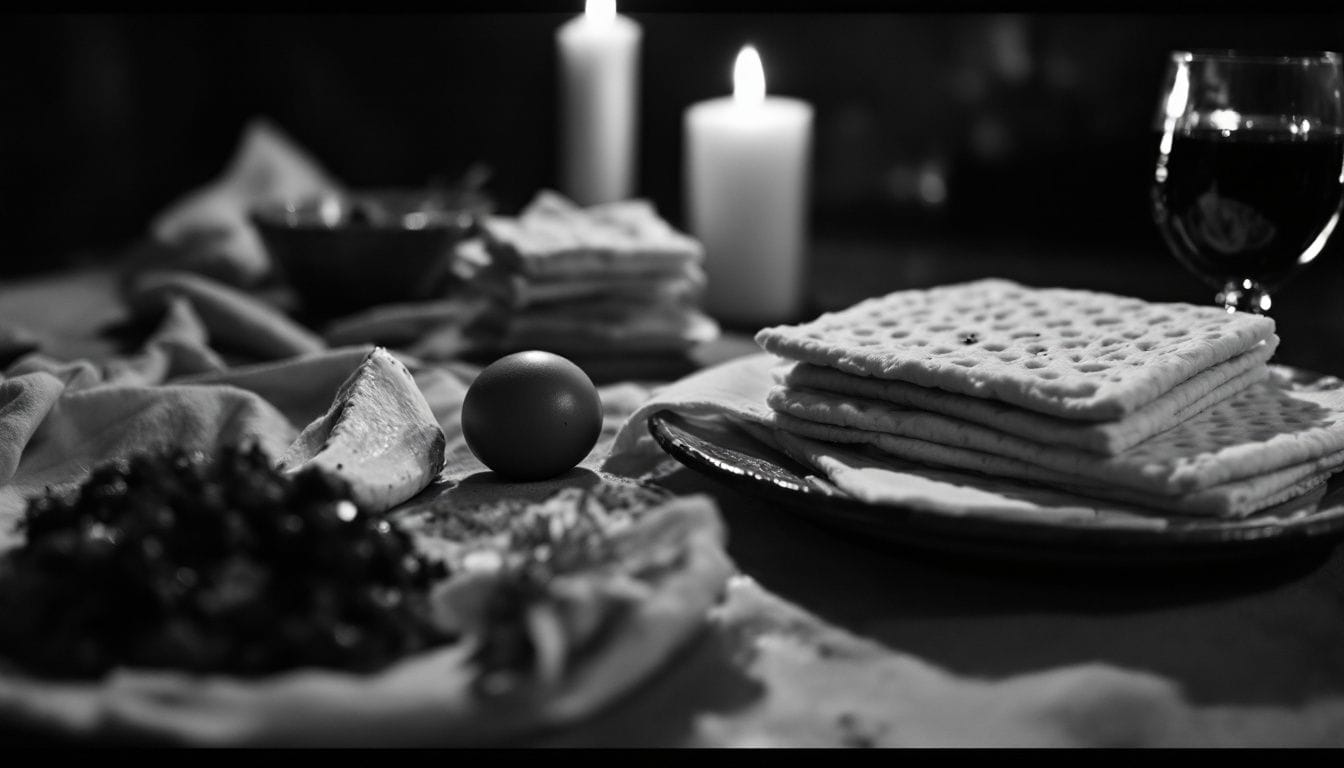
A carefully set table, flat cakes instead of bread, a plate holding a bone, an egg and bitter herbs, and children who are encouraged to ask questions: this is the night of Pesach. What exactly is being celebrated, why does bread vanish from Jewish homes for a week, and what happens during the Seder, a meal that is really a story? This article answers from the Torah, the Mishna, the Talmud, Maimonides (the Rambam) and the Shulchan Aruch, distinguishing the law that is practiced (halakha) from moral and mystical readings, and then sets it all against history.
In short: Pesach (Passover) is the festival of the Exodus from Egypt. It begins on the 15th of the month of Nissan, in the spring, and lasts seven days in Israel and eight in most Diaspora communities. Its name comes from the verb pasach, “to pass over” or “to spare”: on the night when G-d struck the firstborn of Egypt, He spared the houses of Israel (Shemot [Exodus] 12:13). During the festival it is forbidden to eat, to own, or even to let be seen any chametz, dough made from one of the five grains that has risen (Shemot 12:15; 13:7), and one eats matzah, unleavened bread. On the first night (the second as well in the Diaspora) the Seder (“order”) is held: a ritual meal at which the Exodus is told, four cups of wine are drunk, matzah and bitter herbs are eaten, and each person must see himself “as if he himself had left Egypt” (Mishna Pesachim 10:5).
1. The name, the date and the names of the festival
Pesach: “He passed over”
The Torah itself gives the etymology: “It is the Pesach offering to the L-rd, who passed over the houses of the children of Israel in Egypt when He struck Egypt and saved our houses” (Shemot 12:27; see 12:13). The verb has two meanings, which Rashi brings together: mercy, and then leaping.
“‘And I will pass over’: I will have mercy (…) And I say: every pesicha is an expression of skipping and leaping. He would skip over the houses of Israel to reach the houses of Egypt, which were mixed in with one another.”
(Rashi on Shemot 12:13) — ופסחתי. וחמלתי, … ואני אומר, כל פסיחה לשון דלוג וקפיצה
The offering and the festival thus bear the name of a divine act: in the midst of a mixed neighborhood, G-d distinguishes the houses He spares. (In a lecture cited below, Rav Raphaël Benizri proposes another reading of the word, peh-sach, “the mouth that speaks”: this is a homiletical reading, not an etymology.)
When?
The Torah fixes the date: the offering is brought on the 14th of the first month, “between the two evenings,” and the festival of matzot begins on the 15th (Vayikra [Leviticus] 23:5-6). This month is the month of aviv, “spring” or of new ears of grain (Devarim [Deuteronomy] 16:1). In Israel the festival lasts seven days (Vayikra 23:6); outside Israel an eighth day is added. The Gemara explains that in earlier times it was not known on what date the court in Jerusalem had proclaimed the new moon, so two days were observed out of caution; now that the calendar is fixed by calculation, the second day remains as “the custom of our fathers” (Babylonian Talmud, Beitzah 4b, following the classic explanation of that passage). For the year 5787, the first Seder takes place on the evening of Wednesday, April 21, 2027 (the eve of the 15th of Nissan, Thursday, April 22); outside Israel, a second Seder is held on Thursday evening.
Several names for one festival
- Chag HaMatzot, “the Festival of Matzot”: the dominant name in the Torah (Shemot 23:15; Vayikra 23:6).
- Chag HaPesach, “the Festival of Pesach” (Shemot 34:25).
- Chag HaAviv, “the Festival of Spring”: a traditional name, drawn from “the month of Aviv” (Shemot 23:15; 34:18).
- Zeman Cheruteinu, “the season of our freedom”: the name used in the liturgy, in the festival Kiddush. It is rabbinic, not biblical.
2. What the Torah tells: from slavery to the Exodus
The book of Shemot (Exodus) tells of the servitude imposed by Pharaoh, the mission of Moshe and the ten plagues. The last of them, the death of the Egyptian firstborn, is the event that Pesach commemorates. Before it struck, the Torah prescribed a household rite: on the tenth of the month each family takes a lamb or a kid (Shemot 12:3), keeps it until the fourteenth, slaughters it at dusk (12:6), and puts some of its blood on the doorposts and the lintel (12:7). It is eaten that same night, roasted over fire, with matzot and bitter herbs (12:8), “with your loins girded, your sandals on your feet and your staff in your hand,” in haste (12:11). The departure was so sudden that the bread had no time to rise:
“They baked the dough that they had brought out of Egypt into cakes of matzot, for it had not risen: they had been driven out of Egypt and could not delay.”
(Shemot 12:39) — וַיֹּאפוּ אֶת־הַבָּצֵק אֲשֶׁר הוֹצִיאוּ מִמִּצְרַיִם עֻגֹת מַצּוֹת כִּי לֹא חָמֵץ כִּי־גֹרְשׁוּ מִמִּצְרַיִם וְלֹא יָכְלוּ לְהִתְמַהְמֵהַּ וְגַם־צֵדָה לֹא־עָשׂוּ לָהֶם׃
Four expressions of deliverance
Before the plagues, G-d had formulated His promise in four verbs, which tradition would take up in the four cups of the Seder:
“I will bring you out from under the burdens of Egypt, I will deliver you from their bondage, I will redeem you with an outstretched arm and with great judgments. (…) I will take you to Me as a people.”
(Shemot 6:6-7) — וְהוֹצֵאתִי אֶתְכֶם מִתַּחַת סִבְלֹת מִצְרַיִם וְהִצַּלְתִּי אֶתְכֶם מֵעֲבֹדָתָם וְגָאַלְתִּי אֶתְכֶם בִּזְרוֹעַ נְטוּיָה … וְלָקַחְתִּי אֶתְכֶם לִי לְעָם
A festival that is told
The Torah makes transmission the soul of the festival: “When your children say to you: What does this rite mean to you? you shall say: It is the Pesach offering…” (Shemot 12:26-27); “You shall tell your son on that day: it is because of this that the L-rd acted for me when I came out of Egypt” (Shemot 13:8). The text recited when bringing the first fruits to the Temple, “An Aramean sought to destroy my father…” (Devarim 26:5-8), became the backbone of the Haggadah: the Mishna prescribes expounding it “until the end of the whole passage” (Mishna Pesachim 10:4).
The book of Yehoshua mentions a Pesach at Gilgal (Yehoshua 5:10-11); the book of Kings, a Pesach unlike any since the time of the Judges, under Yoshiyahu (II Melakhim [Kings] 23:21-22); Chronicles, Yechizkiyahu’s invitation to the northern tribes (II Divrei HaYamim [Chronicles] 30:1). For those who are impure or traveling, the Torah provides a “second Pesach” a month later (Bamidbar [Numbers] 9:10-11).
3. Chametz and matzah: the law
The prohibition of chametz
“Seven days you shall eat matzot; on the very first day you shall remove leaven from your houses, for whoever eats chametz, from the first day until the seventh, that soul shall be cut off from Israel.”
(Shemot 12:15) — שִׁבְעַת יָמִים מַצּוֹת תֹּאכֵלוּ אַךְ בַּיּוֹם הָרִאשׁוֹן תַּשְׁבִּיתוּ שְּׂאֹר מִבָּתֵּיכֶם כִּי כׇּל־אֹכֵל חָמֵץ וְנִכְרְתָה הַנֶּפֶשׁ הַהִוא מִיִּשְׂרָאֵל מִיּוֹם הָרִאשֹׁן עַד־יוֹם הַשְּׁבִעִי׃
No chametz is to be seen anywhere in one’s domain (Shemot 13:7; 12:19). The Sages specified that it means dough made from one of the five grains (wheat, barley, spelt, oats, rye; Mishna Pesachim 2:5; Shulchan Aruch, Orach Chayim 453:1) that has had time to rise on contact with water. The Shulchan Aruch sets this time at one “mil,” about 18 minutes (Orach Chayim 459:2): this is why matzah dough is kneaded without interruption and baked very quickly. For the Rambam, destroying chametz before the hour when it becomes forbidden is a Torah commandment (Hilkhot Chametz UMatzah 2:1).
Searching, destroying, selling
The Mishna opens the tractate with this law: “On the night of the fourteenth, one searches for chametz by the light of a candle” (Mishna Pesachim 1:1) — אור לארבעה עשר, בודקין את החמץ לאור הנר. Hence the bedikat chametz: on the eve of the Seder, in a house that has already been cleaned, one searches by candlelight, with a blessing, for the last crumbs (Orach Chayim 431:1). The Rema reports the custom of placing a few pieces of bread in advance, so that the blessing is not said in vain (432:2). The next morning, the chametz that was found is burned (445:1, gloss of the Rema). What cannot be destroyed is the object of a sale of chametz to a non-Jew, a real sale with no condition of return (448:3): in practice it is entrusted to a rabbi, whom one also consults for particular cases.
Matzah, bread of affliction and bread of freedom
On the night of the Seder, eating matzah is a Torah commandment (Shemot 12:18). After the destruction of the Temple, Rava ruled that matzah remains a Torah obligation, whereas maror (the bitter herb) is now only rabbinic:
“Rava said: matzah, nowadays, is a Torah obligation, and maror is rabbinic.”
(Pesachim 120a) — אמר רבא: מצה בזמן הזה דאורייתא, ומרור דרבנן
This obligation holds only on that night: on the following days matzah is optional, and only chametz is forbidden (Rambam, Hilkhot Chametz UMatzah 6:1). It is called “bread of affliction”: “Seven days you shall eat matzot, bread of affliction, for it was in haste that you came out of Egypt” (Devarim 16:3). But the same flat cake is the bread of freedom, for the dough had no time to rise before the deliverance. The Talmud plays on the expression lechem oni:
“Shmuel said: ‘Bread of affliction’ is written: a bread over which one answers (onin) many things.”
(Pesachim 115b) — אמר שמואל: ״לחם עוני״ כתיב — לחם שעונין עליו דברים. תניא נמי הכי: ״לחם עוני״ — לחם שעונין עליו דברים הרבה
Matzah is thus also a bread that makes people talk.
Kitniyot: a custom that varies
The Shulchan Aruch permits everyone to eat rice and legumes (kitniyot), which do not rise; the Rema adds: “There are those who forbid them, and the custom in Ashkenazic lands is to be strict, and one should not change” (Orach Chayim 453:1) — והמנהג באשכנז להחמיר ואין לשנות. Sephardim generally follow the Shulchan Aruch, Ashkenazim the Rema. These are communal customs, not disagreements over the Torah.
4. The Pesach offering and the Temple
As long as the Temple in Jerusalem stood, the heart of the festival was the Paschal lamb: slaughtered on the afternoon of the 14th (Shemot 12:6), roasted and eaten at night “in one house,” without breaking a bone of it (12:46). A foreigner could eat it only after converting and being circumcised (12:48). After the destruction the offering ceased, but the meal kept a trace of it: the Rambam writes that at the end of the meal one used to eat the meat of the Pesach and that, “nowadays, one eats an olive’s bulk of matzah (kazayit) and tastes nothing after it,” so that the taste of the mitzvah remains in the mouth (Hilkhot Chametz UMatzah 8:9) — ובזמן הזה אוכל כזית מצה ואינו טועם אחריה כלום. This last mouthful is the afikoman.
The word is of Greek origin (epikomon, what is taken after the meal). The Mishna says: “One does not conclude, after the Paschal lamb, with the afikoman” (Mishna Pesachim 10:8), and the Gemara explains it in two ways: according to Rav, one does not leave one company for another; according to Shmuel, nowadays one eats nothing after the matzah (Pesachim 119b).
5. The Seder step by step
“Seder” means “order”: the Mishna already describes it (Mishna Pesachim, chapter 10). Its basic rules are laid down in the very first paragraph: one does not eat before nightfall, so as to have an appetite for the matzah; “even the poorest man in Israel does not eat until he has reclined”; and one gives him no fewer than four cups of wine, “even from the charity fund” (Mishna Pesachim 10:1).
The fifteen steps
The order is remembered by means of a mnemonic of fifteen words, found in every Haggadah:
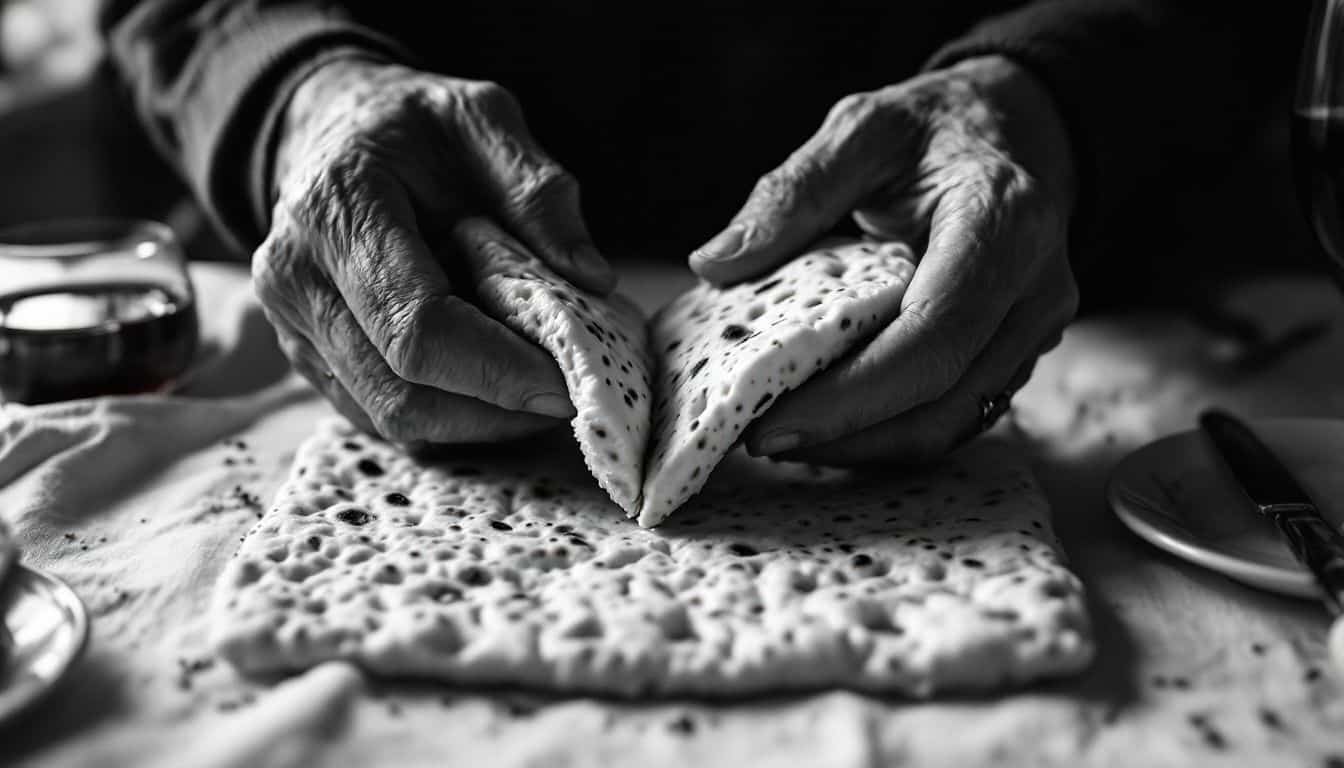
1. Kadesh: the Kiddush over the first cup, with Shehecheyanu; the Rema adds that the head of the household does not pour for himself, but that another pours for him, “in the manner of free men” (Orach Chayim 473:1). 2. Urchatz: one washes the hands, without a blessing (473:6). 3. Karpas: one dips a vegetable in salt water or vinegar, with the blessing boreh peri ha’adamah; the Mishna already describes this first dipping (Mishna Pesachim 10:3). 4. Yachatz: one divides the middle matzah; the larger piece, set aside, will be the afikoman (Orach Chayim 473:6). 5. Maggid: one tells the story: Ha lachma anya (“this is the bread of affliction”), the questions, the Haggadah. 6. Rachtzah: one washes the hands, with a blessing. 7. Motzi: hamotzi over the unleavened bread. 8. Matzah: al achilat matzah, and one eats the matzah, reclining. 9. Maror: the bitter herb, dipped in the charoset. 10. Korech: Hillel’s “sandwich” (see below). 11. Shulchan Orech: the festive meal. 12. Tzafun: the afikoman, after which one eats nothing more. 13. Barech: the Birkat Hamazon, over the third cup (Rambam, Hilkhot Chametz UMatzah 8:10). 14. Hallel: the psalms of praise, completed over the fourth cup (Rambam, ibid.; Mishna Pesachim 10:6). 15. Nirtzah: “May it be accepted”: one closes with songs and the hope of “next year in Jerusalem.”
The four cups
The Mishna requires four cups of wine. The Jerusalem Talmud gives their origin:
“Where do we derive the four cups from? Rabbi Yochanan in the name of Rabbi Binaya: they correspond to the four redemptions. ‘I will bring you out, I will deliver you, I will redeem you, I will take you.'”
(Jerusalem Talmud, Pesachim 10:1) — מניין לארבעה כוסות. רבי יוחנן בשם רבי בנייה. כנגד ארבע גאולות. לכן אמר לבני ישראל אני יי והוצאתי אתכם וגו׳. ולקחתי אתכם לי לעם וגו׳. והוצאתי. והצלתי. וגאלתי. ולקחתי
A fifth promise, “I will bring you into the land” (Shemot 6:8), has no obligatory cup: the Rambam merely permits pouring a fifth cup, for the Great Hallel, without obligation (Hilkhot Chametz UMatzah 8:10). According to a common explanation, the “cup of Eliyahu” is linked to this doubt; it is a custom, not a law.
Reclining
Free men ate reclining. The Talmud requires reclining on the left side, for the matzah as for the wine; the same page specifies: “a woman next to her husband does not need to recline; if she is a person of importance, she reclines” (Pesachim 108a). Present-day customs vary from community to community.
6. The Haggadah: telling of freedom
Who asks the questions?
“A son asks his father, and if he lacks sufficient knowledge, his father teaches him” (Mishna Pesachim 10:4). The Gemara widens the circle:
“If his son is wise, he questions him; if not, his wife questions him; if not, he questions himself; and even two sages who know the laws of Pesach question one another.”
(Pesachim 116a) — חכם בנו — שואלו. ואם אינו חכם — אשתו שואלתו, ואם לאו — הוא שואל לעצמו, ואפילו שני תלמידי חכמים שיודעין בהלכות הפסח — שואלין זה לזה
No one is thus exempt from the night: the man alone asks himself the questions. The Mishna cites four questions: the matzah, the bitter herbs, the roasted meat and the double dipping. It specifies that the question about dipping was asked even after the destruction of the Temple; the one about roasted meat, belonging to the time of the Paschal lamb, no longer has an object without a Temple, and the current text of the Haggadah replaces it with the question about reclining. The Talmud explains why the table is removed in front of the children: “so that the little ones will notice and ask” (Pesachim 115b). The Rema recommends saying the Haggadah in the language that women and children understand (Orach Chayim 473:6) — ויאמרו בלשון שמבינים הנשים והקטנים.
Beginning with shame, ending with praise
The Mishna fixes the structure of the story: “One begins with shame and ends with praise” (Mishna Pesachim 10:4). What does “shame” mean? Two masters disagree:
“One begins with shame and ends with praise. What is shame? Rav says: ‘In the beginning, our fathers were idol worshippers.’ And Shmuel says: ‘We were slaves.'”
(Pesachim 116a) — מתחיל בגנות ומסיים בשבח. מאי בגנות? רב אמר: ״מתחלה עובדי עבודה זרה היו אבותינו״. [ושמואל] אמר: ״עבדים היינו״
The Haggadah keeps both versions: “We were slaves to Pharaoh in Egypt,” then “In the beginning, our fathers served idols.” The debate concerns the starting point of the whole story: political exile or spiritual exile.
The three things, and seeing oneself as having left Egypt
“Rabban Gamliel used to say: whoever has not said these three things on Pesach has not fulfilled his obligation: the Pesach, the matzah and the maror. Pesach, because the Omnipresent passed over the houses of our fathers in Egypt. Matzah, because our fathers were redeemed in Egypt. Maror, because the Egyptians embittered the lives of our fathers in Egypt. In every generation, each person must see himself as if he himself had left Egypt.”
(Mishna Pesachim 10:5) — רבן גמליאל היה אומר, כל שלא אמר שלשה דברים אלו בפסח, לא יצא ידי חובתו, ואלו הן, פסח, מצה, ומרור. פסח, על שום שפסח המקום על בתי אבותינו במצרים. מצה, על שום שנגאלו אבותינו במצרים. מרור, על שום שמררו המצרים את חיי אבותינו במצרים. בכל דור ודור חיב אדם לראות את עצמו כאלו הוא יצא ממצרים
The Rambam draws the law from it: telling of the Exodus on the night of the 15th of Nissan is a positive Torah commandment, derived from “You shall tell your son”; even great sages are bound by it, “and whoever expands on the events is worthy of praise” (Hilkhot Chametz UMatzah 7:1; see Sefer Ha-Chinukh, mitzvah 21). And he adds: “In every generation, a person must show himself as if he had just now left the servitude of Egypt” (7:6).
The four sons
The Haggadah evokes four sons: the wise, the wicked, the simple, and the one who does not know how to ask. This page comes from an ancient teaching:
“Rabbi Chiyya taught: the Torah spoke with regard to four sons: a wise son, a wicked son, a simple son, a son who does not know how to ask.”
(Jerusalem Talmud, Pesachim 10:4) — תני רבי חייה. כנגד ארבעה בנים דיברה תורה. בן חכם בן רשע בן טיפש בן שאינו יודע לשאל
The Mekhilta de-Rabbi Yishmael (Bo, Pischa 18) has a parallel teaching, with different answers: the text was not fixed. The lesson is educational: each has his own way of hearing, and no one is excluded from the table.
The charoset and Hillel’s “sandwich”
The Mishna says of the charoset that it is not a mitzvah, but Rabbi Eliezer son of Rabbi Tzadok maintains that it is (Mishna Pesachim 10:3). According to the Gemara: “Rabbi Levi says: in memory of the apple; and Rabbi Yochanan says: in memory of the clay” (Pesachim 116a) — רבי לוי אומר: זכר לתפוח. ורבי יוחנן אומר: זכר לטיט. As for Hillel, “it was said that he would wrap the matzah and the maror together and eat them, for it is said: ‘with matzot and bitter herbs they shall eat it'”; his colleagues disagree, and the conclusion is that after eating the matzah and the maror separately, with blessings, one eats them together:
“Then he eats the matzah and the lettuce together, without a blessing, in memory of the Temple, like Hillel.”
(Pesachim 115a) — והדר אכיל מצה וחסא בהדי הדדי בלא ברכה זכר למקדש, כהלל
7. The symbols on the Seder plate
On the table one sets out: three covered matzot (the middle one will serve as the afikoman); the maror (horseradish or romaine lettuce); the charoset, a mixture of fruit, nuts and wine, in memory of the mortar (Pesachim 116a); the karpas; the roasted bone (zeroa) and the egg (beitzah), in memory, according to the usual explanation, of the Paschal lamb and of the festival offering, the two meats the Rambam speaks of (Hilkhot Chametz UMatzah 8:1).
8. Ashkenazim, Sephardim, Hasidim: customs that vary
The structure of the Seder is common to all; customs differ. Besides the kitniyot and the “shmurah” matzah (see above): in the Moroccan tradition, people gather at the end of the festival for the Mimouna, a meal at which chametz is eaten for the first time; many families hide the afikoman so that the children can “steal” it and stay awake. These are customs, not laws of the Mishna.
9. Moral, kabbalistic and Hasidic readings
A distinction is needed. Halakha says what must be done: search for, destroy and sell chametz, eat matzah. Aggadah and mussar (ethics) draw a meaning from it; Kabbalah and Hasidism add a mystical reading. These readings are not the law, but they have nourished the festival.
The leaven in the dough
A prayer attributed to Rabbi Alexandri names the leaven:
“Master of the universe, it is revealed and known before You that our will is to do Your will; and what prevents us? The leaven in the dough and the subjugation by the kingdoms. May it be Your will to save us from their hand.”
(Berakhot 17a) — ״רבון העולמים, גלוי וידוע לפניך שרצוננו לעשות רצונך, ומי מעכב? — שאור שבעיסה ושעבוד מלכיות
Rashi explains: “The leaven in the dough: the evil inclination that is in our heart and makes us rise” (Rashi on Berakhot 17a) — שאור שבעיסה – יצר הרע שבלבבנו המחמיצנו. The verb “to make rise” is that of chametz itself. This is the origin of a moral tradition: on Pesach one drives the chametz out of the house, and asks oneself about the chametz within. Rav Benizri takes it up with a nuance (see below).
The hidden miracles
Nachmanides (Ramban), in his commentary on tefillin and the Exodus, writes a famous sentence:
“From the great and manifest miracles, a person comes to acknowledge the hidden miracles, which are the foundation of the whole Torah.”
(Ramban on Shemot 13:16) — ומן הנסים הגדולים המפרסמים אדם מודה בנסים הנסתרים שהם יסוד התורה כלה
Kabbalah and Hasidism
Kabbalah, following the Arizal (Rabbi Yitzchak Luria, 16th century), sees in Egypt (Mitzrayim) the source of all impurities and all exiles (this is how Rav Benizri presents it, below); the word evokes the root metzar, “limit.” In many Hasidic teachings, chametz, which “swells,” represents pride, and matzah, which is flat, humility. These are interpretations, not conditions of the mitzvah: one fulfills the law of Pesach no less if one does not know them.
10. History and archaeology
The Exodus: what is known and what is not
No Egyptian source mentions the ten plagues or the departure of a people of slaves. The stele of Pharaoh Merneptah (around 1208 BCE) contains the oldest extra-biblical mention of a people named Israel, settled in Canaan, but it does not speak of an exodus. Historians therefore debate the date, the scale and even the historicity of the event. For tradition, the festival does not rest on archaeological proof, but on the unbroken transmission of the story from father to son, which the Torah itself institutes (Shemot 13:8).
Ancient traces of the festival
The “Passover papyrus” of Elephantine (419 BCE) is a letter, signed by a certain Hananiah, addressed to the Jewish garrison of Elephantine in Upper Egypt. It contains instructions for the festival of matzot: “Seven days, eat unleavened bread. Now, be pure and take care. [Do] no work on the 15th day and the 21st day of Nissan” (papyrus P. 13464, held in the Egyptian Museum of Berlin). It is one of the oldest extra-biblical attestations of the festival.
The Seder, a banquet
Scholars have compared the Seder to the Greco-Roman banquet (symposion): a meal eaten reclining, dippings at the start of the meal, questions, a final dessert (afikoman). The thesis was formulated by Siegfried Stein (“The Influence of Symposia Literature on the Literary Form of the Pesah Haggadah,” Journal of Jewish Studies, vol. 8, 1957).
The Haggadot
The oldest complete text of the Haggadah to survive is part of the prayer book of Saadia Gaon (10th century); independent Haggadot, sometimes illuminated, spread from the 13th-14th centuries, and printing circulated them from the 15th century.
What Rav Raphaël Benizri teaches
Rav Raphaël Benizri has devoted several lectures to Pesach, gathered on the page Pesach: the festival of freedom in 6 video lectures. What follows summarizes his words.
Searching for the chametz within. In Pesach: searching for the chametz within, the Rav recalls that the search for chametz is not spring cleaning: the house is already clean when the bedikah begins, and what one is really looking for is not in the cupboards. Leaven is not a foreign body in the dough, for left alone, the dough rises by itself: everything is a matter of dosage over time, not of expelling an intruder. For him Pesach also means “the leap”: it is believing that a man can pass from the state of a slave to that of a free man in the blink of an eye.
Where should the Haggadah begin? In Pesach: where should the Haggadah begin?, he takes up the debate between Rav and Shmuel (Pesachim 116a). Our Sages put slavery first, and the Rav sees a rightness in this: every time we agree to live in dependency, we are already idolaters. He relies on the Arizal to make the Exodus the model of every departure from conditioning.
Peh-Sach, the mouth that speaks. In Pesach: Peh-Sach, the mouth that speaks, the Rav breaks the word down into peh sach, “a mouth in motion,” and contrasts it with Pharaoh (peh sach ra, an evil mouth): it is openness, not speech alone, that sets them apart. He reads the four cups as four moments: the departure from Egypt, the tearing away from Egyptian culture, an unearned liberation, and song. For him, “exclusion is forbidden at this table”: the wise, the wicked, the simple and the one who does not know how to ask are the four components of society.
The four questions. In The four questions of the Mah Nishtanah, the Rav reads the questions on four levels (pshat, drash, remez, sod) and proposes a personal reading: what if the four questions were four answers? The tray is moved to awaken the child, who expected to sit down to eat; what he discovers is that we are, and remain, in exile.
The number four; time. In Pesach: the mystery of the number four, he links the four to the four verbs of deliverance and notes that the departure is given only at the ninth plague: the people leave only once they are able to grasp the light through the darkness. In Pesach: time is not continuous, he explains that the sanctification of the firstborn, placed in the middle of the account of the Exodus, is not a digression: “the whole secret is in the beginning.” Mitzrayim, he says, is metzar yam, “the limit of the sea,” and time is not continuous: it is a succession of moments, each of which is a creation.
Common misconceptions about Pesach
“During Pesach, you eat only matzah.” False. The obligation holds only on the first night (Rambam, Hilkhot Chametz UMatzah 6:1); on the following days one eats whatever one likes, as long as it is not chametz.
“Chametz is anything that contains flour.” Not exactly: it is dough made from one of the five grains that has had time to rise; matzah is itself flour and water, baked before that time is up (Mishna Pesachim 2:5; Orach Chayim 459:2).
“Pesach is the Christian Easter.” The two words have the same origin: the French Pâque and the Latin and Greek pascha come from the Aramaic, a form of the Hebrew word pesach. But the two festivals are distinct: Pesach commemorates the Exodus from Egypt, on the 15th of Nissan, with its own liturgy, laws and story.
Frequently asked questions about Pesach
Why does Pesach last seven days in Israel and eight elsewhere?
The Torah prescribes seven days (Vayikra 23:6). The eighth day in the Diaspora comes from an ancient uncertainty about the date of the new moon; according to the classic explanation, it remained after the calendar was fixed (Beitzah 4b).
Why four cups?
They correspond to the four expressions of deliverance in Shemot 6:6-7 (Jerusalem Talmud, Pesachim 10:1), and even the poorest man must receive four (Mishna Pesachim 10:1).
What is the afikoman?
It is the last mouthful of matzah of the meal, in memory of the Paschal lamb (Rambam 8:9; Pesachim 119b). The custom of hiding it so that the children look for it is an educational device.
Further reading
- Pesach: the festival of freedom in 6 video lectures
- Why do we eat matzah on Pesach? Meaning and rules
- Pesach: where should the Haggadah begin?
- Jewish festivals: the meaning of each festival in video lectures
- Glossary of Hebrew terms in Judaism
- The Jewish calendar: months, years and festivals
- What does “kosher” mean? Kashrut explained
- What is the Counting of the Omer and Lag BaOmer?
- What is Shavuot and why do people stay up all night?
- What does Rosh Hashanah mean and why is the shofar blown?
Sources and references (19)
- Shemot (Exodus) 6:6-8; 12:3; 12:6-8; 12:11; 12:13; 12:15; 12:18-19; 12:26-27; 12:39; 12:46; 12:48; 13:7-8; 23:15; 34:18; 34:25
- Vayikra (Leviticus) 23:5-6
- Bamidbar (Numbers) 9:10-11
- Devarim (Deuteronomy) 16:1; 16:3; 26:5-8
- Yehoshua (Joshua) 5:10-11; II Melakhim (II Kings) 23:21-22; II Divrei HaYamim (II Chronicles) 30:1; Tehilim (Psalms) 116:13
- Mishna Pesachim 1:1; 2:5; 10:1; 10:3-6; 10:8
- Babylonian Talmud, Pesachim 108a; 115a-b; 116a; 119b; 120a
- Babylonian Talmud, Berakhot 17a; Beitzah 4b
- Jerusalem Talmud, Pesachim 10:1; 10:4
- Mekhilta de-Rabbi Yishmael, Bo (Pischa) 18
- Rashi on Shemot 12:13; on Berakhot 17a
- Ramban on Shemot 13:16
- Rambam, Mishneh Torah, Hilkhot Chametz UMatzah 2:1; 6:1; 7:1; 7:6; 8:1; 8:9-10
- Sefer Ha-Chinukh, mitzvah 21
- Shulchan Aruch, Orach Chayim 431:1; 432:2; 445:1; 448:3; 453:1; 459:2; 473:1; 473:6
- Siegfried Stein, “The Influence of Symposia Literature on the Literary Form of the Pesah Haggadah,” Journal of Jewish Studies 8, 1957
- Letter of Hananiah to the Elephantine garrison (419 BCE), papyrus P. 13464, Berlin
- Merneptah Stele (around 1208 BCE)
- Lectures by Rav Raphaël Benizri: Pesach: searching for the chametz within; Pesach: where should the Haggadah begin?; Pesach: Peh-Sach, the mouth that speaks; The four questions of the Mah Nishtanah; Pesach: the mystery of the number four; Pesach: time is not continuous
Article by the Pensées Juives editorial team. Passages attributed to Rav Raphaël Benizri are taken from his lectures published on this site.