
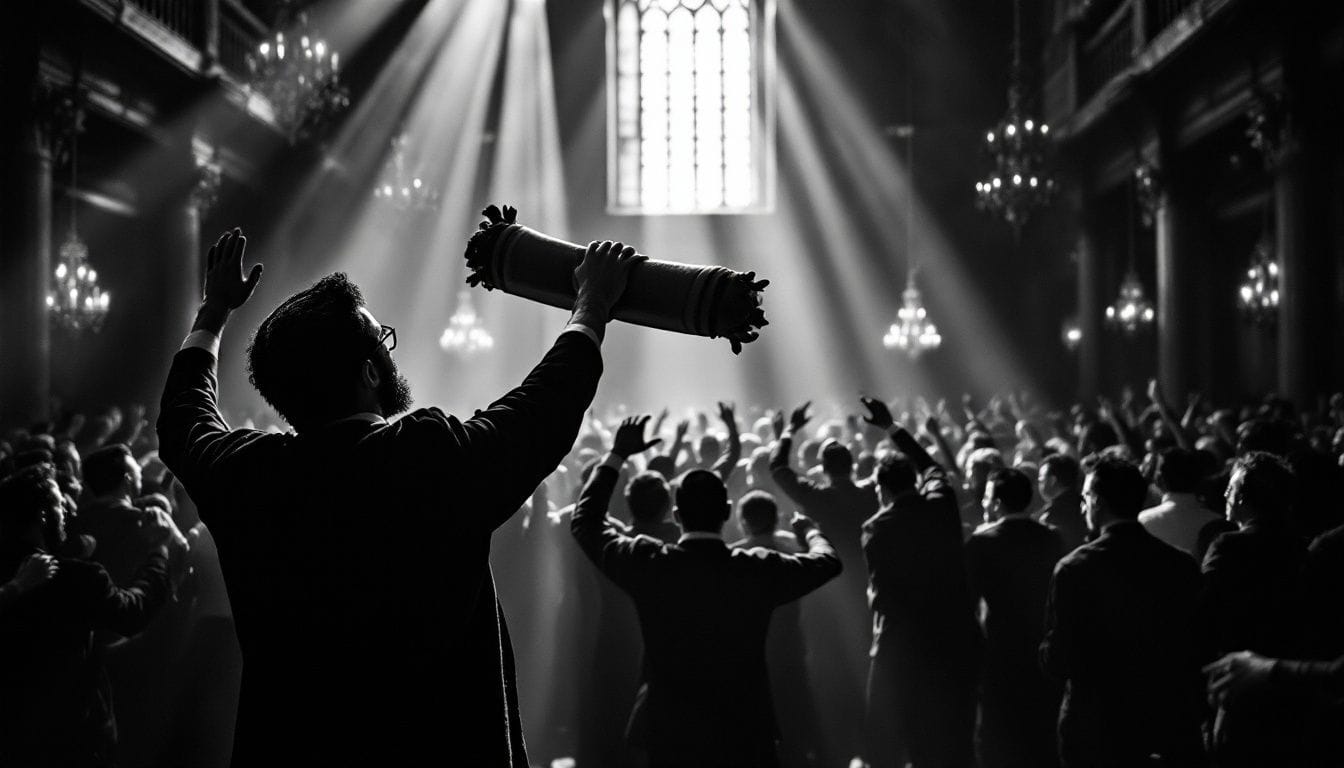
After seven days spent in the sukkah (the booth) with the four species in hand, here is a day with no booth and no lulav, when synagogues fill with song, when all the Torah scrolls are taken out of the ark, when people dance and children parade with flags, before the last sentence of the Torah is read… and the first one is immediately begun again. What is being celebrated? Why dance with a book that is not even being read at that moment? And where does this custom come from, since it is absent from the written Torah?
In short: Simchat Torah (“the joy of the Torah”) is the day on which the annual reading of the Torah is completed (the last parasha, Vezot HaBerakha) and immediately begun again from the start (Bereshit). The written Torah knows only Shemini Atzeret, the “eighth day of conclusion” that follows Sukkot (Vayikra [Leviticus] 23:36; Bamidbar [Numbers] 29:35). In Israel, Shemini Atzeret and Simchat Torah are a single day (22 Tishrei); in the diaspora, Simchat Torah is the second day (23 Tishrei). The dances with the scrolls, the hakafot (“circuits” around the bimah), are a custom, mentioned by the Rama (Orach Chaim 669:1), not a mitzvah of the Torah; but they rest on a principle of halakha stated by the Rambam: the joy with which one performs the mitzvot is “a great service” (Hilchot Lulav 8:15). This article distinguishes the biblical text, halakha, the history of the custom, and the readings of aggada and Hasidism.
1. Shemini Atzeret: an eighth day
What the Torah says
The Torah sets aside a separate day following the seven days of Sukkot:
“For seven days you shall bring an offering by fire to the L-rd; on the eighth day you shall have a holy convocation, and you shall bring an offering by fire to the L-rd: it is an atzeret; you shall do no work of labor.”
(Vayikra 23:36) — שִׁבְעַת יָמִים תַּקְרִיבוּ אִשֶּׁה לַיהֹוָה בַּיּוֹם הַשְּׁמִינִי מִקְרָא־קֹדֶשׁ יִהְיֶה לָכֶם וְהִקְרַבְתֶּם אִשֶּׁה לַיהֹוָה עֲצֶרֶת הִוא כׇּל־מְלֶאכֶת עֲבֹדָה לֹא תַעֲשׂוּ
The Book of Numbers confirms it: “On the eighth day you shall have an atzeret” (Bamidbar 29:35). The word atzeret comes from the root atzar, “to hold back, to stop”; it designates a closing assembly, where one halts. The day has no commandment of its own: no lulav or etrog is taken, and the sukkah is no longer commanded by the Torah; it has its name, its holiness and its sacrifice.
Rashi, on Vayikra 23:36, gives an image of it that has become famous:
“‘It is an atzeret’: I have kept you back with Me. Like a king who invited his sons to a feast for so many days; when the time comes for them to leave, he says: My sons, I beg you, stay with me one more day, your parting is hard for me.”
(Rashi on Vayikra 23:36) — עצרתי אתכם אצלי; כמלך שזמן את בניו לסעודה לכך וכך ימים, כיון שהגיע זמנן לפטר, אמר, בני בבקשה מכם עכבו עמי עוד יום אחד, קשה עלי פרדתכם
Seventy bulls and one
The Talmud draws another lesson from the list of Sukkot sacrifices. During the seven days, bulls are offered in decreasing numbers (thirteen on the first day, then twelve, eleven, down to seven on the seventh day: seventy in all, Bamidbar 29:12-34). On the eighth day, a single bull (Bamidbar 29:36). Rabbi Elazar gives the meaning:
“To what do these seventy bulls correspond? To the seventy nations. And why a single bull? It corresponds to the unique nation.”
(Sukkah 55b) — הני שבעים פרים כנגד מי — כנגד שבעים אומות. פר יחידי למה — כנגד אומה יחידה.
And the Talmud concludes with a parable:
“This is like a king of flesh and blood who said to his servants: prepare me a great feast. On the last day, he said to his friend: prepare me a small meal, so that I may enjoy you.”
(Sukkah 55b) — משל למלך בשר ודם שאמר לעבדיו: עשו לי סעודה גדולה. ליום אחרון אמר לאוהבו: עשה לי סעודה קטנה כדי שאהנה ממך.
After the great festival open to all humanity comes, therefore, the face-to-face encounter. This reading belongs to aggada (non-legal teaching); it explains why the festival of the eighth day is more “intimate” than the preceding ones.
A festival in its own right
Shemini Atzeret is not a mere extension of Sukkot. The Talmud, relying on a series of features, declares it “a festival in itself”:
“A festival in itself with regard to ‘pazer keshav’: a lottery in itself, a time in itself, a festival in itself, a sacrifice in itself, a song in itself, a blessing in itself.”
(Sukkah 48a) — רגל בפני עצמו לענין פז״ר קש״ב. פייס בפני עצמו. זמן בפני עצמו. רגל בפני עצמו. קרבן בפני עצמו. שירה בפני עצמו. ברכה בפני עצמו.
“Pazer keshav” is a mnemonic for the six features: the blessing shehecheyanu (“who has kept us alive until this moment”) is recited on it, the priests who will serve are again chosen by lot, and the sacrifices, the song and the blessing are specific to this day. That is why the prayer does not say “this festival of Sukkot” but “this eighth day” (Shulchan Arukh, Orach Chaim 668:1, with the gloss of the Rama, who prefers “yom hashemini atzeret” to “chag ha’atzeret”, because the Torah nowhere calls this day “chag”).
The sukkah on that day
In the diaspora, one eats in the sukkah on 22 Tishrei, in case that day is in fact the seventh of Sukkot, but without a blessing:
“And outside the Land, one eats in the sukkah at night and by day, because it may be the seventh day, and one does not bless over dwelling in it.”
(Rama on Orach Chaim 668:1) — ובחוצה לארץ אוכלים בסוכה בלילה וביום מפני שהוא ספק שביעי ואין מברכים על ישיבתה
In Israel, one does not eat in it. This difference comes from the principle that the diaspora adds one day to each festival, developed below.
The prayer for rain
It is on Shemini Atzeret that we begin to mention in the prayer “He causes the wind to blow and the rain to fall” (in Hebrew mashiv haruach umorid hagashem). The Mishna (Taanit 1:1) records the disagreement: Rabbi Eliezer said it from the first day of the festival, Rabbi Yehoshua from the last. Halakha follows Rabbi Yehoshua:
“One begins to say in the second blessing ‘He causes the wind to blow and the rain to fall’ at the Musaf prayer of the last day of the festival, and one does not stop until the Musaf of the first day of Pesach.”
(Shulchan Arukh, Orach Chaim 114:1) — מתחילין לומר בברכה שנייה משיב הרוח ומוריד הגשם בתפלת מוסף של י”ט האחרון של חג ואין פוסקין עד תפלת מוסף של י”ט הראשון של פסח
The Shulchan Arukh adds that the cantor announces the formula before the prayer (Orach Chaim 668:2):
“…and he announces: ‘He causes the wind to blow and the rain to fall.'”
(Shulchan Arukh, Orach Chaim 668:2) — ומכריז משיב הרוח ומוריד הגשם
This moment can be read as follows: Sukkot is the festival of the universal, and Shemini Atzeret is the day when Israel, in the intimacy of its relationship with G-d, asks for rain for the coming year.
2. Two days in the diaspora: from Shemini Atzeret to Simchat Torah
The Torah speaks only of the “eighth day”, 22 Tishrei. Where does the second day, 23 Tishrei, called Simchat Torah, come from? It is the “second festival day of the exiles” (yom tov sheni shel galuyot). In antiquity, the court in Jerusalem fixed the beginning of the month on the testimony of the new moon; distant communities, who did not know for certain which day the court had proclaimed, observed two days as a precaution. The Talmud discusses the status of these two days (Beitzah 4b). Even after the calendar came to be fixed by calculation, the practice was maintained for diaspora communities.
That is why, in Israel, Shemini Atzeret and Simchat Torah are a single day, 22 Tishrei: the end of the Torah is read and begun again. In the diaspora, Shemini Atzeret is the 22nd, and Simchat Torah the 23rd. The Shulchan Arukh describes it: “Where two festival days are kept, on the night of the ninth [day of the festival], one makes Kiddush and says shehecheyanu; the next day, three scrolls are taken out” (Orach Chaim 669:1). The Talmud already knew the principle: in the passage on the Torah readings for each festival, it provides for the last day the reading of “Kol habechor” and for the next day (“lemachar”) that of Vezot HaBerakha:
“The next day, one reads ‘And this is the blessing’, and as haftarah one reads ‘And Solomon stood’.”
(Megillah 31a) — למחר קורין ״וזאת הברכה״, ומפטירין ״ויעמד שלמה״.
It is therefore remarkable that, as early as the Talmud, the reading of the end of the Torah is attached to the day after Shemini Atzeret. But the name “Simchat Torah” does not appear there: the Talmud designates the day as Shemini Atzeret. The name is later: historians place the appearance of the celebration of the end of the cycle, with the taking out of the scrolls and the dances, in the period of the Geonim and the early Rishonim (11th century), when Rabbi Yitzchak ibn Ghayat notes that this is done “in certain places” and when the opinion of Rav Hai Gaon is reported, according to which it is permitted because it honors the Torah (according to the synthesis of the online encyclopedia Wikipedia, which we mention as historical context, not as a source of halakha). The Rama, for his part, explains the name in one line:
“The last festival day is called Simchat Torah, because one rejoices, and one holds a festive meal for the completion of the Torah.”
(Rama on Orach Chaim 669:1) — וקורין י”ט האחרון שמחת תורה לפי ששמחין ועושין בו סעודת משתה לגמרה של תורה
3. Finishing the Torah, beginning it again
The annual cycle
The Torah is read in public, in sections, throughout the year: this is the weekly parasha. The Talmud reports that there were two cycles: in Babylonia, the Torah was completed in one year; in the Land of Israel, in three years (Megillah 29b), in reference to those “of the West who complete the Torah in three years”:
“…for the people of the West [the Land of Israel], who complete the Torah in three years.”
(Megillah 29b) — לבני מערבא דמסקי לדאורייתא בתלת שנין.
The annual Babylonian cycle ended up prevailing everywhere. It ends on Simchat Torah with the parasha Vezot HaBerakha (Devarim [Deuteronomy] 33:1 – 34:12), which is read in the presence of the whole community.
The last parasha
It opens with Moshe’s blessing of the twelve tribes, which contains a sentence that every Jewish child learns:
“Moshe commanded us the Torah, an inheritance of the congregation of Yaakov.”
(Devarim 33:4) — תּוֹרָה צִוָּה־לָנוּ מֹשֶׁה מוֹרָשָׁה קְהִלַּת יַעֲקֹב
It ends with the death of Moshe, buried “in the valley, in the land of Moab”, and no one knows his grave “to this day” (Devarim 34:5-6). The Talmud asks: how could Moshe have written the account of his own death? It answers that the last eight verses of the Torah were written by Yehoshua:
“…up to here Moshe wrote; from here on Yehoshua wrote.”
(Bava Batra 15a) — אלא עד כאן כתב משה, מכאן ואילך כתב יהושע
According to another opinion, Moshe wrote these verses too, but “in tears” (Menachot 30a). In both cases, one can read in it that the Torah does not end with Moshe: it passes from hand to hand, and it is this continuity that the festival stages. The haftarah of Simchat Torah, the Book of Yehoshua, begins moreover exactly where the Torah ends: “After the death of Moshe…”. And it is in this book that we find the sentence:
“This book of the Torah shall not depart from your mouth; meditate on it day and night.”
(Yehoshua [Joshua] 1:8) — לֹא־יָמוּשׁ סֵפֶר הַתּוֹרָה הַזֶּה מִפִּיךָ וְהָגִיתָ בּוֹ יוֹמָם וָלַיְלָה לְמַעַן תִּשְׁמֹר לַעֲשׂוֹת כְּכׇל־הַכָּתוּב בּוֹ כִּי־אָז תַּצְלִיחַ אֶת־דְּרָכֶךָ וְאָז תַּשְׂכִּיל
The last words of the written Torah are “before the eyes of all Israel” (Devarim 34:12). Rashi reads in them the breaking of the Tablets: Moshe had the heart to break the Tablets “before their eyes”, and G-d approved his act (Rashi on Devarim 34:12):
“‘Before the eyes of all Israel’: his heart moved him to break the Tablets before their eyes.”
(Rashi on Devarim 34:12) — שנשאו לבו לשבר הלוחות לעיניהם
This reading belongs to commentary: Rashi connects the last verse of the Torah to the broken Tablets, which are followed, according to tradition, by the second Tablets received on Yom Kippur. It joins, as we shall see, what Rav Benizri says about the joy that follows Yom Kippur.
Beginning again at once
The Shulchan Arukh provides for three scrolls: in the first, one reads Vezot HaBerakha to the end of the Torah; in the second, Bereshit, from “In the beginning” to “which G-d had created to make” (Bereshit [Genesis] 1:1 – 2:3); in the third, the maftir of Shemini Atzeret (Bamidbar 29:35 ff.). The haftarah is the beginning of the Book of Yehoshua (Orach Chaim 668:2; 669:1). The Talmud itself, as we have seen, mentions only the reading of Vezot HaBerakha; the addition of Bereshit is later: some communities practiced it in the Middle Ages, and the Shulchan Arukh (around 1565) fixed it. The honors are special: the one who finishes the Torah is called Chatan Torah (“the groom of the Torah”), the one who begins is Chatan Bereshit. The Rama notes that they undertake to make donations and invite the congregation to a feast (Orach Chaim 669:1).
“In the beginning, G-d created the heavens and the earth.”
(Bereshit 1:1) — בְּרֵאשִׁית בָּרָא אֱלֹהִים אֵת הַשָּׁמַיִם וְאֵת הָאָרֶץ
Why begin again at that very instant? The classic answer is a message: the Torah is not a book that one has “finished”. Ben Bag Bag says of it: “Turn it over and turn it over, for everything is in it; look into it, grow old and gray in it, do not stir from it, for there is no better portion than it” (Pirkei Avot 5:22):
“Turn it over and turn it over, for everything is in it.”
(Pirkei Avot 5:22) — הפך בה והפך בה, דכלא בה.
4. The hakafot: circling with the Torah
What the Rama says
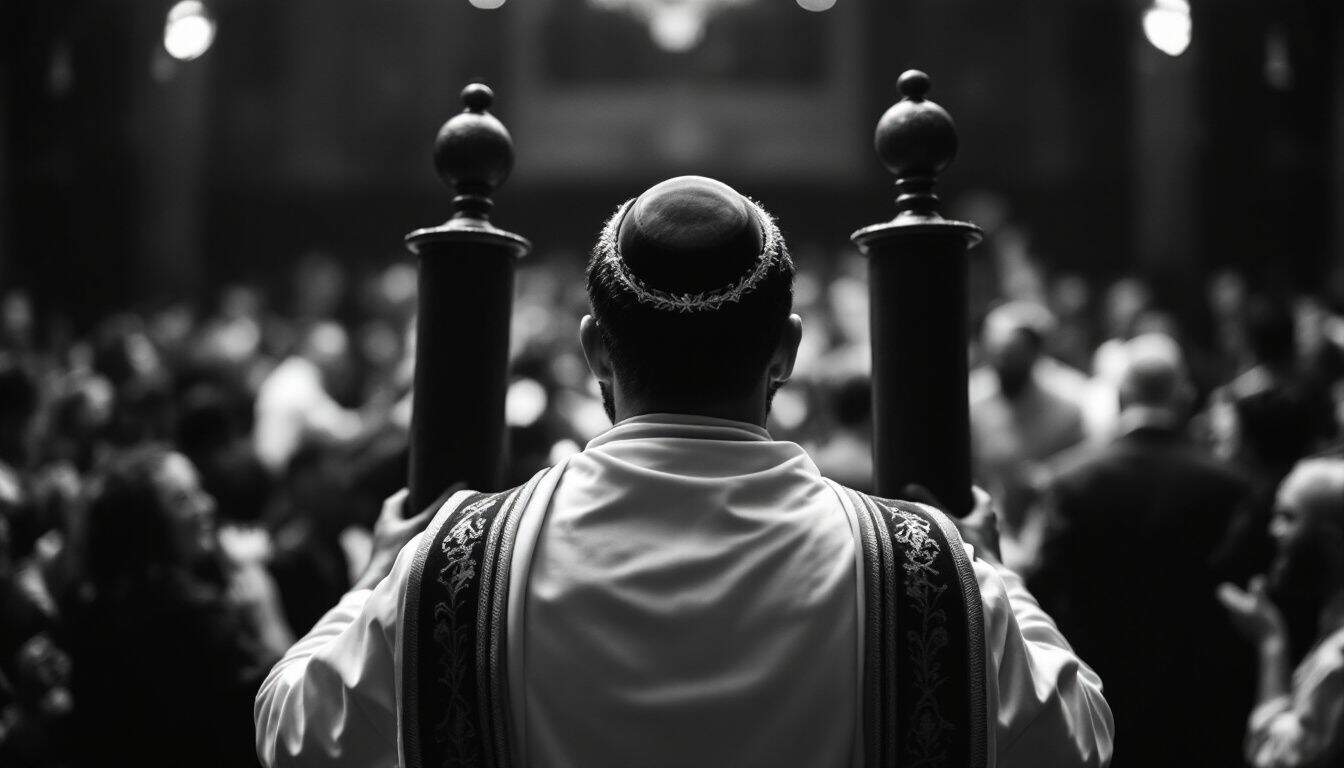
The hakafot (“circuits”) are the most visible part of the festival. The Shulchan Arukh does not mention them, but the Rama, in his gloss (Orach Chaim 669:1), describes the Ashkenazi customs of the 16th century:
“And it is also customary to circle the bimah of the synagogue with the Torah scrolls, just as one circles with the lulav, and all this out of joy.”
(Rama on Orach Chaim 669:1) — ועוד נהגו להקיף עם ספרי התורה הבימה שבבית הכנסת כמו שמקיפים עם הלולב והכל משום שמחה
The gloss specifies other customs: in the evening and in the morning, all the scrolls are taken out of the ark, songs and praises are recited, “each place according to its custom”; the number of those called to the Torah is multiplied, even if it means rereading the same parasha several times (“and there is no prohibition in this”); and “all the children” are called up:
“It is also customary to call all the children to the Torah, and to read to them the parasha of ‘the redeeming angel’.”
(Rama on Orach Chaim 669:1) — עוד נהגו לקרות כל הנערים לספר תורה וקורים להם פרשת המלאך הגואל
The “parasha of the redeeming angel” is Yaakov’s blessing of his grandsons: “The angel who has redeemed me from all evil will bless these boys” (Bereshit 48:16). The Rama speaks of the evening as well as the morning: the hakafot are therefore held from the night of the festival. Customs in Israel and in Sephardi or Hasidic communities vary: the number of circuits, the songs, the circle dances, the time of the hakafot. Hasidim often prolong the joy until very late at night. One follows the custom of one’s community.
A circle around a center
The Rama’s comparison with the lulav refers to a Temple rite: during Sukkot, the altar was circled every day, and seven times on the seventh day (Mishna Sukkah 4:5). The hakafot of Simchat Torah transpose this circuit: the center is no longer the altar but the book. One reading, developed by Rav Benizri (see below), stresses that in a circle no one is in front or behind, and that everyone stands at an equal distance from the center. This is a reading, not a rule; but it matches the practice of the day, which calls everyone to the Torah, even the children. It also recalls the mitzvah of Hakhel: every seven years, at Sukkot, the Torah was read before the assembled people:
“Assemble the people, the men, the women and the children, and your stranger who is within your gates, so that they may hear and so that they may learn.”
(Devarim 31:12) — הַקְהֵל אֶת־הָעָם הָאֲנָשִׁים וְהַנָּשִׁים וְהַטַּף וְגֵרְךָ אֲשֶׁר בִּשְׁעָרֶיךָ לְמַעַן יִשְׁמְעוּ וּלְמַעַן יִלְמְדוּ וְיָרְאוּ אֶת־יְהֹוָה אֱלֹהֵיכֶם וְשָׁמְרוּ לַעֲשׂוֹת אֶת־כׇּל־דִּבְרֵי הַתּוֹרָה הַזֹּאת
The verse immediately states the purpose: “so that they may fear the L-rd your G-d and take care to do all the words of this Torah” (Devarim 31:12; for the ceremony, see Mishna Sotah 7:8).
Joy as a mitzvah
Dancing with the Torah is not a folkloric gesture; it ties in with a central principle of halakha. The Torah commands the joy of Sukkot: “You shall rejoice in your festival… and you shall be only joyful” (Devarim 16:14-15). And it presents the absence of joy as a fault: “…because you did not serve the L-rd your G-d with joy and gladness of heart” (Devarim 28:47). The Rambam draws the consequence, in connection with the festival of joy in the Temple:
“The joy with which a person rejoices in the performance of the mitzvah and in the love of the G-d who commanded it is a great service.”
(Mishneh Torah, Hilchot Shofar, Sukkah and Lulav 8:15) — השמחה שישמח אדם בעשית המצוה ובאהבת האל שצוה בהן. עבודה גדולה היא.
In the preceding paragraph he describes the joy of the Temple, where the greatest sages danced, clapped their hands and sang before all the people (Hilchot Shofar, Sukkah and Lulav 8:12-14), and he warns: whoever “holds himself back from this joy” deserves to be punished (8:15). The Mishna says of this festival, the “Simchat Beit HaShoeva” (the joy of the water libation):
“Whoever has not seen the joy of Beit HaShoeva has never seen joy in his life.”
(Mishna Sukkah 5:1) — כל מי שלא ראה שמחת בית השואבה, לא ראה שמחה מימיו
The rabbis do not ask that Simchat Torah be the same thing as Beit HaShoeva: the Mishna and the Rambam speak of the Temple, and Simchat Torah is a synagogue custom of another age. But they place the joy of Sukkot, the peak of the year, at the center of the relationship with the Torah.
5. Why dance with a book one is not reading?
Four levels of reading complement one another, and care should be taken not to confuse them.
- Halakha. Joy accompanies the mitzvah (Rambam). The Rama mentions the feast “for the completion of the Torah”, a kind of siyum (a meal marking the end of a course of study). There is no mitzvah to dance with the Torah; there is a custom of joy, which the Rama reports with the words “out of joy”.
- Mussar (moral reading). It is often pointed out that we celebrate the Torah by carrying it in our arms, without opening it: joy expresses an attachment that goes beyond understanding. The psalm says it: “The precepts of the L-rd are upright, rejoicing the heart” (Tehillim [Psalms] 19:9). Joy is not a supplement to study; it is its goal.
- History. The rite developed in the medieval period, as we have seen, and took its present form in the 16th century (the Rama).
- Hasidism. The Hasidic movement made Simchat Torah one of the peaks of the year, with hakafot prolonged late into the night, songs and dances. The Torah, finished and begun again without interruption, is experienced there as a living bond rather than as a book one has finished.
The common thread is that the Torah is a living bond. One studies it, one observes it, but one also dances it, to say that one belongs to it.
6. A little history
Several stages can be distinguished, with the caution appropriate to a custom with no ancient written source.
- Biblical and Second Temple period. After the return from the Babylonian exile, Ezra reads the Torah before the people at Sukkot: “He read from the book of the Torah of G-d day by day, from the first day to the last; they kept the festival seven days, and on the eighth day an atzeret, according to the ordinance” (Nechemya [Nehemiah] 8:18):
“He read from the book of the Torah of G-d day by day, from the first day to the last; they kept the festival seven days, and on the eighth day an atzeret, according to the ordinance.”
(Nechemya 8:18) — וַיִּקְרָא בְּסֵפֶר תּוֹרַת הָאֱלֹהִים יוֹם בְּיוֹם מִן־הַיּוֹם הָרִאשׁוֹן עַד הַיּוֹם הָאַחֲרוֹן וַיַּעֲשׂוּ־חָג שִׁבְעַת יָמִים וּבַיּוֹם הַשְּׁמִינִי עֲצֶרֶת כַּמִּשְׁפָּט
In the same account, Nechemya says to the weeping people: “Do not grieve, for the joy of the L-rd is your strength” (Nechemya 8:10).
- Talmudic period. An eighth day of conclusion, with a reading of the end of the Torah on the following day in the diaspora (Megillah 31a). Simchat Torah is not yet mentioned.
- Period of the Geonim and the Rishonim. Appearance of the taking out of the scrolls and of dances “in certain places”, according to an 11th-century authority, Yitzchak ibn Ghayat, and with the approval of Rav Hai Gaon (according to the synthesis cited above).
- 12th-13th centuries. According to the same synthesis, the Chatan Torah is established as early as the 12th century, and the reading of Bereshit immediately after Devarim is added from the 13th century in certain communities.
- 16th century. The Shulchan Arukh and the Rama codify the festival; the hakafot around the bimah become a general custom.
- Modern period. In Israel, the festival is celebrated with hakafot in synagogues and in public squares, with the children. 22 Tishrei 5784 (7 October 2023), a Shabbat and Simchat Torah in Israel, is also the day of Hamas’s deadly attack on southern Israel; Jewish memory now associates these two dates.
7. What Rav Raphaël Benizri teaches
Rav Raphaël Benizri has not devoted a lecture to Simchat Torah itself, but his lecture Sukkot: the festival of joy deals with the joy of the festival, of which Shemini Atzeret and Simchat Torah are the crowning. Here is what can be said about it, attributing to him nothing other than what he develops there.
The Rav distinguishes joy from pleasure: in a relationship of love, what matters is not the gifts one gives each other but the intimacy one shares; joy is born of “contradictions that complement one another harmoniously”, it is a fullness and not an amenity. He notes that Sukkot is the festival of the universal: the Jewish people offers sacrifices there for the seventy nations, and it is the only festival that the nations are called to celebrate in the future (the prophet announces it in Zechariah 14:16). He adds that the word “chag” (festival) is connected to the circle (according to the transcription of the lecture).
Above all, he describes the hakafot as what characterizes Sukkot: we circle around the Torah, as we once circled around the altar, in the ideal geometric figure where everyone stands at an equal distance from the center and where all join hands. “To dance is to lift the foot,” he says: not to be content with scraping the ground, remaining confined in one’s matter, but to make an effort of levitation. Finally he explains why joy comes now: after Yom Kippur, we have received the second Tablets, after having broken the first, and we have overcome the obstacle; he cites the Hasidim: happy is the one who makes no mistake, but happier still is the one who has managed to be forgiven for his lapses. In the same lecture, he reads the sukkat David as a fragile house, but one open to nature, to people, to all tendencies.
Lecture to find: Sukkot: the festival of joy. The page for the parasha Vezot HaBerakha indicates that there is not yet a lecture by the Rav on this parasha.
8. Common misconceptions about Simchat Torah
“Simchat Torah is a festival of the written Torah.” No. The written Torah knows only Shemini Atzeret (Vayikra 23:36). The name and the dances are more recent.
“Shemini Atzeret is just the end of Sukkot.” No. The Talmud makes it a festival in itself (Sukkah 48a), with its own shehecheyanu blessing.
“We dance because we have finished the Torah.” Not only that: we begin it again immediately. The festival is not that of a finished book, but of an endless study.
“Only scholars can be called to the Torah that day.” On the contrary: the number of those called up is multiplied, and all the children are called up (Rama, Orach Chaim 669:1).
“Simchat Torah is outside halakha.” The dances are a custom, but the day is a yom tov (festival day), with all its rules: no work, Kiddush, a festive meal. Only the custom of the hakafot does not appear in the Talmud.
Frequently asked questions about Simchat Torah
What is the difference between Shemini Atzeret and Simchat Torah?
Shemini Atzeret is the eighth day following Sukkot (22 Tishrei), known to the Torah; Simchat Torah is the celebration of the completion and the beginning anew of the Torah. In Israel, it is the same day; in the diaspora, Simchat Torah is the second day (23 Tishrei).
Why does Simchat Torah fall on a different day in Israel and in the diaspora?
Because the diaspora observes an additional day for each festival (Beitzah 4b), a legacy of the time when distant communities did not know the exact date announced by the court in Jerusalem.
Can one dance with the scrolls without having opened them?
Yes: it is the custom. The scrolls are carried in the arms, dressed in their mantles, and the hakafot are made around the bimah (Rama on Orach Chaim 669:1). Customs regarding the number of circuits and the time vary from one community to another.
Do women take part in Simchat Torah?
Customs vary. In many synagogues, the men dance with the scrolls and the women watch and sing from their section; in other communities, hakafot reserved for women exist. For the question of separation and dress rules, one consults the rabbi of one’s community.
Does one eat in the sukkah on Simchat Torah?
In Israel, one does not eat in the sukkah on Shemini Atzeret; in the diaspora, one eats in it on the first day (22 Tishrei) without a blessing (Rama on Orach Chaim 668:1). For the second day, one consults the custom of one’s community.
What is read on Simchat Torah?
Three scrolls are taken out: Vezot HaBerakha (Devarim 33-34), then Bereshit 1:1 – 2:3, then the maftir of Shemini Atzeret; the haftarah is taken from the beginning of Yehoshua (Shulchan Arukh, Orach Chaim 669:1).
Why do children have flags?
It is a custom of joy that is mentioned neither by the Talmud nor by the Shulchan Arukh. What the Rama reports is the calling of all the children to the Torah (Orach Chaim 669:1).
Further reading
- Shemini Atzeret and Simchat Torah: meaning and customs
- Sukkot: the festival of joy (lecture by Rav Benizri)
- Sukkot: the festival of booths explained in video
- Why do we live in the sukkah?
- Lulav and etrog: the meaning of the four species of Sukkot
- Sukkot: from Yom Kippur to the sukkah of peace
- Yom Kippur: the meaning of the Day of Atonement
- Bereshit: the beginning of Creation
- Sukkot, lulav and etrog
- What is the Torah?
- The Jewish calendar
- How does a synagogue service work?
Sources and references (21)
- Bereshit (Genesis) 1:1 – 2:3; 48:16
- Vayikra (Leviticus) 23:36
- Bamidbar (Numbers) 29:12-38
- Devarim (Deuteronomy) 16:14-15; 28:47; 31:10-13; 33:4; 34:5-12
- Yehoshua (Joshua) 1:8
- Zechariah 14:16
- Nechemya (Nehemiah) 8:10; 8:18
- Tehillim (Psalms) 19:9
- Mishna Sukkah 4:5; 5:1
- Mishna Sotah 7:8
- Mishna Taanit 1:1
- Mishna Pirkei Avot 5:22
- Babylonian Talmud, Sukkah 48a; 55b
- Babylonian Talmud, Megillah 29b; 31a
- Babylonian Talmud, Beitzah 4b
- Babylonian Talmud, Bava Batra 15a; Menachot 30a
- Rashi on Vayikra 23:36; on Devarim 34:12
- Rambam, Mishneh Torah, Hilchot Shofar, Sukkah and Lulav 8:12-15
- Shulchan Arukh, Orach Chaim 114:1; 668:1-2; 669:1 (with the glosses of the Rama)
- Historical synthesis on the history of Simchat Torah: article “Simchat Torah”, Wikipedia (references cited: Yitzchak ibn Ghayat, 11th century; Rav Hai Gaon; Chatan Torah in the 12th century; reading of Bereshit in the 13th century)
- Lecture by Rav Raphaël Benizri: Sukkot: the festival of joy
Article by the Pensées Juives editorial team. Passages attributed to Rav Raphaël Benizri are taken from his lectures published on this site.