
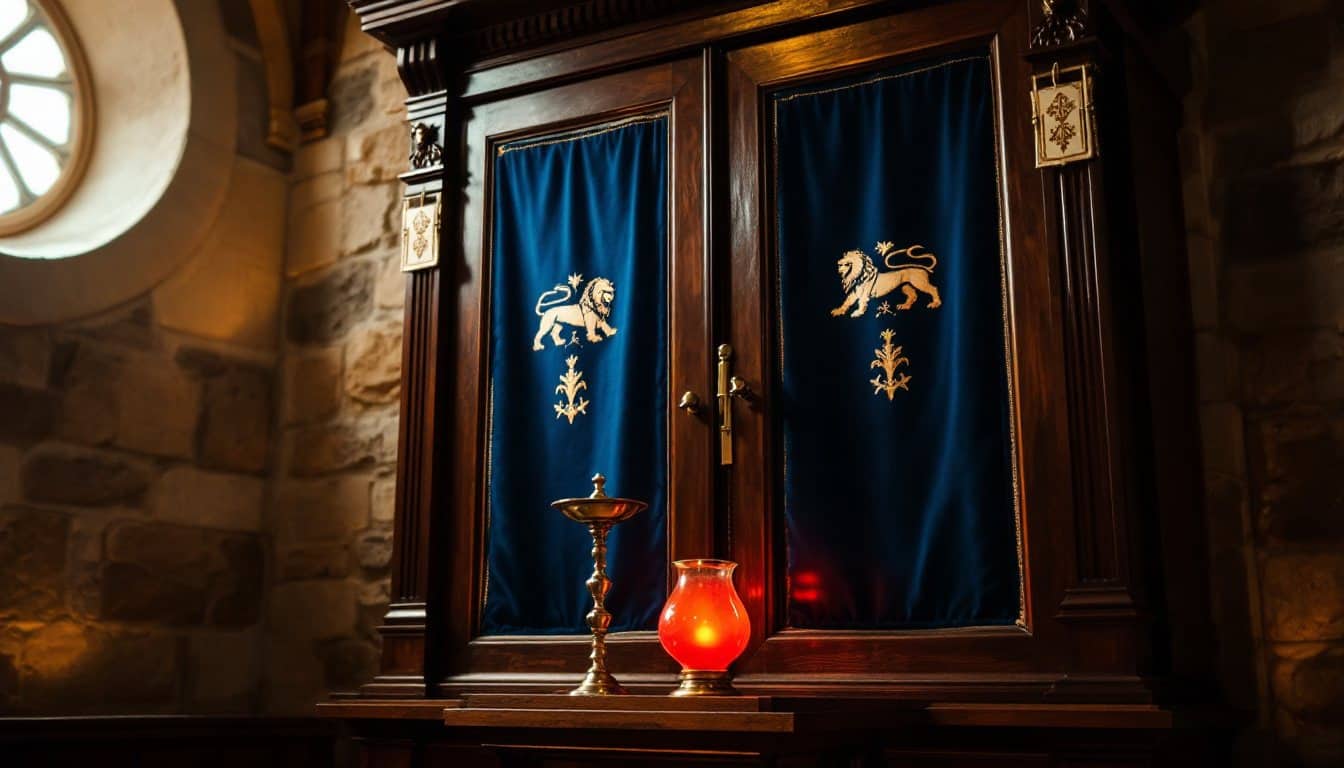
A large hall, a cabinet covered by an embroidered curtain, a raised platform in the middle, a small lamp that never goes out. Seen from the outside, the synagogue is puzzling: a temple, a Jewish church, a school? What goes on inside, and why do you need ten people to pray there? Here is a complete answer, with the sources, the history and the meaning of this place.
In short: the synagogue, in Hebrew beit haknesset (“house of assembly”), is the place where the Jewish community gathers to pray, read the Torah and study. It is not the Temple in Jerusalem, which was the only place of sacrifice and was destroyed in the year 70; it is a “small sanctuary” (Yechezkel 11:16), which the Sages identify with the synagogues and houses of study (Talmud, Megillah 29a). Its heart is the holy ark, the cabinet that holds the Torah scrolls, facing Jerusalem. People pray there three times a day, and the most important prayers require a minyan, a group of at least ten adult men (Mishna Megillah 4:3). Wherever ten Jews live, teaches the Rambam, they must set up a synagogue (Hilkhot Tefillah 11:1).
What does the word “synagogue” mean?
The English word comes from the Greek synagōgē, meaning “gathering” or “assembly”. It is the word used by the Greek translation of the Bible, the Septuagint, to render the Hebrew eda, the community of Israel. So the name does not refer first of all to a building, but to people gathered together.
Hebrew says exactly the same thing. Beit haknesset means “the house of gathering”. The root kanas, “to gather”, is also the root of the Knesset, the Israeli parliament, and of the Knesset HaGedolah, the “Great Assembly” of Sages who, according to the Talmud, set the text of the prayers at the beginning of the Second Temple period (Berakhot 33a).
Communities have given it many other names. Ashkenazi Jews (from Central and Eastern Europe) often say shul, a Yiddish word that comes from “school”, because people study there as much as they pray. Sephardi Jews readily speak of the kahal, “the assembly”, or, in Judeo-Spanish, the esnoga. One also hears beit tefillah, “house of prayer”, after the verse in Isaiah: “For My house shall be called a house of prayer for all peoples” (Yeshayahu [Isaiah] 56:7).
An important clarification: a synagogue is sometimes called a “temple”, particularly in Reform Judaism and in nineteenth-century French usage. But in the tradition, the Temple, with a capital T, is unique: it is the Beit HaMikdash in Jerusalem. The synagogue is not its replacement; it is its reflection.
A “small sanctuary”: what the Torah and the prophets say
The Torah does not speak of a synagogue. It speaks of the Mishkan, the portable sanctuary in the desert, and then of the place “which the L-rd will choose” (Devarim [Deuteronomy] 12:5), which would become the Temple in Jerusalem. It was there, and there alone, that sacrifices were offered.
And yet prayer exists in the Torah long before any building. Avraham prays for Sodom, Yitzchak goes out “to meditate in the field” (Bereshit [Genesis] 24:63), Moshe pleads for his people. And when King Shlomo (Solomon) dedicates the First Temple, he asks G-d to hear also the prayer of those who, far from Jerusalem, even in exile, “pray to You toward their land […], the city which You have chosen and the house which I have built for Your Name” (Melakhim I [1 Kings] 8:48). This verse is the source of a rule found in every synagogue in the world: one prays facing Jerusalem.
The founding text is a statement of the prophet Yechezkel (Ezekiel), addressed to the exiles in Babylon after the destruction of the First Temple: “Although I have removed them far off among the nations […], yet I have been to them a small sanctuary (mikdash me’at) in the countries where they have come” (Yechezkel 11:16). The Talmud explains: “These are the synagogues and houses of study in Babylon” (Megillah 29a). In other words, when the great sanctuary is no longer within reach, G-d accompanies His people in sanctuaries of human scale.
The same passage adds that wherever Israel was exiled, the Shechinah, the Divine Presence, went with them. Rava also reads into it the psalm “L-rd, You have been our dwelling place in every generation” (Tehilim [Psalms] 90:1): these, he says, are the synagogues and the houses of study.
What the Talmud says: G-d in the assembly
For the Talmud, the synagogue is not simply a meeting place. It is a place of presence. “How do we know that the Holy One, blessed be He, is found in the synagogue? For it is said: ‘G-d stands in the divine assembly’ (Tehilim 82:1)” (Berakhot 6a). The same passage teaches that when ten people pray together, the Shechinah is with them.
Abba Binyamin goes further: a person’s prayer is fully heard only in the synagogue (Berakhot 6a). He bases this on Shlomo’s prayer in the Temple, where G-d is asked to listen “to the song and to the prayer” in the place where His praises are sung (Melakhim I 8:28).
The Talmud also stresses communal prayer. The psalmist says: “As for me, may my prayer come to You, L-rd, at a favorable time” (Tehilim 69:14). What is that favorable time? “The time when the community prays” (Berakhot 8a). And Reish Lakish has a stern formula: whoever has a synagogue in his town and does not go in to pray is called a “bad neighbor” (Berakhot 8a, based on Yirmeyahu [Jeremiah] 12:14).
Finally, a famous midrash shows what the synagogue represents for the Jewish people. The pagan prophet Bilaam had been sent to curse Israel. On seeing the camp, he cried out in spite of himself: “How goodly are your tents, O Yaakov, your dwellings, O Israel!” (Bamidbar [Numbers] 24:5). The Talmud explains that Bilaam had wanted to wish that Israel would have neither synagogues nor houses of study, and that G-d turned his curse into a blessing: these “tents” are the synagogues (Sanhedrin 105b). It is this verse, Ma Tovu, that many people recite when entering the synagogue in the morning.
Where do synagogues come from? A little history
Ancient roots
No one knows the exact date of the first synagogue. Jewish tradition places its roots very early. The Talmud relates that the prophets had already established that Israel would never go three days without a public reading of the Torah, and that Ezra the Scribe instituted the reading on Monday, Thursday and Shabbat afternoon (Bava Kamma 82a). The book of Nechemia describes Ezra reading the Torah before all the assembled people, standing on a wooden platform (Nechemia [Nehemiah] 8:1-8): this is already, in embryo, the synagogue service.
Most historians believe that the synagogue developed during or after the Babylonian exile (6th century BCE), as the verse in Yechezkel suggests. The oldest archaeological traces come from Egypt: Greek inscriptions from the 3rd century BCE dedicate “houses of prayer” (proseuchē) in honor of King Ptolemy III.
In the Second Temple period
In the 1st century, synagogues existed wherever Jews lived, in the Land of Israel as in the Diaspora, alongside the Temple that was still standing. The Jerusalem Talmud reports that there were 480 of them in Jerusalem before the destruction (Megillah 3:1). Archaeology has uncovered synagogues at Gamla, Masada, Herodium and Magdala, where a stone carved with a menorah was discovered in 2009.
In Jerusalem, a Greek inscription found in 1913 in the City of David, the Theodotos inscription, dated to before the year 70, describes a synagogue built “for the reading of the Law and the teaching of the commandments”, with rooms to host travelers. Everything is there: reading, study, hospitality.
After the destruction of the Temple
In the year 70, the Romans destroyed the Second Temple. The synagogue then became the center of Jewish life. The daily prayers, fixed by the Sages, took the place of the daily sacrifices: the Talmud teaches that the morning and afternoon services correspond to the perpetual offerings of the Temple (Berakhot 26b), in line with the verse “we will offer, instead of bulls, the words of our lips” (Hoshea [Hosea] 14:3).
The following centuries left remarkable synagogues: Dura-Europos in Syria (3rd century), its walls covered with biblical paintings; Beit Alpha in Galilee (6th century), with its mosaic; the Old-New Synagogue in Prague (around 1270), still in use today. In France, the synagogue of Carpentras, founded in the 14th century, is the oldest still in use.
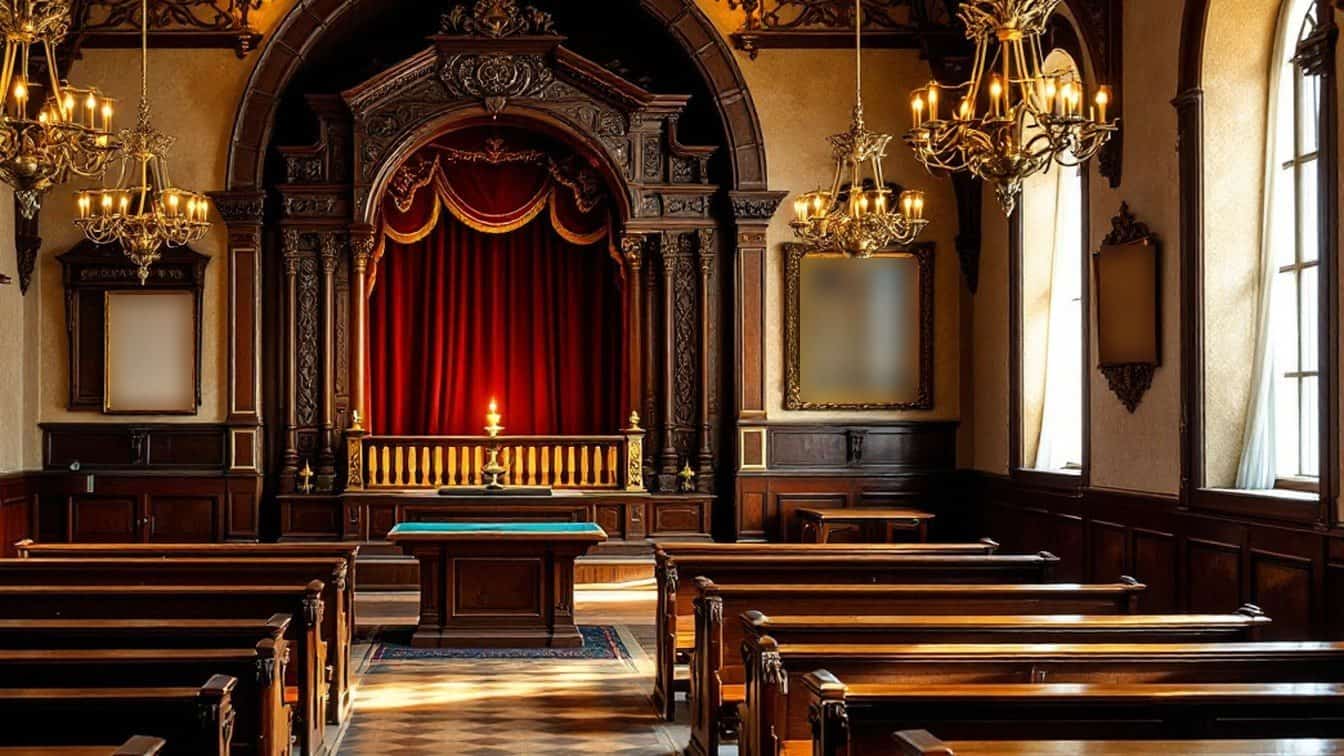
What does a synagogue look like? The holy ark and the other elements
There is no single floor plan: a synagogue can be a stone cathedral or a simple room. But the same elements are almost always found, recalling the sanctuary in the desert and the Temple.
The holy ark (aron hakodesh)
This is the heart of the synagogue. The aron hakodesh, the “holy ark”, is a cabinet set against the wall that faces Jerusalem. It holds the Sifrei Torah, the Torah scrolls handwritten on parchment by a scribe, wrapped in a fabric mantle (among Ashkenazim) or kept in a rigid case of wood or metal (among many Sephardim). Sephardim call the ark the heikhal, the “palace”, after the main hall of the Temple; the Rambam already uses this term (Hilkhot Tefillah 11:2).
The ark recalls the Ark of the Covenant which, in the Holy of Holies, held the Tablets of the Law. It is often closed by an embroidered curtain, the parochet, named after the veil that screened off the Holy of Holies in the Sanctuary (Shemot [Exodus] 26:31-33). It is opened to take out the Torah, and for certain solemn prayers. When the ark is open, the congregation stands.
The eternal light (ner tamid)
Above or in front of the ark burns a small lamp that is never allowed to go out, the ner tamid. It recalls the light that the Torah commanded to be kept burning continually in the Sanctuary (Shemot 27:20-21). It is a custom, not a law, but it is universal.
The bimah, the reading platform
In the middle of the hall stands a platform, the bimah (which Sephardim call the tevah). The Torah is read from there. The Rambam gives the reason: the platform is placed in the middle of the hall so that whoever reads the Torah or teaches can be heard by all (Hilkhot Tefillah 11:3). Among Ashkenazim, the prayer leader usually prays at a lectern near the ark, the amud; among Sephardim, he often leads the service from the tevah itself, in the midst of the congregation.
Orientation and windows
One prays facing Jerusalem, and in Jerusalem facing the Temple Mount (Berakhot 30a; Shulchan Aruch, Orach Chaim 94:1). In France, therefore, people pray toward the east, or more precisely the southeast. The Shulchan Aruch also asks that the prayer hall have windows open toward Jerusalem, like the prophet Daniel, who prayed three times a day before his windows open toward Jerusalem (Daniel 6:11), and it adds that it is good for a synagogue to have twelve windows (Orach Chaim 90:4).
The place of women
In Orthodox synagogues, men and women pray separately. The partition, the mechitzah, may be an upstairs gallery, a partition wall or a curtain. The Sages link it to the practice of the Temple, where during the festival of Sukkot a gallery was built for the women to prevent mingling (Talmud, Sukkah 51b). The aim is not to exclude, but to allow everyone to concentrate on prayer. Synagogues of the Reform and Masorti (Conservative) movements generally have mixed seating.
What happens in a synagogue?
Prayer, three times a day
The synagogue lives first of all to the rhythm of the three daily prayers: Shacharit in the morning, Mincha in the afternoon, Arvit in the evening. Their center is the Amidah, a prayer of blessings recited standing, in silence, facing Jerusalem, which the prayer leader then repeats aloud. The Shema Yisrael is also recited there morning and evening. The Rambam lays down the rule: wherever ten Jews live, a place must be established where they gather to pray at every service (Hilkhot Tefillah 11:1).
The prayer leader is called the shaliach tzibbur, “the messenger of the community”, or chazzan when he is a cantor. He is not a priest: any man who knows the prayers can lead the service. The rabbi, for his part, is a teacher and a halakhic authority, not an intermediary between the faithful and G-d.
The Torah reading
On Monday and Thursday mornings, on Shabbat, on festivals and on the first day of the month (Rosh Chodesh), a scroll is taken out of the ark and carried in procession to the bimah. On Shabbat morning, the weekly parasha is read: the Torah is divided into sections read in order, so that it is completed in one year. Several members of the congregation are called to “go up” to the Torah to recite a blessing before and after each passage. The reader follows the text with a small silver hand, the yad, so as not to touch the parchment.
Study
The synagogue is also a house of study. Classes are given between services, people study in pairs (in chavruta), and there are libraries of Talmud and commentaries.
Community life
Finally, the synagogue accompanies the whole of Jewish life: the bar mitzvah, when a thirteen-year-old boy goes up to the Torah for the first time; the Kaddish recited by mourners; the kiddush shared after the Shabbat service; tzedakah (charity).
The minyan: why do you need ten?
What requires a minyan
A Jew can pray alone, at home or anywhere else. But certain parts of the service can only be said in the presence of a minyan, a word meaning “count” or “number”: a quorum of ten Jewish men aged at least thirteen. The Mishna lists what is not done with fewer than ten: the solemn call that opens the prayer (Barchu), the prayer leader’s repetition of the Amidah, the Priestly Blessing, the public reading of the Torah and the reading of the Prophets (Mishna Megillah 4:3). The Kaddish and the Kedusha, texts of sanctification, are also among them.
Where does the number ten come from?
The Talmud derives it through a subtle line of reasoning (Megillah 23b). The Torah says: “I shall be sanctified in the midst of the children of Israel” (Vayikra [Leviticus] 22:32). The word “midst” (betoch) appears again in the story of Korach: “Separate yourselves from the midst of this assembly” (Bamidbar 16:21). And the word “assembly” (eda) refers elsewhere to the ten spies who had spoken ill of the Land of Israel: “How long shall I bear with this evil assembly?” (Bamidbar 14:27). An “assembly”, therefore, is ten people, and the public sanctification of G-d’s Name requires an assembly.
The number ten already appears in Avraham’s bargaining over Sodom: G-d agrees to spare the city if ten righteous people are found there (Bereshit 18:32). Fewer than ten is no longer a community.
Why pray together?
The Rambam sums up the teaching of the Talmud: “The prayer of the community is always heard. Even if there are sinners among them, the Holy One, blessed be He, does not reject the prayer of the many. Therefore a person should join the community and not pray alone whenever he is able to pray with the community” (Hilkhot Tefillah 8:1). To pray in a minyan is to stand before G-d not as an isolated individual but as a member of a people; that is why most of the prayers are in the plural: “bless us”, “forgive us”.
Who counts in the minyan?
According to traditional Jewish law, followed by Orthodox synagogues, the minyan is made up of ten Jewish men who have reached the age of bar mitzvah. The Masorti (Conservative) movement has also counted women since the 1970s, and Reform Judaism generally does not require a minyan. For particular cases, consult a rabbi.
What Rav Raphaël Benizri teaches
Rav Benizri did not devote an entire lecture to the synagogue, but several of his teachings shed light on its meaning: the minyan, the community, prayer and the home as a sanctuary.
The minyan: nine plus one
In his lecture Pirkey Avot 5: ten generations from Adam, the Rav explains that the number ten is the expression of perfect creation: ten utterances to create the world, ten utterances at Sinai, ten trials of Avraham. He recalls the teaching of the Sages that the Divine Presence rests among ten who study. But, he adds, the minyan is always “nine plus one”: the tenth is the added strength, the bonus. He compares it to the counting of the Omer, in which forty-nine days are counted and the fiftieth “arises on its own”.
In the same lecture, he answers a question: what is the difference between the Divine Presence that rests on ten and the one that rests on three? In a group of ten, he explains, the members can remain separate; even if there are unbelievers among them, the Presence is there, because each one is integrated into the whole. In a smaller group, on the contrary, there must be a real dialogue, a participation by each person.
A tzibbur, not a crowd
In Shavuot: the fiftieth day, outside the count, the Rav comments on the expression that describes Israel at the foot of Sinai, “like one man, with one heart”. This does not mean merged into one, he explains: it means that each person stepped back a little to give the other his reality, so that it would truly be a tzibbur, a gathered whole. That is exactly the word used for the community at prayer.
In Elul: the role of man, he reads in the parasha of Nitzavim, “you are all standing today”, the abolition of all spiritual hierarchy: from the leader down to the woodcutter and the water drawer, all are on the same level. “That is why,” he says, “the tallit becomes the shawl of uniformity of our prayers and of our persons in the synagogue.”
And in Sukkot: from Yom Kippur to the sukkah of peace, he stresses that Yom Kippur brings about the unity of all the streams of the people, “in the same synagogue, with the same prayer book”, in a shared service. When Yom Kippur ends, he adds, we must prove that we remain faithful to this solidarity.
Song and silence
In Elul: what makes each person unique, a participant asks the Rav how not to get lost in the routine of the service. The Rav does not disparage the folklore: we need cantors, songs and melodies to beautify prayer. But one must be aware of the place it occupies. The best moment of prayer, he says, is the one in which everyone falls silent and one truly stands face to face with oneself: G-d is not in the storm or in the thunder, but in the “still, small voice” (Melakhim I 19:12). Everything else is only preparation.
Small sanctuaries that make up the great one
Finally, in Vayakhel: the Tabernacle beyond space, the Rav explains that the sanctuary is the meeting place between G-d and man, just as Shabbat is its meeting time. Whoever builds a home and marks its door with a mezuzah wants to make it a small sanctuary, and “these small sanctuaries, added together, make up the great sanctuary”, in which there is room for all humanity. The Rav is speaking here of the home, but the image also sheds light on the synagogue, that mikdash me’at.
Misconceptions about the synagogue
“The synagogue is the Jews’ church.” Not quite. There is neither sacrament nor sacrifice in the synagogue, and the rabbi is not a priest. The synagogue is first of all a house of assembly, prayer and study. The priests of Judaism, the Kohanim, served in the Temple; today they bless the congregation at certain services, but they do not run the synagogue.
“The synagogue is a holy place like the Temple.” It has a real holiness, which calls for rules of respect, but it is not the Temple. No sacrifices are offered there, and the Temple in Jerusalem remains, in Jewish consciousness, the one awaited place.
How should you behave in a synagogue?
Since the synagogue is a “small sanctuary”, Jewish law requires that it be treated with respect. The Shulchan Aruch forbids frivolous behavior there, joking or idle conversation, eating or drinking except at a mitzvah meal, or entering it merely for shelter from the sun or the rain (Orach Chaim 151:1; Talmud, Megillah 28a). Talking during the prayers and the Torah reading is particularly frowned upon.
For a visitor, a few simple guidelines:
- Men cover their heads with a kippah; there are often some available at the entrance.
- Dress modestly: arms and legs covered for women in Orthodox synagogues, and no beachwear for anyone.
- On Shabbat and festivals, do not use the phone, take photographs or carry money.
- When the ark is open or the Torah is carried in procession, stand up.
- Do not walk in front of someone who is reciting the Amidah, the silent standing prayer.
Frequently asked questions about the synagogue
What is the difference between a synagogue and the Temple?
The Temple (Beit HaMikdash) was a single sanctuary, in Jerusalem, where the Kohanim offered the sacrifices. It was destroyed in 586 BCE (by Babylon) and again in the year 70. The synagogue, a “small sanctuary” (Megillah 29a), can exist anywhere; it does not replace the Temple, whose rebuilding is asked for every day in prayer.
What is inside the holy ark?
The Torah scrolls (Sifrei Torah), which contain the Five Books of Moshe handwritten by a scribe. They are dressed in an embroidered mantle or kept in a case, often adorned with a crown or silver bells.
Why do you need ten men to pray?
Because the public sanctification of G-d’s Name (Kaddish, Kedusha, Barchu, the Torah reading) requires an “assembly”, and the Talmud derives from the verses that an assembly begins at ten (Megillah 23b). The Talmud also teaches that the Divine Presence is with ten people who pray (Berakhot 6a). Alone, one prays normally, but without these passages.
Do women go to synagogue?
Yes. They are not obligated to pray in a minyan as men are, but many come, especially on Shabbat and festivals. In Orthodox synagogues they pray in a separate section; elsewhere, seating is often mixed.
Can a non-Jew enter a synagogue?
Yes, as a general rule, and he or she will be welcomed provided the place is respected: head covered for men, modest dress for everyone. Many synagogues organize visits, notably during the European Days of Jewish Culture. For security reasons, an identity document is often requested.
Further reading
- The weekly parasha: what is it?
- Pirkey Avot 5: ten generations from Adam
- Vayakhel: the Tabernacle beyond space
- Elul: what makes each person unique
- What Is the Kaddish?
- What Does Shema Yisrael Mean?
- What Is the Torah?
- What Is a Rabbi?
- Glossary of Hebrew terms in Judaism
Sources and references
- Bereshit (Genesis) 18:32; Bereshit 24:63
- Shemot (Exodus) 26:31-33; Shemot 27:20-21
- Vayikra (Leviticus) 22:32
- Bamidbar (Numbers) 14:27; Bamidbar 16:21; Bamidbar 24:5
- Devarim (Deuteronomy) 12:5
- Melakhim I (1 Kings) 8:28; Melakhim I 8:48; Melakhim I 19:12
- Yeshayahu (Isaiah) 56:7
- Yirmeyahu (Jeremiah) 12:14
- Yechezkel (Ezekiel) 11:16
- Hoshea (Hosea) 14:3
- Tehilim (Psalms) 69:14; Tehilim 82:1; Tehilim 90:1
- Daniel 6:11
- Nechemia (Nehemiah) 8:1-8
- Mishna Megillah 4:3
- Babylonian Talmud, Berakhot 6a; Berakhot 8a; Berakhot 26b; Berakhot 30a; Berakhot 33a
- Babylonian Talmud, Megillah 23b; Megillah 28a; Megillah 29a
- Babylonian Talmud, Sukkah 51b
- Babylonian Talmud, Bava Kamma 82a
- Babylonian Talmud, Sanhedrin 105b
- Jerusalem Talmud, Megillah 3:1
- Rambam, Mishneh Torah, Hilkhot Tefillah 8:1; 11:1-3
- Shulchan Aruch, Orach Chaim 90:4; 94:1; 151:1
- Theodotos inscription (Jerusalem, 1st century, discovered in 1913)
- Rav Raphaël Benizri, Pirkey Avot 5: ten generations from Adam
- Rav Raphaël Benizri, Shavuot: the fiftieth day, outside the count
- Rav Raphaël Benizri, Elul: the role of man
- Rav Raphaël Benizri, Elul: what makes each person unique
- Rav Raphaël Benizri, Sukkot: from Yom Kippur to the sukkah of peace
- Rav Raphaël Benizri, Vayakhel: the Tabernacle beyond space
Article by the Pensées Juives editorial team. Passages attributed to Rav Raphaël Benizri are taken from his lectures published on this site.