
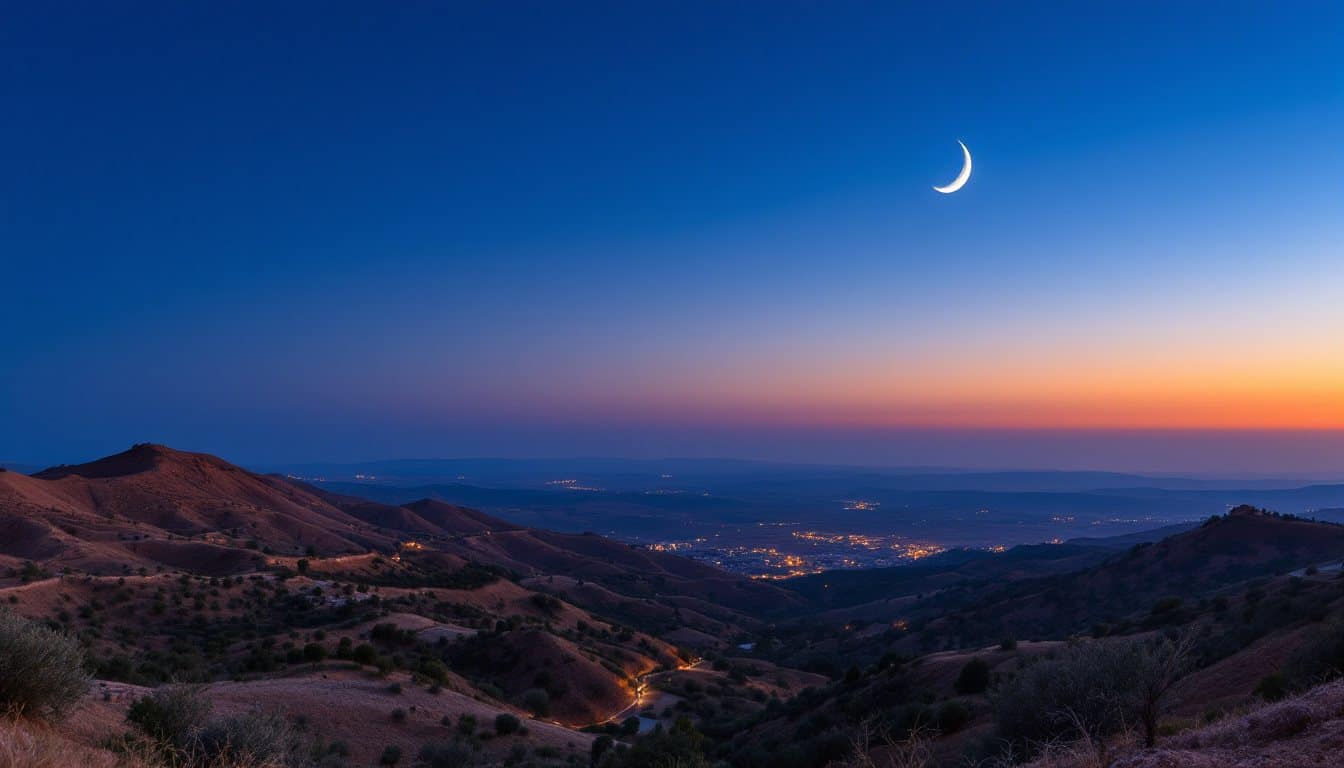
In 2026, Pesach fell on April 2; in 2027 it will fall on April 22, and in 2028 on April 11. Seen from the outside, the Jewish holidays seem to move around at random. In reality, they follow a very precise calendar, several thousand years old, that keeps the moon and the sun in step with each other. Here is how it works, where it comes from, what the Torah and the Talmud say about it, and what it teaches.
In short: the Jewish calendar is lunisolar. The months follow the moon: each month begins at the new moon and lasts 29 or 30 days. But the holidays must stay in their season, because the Torah requires Pesach (Passover) to be celebrated in the spring (Devarim [Deuteronomy] 16:1). Yet twelve lunar months add up to only about 354 days, eleven days fewer than a solar year. To make up the difference, a thirteenth month, Adar II, is added seven times every nineteen years. That is why the Jewish holidays never change date in the Hebrew calendar, but “move” by a few weeks in the civil calendar. Years are counted from the creation of the world according to tradition: the year 5787 began in September 2026.
A fixed date… in a different calendar
The first thing to understand is simple: the Jewish holidays do not change date. Pesach always falls on the 15th of the month of Nissan, Shavuot on 6 Sivan, Rosh Hashana on 1 Tishrei, Yom Kippur on 10 Tishrei, Sukkot on 15 Tishrei, Chanukah on 25 Kislev, Purim on 14 Adar. These dates were set by the Torah or by the Sages, and they never move.
What changes is how they line up with the Gregorian calendar, the civil calendar, which is purely solar and whose months no longer have any connection with the moon. The Jewish calendar, by contrast, is regulated by both the moon and the sun. The gap between the two calendars varies from year to year within a range of about a month: Pesach always falls in the spring, between late March and late April, but rarely on the same civil date two years in a row.
The Jewish calendar governs everything in Jewish life: it sets the holidays and fast days, the weekly Torah reading, the date of a bar mitzvah, and the anniversary of a relative’s death (the yahrzeit among Ashkenazim, the azkara or nahala among Sephardim), which is commemorated every year on the same Hebrew date. Many Jewish families thus live with two calendars in mind.
What the Torah says: “This month shall be for you…”
The account of Creation already lays the foundations. G-d creates the luminaries, the sun and the moon, and gives them a function: “let them be for signs, and for seasons (moadim), and for days and years” (Bereshit [Genesis] 1:14). The psalm echoes it: “He made the moon to mark the seasons; the sun knows its setting” (Tehillim [Psalms] 104:19). From the very start, the moon is tied to the moadim, the appointed times, that is, the festivals.
The commandment itself is given in Egypt, just before the Exodus. Even before the instruction to offer the Passover lamb, G-d says to Moshe and Aharon: “This month shall be for you the beginning of months; it shall be for you the first of the months of the year” (Shemot [Exodus] 12:2). The Hebrew word for “month”, chodesh, comes from the root chadash, “new”: a month is literally a “renewal”, that of the moon reappearing.
Rashi, in his very first comment (on Bereshit 1:1), quotes the question of Rabbi Yitzchak: why does the Torah not begin with this verse, the first commandment given to Israel as a people? The Sefer Ha-Chinukh counts it as the fourth of the 613 mitzvot: the mitzvah of kiddush ha-chodesh, the sanctification of the month (mitzvah no. 4).
A second verse imposes the link with the sun: “Observe the month of spring (chodesh ha-aviv), and keep the Passover to the L-rd your G-d, for in the month of spring the L-rd your G-d brought you out of Egypt” (Devarim 16:1). Pesach must fall in the spring, Shavuot at the time of the wheat harvest, Sukkot at “the end of the year”, when the crops are gathered in (Shemot 23:16). The festivals are therefore tied to the seasons, which depend on the sun. All the complexity of the Jewish calendar arises from the meeting of these two requirements: lunar months and seasonal festivals.
The lunar month and Rosh Chodesh
A Jewish month follows the cycle of the moon. Between one new moon and the next, there elapse on average 29 days, 12 hours and 793 “parts” of an hour, an hour being divided into 1,080 parts (Rambam, Hilkhot Kiddush Ha-Chodesh 6:3). This value, handed down by tradition and already mentioned in the Talmud in the name of Rabban Gamliel (Rosh Hashana 25a), is remarkably close to the measurement of modern astronomers: the difference is less than half a second.
Since a month cannot contain half a day, Jewish months have either 29 days (“deficient” months) or 30 days (“full” months). The first day of each month is called Rosh Chodesh, the “head of the month”. When the preceding month has 30 days, Rosh Chodesh is celebrated for two days: the 30th of the outgoing month and the 1st of the new month.
Rosh Chodesh is a minor festive day: the passage Yaaleh Veyavo is added to the prayers, along with Hallel (in its shortened form) and an additional service, Musaf. On the preceding Shabbat, the new month is announced in the synagogue and a prayer is said that it be a month of life and blessing. According to a tradition recorded in Pirkei deRabbi Eliezer (chapter 45) and by the Tur (Orach Chaim 417), Rosh Chodesh is a day especially connected with women: they had refused to hand over their jewelry to make the golden calf, and they received this festive day as a reward. Many women have the custom of refraining from certain kinds of work on that day.
Each month, once the moon is clearly visible, a blessing called kiddush levana, the sanctification of the moon, is also recited outdoors (Shulchan Aruch, Orach Chaim 426). The Talmud teaches that whoever blesses the moon in its proper time is like one who welcomes the Divine Presence, the Shechinah (Sanhedrin 42a).
The twelve months and their names
Here are the months of the Jewish year, in the order in which they are counted from the spring:
- Nissan (March-April): Pesach, the Exodus from Egypt;
- Iyar (April-May): the counting of the Omer, Lag BaOmer;
- Sivan (May-June): Shavuot, the giving of the Torah;
- Tammuz (June-July): the fast of 17 Tammuz;
- Av (July-August): Tisha BeAv, mourning for the Temple;
- Elul (August-September): the month of teshuva, of return;
- Tishrei (September-October): Rosh Hashana, Yom Kippur, Sukkot, Simchat Torah;
- Cheshvan (October-November): the only month without a festival;
- Kislev (November-December): Chanukah;
- Tevet (December-January): the end of Chanukah, the fast of 10 Tevet;
- Shevat (January-February): Tu BiShvat, the New Year for trees;
- Adar (February-March): Purim.
In the Torah, the months have no names: they are called “the first month”, “the seventh month”, always counting from the Exodus. Thus Yom Kippur falls “in the seventh month, on the tenth of the month” (Vayikra [Leviticus] 16:29). This way of counting is already an act of memory: every time a month is named, the liberation is recalled. The book of Kings mentions a few ancient names, such as Ziv (Melakhim I [1 Kings] 6:1) or Etanim (Melakhim I 8:2).
The names we use today come from Babylon. The Jerusalem Talmud says so explicitly: “the names of the months came up with them from Babylon” (Rosh Hashana 1:2), that is, with the exiles who returned to the Land of Israel in the time of Ezra. They are found in the biblical books of that period: Nissan (Esther 3:7; Nechemia [Nehemiah] 2:1), Kislev (Nechemia 1:1), Adar (Esther 3:7), Elul (Nechemia 6:15). The Ramban explains that the Jews kept these names from the exile as a reminder of their return, without giving up the counting from Nissan (Ramban on Shemot 12:2).
The problem: an eleven-day gap every year
Twelve lunar months make about 354 days. A solar year, the one that brings back the seasons, has about 365 and a quarter. Every year, then, the moon gets eleven days ahead of the sun. If nothing were corrected, Pesach would move back eleven days a year: in three years it would slip by a month; in sixteen or seventeen years it would land in the middle of winter, then in autumn. The Torah would no longer be observed, since it requires Pesach to be celebrated in “the month of spring”.
The Muslim calendar, which is purely lunar, shows what happens without a correction: Ramadan travels all the way around the seasons in a little over thirty-two years.
The solution is called the leap year (in Hebrew, shana me’uberet, “the pregnant year”). In certain years a thirteenth month is added: the month of Adar is doubled. There is then an Adar I (Adar Rishon) and an Adar II (Adar Sheni). Purim is celebrated in Adar II, so that it stays close to Pesach (Megilla 6b). An ordinary year has 353, 354 or 355 days; a leap year, 383, 384 or 385 days.
In the days when the Sanhedrin, the great court, was in session, it decided each year whether this month needed to be added. The Talmud teaches that the year was made a leap year for three reasons: if the ears of grain were not yet ripe, if the fruit of the trees was late, or if the spring equinox (the tekufa) was liable to fall after Pesach (Sanhedrin 11b). The same passage quotes a letter from Rabban Gamliel to the communities of the exile: “the young pigeons are still tender, the lambs are too young, and the time of spring (aviv) has not yet come; it seemed good to me and to my colleagues to add thirty days to this year.” The calendar was no abstraction: it looked at the fields.
The nineteen-year cycle
Today, the addition of the thirteenth month follows a fixed rule. It rests on an ancient discovery: 19 solar years correspond almost exactly to 235 lunar months. Over a nineteen-year cycle, it is therefore enough to include seven years of thirteen months for the moon and the sun to come back into line. In each cycle, these are years 3, 6, 8, 11, 14, 17 and 19 (Rambam, Hilkhot Kiddush Ha-Chodesh 6:11).
The year 5787, which began in September 2026, is the eleventh of its cycle: it is a thirteen-month year. That is why Pesach 2027 will fall late, on Thursday, April 22, whereas Pesach 2026 fell on April 2. The following year, 5788, will be an ordinary year, and Pesach will “move back” to April 11, 2028.
This system is not accurate to the second: the average Jewish year is slightly longer than the true solar year, and the discrepancy reaches about one day every two hundred and twenty years. The festivals are therefore drifting very slowly toward summer, on a time scale of several thousand years.
The rules of Rosh Hashana: why Yom Kippur never falls on a Friday
The calendar also includes a series of finer rules, called dechiyot (“postponements”). The best known is summed up in a mnemonic: “lo ADU Rosh”: Rosh Hashana never falls on a Sunday (Aleph, the first day), a Wednesday (Dalet, the fourth day) or a Friday (Vav, the sixth day) (Rambam, Hilkhot Kiddush Ha-Chodesh 7:1). If the calculation lands on one of these days, it is postponed by one day.
The reasons are both practical and profound. If Rosh Hashana fell on a Wednesday, Yom Kippur would fall on a Friday; if it fell on a Friday, Yom Kippur would fall on a Sunday. Either way, Yom Kippur and Shabbat would be back to back: two consecutive days on which one can neither cook nor bury the dead. If Rosh Hashana fell on a Sunday, Hoshana Rabba, the seventh day of Sukkot, would fall on Shabbat, and the willow ritual (aravot), which is at its heart, could not be performed. To respect these rules, the months of Cheshvan and Kislev, the two “elastic” months of the calendar, are lengthened or shortened by one day. That is why the year varies between 353 and 385 days, and why certain festivals never fall on certain days: the first day of Pesach, for example, never falls on a Monday, a Wednesday or a Friday.
From the witnesses of the moon to Hillel’s calculation
For centuries, the new month was not calculated in advance: it was proclaimed. At the end of each month, witnesses who had sighted the thin crescent of the new moon went up to Jerusalem and appeared before the court. They were carefully questioned about the position and shape of the crescent. The Mishna relates that Rabban Gamliel kept charts in his upper room showing the shapes of the moon, in order to check their testimony (Mishna Rosh Hashana 2:8). If the testimony was accepted, the head of the court proclaimed: “Mekudash!”, “It is sanctified!”, and all the people answered: “Mekudash, mekudash!” (Mishna Rosh Hashana 2:7).
Then the distant communities had to be informed. At first, bonfires were lit on the hilltops, from mountain to mountain, all the way to Babylon; when the Samaritans lit false fires to sow confusion, they were replaced by messengers (Mishna Rosh Hashana 2:2-4). Communities that the messengers could not reach in time celebrated the festivals for two days, out of doubt. This is the origin of the second day of festivals in the Diaspora (yom tov sheni shel galuyot). Once the fixed calendar was established, the doubt disappeared, but the Sages asked that the custom be kept: “Be careful with the custom of your fathers” (Beitza 4b). To this day, Pesach lasts eight days outside Israel and seven in Israel.
In the 4th century, under a Roman Empire that had become Christian, proclaiming the month through witnesses was becoming more and more difficult. According to a tradition reported in the name of Rav Hai Gaon, the patriarch Hillel II then published the rules for calculating the calendar, in the year 4119 from Creation, that is, around 358-359 CE. The Rambam explains that when there is no longer a Sanhedrin, the months are set by calculation and no longer by observing the moon, and that this is a rule handed down from Moshe at Sinai (Hilkhot Kiddush Ha-Chodesh 5:1-3). He specifies that this calculation draws its validity from the fixing of the calendar by the inhabitants of the Land of Israel (ibid. 5:13). Historians believe that certain details were refined further in the following centuries; but it is this calculated calendar, no longer an observed one, that all the Jews of the world follow today.
A famous episode: Yom Kippur on a different day
The Mishna records an episode that shows the force of this principle (Rosh Hashana 2:8-9). One month, Rabban Gamliel, the head of the court, accepted witnesses whom Rabbi Yehoshua considered unreliable. According to Rabbi Yehoshua’s calculation, Yom Kippur therefore fell on a different day. Rabban Gamliel ordered him to come to him, with his staff and his purse, on the day that was Yom Kippur by his own reckoning. Rabbi Yehoshua was distraught. Rabbi Akiva came to comfort him: the Torah says “the festivals of the L-rd, which you shall proclaim (otam)” (Vayikra 23:4). One may read otam (“them”) as atem (“you”): the day set by the court becomes the festival, even if the court was mistaken (Rosh Hashana 25a). Rabbi Yehoshua came. Rabban Gamliel rose, kissed him on the head and said to him: “Come in peace, my master and my disciple.”
The lesson is immense. Sacred time is not only written in the sky: it is entrusted to human beings. G-d waits for the court of Israel to proclaim the festivals, and He “follows” its decision.

The day, the week and the year
The day begins in the evening. In the account of Creation, the Torah says: “And there was evening and there was morning, one day” (Bereshit 1:5). That is why Shabbat begins on Friday at sunset, and every festival on the evening before. A Hebrew date changes at nightfall, not at midnight.
The week depends on no heavenly body. The days do not bear the names of planets or gods: they are called “first day”, “second day”… up to Shabbat, the seventh. The seven-day week comes straight from the account of Creation and has no astronomical basis. It is the imprint of Shabbat on time.
The year has several “heads”. The Mishna (Rosh Hashana 1:1) teaches that there are four “new years”: 1 Nissan for counting the reigns of kings and for the festivals, 1 Elul for the tithe of animals, 1 Tishrei for years, sabbatical years and the jubilee, and 15 Shevat (Tu BiShvat), according to the school of Hillel, for trees. So the months are counted from Nissan, but the number of the year changes on Rosh Hashana, in Tishrei.
Years are counted from Creation. The traditional count, based mainly on Seder Olam Rabba, a chronicle attributed to Rabbi Yose ben Halafta (2nd century), adds up the generations and reigns of the Bible from Adam onward. The year 5787 began on September 12, 2026; the year 5788 will begin on October 2, 2027. This count became widespread only in the Middle Ages; before that, documents were often dated according to the “era of contracts”, which starts in 312 BCE. In Hebrew, the year is written with letters, and the thousands are often omitted: 5787 is written tashpaz (תשפ״ז).
Why the moon? The meaning of the calendar
Why so much complexity, when a purely solar calendar would be simpler? First, because the Jewish calendar holds history and nature together. The months recall the Exodus from Egypt, since they are counted from Nissan; the seasons recall that the festivals are also agricultural: spring, the harvest, the ingathering.
The sun is always the same; the moon wanes, disappears, then is reborn. The Talmud teaches: “Israel counts by the moon, the nations by the sun” (Sukkah 29a). Like the moon, Israel has known exiles and rebirths, and every person can renew himself. The Talmud also relates that the moon was “diminished” at Creation (Chullin 60b), and the prayer of kiddush levana asks that it one day regain its light.
Above all, the mitzvah of sanctifying the month was given to slaves who were about to become free. A slave is not master of his time: his master disposes of it. By giving Israel the power to set its own months and festivals, G-d gives it back mastery of its time. It is the first act of freedom, even before the Exodus from Egypt (an idea developed by the Sforno on Shemot 12:2).
What Rav Raphaël Benizri teaches
Without devoting an entire lecture to it, Rav Benizri often comes back to the calendar to show that the way we count time says something about the human being.
The month is mine to consecrate
In Shavuot: the festival of oaths, the Rav distinguishes four movements in time: the day, the week, the month and the year. The month is governed by the lunar cycle, the year by the cycle of nature; the week, for its part, is “the only time that depends neither on the sun nor on the moon”.
And the Rav adds a striking distinction: the day imposes itself, independently of my will; but the month “is mine to consecrate”. It is a call to renewal, which I do not undergo but ask for. As for the year, it comes to an end with its difficulties and gives rise to the need to aspire to something else, to erase and start over.
The “pregnant” year
In Lech Lecha: faith in motion, the Rav starts from the word ibbur, which means both pregnancy and intercalation (the Sages called the science of the calendar sod ha-ibbur, the “secret of intercalation”). A pregnant woman is called me’uberet: she carries within her a life different from her own. In the same way, he explains, ibbur ha-shana is the year that carries within it a thirteenth month, to bring the paths of the moon and the sun back into line.
The solar year, he says, is a cycle that is always identical to itself; the lunar year, made of months, carries the chodesh, renewal: nothing repeats itself automatically, and an effort of adjustment is required each time. This is the “secret of conception”, which he extends to study: one does not study Torah by repeating a text, but by searching for what it hides in its depths.
The thirteenth month, what keeps us from drifting
In Chayei Sarah: Avraham’s family, the Rav notes that the number twelve recurs in every line of descendants in the Torah, each time with the possibility of a thirteenth, feminine element: with Yaakov, there are twelve sons and Dina. He compares this thirteenth to the thirteenth month, the one that restores the balance between the lunar year and the solar year. It is not a surplus, he explains: it is what keeps the count from drifting.
A time that man establishes
In The month of the Omer, the Rav stresses that the Hebrew calendar “is not content with nature”: the court can postpone Rosh Hashana, the very anniversary of Creation, to balance the solar year and the lunar year. The time of the festivals is a time that man establishes, the time that G-d asked us to count for ourselves, and which we begin to count on the day after Pesach with the Omer. In Pesach: time is not continuous, he adds that the sanctification of the month is a perpetual beginning, lunar but brought back into line with the solar cycle over nineteen years, so that the remembrance of the Exodus from Egypt stays in the spring, the month of budding.
Misconceptions about the Jewish calendar
“The year 5787 claims to give the scientific age of the universe.” The count of years follows the chronology of the biblical generations from Adam. The relationship between this count and scientific data has been the subject of much reflection among Jewish thinkers; to go deeper, consult a rabbi or specialized works.
“The Jewish calendar is an ancient calendar, abandoned in favor of the civil calendar.” To this day it governs the festivals, prayers, Torah readings and anniversaries of death in every community. In Israel, it is even an official calendar, alongside the Gregorian calendar.
Frequently asked questions about the Jewish calendar
What year is it in the Jewish calendar?
Since Rosh Hashana, on September 12, 2026, we are in the year 5787. The year 5788 will begin on Saturday, October 2, 2027 (Rosh Hashana begins the evening before). To convert a civil year, add 3760 before Rosh Hashana and 3761 after it.
What is a Jewish leap year?
It is a year of thirteen months, in which a second month of Adar is added. It comes around seven times every nineteen years, so that the lunar year catches up with the solar year and Pesach stays in the spring (Devarim 16:1).
Why do Jewish holidays begin the evening before?
Because in the Torah, the day begins in the evening: “And there was evening and there was morning” (Bereshit 1:5). A festival dated the 15th therefore begins at sunset on the 14th.
Why do some holidays last one day longer outside Israel?
In the days when the month was proclaimed by witnesses in Jerusalem, distant communities did not find out in time on which day the month had begun, and they celebrated two days out of doubt. The Sages asked that this custom be kept even after the calendar was fixed (Beitza 4b).
Why does Yom Kippur never fall on a Friday or a Sunday?
Because the calendar prevents Rosh Hashana from falling on a Sunday, a Wednesday or a Friday (Rambam, Hilkhot Kiddush Ha-Chodesh 7:1). Yom Kippur is thus never back to back with Shabbat, which would cause serious practical difficulties, especially for the dead and for preparing meals.
Further reading
- Shavuot: the festival of oaths
- Lech Lecha: faith in motion
- The month of the Omer: counting to count ourselves
- Pesach: time is not continuous
- Rosh Hashana: the meaning of the Jewish New Year
- Jewish holidays: the meaning of each festival in video lectures
- What is Shabbat?
- Why do Jews fast?
- Glossary of Hebrew terms in Judaism
Sources and references
- Bereshit (Genesis) 1:5; 1:14
- Shemot (Exodus) 12:2; 23:16
- Vayikra (Leviticus) 16:29; 23:4
- Devarim (Deuteronomy) 16:1
- Melakhim I (1 Kings) 6:1; 8:2
- Tehillim (Psalms) 104:19
- Esther 3:7; Nechemia (Nehemiah) 1:1; 2:1; 6:15
- Mishna Rosh Hashana 1:1; 2:2-4; 2:7; 2:8-9
- Babylonian Talmud, Rosh Hashana 25a
- Babylonian Talmud, Sanhedrin 11b, 42a
- Babylonian Talmud, Sukkah 29a
- Babylonian Talmud, Chullin 60b
- Babylonian Talmud, Beitza 4b
- Babylonian Talmud, Megilla 6b
- Jerusalem Talmud, Rosh Hashana 1:2 (the names of the months brought from Babylon)
- Rashi on Bereshit 1:1
- Ramban on Shemot 12:2
- Sforno on Shemot 12:2
- Pirkei deRabbi Eliezer, chapter 45; Tur, Orach Chaim 417 (Rosh Chodesh and women)
- Sefer Ha-Chinukh, mitzvah no. 4 (sanctification of the month)
- Rambam, Mishneh Torah, Hilkhot Kiddush Ha-Chodesh 5:1-3; 5:13; 6:3; 6:11; 7:1
- Shulchan Aruch, Orach Chaim 426 (kiddush levana)
- Seder Olam Rabba, attributed to Rabbi Yose ben Halafta
- Tradition reported in the name of Rav Hai Gaon on the publication of the calendar by Hillel II (year 4119, around 358-359 CE)
- Rav Raphaël Benizri, Shavuot: the festival of oaths
- Rav Raphaël Benizri, Lech Lecha: faith in motion
- Rav Raphaël Benizri, Chayei Sarah: Avraham’s family
- Rav Raphaël Benizri, The month of the Omer: counting to count ourselves
- Rav Raphaël Benizri, Pesach: time is not continuous
Article by the Pensées Juives editorial team. Passages attributed to Rav Raphaël Benizri are taken from his lectures published on this site.