
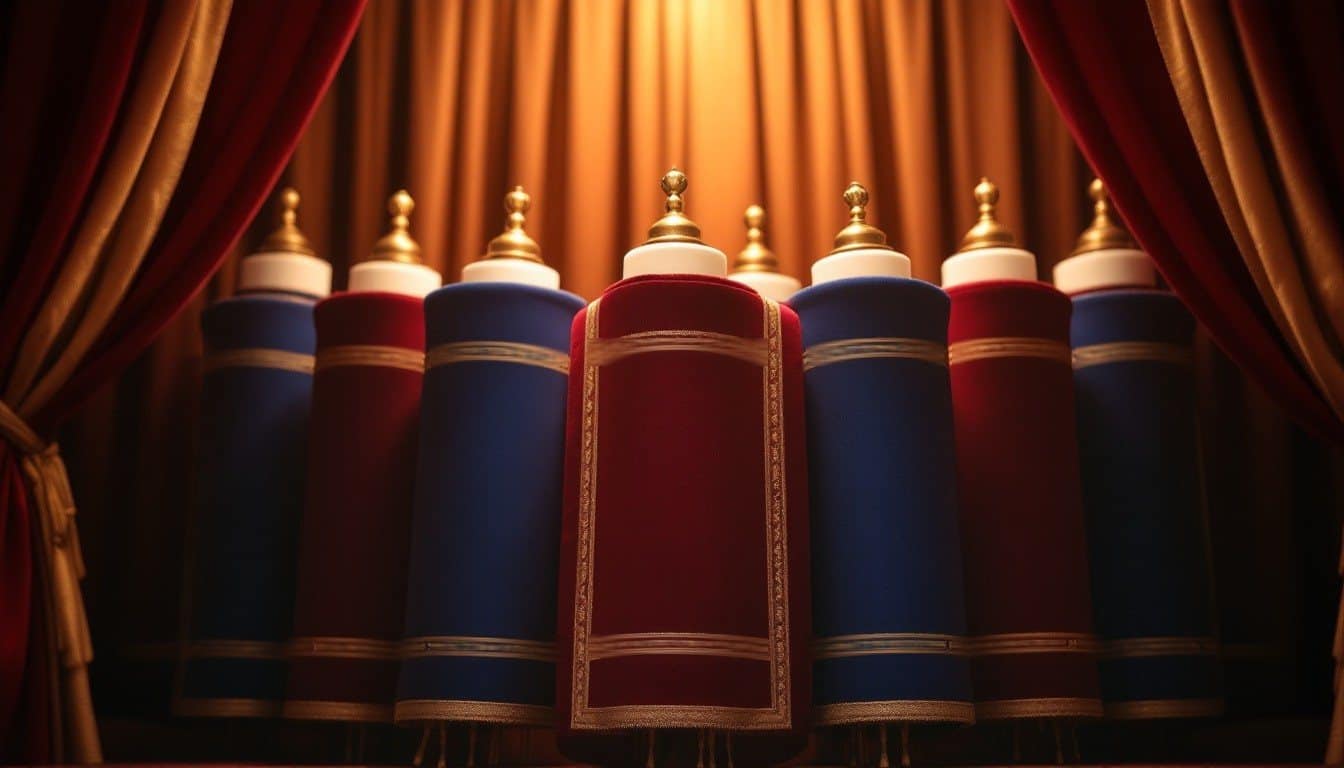
It is taken out of the holy ark to the sound of singing, people kiss it as it passes, they dance with it on Simchat Torah, and if a scroll falls to the ground, custom has those who saw it fall observe a fast. But what exactly is the Torah? A book, a law, a Bible? Why do people speak of a “written” Torah and an “oral” Torah, and why is it still copied by hand, letter by letter, on parchment? Here is a complete answer.
In short: the Hebrew word Torah (תּוֹרָה) means “teaching” or “instruction”, not “law”. In the narrow sense, the Torah refers to the five books of Moshe (Moses): Bereshit, Shemot, Vayikra, Bamidbar and Devarim, which Jewish tradition holds were revealed by G-d to Moshe at Mount Sinai and in the desert. This is called the Written Torah. According to the same tradition, it is accompanied by an Oral Torah, handed down from master to disciple and later committed to writing in the Mishna and the Talmud, which gives its meaning and its practical application. The text of the Written Torah is copied by hand onto a parchment scroll, the Sefer Torah, which is read publicly in the synagogue every Shabbat. In the broad sense, “Torah” refers to the whole of Jewish teaching.
A word that means “to teach”, not “law”
The Greek and then Latin translations rendered Torah as nomos and lex, “the Law”. This is where the expression “the Law of Moses” comes from. But the Hebrew root of the word, yara (י-ר-ה), means “to direct, to point out, to aim”. It appears in moreh, the teacher, the one who instructs, and in hora’ah, the ruling that guides conduct. The Torah is therefore first of all a direction given to life: it shows the way.
The book of Proverbs uses the word in this everyday sense: “Hear, my son, the instruction of your father, and do not forsake the teaching (torat) of your mother” (Mishlei [Proverbs] 1:8). Nobody here is thinking of a legal code: it is about what parents pass on to their child so that he may live well. The Torah certainly contains laws, a great many of them, but also narratives, genealogies, poems, blessings and warnings.
The Torah in fact presents itself as an inheritance: “Moshe commanded us a Torah, the heritage (morasha) of the congregation of Yaakov” (Devarim [Deuteronomy] 33:4). It is one of the first verses taught to Jewish children, as soon as they can speak (Talmud, Sukkah 42a).
The five books of Moshe
The Written Torah, also called the Chumash (from chamesh, “five”) or, from the Greek, the Pentateuch, is made up of five books. In Hebrew, each is named after one of the first words of its text:
- Bereshit (“In the beginning”, Genesis): the creation of the world, Adam and Chava (Eve), the flood and Noach, the tower of Babel, then the story of the patriarchs Avraham, Yitzchak and Yaakov, and of Yosef in Egypt.
- Shemot (“Names”, Exodus): slavery in Egypt, Moshe, the ten plagues, the Exodus from Egypt, the crossing of the sea, the revelation at Sinai and the Ten Commandments, then the building of the Mishkan, the sanctuary in the desert.
- Vayikra (“He called”, Leviticus): the service of the offerings, purity, the dietary laws, the festivals, and major moral commandments such as “love your neighbor as yourself” (Vayikra 19:18).
- Bamidbar (“In the desert”, Numbers): the forty years of wandering in the desert, the censuses, the rebellions and the trials of the people.
- Devarim (“Words”, Deuteronomy): Moshe’s great farewell speeches before his death, in which he reviews and completes his teaching, including the Shema Yisrael (Devarim 6:4-9).
Altogether it contains a little over 5,800 verses and, according to the traditional count, 304,805 letters. The Talmud counts 613 commandments (mitzvot) in this text: 248 positive and 365 negative (Makkot 23b). The Rambam, Maimonides, listed them one by one in his Sefer Ha-Mitzvot.
For Jewish tradition, these five books were written by Moshe at G-d’s dictation. The Talmud debates only the last eight verses, which recount Moshe’s death: either Yehoshua (Joshua) added them, or Moshe wrote them himself “in tears” (Bava Batra 15a; Menachot 30a). The Torah itself says: “Moshe wrote this Torah and gave it to the kohanim” (Devarim 31:9), and he commanded that it be placed beside the ark of the covenant (Devarim 31:24-26).
Torah, Bible, Tanakh: what is the difference?
This is one of the most frequent questions, and the confusion is understandable. The Torah is not the whole Jewish Bible: it is its first part, and the holiest.
The Hebrew Bible is called the Tanakh in Hebrew, a word formed from the initials of its three parts:
- Torah: the five books of Moshe;
- Nevi’im (the Prophets): Yehoshua (Joshua), Judges, Shmuel (Samuel), Kings, Yeshayahu (Isaiah), Yirmeyahu (Jeremiah), Yechezkel (Ezekiel) and the twelve “minor” prophets;
- Ketuvim (the Writings, or Hagiographa): Psalms (Tehilim), Proverbs, Job, the five megillot (Song of Songs, Ruth, Eicha [Lamentations], Kohelet [Ecclesiastes], Esther), Daniel, Ezra-Nehemiah and Chronicles.
According to the traditional count, the Tanakh contains twenty-four books; the Talmud gives their order and their authors (Bava Batra 14b-15a). All are sacred, but to different degrees: the Prophets and the Writings were composed through prophetic inspiration or the holy spirit, whereas the Torah is held to be the word of G-d transmitted word for word. That is why only the text of the Torah is read in its entirety, continuously, from a parchment scroll.
What Christians call “the Old Testament” corresponds, apart from a few differences in order and in the books included, to the Tanakh. Judaism does not use that expression: for Judaism there is no “old” or “new” testament, but a single covenant, still in force. The New Testament is not part of the Jewish sacred texts.
The Written Torah and the Oral Torah
This is the most important notion for understanding Judaism, and the least known. According to tradition, Moshe did not receive only a text at Sinai. He also received its explanation, transmitted by word of mouth: this is the Oral Torah (Torah she-be’al peh, “the Torah that is upon the mouth”), as opposed to the Written Torah (Torah she-bikhtav).
A famous story from the Talmud
The Talmud tells that a non-Jew came to the sage Shammai and asked him: “How many Torahs do you have?” Shammai answered: “Two: the Written Torah and the Oral Torah.” The man said: “As for the written one, I believe you; as for the oral one, I do not believe you. Convert me on condition that you teach me only the Written Torah.” Shammai drove him away. The man went to Hillel, who accepted him. On the first day, Hillel taught him the alphabet: aleph, bet, gimel, dalet. The next day, he showed him the letters in a different order. “But yesterday you did not teach them to me like that!” the man protested. Hillel replied: “So you relied on me for the letters. Rely on me for the Oral Torah as well” (Shabbat 31a).
The lesson: even to read a written text, you need a teacher.
Why the Written Torah is not enough
The Written Torah is often elliptical: it commands without saying how. A few examples:
- It forbids “doing work” on Shabbat (Shemot 20:10), but nowhere defines what work is. It is the oral tradition that gives its thirty-nine categories (Mishna Shabbat 7:2).
- It commands binding its words “as a sign upon your hand and as totafot between your eyes” (Devarim 6:8), without describing tefillin: their square shape, their black color and their contents come from the tradition.
- It permits slaughtering an animal “as I have commanded you” (Devarim 12:21), even though no verse describes this method of slaughter. The Talmud concludes that the rules of shechita, ritual slaughter, were commanded orally to Moshe (Chullin 28a).
- The famous “eye for an eye” (Shemot 21:24) was never applied literally in Jewish law: the oral tradition explains it as monetary compensation equivalent to the damage (Bava Kamma 83b-84a).
Without the Oral Torah, then, the Written Torah would be a closed book, or one left to everyone’s own interpretation. The Talmud sees this twofold transmission in a verse: “I will give you the tablets of stone, the Torah and the commandment that I have written, to teach them” (Shemot 24:12). The tablets are the Ten Commandments; “the Torah” is the text; “the commandment” is the Mishna; “to teach them” is the Talmud. And the Talmud concludes: “All of it was given to Moshe at Sinai” (Berakhot 5a).
Why “oral”?
For centuries it was actually forbidden to put the Oral Torah in writing: “words that are written, you may not say from memory; words that are oral, you may not write down” (Gittin 60b; Temurah 14b). Why? Because an oral teaching stays alive. It passes through a relationship between a teacher and a student, it answers questions, it adapts to the one who is listening. A written text, on the other hand, can be read by anyone, without a teacher, and twisted away from its meaning.
But after the destruction of the Second Temple, persecution and the dispersion of the people threatened to make this teaching forgotten. Around the year 200 of the Common Era, Rabbi Yehuda HaNasi gathered the essentials of the tradition in the Mishna. The Talmud justifies committing it to writing with the verse “it is time to act for the L-rd” (Tehilim [Psalms] 119:126), read as permitting one rule to be set aside in order to save the whole (Gittin 60a; Temurah 14b). The discussions of the following generations on the Mishna formed the Gemara; the Mishna and the Gemara together make up the Talmud, completed in the Land of Israel around the year 400 (the Jerusalem Talmud) and in Babylonia around the year 500 (the Babylonian Talmud).
The chain of transmission
The tractate Pirkei Avot, the “Ethics of the Fathers”, opens with a sentence that sums up this whole conception: “Moshe received the Torah from Sinai and passed it on to Yehoshua, Yehoshua to the Elders, the Elders to the Prophets, and the Prophets passed it on to the men of the Great Assembly” (Avot 1:1). In the introduction to his Mishneh Torah, the Rambam extends this chain name by name, over forty generations, from Moshe down to Rav Ashi, one of the editors of the Babylonian Talmud.
This does not mean that the Oral Torah is frozen. The Talmud teaches that G-d showed Moshe at Sinai “what an accomplished student would one day teach before his master” (Jerusalem Talmud, Pe’ah 2:4; see also Megillah 19b). It also tells that Moshe, transported into the academy of Rabbi Akiva, did not understand what was being said there, until Rabbi Akiva declared that he held his teaching from “Moshe at Sinai” (Menachot 29b). The Oral Torah is thus one and the same source that keeps flowing, generation after generation, through the work of the sages.

What Rav Raphaël Benizri teaches
Rav Benizri devoted an entire lecture to this first mishna of Pirkei Avot, Pirkei Avot: the chain of transmission. In it he points out a detail: the text does not say that Moshe received the Torah “from G-d”, but “from Sinai”. For one can only receive what one is capable of receiving. Sinai was the meeting place between the divine and the human, one of the descents in which G-d places Himself at man’s level. What Moshe received were laws that allow man to “take responsibility for himself here below”: according to the Rav, the Torah is not meant to tear us away from this world and carry us off to higher spheres, but to bind us to this world in its own reality.
In the same lecture, he explains the image the sages use to describe transmission: a ball passed from hand to hand without ever being dropped. A ball is passed on whole.
On the Oral Torah itself, the Rav offers a powerful image in his lecture 10 Tevet: the fast that opens the destruction. The 8th of Tevet, he recalls, is the day the Torah was translated into Greek, a day the sages compared to the day of the golden calf. A translation is a garment laid over the text, and every garment dims the light. The Oral Law is a garment too, but a living garment: its interpretation yields different meanings, sometimes opposite ones, and that is its genius, because it gives the Written Torah a human and universal reach. It is also personal to each individual: that is why, he explains, someone who is present at the last breath of a sage must tear his garment as a sign of mourning, for he is losing a Torah that was that man’s personal contribution to the whole community of Israel.
In Hanukkah: everyone’s light, he develops this idea further: the Written Torah could be translated and adopted by others; thought is something we share with everyone. But the Oral Law, with its controversies and debates, remains the place from which the Jewish people draws a way of life that belongs to it alone.
The Sefer Torah: a scroll written by hand
In the synagogue, the Torah is not read from a printed book but from a Sefer Torah, a parchment scroll written by hand. It is the holiest object in Judaism.
How it is made
A Sefer Torah is written by a sofer, a specially trained scribe, who must be a pious and learned man. He writes with a quill (traditionally a goose feather, or a reed) and a special black ink, on sheets of parchment made from the hide of a kosher animal, sewn together with threads of sinew. The text is laid out in columns; the most widespread custom is to write 248 of them, with 42 lines each. The letters are formed in a particular square script, ktav ashuri, with small crowns called tagin on certain letters. The scroll is attached to two wooden rollers, the atzei chaim (“trees of life”), after the verse that says of the Torah: “it is a tree of life to those who hold fast to it” (Mishlei 3:18).
The sofer always copies from a model, never writing from memory, and pronounces each word before writing it. Before writing one of the divine names, he declares that he is writing it for the sanctity of the Name. The rules are extremely strict: a Sefer Torah missing a single letter, or with one letter too many, is invalid (pasul) until it has been corrected (Rambam, Hilkhot Sefer Torah 7:11). The laws of writing a Sefer Torah are codified in the Shulchan Aruch (Yoreh De’ah 270 to 284).
The 613th mitzvah
The last of the Torah’s 613 commandments is to write a Sefer Torah oneself. It is derived from the verse: “And now, write for yourselves this song” (Devarim 31:19), which tradition understands as applying to the whole Torah (Sanhedrin 21b; Rambam, Hilkhot Sefer Torah 7:1; Shulchan Aruch, Yoreh De’ah 270:1). Since few people know how to write a scroll, one fulfills the obligation by having it written by a sofer, or by taking part in the completion of a scroll by writing, guided by the sofer, one of the last letters. The completion of a scroll is celebrated with a joyful procession to the synagogue.
The respect owed to the scroll
One stands up when a Sefer Torah passes by (Shulchan Aruch, Yoreh De’ah 282:2), and many kiss it as it goes by, touching it with the corner of their tallit or with their prayer book. The parchment is not touched directly with the fingers: the reader follows the text with a small silver hand, the yad. The scroll is dressed in a fabric mantle (among Ashkenazim and in many communities) or kept in a rigid case of wood or metal, the tik (among many Sephardim and Mizrachi Jews), adorned with silver crowns and bells. When a scroll is too damaged to be used, it is not thrown away: it is buried, like a human being, often near the grave of a sage.
The Torah reading in the synagogue
The Torah is read publicly, before the whole community. According to tradition, Moshe himself instituted its reading on Shabbat and on festivals (Jerusalem Talmud, Megillah 4:1). The prophets of his time also fixed it on Mondays and Thursdays, so that the people would never go three days without Torah, and Ezra the scribe added the reading on Shabbat afternoon (Bava Kamma 82a).
The text is divided into 54 sections, the parashiyot (singular: parasha). Every Shabbat morning, the parasha of the week is read, so that the complete reading of the Torah is finished in one year. In the Land of Israel in ancient times, the custom was to complete it in about three years (Megillah 29b). The annual cycle ends and begins again on the same day, on Simchat Torah, the “joy of the Torah”, at the end of the festival of Sukkot (22 Tishrei in the Land of Israel, 23 Tishrei in the diaspora): the last verses of Devarim are read, followed immediately by the first verses of Bereshit, to show that the study of the Torah has no end.
The reading is chanted according to traditional musical signs, the te’amim, which also serve as punctuation. Several worshippers are called up in turn to recite a blessing before and after each passage: this is the aliyah, the “going up” to the Torah. The closing blessing sums up the twofold nature of the Torah: “Blessed are You… who has given us a Torah of truth and planted eternal life within us.”
In ancient times, the Torah even prescribed a solemn reading every seven years before the whole people assembled, the Hakhel (Devarim 31:10-13).
Why is the Torah so central?
The blueprint of the world
The Midrash compares G-d to an architect who consults his plans before building a palace: “The Holy One, blessed be He, looked into the Torah and created the world” (Bereshit Rabba 1:1). The Torah is therefore not just a book for Jews: according to this tradition, it is the blueprint by which the world was conceived. To study it is to seek to understand the intention of the One who created the world.
Study as a mitzvah
The study of Torah is itself a commandment: “you shall teach them to your children, and speak of them” (Devarim 6:7). The Mishna lists deeds whose fruits a person enjoys already in this world, such as honoring one’s parents, performing acts of kindness and making peace between people, and concludes: “and the study of Torah is equal to them all” (Mishna Pe’ah 1:1). Why? Because study leads to action, the Talmud answers (Kiddushin 40b). The Rambam writes that every Jew, rich or poor, young or old, healthy or suffering, must set aside a time for study by day and by night (Hilkhot Talmud Torah 1:8).
The sages sum up this inexhaustible relationship with the text in the words of Ben Bag Bag: “Turn it over and turn it over again, for everything is in it” (Avot 5:22).
Several levels of reading
Tradition distinguishes four levels of reading, known by the acronym PaRDeS (“orchard”): peshat, the plain meaning; remez, the allusion; derash, the homiletic interpretation; and sod, the secret, mystical meaning. The Ramban, Nachmanides, writes in the introduction to his commentary on the Torah that at the deepest level the entire Torah is made up of the names of G-d, and that its letters could be read in a way other than the usual division into words. This is one of the reasons why a single missing letter makes a Sefer Torah invalid.
On the moral level, the Torah is first and foremost a path of life. Its laws are not limited to ritual: they concern justice, the worker’s wages, the stranger, the widow and the orphan, respect for animals, honesty in business. The Rambam writes that the laws of the Torah were given not for vengeance, but to bring “mercy, kindness and peace into the world” (Hilkhot Shabbat 2:3), quoting the verse: “its ways are ways of pleasantness, and all its paths are peace” (Mishlei 3:17).
A little history
The text of the Torah has been copied with extraordinary care for more than three thousand years. A few milestones:
- The Ketef Hinnom amulets. Discovered in 1979 in Jerusalem, these two small silver plaques, dated to the end of the First Temple period (around the 7th-6th century BCE), bear a version of the priestly blessing (Bamidbar [Numbers] 6:24-26). They are considered the oldest biblical text known to date.
- Ezra and the square script. According to the Talmud, on the return from the Babylonian exile in the 5th century BCE, the Torah was given to Israel anew by Ezra in the square script, ktav ashuri (Sanhedrin 21b-22a). Ezra also held a solemn public reading of the Torah before the whole people (Nehemiah 8).
- The Greek translation. In the 3rd century BCE, King Ptolemy had the Torah translated into Greek in Alexandria by seventy-two sages: this is the Septuagint (Megillah 9a). A rabbinic text says that this day was as hard for Israel as the day the golden calf was made (Masechet Soferim 1:7).
- The Dead Sea Scrolls. Discovered from 1947 onward in the caves of Qumran, they contain fragments of every book of the Tanakh except Esther, some of them copied more than two thousand years ago. Comparing them with today’s text shows a remarkable faithfulness in transmission.
- The Masoretes and the Aleppo Codex. Between the 7th and 10th centuries, scholars in Tiberias, the Masoretes, fixed the vowels, the accents and the meticulous count of letters and verses. The Aleppo Codex, written around the year 930 and checked by Aharon ben Asher, was regarded by the Rambam as the most accurate model (Hilkhot Sefer Torah 8:4). It is now kept at the Israel Museum in Jerusalem.
For Jewish tradition, this faithfulness is no accident: the ninth of the thirteen principles of faith formulated by the Rambam states that the Torah will be neither changed nor replaced, and the eighth that it comes entirely from Heaven (Commentary on the Mishna, Sanhedrin, chapter 10). The academic world puts forward other hypotheses about how the text was formed; Jewish faith, for its part, rests on the public revelation at Sinai, experienced by an entire people and transmitted from generation to generation.
Misconceptions about the Torah
“The Torah is a book of laws”
No. A large part of the text is made up of narratives. The Torah actually begins with the story of creation, not with a commandment. Rashi, in his very first comment, asks why, and answers that it first teaches that the earth belongs to G-d, who gives it to whomever He wishes (Rashi on Bereshit 1:1).
“The Torah is only about the past”
It is read, studied and discussed every day. Today’s rabbis draw from it answers to new questions, such as electricity on Shabbat or medical ethics: that is the role of the Oral Torah.
Frequently asked questions about the Torah
What does the word “Torah” mean?
“Teaching” or “instruction”, rather than “law”: the word comes from the root yara, “to direct, to point out”. It refers to the five books of Moshe and, in the broad sense, to the whole of Jewish teaching.
What is the difference between the Torah and the Bible?
The Torah is only the first and holiest part of the Hebrew Bible (the Tanakh), which also includes the Prophets and the Writings. The New Testament is not part of it.
What is the Oral Torah?
It is the explanation of the Written Torah, received by Moshe at Sinai and transmitted by word of mouth, then committed to writing in the Mishna (around 200) and the Talmud. Without it, many commandments would be impossible to carry out.
How long does it take to write a Sefer Torah?
About a year of work for an experienced scribe. The scroll contains 304,805 letters, written by hand on parchment, with no mistake allowed. That is why a Sefer Torah often costs several tens of thousands of euros.
Why was the Torah given at Sinai, in the desert?
The sages explain that it was given in a place that belonged to no one, so that no nation could claim it belonged to them more than to others, and so that anyone could come and take it (Mekhilta on Shemot 19:2). This giving is commemorated on Shavuot, on 6 Sivan, seven weeks after Pesach (Passover).
Why do people dance with the Torah on Simchat Torah?
Because on that day the annual reading is completed and immediately begun again. All the scrolls are taken out and carried seven times around the synagogue with singing and dancing, out of joy at having received the Torah.
Further reading
- Pirkei Avot: the chain of transmission
- 10 Tevet: the fast that opens the destruction
- Hanukkah: everyone’s light
- Shavuot: the giving of the Torah and the book of Ruth
- Shemini Atzeret and Simchat Torah: meaning and customs
- The weekly parasha: definition, cycle and study
- What is the Talmud?
- The 613 commandments of the Torah
- The Ten Commandments
- Glossary of Hebrew words in Judaism
Sources and references
- Bereshit (Genesis) 1:1 and Rashi on Bereshit 1:1
- Shemot (Exodus) 20:10; 21:24; 24:12
- Vayikra (Leviticus) 19:18
- Bamidbar (Numbers) 6:24-26
- Devarim (Deuteronomy) 6:4-9; 12:21; 31:9-13; 31:19; 31:24-26; 33:4
- Tehilim (Psalms) 119:126
- Mishlei (Proverbs) 1:8; 3:17-18
- Nechemia (Nehemiah) 8
- Mishna Shabbat 7:2
- Mishna Pe’ah 1:1
- Pirkei Avot 1:1 and 5:22
- Babylonian Talmud, Berakhot 5a
- Babylonian Talmud, Shabbat 31a
- Babylonian Talmud, Sukkah 42a
- Babylonian Talmud, Megillah 9a, 19b and 29b
- Jerusalem Talmud, Megillah 4:1
- Babylonian Talmud, Gittin 60a-60b; Temurah 14b
- Babylonian Talmud, Kiddushin 40b
- Babylonian Talmud, Bava Kamma 82a and 83b-84a
- Babylonian Talmud, Bava Batra 14b-15a; Menachot 29b and 30a
- Babylonian Talmud, Sanhedrin 21b-22a
- Babylonian Talmud, Makkot 23b
- Babylonian Talmud, Chullin 28a
- Jerusalem Talmud, Pe’ah 2:4
- Masechet Soferim 1:7
- Mekhilta de-Rabbi Yishmael on Shemot 19:2
- Bereshit Rabba 1:1
- Rambam, introduction to the Mishneh Torah
- Rambam, Mishneh Torah, Hilkhot Talmud Torah 1:8
- Rambam, Mishneh Torah, Hilkhot Sefer Torah 7:1; 7:11; 8:4
- Rambam, Mishneh Torah, Hilkhot Shabbat 2:3
- Rambam, Commentary on the Mishna, Sanhedrin chapter 10 (the thirteen principles of faith)
- Rambam, Sefer Ha-Mitzvot
- Ramban, introduction to the commentary on the Torah
- Shulchan Aruch, Yoreh De’ah 270:1; 270-284; 282:2
- Silver amulets from Ketef Hinnom (Israel Museum), end of the First Temple period
- Dead Sea Scrolls (Qumran), discovered from 1947 onward
- Aleppo Codex (c. 930), Israel Museum, Jerusalem
- Rav Raphaël Benizri, Pirkei Avot: the chain of transmission
- Rav Raphaël Benizri, 10 Tevet: the fast that opens the destruction
- Rav Raphaël Benizri, Hanukkah: everyone’s light
Article by the Pensées Juives editorial team. Passages attributed to Rav Raphaël Benizri are taken from his lectures published on this site.