
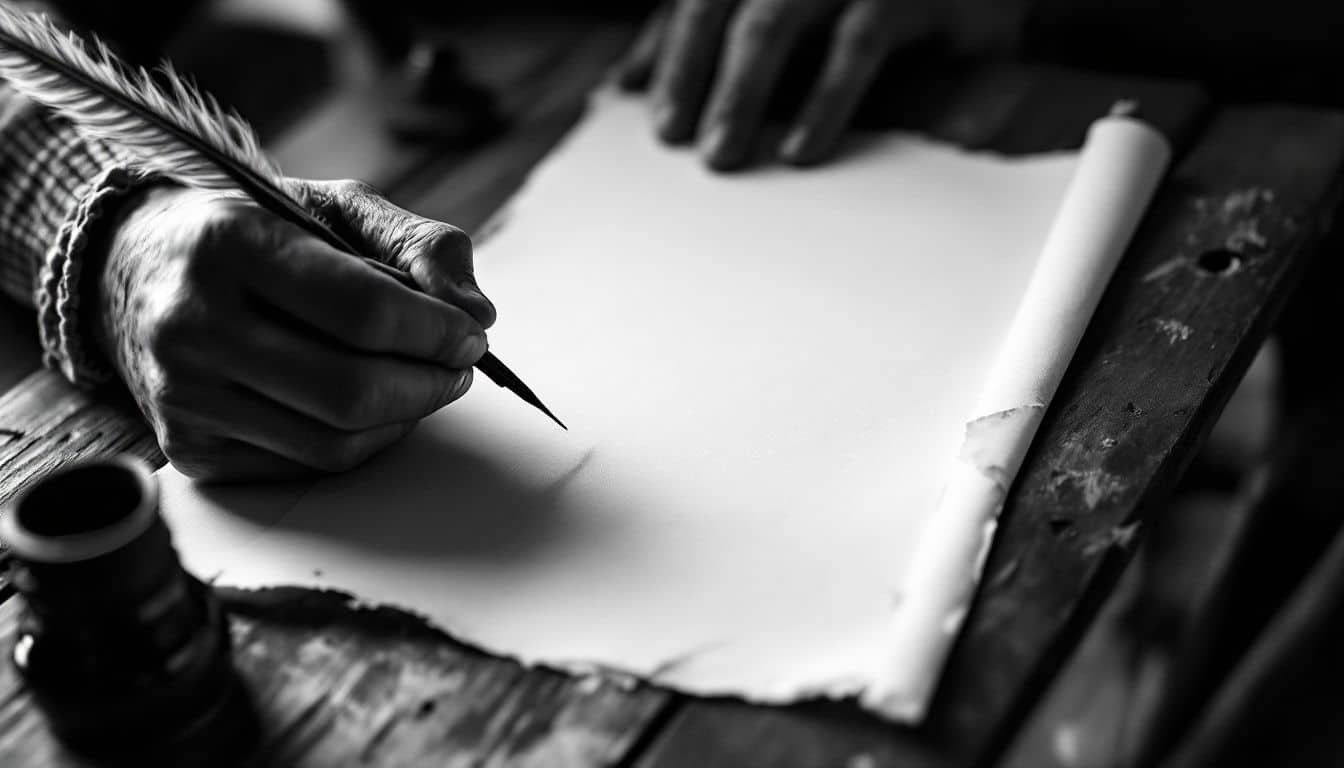
A scroll of parchment, black ink, a trimmed reed, and a man copying, letter by letter, a text he is not allowed to write from memory: this is a Sefer Torah. A single wrong or damaged letter is enough to make it unfit for public reading. How does one become a sofer (scribe)? What does one write with? What is done with a worn-out scroll? This article answers from the Torah, the Talmud, Maimonides (Rambam) and the Shulchan Aruch, distinguishing halachah (the law as practiced), aggadah (moral reading), Kabbalah and Chassidism, and finally history and archaeology.
In short: the Sefer Torah is the handwritten scroll of the five books of Moses, written on parchment by a trained scribe, with a prescribed ink and reed, with the intention of holiness (lishmah), copied from a reference text. The laws come from the Talmud and Rambam, and are taken up in the Shulchan Aruch (Yoreh De’ah 270 to 284). Ashkenazic, Sephardic and Chassidic communities all follow them, with differences of script and detail. According to Rambam, every man in Israel is obligated to write a Sefer Torah, or to have one written, for himself.
What is a Sefer Torah?
The Sefer Torah (“book of the Torah”) is the scroll containing the text of the Pentateuch (Bereshit, Shemot, Vayikra, Bamidbar, Devarim), without vowels, without cantillation marks and without punctuation. It is the scroll from which the weekly parashah is read in the synagogue (see What is the Torah? and What is a synagogue?). It is made of sheets of parchment sewn together and rolled onto two wooden poles (atzei chaim, “trees of life”); the Talmud already describes this way of rolling, from both ends toward the middle, “as the scribes of Jerusalem did” (Bava Batra 14a).
Tefillin and the mezuzah also contain passages of the Torah, written by the same type of scribe according to similar rules (see tefillin and the mezuzah): together they are known as STaM (Sefer Torah, Tefillin, Mezuzot). A chumash, a printed book or a scroll of a single book of the Torah, does not have the sanctity of a complete Sefer Torah (Rambam, Hilchot Sefer Torah 7:14; Shulchan Aruch, Yoreh De’ah 283:1).
The figure of 304,805 letters is commonly cited for a Sefer Torah. It does not come from the Talmud: the Gemara reports rather that the early “sofrim” counted the letters, and that already in the time of Rav Yosef the exact count was no longer known, for lack of expertise in full and defective spellings (Kiddushin 30a). The figure is therefore a customary indication, not a halachic rule.
The sources of the commandment: writing a Sefer Torah
The Torah itself speaks of writing. Moses “wrote this Torah and gave it to the priests” (Devarim [Deuteronomy] 31:9); he then asked the Levites to place “this book of the Torah” beside the Ark (31:26). The king, for his part, must write for himself a copy of the Torah, keep it with him and read in it “all the days of his life” (Devarim 17:18-19). But it is another verse of Devarim, in chapter 31, that the Talmud and Rambam take as applying to every Israelite:
“And now, write for yourselves this song, teach it to the children of Israel, place it in their mouths.”
(Devarim 31:19) — וְעַתָּה כִּתְבוּ לָכֶם אֶת־הַשִּׁירָה הַזֹּאת וְלַמְּדָהּ אֶת־בְּנֵי־יִשְׂרָאֵל שִׂימָהּ בְּפִיהֶם
The Talmud cites this verse in this connection (Sanhedrin 21b), and Rambam specifies how he reads it:
“It is a positive commandment for every man in Israel to write a Sefer Torah for himself, as it is said: ‘And now, write for yourselves this song,’ that is: write for yourselves the Torah that contains this song, for the Torah is not written in separate sections. Even if his fathers left him a Sefer Torah, it is a mitzvah to write one of his own. If he wrote it with his own hand, it is as if he had received it from Mount Sinai.”
(Rambam, Hilchot Sefer Torah 7:1) — מִצְוַת עֲשֵׂה עַל כָּל אִישׁ וְאִישׁ מִיִּשְׂרָאֵל לִכְתֹּב סֵפֶר תּוֹרָה לְעַצְמוֹ שֶׁנֶּאֱמַר ״וְעַתָּה כִּתְבוּ לָכֶם אֶת הַשִּׁירָה״. כְּלוֹמַר כִּתְבוּ לָכֶם תּוֹרָה שֶׁיֵּשׁ בָּהּ שִׁירָה זוֹ, לְפִי שֶׁאֵין כּוֹתְבִין אֶת הַתּוֹרָה פָּרָשִׁיּוֹת פָּרָשִׁיּוֹת. וְאַף עַל פִּי שֶׁהִנִּיחוּ לוֹ אֲבוֹתָיו סֵפֶר תּוֹרָה מִצְוָה לִכְתֹּב מִשֶּׁלּוֹ. ואִם כְּתָבוֹ בְּיָדוֹ הֲרֵי הוּא כְּאִלּוּ קִבְּלָהּ מֵהַר סִינַי
This commandment is among the 613 mitzvot (see the 613 mitzvot; Rambam, Sefer HaMitzvot, positive commandment 18). Few people know how to write a Sefer Torah: according to Rambam, whoever cannot do so has it written by others (Hilchot Sefer Torah 7:1). The Gemara says that whoever buys a Sefer Torah in the marketplace is “like one who seizes a mitzvah in the marketplace,” whereas whoever writes it is credited as if he had received it at Sinai; and that whoever corrects even a single letter is regarded as if he had written all of it (Menachot 30a).
Selling a Sefer Torah is in principle forbidden, even for the poor; Rambam allows a sale only in order to study Torah or to marry, and only for lack of any other possession to sell (Hilchot Sefer Torah 10:2; Shulchan Aruch, Yoreh De’ah 270:1). Today one also fulfills the commandment by writing or buying books of study, since it is mainly through them that one studies (Yoreh De’ah 270:2).
The sofer: training, qualities, mission
The word sofer comes from the root meaning “to count,” and the Talmud gives the reason:
“This is why the early masters were called sofrim (‘counters’): they counted all the letters of the Torah. They said that the vav of ‘gachon’ is the middle of the letters of the Sefer Torah (…).”
(Kiddushin 30a) — לְפִיכָךְ נִקְרְאוּ רִאשׁוֹנִים ״סוֹפְרִים״, שֶׁהָיוּ סוֹפְרִים כׇּל הָאוֹתִיּוֹת שֶׁבַּתּוֹרָה, שֶׁהָיוּ אוֹמְרִים: וָא״ו דְּ״גָחוֹן״– חֶצְיָין שֶׁל אוֹתִיּוֹת שֶׁל סֵפֶר תּוֹרָה
The page continues with darosh darash (the middle of the words) and vehitgalach (the middle of the verses); but Rav Yosef objects that the earlier masters “were experts in full and defective spellings, and we are not” (Kiddushin 30a). Writing “full” or “defective” exactly has been at the heart of the craft from the beginning.
The sofer is defined less by a diploma than by a mission: preserving the letter exactly. Rabbi Meir relates:
“(…) ‘I am a scribe.’ He said to me: ‘My son, be careful in your work, for your work is the work of Heaven: if you omit a single letter or add a single letter, you destroy the entire world.'”
(Eruvin 13a) — לַבְלָר אֲנִי. אָמַר לִי: בְּנִי, הֱוֵי זָהִיר בִּמְלַאכְתֶּךָ, שֶׁמְּלַאכְתְּךָ מְלֶאכֶת שָׁמַיִם הִיא, שֶׁמָּא אַתָּה מְחַסֵּר אוֹת אַחַת אוֹ מְיַיתֵּר אוֹת אַחַת — נִמְצֵאתָ מַחֲרִיב אֶת כָּל הָעוֹלָם כּוּלּוֹ
This statement is an exhortation (aggadah), but halachah makes it very concrete. The scribe must be Jewish, an adult, faithful to the Torah, and must know the laws of writing. Rambam lists those whose writing is invalid:
“A Sefer Torah, tefillin and mezuzot written by an apikoros shall be burned. If they were written by a Samaritan, a Jewish apostate, an informer who delivers Jews to an oppressor, a slave, a woman or a minor, they are unfit (…).”
(Rambam, Hilchot Sefer Torah 1:13) — סֵפֶר תּוֹרָה תְּפִלִּין וּמְזוּזוֹת שֶׁכְּתָבָן אֶפִּיקוֹרוֹס יִשָּׂרְפוּ. כְּתָבָן כּוּתִי אוֹ יִשְׂרָאֵל מוּמָר אוֹ מוֹסֵר בְּיַד אַנָּס אוֹ עֶבֶד אוֹ אִשָּׁה אוֹ קָטָן הֲרֵי אֵלּוּ פְּסוּלִין
And women?
The source of this exclusion is Talmudic: the Gemara deduces from the proximity of the verses “you shall bind them (…) you shall write them” (Devarim 6:8-9) that only one who is obligated in the mitzvah of tefillin may write a Sefer Torah, tefillin and mezuzot (Gittin 45b; Menachot 42b). Rambam applies this to women (Hilchot Sefer Torah 1:13 above; 7:1 speaks of “every man”) and the Shulchan Aruch rules likewise (Yoreh De’ah 281:3). This is the rule followed in Orthodoxy; we do not address here the contemporary positions that challenge it, and we refer the reader to a rabbi for any concrete situation.
Training and practice
The craft is transmitted through apprenticeship: the future sofer studies the laws of writing (gathered notably in Yoreh De’ah 270-284 and in specialized works) and practices with a master how to form the 22 letters. Rambam considers a revealing case: if the scribe states, after the fact, that he did not write the Divine Names for the sake of their holiness, he is not believed so as to invalidate the scroll, but he is believed so as to forfeit his payment; if he says that the hides were not processed for the Sefer Torah, he is believed and the scroll is unfit (Hilchot Sefer Torah 1:18).
The materials: parchment, ink, quill, sinews
The parchment
Halachah fixes the hide. Rambam distinguishes three kinds (Hilchot Sefer Torah 1:6-7): the gevil (the whole hide, with the hair removed, salted, treated with flour and then with gallnut), the klaf (the inner layer of the hide, the flesh side, after splitting) and the duchsustus (the outer layer, the hair side). He writes:
“It is a halachah given to Moses at Sinai that one writes a Sefer Torah on gevil, on the hair side (…).”
(Rambam, Hilchot Sefer Torah 1:8) — הֲלָכָה לְמשֶׁה מִסִּינַי שֶׁיִּהְיוּ כּוֹתְבִין סֵפֶר תּוֹרָה עַל הַגְּוִיל וְכוֹתְבִין בִּמְקוֹם הַשֵּׂעָר
Rambam specifies that if one has written on klaf, it is valid (1:9). The Rema notes that our parchments are of better quality than gevil and that today one writes on the flesh side of the klaf; he considers a Sefer Torah written on the hair side of our klafim invalid in principle, while reporting lenient opinions (Shulchan Aruch, Yoreh De’ah 271:3). The hide must come from a pure animal, even one that died naturally or was declared treifah, but not from a fish (Rambam 1:10; Yoreh De’ah 271:1); it must have been processed “for the Sefer Torah,” stating so during the tanning (Rambam 1:11; Yoreh De’ah 271:1). It must then be ruled with lines: a Sefer Torah written without lines is unfit (Rambam 1:12; Yoreh De’ah 271:5).
The ink
The classic ink is made of soot (from the smoke of oil, pitch or wax), bound with tree gum and a little honey, dried into cakes, which are dissolved at the time of writing in a decoction of gallnut (Rambam 1:4). It must be black and durable: any other color, or gold, invalidates, even for a single letter (Rambam 1:5; Yoreh De’ah 271:6). The Rema, citing the Zohar (Terumah), recommends preparing the ink with ingredients that come from the tree (271:6). The Talmud reports that Rabbi Meir put iron sulfate (kankantom) into the ink when he studied with Rabbi Akiva (Eruvin 13a); Rambam allows an ink of gallnut and kankantom, which does not fade (1:4).
The quill
The Talmud speaks of a kulmus, a trimmed reed (Shabbat 133b). The Shulchan Aruch says that one writes with the right hand (Yoreh De’ah 271:7); the Rema also reports the opinion of those who require a reed and not a bird’s feather (ibid.).
The sinews
The sheets are sewn together with sinews (gidin) of a pure animal; the stitching does not run all the way to the ends of the sheet (Shulchan Aruch, Yoreh De’ah 278:1).
Why so much care? The Talmud sees in it a duty to beautify the mitzvah, based on the verse “This is my G-d and I will glorify Him” (Shemot [Exodus] 15:2):
“A beautiful Sefer Torah, and write in it, for His Name, with beautiful ink, a beautiful reed and a skilled scribe (…).”
(Shabbat 133b, based on Shemot 15:2) — סֵפֶר תּוֹרָה נָאֶה, וּכְתוֹב בּוֹ לִשְׁמוֹ בִּדְיוֹ נָאֶה, בְּקוּלְמוֹס נָאֶה, בְּלַבְלָר אוּמָּן
The writing, letter by letter
Lishmah: writing for the sake of holiness
The sofer must write with the intention of holiness. The Shulchan Aruch specifies the gesture:
“The scribe must say, when he begins to write: ‘I am writing this book for the sake of the holiness of the Sefer Torah,’ and this suffices for the whole book. He must have another book before him from which to copy, for it is forbidden to write a single letter from memory (…).”
(Shulchan Aruch, Yoreh De’ah 274:1-2) — צריך שיאמר הסופר כשיתחיל לכתוב ספר זה אני כותב לשם קדושת ספר תורה ומספיק לכל הספר צריך שיהיה לפניו ספר אחר שיעתיק ממנו שאסור לכתוב אות אחת שלא מן הכתב וצריך שיקרא כל תיבה בפיו קודם שיכתבנה
The sofer thus reads each word aloud before writing it, which prevents errors of memory. The Divine Names call for even greater attention:
“Whoever writes a Sefer Torah, tefillin or a mezuzah without intention, writing a Divine Name not for its holiness, renders them unfit. This is why, when one is writing the Name, even if the king of Israel greets you, one does not answer him.”
(Rambam, Hilchot Sefer Torah 1:15) — הַכּוֹתֵב סֵפֶר תּוֹרָה אוֹ תְּפִלִּין אוֹ מְזוּזָה וּבִשְׁעַת כְּתִיבָה לֹא הָיְתָה לוֹ כַּוָּנָה וְכָתַב אַזְכָּרָה מִן הָאַזְכָּרוֹת שֶׁבָּהֶן שֶׁלֹּא לִשְׁמָן פְּסוּלִין. לְפִיכָךְ הַכּוֹתֵב אֶת הַשֵּׁם אֲפִלּוּ מֶלֶךְ יִשְׂרָאֵל שׁוֹאֵל בִּשְׁלוֹמוֹ לֹא יְשִׁיבֶנּוּ
If the scribe writes two or three Names in a row, he may pause between them to respond (Rambam 1:15; Yoreh De’ah 276:3). If he forgot an entire Name, he may add it between the lines; but a Name written partly in the line and partly above it makes the scroll unfit (Rambam 1:16).
The shape of the letters
The Shulchan Aruch requires a script that is beautiful, straight and complete: an aleph and a lamed written stuck to each other are unfit (Yoreh De’ah 274:3). Each of the 22 letters has a precise shape, and none may touch the neighboring letter. Rambam counts twenty causes for invalidating a scroll, among them the omission or addition of a single letter, a letter touching another, a letter damaged to the point of being unreadable or of resembling another (Hilchot Sefer Torah 10:1). For words written “malei” (with a letter of reading) or “chaser” (without), the copy must be exact, even if the meaning does not change (Rambam 7:11).
On certain letters, the sofer adds small strokes, the tagin (“crowns”). Rambam writes: “There is a letter that has a single tag, and one that has seven. All the tagin are in the shape of a zayin, as fine as a hair” (7:8). The Talmud specifies that seven letters (shin, ayin, tet, nun, zayin, gimel, tzadi) bear three (Menachot 29b). An aggadah relates their reason:
“Rav Yehudah said in the name of Rav: when Moses went up on high, he found the Holy One, blessed be He, sitting and attaching crowns to the letters. He said to Him: ‘Master of the universe, who is holding You back?’ He answered him: ‘There is a man who will exist, many generations from now, Akiva ben Yosef by name, who will derive from every point of these crowns heaps and heaps of halachot.'”
(Menachot 29b) — בְּשָׁעָה שֶׁעָלָה מֹשֶׁה לַמָּרוֹם, מְצָאוֹ לְהַקָּדוֹשׁ בָּרוּךְ הוּא שֶׁיּוֹשֵׁב וְקוֹשֵׁר כְּתָרִים לָאוֹתִיּוֹת, אָמַר לְפָנָיו: רִבּוֹנוֹ שֶׁל עוֹלָם, מִי מְעַכֵּב עַל יָדֶךָ? אָמַר לוֹ: אָדָם אֶחָד יֵשׁ שֶׁעָתִיד לִהְיוֹת בְּסוֹף כַּמָּה דּוֹרוֹת וַעֲקִיבָא בֶּן יוֹסֵף שְׁמוֹ, שֶׁעָתִיד לִדְרוֹשׁ עַל כׇּל קוֹץ וָקוֹץ תִּילִּין תִּילִּין שֶׁל הֲלָכוֹת
The rest of the passage relates that Moses, placed at the back of Rabbi Akiva’s study hall, does not understand what is being said, and then calms down on hearing that it is a halachah given to Moses at Sinai (Menachot 29b). This is aggadah, not a rule of practice.
The layout
Rambam notes scribal customs: from 48 to 60 lines per column (7:10), each line able to hold three times the word “lemishpechotechem,” about thirty letters (7:4). The common practice today is 42 lines, and 51 among the Yemenites (Wikipedia, “Torah scroll”). Four blank lines are left between the books of the Torah (Rambam 7:7; Yoreh De’ah 273:1), and the two songs (the Sea, Haazinu) have a particular layout (Rambam 7:10-11; 8:3).
The scribe must not stretch the letters to fill a gap at the end of a line: he leaves the space empty (Yoreh De’ah 273:3; Rambam 7:5-6).
Fidelity of the text: open and closed sections, Ben Asher, corrections, genizah
Open and closed parshiyot
The text of the Torah is not continuous: it is divided into sections separated by a blank space, the open (petuchah) and closed (setumah) parshiyot. Rambam, noting “great confusion in the books” on this point, recorded the complete list of these sections and said which copy he relied on:
“The book on which we have relied for these matters is the one known in Egypt, which comprises the twenty-four books, which had been in Jerusalem for many years so that books could be corrected from it, and on which everyone relied, because Ben Asher had corrected it, had worked on it for many years and had reviewed it many times as it was being copied. It is on this that I relied for the Sefer Torah that I wrote according to halachah.”
(Rambam, Hilchot Sefer Torah 8:4) — וְסֵפֶר שֶׁסָּמַכְנוּ עָלָיו בִּדְבָרִים אֵלּוּ הוּא הַסֵּפֶר הַיָּדוּעַ בְּמִצְרַיִם שֶׁהוּא כּוֹלֵל אַרְבָּעָה וְעֶשְׂרִים סְפָרִים שֶׁהָיָה בִּירוּשָׁלַיִם מִכַּמָּה שָׁנִים לְהַגִּיהַּ מִמֶּנּוּ הַסְּפָרִים וְעָלָיו הָיוּ הַכּל סוֹמְכִין לְפִי שֶׁהִגִּיהוֹ בֶּן אָשֵׁר וְדִקְדֵּק בּוֹ שָׁנִים הַרְבֵּה וְהִגִּיהוֹ פְּעָמִים רַבּוֹת כְּמוֹ שֶׁהֶעְתִּיקוּ וְעָלָיו סָמַכְתִּי בְּסֵפֶר הַתּוֹרָה שֶׁכָּתַבְתִּי כְּהִלְכָתוֹ
This copy is generally identified with the Aleppo Codex, written around 920 in Tiberias, with the vowel points and Masoretic notes of Aaron ben Asher; most of the Torah section was lost in the Aleppo riots of 1947 (Wikipedia, “Aleppo Codex”).
Disagreements remain about the exact form of these sections. The Shulchan Aruch draws from this a cautious course of conduct:
“As for the form of the open parashah and the closed parashah, there is a disagreement between Rambam and the Rosh, and one who fears Heaven will satisfy all the opinions (…).”
(Shulchan Aruch, Yoreh De’ah 275:2) — בצורת פתוחה וצורת סתומה יש מחלוקת בין הרמב”ם והרא”ש וירא שמים יצא את כולם
The Rema adds that, if this cannot be achieved, one does not depart from Rambam, on whom the others relied (ibid.).
Errors and corrections
A Sefer Torah must be reviewed and corrected: according to Rambam, an uncorrected scroll may not be kept for more than thirty days (7:12; Yoreh De’ah 279:1). With three errors per page, it is corrected; with four, it is put in genizah (7:12). A forgotten word may be suspended between the lines, but not between two sheets (Yoreh De’ah 276:1); a word written full instead of defective is scraped off (Rambam 7:13). An error in the layout of the sections is more serious: Rambam holds that the entire page must be removed (8:3), whereas other authorities permit correction (Rema on Yoreh De’ah 275:1).
A Sefer Torah is never corrected “by reasoning,” but only on clear proof of the error (Yoreh De’ah 279:1). A sheet torn after sewing is sewn back with the same sinews, under precise conditions (Yoreh De’ah 280:1).
What is done with a worn-out scroll?
“A Sefer Torah that has worn out or become unfit is placed in an earthenware vessel and buried beside disciples of the wise: this is its genizah.”
(Rambam, Hilchot Sefer Torah 10:3) — סֵפֶר תּוֹרָה שֶׁבָּלָה אוֹ שֶׁנִּפְסַל נוֹתְנִין אוֹתוֹ בִּכְלִי חֶרֶשׂ וְקוֹבְרִין אוֹתוֹ אֵצֶל תַּלְמִידֵי חֲכָמִים וְזוֹ הִיא גְּנִיזָתוֹ
An unfit scroll is therefore neither thrown away nor burned (unless it was written by an apikoros). Worn-out covers serve as a shroud for a person with no family to bury them (a met mitzvah); the ark and the seat on which the scroll is placed are also buried when worn out (Rambam 10:3-4; Yoreh De’ah 282:10-12). As for the respect owed to the scroll, one stands when one sees it pass (Yoreh De’ah 282:2), one does not take it into a bathroom, a bathhouse or a cemetery (282:4), and one does not turn one’s back to it (282:1).
Ashkenazim, Sephardim, Chassidim: what changes, what does not
The laws of writing are common to all Orthodox communities; the differences concern details of form and practice (see What is the difference between Ashkenazic and Sephardic Jews? and What is Chassidism?).
- The script. Three main scribal scripts are distinguished: the ketav Beit Yosef, the standard Ashkenazic usage; the ketav ha-Ari (named for the Arizal), a Chassidic script; the ketav Baal HaTanya, the Chabad script; and the ketav Sefardi, also called “Velish,” used by Sephardic and Eastern Jews, including the Yemenites (Wikipedia, “Ktav Stam”). Each family has its own letter forms; we refer the reader to a scribe for the details.
- The points of detail already seen (gevil or klaf, reed or quill, the form of the open and closed sections, the number of lines) are also points of divergence among Rambam, the Rema and local customs; the Yemenites write 51 lines per column, against 42 in common usage (Wikipedia, “Torah scroll”).
One thing in common: whatever the community, a Sefer Torah is read in public only if it is free of Rambam’s twenty causes of invalidation (Hilchot Sefer Torah 10:1).
Aggadah, Kabbalah and Chassidism
Tradition has meditated at length on the form of the Sefer Torah. Here we distinguish the moral reading, the mystical one and the law.
Aggadah. A tradition, reported notably by Rashi, says that the Torah was written before G-d “in black fire on white fire”:
“(…) because it was written before Him in black fire on white fire.”
(Rashi on Shir Hashirim 5:11) — עַל שֵׁם שֶׁהָיְתָה כְתוּבָה לְפָנָיו אֵשׁ שְׁחוֹרָה עַל גַּבֵּי אֵשׁ לְבָנָה
In this image, the ink is the black fire and the parchment the white fire. Another aggadah, already cited, sees in the crowns of the letters the seed of Rabbi Akiva’s interpretation (Menachot 29b).
Kabbalah and Chassidism. The Rema, citing the Zohar (Terumah), recommends preferring, for the ink, ingredients that come from the tree (Yoreh De’ah 271:6). Chassidism has its own scribal scripts (ketav ha-Ari, named for the Arizal; ketav Baal HaTanya for Chabad): these choices belong to the custom of the community (minhag), not to the basic validity of the scroll.
A little history and archaeology
The script of the Torah. In the Talmud, a discussion concerns the script itself. Mar Zutra says:
“At first, the Torah was given to Israel in Hebrew script (ivrit) and in the holy tongue; it was given to them again, in the days of Ezra, in Assyrian script (ashurit) and in the Aramaic language. Israel chose the Assyrian script and the holy tongue, and left to the ordinary people the Hebrew script and the Aramaic language.”
(Sanhedrin 21b) — בַּתְּחִלָּה נִיתְּנָה תּוֹרָה לְיִשְׂרָאֵל בִּכְתָב עִבְרִי וּלְשׁוֹן הַקּוֹדֶשׁ. חָזְרָה וְנִיתְּנָה לָהֶם בִּימֵי עֶזְרָא בִּכְתָב אַשּׁוּרִי וּלְשׁוֹן אֲרַמִּי. בֵּירְרוּ לָהֶן יִשְׂרָאֵל כְּתָב אַשּׁוּרִי וּלְשׁוֹן הַקּוֹדֶשׁ, וְהִנִּיחוּ לַהֶדְיוֹטוֹת כְּתָב עִבְרִית וּלְשׁוֹן אֲרַמִּי
Another opinion, that of Rabbi Yehudah HaNasi, is that the Torah was given in Ashurit script from the beginning; it would later have become a different script before returning (Sanhedrin 22a). According to scholarly usage, the script the Samaritans preserved is close to the ancient paleo-Hebrew script. Tradition itself thus wavers among several answers.
The oldest texts. The silver amulets of Ketef Hinnom (Jerusalem, discovered in 1979 by Gabriel Barkay, dated to the late seventh or early sixth century BCE) bear a variant of the priestly blessing (Bamidbar [Numbers] 6:24-26): among the oldest known quotations of a biblical text, but not of a Sefer Torah. At Qumran, the Great Isaiah Scroll (around 125 BCE; 17 sheets sewn together, about 7.3 meters; Shrine of the Book, Jerusalem) shows what an ancient biblical scroll could look like, but does not contain the Torah. At En-Gedi, a scroll of Vayikra (the beginning of chapters 1 and 2), burned along with the synagogue and deciphered in 2015 by virtual unrolling (Brent Seales), is dated by carbon-14 to the third-fourth centuries CE (paleography places it earlier); its text corresponds to the Masoretic text. The oldest known complete Sefer Torah is the one at the University of Bologna, identified in 2013 by Mauro Perani and dated by carbon-14 to about 1155-1225, about 36 meters long (Wikipedia, “Bologna Torah Scroll”).
These discoveries are a matter of scholarly debate (Qumran attests other forms of the text before the fixing of the Masoretic text); halachah, for its part, fixes the text for practice by means of the codex of which Rambam speaks.
What Rav Raphaël Benizri teaches
Rav Benizri has not devoted a lecture to the writing of the Sefer Torah, but he returns to it as an image. We report what his published lectures say about it, adding nothing.
- Each person is a letter of the Sefer Torah. In his lecture on Elul (“everyone’s uniqueness”), the Rav explains that the Jewish people has as many souls as the Torah has letters, and that a single damaged letter makes the whole Sefer Torah unfit; each letter has its function in the word. See Elul: everyone’s uniqueness. He returns to it in Elul: the role of man: if a single letter were missing, the Sefer would be “out of circulation,” like the world when man does not fulfill his function. This is a homiletic reading, not a rule of halachah.
- The white space around the letter. In his lecture on Pirkei Avot (Shemaya and Avtalyon), the Rav distinguishes four levels in the letter (its shape, its phonetics, its music, and its autonomy: it must not touch the neighboring letter) and cites a thought according to which the most important thing in the letter is “the white that surrounds it, not the black that writes it.” See Pirkei Avot: Shemaya and Avtalyon. In Chayei Sarah: the source of life, he says that what is most sacred in the writing of a Sefer Torah is neither the letter, nor the tag, nor the cantillation, but the white space around the letter, “where nothing is written and where everything is to be discovered.”
- The parchment that has become sacred. In the lecture on Vayetze, the Rav remarks that as long as the page is blank, one can write anything on it; if one writes something sacred on it, the page becomes sacred, and if the writing fades, the scroll loses its function but cannot be thrown away. See Vayetze: the confrontations of the patriarchs. This ties in with the genizah (Rambam, Hilchot Sefer Torah 10:3): a connection made by the editors.
- The Ashurit script. In the lecture on the Tower of Babel, the Rav mentions the writing of the Sefer Torah, the ktav Ashuri, which was not the original script (preserved, he says, by the Samaritans) but the one that recovered its values in the time of Ezra. This ties in with the Talmudic discussion cited above (Sanhedrin 21b-22a; a connection made by the editors). See Noach: the Tower of Babel.
Common misconceptions about the Sefer Torah
“A Sefer Torah is written by a rabbi.” Not necessarily: it is a scribe (sofer) who writes it. His competence is in the laws of writing; he may or may not be a rabbi.
“A mistake is corrected as in a document.” Certain errors are corrected by scraping or adding, within precise limits (Rambam 7:12-13); others, such as a section wrongly opened or closed, may require removing the page (8:3). An uncorrected Sefer Torah may not be kept for more than thirty days (Yoreh De’ah 279:1).
“The number of letters (304,805) is a rule.” It is a count from tradition, not a rule of halachah; in the Gemara, Rav Yosef acknowledges that the exact count is no longer known (Kiddushin 30a).
Frequently asked questions about the Sefer Torah
How long does it take to write a Sefer Torah?
Modern sources indicate about one year to a year and a half (Chabad.org, “Torah Scroll Facts”; Wikipedia, “Torah scroll”).
What is the difference between a Sefer Torah, tefillin and a mezuzah?
They are three different products of the same craft (STaM). The Sefer Torah is the complete scroll; tefillin contain four passages and the mezuzah two (Rambam, Hilchot Sefer Torah 1:1-2). See tefillin and the mezuzah.
Can one buy a Sefer Torah?
Yes, from a scribe or a trustworthy institution; the Gemara considers it more meritorious to write one than to buy one in the marketplace (Menachot 30a). For an old or second-hand scroll, a competent scribe must verify that it is kosher.
Who may touch a Sefer Torah?
According to Rambam, even people in a state of impurity, even a niddah or a Samaritan (kuti), may touch a Sefer Torah and read from it, because “words of Torah do not receive impurity,” provided their hands are clean (Hilchot Sefer Torah 10:8). The Shulchan Aruch asks that it not be held bare, without a cover (Yoreh De’ah 282:4). Some communities have stricter customs: one should follow one’s rabbi.
Can a Sefer Torah be written with a computer or a printer?
The sources describe handwriting, on parchment, with the prescribed ink and a reed (Rambam 1:4-12; Yoreh De’ah 271:6-7; 274:1). For any question about a modern process, consult a competent rabbi. Printed books (chumashim) serve for study but do not have the sanctity of a Sefer Torah (Yoreh De’ah 283:1).
Further reading
To continue:
- What is the Torah?
- What are tefillin?
- What is the mezuzah fixed to doorposts?
- Hebrew, the holy tongue: history and meaning
- What is Simchat Torah and why do people dance with the scrolls?
- How does Jewish divorce (get) work? (the divorce document is written by a sofer)
- Elul: everyone’s uniqueness — lecture by Rav Raphaël Benizri
- Pirkei Avot: Shemaya and Avtalyon — lecture by Rav Raphaël Benizri
- Glossary of Hebrew words in Judaism
Sources and references (16)
- Shemot (Exodus) 15:2
- Devarim (Deuteronomy) 6:8-9; 17:18-19; 31:9; 31:19; 31:26
- Babylonian Talmud, Shabbat 133b
- Babylonian Talmud, Eruvin 13a
- Babylonian Talmud, Gittin 45b; 60a
- Babylonian Talmud, Kiddushin 30a
- Babylonian Talmud, Menachot 29b; 30a; 42b
- Babylonian Talmud, Sanhedrin 21b-22a
- Babylonian Talmud, Bava Batra 14a; 15a
- Rashi on Shir Hashirim (Song of Songs) 5:11
- Rambam, Mishneh Torah, Hilchot Tefillin, Mezuzah ve-Sefer Torah 1:1-18; 7:1-14; 8:1-4; 10:1-11
- Rambam, Sefer HaMitzvot, positive commandment 18
- Shulchan Aruch, Yoreh De’ah 270:1-2; 271:1-7; 273:1-4; 274:1-3; 275:1-2; 276:1-3; 278:1; 279:1; 280:1; 281:3; 282:1-12; 283:1
- En-Gedi: Seales et al., Science Advances 2, 2016; Segal et al., Textus 26, 2016. Bologna: Mauro Perani, The Ancient Sefer Torah of Bologna, Brill. Ketef Hinnom, Great Isaiah Scroll, Aleppo Codex: see Wikipedia
- Scribal scripts: see Wikipedia, “Ktav Stam”; Chabad.org, “Torah Scroll Facts”
- Lectures of Rav Raphaël Benizri: Elul (everyone’s uniqueness; the role of man), Pirkei Avot (Shemaya and Avtalyon), Chayei Sarah (the source of life), Vayetze (the confrontations of the patriarchs), Noach (the Tower of Babel)
Article by the Pensées Juives editorial team. Passages attributed to Rav Raphaël Benizri are taken from his lectures published on this site.