

On the right-hand doorpost of the front door of Jewish homes, you will often notice a small case, made of wood, metal or ceramic, fixed at a slant. As they pass, many people touch it with their fingers and then bring their fingers to their lips. People sometimes assume it is a good-luck charm, a sign of belonging or a small decoration. In fact, it is the mezuzah, one of the oldest commandments of the Torah, and one of the most present in daily life. What does it contain, where does it come from, why do people kiss it, and what does it mean? Here is a complete answer, with the verses, the Talmud, the history and the deeper meaning of this small scroll.
In short: the mezuzah is not the case, but the small parchment scroll it protects. A scribe has written on it, by hand, two passages of the Torah: the Shema Yisrael, “Hear, O Israel, the L-rd is our G-d, the L-rd is One” (Devarim [Deuteronomy] 6:4-9), and the passage that follows it in the prayer (Devarim 11:13-21). These two texts themselves command that they be written “on the doorposts of your house and on your gates” (Devarim 6:9; 11:20). The Hebrew word mezuzah in fact means “doorpost.” It is fixed on the right-hand doorpost of every door of a dwelling, in the upper third, and by touching it one is reminded, each time one passes, that the home stands under G-d’s gaze. According to the Rambam, its purpose is to wake a person from routine every time he comes in or goes out (Hilchot Mezuzah 6:13).
What does the word “mezuzah” mean?
In biblical Hebrew, mezuzah (מְזוּזָה, plural mezuzot) first refers to the vertical post of a door, the post on which the door hangs. The word appears with this meaning well before the commandment: at the Exodus from Egypt, the Hebrews are commanded to put the blood of the Passover lamb “on the two doorposts (mezuzot) and on the lintel” of their houses (Shemot [Exodus] 12:7). It appears again for the Hebrew slave who refuses his freedom: his master brings him “to the door or to the doorpost (mezuzah)” and pierces his ear (Shemot 21:6).
By extension, the word passed from the door to the object fixed on it. When people say “a mezuzah” today, they think of the scroll and its case. But the distinction should be kept in mind: the case is only a protection, often beautiful, sometimes a work of art; what constitutes the mitzvah (the commandment) is the parchment written inside. An empty case, however lovely, is not a mezuzah.
What the Written Torah says
The commandment of mezuzah appears twice in the Torah, in the book of Devarim (Deuteronomy), within the first two paragraphs of the Shema.
The first passage is the heart of the Jewish faith: “Hear, O Israel, the L-rd is our G-d, the L-rd is One. You shall love the L-rd your G-d with all your heart, with all your soul and with all your might. And these words which I command you today shall be upon your heart. You shall teach them to your children, and you shall speak of them when you sit in your house, when you walk on the way, when you lie down and when you rise up. You shall bind them as a sign upon your arm, and they shall be as frontlets between your eyes, and you shall write them on the doorposts of your house and on your gates” (Devarim 6:4-9).
The second passage, a few chapters later, repeats the same command after speaking of reward and responsibility: “If you will diligently obey My commandments […] I will give the rain of your land in its season […]. You shall place these words of Mine upon your heart and upon your soul […]. You shall write them on the doorposts of your house and on your gates, so that your days and the days of your children may be multiplied on the land which the L-rd swore to your fathers to give them” (Devarim 11:13-21).
Two things stand out. First, the mezuzah is announced in the same sentence as tefillin, the prayer boxes bound on the arm and the head: the Torah asks that the same words be inscribed on the body and on the home. Second, what is written on the door is precisely the text that commands it to be written there. The mezuzah does not contain a magic formula or just any prayer: it contains the very words that establish it, and that sum up the whole covenant.
The precedent of Egypt
Tradition links this commandment to the night of the Exodus from Egypt. That night, the blood on the doorposts was to be a sign: “I will see the blood, and I will pass over you” (Shemot 12:13; see also 12:22-23). The door of the Hebrew houses was already the place where belonging to G-d, and His protection, were marked.
The Talmud itself makes the connection. Why does the slave who refuses his freedom have his ear pierced against the door and the doorpost? Because, teaches Rabbi Shimon son of Rabbi, it was the door and the doorpost that were witnesses in Egypt, when G-d passed over the houses and brought Israel out of slavery. The one who prefers a human master is marked at the very place where his freedom began (Kiddushin 22b; Rashi on Shemot 21:6).
What a mezuzah contains, and how it is written
A valid mezuzah follows precise rules, laid down by the Mishnah, the Talmud and the codes of law (Shulchan Aruch, Yoreh De’ah 285 to 291).
- The text: the two passages of Devarim 6:4-9 and 11:13-21, written one after the other, in Hebrew, on a single sheet. The Mishnah teaches that these two passages are inseparable: the absence of one of them invalidates the whole, and so does even a single missing letter (Mishnah Menachot 3:7).
- The material: a klaf, a parchment prepared from the hide of a pure (kosher) animal.
- The scribe: a sofer, a qualified scribe, who writes by hand, in black ink, with a quill, in the traditional square script, with the intention of writing a mezuzah. The custom is to write it in twenty-two lines.
- No errors: a damaged or faded letter, or one touching its neighbor, can render the mezuzah unfit. That is why a printed or photocopied mezuzah, or one sold at a very low price, should arouse suspicion.
The parchment is then rolled from the end toward the beginning, so that the first words, “Shema Yisrael,” are on the outside of the scroll. On the back of the parchment, one word is written: Shaddai (שדי), one of the names of G-d, often interpreted as the initials of “Shomer Daltot Yisrael,” “Guardian of the doors of Israel.” The custom of writing it on the back is already recorded by the Shulchan Aruch (Yoreh De’ah 288:15). The case is shaped or pierced so that this word remains visible or legible through it.
The value of a mezuzah is therefore not measured by the beauty of the case, but by the quality of the parchment: better a simple case with a checked text, bought from a scribe or a trustworthy seller.
Where and how is the mezuzah put up?
On which doors?
The obligation applies to the doors of living spaces: the front door, but also the doors of the bedrooms, living room, kitchen and study. The Talmud discusses the conditions at length (Yoma 10a-11b; Menachot 33a-34a): there must be a door with two doorposts and a lintel, a room of a minimum size, a place where people live. Bathrooms and toilets are exempt, because the words of the Torah are not placed somewhere unbefitting their dignity (Shulchan Aruch, Yoreh De’ah 286:2). Synagogues and houses of study also have particular rules. For specific cases, such as a garage, basement, balcony or business premises, consult a rabbi.
On which side, at what height?
The mezuzah is fixed on the right-hand doorpost, from the point of view of the person entering. The Talmud derives this from the word “your house” (beitecha), which it reads as “your entrance” (bi’atcha): one naturally enters leading with the right foot (Yoma 11b; Menachot 33b-34a). It is placed at the beginning of the upper third of the height of the doorway (Menachot 33a; Shulchan Aruch, Yoreh De’ah 289:2), and on the outer part of the doorpost’s thickness, toward the street or the hallway, within a tefach (roughly a handbreadth) of the edge.
Why is it slanted?
This is one of the details that most intrigue people. The Talmud does not state clearly whether the mezuzah should be vertical or horizontal. Rashi, the great eleventh-century commentator, held that it should stand upright, like a doorpost; his grandson Rabbeinu Tam held that it should lie flat, like a scroll laid down. Ashkenazi communities adopted a compromise, recorded by the Rema: it is fixed at a slant, with the top pointing toward the inside of the house (Rema on Shulchan Aruch, Yoreh De’ah 289:6). Many Sephardi communities, on the other hand, fix it straight up, vertically, following the view of Rashi and the Shulchan Aruch. Both customs are entirely legitimate.
A lesson has often been drawn from this compromise: in a home, one must know how to make room for the other person’s view. The slanted mezuzah is a concrete sign that two great masters were both respected.
The blessing and the timing
Before fixing it, one recites the blessing: “Baruch Atah Hashem, Elokeinu Melech haolam, asher kideshanu bemitzvotav, vetzivanu likboa mezuzah”: “Blessed are You, Hashem our G-d, King of the universe, who has sanctified us with His commandments and commanded us to affix the mezuzah” (Shulchan Aruch, Yoreh De’ah 289:1). It is fastened securely, with nails, screws or a durable adhesive. A single blessing is enough for several mezuzot put up one after another.
In Israel, the mezuzah is put up as soon as one moves into a home. Outside Israel, someone renting an apartment has thirty days (Menachot 44a; Shulchan Aruch, Yoreh De’ah 286:22). When leaving a home into which Jews will move, one leaves the mezuzot in place.
Checking
A parchment deteriorates over time: humidity, sun, flaking ink. The Talmud requires the mezuzot of a private home to be checked twice every seven years (Yoma 11a; Shulchan Aruch, Yoreh De’ah 291:1). Many people have them checked by a scribe during the month of Elul, before Rosh Hashanah.
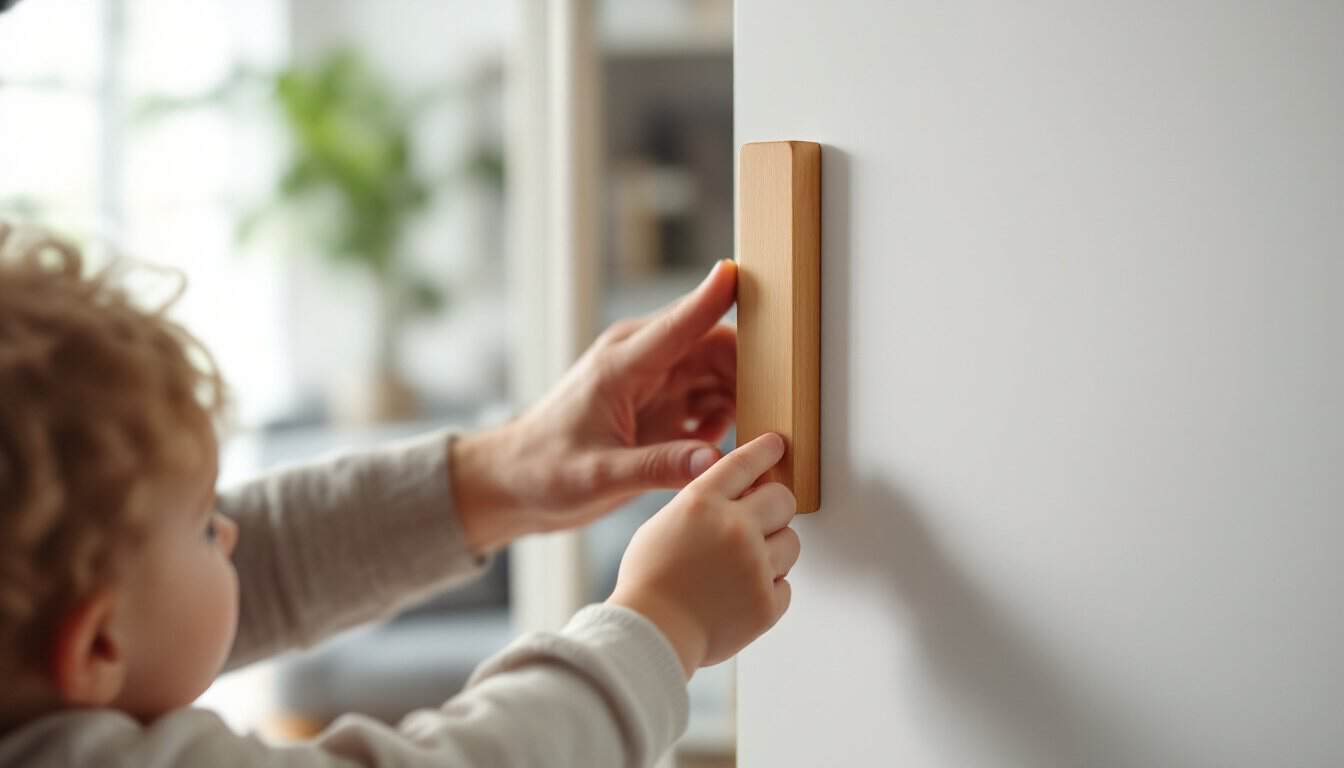
Why do Jews kiss the mezuzah?
This is the question many passers-by ask: why do people touch the door, then kiss their fingers?
The gesture is ancient. The Talmud tells the story of Onkelos, a Roman nobleman who converted to Judaism (Avodah Zarah 11a; elsewhere, the Talmud presents him as the nephew of the emperor Titus, Gittin 56b). The emperor sends soldiers to bring him back. As he leaves his house with them, Onkelos places his hand on the mezuzah and asks them: “What is this?” “You tell us,” they reply. He then explains: “Ordinarily, the king sits inside and his servants guard him from outside. But with the Holy One, blessed be He, His servants sit inside, and it is He who guards them from outside, as it says: ‘The L-rd will guard your going out and your coming in, from now and forever’ (Tehillim [Psalms] 121:8).” The soldiers, moved, convert in turn.
The Rema records the custom of placing one’s hand on the mezuzah when leaving home and saying: “The L-rd is my guardian, the L-rd is my shade at my right hand” (Rema on Yoreh De’ah 285:2, based on Tehillim 121:5). The habit of then bringing one’s fingers to one’s lips is reported in the name of the Arizal, the great master of Kabbalah in sixteenth-century Safed, by the commentators on the Shulchan Aruch. It is most often done when entering and leaving the house.
This kiss has nothing to do with worshipping an object. People kiss a Torah book they have dropped, they kiss the tzitzit during the Shema, they kiss the mezuzah. It is a gesture of affection toward the word of G-d, the way one kisses a photo of a loved one. And above all it is a way of becoming aware of a moment that would otherwise go unnoticed: I am crossing a threshold.
A mezuzah is not an amulet
This is probably the most widespread misconception, and Jewish tradition has fought it vigorously. The mezuzah does not “bring luck” and does not work like a talisman.
On this point the Rambam is exceptionally severe. He speaks of those who write names of angels, holy names, verses or additional signs inside the mezuzah, and writes that they are “among those who have no share in the World to Come.” Why such severity? Because, he says, “these fools” do not merely cancel the mitzvah: they take a great commandment, which consists in proclaiming the oneness of G-d, His love and His service, and turn it into an amulet for their own benefit, imagining that it will be useful to them for the vanities of the world (Hilchot Mezuzah 5:4).
This does not mean that the mezuzah has nothing to do with protection. The Talmud itself says that it guards the house, as in the story of Onkelos. But the protection comes from G-d, not from the object, and it works through what the mezuzah does to a person: reminding him, every day, under whose gaze he lives. A mezuzah put up out of superstition and then forgotten misses the essential point.
The reasons for the mezuzah: what the Sages say
Waking a person from routine
The most famous text on the meaning of the mezuzah is found at the end of the Rambam’s laws on the subject. It deserves to be quoted almost in full: “A person must be very careful with the mezuzah, for it is a constant obligation upon everyone. Every time he comes in and goes out, he will encounter the oneness of the Name of the Holy One, blessed be He, he will remember His love, he will awaken from his slumber and from his absorption in the vanities of the time, and he will know that nothing endures forever except the knowledge of the Rock of the world. He immediately returns to clarity of mind and walks in the paths of the upright” (Rambam, Hilchot Mezuzah 6:13).
And the Rambam adds: the early Sages said that whoever has tefillin on his head and arm, tzitzit on his garment and a mezuzah on his door is assured that he will not sin, for he has many reminders, and these are the angels that protect him, as it says: “The angel of the L-rd encamps around those who fear Him, and delivers them” (Tehillim 34:8; Menachot 43b).
The idea is simple and profound: people forget. The mezuzah turns the mechanical act of coming in and going out into an appointment, and places Judaism’s most important proclamation, “the L-rd is One,” at the spot through which all of daily life passes.
Sanctifying the home
The mezuzah also says something about the Jewish home. The Shema asks us to speak the words of the Torah “when you sit in your house.” The home is not a neutral space, sheltered from the sacred: it is the first place where the Torah must be lived, in the way we speak, welcome guests and raise children. The Sefer HaChinuch, a thirteenth-century work that explains the 613 commandments, sees the mezuzah as a constant reminder of faith in G-d placed at the heart of existence (Sefer HaChinuch, mitzvah 423).
This is also why women, who are exempt from certain commandments tied to a specific time, are fully obligated in mezuzah (Mishnah Berachot 3:3). The home belongs to all who live in it, and so does the word that protects it. The Talmud explains that the verse promises “so that your days may be multiplied”: women too need this blessing (Berachot 20b).
A promise of life and protection
The second passage of the mezuzah ends with the promise “so that your days and the days of your children may be multiplied” (Devarim 11:21). The Talmud links several teachings to the mezuzah. Rav Huna says: “Whoever is careful with the mezuzah merits a beautiful dwelling” (Shabbat 23b). Conversely, the Talmud sees neglect of this commandment as a cause of misfortune for the family (Shabbat 32b).
The most touching story is told by the Jerusalem Talmud (Pe’ah 1:1). The Parthian king Artaban sends Rabbi Yehudah HaNasi, the editor of the Mishnah, a pearl of priceless value, asking in return for an object just as precious. Rabbi sends him a mezuzah. The king is astonished: “I sent you a priceless object, and you send me back something worth a coin!” Rabbi sends back this reply: “Neither my possessions nor yours can equal it. You sent me something that I must guard; I sent you something that guards you while you sleep,” and he quotes the verse: “When you walk, it will lead you; when you lie down, it will watch over you” (Mishlei [Proverbs] 6:22).
A little history: the mezuzah through the centuries
The mezuzah is attested very early. The oldest known mezuzah parchments were found among the Dead Sea Scrolls, in the caves of Qumran (notably in caves 4 and 8), and date from the Second Temple period, more than two thousand years ago. They show that the practice was already well established at that time, even though the texts chosen and their layout show some variations compared with the practice later fixed by the Talmud.
The historian Flavius Josephus, in the first century, also describes the custom of inscribing G-d’s kindnesses on the doors of houses (Antiquities of the Jews IV, 213). The Mishnah and the Talmud, between the second and sixth centuries, set out its laws in detail, notably in the tractate Menachot.
In the Middle Ages, the halachic authorities had to fight against the addition of names of angels and magical formulas, hence the severity of the Rambam in the twelfth century; this is also the period of the debate between Rashi and Rabbeinu Tam on the position of the mezuzah.
Today, the mezuzah is probably the most visible Jewish sign in public space: on the doors of homes, offices, hotels, Israeli government ministries and army bases. For many Jews, even those far from religious practice, putting up a mezuzah when moving in remains a natural gesture, often a young couple’s first religious act in their home.
What Rav Raphaël Benizri teaches
Rav Benizri did not devote an entire lecture to the mezuzah, but he returns to it in several teachings, drawing from it a lesson on how to inhabit space and time.
The mezuzah in space, the shofar in time
In his lecture Elul and the cry of the shofar, the Rav brings together two mitzvot which, according to the Rambam, keep a person in a state of constant wakefulness: the shofar in time, and the mezuzah in space. Growing old, he explains, is not first of all a matter of age: it is remaining in a way of life where everything becomes everyday, repetitive, natural. The mezuzah calls on us to change our attitude as we pass from one space to another. As long as one stays in the same space, there is no need for a mezuzah; but as soon as the public domain must be separated from the private domain, one is needed. And every time we pass a mezuzah, a change of attitude and behavior is called for. The shofar does the same thing in time: “Wake up, you sleepers, from your slumber.”
Shaddai, the Name that sets limits
In Vaera: why there is suffering, the Rav dwells on the Name written on the back of the mezuzah. It is not the four-letter Name, the Name of inner knowledge, but Shaddai, the Name by which G-d says: it is I who set limits to the expansion of My creation. G-d does not ask those who believe in Him to scatter themselves in space or to try to confine Him within it, since it is He who contains space; He asks to be grasped in time, in the existence He shares with them. We must not look for G-d outside ourselves, but within. The mezuzah on our doors thus tells us: be careful, there are limits to respect in space, even if our behavior changes from one place to another, as long as we remain consistent with ourselves.
He takes up this idea again in Bereshit: the beginning of Creation. Among the things that, according to the Sages, preceded the creation of the world is the Throne of Glory, which expresses the ability not to be overwhelmed by creation, to manage it, to limit it. The Rav connects it to Shaddai, “the attribute displayed on the doors of our houses,” the mezuzah setting the limits of our activities within a given space. This, he says, is the principle of Providence: the world is not left to chance; G-d continues to manage it.
The mezuzah is not enough
The Rav also warns against a practice that would be content with the gesture alone. In Bereshit Rabbah 40, part 1: the beauty of Sarah, he recalls that the book of Bereshit is not first of all a book of commandments, but the “book of the upright,” the book of the way of being that the patriarchs bequeathed to us, onto which the mitzvot are then grafted. “Putting a mezuzah on the door of your house commits you to nothing,” he says: that’s that, but what are we deep inside ourselves? It is not the mezuzah that fulfills our being: it gives a direction to our home. It is much harder, he adds, to master one’s anger. The mezuzah points out a path; it is up to the person to walk it.
Between the mezuzah and the light of Chanukah
The Talmud asks that the Chanukah lights be kindled at the entrance of the house, on the left, opposite the mezuzah, which is on the right, so that the person entering is surrounded by mitzvot (Shabbat 22a). In Chanukah: Jewish re-education, the Rav gives this arrangement a powerful meaning. What threatens the Jewish people is the “transfer” of its identity, the abandonment of its inner life in favor of the surrounding culture. This transfer, he says, threatens us at the door of the house, not on the right side where the mezuzah is placed, but on the left side, through which every kind of deviation of thought can seep in. Hence the place of the chanukiah: on the left, opposite the mezuzah, so that a person passes between the two and stands in the middle of what he has received.
At the threshold, the Divine Presence
Finally, in Elul: the role of man, the Rav describes the progression of the festivals of Tishrei: a relationship like that of a couple on Rosh Hashanah, a relationship of father and son on Yom Kippur, then Sukkot, when the house is built, “but at the threshold of the door, at the mezuzah, not between four walls,” and when the Shechinah, the Divine Presence, settles in with us like a member of the household. The mezuzah marks that place of the threshold where the relationship with G-d becomes a way of dwelling.
Frequently asked questions about the mezuzah
Can a non-Jew have a mezuzah?
The mitzvah concerns Jews in their own home. A non-Jew is not obligated, and halachic authorities discuss whether it is appropriate to give one a mezuzah, notably out of concern that it may not be treated with the respect due to a sacred text. For a particular case, such as a mixed couple or a friend who asks for one, consult a rabbi.
Does every door in the house need a mezuzah?
Yes, in principle every door of a living space, not only the front door: bedrooms, living room, kitchen, study. Bathrooms and toilets are exempt. Some places raise specific questions (garage, storage room, a door without a lintel): ask a rabbi for advice.
Can I put up the mezuzah myself?
Yes, and that is in fact the custom: everyone puts up their own mezuzot, reciting the blessing. Many invite a rabbi or friends for the occasion and hold a small celebration to inaugurate the home, the chanukat habayit. No intermediary is needed.
What should I do with an old, damaged mezuzah?
A mezuzah parchment contains the Name of G-d: it is not thrown in the trash. An invalid mezuzah is placed in a genizah, the place where worn-out sacred texts are collected for burial, often at the synagogue. The case itself can be reused.
Does the mezuzah protect the house?
Tradition says that G-d guards those who live under the mezuzah, as in the story of Onkelos. But it is not a good-luck charm: the Rambam severely condemns those who turn it into an amulet. Its protection works through what it awakens in a person: the awareness that his home stands under G-d’s gaze.
Further reading
A few lines on a rolled parchment, fixed to a doorpost: almost nothing. And yet, each time we pass, the most ordinary threshold becomes the place where we remember that “the L-rd is One,” and where we decide what kind of home we want to live in.
- Elul and the cry of the shofar
- Vaera: why there is suffering
- Chanukah: Jewish re-education
- Why eight candles on Chanukah?
- What does the Shema Yisrael mean?
- What are tefillin?
- What are tzitzit, the “fringes” Jews wear?
- What are the 613 commandments (mitzvot)?
- Glossary of Hebrew words in Judaism
Sources and references
- Devarim (Deuteronomy) 6:4-9 and 11:13-21 (the two passages of the mezuzah); Devarim 6:9; 11:20-21
- Shemot (Exodus) 12:7; 12:13; 12:22-23 (the blood on the doorposts in Egypt)
- Shemot (Exodus) 21:6 (the slave at the door and the doorpost)
- Tehillim (Psalms) 34:8; 121:5; 121:8
- Mishlei (Proverbs) 6:22
- Mishnah Menachot 3:7
- Mishnah Berachot 3:3
- Babylonian Talmud, Menachot 33a, 33b-34a, 43b, 44a
- Babylonian Talmud, Yoma 10a-11b
- Babylonian Talmud, Kiddushin 22b
- Babylonian Talmud, Avodah Zarah 11a (Onkelos); Gittin 56b
- Babylonian Talmud, Shabbat 22a, 23b, 32b
- Babylonian Talmud, Berachot 20b
- Jerusalem Talmud, Pe’ah 1:1 (Artaban and Rabbi Yehudah HaNasi)
- Rashi on Shemot (Exodus) 21:6
- Rambam, Mishneh Torah, Hilchot Tefillin uMezuzah veSefer Torah 5:4 and 6:13
- Sefer HaChinuch, mitzvah 423
- Shulchan Aruch, Yoreh De’ah 285 to 291, notably 285:2 (Rema); 286:2; 286:22; 288:15; 289:1-2; 289:6 (Rema); 291:1
- Flavius Josephus, Antiquities of the Jews IV, 213
- Dead Sea Scrolls: mezuzah fragments from Qumran caves 4 and 8
- Rav Raphaël Benizri, Elul and the cry of the shofar
- Rav Raphaël Benizri, Vaera: why there is suffering
- Rav Raphaël Benizri, Bereshit: the beginning of Creation
- Rav Raphaël Benizri, Bereshit Rabbah 40, part 1: the beauty of Sarah
- Rav Raphaël Benizri, Chanukah: Jewish re-education
- Rav Raphaël Benizri, Elul: the role of man
Article by the Pensées Juives editorial team. Passages attributed to Rav Raphaël Benizri are taken from his lectures published on this site.