

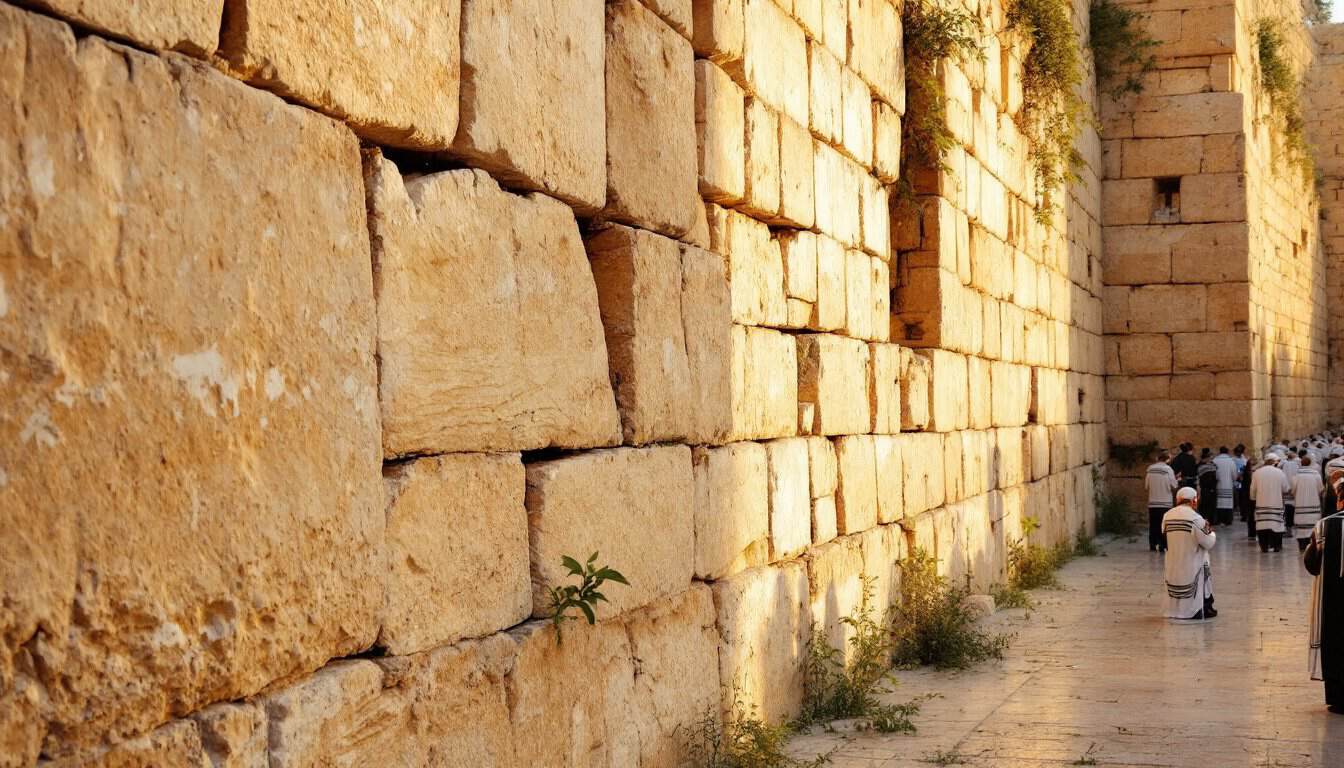
In the morning, in a synagogue or at the Western Wall, you can see men wearing a small black square box on their forehead, and another on their arm, held in place by a leather strap wound down to the hand. These are tefillin. What do these boxes contain? Why are they worn in that precise spot, and only on weekdays? Here is a complete answer: the verses, the Talmud, how they are made, how they are put on, their history and the meaning of a commandment that has been observed for more than two thousand years.
In short: tefillin (in Hebrew tefilin, often called “phylacteries” in English) are two perfectly square black leather boxes containing passages from the Torah handwritten on parchment. One is bound on the left arm, facing the heart; the other on the head, above the forehead. The Torah commands it four times: “You shall bind them as a sign upon your hand, and they shall be totafot between your eyes” (Devarim [Deuteronomy] 6:8). Jewish men put them on every weekday morning, from their bar mitzvah onwards, during prayer. The texts they contain proclaim the oneness of G-d and recall the Exodus from Egypt: by putting them on, a person dedicates his mind, his heart and his deeds to G-d.
What does the word “tefillin” mean?
The word tefillin (תְּפִלִּין) does not appear in the Torah. It comes from the language of the Sages, the language of the Mishnah and the Talmud. It is most often linked to tefillah, “prayer”, because tefillin are worn during the morning prayer. Others connect it to the root pelel, which evokes judgment and proof: tefillin would then be a testimony that one wears on oneself.
The Torah itself uses three words. It speaks of an ot, a “sign”, on the hand; of a zikaron, a “remembrance”, between the eyes (Shemot [Exodus] 13:9); and of totafot, a rare and mysterious word, for the head box (Shemot 13:16; Devarim 6:8 and 11:18). Rabbi Akiva explains that tat means “two” in one language of the time and pat means “two” in another: totafot therefore means “four” (Menachot 34b). This is the source for the head box being divided into four compartments.
In English, they are often called phylacteries, from the Greek phylaktērion, “an object that protects”. This ancient name is misleading: tefillin are not a talisman, as we shall see.
What the Torah says: four passages
The commandment to wear tefillin is given four times in the Torah, and it is precisely these four passages that are enclosed in the boxes.
- Kadesh (Shemot 13:1-10). The consecration of the firstborn and the remembrance of the Exodus from Egypt. “It shall be for you a sign upon your hand and a remembrance between your eyes, so that the Torah of the L-rd may be in your mouth, for with a strong hand the L-rd brought you out of Egypt” (Shemot 13:9).
- Vehaya ki yeviacha (Shemot 13:11-16). The redemption of the firstborn, and the answer to give the child who asks “What is this?”. The passage again ends with the sign upon the hand and the totafot between the eyes (13:16).
- Shema (Devarim 6:4-9). “Hear, O Israel, the L-rd is our G-d, the L-rd is One” (6:4), followed by the love of G-d and the commandment of tefillin (6:8).
- Vehaya im shamoa (Devarim 11:13-21). The second paragraph of the Shema, which ties the life of the people to the keeping of the commandments: “You shall place these words of Mine upon your heart and upon your soul, and bind them as a sign upon your hand…” (11:18).
These four texts sum up the foundations of the Jewish faith: the Exodus from Egypt, in which G-d intervenes in history and sets free, and the oneness of G-d, with the love and responsibility that flow from it. The two passages from Deuteronomy also make up the Shema Yisrael, recited morning and evening.
The Talmud draws a strong conclusion from this. Whoever recites the Shema without wearing tefillin, says Ulla, is like someone who gives false testimony against himself: he proclaims “you shall bind them” and does not bind them (Berachot 14b). And Rav Sheshet teaches that whoever does not put on tefillin transgresses eight positive commandments, since the command is given four times, for the hand and for the head (Menachot 44a).
Should the verse be taken literally?
One could read “as a sign upon your hand” figuratively: never forget. The Rashbam, Rashi’s grandson, even notes that the simplest literal meaning allows such a reading, along the lines of the verse “Set me as a seal upon your heart” (Rashbam on Shemot 13:9; Shir HaShirim [Song of Songs] 8:6). But Jewish tradition, handed down through the Oral Torah, has always understood the commandment concretely, and the Rashbam himself does not call the practice into question. The form of the tefillin is a halachah leMoshe miSinai, a law transmitted orally to Moshe at Sinai: the square shape, the black color of the straps, the letter shin in relief, the shape of the knots (Menachot 35a-35b). The verse gives the principle; the tradition gives the manner.
How are tefillin made?
A pair of tefillin consists of two separate items: the tefillah shel yad, for the arm, and the tefillah shel rosh, for the head. Each is an independent mitzvah: the Mishnah states that the absence of one does not prevent the fulfillment of the other (Menachot 38a), and the Sefer HaChinuch counts them as two commandments (mitzvot no. 421 and 422).
The boxes
The boxes, called batim, “houses”, are made from the leather of a kosher animal, that is, a species permitted for eating. They must be perfectly square (Menachot 35a) and painted black. Each box rests on a wider base, the titura, and has at the back a passage, the ma’abarta, through which the strap slides.
- The arm box contains a single compartment, in which the four passages are written one after the other on a single parchment.
- The head box is divided into four compartments, each containing a separate parchment (Menachot 34b). On its two sides, the letter shin is molded in relief: on the right, an ordinary three-pronged shin; on the left, according to tradition, a four-pronged shin.
The parchments
The texts are handwritten by a sofer, a specialized scribe, on klaf, a parchment prepared from the hide of a kosher animal, with black ink and a quill. The writing follows the same strict rules as that of a Torah scroll: every letter must be well formed and separate from the others; a single missing or damaged letter renders the whole unfit.
That is why a pair of tefillin costs several hundred euros. They are checked by a sofer from time to time, because the ink can flake.
The straps
The retzuot, the straps, are made of leather and black on their outer side: this too is a law transmitted to Moshe at Sinai (Menachot 35a). The head strap forms a knot at the back in the shape of the letter dalet; the arm strap forms a small knot near the box in the shape of a yud, as Rashi explains. Together with the shin on the box, these three letters, shin, dalet, yud, spell the divine name Shaddai, “the Almighty”, which also appears on the mezuzah.
Rashi and Rabbeinu Tam
Rashi and his grandson Rabbeinu Tam disagree on the order of the four parchments in the head tefillin (Tosafot on Menachot 34b). The general custom follows Rashi (Shulchan Aruch, Orach Chaim 34:1); some, especially among Sephardim and Chassidim, also put on a pair “of Rabbeinu Tam” at the end of the prayer, in order to fulfill the obligation according to all opinions (34:2).
How are tefillin put on?
Here are the main steps, as they are learned before a bar mitzvah. For the details specific to each community, consult a rabbi.
The arm first
One begins with the arm tefillin, because the verse mentions the hand first, then the eyes (Devarim 6:8; Menachot 36a). It is placed on the left arm, the one used less: the Talmud reads the word yadcha, “your hand”, as yad keihah, “the weak hand” (Menachot 37a). A left-handed person therefore puts it on the right arm.
The box is placed on the upper arm, on the muscle, turned slightly toward the body. The Talmud learns this from the verse “you shall place these words of Mine upon your heart” (Devarim 11:18): the box must be facing the heart (Menachot 37b). One recites the blessing: “Baruch Atah… asher kideshanu bemitzvotav vetzivanu lehaniach tefillin”, “who has sanctified us with His commandments and commanded us to put on tefillin”. The strap is tightened, then wound seven times around the forearm.
Then the head
Next, the head box is placed above the forehead, at the hairline, in the middle, “where a newborn’s skull is still soft”, as the Sages say (Menachot 37a-b). “Between your eyes” therefore does not mean the space between the eyebrows, but the top of the forehead, in line with the center of the face. The dalet-shaped knot sits at the back, on the nape of the neck, and the two straps hang down over the chest.
According to Ashkenazi custom, a second blessing, “al mitzvat tefillin”, is said over the head tefillin, followed by “Baruch shem kevod malchuto le’olam va’ed”. According to Sephardi custom, only one blessing is said for both, provided one does not speak between putting on the first and the second (Shulchan Aruch, Orach Chaim 25:5 and the Rema).
The morning betrothal
Finally, one returns to the arm: the strap is wound three times around the middle finger and across the palm, tracing the letters of the name Shaddai. During this gesture, many recite the verses of the prophet Hoshea: “I will betroth you to Me forever; I will betroth you to Me in righteousness and in justice, in kindness and in mercy; I will betroth you to Me in faithfulness, and you shall know the L-rd” (Hoshea [Hosea] 2:21-22). The strap around the finger evokes a ring: every morning, the covenant is renewed.
At the end of the prayer, the tefillin are removed in reverse order: first the head tefillin, then the arm tefillin, because the Talmud deduces from the verse that as long as the head tefillin is in place, the arm tefillin must be too (Menachot 36a).
Who wears them, and when?
Every weekday morning
Tefillin are worn by day, not at night (Menachot 36b). The custom today is to put them on during the morning prayer, Shacharit, particularly for the reading of the Shema and the Amidah, and to remove them at the end of the service. In the time of the Talmud, the Sages wore them all day long, and the Rambam points out that the mitzvah is to wear them the whole day, and all the more so during prayer (Hilchot Tefillin 4:25). But this requires a clean body and a mind that does not let itself be distracted. The Sages, says the Talmud, require for tefillin “a body as pure as that of Elisha, the man of the wings” (Shabbat 49a). That is why today people limit themselves to the time of prayer.
Not on Shabbat or festivals
Tefillin are not worn on Shabbat or on festivals (Shulchan Aruch, Orach Chaim 31:1). The Talmud explains it this way: tefillin are a “sign” between G-d and Israel; and Shabbat and the festivals are themselves called a “sign” (Shemot 31:13). On those days, the sign is already present: there is no need to add another (Menachot 36b; Eruvin 96a). For the intermediate days of the festivals (Chol HaMoed), customs differ (Orach Chaim 31:2). The fast of Tisha B’Av is a special case: as a sign of mourning, tefillin are not worn in the morning, but at the afternoon prayer.
From bar mitzvah onwards
The obligation begins at 13, the age of religious majority for a boy. In many Ashkenazi families, boys begin putting them on a month or two beforehand, to get used to them; among many Sephardim, they are put on for the first time on the day of the bar mitzvah itself, often a Monday or a Thursday, the days the Torah is read.
What about women?
Women are exempt from tefillin. The Talmud classes them among the time-bound positive commandments, since they are worn neither at night nor on Shabbat, from which women are generally exempt (Kiddushin 34a-35a). The Talmud relates that Michal, daughter of King Shaul, wore tefillin, and that the Sages did not object (Eruvin 96a). But the halachic authorities later discouraged this practice: the Rema writes that one should object to it (Orach Chaim 38:3), and the commentators explain this by the requirements of bodily purity that tefillin demand. This is the position of traditional Judaism; some liberal movements have adopted a different custom.
Why tefillin? The reasons for the commandment
The Torah itself gives the first reason: “so that the Torah of the L-rd may be in your mouth, for with a strong hand the L-rd brought you out of Egypt” (Shemot 13:9). The commentators have developed several levels of explanation, which complement one another.
The heart and the brain
The Shulchan Aruch asks whoever puts on tefillin to have a precise intention. He should think that G-d commanded us to place these four passages, which speak of His oneness and of the Exodus from Egypt, on the arm facing the heart and on the head facing the brain, so that we remember the miracles He performed for us, and so as to subject to Him the soul, which resides in the brain, and the desires and thoughts of the heart (Orach Chaim 25:5).
The Sefer HaChinuch, a 13th-century work on the 613 commandments, points out that a person is shaped by his actions: concrete, repeated gestures are needed to engrave ideas within us (mitzvot no. 421-422).
The arm, the head, and the order of things
The order of the gestures also carries a lesson. One begins with the arm, then the head. The arm represents action; the head, thought. In Judaism, action does not have to wait until everything has been understood: at Sinai, the people said “na’aseh venishma”, “we will do and we will understand” (Shemot 24:7).
A remembrance that grounds faith
The Ramban, at the end of his commentary on parashat Bo (Shemot 13:16), offers an overall explanation. The miracles of the Exodus from Egypt showed that the world has a Creator, that He knows what happens in it and that He intervenes in it. But G-d does not repeat these miracles in every generation; that is why He gave commandments that preserve their memory, such as tefillin, the mezuzah or Pesach, a permanent testimony to these truths.
The effect on a person
The Rambam describes the effect of tefillin on the one who wears them: “The holiness of tefillin is very great. As long as the tefillin are on a man’s head and arm, he is humble and G-d-fearing, he is not drawn into frivolity and idle talk, he does not stray into bad thoughts, but turns his heart to words of truth and righteousness” (Mishneh Torah, Hilchot Tefillin 4:25).
The tefillin of G-d
The Talmud contains a surprising teaching: G-d Himself “wears tefillin” (Berachot 6a). What do they contain? Our tefillin say: “Hear, O Israel, the L-rd is our G-d, the L-rd is One.” G-d’s tefillin say: “Who is like Your people Israel, one nation on earth?” (Divrei HaYamim I [1 Chronicles] 17:21). The Talmud adds that when Moshe asked to see the divine glory and was told “you shall see My back” (Shemot 33:23), G-d showed him the knot of His tefillin (Berachot 7a).
This is not a matter of attributing a body to G-d, but of saying that the relationship is mutual: Israel proclaims the oneness of G-d, and G-d “proclaims” the uniqueness of Israel.
A visible sign before the world
Finally, the Torah says: “All the peoples of the earth shall see that the name of the L-rd is called upon you, and they shall fear you” (Devarim 28:10). Rabbi Eliezer the Great teaches that this verse refers to the head tefillin (Berachot 6a; Menachot 35b). The head box is not only a reminder for oneself; it is a mark of dignity, a way of publicly embracing one’s bond with G-d.
The history of tefillin
The tefillin of Qumran
We know with certainty that tefillin were worn in the Second Temple period. In the caves of Qumran, near the Dead Sea, and in other caves of the Judean Desert, archaeologists found leather boxes and tiny parchments covered in closely packed writing. The Israeli archaeologist Yigael Yadin published a remarkable set of them in 1969. These pieces date mostly from around the turn of the Common Era. Some contain additional texts, such as the Ten Commandments; the Mishnah and the Talmud later fixed the rules that have remained those of the entire Jewish people. The historian Flavius Josephus, in the 1st century, also mentions the obligation to inscribe G-d’s kindnesses on the head and on the arm (Jewish Antiquities IV, 213).
The time of persecution
The Talmud tells a story that has become famous (Shabbat 49a and 130a). The Roman authorities had decreed the death penalty for anyone who wore tefillin. Elisha nevertheless wore them in the open street. An officer chased him. Elisha took the tefillin off his head and hid them in his hand. “What do you have in your hand?” “Dove’s wings.” He opened his hand, and dove’s wings were found in it. From then on he was called Elisha Ba’al Kenafayim, “the man of the wings”.
A mitzvah that returns in the 20th century
On the eve of the Six-Day War, in June 1967, the Lubavitcher Rebbe, Rabbi Menachem Mendel Schneerson, launched a campaign to offer every Jewish man the chance to put on tefillin, even if only once. After the reunification of Jerusalem, thousands of soldiers and visitors put them on at the Western Wall.
What Rav Raphaël Benizri teaches
Rav Benizri returns to tefillin several times in his lectures.
The third sign of the covenant
In his lecture on parashat Lech Lecha, The dialogue of revelation, the Rav recalls that a Jew bears “signs”, otot, of his covenant with G-d: Shabbat, circumcision and tefillin. A Jew, he explains, is a bearer of witnesses. Circumcision is part of his very being. Tefillin, which he calls “the concentrate of the Jewish faith”, are worn every day except Shabbat, because Shabbat is itself a sign. Wearing tefillin, says the Rav, is a concrete way of bearing G-d’s covenant.
Avraham’s shoelace
In The war against the four kings, the Rav comments on Avraham’s refusal, after his victory, to take from the king of Sodom “neither a thread nor a shoelace” (Bereshit [Genesis] 14:23). The Sages link this refused thread to the thread of the tzitzit, and this shoelace, made of leather at the time, to the straps of the tefillin (see Sotah 17a). For the Rav, this is the only spoil Avraham brings back from that war: the right to wear these signs, “of which it is said that all the peoples of the earth shall see that the name of G-d is called upon you”.
In place of the Pharaohs’ serpent
In his lecture on the four questions of the Ma Nishtana, the Rav draws a striking parallel. The kings of Egypt wore the uraeus on their foreheads, a serpent’s head, a symbol of knowledge. The Torah, he says, replaced it with tefillin: in place of the serpent, four parchments, which the Rav sums up as follows: the oneness of G-d, the sanctification of the firstborn, the remembrance of the Exodus from Egypt and the redemption.
Regularity before great feats
In a lecture on the Ethics of the Fathers (Pirkei Avot, part 7), the Rav answers someone who wants to take up spiritual practices reserved for an elite, such as tikkun chatzot, the midnight prayer. His answer is simple: “I would rather you put on tefillin every day.” Put the emphasis on the regularity of daily prayer, on the laws of Shabbat, on peace in the home; the rest will come of itself. Spiritual greatness begins with faithfulness to the gestures of every day.
Tefillin are not enough
The Rav also warns against a practice that would remain purely external. In a lecture on Bereshit Rabbah, chapter 40, he remarks that putting on tefillin, affixing a mezuzah or eating kosher, in the end, “commits you to nothing” if one stops there. It is not the mezuzah that brings our being to fulfillment: it gives the home a direction; tefillin give content to this way of being. It is far harder, he says, to master one’s anger. The Sages said of a person who flies into a rage that it is as if he worshipped an idol, something they said of no commandment. The Rav makes clear that this does not make the mitzvot unimportant: they give a direction, but the work on oneself still has to be done.
Common misconceptions about tefillin
“They are amulets.” No. The word “phylacteries” suggests it, but tefillin are not a good-luck charm. They contain passages of the Torah that anyone can read in their own Bible, with no magic formula. Regarding the mezuzah, the Rambam speaks out forcefully against those who turn it into an amulet by adding names of angels to it: they transform a mitzvah that unites a person with G-d into an object of protection for their own benefit (Hilchot Tefillin, Mezuzah veSefer Torah 5:4). Tefillin remind and commit; they do not protect mechanically.
“You have to be very observant to put them on.” No. The mitzvah applies to every Jewish man over 13, whatever his level of observance, and putting them on for a single day is already fulfilling a mitzvah.
“The boxes are empty, or contain only a symbol.” They hold four complete texts from the Torah, handwritten letter by letter. Without them, the boxes have no value.
Frequently asked questions about tefillin
What exactly do tefillin contain?
Four passages from the Torah written on parchment: Shemot 13:1-10; Shemot 13:11-16; Devarim 6:4-9 (the Shema); Devarim 11:13-21. In the arm box, they are written one after the other on a single parchment; in the head box, on four separate parchments, each in its own compartment.
Why are tefillin black and square?
These are rules handed down by the oral tradition since Sinai, according to the Talmud (Menachot 35a). The square evokes stability and uprightness; the black, sobriety. But the primary reason is faithfulness to a form that was received.
Can you put on tefillin without knowing Hebrew?
Yes. The mitzvah consists of putting on tefillin with the intention of fulfilling the commandment. You can recite the blessing by reading a transliteration, and say the Shema in a language you understand. It is good, afterwards, to learn the meaning of the texts little by little.
Until what time can tefillin be put on?
Ideally, they are worn during the morning prayer. But someone who did not put them on in the morning can still do so at any time during the day, until sunset, even if only for a few minutes, while reciting the Shema. For special cases (travel, work early in the morning), consult a rabbi.
Can a non-Jew put on tefillin?
No, tefillin are a sign of the covenant specific to the Jewish people. A non-Jew, however, is entirely welcome to look at them, ask questions and respect this practice. Judaism does not ask non-Jews to adopt its signs, but to follow the seven Noahide laws.
Further reading
- Lech Lecha: the dialogue of revelation
- The war against the four kings (part 1)
- The four questions of the Ma Nishtana
- Pirkei Avot, part 7: a teacher, a friend, a judgment
- What does the Shema Yisrael mean?
- What are tzitzit, the “fringes” that Jews wear?
- What is the mezuzah fixed to doorposts?
- What are bar mitzvah and bat mitzvah?
- Glossary of Hebrew words in Judaism
Sources and references
- Shemot (Exodus) 13:1-10; Shemot 13:11-16 (especially 13:9 and 13:16)
- Devarim (Deuteronomy) 6:4-9 (especially 6:8); Devarim 11:13-21 (especially 11:18)
- Devarim 28:10
- Shemot 24:7; Shemot 31:13; Shemot 33:23
- Bereshit (Genesis) 14:23
- Hoshea (Hosea) 2:21-22
- Shir HaShirim (Song of Songs) 8:6
- Divrei HaYamim I (1 Chronicles) 17:21
- Babylonian Talmud, Berachot 6a, 7a and 14b
- Babylonian Talmud, Shabbat 49a and 130a
- Babylonian Talmud, Eruvin 96a
- Babylonian Talmud, Kiddushin 34a-35a
- Babylonian Talmud, Sotah 17a
- Babylonian Talmud, Menachot 34b (and Tosafot), 35a-35b, 36a-36b, 37a-37b, 38a and 44a
- Rashbam on Shemot 13:9
- Ramban on Shemot 13:16
- Rambam, Mishneh Torah, Hilchot Tefillin, Mezuzah veSefer Torah 4:25; 5:4
- Sefer HaChinuch, mitzvot no. 421 and 422
- Shulchan Aruch, Orach Chaim 25:5 (with the Rema); 31:1-2; 34:1-2; 38:3 (Rema)
- Flavius Josephus, Jewish Antiquities IV, 213
- Yigael Yadin, Tefillin from Qumran (XQ Phyl 1-4), Jerusalem, 1969
- Rav Raphaël Benizri, The dialogue of revelation
- Rav Raphaël Benizri, The war against the four kings (part 1)
- Rav Raphaël Benizri, The four questions of the Ma Nishtana
- Rav Raphaël Benizri, Pirkei Avot, part 7
- Rav Raphaël Benizri, Bereshit Rabbah 40, part 1
Article by the Pensées Juives editorial team. Passages attributed to Rav Raphaël Benizri are taken from his lectures published on this site.