
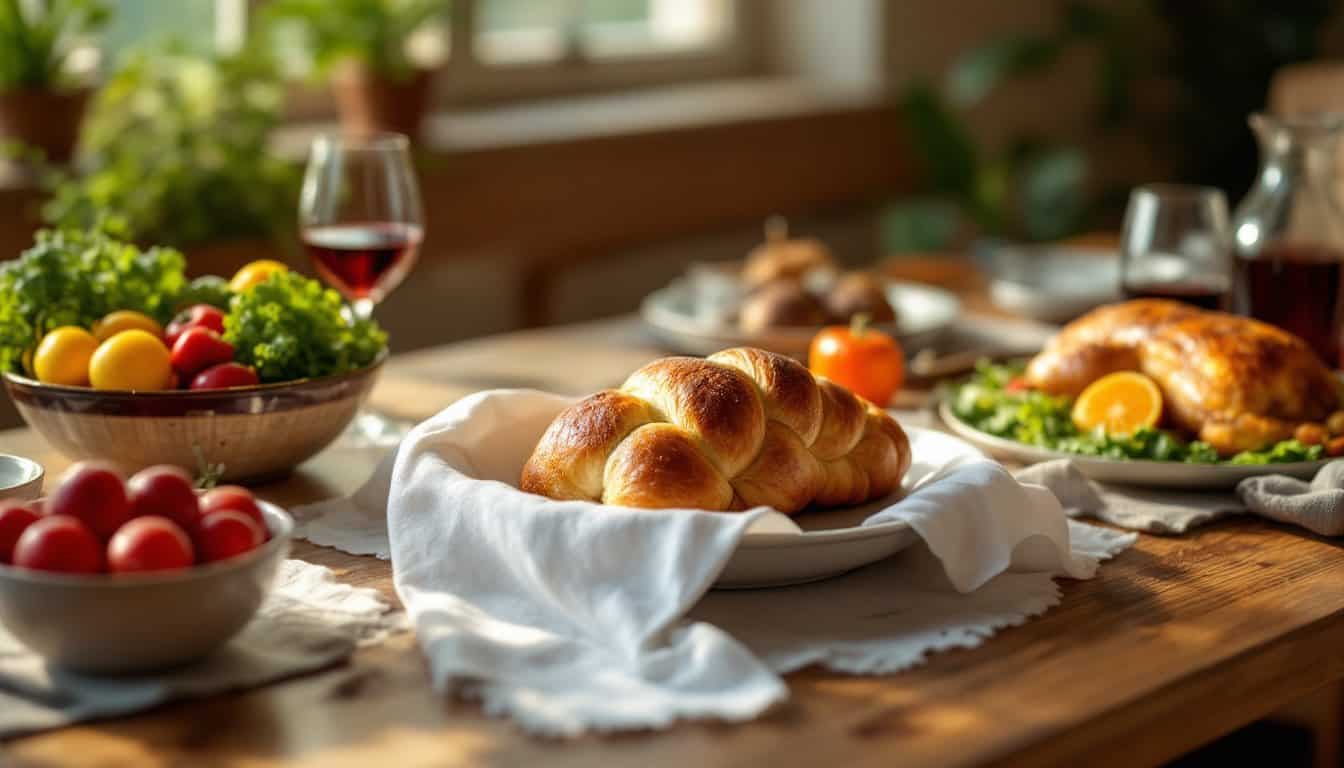
A small logo on a packet of biscuits, a special aisle in the supermarket, a butcher’s shop with a certificate hanging on the wall, a friend who politely turns down a dish that looks delicious: the word “kosher” is part of everyday life, yet few people really know what it covers. Is it about hygiene, a rabbi’s blessing, family tradition? Here is a complete answer: the meaning of the word, the rules of the Torah, what the Talmud and the great Sages say about them, the history, and above all the deeper reasons why Jews eat kosher.
In short: kosher (also spelled kasher; in French casher or cachère) is a Hebrew word meaning “fit”, “proper”, “in order”. Applied to food, it refers to food that Jewish law permits one to eat. The whole body of these rules is called kashrut. They come from the Torah itself: some animals are permitted and others forbidden (Vayikra [Leviticus] 11; Devarim [Deuteronomy] 14), meat must come from an animal slaughtered according to a precise rite and drained of its blood, and meat and milk are never mixed. So a food is not kosher because a rabbi has blessed it, but because it has been produced and prepared according to these laws. In Jewish tradition, kashrut is first and foremost a commandment of G-d, a discipline of holiness that turns the most everyday act of all, eating, into an act of awareness.
Where does the word “kosher” come from?
The Hebrew root k-sh-r expresses the idea of what is fitting, of what is in a state to succeed. It appears in the Bible, but never in connection with food. In the Book of Esther, the queen says to the king: “if the thing seems right (vekhasher hadavar) before the king” (Esther 8:5). The Book of Kohelet (Ecclesiastes) uses the same verb to speak of what “will succeed” (Kohelet 11:6).
When the Torah speaks about food, it does not use the word kosher. It speaks of animals that are tahor (“pure”) and tameh (“impure”), and of what is “permitted” or “forbidden” to eat. It was the language of the Mishna and the Talmud that made the word kosher widespread, to say that an object or an act is valid according to the law. So a Torah scroll, a sukkah or a pair of tefillin are said to be “kosher”, meaning that they are in order and can be used for the mitzvah (the commandment). Everyday usage then kept mainly the food-related meaning.
The different spellings come from different pronunciations. Sephardic communities say “kasher”; Ashkenazic communities pronounce it “kosher”, which is where the English word comes from. French dictionaries accept casher, cachère, kasher and kascher. The opposite of kosher is taref (or treif, tereifa), a word that originally referred to an animal “torn” by a predator and that came to describe any forbidden food.
What the Torah says: permitted and forbidden animals
The heart of the laws of kashrut is found in two chapters of the Torah: Vayikra 11 (in the parasha of Shemini) and Devarim 14 (in the parasha of Re’eh). They give criteria, and sometimes lists, for each major family of animals.
Mammals: two signs
“Any animal that has a split hoof, divided into two, and that chews the cud, among the beasts, you may eat” (Vayikra 11:3). Both signs are needed at the same time. The ox, the sheep, the goat, the deer and the gazelle have them; the Book of Devarim (14:4-5) gives a list of ten species.
The Torah then names four animals that have only one of the two signs and remain forbidden: the camel, the shafan (the hyrax) and the arnevet (the hare), which chew the cud but do not have split hooves, and the pig, which has split hooves but does not chew the cud (Vayikra 11:4-7). This is why, over the course of history, the pig became the very symbol of forbidden food. The horse, the rabbit, the dog and the cat, which have neither sign, are obviously excluded as well. This subject is developed in our article Why don’t Jews eat pork or seafood?.
Fish: fins and scales
“These you may eat of all that is in the waters: whatever has fins and scales in the waters, in the seas and in the rivers, them you may eat” (Vayikra 11:9). Salmon, tuna, sardines and cod are permitted. Shellfish and molluscs (shrimp, lobster, oysters, mussels) are forbidden, and so are some fish without visible scales, such as eel, catfish and monkfish.
The Mishna makes a remarkable observation: every fish that has scales also has fins, but the reverse is not true (Mishna Niddah 6:9). In practice, then, it is enough to check for scales, provided they can be detached from the skin.
Birds: a list and a tradition
For birds, the Torah gives no signs: it lists about twenty forbidden species, almost all of them birds of prey or scavengers, such as the eagle, the vulture, the raven and the owl (Vayikra 11:13-19; Devarim 14:11-18). All the others are permitted in principle. But since the exact identification of the Hebrew names has been partly lost, the Sages handed down additional signs (Mishna Chullin 3:6), and the halachic authorities ruled that a bird may be eaten only if there is an unbroken tradition (masoret) that it is permitted (Rema, Yoreh De’ah 82:3). This is the case for chicken, turkey, duck, goose and pigeon.
Insects and small creatures
All insects, worms and “small creatures that creep on the earth” are forbidden (Vayikra 11:41-43). The Torah makes a single exception for four kinds of locusts (Vayikra 11:21-22). Only a few communities, in particular the Jews of Yemen and some North African Jews, have preserved a precise tradition about how to identify them. Everyone else refrains, as a precaution.
This prohibition of insects has a very practical consequence that is often overlooked: fruit, vegetables, grains and pulses have to be checked. A lettuce, a head of broccoli or strawberries may harbour tiny insects. The vegetable is kosher; the insect hiding in it is not.
Meat: ritual slaughter, blood and forbidden parts
It is not enough for an animal to belong to a permitted species. For its meat to be kosher, several conditions must be met.
Shechita, ritual slaughter
The Torah says: “you shall slaughter of your cattle and of your sheep […] as I have commanded you” (Devarim 12:21). The Talmud asks: where, then, did the Torah command how to slaughter? Nowhere in the written text. It concludes that the rules of slaughter were transmitted orally to Moshe at Sinai (Chullin 28a). This is one of the classic examples showing that the Written Torah cannot be understood without the Oral Torah.
Shechita is carried out in one continuous movement, without pausing or pressing down, with a perfectly sharpened knife free of even the slightest nick, which severs the windpipe and the oesophagus (for a bird, one of the two is enough). The shochet, the slaughterer, is a pious and trained man who knows the laws in detail and checks his knife before and after every animal. The Rambam explains that this method of slaughter was chosen because it brings about the quickest and least painful death possible (Moreh Nevukhim [Guide for the Perplexed] III, 48).
An animal that died on its own or was killed in any other way is called nevela: its meat is forbidden (Devarim 14:21).
The inspection: the animal must be healthy
After slaughter, the animal is examined. If it shows certain serious lesions, particularly in the lungs, it is declared tereifa, “torn”, meaning that it had an injury or disease it would not have survived. Its meat is forbidden, even if it was slaughtered according to the rules: “you shall not eat flesh torn in the field; you shall throw it to the dogs” (Shemot [Exodus] 22:30). The Mishna lists the main categories of tereifot (Chullin 3:1).
When the lungs are perfectly smooth, with no adhesions at all, the meat is called glatt in Yiddish, or chalak in Hebrew, meaning “smooth”. This is the standard required by the Shulchan Aruch, which Sephardic communities follow; many Ashkenazim have adopted it as well.
Blood: “for the blood is the soul”
The prohibition of blood is one of the most often repeated in the Torah. It already appears with Noah, when G-d permits humanity to eat meat: “Only flesh with its soul, its blood, you shall not eat” (Bereshit [Genesis] 9:4). It comes up again several times, with its reason: “for the soul of the flesh is in the blood” (Vayikra 17:11); “for the blood is the soul, and you shall not eat the soul with the flesh” (Devarim 12:23).
This is why kosher meat is koshered: after slaughter, it is soaked in water, then covered with coarse salt for a set length of time, before being carefully rinsed (Shulchan Aruch, Yoreh De’ah 69). The liver, which is very rich in blood, can only be koshered by broiling over a fire (Yoreh De’ah 73). Even an egg with a blood spot in it is set aside.
Fats and the sciatic nerve
The Torah also forbids certain fats, called chelev, which were offered on the altar in the time of the Temple (Vayikra 3:17; 7:23-25), as well as the gid hanasheh, the sciatic nerve, in remembrance of Yaakov’s struggle with the angel, during which he was injured in the hip (Bereshit 32:33). Removing these parts is called nikkur (deveining). It is so delicate for the hindquarters of the animal that in many countries, including France, these cuts are often simply not sold as kosher.
Milk and meat: a complete separation
“You shall not cook a kid in its mother’s milk.” This enigmatic verse appears three times in the Torah (Shemot 23:19; 34:26; Devarim 14:21). The Talmud explains that this threefold repetition teaches three prohibitions: eating meat cooked with milk, cooking them together, and deriving benefit from such a mixture (Chullin 115b).
The oral tradition extended this law to the meat of any permitted animal, and the Sages added poultry (Mishna Chullin 8:1). In practice, a kosher kitchen has two separate sets of dishes, one for meat (besari, often called “fleishig”) and the other for dairy (chalavi, or “milchig”). After eating meat, one waits a certain time before having dairy products: six hours according to the Rambam and the Shulchan Aruch (Yoreh De’ah 89:1), three hours or one hour according to some Ashkenazic customs. The Talmud already reports that Mar Ukva would wait from one meal to the next (Chullin 105a).
Foods that are neither meat nor dairy, such as vegetables, fruit, eggs or fish, are called pareve (neutral) and may go with either. For all the details, see our article Why don’t Jews mix meat and milk?.

Kashrut today: from the kitchen to the supermarket
In biblical times, people slaughtered their own animals, baked their own bread and pressed their own wine. Today, almost everything we eat is processed by industry. Kashrut has adapted to this new world without changing its principles.
Processed foods
A biscuit may contain gelatine (often from pigs), a flavouring extracted from an animal, a colouring made from insects (carmine, E120) or an emulsifier of animal origin, or it may have been made on a machine that is also used for dairy products. This is why industrial products carry a certification (in Hebrew, hekhsher), issued by a rabbinical body that checks the ingredients and the manufacturing process. In France, the Beth Din of Paris, linked to the Consistoire, and other bodies publish lists of approved everyday products every year. The supervisors who carry out on-site checks are called mashgichim.
Wine, bread and cooked dishes
Some rules do not come from the Written Torah but from the Sages, who instituted them to protect the identity of the Jewish people. In the past, wine had to be kept away from any idolatrous use, since it was poured out as a libation to idols; this is why kosher wine is produced and handled only by Shabbat-observant Jews (once it has been cooked, or “mevushal”, most halachic authorities hold that this restriction no longer applies). The Talmud also records decrees concerning bread, oil and dishes cooked by non-Jews, instituted to limit an excessive closeness at the table that would have led to intermarriage (Avoda Zara 35b-38a). These decrees, known as pat akum and bishul akum, involve important nuances depending on the food and the community.
Milk, too, is subject to a rule of the Sages: it must have been milked under supervision, to make sure it has not been mixed with the milk of a forbidden animal (Mishna Avoda Zara 2:6). For the general principle is that whatever comes from an impure animal is impure (Mishna Bekhorot 1:2): mare’s milk or camel’s milk is forbidden. Honey is the exception: bees do not produce it from their own bodies, they make it from the nectar of flowers (Bekhorot 7b).
At home
In a kosher home, meat is bought from a supervised butcher, meat and dairy utensils are kept separate, and vegetables, herbs and dried fruit are checked to make sure they contain no insects. When new metal or glass utensils made by a non-Jew are bought, they are immersed in a ritual bath, the mikveh, before being used: this is tevilat kelim, learned from the account of the war against Midian (Bamidbar [Numbers] 31:21-23). The same passage is the source for kashering utensils, with boiling water or fire depending on how they are used.
In the Land of Israel, there are additional laws specific to agriculture: portions set aside from the harvest (terumah and maaser), the prohibition of a tree’s fruit during its first three years (orlah), and the sabbatical year (shemitah). For all special cases, such as a kitchen that changes hands or a utensil used for the wrong food by mistake, consult a rabbi.
Why do Jews eat kosher? The reasons
The question springs to mind at once: why so many rules for a simple meal? Jewish tradition answers it on several levels, which do not exclude one another.
First of all, a commandment of G-d
The Torah itself does not give a detailed reason for most of these laws. They belong to the chukim, decrees whose deeper meaning partly escapes us and which we fulfil out of faithfulness. On this subject, Rashi quotes a famous teaching of Rabbi Elazar ben Azaria: “A person should not say: I have no desire to eat pork. Rather, he should say: I do want to, but what can I do, since my Father in Heaven has forbidden it to me” (Rashi on Vayikra 20:26, based on the Sifra).
This text is essential. It means that kashrut is not a matter of taste, or of distaste, or of cultural preference. It is an act of relationship: I give something up because G-d asks it of me. Every meal thus becomes an opportunity to affirm that I am not guided by my appetites alone.
A school of holiness
The only reason the Torah gives explicitly is holiness. At the end of the chapter on permitted and forbidden animals, it concludes: “You shall sanctify yourselves and you shall be holy, for I am holy” (Vayikra 11:44), and again: “to distinguish between the impure and the pure” (Vayikra 11:47). The Book of Devarim links these laws directly to the identity of the people: “For you are a holy people to the L-rd your G-d” (Devarim 14:2).
In Jewish thought, holiness (kedusha) does not mean fleeing the world, but bringing into it a measure, a separation, a choice. Eating is an animal need; eating while choosing, pausing and waiting turns that need into a human and spiritual act. The Midrash says it in one sentence: “The mitzvot were given only to refine people. What difference does it make to the Holy One, blessed be He, whether one slaughters an animal at the throat or at the back of the neck?” (Bereshit Rabba 44:1). The aim is not to “feed” G-d with our rules, but to transform ourselves.
What you eat becomes what you are
Several commentators add a moral and spiritual dimension. The Ramban notes that almost all the forbidden birds are birds of prey, and explains that the Torah wanted to keep people away from the flesh of cruel animals, so that their nature would not leave its imprint on them (Ramban on Vayikra 11:13). The permitted animals, by contrast, are mostly peaceful herbivores.
The Talmud reads in a verse from this same chapter, “do not make yourselves impure through them, lest you be defiled by them” (Vayikra 11:43), an allusion to the “blocking of the heart” (timtum halev): forbidden food dulls a person’s spiritual sensitivity (Yoma 39a). What we eat affects not only the body but also the soul.
Respect for life
The prohibition of blood carries a clear lesson: even when the Torah allows an animal to be killed for food, it demands that people remember they are touching life itself. Blood “is the soul”; it is not consumed, and in the case of wild animals and birds, it must even be covered with earth (Vayikra 17:13). Shechita, which seeks to spare suffering, and the extreme care taken over the knife point in the same direction. Tradition also points out that mankind was permitted to eat meat only after the Flood (Bereshit 9:3): meat is a concession, not an ideal.
Health? A secondary explanation
It is often said that kashrut is a hygiene rule: pork transmits parasites, and seafood spoils quickly in the climate of the Middle East. The Rambam himself suggested an explanation of this kind for certain foods (Moreh Nevukhim III, 48). But many commentators, including Don Isaac Abravanel in his commentary on Vayikra 11, rejected the idea that this is the main reason: the Torah, they say, is not a medical textbook, and many peoples eat pork without harm. Turning kashrut into mere dietetics would empty it of its meaning and make it obsolete as soon as science advances.
A bond across the centuries
Finally, kashrut has had a considerable historical effect: it has shaped Jewish life around the family and community table. Sharing a kosher meal means sharing the same discipline and the same memory. Throughout the centuries of exile, it was one of the strongest bonds between scattered Jews, from Fez to Vilna.
A little history
Faithfulness to the dietary laws appears very early in the texts. The Book of Daniel tells how the young Daniel, exiled to Babylon and brought up at the king’s court, “resolved in his heart not to defile himself with the king’s food or with the wine he drank” (Daniel 1:8). He asks to eat only vegetables and water, and ends up healthier than all the other young men.
In the 2nd century BCE, under the Seleucid king Antiochus IV, refusing pork became a matter of life and death. The Second Book of Maccabees tells the story of the old man Eleazar and that of a mother and her seven sons, who chose to die rather than eat the forbidden meat. It was these persecutions that led to the revolt of the Hasmoneans, whose victory is commemorated at Hanukkah.
Archaeology sheds interesting light on this: at sites in the highlands of Israel from the biblical period, pig bones are almost absent, whereas they are common in the neighbouring Philistine cities. Many archaeologists see this as one of the markers of ancient Israelite identity.
In modern times, industrialisation gave rise to rabbinical certification as we know it. In the United States, the Orthodox Union began putting its symbol on industrial products in the 1920s; today, tens of thousands of products around the world carry a kosher label, and a large share of the people who buy them are not even Jewish. In Europe, shechita is regularly the subject of debate: Switzerland banned slaughter without stunning as early as 1893, and several countries and regions have followed since, forcing the communities concerned to import their meat.
Common misconceptions about kosher food
“Kosher food is food that has been blessed by a rabbi.” No. A rabbi does not bless food to make it kosher. He checks that it has been produced according to the rules. An apple from the orchard is kosher without any rabbi ever seeing it; a beef steak from an animal slaughtered without shechita is not, even if every blessing in the world is said over it.
“Kosher is healthier.” Not necessarily. A kosher cake contains as much sugar as any other. Kashrut is not a diet, even though some of its requirements (inspection of the animal, control of the ingredients) offer guarantees of quality.
“It’s enough not to eat pork.” Far from it. Beef or chicken not slaughtered by shechita, seafood, mixing meat and milk, and non-kosher wine are all just as forbidden.
“Fish and meat are the same thing.” No. Fish does not require shechita and is not subject to the prohibition of milk and meat. Under a separate rule, based on a health concern mentioned in the Talmud (Pesachim 76b), fish and meat are nevertheless not cooked or eaten together (Shulchan Aruch, Yoreh De’ah 116:2).
“Kashrut is a relic of the past.” On the contrary, it is one of the most living practices in Judaism, observed by millions of people, and it constantly adapts to food technology, from the chemistry of flavourings to industrial machinery.
Frequently asked questions about kosher food
What is the difference between kosher and halal?
The two systems have some points in common, such as the prohibition of pork and, in principle, the slaughter of a conscious animal with a blade. But they differ on many others: kashrut also forbids mixing meat and milk, certain fats, the sciatic nerve and seafood, and requires very precise rules for the knife, the shochet and the inspection of the lungs. Halal meat is therefore not kosher.
Can a non-Jew eat kosher food?
Of course. Nothing forbids it, and many non-Jews buy kosher products for their quality or their traceability. The laws of kashrut are binding only on Jews. According to tradition, all of humanity is only required not to eat a limb torn from a living animal, one of the seven laws of the children of Noah (Sanhedrin 56a).
Do all Jews keep kosher?
No. Observant Jews keep kashrut in full. Many others keep part of it: they do not eat pork or seafood, or they buy their meat from a kosher butcher without keeping two sets of dishes. Every step counts, and Judaism regards every mitzvah fulfilled as precious.
What does “pareve” mean?
It is a Yiddish word for a neutral food, neither meat nor dairy: vegetables, fruit, grains, eggs, fish. It can be eaten with either a meat meal or a dairy meal. On labels, the word pareve also indicates that the product contains no dairy or meat ingredients.
Why is kosher meat more expensive?
Because producing it takes much more work: a qualified slaughterer, the inspection of every animal (some of which are declared unfit), the removal of forbidden fats and nerves, koshering with salt, and constant supervision. In some countries, giving up the hindquarters of the animal raises the cost even further.
Is kosher slaughter more respectful of the animal?
Jewish law forbids causing an animal unnecessary suffering (tza’ar ba’alei chayim), and shechita was designed to bring about a rapid death, with a perfectly sharpened knife, in a single movement. The question of prior stunning is debated in Europe; rabbinical authorities hold that an animal stunned by the usual methods is likely to be injured and thus rendered tereifa, and they defend shechita as a method that respects the animal.
How can you tell if a product is kosher?
Check whether it carries a recognised certification label, or whether it appears on the list published by a rabbinical authority (in France, the list of the Beth Din of Paris). Fresh unprocessed produce, fruit and vegetables, is kosher by nature, provided it is checked. When in doubt, consult a rabbi.
Further reading
Kashrut does not begin at the supermarket: it begins with the way we look at what we put in our mouths. Three times a day, it reminds us that a human being is not only a creature that consumes, but a creature that chooses, and that can make its table a place of holiness.
- Why don’t Jews eat pork or seafood?
- Why don’t Jews mix meat and milk?
- What is Shabbat?
- Weekly parasha: Rav Benizri’s lectures
- Shavuot: the giving of the Torah and the Book of Ruth
- Why do we eat matzah on Pesach?
- “The Fragrances of a Blessing”: the berakhot
- Glossary of Hebrew terms in Judaism
Sources and references
- Torah: Bereshit (Genesis) 9:3-4; Bereshit 32:33; Shemot (Exodus) 22:30; Shemot 23:19; Shemot 34:26; Vayikra (Leviticus) 3:17; Vayikra 7:23-25; Vayikra 11 (verses 3-7, 9, 13-19, 21-22, 41-47); Vayikra 17:11-13; Bamidbar (Numbers) 31:21-23; Devarim (Deuteronomy) 12:21 and 23; Devarim 14:2-21
- Other biblical books: Esther 8:5; Kohelet (Ecclesiastes) 11:6; Daniel 1:8
- Second Book of Maccabees, chapters 6 and 7
- Mishna: Niddah 6:9; Chullin 3:1; Chullin 3:6; Chullin 8:1; Avoda Zara 2:6; Bekhorot 1:2
- Babylonian Talmud: Chullin 28a; Chullin 105a; Chullin 115b; Avoda Zara 35b-38a; Bekhorot 7b; Yoma 39a; Pesachim 76b; Sanhedrin 56a
- Midrash: Bereshit Rabba 44:1; Sifra on Vayikra 20:26 (quoted by Rashi)
- Rashi on Vayikra 20:26
- Ramban (Nachmanides) on Vayikra 11:13
- Rambam (Maimonides), Moreh Nevukhim (Guide for the Perplexed) III, 48
- Don Isaac Abravanel, commentary on Vayikra 11
- Shulchan Aruch, Yoreh De’ah 69 (salting meat); 73 (liver); 89:1 (waiting between meat and milk); 116:2 (fish and meat)
- Rema (Rabbi Moshe Isserles), Yoreh De’ah 82:3 (tradition regarding birds)
Article by the Pensées Juives editorial team.