
Every Shabbat, in every synagogue in the world, the same scroll is taken out and the same passage of the Torah is read. This portion is called the weekly parashah. Where does this weekly appointment come from, how is the cycle organized, why are two parashiyot read on certain weeks, and how can one turn it into real study? Here is a complete guide, illuminated by the lectures of Rav Raphaël Benizri.
The weekly parashah is the portion of the Torah read publicly in the synagogue on Shabbat morning. The Five Books of Moshe are divided into 54 portions, called parashiyot (singular parashah, “section”). One is read each week, in order, and the cycle begins again every year in the autumn. The last portion, Vezot Haberachah, is read on Simchat Torah. On the following Shabbat, the reading resumes from the very first word: Bereshit, “In the beginning.” The parashah also gives its name to the entire week. In the Jewish world, people do not only say “the week of October 12”: they say “the week of Noach” or “the week of Lech Lecha.”
For the year 5787, the calendar is as follows. Sukkot begins on the evening of Friday, September 25, 2026, and on Shabbat, September 26, a passage specific to the festival is read rather than the weekly parashah. Shemini Atzeret begins on the evening of Friday, October 2. In Israel, Simchat Torah falls on the same day, Saturday, October 3. In the Diaspora, it begins on the evening of Saturday, October 3, and is celebrated on Sunday, October 4. On Shabbat, October 10, 2026, every community opens the scroll once again at Parashat Bereshit.
A simple definition: parashah, sidra, 54 portions
The Hebrew word parashah means “section,” “a delimited passage.” In the Torah scroll, it first refers to the small units of the text, separated by blank spaces. Some are called “open” (petuchot): the text resumes on the next line. Others are called “closed” (setumot): a space separates the passages on the same line. But in common usage, “the parashah” refers to the large weekly portion. Ashkenazi communities also call it the sidra, “order” or “arrangement.” One detail is worth knowing: the boundaries of the weekly portions are not marked in the scroll. The reader knows them by tradition, and printed editions of the Pentateuch, the chumashim, indicate them in the margin.
Each parashah bears the name of one of its first significant words. This name does not necessarily summarize the content: Parashat Chayei Sarah, “the life of Sarah,” opens with the death of Sarah. The parashah that recounts the giving of the Torah at Sinai is called Yitro, after a priest of Midian who came from outside. These names, as we shall see, often hold the key to understanding it.
The 54 portions are distributed among the five books as follows:
- Bereshit (Genesis): 12 parashiyot, from the creation of the world to the death of Yosef.
- Shemot (Exodus): 11 parashiyot, from slavery in Egypt to the completion of the Tabernacle.
- Vayikra (Leviticus): 10 parashiyot, on worship, purity and holiness.
- Bamidbar (Numbers): 10 parashiyot, the forty years in the wilderness.
- Devarim (Deuteronomy): 11 parashiyot, the final discourses of Moshe.
Why 54 portions, when an ordinary year has only 50 or 51 Shabbatot, and a leap year 54 or 55? First, because the last portion is read on Simchat Torah and not on a Shabbat. Next, because on certain Shabbatot the parashah is not read: when a festival falls on Shabbat, a passage specific to the festival is read instead. Finally, an ordinary Jewish year is shorter than a leap year, which has an extra month (two months of Adar). So that the cycle always ends on the same date, certain portions are therefore read in pairs. We will come back to this.
Where does the public reading of the Torah come from?
The public reading of the Torah is one of the oldest institutions of Judaism. The Torah itself prescribes a solemn reading. Every seven years, on the festival of Sukkot following the shemitah year (the sabbatical year), the entire people is gathered to hear the Torah: men, women, children and strangers (Devarim 31:10-13). This is the mitzvah of Hakhel, “assemble.”
The Talmud traces the custom of reading, on each festival, the passage that concerns it back to Moshe. It derives this from the verse “Moshe declared the festivals of the L-rd to the children of Israel” (Vayikra 23:44) (Megillah 32a). It also relates that the prophets instituted the readings on Monday, Thursday and Shabbat, so that three days would never pass without Torah. The Talmud connects this custom to the episode in which Israel walked three days in the wilderness “and found no water” (Shemot 15:22). And water, in the language of the Sages, refers to the Torah (Bava Kamma 82a).
The same passage attributes a decisive step to Ezra the Scribe. Having returned from the Babylonian exile in the fifth century BCE, he added a reading on Shabbat afternoon. He also set the framework for the Monday and Thursday readings: three readers, and at least ten verses. The book of Nechemiah recounts the founding scene. Ezra stands on a wooden platform before the whole people gathered in Jerusalem, and reads the Torah from morning until midday. “They read in the book, in the Torah of G-d, distinctly, and gave the sense, and they understood what was read” (Nechemiah 8:8). The Talmud sees in this verse the origin of the translation that accompanied the reading (Megillah 3a). The public reading was never a mere recitation: it had to be understood.
In his lecture on the chain of transmission, Rav Raphaël Benizri recalls this role of Ezra. On the return from Babylon, Ezra gathered around him the last prophets and the Elders: these are the Men of the Great Assembly. According to the Rav, it was they who gave the Torah and prayer their present structure. He also quotes the saying of the Sages that Ezra would have been worthy of receiving the Torah had Moshe not preceded him.
From the triennial cycle to the annual cycle
The one-year cycle was not always the rule. The Talmud notes that “the people of the West,” that is, the Jews of the Land of Israel, completed the reading of the Torah in three years (Megillah 29b). The communities of Babylonia, for their part, completed it in one year. The two customs coexisted for centuries. The Masoretic manuscripts preserve traces of the cycle of the Land of Israel: the text is divided there into a little more than 150 sections, called sedarim, whose number varies according to the sources. As late as the twelfth century, synagogues in Egypt are reported to have followed the custom of the Land of Israel.
It was the Babylonian custom that prevailed everywhere. The Rambam (Maimonides) observes this in the twelfth century: “The custom widespread throughout Israel is to complete the Torah in one year. One begins on the Shabbat after the festival of Sukkot and finishes on Sukkot. There are those who complete the Torah in three years, but that is not a widespread custom” (Mishneh Torah, Laws of Prayer 13:1). The result is remarkable: today, from one end of the world to the other, every community reads the same parashah in the same week, with a single exception that we will discuss below.
On the Shabbat after Sukkot, then, Bereshit begins. Every autumn, Israel reopens the first chapter of Genesis. We reread the creation of the world just as nature itself is preparing to fall asleep for the winter.
How the reading takes place on Shabbat
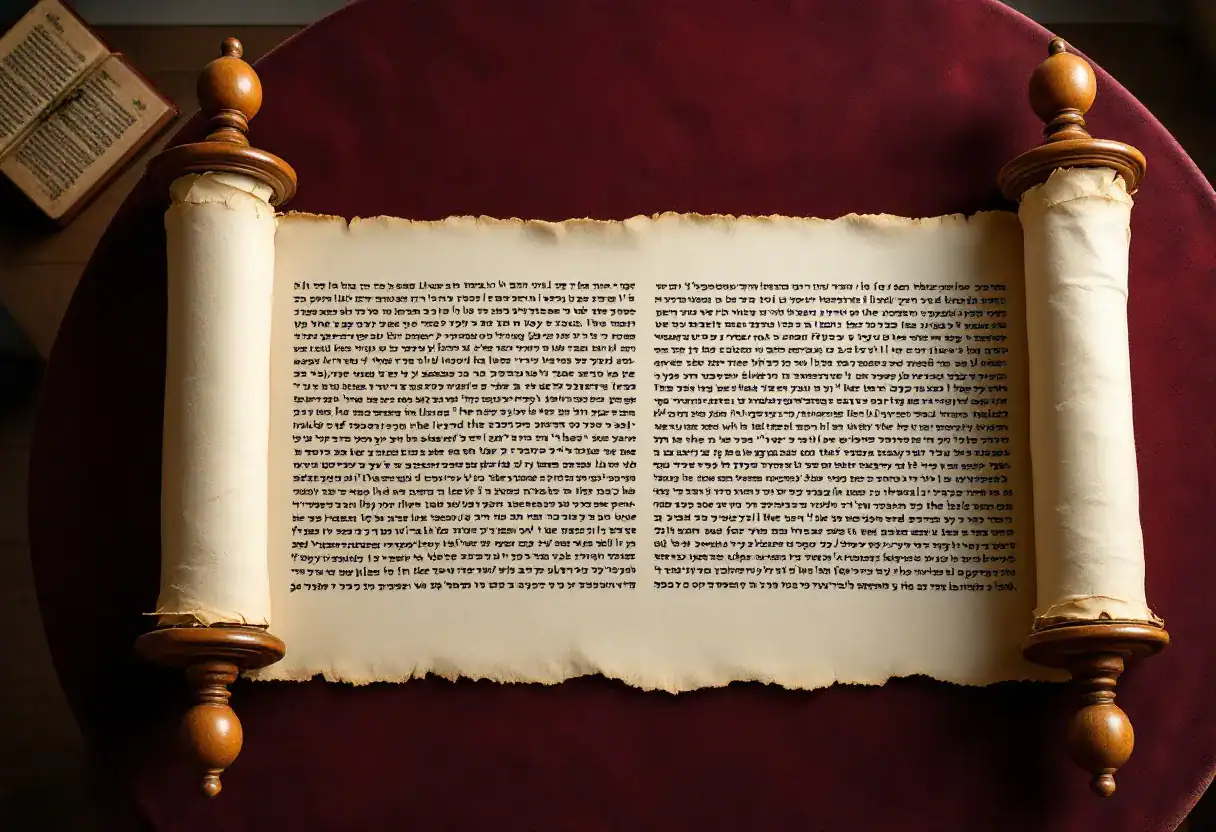
The reading is done from a Sefer Torah, a parchment scroll copied by hand by a scribe, the sofer. The text has neither vowels nor cantillation marks. The reader, called the baal korei, must have prepared his reading in order to chant it according to the traditional accents, the te’amim. A single damaged or erased letter is enough to render the scroll unfit for reading until it is repaired.
The parashah is divided into sections, and for each section a member of the congregation is called up to the Torah. This is the aliyah, the “going up.” The one who goes up recites a blessing before and after the reading. The Mishnah sets the minimum number of aliyot: three on Monday, Thursday and Shabbat afternoon, four on Rosh Chodesh (the beginning of the month) and on the intermediate days of festivals, five on festivals, six on Yom Kippur, seven on Shabbat (Mishnah Megillah 4:1-2). On Shabbat, more may be added. After the seven aliyot, the maftir is called: the last verses are reread for him, or, on special Shabbatot, a passage read from a second scroll. It is he who then reads the haftarah.
On Shabbat afternoon, at the Minchah service, the beginning of the following parashah is already read. This same beginning is read again on Monday and Thursday morning. The week is thus oriented toward the next Shabbat: one enters the parashah several days before reading it in full.
Finally, certain Shabbatot add a special reading, read from a second scroll. The Mishnah (Megillah 3:4) mentions the four “parashiyot” of the weeks preceding Pesach. Shekalim recalls the half-shekel given for the Temple. Zachor, read on the Shabbat before Purim, recalls the command to remember Amalek (see the Rav’s lecture on the war against Amalek). Parah deals with the red heifer and purification. Hachodesh announces the month of Nissan. A special passage is also read when Rosh Chodesh or a festival falls on Shabbat.
The haftarah: the Prophets echoing the Torah
After the Torah reading, the maftir reads a passage from the books of the Prophets, the haftarah. The word comes from a root meaning “to conclude” or “to take leave”: it is the reading that closes the Torah service. The Talmud requires that it contain at least 21 verses, unless the subject ends sooner (Megillah 23a-b). It is read from a printed book or from a scroll, with one blessing before and several after: one pleads for mercy upon Zion, another asks for the coming of Eliyahu the prophet and the restoration of the kingship of David.
The precise origin of the haftarah is not known with certainty. Several medieval commentators, notably the Abudraham, report an explanation: under a persecution that forbade the reading of the Torah, a passage from the Prophets recalling the theme of the parashah was read instead. When the Torah reading was restored, the haftarah was kept. Whether or not one accepts this explanation, the principle is clear. In general, the haftarah echoes the parashah through a word, a character or a theme. After the account of creation, for example, one reads the verses of the prophet Yeshayahu (Isaiah) about the Creator “who created the heavens and stretched them out” (Yeshayahu 42:5).
The calendar also imposes its own haftarot. The three Shabbatot preceding Tishah B’Av have haftarot of rebuke, the three “of affliction.” The seven Shabbatot following the fast have haftarot of consolation, the first of which opens with “Comfort, comfort My people” (Yeshayahu 40:1). Between Rosh Hashanah and Yom Kippur, Shabbat Shuvah takes its name from the haftarah “Return, O Israel” (Hoshea 14:2). The hubs on fast days and the month of Elul follow this path closely.
Rav Raphaël Benizri readily dwells on these choices. In Pesach: The Mystery of the Number Four, he offers a personal explanation of the “Great Shabbat” that precedes Pesach, Shabbat HaGadol: it closes the Shabbat of creation and prepares the birth of the people. And, he remarks, nothing else marks this Shabbat but its haftarah. It is taken from Malachi, the last of the prophets, who closes the book of prophecy and announces the messianic era. In Yom Kippur: The Book of Yonah and the Mission of Israel, he explains why the haftarah designated for the Minchah service of Yom Kippur is the book of Yonah. Yonah is a prophet who lives through the torment of a total commitment to G-d. For the Rav, life with G-d is not free of torment, and to claim otherwise would be entirely false: a person engaged on the path of spirituality passes through difficult trials.
Simchat Torah: the end that is a beginning
The annual cycle ends at the close of Sukkot. The Talmud already sets the reading for the last day of the festival: “Vezot Haberachah,” Moshe’s blessing to the tribes, is read, and the haftarah is Shlomo’s prayer at the inauguration of the Temple (Megillah 31a). This day later received the name Simchat Torah, “the joy of the Torah.” In Israel, it coincides with Shemini Atzeret. In the Diaspora, where festivals last one day longer, it is the second day of Shemini Atzeret.
Over the centuries, the festival has been enriched with customs that everyone knows today. All the scrolls are taken out of the ark and people dance around the reading platform in seven circuits, the hakafot. Every member of the congregation is called up to the Torah, often including children. Two people are honored: the chatan Torah, “the bridegroom of the Torah,” who reads the end of Deuteronomy, and the chatan Bereshit, “the bridegroom of the beginning,” who immediately reads the first chapter of Genesis from another scroll. The Torah is never finished without being begun again in the same breath. No day separates the last word, “before the eyes of all Israel,” from the first, “In the beginning.”
At the end of each book, the congregation rises and proclaims “Chazak, chazak venitchazek“: “Be strong, be strong, and let us be strengthened.” This transition from one book to the next inspired a striking commentary from the Rav. In Pekudei: The Inner Tabernacle, he observes that the Torah could have ended at the close of the book of Shemot: the sanctuary is complete and the cloud fills it. The last words of this parashah, the fire burning at night “before the eyes of all the house of Israel,” indeed echo the last words of the Torah. The difference lies in one expression: “throughout all their journeys.” The revelation has taken place, but it is now that the journey begins. What has been built is not an achievement to rest on; it is a point of departure. The same can be said of every Simchat Torah: we finish in order to set out again.
For the festival itself, see the page Sukkot and the article Why dwell in the sukkah?, as well as the Rav’s lecture Sukkot: The Festival of Joy.
Why are two parashiyot sometimes read on the same Shabbat?
The cycle must always end on Simchat Torah, whatever the number of Shabbatot available in the year. To adjust, seven pairs of parashiyot may be read together:
- Vayakhel and Pekudei, at the end of the book of Shemot;
- Tazria and Metzora;
- Acharei Mot and Kedoshim;
- Behar and Bechukotai;
- Chukat and Balak (in the Diaspora only);
- Matot and Masei;
- Nitzavim and Vayelech.
In an ordinary year, many of these pairs are combined. In a leap year, which has an extra month of Adar, almost all of them are read separately. The year 5787 is a leap year. In the Diaspora, only Chukat and Balak (July 17, 2027), Matot and Masei (July 31, 2027), and Nitzavim and Vayelech (September 25, 2027) are combined. In Israel, only the last two pairs are combined.
These adjustments are not left to chance. They follow markers set by tradition and codified in the Shulchan Aruch (Orach Chaim 428). Bamidbar is read before Shavuot. Devarim is read on the Shabbat before Tishah B’Av, followed by Va’etchanan, with its haftarah of consolation, just after the fast. Nitzavim is read before Rosh Hashanah. The Talmud gives the deeper reason: Ezra instituted that the curses of the book of Vayikra be read before Shavuot, and those of the book of Devarim before Rosh Hashanah, “so that the year may end together with its curses” (Megillah 31b).
Rav Raphaël Benizri starts precisely from this rule of Ezra in his lecture Elul: When the Curse Is a Blessing. He quotes the New Year wish: “may the year end with its curses, and may the year begin with its blessings.” Then he raises a question. The curses read before Shavuot, in Bechukotai, end with words of consolation. Those of Ki Tavo, read before Rosh Hashanah, end on the contrary with the threat of a return to Egypt. These threats we reread every year without being able to erase them: how, then, can the year begin with its blessings? The Rav relates that this question was put to Rabbi Shimon bar Yochai, hiding in his cave, and that at first he did not know what to answer. The secret was later revealed to him: the curse is in itself a blessing.
To understand this, the Rav distinguishes between the two series. The first set refers mainly to the destruction of the First Temple, and there is a consolation, since the Temple was rebuilt seventy years later. The second refers instead to the destruction of the Second Temple. He then draws on the verse read on the morning of Tishah B’Av: “When you beget children and grandchildren, and have grown old in the land” (Devarim 4:25). The word venoshantem, “you have grown old,” shares its root with yashen, “to sleep.” The greatest danger, the Rav explains, is this state of indolence and routine. The true disappearance of the people would not be physical: it would be assimilation, the day when no one would any longer distinguish between a Jew and a non-Jew. The exile itself, according to the Rav, came before its appointed time in order to prevent this death, and to compel the people to rethink itself. The curses read every year before Rosh Hashanah are therefore not an inescapable fate: they carry within them the promise that this people will endure.
Israel and the Diaspora: when the calendar shifts
All communities read the same parashah in the same week, except in one specific case. In the Diaspora, the festivals of Pesach and Shavuot have one more day than in Israel. When this extra day falls on Shabbat, the Diaspora reads the festival passage. In Israel, it is already an ordinary Shabbat, and the next parashah is read there. For a few weeks, Israel is therefore one parashah ahead. Then the Diaspora catches up by combining two portions that are read separately in Israel.
This is exactly what will happen in 5787. Shavuot begins on the evening of Thursday, June 10, 2027. In Israel, the festival lasts only one day, Friday, June 11. On Shabbat, June 12, Nasso is therefore read there. In the Diaspora, this Shabbat is the second day of Shavuot, and Nasso is read only on June 19. The gap lasts five weeks. On July 10, Israel reads Chukat and the Diaspora Korach. On Shabbat, July 17, 2027, the Diaspora reads Chukat and Balak together, while Israel reads Balak alone. From then on, everyone once again reads the same parashah.
For the traveler who goes from Israel to the Diaspora, or the reverse, during these weeks, the question of which parashah to follow, and how not to miss one, is dealt with in works of halachah. For a concrete case, consult a rabbi.
How to study the weekly parashah
Listening to the reading in the synagogue is a first step. Tradition asks for more: that each person study the parashah on their own during the week. The Talmud teaches: “A person should always complete his parashiyot together with the community: the text twice and the translation once” (Berachot 8a). This is the custom of shnayim mikra ve’echad targum. Each verse is read twice in Hebrew, then once in the Aramaic translation of Onkelos. The Shulchan Aruch codifies it (Orach Chaim 285) and specifies that the translation may be replaced by the commentary of Rashi, which explains the text. The pious read both. The ideal practice is to finish before the Shabbat morning meal.
Who was Onkelos? Rav Benizri recalls this in Pirkei Avot: Judging Without Setting Yourself Up as Judge. He was a convert, and yet it was he who translated and interpreted the Torah. His translation still accompanies the written text, and it is a mitzvah to read it every week. For the Rav, this is proof that converts have their place in the transmission, and a place of honor. In Elul: The Uniqueness of Each Person, he sees in the Targum of Onkelos the first true commentary written in a foreign language: a way of converting a culture from the profane to the sacred.
In practice, here is one way to go about it, whether you have ten minutes a day or two hours on Friday:
- Read the whole text, in Hebrew if possible, otherwise in a good bilingual translation. Dividing the parashah into seven parts, one per day, corresponds to the seven aliyot of Shabbat.
- Note the name of the parashah and ask yourself why it bears that name. The title often holds the key to understanding it.
- Read Rashi on the verses that surprise you. Rashi (Rabbi Shlomo Yitzchaki, Troyes, 1040-1105) almost always starts from a difficulty in the text: a repetition, a rare word, an unexpected order.
- Write down your own questions before looking for the answers. Why this story here? Why this detail? What does the text not say?
- Open a midrash on a passage, for example Bereshit Rabbah for the book of Bereshit.
- Share a question at the Shabbat table. For several parashiyot, the site offers printable booklets: one question per page, the Rav’s answer, its source and a lesson to discuss as a family.
- Listen to a lecture on the parashah, to hear how a master connects the verses to one another.
For the Hebrew terms encountered along the way, the site’s glossary explains them. And if you do not know which lecture to start with, the page Where to begin? suggests a path.

What Rav Raphaël Benizri teaches about the parashah
A large part of Rav Raphaël Benizri’s lectures follows the thread of the weekly parashah. They are gathered on the page Weekly Parashah. One can see a method in them, and also an idea of what it means to read the Torah week after week. Here are the main points that emerge from his lectures.
Mikra: a call to read, coming from the text
In Bereshit: The Beginning of Creation, the Rav dwells on the Hebrew word that designates Scripture and its reading: mikra. Ordinary reading is called keriah. The mikra, by contrast, is a call to read that comes from within: the text suggests its reading to me, and I read what it suggests to me. The initial mem makes the word a kli, an instrument, as in mizbe’ach, the altar. The Torah is the tool that makes it possible to read creation. It is needed precisely where “darkness covers the deep,” where one understands nothing and knows neither how to interpret nor how to read. One may begin with a rough approach, the Rav explains, but by dint of deepening and deciphering, one discovers a treasure of thought. This is a good definition of studying the parashah: letting the text raise its own questions.
Rereading every year is not repeating oneself
Why do these ancient stories still concern us? The Rav opens his lecture The Three Patriarchs: Mirrors of Our Own Lives with this sentence: “The repetition of the parashiyot corresponds to a renewed perspective on the history of man as Israel, and of Israel among all the nations.” The story of Avraham did not happen only once: it is replayed and reread from era to era, and the same is true of Yitzchak, Yaakov and Yosef. The book of Bereshit then becomes the mirror of a history, that of the Jewish people and that of humanity: “we are Avraham, we are Yitzchak, we are Yaakov, we are Yosef.” This is also what gives meaning to the rereading each year: the same story sheds light on a new era.
Rewriting the Sefer Torah every week
In Elul: The Uniqueness of Each Person, the Rav starts from an image. The Jewish people has as many souls as the Torah has letters, and each letter represents one of us. A single broken letter renders the scroll unfit: likewise, harm done to a single person affects the whole people. He adds that we are in the process of writing this Sefer Torah. Every week, we give it another connotation, another version, another spirit: we dust it off and breathe a new spirit into it. Just as G-d renews the work of creation every day, we renew it through the spirit we breathe into the text.
The name of the parashah as a key
The Rav pays close attention to titles. In Shemot: Naming — the Meaning of Names, he recalls that the five books bear the name of their first parashah, but that this name applies to the whole book. Bereshit is not only the account of creation; it is also the youth of the Jewish people through the Patriarchs. Shemot, “names,” announces what is at stake in the book: receiving an identity. In Chayei Sarah: The Death of Sarah, he points out that two parashiyot recount the passing of a righteous person and yet bear the word “life” in their title: Chayei Sarah, “the life of Sarah,” and Vayechi, “Yaakov lived.” The title does not hide the content: it corrects it, for the righteous, even in their death, are called living. And in Yitro: Who Was Yitro?, he starts from this anomaly: the parashah of the revelation at Sinai, the one that defines what it is to be a Jew, bears the name of a man who came from outside.
Two neighboring parashiyot, two lessons
The Rav also reads the parashiyot in pairs. In Tetzaveh: Elevating the Self, given between the reading of Terumah and that of Tetzaveh, he contrasts the two portions devoted to the Tabernacle. Terumah is the parashah of the heart’s impulse, in which the name of Moshe recurs constantly. But one cannot live on the heart’s impulse alone: discipline and law are needed as well. He warns against a spirituality made of “recipes,” closed circuits with neither novelty nor elevation. According to him, Judaism demands that we review our spirituality every day and enrich it with our experience.
Several readings, not just one
In Noach: The Tower of Babel, the Rav sees the misfortune of Babel in uniformity: a single interpretation, a single perception, a single language. When one swears by a single interpretation and stifles different sensibilities, there is no longer any possible unity, he says, for unity presupposes that we are different. One can read in this a lesson for study itself: the parashah is read with many voices, and the Shabbat table is made for that.
A study that resumes every year
Finally, at the end of a lecture on Noach, a listener asks whether they will continue with Noach the following week. The Rav answers no: they move on to Lech Lecha. Whatever they finish will be finished, and next year, if G-d grants him life, they will continue. He relates that he used to study Rashi this way with his teacher Emmanuel Levinas: every Shabbat, they would take up the parashah where they had left off the previous year. That is the whole spirit of the annual cycle. It is never exhausted, and that is precisely why one returns to it. His lectures, moreover, follow this rhythm: in Chayei Sarah: The Source of Life, he begins by translating the first verses “of this week’s parashah” before commenting on them.
The 54 parashiyot, book by book
Each parashah has its own page on the site, with its summary, its references, its themes and, where they exist, the Rav’s lectures that comment on it.
Bereshit
- Bereshit, Noach, Lech Lecha, Vayera, Chayei Sarah, Toldot, Vayetzei, Vayishlach, Vayeshev, Miketz, Vayigash, Vayechi
Shemot
Vayikra
- Vayikra, Tzav, Shemini, Tazria, Metzora, Acharei Mot, Kedoshim, Emor, Behar, Bechukotai
Bamidbar
Devarim
- Devarim, Va’etchanan, Eikev, Re’eh, Shoftim, Ki Tetzei, Ki Tavo, Nitzavim, Vayelech, Haazinu, Vezot Haberachah
Frequently asked questions about the weekly parashah
What is this week’s parashah?
Shabbat, September 26, 2026, falls during Sukkot: a passage specific to the festival is read. Shabbat, October 3, is Shemini Atzeret: here too, the festival’s own passage is read. Vezot Haberachah is read on Simchat Torah, October 3 in Israel and October 4 in the Diaspora. The cycle resumes with Bereshit on Shabbat, October 10, 2026, then Noach on October 17 and Lech Lecha on October 24. The page Weekly Parashah shows the current portion each week.
What is the difference between parashah, sidra and haftarah?
Parashah and sidra refer to the same thing: the weekly portion of the Torah. The first word is used mainly among Sephardim, the second among Ashkenazim. The haftarah is a passage from the Prophets read after the parashah, which echoes it through a theme or through the calendar.
Do you need to know Hebrew to study the parashah?
No. You can begin with a bilingual translation and a translated commentary of Rashi. There are good English editions. But Hebrew opens doors that translation closes: many commentaries, and a large part of the Rav’s lectures, start from a word, a root or a letter. Learning to read the text, even slowly, is part of the study.
Why does the reading end on Simchat Torah and not on Rosh Hashanah?
The Talmud sets the reading of Vezot Haberachah on the last day of Sukkot (Megillah 31a), and the Rambam describes the custom of beginning on the Shabbat after Sukkot (Laws of Prayer 13:1). The Torah is completed at the height of “the season of our joy,” after the days of judgment, and begun again immediately. Rosh Hashanah is preceded by the curses and by Nitzavim, which speaks of return and of choice: “Choose life” (Devarim 30:19).
Can one study the parashah alone, without a lecture or a synagogue?
Yes. The custom of shnayim mikra ve’echad targum is precisely a personal study, which each person does at home during the week. But tradition insists that one “complete one’s parashiyot together with the community”: personal study prepares for the public reading; it does not replace it. Studying with a partner, as a family or by listening to a lecture often gives the text greater depth.
Are women and children concerned?
The reading of the Torah is an institution of the whole community. The mitzvah of Hakhel expressly mentions men, women and children (Devarim 31:12). Today, studying the parashah at the Shabbat table, with questions suited to each age, is one of the most vibrant ways of passing it on. For questions of synagogue practice, which vary from community to community, consult a rabbi.
Going further
The weekly parashah is not simply an excerpt read out of habit. It is an appointment with the text, renewed every year, which gives each week its name and its question. As Rav Raphaël Benizri puts it, the mikra is a call: it is the text that invites us to read it. The Rav’s lectures make it possible to answer this call week after week.
- Weekly Parashah: all of Rav Benizri’s lectures
- Bereshit: The Beginning of Creation
- The Three Patriarchs: Mirrors of Our Own Lives
- Elul: When the Curse Is a Blessing
- Pekudei: The Inner Tabernacle
- Question booklets for the Shabbat table
- Bereshit Rabbah with the Rav’s commentary
- All the Jewish festivals
Article by the Pensées Juives editorial team. The passages attributed to Rav Raphaël Benizri are drawn from his lectures published on this site.