
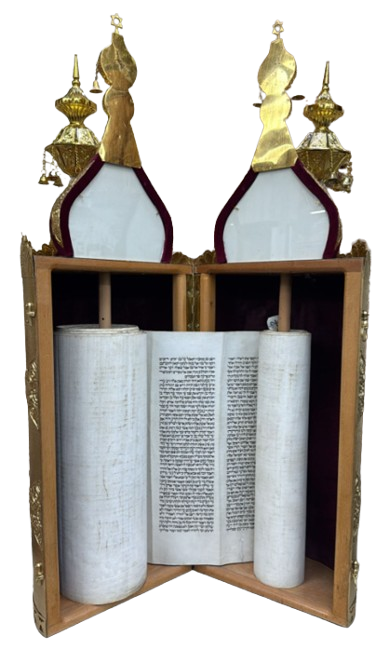
BERESHIT RABBAH 39

Bereshit Rabbah 39, Part 1: Lech Lecha
The flask of balm and the little sister: Avram’s departure as the condition for spreading his light, against the comfort of Haran. View the lecture and its transcript →
Bereshit Rabbah 39, Part 2: Lech Lecha
The burning city and its master: idolatry as frozen thought, and lech lecha as a ceaseless journey. View the lecture and its transcript →

Bereshit Rabbah 39, Part 3: Wisdom
Wisdom stronger than ten rulers: Avram’s calling, the world versus justice, and the figure of the rasha. View the lecture and its transcript →

Bereshit Rabbah 39, Part 4: Terah and the Call
Terah’s sixty-five erased years: prophecy, the veil of Lot, painful love and the dove. View the lecture and its transcript →

Bereshit Rabbah 39, Part 5: Lech Lecha
The two lech lechas and the king who sifts the sand: the reward for every step, from Avraham’s departure to David. View the lecture and its transcript →

Bereshit Rabbah 39, Part 6: Goy Gadol
The promise to Avraham, the four banners and the land: what is one more nation worth when there are already seventy? View the lecture and its transcript →

Bereshit Rabbah 39, Part 7: Be a Blessing
Blessing as a duty, not a reward: the heh added to the name, Haran, and conversion as re-creation. View the lecture and its transcript →
Bereshit Rabbah 39, Part 8: Beit-El
Beit-El, Sarah’s tent and the descent into Egypt: the covenant with the land and exile as a mission. View the lecture and its transcript →
Bereshit Rabbah 40

Bereshit Rabbah 40, Part 1: The Beauty of Sarah and the Attributes
Avram goes down to Egypt: the attributes, the book of right conduct, Sarah’s beauty and the meaning of leaving Egypt. View the lecture and its transcript →

Bereshit Rabbah 40, Part 2: “Say That You Are My Sister”
“Say that you are my sister”: Avram and Barak effaced, the trunk at customs, and what Pharaoh really wanted to take. View the lecture and its transcript →
Bereshit Rabbah 41

Bereshit Rabbah 41, Part 1: Lot
Lot, Avraham’s veil: the four gifts received, the shepherds’ falling-out, Moav and Amon, then Ruth and Naamah. View the lecture and its transcript →

Bereshit Rabbah 41, Part 2: Lot
After the parting from Lot, offspring like the dust of the earth: exile, walking the land, and the war of the kings. View the lecture and its transcript →
Bereshit Rabbah is the Sages’ great commentary on the book of Genesis. Composed in the first centuries of the Common Era, it proceeds verse by verse, sometimes word by word, and from each detail it unfolds stories, questions and parables.
What a midrash is
The midrash starts from an anomaly in the text: an extra word, a repetition, a silence where one would expect an explanation. Where a hurried reader would read straight past, the Sages stop and ask why.
The answer rarely takes the form of a proof. It takes the form of a story. And several contradictory stories can coexist on the same verse without anyone trying to decide between them — because a text received as infinite cannot have only one meaning.
A surprising freedom
Those who discover Bereshit Rabbah are often astonished by its boldness. In it the Sages make the letters of the alphabet speak, imagine dialogues, attribute to the characters motives the text does not mention, and do not hesitate to raise unsettling questions about creation, about justice, about the first human beings.
This freedom is not whimsy. It rests on an extremely attentive reading: one can only take liberties with a text if one knows every word of it.
Why begin with Genesis
Because it is the book of beginnings, and everything that follows is already there in seed: creation, the rift, siblings, the covenant, exile. To study Bereshit Rabbah is to learn to read the Torah as the Sages read it — and once that way of reading is acquired, one never reads any text in quite the same way again.
Continue studying
Pirkei Avot, Mishlei and the three Patriarchs — the other paths of Jewish philosophy.