


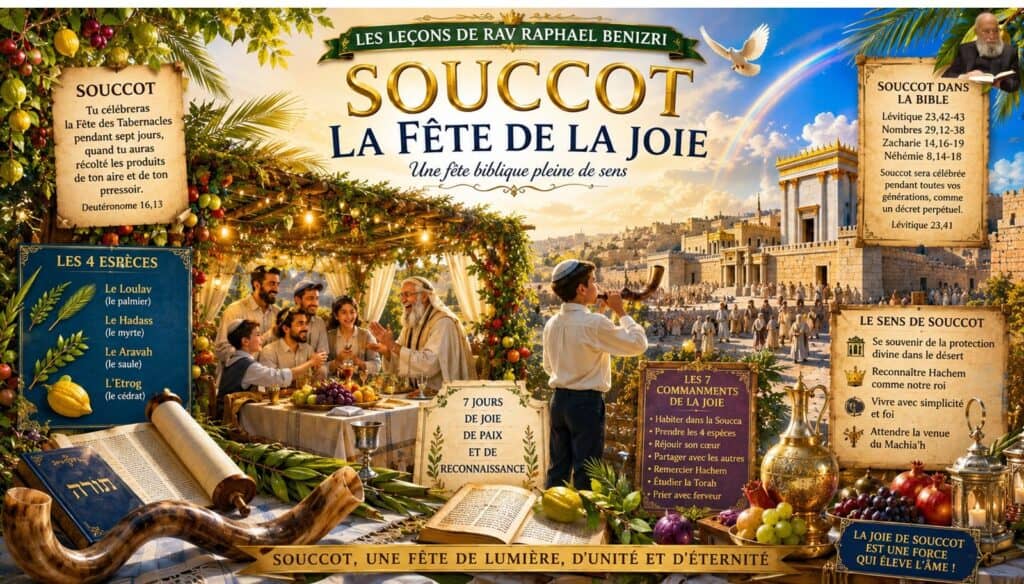
Sukkot: The Festival of Joy
Sukkot, zeman simchatenu: the festival of joy, of the universal and of sharing. Watch the lecture and read its transcript →
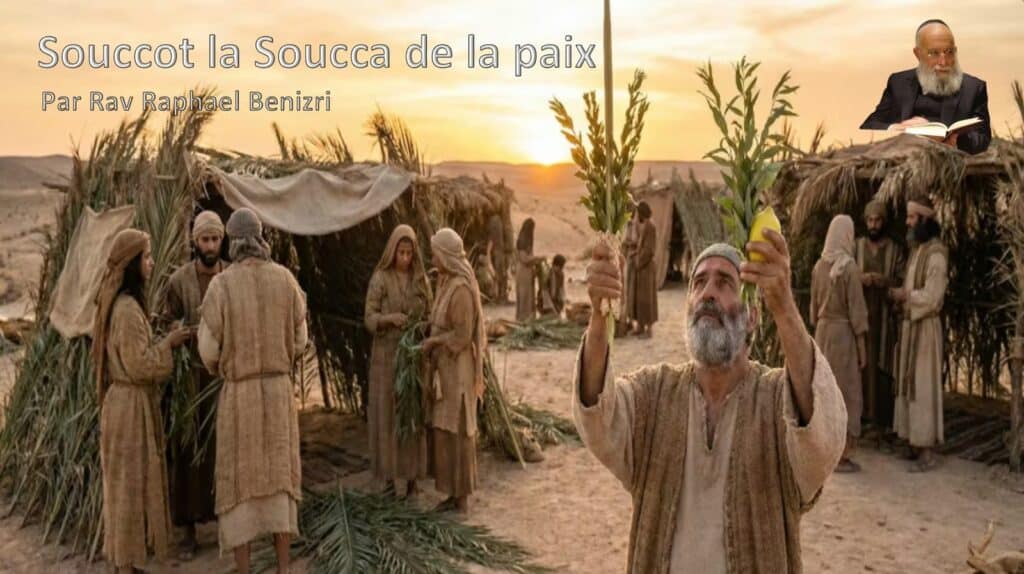
Sukkot: From Kippur to the Sukkah of Peace
“Sukkat shalom”: the shelter of peace, fragile on the outside, unshakable within. Watch the lecture and read its transcript →
Study booklets for each lecture: questions to reflect on as a family
The Sukkot Leaflet

Read the text of the leaflet
THE FESTIVAL OF SUKKOT
The meaning we give to the mitzvot is, in a way, reminiscent of the manna: that food from heaven which each of the Children of Israel experienced in his own way in the desert. The commandments remain the same, but every generation discovers in them meanings that answer its own questions and needs. This is one of the roles of the Oral Torah: to enrich the study of the commandments so that they continue to speak to man and to renew his life.
So it is with the sukkah. The Torah explains its purpose: “So that your generations may know that I made the Children of Israel dwell in booths when I brought them out of Egypt.” But what booths were these?
In the Talmud, Rabbi Eliezer and Rabbi Akiva offer two readings. For Rabbi Eliezer, they are the clouds of glory that protected the Children of Israel as they journeyed through the desert. For Rabbi Akiva, they are actual booths, in which they lived at every stage of their journey. The two readings shed light on one and the same story: the fragility of their living conditions and the divine protection that accompanied them.
For forty years, the Children of Israel lived without permanent homes, without fields or any ordinary source of food, sustained by the manna. Despite these harsh conditions, they built a family and community life. Bilam, summoned to curse Israel, was struck by what he saw and declared: “How goodly are your tents, O Yaakov, your dwellings, O Israel!”
The dispute between Rabbi Akiva and Rabbi Eliezer thus brings out two aspects of Israel’s life. The actual booth recalls each person and each family living in the desert under a temporary roof, with no certainty about tomorrow. The clouds of glory recall that, even in this precariousness, the whole people enjoyed divine protection. Each individual lived in a fragile booth, while the community as a whole was surrounded by a cloud. These two images also accompany our reflection on exile: on the one hand, insecurity and impermanence; on the other, the hope that Providence does not abandon us.
The Maharal links Sukkot to Rosh Hashanah and Yom Kippur. The Exodus from Egypt took place in Nissan; yet it is in Tishrei, after the days of repentance, that we leave our homes for the sukkah. One may see in this act the voluntary acceptance of a temporary life, for as long as it takes to reflect on our deeds. Once we have asked for forgiveness, the sukkah reminds us that we must also change our conduct. Just as Cain was condemned to wander after killing his brother Abel, this departure from the home can invite us to look at what, in our own lives, calls for repair.
And yet, Sukkot is a joyful festival. Perhaps because we know that leaving home is not an end in itself: this departure points us toward a return — to ourselves, to our people and to the Promised Land. May every sukkah remind us that wandering is not our destination; may it strengthen our resolve to repair what leads to exile and to direct our steps toward the land of hope.
Sukkot
Five days after Yom Kippur, we leave our homes. Outdoors, we build a hut with light walls and a roof of branches through which the sky must be visible, and we live in it for a week: we eat there, we host guests there, sometimes we sleep there. The most joyful festival of the year takes place in the most fragile of structures.
A House That Does Not Protect
That, of course, is the point. A sukkah does not stand up to the wind, does not stand up to the rain, does not stand up to much of anything. By entering it, we agree for a few days to give up the illusion that our walls truly protect us. Not to frighten ourselves, but to remember where security really comes from.
Those who crossed the desert knew this: they had nothing, and they endured. The sukkah is the memory of that period — and the unsettling yet liberating idea that the strength of a life is not measured by the thickness of its walls.
The Four Species
We take four plants in hand: the palm branch, the citron, the sprigs of myrtle and of willow. The midrash sees in them four types of people, according to whether they have taste, fragrance, both, or neither — and the rule is that the mitzvah can only be performed by holding them all together.
None is superfluous. None may be set aside because it has no fragrance or nothing to offer. It is a remarkably unsentimental lesson in community: unity is not a preference, it is a condition.
Joy as an Obligation
Sukkot is called “the season of our joy.” Joy is commanded on this festival, which may seem absurd — one cannot decree a feeling. But perhaps it is not a matter of feeling. Perhaps it is a matter of decision: the decision to host, to invite, to sing, even when not everything is settled. After the Days of Awe, it is a way of saying that solemnity does not have the last word.
Continue studying
Rosh Hashanah and Yom Kippur, which precede the festival; Pesach and Shavuot, the two other pilgrimage festivals.
To prepare for the festival: Why do we live in the sukkah for seven days? and The four species of Sukkot: what do the lulav and etrog represent?