


Elul: When the Curse Is a Blessing
Why the curse of Ki Tavo is in itself a blessing: the Thirteen Attributes, the shofar as the primal breath of speech, and the four acrostics of Elul. Watch the lecture and read its transcript →

Elul: The Role of Man
Elul as an exploration of the self: the irreplaceable function of every person, the three passages of the Shema, and the rejection of any spiritual hierarchy. Watch the lecture and read its transcript →

Elul: The Uniqueness of Each Person
Each person is a letter in the Torah scroll: “Ani ledodi vedodi li,” the numerical value of Binah, the selichot, and the release of the captive soul. Watch the lecture and read its transcript →

Elul: The Reckoning of the Year
Why the twelfth month is the time of reckoning: the harvest of Elul, the second Tablets of the Law, the circumcision of the heart, and the call of the shofar. Watch the lecture and read its transcript →

Elul: Returning to One’s Sources
The yud, teshuvah and the return to the Avot: the letter of the month, the 974 erased generations, the three levels of return, and honoring one’s parents as the axis of the entire Law. Watch the lecture and read its transcript →
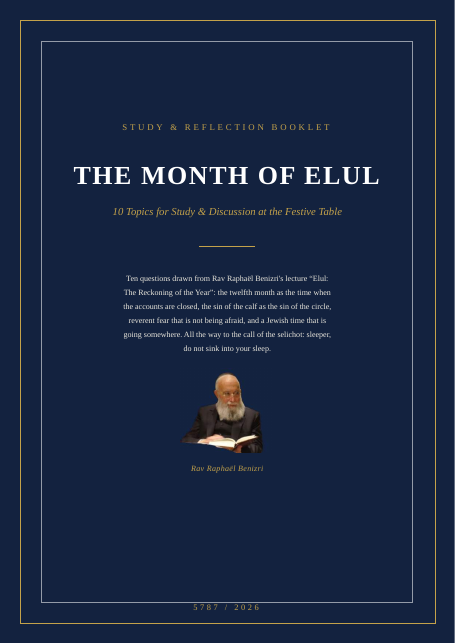
Study booklets for each lecture: questions to reflect on as a family
Elul is the last month of the year, and the only one whose function is entirely directed toward what comes after it. Nothing is celebrated in it. It is a month of approach.
The King in the Field
An image from the Chassidic tradition has traveled throughout the Jewish world: ordinarily, to see the king, one must pass through gates, obtain an audience, observe protocol. But at times the king passes through the countryside, and then anyone may approach him, in everyday clothes, and speak to him.
Elul is said to be that moment. Not that anything has changed on the king’s side — it is the distance that has shrunk.
Taking Stock
The work of Elul has a name: the accounting of the soul. It is neither a matter of self-flagellation nor of self-reassurance, but of looking at the past year with ordinary honesty. What did I begin and abandon? Whom did I wrong without making amends? What do I repeat every year while promising myself it will be the last time?
These are an accountant’s questions more than a mystic’s. Above all, they ask us not to lie.
The Shofar Every Morning
From the start of the month, the shofar is sounded every morning. It is not yet the shofar of Rosh Hashanah, the shofar of judgment: it is a daily wake-up call, a reminder that the day is drawing near.
There is practical wisdom in this. No one can transform himself in a single day. A whole month of small reminders is worth more than a heroic resolution made the night before — and that is probably why the tradition placed Elul before Rosh Hashanah rather than letting us arrive unprepared.
Continue studying
Rosh Hashanah and Yom Kippur, for which this month prepares us.