
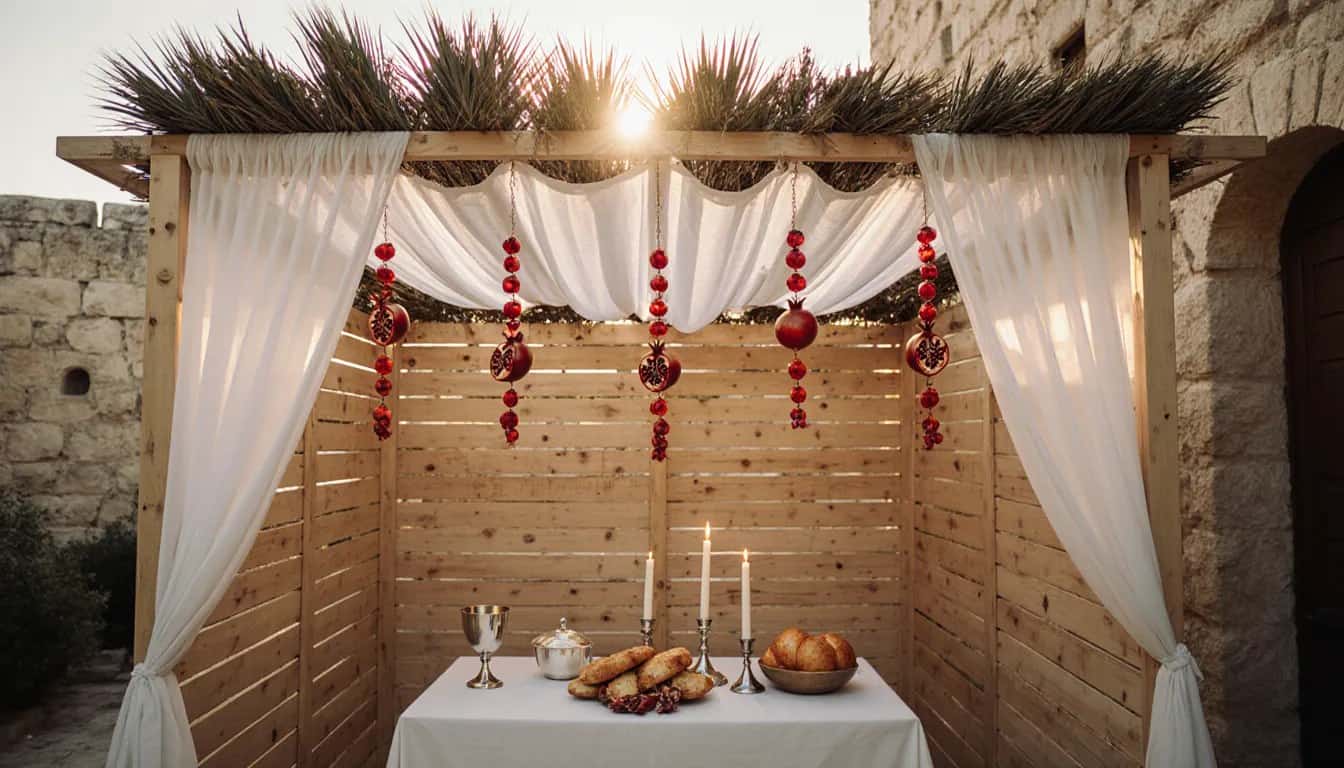
Five days after Yom Kippur, whole families leave their homes to live for a week in a hut roofed with branches. Why this move, and what does it say about us?
In 2026 (5787), Sukkot begins on Friday evening, September 25, the 15th of Tishrei, and lasts seven days, until Hoshana Rabbah on Friday, October 2. It is followed by Shemini Atzeret on Saturday, October 3, and, outside Israel, by Simchat Torah on Sunday, October 4. During these seven days, the sukkah becomes home: we eat there, host guests there, study there, and some even sleep there.
What the Torah says
The obligation comes from a verse in Leviticus: “You shall dwell in booths for seven days; every citizen in Israel shall dwell in booths, so that your generations may know that I made the children of Israel dwell in booths when I brought them out of the land of Egypt” (Vayikra 23:42-43).
The sukkah, then, is not first and foremost a festive backdrop. It is a memory one lives in: for forty years in the desert, the people lived without houses, under the protection of G-d alone.
Huts, or clouds?
The Talmud (Sukkah 11b) records two readings of this verse. For Rabbi Akiva, these were real huts, set up by the Hebrews at every stage of the journey. For Rabbi Eliezer, the “booths” are the ananei hakavod, the clouds of glory that surrounded the camp and shielded it from the sun and from enemies.
The two readings meet: by stepping out of our homes, we acknowledge that it is not our walls that protect us.
Why in autumn, and not in spring?
The Exodus from Egypt took place in spring, in the month of Nisan. Why, then, dwell in the sukkah in Tishrei? The Tur (Orach Chaim 625) answers: in spring, everyone goes out to sit in the cool shade of a shelter, and no one would notice the difference. In autumn, when everyone heads back indoors as the rains approach, moving out into a hut can only be done for the sake of the commandment.
Sukkot is also chag ha’asif, the festival of the harvest: just when the storehouses are full and one might feel secure, the Torah asks us to go outside.
What makes a sukkah valid?
- The roof (schach) is made of cut plant material: branches, palm fronds, bamboo. It must provide more shade than sun, while still letting the sky show through.
- The walls: at least two complete walls and part of a third. They may be made of any material, as long as they withstand the wind.
- The height: at least ten tefachim (about 80 to 96 cm) and at most twenty cubits (about 9.6 to 11.5 m, depending on the opinion).
- A temporary dwelling: it is a dirat arai, made to last seven days. It is often decorated with fruit, garlands and children’s drawings.
For special cases (a balcony, a sukkah under a tree, roofing materials), consult a competent rabbi.
Living in the sukkah
Meals are eaten in the sukkah. When eating bread or a grain dish there, one adds the blessing “leishev basukkah“: “who has sanctified us with His commandments and commanded us to dwell in the sukkah.” On the first night, one is obligated to eat at least a piece of bread there.
If it rains enough to spoil the meal, one is exempt: the Torah asks us to live in the sukkah the way we live in our home, and no one would stay in their house with the rain pouring in.
Each evening, tradition also invites guests from on high, the ushpizin: Avraham, Yitzchak, Yaakov, Moshe, Aharon, Yosef and David. And they are all the more welcome when flesh-and-blood guests are hosted as well.
What Rav Raphaël Benizri says
In his lecture Sukkot: The Festival of Joy, Rav Benizri quotes this saying: “My true home is the sukkah.” A home vulnerable on the outside, but solid on the inside.
In Sukkot: From Kippur to the Sukkah of Peace, he explains that after Kippur it is not enough to ask forgiveness: one must prove it in daily life. We step out of our homes, our conditioning and our convictions, we open our door, and we place ourselves in the shade of G-d.
He also cites the Maharal of Prague, who asks why we say “sukkat David,” the hut of David, and not “beit David,” his house. A house in ruins is rebuilt differently, on new plans. A hut that falls is put back up exactly as it was, like a puzzle that has come apart.
Further reading
- Sukkot: all of Rav Benizri’s lectures
- “Questions for the Sukkot Table” booklet (PDF)
- The four species of Sukkot: what do the lulav and etrog represent?
- Yom Kippur, which precedes the festival, and all the Jewish holidays
Article by the Pensées Juives editorial team. Passages attributed to Rav Raphaël Benizri are drawn from his lectures published on this site.