

Twenty-five hours without eating or drinking, white clothing, a synagogue full from evening to evening, and at the end a single blast of the shofar. What really happens on Yom Kippur? Why is it rendered in French as the “Great Pardon,” when the Hebrew word says something else? Sources, prayers, laws and the deeper meaning of the holiest day of the year, illuminated by the teaching of Rav Raphaël Benizri.
Yom Kippur, the “Day of Atonement,” falls on the 10th of the month of Tishrei, ten days after Rosh Hashanah. It is the holiest day of the Jewish calendar. The Torah describes it as a day on which G-d wipes away the sins of His people: “For on this day atonement shall be made for you, to purify you; of all your sins before Hashem you shall be pure” (Vayikra 16:30). It is spent in fasting, prayer and teshuvah, a word usually translated as “repentance” but which literally means “return.”
Yom Kippur 5787 has just been observed, from Sunday, September 20 to Monday, September 21, 2026. The next Yom Kippur, that of the year 5788, will begin on the evening of Sunday, October 10, 2027 and end at nightfall on Monday, October 11, 2027. In the meantime, the lesson of the day is not to be shelved: it is even said that Sukkot, which begins four days later, is its test.
This article covers the subject in full: what the Torah says, what the words kippur and kapparah mean, the five prohibitions of the day, the great prayers from Kol Nidre to Ne’ilah, the reading of the Book of Yonah, and the crucial rule that Kippur does not repair wrongs done to one’s fellow until one has appeased him. Throughout, the teaching of Rav Raphaël Benizri deepens what the texts lay down.
What the Torah says
Three passages in the Torah describe Yom Kippur, and a fourth mentions it in connection with the Jubilee (Vayikra 25:9). The main passage is in the parasha of Acharei Mot (Vayikra 16). It describes the service of the High Priest, the Kohen Gadol, who on that day enters the Holy of Holies alone to make atonement “for himself, for his household and for the whole congregation of Israel.” The chapter ends by instituting the day for all generations: “In the seventh month, on the tenth of the month, you shall afflict your souls and do no work […]; it is a Sabbath of Sabbaths for you” (Vayikra 16:29-31).
The second passage is found in the calendar of the festivals (Vayikra 23:26-32). It repeats the obligation to “afflict oneself” and adds the prohibition of work, as strict as that of Shabbat. The third (Bamidbar 29:7-11) describes the sacrifices specific to the day. It is this last passage that is read in the synagogue as the maftir, the supplementary reading of the morning.
In the Temple, the Kippur service included a famous rite: lots were drawn over two identical goats. One was offered to G-d; the other, the “goat for Azazel,” was sent into the wilderness after the High Priest had confessed the sins of the people over it (Vayikra 16:8-10 and 21-22). This service is described in detail in Tractate Yoma of the Mishnah. Today, without the Temple, its account is recited in the Mussaf service: this is the Avodah, the moment when, in many communities, the congregation prostrates itself, as the people did when they heard the High Priest pronounce the Divine Name.
Kippur also has a historical origin. According to tradition (Seder Olam, and Rashi on Shemot 33:11), Moshe ascended Sinai on the first day of the month of Elul to receive the second Tablets of the Law, after the first had been broken because of the golden calf. He came down forty days later, on the 10th of Tishrei, bearing the Tablets and the news of forgiveness. From its very origin, then, Yom Kippur is the day of a covenant renewed after sin.
Kippur does not mean “pardon”
In French, this day is called the “Grand Pardon,” the Great Pardon. The word is beautiful, but it is not accurate. In Hebrew, pardon is selichah or mechilah. The word kippur, by contrast, comes from the root kaper, which means “to cover.” The first use of this root in the Torah shows it clearly: G-d tells Noach to coat the ark with pitch, “vekhafarta otah,” “you shall cover it” inside and out (Bereshit 6:14). Kapparah, atonement, is first of all a covering, a protection that prevents the sin from continuing to act.
The Torah itself, moreover, does not say “Yom Kippur” but Yom HaKippurim, in the plural (Vayikra 23:27). This plural has given much food for thought. Rav Benizri draws a major lesson from it, which we will see below: Kippur is the day on which each person “covers” the other.
The Sages distinguish three levels, which complement one another without merging: teshuvah, the process of the person who returns; selichah, the forgiveness that cancels the debt; and kapparah, the atonement that erases the traces left by the sin. Yom Kippur is the day on which these three dimensions come together.
Teshuvah: returning, not merely regretting
The word teshuvah comes from shuv, “to return.” It does not speak first of shame or remorse, but of a movement: one had drifted away, and one comes back. Back to G-d, back to one’s sources, and back to oneself.
The Rambam, in his Laws of Teshuvah, gives a precise definition of it (Hilchot Teshuvah 2:2). The sinner abandons his sin, removes it from his thoughts and resolves in his heart never to commit it again. He regrets the past. He confesses it quietly before G-d: this is the viduy, the confession (Hilchot Teshuvah 1:1). Complete teshuvah, the Rambam adds, is when the same opportunity arises again, under the same conditions, and one refrains, not out of fear or weakness, but because one has changed (2:1).
The Rambam also writes that throughout the year, each person should regard himself as though his merits and his sins were evenly balanced, and the whole world likewise. A single act can then tip the scale, for oneself and for the world (Hilchot Teshuvah 3:4). Rav Benizri takes up this idea in his own way in Elul: The Role of Man: everything rests on the “I,” each of us is a little Avraham, and just as an insignificant microbe can destroy a life, a single positive act can heal an entire world.
The Talmud goes further still (Yoma 86a-b). “Great is teshuvah, for it reaches the Throne of Glory.” And Reish Lakish teaches: teshuvah done out of fear turns deliberate sins into inadvertent ones; teshuvah done out of love turns them even into merits, into zechuyot. A sin, once understood and overcome, becomes what made us grow.
Finally, the Mishnah sets an important limit (Yoma 8:8-9). One who says, “I will sin, and Yom Kippur will obtain atonement for me” does not obtain it. Kippur is not an automatic dispenser of pardon. It atones together with teshuvah, never without it.
A midrash on sin: four answers
Rav Benizri opens his lecture Yom Kippur: The Book of Yonah and the Mission of Israel with a famous midrash, recorded notably in the Jerusalem Talmud (Makkot 2:6). Wisdom is asked: what is the fate of the sinner? It answers: “evil pursues sinners.” Prophecy is asked, and it answers: “the soul that sins, it shall die.” The Torah is asked: let him bring a guilt offering and he will be forgiven. And the Rav points out the limit of this answer: one who cannot afford to bring the offering is left without remedy. Finally G-d Himself is asked, and He answers: let him do teshuvah, and he will be forgiven.
The Rav connects this midrash to the verse in Tehillim: “G-d is good and upright; therefore He shows sinners the way” (Tehillim 25:8). He does not desire the death of the sinner; He wants him to return to himself and live. To do teshuvah, the Rav explains, is “to decide to return to oneself, to return to one’s sources, to return to one’s roots.”
Elul, the Ten Days, then Kippur: an ascent
Yom Kippur does not arrive all at once. It is the culmination of a forty-day preparation. The month of Elul opens this period, with the selichot, the prayers of supplication. Then Rosh Hashanah, on the 1st and 2nd of Tishrei, proclaims G-d King and opens the judgment. Next come the Aseret Yemei Teshuvah, the Ten Days of Return, of which Kippur is the summit and the conclusion. According to the Talmud (Rosh Hashanah 16b), three books are opened on Rosh Hashanah: the righteous are immediately inscribed for life, while the fate of those “in between” remains suspended until Yom Kippur. Hence the formula of the liturgy: one is inscribed on Rosh Hashanah and sealed on Yom Kippur.
Rav Benizri describes this ascent as a change of relationship. In Elul: The Role of Man, he explains that on Rosh Hashanah the relationship with G-d is comparable to that of a couple, something one prepares for. On Kippur it becomes a relationship of father and son: “kerachem av al banim,” “as a father has compassion on his children” (Tehillim 103:13). And he adds that a man discovers fatherhood only with his first child: it is the firstborn who gives the parents the title of father and mother. Now, he recalls in the same lecture, Israel is called “My son, My firstborn” (Shemot 4:22). Then comes Sukkot: the house is built, but at the threshold, at the mezuzah, and the Shechinah, the Divine Presence, settles in with us like a member of the household.
In the same lecture, the Rav reads the first paragraph of the Shema as a map of the festivals: “when you lie down and when you rise up” is Rosh Hashanah, when one must not fall asleep; “when you sit in your house” is the sukkah; and “when you walk on the way” is Kippur, because with the giving of the second Tablets, Kippur sets us back on the road.
In The Month of Elul and the Cry of the Shofar, he recalls that the forty days of Elul replay, every year, Moshe’s ascent after the sin of the golden calf. And that this sin does not belong to the past: to commit the sin of the calf is to cling to one aspect of the divine manifestation and freeze there, to settle into a thought that no longer moves. The teshuvah of Kippur is the opposite: agreeing to be reshaped.
The eve of Kippur: eating, asking forgiveness, preparing
The eve of Kippur, the 9th of Tishrei, is no ordinary day. The Talmud teaches that whoever eats and drinks on the 9th is considered as though he had fasted on the 9th and the 10th (Berachot 8b; Yoma 81b). Eating on that day is therefore a mitzvah, a commandment.
Several customs mark this day:
- Asking forgiveness. The Shulchan Aruch (Orach Chaim 606:1) calls on us to use the eve of Kippur to go and ask forgiveness of those we have hurt. We return to this below.
- Kapparot. An ancient custom, today most often performed with money given to tzedakah. The Shulchan Aruch discourages it, the Rema endorses it (Orach Chaim 605:1); each person follows the custom of his community.
- Ritual immersion. Many men immerse in the mikveh, out of concern for purity before the holy day.
- The final meal. The seudah mafseket, the “concluding” meal, is eaten in the afternoon, before sunset. One eats nourishing but light food.
- Blessing the children. Before leaving for the synagogue, many parents bless their children.
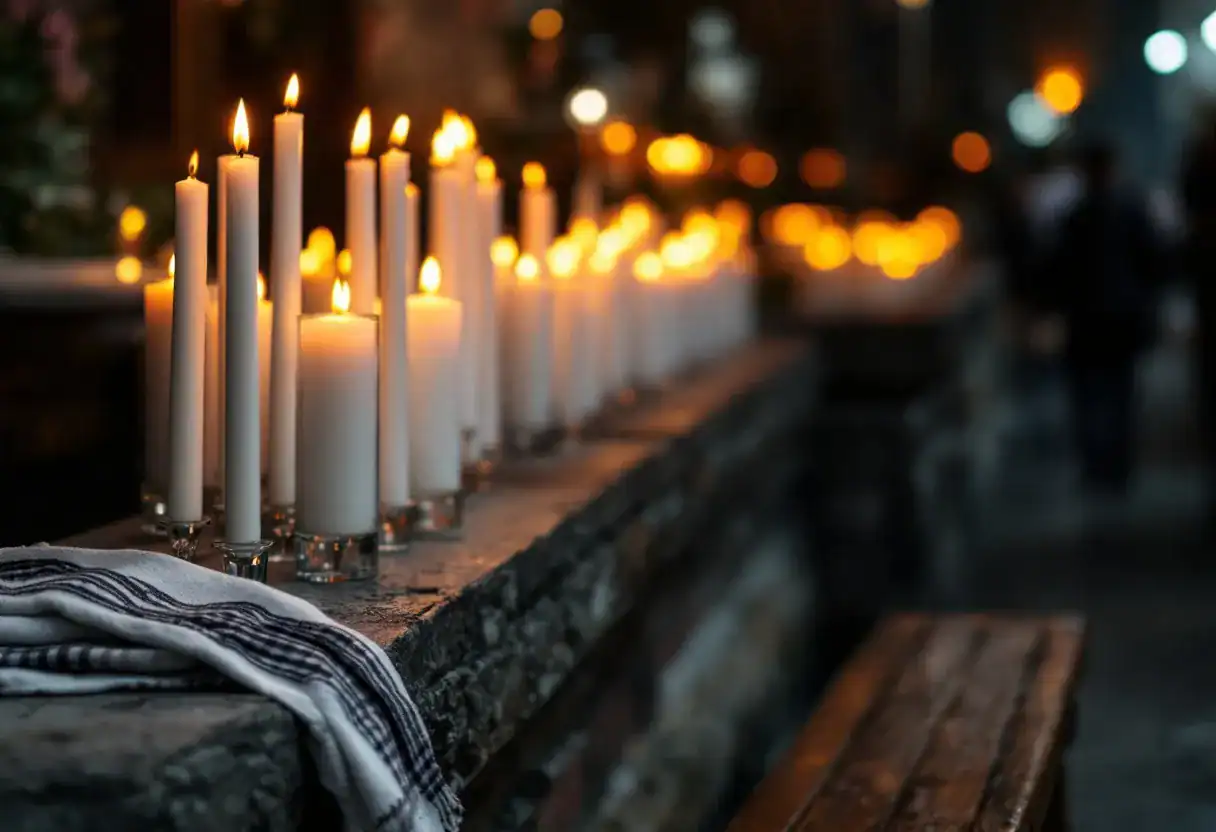
- Lighting the candles. The candles are lit with the blessing “lehadlik ner shel Yom HaKippurim” (and, if it is Shabbat, “shel Shabbat veShel Yom HaKippurim”).
One begins the fast a little before sunset, adding some ordinary time to the holy day (Yoma 81b). The fast thus lasts about twenty-five hours, until the stars come out the following evening.
The five prohibitions of the day
The Torah commands us to “afflict ourselves” on that day (Vayikra 16:29), without specifying how. The Oral Tradition, recorded in the Mishnah (Yoma 8:1), gives its content: five abstentions, known as the five inuyim.
- No eating or drinking. This is the main prohibition: the Torah punishes it with karet, spiritual excision (Vayikra 23:29).
- No washing. One does not wash for pleasure. In the morning, one rinses only the fingertips.
- No anointing. No creams, oils or perfumes on the body.
- No leather shoes. One wears shoes of canvas, rubber or cloth (Yoma 78b).
- Abstaining from marital relations.
Why five? The Talmud (Yoma 76a) links them to the five mentions of “affliction” in the Torah passages devoted to this day; others see in them a correspondence with the five senses. The general meaning is clear: for one day, we suspend what nourishes and adorns the body. Not to despise it, but to leave all the room to the soul. The Sages compare man on Kippur to the angels, who do not eat, do not drink and stand upright. That is why one dresses in white, and many men wear the kittel, a white garment that also recalls the shroud (Rema, Orach Chaim 610:4).
These prohibitions are never a reason to endanger oneself. Anyone whose life or health requires it must eat and drink: this is an absolute rule of the Torah. Children, pregnant or nursing women, the sick and the elderly have specific rules. Consult a competent rabbi, and a doctor, well before the day.
The five prayers of the day
Yom Kippur is the only day of the year on which five services are prayed: Arvit in the evening, Shacharit in the morning, Mussaf, Minchah in the afternoon and Ne’ilah at sunset. In each, the viduy, the collective confession, is recited.
Kol Nidre: the opening
The evening service opens with Kol Nidre, probably the best-known text of the Jewish liturgy. The Torah scrolls are taken out. The prayer leader, flanked by two notables, recites this Aramaic formula three times, in an ever louder voice: all the vows and commitments we might make are released and annulled. In many communities, the formula refers to the vows of the coming year, following the opinion of Rabbeinu Tam.
Just before, it is proclaimed: “With the consent of the Almighty and the consent of the congregation, […] we permit prayer with the transgressors.” This formula, attributed to the Maharam of Rothenburg and cited by the Tur (Orach Chaim 619), opens the door of the synagogue to all. No one is excluded from Kippur, and no one enters it believing himself perfect.
Why open the holiest day with the annulment of vows? Because speech is what binds us most, and what we betray most easily. Before asking forgiveness, we begin by untying the bonds we have lightly imposed on ourselves. On the evening of Kippur, the verse “Baruch shem kevod malchuto le’olam va’ed,” said quietly all year round, is also recited aloud (Shulchan Aruch, Orach Chaim 619:2): on that day, we are like the angels.
The viduy: Ashamnu and Al Chet
The confession takes two forms. Ashamnu, “we have sinned,” follows the letters of the Hebrew alphabet. Al Chet lists, in a long litany, the sins committed “through speech,” “through hardness of heart,” “through a haughty look,” “through slander.” At each mention, one strikes the chest lightly, over the heart.
The viduy is said in the plural. One does not say “I have sinned” but “we have sinned.” Each person also confesses sins he may not have committed himself, because all of Israel are responsible for one another. Here we find again the plural of Kippurim.
The Thirteen Attributes of Mercy
Throughout the day, and above all at Ne’ilah, we proclaim the Thirteen Attributes of Mercy that G-d revealed to Moshe after the sin of the golden calf: “Hashem, Hashem, G-d, merciful and gracious, slow to anger, abounding in kindness and truth…” (Shemot 34:6-7). The Talmud (Rosh Hashanah 17b) teaches that G-d showed Moshe the order of this prayer and told him: whenever Israel sins, let them recite it before Me, and I will forgive them.
Rav Benizri insists on one condition. These attributes, he explains in Elul: The Role of Man, remain abstract notions if we do not transpose them onto ourselves. If we ourselves do not show chesed, kindness, there is no point in reciting prayers. We know G-d only through these attributes, just as we know a person only through his qualities: “you will see My back, but My face shall not be seen” (Shemot 33:23).
The morning and Mussaf readings
In the morning, the Torah reading is the account of the High Priest’s service (Vayikra 16), followed by the passage of the sacrifices (Bamidbar 29:7-11). The haftarah, the reading from the Prophets, is taken from Yeshayahu (57:14 to 58:14). There the prophet raises a burning question: “Is this the fast that I desire, a day for a man to afflict his soul? […] Is it not rather this: to loosen the chains of injustice, to share your bread with the hungry?” (Yeshayahu 58:5-7). At the very heart of the fast day, the prophet reminds us that fasting has value only if it transforms our conduct toward others.
In Mussaf comes the Avodah, the account of the Temple service. In many communities, the account of the Ten Martyrs, ten Sages put to death by the Romans, is added.
Minchah: the forbidden unions and the Book of Yonah
In the afternoon, the Torah reading is the chapter of the arayot, the forbidden unions (Vayikra 18), in accordance with the Talmud (Megillah 31a). Then the entire Book of Yonah is read as the haftarah, followed by the last verses of the prophet Michah (7:18-20): “Who is a G-d like You, who pardons iniquity… You will cast all their sins into the depths of the sea.”
Why read about the forbidden unions?
The question seems strange: at the height of the holy day, we speak of the lowest instincts. Rav Benizri sees in it a lesson in clear-sightedness. Man’s struggles, he says, do not change their nature as if by magic because he has fasted for a day and prayed fervently. The next day, life goes on. The ideal teshuvah, which one imagines reaching in one stroke, is not possible.
What is needed, then, the Rav explains, is to make a precise decision: to choose one particular weakness one wishes to overcome, and to decide not to give in on that one. To hold on to one aspect of life and seek to correct it is the promise of all the repairs to come. A concrete, limited teshuvah that is kept is worth more than a grand resolution that evaporates on the way out of the synagogue.
The story of Yonah
The Book of Yonah consists of four short chapters. Yonah son of Amitai, a prophet also known from the Book of Kings (Melachim II 14:25), is commanded to go to Nineveh, the great capital of Assyria, to announce its destruction because of its wickedness. Instead of going east, he sets sail from Jaffa for Tarshish, to the west, “away from the presence of Hashem” (Yonah 1:3).
A storm arises. The sailors each cry out to their own god. Yonah is asleep in the hold of the ship. Lots are cast, and the lot falls on him. He asks to be thrown into the sea; the sea grows calm. A great fish swallows him, and he stays there three days and three nights, praying from within it (chapter 2). Cast up on dry land, he is commanded a second time to go to Nineveh. This time he goes, and proclaims: “Forty more days, and Nineveh shall be overturned” (3:4).
The people of Nineveh believe, fast and put on sackcloth, and the king orders each one to “turn from his evil way and from the violence that is in his hands” (3:8). G-d sees their deeds and relents from the evil He had announced (3:10). Yonah is deeply displeased. He sits down outside the city; G-d makes a plant, a kikayon, grow over him to give him shade, then makes it wither. The book ends with a question from G-d left unanswered: “And should I not have pity on Nineveh, the great city, in which there are more than a hundred and twenty thousand human beings […] and many beasts?” (4:11).
What Yonah teaches about teshuvah
The Mishnah draws a fundamental lesson from this book (Ta’anit 2:1). The verse does not say that G-d saw their sackcloth and their fasting, but “G-d saw their deeds, that they had turned from their evil way” (Yonah 3:10). It is not the ritual that counts, it is the change. The Talmud specifies, regarding “the violence that is in their hands,” that even one who had stolen a beam and built it into his palace would tear down the palace to return it (Ta’anit 16a).
The book also teaches that one cannot flee from G-d, nor from the mission He entrusts to us. And that teshuvah is open to all, even to a foreign and violent city. It is a universal reading, at the heart of the most Jewish day of the year.
Rav Benizri’s reading: Yonah is Israel
In his lecture Yom Kippur: The Book of Yonah and the Mission of Israel, Rav Raphaël Benizri offers a profound reading of this book. He first recalls that Yonah’s entire prophecy consists of five Hebrew words: “Od arba’im yom veNineveh nehpachet.” All the rest of the book is the autobiographical account of a man grappling with the mission G-d imposes on him.
The dove and the truth. Yonah means “dove.” The Rav links the prophet to Noach’s dove, which goes out of the ark three times: the first time, it finds no rest and returns; the second, it returns with an olive branch, a sign that there is hope; the third, it does not come back, having won its freedom (Bereshit 8:8-12). These three stages are found again in Yonah. His father is called Amitai, from emet, truth. Yonah would like everything to rest on strict truth. But truth alone would demand strict justice, and under strict justice the world could not endure. Kindness is needed: “justice and peace kiss each other” (Tehillim 85:11).
Tarshish, or the temptation to withdraw. Why flee to Tarshish in particular? The Rav recalls that tarshish is also the name of one of the stones on the breastplate of the High Priest Aharon, on which each tribe had its stone, and that Yonah is thought to have been from the tribe of Asher, whose stone it was. Sent east, he heads west, toward the jewel of his own tribe. He would like to shut himself up in what he is, within the space of his tribe and his people, and not invest himself in the outside world. Why? Because the mission is too heavy and the disappointments too great. This, says the Rav, is the perennial temptation: to flee confrontation, to flee the other, sometimes to flee oneself.
The Rav further explains that Yonah is fleeing neither G-d nor his conscience. He would like the other to follow him unconditionally. He knows that G-d is merciful and will relent from punishing Nineveh (Yonah 4:2); he would then have carried out a mission for nothing, and looked ridiculous. “These are thoughts,” the Rav concludes, “that may well haunt us on the day of Kippur.”
Israel, responsible for the bond with humanity. Nineveh is not a Jewish city. Of the nations, the Rav recalls, only the seven Noahide laws are required, a basic moral framework on which each embroiders its own path. But the one who must watch over this structure is the Jewish people. “And the Jewish people is Yonah.” The Rav compares Israel to challah, the portion set aside that sanctifies the whole dough: it has value only if it continues to nourish the rest. He goes so far as to say that withdrawing into one’s neighborhood, into one’s enclave, while remaining indifferent to the society around us, is also a sin for which one must do teshuvah on Kippur.
“Ivri anochi”: I am one who carries across. On the ship, the sailors, who, the Rav recalls, are counted as seventy, like the seventy nations, each cry out to their own god. Yonah, for his part, has gone down into the hold of the ship and is asleep. Yet this was the moment to speak. The captain wakes him: “What are you doing asleep? Get up, call upon your G-d!” (Yonah 1:6). He is asked: “What is your occupation? Where do you come from? What is your country?” (1:8). The Rav notes that the verse says melachah, which evokes malach, the messenger: “What is your message?” Yonah answers: “Ivri anochi, I am a Hebrew, and I fear Hashem, the G-d of heaven, who made the sea and the dry land” (1:9). Ivri is the one who comes “from the other side,” like Avraham who came from beyond the river; but it is also, from la’avor, “to bring across,” the one who carries across. The Jew is the one who carries across, who links heaven and earth.
What he failed to transmit passes on through his disappearance. Thrown into the sea at his own request, Yonah calms the waves, and the sailors “feared Hashem with a great fear,” offered Him a sacrifice and made vows (1:16). The Rav sees in this scene an image of history: the nations appropriated the G-d of Israel while believing they were doing away with Yonah, and that is what the great religions did. But the Jewish people, though it knows descents down to she’ol, the abode of the dead, does not die of them. Thrown into the waters, it always ends up rising again.
And the first lesson, for the Rav, is never to despair. Even if one has advanced only one step along the mile to be covered, that step counts. He quotes the Ethics of the Fathers: “It is not up to you to finish the work, but neither are you free to desist from it” (Pirkei Avot 2:16).

Forgiveness between people
This is perhaps the most important rule of all of Kippur. The Mishnah (Yoma 8:9) teaches: “For sins between man and G-d, Yom Kippur atones. For sins between man and his fellow, Yom Kippur does not atone until he has appeased his fellow.” Rabbi Elazar ben Azariah derives this from the verse itself: “before Hashem you shall be pure” (Vayikra 16:30), meaning that only sins “before Hashem” are erased by the day.
In practice, this means:
- Repair first. If one has caused damage or taken something, one must pay it back. The Rambam specifies that even after paying, one must still appease the person and ask his forgiveness (Hilchot Teshuvah 2:9).
- Ask clearly. The Shulchan Aruch (Orach Chaim 606:1) teaches that if the person does not forgive the first time, one comes back a second and a third time, accompanied by three people, each time using a different way of appeasing him.
- Name the wrong. Rav Benizri insists: when asking forgiveness, one must tell the other exactly what wrong one has done to him. A general “sorry for everything” is not always enough.
- Know how to forgive. The Rambam writes that it is forbidden to be cruel and refuse to forgive. When the one who has sinned asks forgiveness, one must forgive wholeheartedly and with a sincere soul (Hilchot Teshuvah 2:10).
Rabbi Akiva concludes Tractate Yoma with a word of hope (Mishnah Yoma 8:9): “Happy are you, Israel! Before whom do you purify yourselves, and who purifies you? Your Father in heaven.” And he quotes the prophet: “Mikveh Yisrael Hashem,” “the Hope of Israel is Hashem” (Yirmeyahu 17:13), which Rabbi Akiva also reads as “the purifying bath of Israel is Hashem.” Just as the mikveh purifies the one who immerses in it, G-d purifies Israel.
What Rav Raphaël Benizri teaches
Beyond the Book of Yonah, several of Rav Benizri’s lectures shed light on the meaning of Kippur. Here are the main ideas, faithfully summarized.
Kippurim: the day we cover one another
In Sukkot: From Kippur to the Sukkah of Peace, the Rav starts from a linguistic observation. The Jewish festivals bear plural names, Shavuot, Sukkot, Kippurim, with the exception of Pesach and Chanukah. Pesach is in the singular, he says, because there is no collective freedom: each person must tear himself away from his own conditioning. Chanukah too, because education is always tailored to each individual, “according to his way” (Mishlei 22:6).
But Kippur is in the plural. “Kippurim does not mean forgiveness,” the Rav stresses. Forgiveness is selichah. Of course, one must ask forgiveness of G-d and of one’s fellow, but that is not enough. Kaper means to cover: to provide cover for the other, to stand in solidarity with him, to regard his commitment as binding on me as well. Kippur is the day on which the effective solidarity of all the members of the people of Israel is affirmed, each taking responsibility for the other. Hence the plural.
Two questions on the day of judgment
In the same lecture, the Rav quotes Tanna Devei Eliyahu: when a person comes to give his account, he is asked whether he proclaimed G-d King. But a second question is bound up with the first: did you also acknowledge the sovereignty of your fellow? One without the other, says the Rav, leads nowhere. Serving others is even the place where faith in G-d is forged. One who separates the service of G-d from the service of man has not yet emerged from his isolation.
The Rav shows this link in the Ten Commandments, engraved on two Tablets facing each other. “I am Hashem your G-d” faces “you shall not murder,” for one who kills destroys the image of G-d in man. Not taking G-d’s Name in vain faces “you shall not steal.” Shabbat faces false testimony. It is the same logic as the Mishnah in Yoma: one cannot be right with G-d while remaining at fault with one’s fellow.
Covering or erasing?
In Elul: The Role of Man, the Rav develops another nuance of the word. Kaper means to cover, as one applies a coat of paint to a dirty wall to hide the stain. But teshuvah goes further: it makes it possible to truly erase. Why? Because sin does not touch the essence of Israel; it stains only its garment. The soul itself remains intact: this is what we affirm every morning, “the soul You have given me is pure.” It is enough to remove what hides it.
In the same lecture, he cites the teaching of the Talmud according to which deliberate sins become inadvertent ones, and even merits, through the lesson they have taught us, which today makes us rise above them. The new cycle, he says, does not break with the past: it gives it another meaning.
Two kinds of forgiveness
In Elul: Returning to One’s Sources, the Rav distinguishes a “lower” teshuvah from a “higher” teshuvah. Before a superior, one can be forgiven without being reinstated: “all right, I forgive you, but I no longer count on you; you have lost my trust.” And there is another kind of forgiveness: “you have committed a grave fault, I forgive you, and I give you the chance to prove yourself further.” It is this second forgiveness that we aspire to on Kippur: the one that opens an additional measure of mercy to move forward.
Kippur, head of the year and day of freedom
In the lecture on Yonah, the Rav makes a surprising remark. Nowhere in the Torah, the Prophets or the Writings is the first of Tishrei called “Rosh Hashanah”: there it is named Yom Teruah, the day of the shofar blast, or Yom HaZikaron, the day of remembrance. The expression “Rosh Hashanah” appears in the prophet Yechezkel (40:1), and the Talmud (Arachin 12a) applies it to the day of Kippur in a Jubilee year. For the Rav, Kippur is in this sense the true head of the year.
He recalls that it was on Kippur, in the Jubilee year, that the shofar was sounded to free the slaves and return the lands to their owners (Vayikra 25:9-10). But, he says, it is not first of all the liberation of others that we must think about. As long as we remain enslaved to our relative ideals, to our habits of life and thought, we have not stepped outside ourselves. Kippur is the day on which one rethinks one’s own liberation.
That is why, in The Month of Elul and the Cry of the Shofar, the Rav recalls the Mishnah stating that there were no days in Israel as joyous as the 15th of Av and Yom Kippur (Ta’anit 4:8). Kippur is not an austere day, he explains, but a day of joy, because it opens another path for man: just as all the slaves are freed on that day, man too gains access to his own freedom.
Ne’ilah: the closing of the gates
At sunset the fifth prayer begins, Ne’ilah, the “closing.” The name recalls the closing of the Temple gates at the end of the day and, in the traditional reading, the closing of the gates of heaven. It is the most intense moment of Kippur. In many communities, the ark remains open throughout the service and one prays standing. In the prayers, one no longer says “inscribe us” but “seal us” in the Book of Life.
The service ends with proclamations that the congregation cries out with one voice: “Shema Yisrael” once, “Baruch shem kevod malchuto le’olam va’ed” three times, and “Hashem Hu HaElokim,” “Hashem is G-d,” seven times, the words the people cried out on Mount Carmel before the prophet Eliyahu (Melachim I 18:39). Then a long blast of the shofar sounds, and we say: “Next year in Jerusalem!”
In Sukkot: From Kippur to the Sukkah of Peace, Rav Benizri gives this “Hashem Hu HaElokim” a profound meaning. The name Elokim, which appears thirty-two times in the account of creation, corresponds to the numerical value of lev, the heart. It is the name of the laws of nature, of cause and effect, and therefore of a path that leads, little by little, toward death. The name Hashem, on the other hand, is that of chesed, of love. To proclaim at the end of Kippur “Hashem is Elokim” is to say that everything belonging to nature must pass into the sphere of love, which alone can triumph over strict justice and over death.
After Kippur: the proof of the sukkah
The fast ends when the stars come out, with Havdalah, the prayer of separation between the holy and the ordinary. Many have the custom of then reciting the blessing of the moon and beginning, that very evening, to build their sukkah (Rema, Orach Chaim 624:5): one goes from one mitzvah to another.
In the same lecture, Rav Benizri explains this transition forcefully. As soon as Kippur ends, in the evening prayer, we already say “forgive us, for we have sinned.” Why? Because everything we have promised ourselves, we have not yet proven that we will keep. It is not enough to have asked forgiveness: one must prove it in daily life. That is why we build a sukkah. We leave our house, our habits, our certainties; we open our door and place ourselves in the shade of G-d. The verdict of Kippur, he says, is only truly handed down on Hoshana Rabbah, once we have shown that the resolution was sincere.
The next festival is therefore very close: Sukkot 5787 begins on the evening of Friday, September 25, 2026. To live it as the continuation of Kippur, read Why Do We Live in the Sukkah for Seven Days? and The Four Species of Sukkot, or visit the Sukkot page.
Frequently asked questions about Yom Kippur
Why is it called the “Great Pardon” in French?
It is the traditional French translation. The Hebrew word kippur means rather “atonement,” from the root “to cover.” Forgiveness in the strict sense is selichah. Kippur includes forgiveness but goes beyond it: it erases the traces of sin and, according to Rav Benizri, affirms each person’s solidarity with all.
What greeting is used on Yom Kippur?
Before the fast, people wish each other “Gmar chatimah tovah,” “may the seal be good,” or “Tzom kal,” “an easy fast.” Many Sephardim say “Tizku leShanim rabot.” People generally avoid simply saying “happy holiday.”
Does Kippur erase all sins?
No, not automatically. It atones together with teshuvah, not without it (Mishnah Yoma 8:8). And it does not erase sins against one’s fellow until one has appeased him (Yoma 8:9). One who counts on Kippur in order to sin with an easy mind is not forgiven.
Why is the Book of Yonah read?
Because it shows the power of teshuvah: an entire city, foreign and violent, changes its conduct, and G-d relents from punishing it. It also teaches that one cannot flee from G-d or from one’s mission. For Rav Benizri, Yonah represents the Jewish people, charged with being the one who “carries across” between heaven and humanity.
Must children and the sick fast?
Children below the age of mitzvot (13 for a boy, 12 for a girl) are not obligated in the full fast; they are gradually accustomed to it according to their age. The sick, pregnant or nursing women, and anyone whose health is at stake must consult a rabbi and a doctor: preserving life comes before the fast.
May one brush one’s teeth or wear sneakers?
Leather shoes are not worn; shoes made of canvas, cloth or plastic are permitted. As for brushing teeth, the widespread custom is to refrain, because of the prohibitions on drinking and washing. For any particular case, consult a rabbi.
To go further
Yom Kippur is not a twenty-five-hour parenthesis. It is the moment when we go back up to the source, to set out again with new Tablets, hewn by our own hands. Rav Benizri sums it up in one idea: it is not up to us to finish the work, but neither are we free to desist from it. One step, a single one, is enough to begin.
- Yom Kippur: all of Rav Benizri’s lectures
- Yom Kippur: The Book of Yonah and the Mission of Israel
- Sukkot: From Kippur to the Sukkah of Peace
- Elul: The Role of Man
- Elul: Returning to One’s Sources
- The Month of Elul and the Cry of the Shofar
- Parasha Acharei Mot: The Service of the High Priest
- Booklets to download, including the Yom Kippur booklet
- Pirkei Avot: Ethics of the Fathers
- Glossary of Hebrew words
- All the Jewish holidays
An article by the Pensées Juives editorial team. The passages attributed to Rav Raphaël Benizri are drawn from his lectures published on this site.