
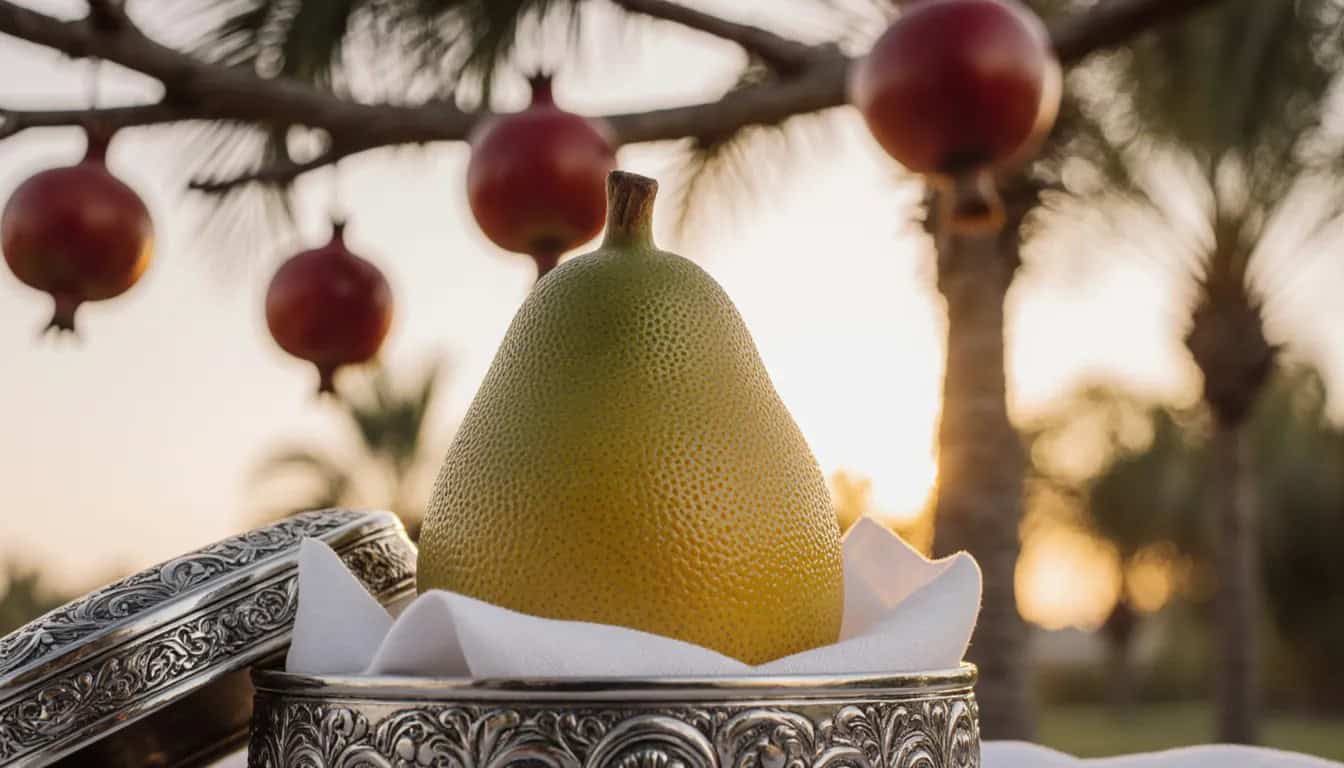
Every morning of Sukkot, we take a citron and a bundle of palm, myrtle and willow in hand and wave them in every direction. Where does this gesture come from, and what do these four plants mean?
The four species (arba minim) are taken every day of Sukkot, except on Shabbat. In 2026, the first day of the festival falls on Saturday, September 26: the lulav is therefore taken for the first time on Sunday, September 27, both in Israel and outside Israel.
The verse
“You shall take for yourselves, on the first day, the fruit of the hadar tree, branches of palm trees, boughs of the leafy tree and willows of the brook, and you shall rejoice before the Lord your G-d for seven days” (Vayikra 23:40).
The oral tradition identifies these four plants:
- The etrog: the citron, a yellow citrus fruit with a thick, bumpy peel;
- The lulav: a young date-palm frond, straight and still closed;
- The hadas: the myrtle, of which three branches are taken;
- The aravah: the brook willow, of which two branches are taken.
The lulav, the myrtles and the willows are bound together. The etrog is held separately, in the other hand.
How they are taken
One holds the lulav in the right hand and the etrog in the left, brings them together and recites the blessing “al netilat lulav“. They are then waved in six directions, the four sides, upward and downward, in the order followed by each community. The gesture is repeated during Hallel.
In the synagogue, one also circles the bimah holding the four species while chanting the Hoshanot. On the seventh day, Hoshana Rabbah (Friday, October 2, 2026), seven circuits are made, and then the ground is struck with a small bundle of willows.
Four kinds of Jews
The Midrash (Vayikra Rabbah 30:12) sees the four species as four kinds of Jews:
- the etrog has both taste and fragrance: one who has both Torah and good deeds;
- the lulav, frond of the date palm, has taste but no fragrance: Torah without deeds;
- the myrtle has fragrance but no taste: deeds without Torah;
- the willow has neither.
The rule is that the commandment can only be fulfilled by holding them all together. If one is missing, the gesture counts for nothing. None is superfluous, none can be set aside.
Another midrash (Vayikra Rabbah 30:14) sees in them the human body: the etrog is the heart, the lulav the spine, the myrtle the eyes and the willow the lips. The whole person turns toward G-d.
Choosing a beautiful etrog
The verse speaks of the fruit of the hadar tree, the “beautiful” tree. One therefore looks for an etrog that is whole and clean, without holes or significant blemishes, and a straight lulav whose central leaves are closed. One buys the four species from a seller supervised by a rabbinate, and consults a rabbi in case of doubt.
What Rav Raphaël Benizri says
In his lecture Sukkot: From Kippur to the Sukkah of Peace, Rav Benizri highlights a paradox: the four species are worth nothing, and they are worth everything. Yesterday they were worth nothing; after the festival they will be worth nothing again. During Sukkot, they carry the value of serving G-d and man.
He returns to the four figures: the aravah with neither fragrance nor taste, the etrog tempted by a life apart, the lulav that bears fruit but has no fragrance. Each, he says, is called upon to share what it has.
In Sukkot: The Festival of Joy, he recalls that Sukkot is the festival of the universal: seventy offerings were brought during the festival for the seventy nations, and it is the only festival that the nations are called to celebrate.
Further reading
- Why do we live in the sukkah for seven days?
- Sukkot: all of Rav Benizri’s lectures
- “Questions for the Table” booklet for Sukkot (PDF)
- All the Jewish holidays
Article by the Pensées Juives editorial team. Passages attributed to Rav Raphaël Benizri are drawn from his lectures published on this site.