
Chapter 1

Pirkei Avot, Part One: An Introduction to the Tractate
An introduction to the tractate: mussar in the Torah, the Rambam’s two positions, and the place of Avot within the order of Nezikin. Watch the lecture and read its transcript →

Pirkei Avot, Part 2 — All Israel Has a Share in the World to Come
Before the first mishnah: “All Israel has a share in the World to Come,” morality before Sinai, and the law broken down into 613 commandments. Watch the lecture and read its transcript →

Pirkei Avot, Part 3 — The Chain of Transmission
The first mishnah, from Moshe to the Men of the Great Assembly, and the three principles it bequeaths to the generations. Watch the lecture and read its transcript →

Pirkei Avot: The Three Pillars of the World
Torah, divine service and acts of kindness: the mishnah of Shimon HaTzaddik, the rainbow of ideas, and the passage from Persia to Greece. Watch the lecture and read its transcript →

Pirkei Avot, Part 5: Serving Without Expecting a Reward
The mishnah of Antigonos of Sokho: Honi, who demands a miracle, and Chanina ben Dosa, who expects nothing; love and awe. Watch the lecture and read its transcript →

Pirkei Avot: Let Your House Be Open
The first pair of sages: the home as a place of study, the home open to the poor, and speech between husband and wife. Watch the lecture and read its transcript →

Pirkei Avot, Part 7 — Make Yourself a Teacher, Acquire Yourself a Friend
Judging every person favorably and keeping away from a bad neighbor: the mishnayot of Yehoshua ben Perachyah and Nittai of Arbel. Watch the lecture and read its transcript →

Pirkei Avot: Judging Without Setting Yourself Up as Judge
Yehudah ben Tabbai and Shimon ben Shetach on how to judge, then Shemaya and Avtalion: love work, shun authority. Watch the lecture and read its transcript →

Pirkei Avot, Part 9: Shemaya and Avtalion
Pirkei Avot 1:10–11: love work, shun authority, and Avtalion’s warning about tainted waters. Watch the lecture and read its transcript →
Chapters 2, 3 and 5
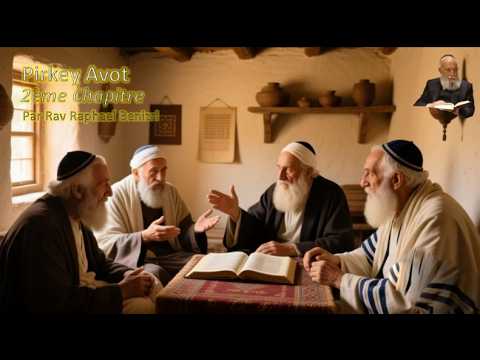
Pirkei Avot, Chapter Two: The Straight Path and a Trade
Pirkei Avot 2:1–2: which straight path to choose, Torah and earning a living, then Akavya ben Mahalalel and his three considerations. Watch the lecture and read its transcript →

Pirkei Avot: The State and the Divine
Praying for the welfare of the government: the mishnah of Rabbi Chanina, the fear of authority, and the limits of blessing. Watch the lecture and read its transcript →

Pirkei Avot 3: Where You Come From, Where You Are Going
Know where you came from, where you are going, and before Whom you will have to give an account: time, space, and the figure of the rasha, the wicked man. Watch the lecture and read its transcript →

Pirkei Avot: The Mitzvah According to Ben Azzai
Command or bond: the three levels of the mitzvah according to Ben Azzai, the reward that is itself a mitzvah, and the inclination that turns into sin. Watch the lecture and read its transcript →

Pirkei Avot: Acquiring the Torah Before Shavuot
The chapter read before Shavuot: the mishnah of Rabbi Meir, the meaning of the word “acquire,” and study as something that engages the whole world. Watch the lecture and read its transcript →

Pirkei Avot: The Arithmetic of Creation
Why ten utterances to create the world: an arithmetic of three and ten, and the dynamics of history. Watch the lecture and read its transcript →

Pirkei Avot, Chapter 4: Ben Azzai and the Race Toward the Mitzvah
Run after a minor mitzvah and flee from sin: the mitzvah as a lamp, as a bond, and as an indivisible whole. Watch the lecture and read its transcript →

Pirkei Avot, Chapter 5: Ten Generations from Adam to Avraham
Ten generations from Adam to Noach, ten from Noach to Avraham: three and ten, and the dynamics of history. Watch the lecture and read its transcript →
Pirkei Avot holds a place of its own in the Mishnah. Every other tractate settles specific questions — the festivals, damages, agriculture, purity. This one settles nothing. It gathers sayings on how to conduct oneself.
A chain, above all
The tractate opens not with a principle but with a genealogy: Moshe received the Torah at Sinai and passed it on to Yehoshua, who passed it on to the elders, and so on. Before saying anything at all, the text establishes where it is speaking from.
It is a way of saying that wisdom is not invented alone. It passes from hand to hand, and each generation must both receive it intact and make it its own.
Short sayings, far-reaching meaning
“If I am not for myself, who will be for me? And if I am only for myself, what am I? And if not now, when?” In three lines, Hillel sets out the tension between caring for oneself and concern for others, then cuts short any procrastination.
The whole tractate works this way from beginning to end: on speech and silence, anger, money, power, friendship, pride, how to learn and how to teach. Nothing abstract. These are observations about what people actually do.
Why this tractate is so widely read
The custom is to study it chapter by chapter, one each week, over the summer. The format lends itself to this: each maxim fits in a few words and can bear being reread twenty times.
It is also the easiest gateway into Jewish thought. It requires no prior knowledge, and yet one never exhausts it — because a sentence about humility does not mean the same thing at twenty as it does at fifty.
Continue studying
Mishlei, the Book of Proverbs, the Midrash Bereishit Rabbah and the three Patriarchs — the other paths of Jewish philosophy.