


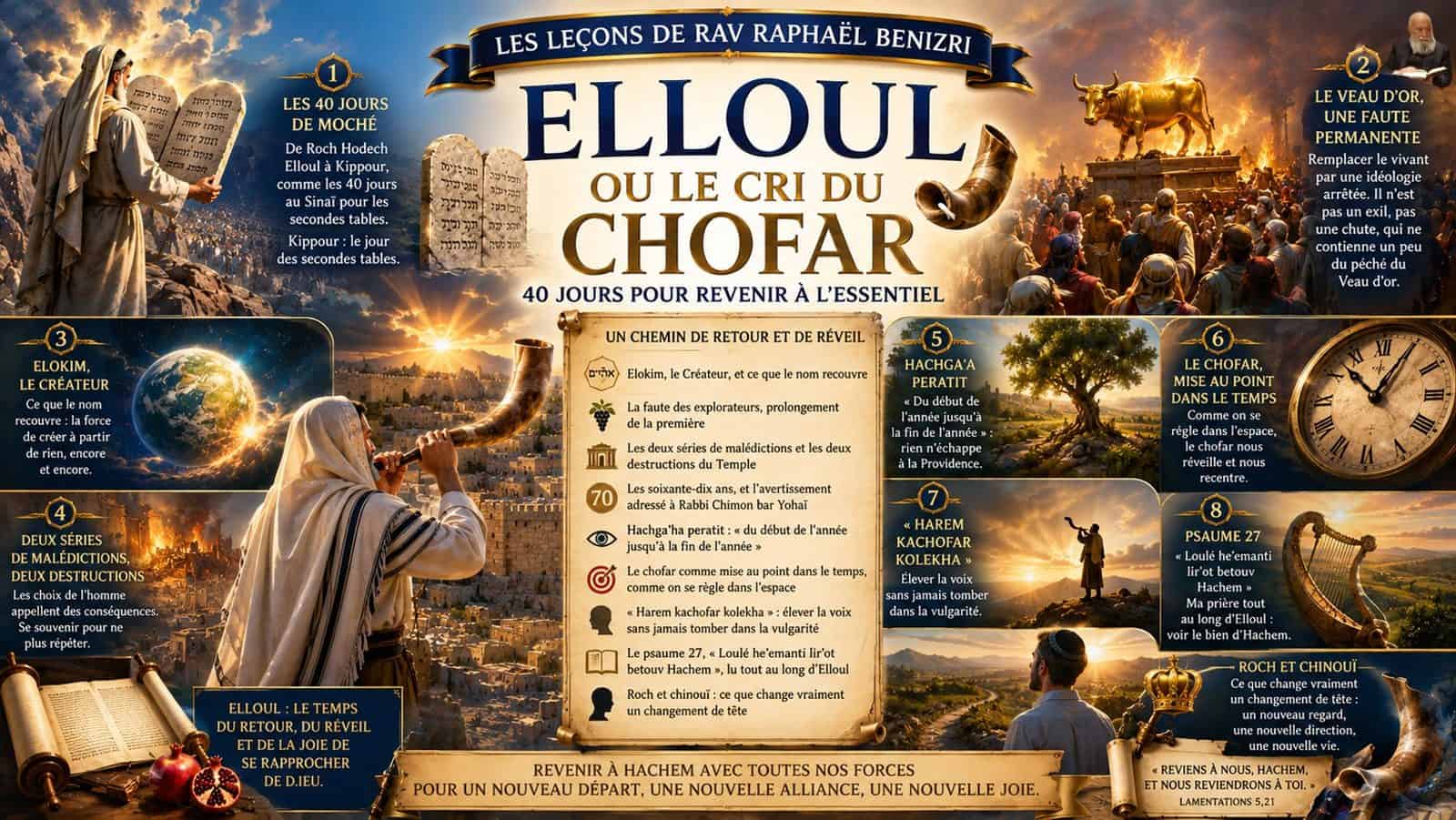
Rosh Hashanah: The Month of Elul and the Cry of the Shofar
Forty days that re-enact those of Moshe at Sinai, and the shofar as a refocusing in time. Watch the lecture and read its transcript →
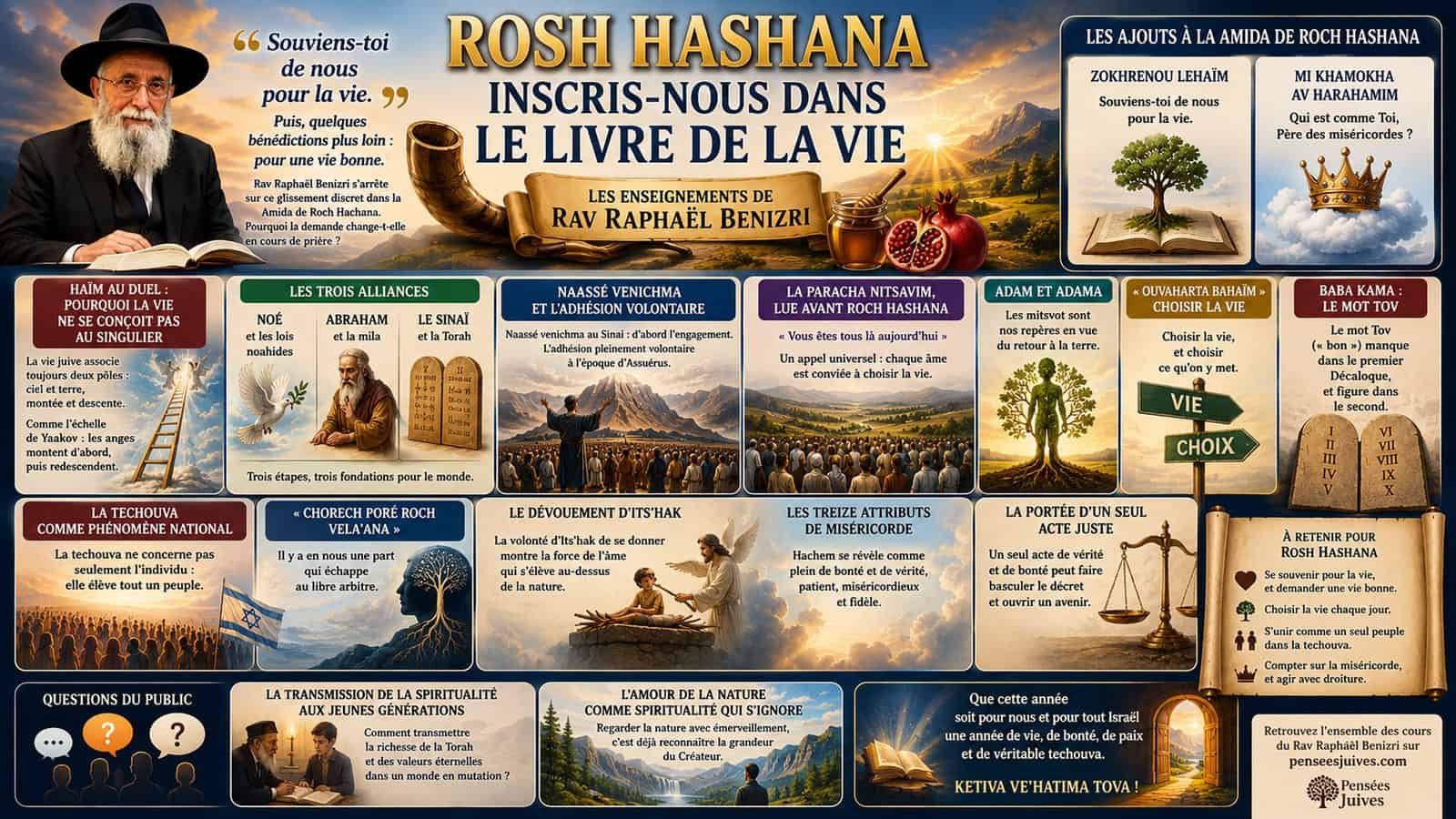
Rosh Hashanah: Inscribe Us in the Book of Life
Why the Amidah asks first for life, then for a good life — and why chayim is in the dual form. Watch the lecture and read its transcript →
Study booklets for each lecture: questions to reflect on as a family
Rosh Hashanah does not mean “the beginning of the year” but “the head of the year.” The nuance is decisive. A beginning is something you pass and then forget. A head, by contrast, directs the whole body: what is at stake here shapes the twelve months that follow, just as thought shapes action.
A Day of Judgment, and Yet a Festival
Tradition presents Rosh Hashanah as a day of judgment, on which all of creation passes in review. One might expect a somber day. Yet it is a festival: we put on fine clothes, we set a table, we dip the apple in honey, we wish one another a good year.
This apparent contradiction may be the very heart of the day. To be judged is, first of all, to be taken seriously. A world without judgment would be a world in which nothing we do carried any weight. The joy of Rosh Hashanah is not carelessness: it is the confidence of someone who knows that he matters.
The Shofar
At the center of the day there is a sound. Not a speech, not an additional prayer: a raw ram’s horn, from which come tones that resemble no music at all. One long blast, broken blasts, short sobs.
Commentators have heard a thousand things in it — a wordless cry, an awakening, a call, a reminder of Avraham’s ram. What they share is the idea that some things cannot be put into words. There are times when we need a sound rather than a sentence.
The Table and Its Symbols
The apple in honey for sweetness; the pomegranate, said to contain as many seeds as we can carry merits; the fish head, so that we may be at the head and not trailing behind. These customs are not superstition: they are ways of expressing a wish with the body rather than with words.
What Truly Begins
Rosh Hashanah opens ten days that lead to Yom Kippur. It is therefore not an end in itself, but a gateway. What is decided here must then be confirmed — and that is why the festival is at once solemn and light, without having to choose between the two.
Continue studying
The month of Elul, which prepares for these days; Yom Kippur, which brings them to a close; and Sukkot, the joy that follows them.