


Yom Kippur: The Book of Yonah and the Mission of Israel
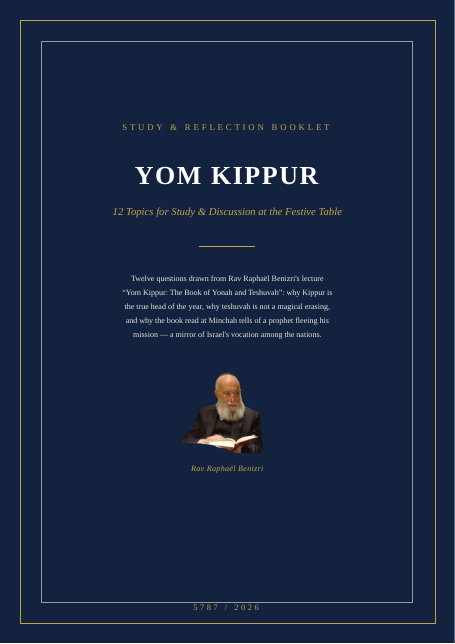
The midrash of the four answers, teshuvah (return) on a single point, and Yonah the prophet who flees because he knows G-d’s mercy all too well. View the lecture and its transcript →
Study booklets for each lecture: questions to reflect on as a family
Yom Kippur
There are days on which we add, and one day on which we take away. Yom Kippur is that day. We do not eat, we do not drink, we leave comfort behind, we let go of everything that ordinarily occupies us. What remains then, once the setting has been stripped away, is who we are.
Teshuvah Is Not Remorse
The word we translate as “repentance” literally means “return.” The difference is immense. Remorse looks back and settles there; return looks back in order to set out again. Jewish tradition does not ask us to hate ourselves for our failings — it asks us to acknowledge them, to repair as much as possible, and to begin again.
It is a remarkably optimistic outlook: it assumes that no one can be reduced to what he has done, and that a person remains capable of change until his very last day.
What Forgiveness Does Not Cover
One principle runs through the entire day: Yom Kippur repairs what has taken place between man and G-d, but does not touch what has taken place between man and his fellow. For that, one must go to the person concerned, say what needs to be said, and repair what can be repaired. No prayer can replace a conversation one has not had.
This is no doubt the hardest part of the day — and it takes place before the day begins.
The Fast
The fast is neither a punishment nor a feat of endurance. It simply sets aside, for twenty-five hours, the machinery of needs that governs all our other days. Many describe the same experience: once past the difficulty of mid-afternoon, something grows lighter. Not the body, but one’s attention.
The Close of the Day
Yom Kippur ends with a final prayer as the light fades, followed by a single blast of the shofar. Then we go home and eat. And the custom is to begin preparing the sukkah that very evening — as though the tradition refused to let such a day close in on itself, and wanted it to lead straight into action, and into joy.
Continue studying
The month of Elul and Rosh Hashanah, which open this season; Sukkot, which brings it to a close in joy.
Yom Kippur Lectures
In-depth study, with summary and full transcript: Yom Kippur: The Book of Yonah and the Mission of Israel.