
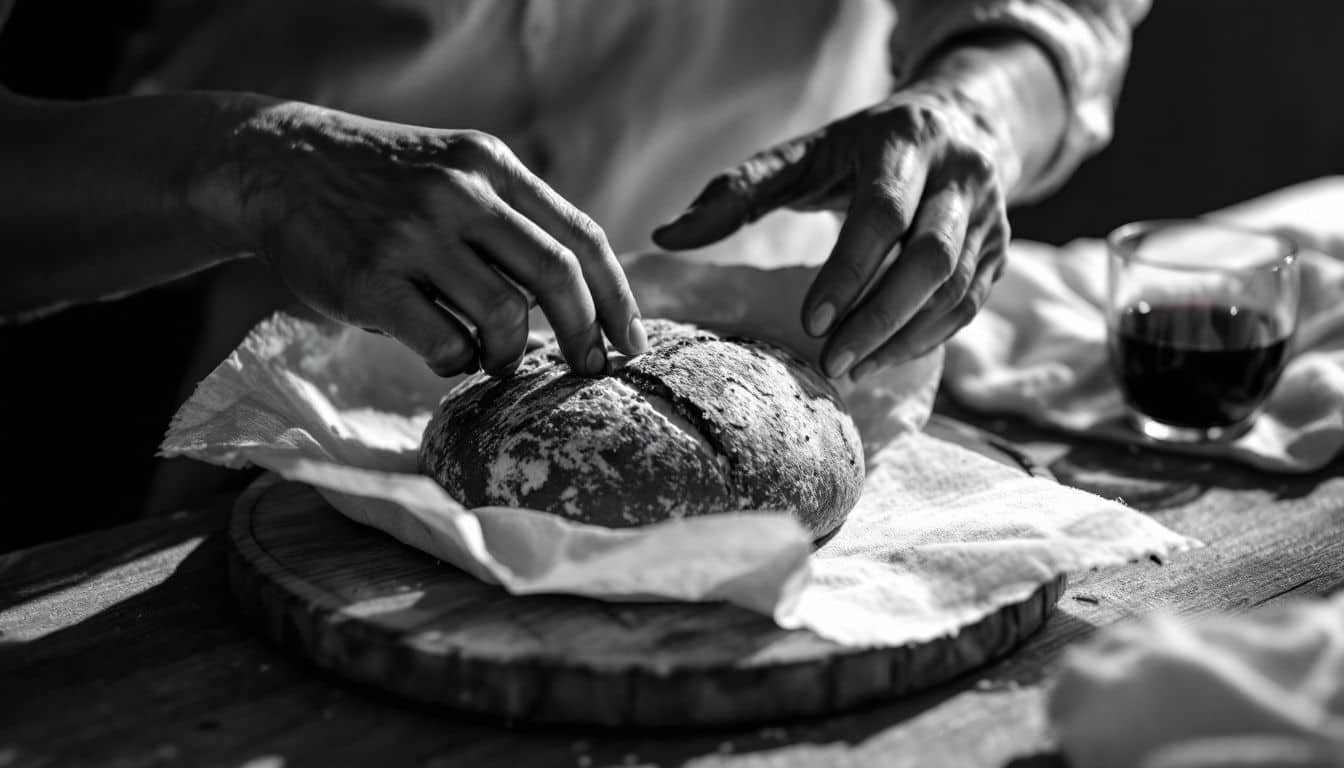
An observant Jew does not bring a piece of fruit to his mouth without saying a few words, and after a meal with bread he does not leave the table without a long expression of thanks. These words are the blessings, the berakhot; this thanksgiving is Birkat Hamazon, the “blessing over food”. Where do they come from? What do the Torah, the Talmud, Maimonides and the Shulchan Aruch say? What are the rules, the customs, the reasons? This article answers by distinguishing what belongs to the written Torah, to the decision of the Sages (halakha), to moral and mystical reading, and to history.
A berakha is a formula of praise that begins with “Blessed are You, L-rd, our G-d, King of the universe” and that one says before enjoying something, before performing a mitzvah, or to give thanks for an event. The Torah explicitly prescribes only one blessing concerning food: the one after the meal, “you shall eat, and be satisfied, and bless the L-rd” (Devarim [Deuteronomy] 8:10), that is, Birkat Hamazon, composed of four blessings. The blessings before eating, and those after lighter foods, are the work of the Sages, who grounded in reason a simple rule: it is forbidden to enjoy this world without blessing. They are said in Hebrew or in a language one understands, briefly, sometimes together.
What is a berakha?
The word berakha means “blessing”; the verb levarech, “to bless”. In Judaism, to bless G-d does not mean to give Him something: it is to acknowledge Him as the source of what is given to us. Almost all the formulas follow the same framework: Baruch ata Hashem Elokeinu melech haolam, “Blessed are You, L-rd, our G-d, King of the universe”, then the reason specific to the circumstance: “who creates the fruit of the tree”, “who has sanctified us with His commandments”, and so on.
Maimonides distinguishes three families of blessings (Rambam, Mishneh Torah, Hilkhot Berakhot 1:1-3):
- blessings of enjoyment (birkot hanehenin): before eating, drinking or smelling a fragrance;
- blessings of mitzvot (birkot hamitzvot): before performing a commandment (lighting lamps, putting on tefillin, washing the hands…);
- blessings of praise and request: for an event that occurs (lightning, good news), “so that we always remember the Creator, even if we have not enjoyed anything or performed a mitzvah” (Hilkhot Berakhot 1:3).
The Sages thus made the Jewish day a fabric of blessings. Rabbi Meir teaches that “a person is obligated to say one hundred blessings every day”, reading “and now, Israel, what (mah) does the L-rd your G-d ask of you” as “one hundred (me’ah)” (Menachot 43b; Devarim 10:12). This is a reading of the Aggada (homiletic) more than a decree, but the practice of the hundred blessings, from the prayers of the day to the blessings of meals, stems from it.
“Rabbi Meir used to say: a person is obligated to say one hundred blessings every day, for it is written: ‘And now, Israel, what does the L-rd your G-d ask of you’ (…).”
(Menachot 43b) — רַבִּי מֵאִיר אוֹמֵר: חַיָּיב אָדָם לְבָרֵךְ מֵאָה בְּרָכוֹת בְּכׇל יוֹם, שֶׁנֶּאֱמַר: ״וְעַתָּה יִשְׂרָאֵל מָה ה׳ אֱלֹהֶיךָ שֹׁאֵל מֵעִמָּךְ״.
Why bless? The world is not ours
The Talmud poses the question about food and gives an answer that has remained a cornerstone: “It is forbidden for a person to enjoy this world without a blessing.” The Gemara first looks for a verse on which to ground the blessing before eating. It tries several readings, rejects them one by one, and ends up concluding: “it is a logical argument” (sevara hu). The principle is then taken up by the baraita (teaching of the Sages of the Mishna):
“The Sages taught: it is forbidden for a person to enjoy this world without a blessing; and whoever enjoys this world without a blessing has committed me’ila (a misappropriation of sacred property).”
(Berakhot 35a) — תָּנוּ רַבָּנַן: אָסוּר לוֹ לָאָדָם שֶׁיֵּהָנֶה מִן הָעוֹלָם הַזֶּה בְּלֹא בְּרָכָה. וְכׇל הַנֶּהֱנֶה מִן הָעוֹלָם הַזֶּה בְּלֹא בְּרָכָה מָעַל.
Why a “misappropriation”? Because, according to Rav Yehuda in the name of Shmuel, “whoever enjoys this world without a blessing, it is as if he were enjoying things consecrated to heaven”, for it is written: “The earth and all it contains belong to the L-rd” (Tehilim [Psalms] 24:1). But Rabbi Levi points out a contradiction with another verse: “The heavens are the heavens of the L-rd, but the earth He has given to the children of man” (Tehilim 115:16). And he answers: “It is not a difficulty: here, before the blessing; there, after the blessing” (Berakhot 35a-35b).
“Rav Yehuda said in the name of Shmuel: whoever enjoys this world without a blessing, it is as if he were enjoying things consecrated to heaven, for it is written: ‘The earth and all it contains belong to the L-rd.’ Rabbi Levi raised a contradiction: it is written ‘The earth and all it contains belong to the L-rd’, and it is written ‘The heavens are the heavens of the L-rd, and the earth He has given to the children of man.’ It is not a difficulty: here, before the blessing, there, after the blessing.”
(Berakhot 35a-35b) — אָמַר רַב יְהוּדָה אָמַר שְׁמוּאֵל: כׇּל הַנֶּהֱנֶה מִן הָעוֹלָם הַזֶּה בְּלֹא בְּרָכָה כְּאִילּוּ נֶהֱנָה מִקׇּדְשֵׁי שָׁמַיִם, שֶׁנֶּאֱמַר: ״לַה׳ הָאָרֶץ וּמְלוֹאָהּ״. רַבִּי לֵוִי רָמֵי: כְּתִיב ״לַה׳ הָאָרֶץ וּמְלוֹאָהּ״, וּכְתִיב ״הַשָּׁמַיִם שָׁמַיִם לַה׳ וְהָאָרֶץ נָתַן לִבְנֵי אָדָם״! לָא קַשְׁיָא כָּאן קוֹדֶם בְּרָכָה. כָּאן לְאַחַר בְּרָכָה.
The blessing is therefore what moves food from the world belonging to G-d to man’s table: through speech, I acknowledge that what I eat is given to me. Rabbi Chanina bar Papa goes further: “whoever enjoys this world without a blessing, it is as if he were robbing the Holy One, blessed be He, and the community of Israel”, reading the verse in Proverbs about “one who robs his father and mother” (Mishlei [Proverbs] 28:24): the father is G-d; the mother, the community of Israel (Berakhot 35b).
“Rabbi Chanina bar Papa said: whoever enjoys this world without a blessing, it is as if he were robbing the Holy One, blessed be He, and the community of Israel.”
(Berakhot 35b) — אָמַר רַבִּי חֲנִינָא בַּר פָּפָּא: כׇּל הַנֶּהֱנֶה מִן הָעוֹלָם הַזֶּה בְּלֹא בְּרָכָה כְּאִילּוּ גּוֹזֵל לְהַקָּדוֹשׁ בָּרוּךְ הוּא וּכְנֶסֶת יִשְׂרָאֵל,
These formulas are derashot: they dramatize deliberately. Maimonides draws from them the sober rule: “One who enjoys without a blessing has committed a me’ila”; one must therefore bless “before enjoying” even a small quantity (Hilkhot Berakhot 1:2).
Torah or Sages? An important distinction
Two levels must be distinguished. According to the Rambam, the only blessing over food that is a mitzvah of the Torah is the one after the meal, and only when one is satisfied, based on Devarim 8:10; before eating, as after a snack, it is an institution of the Sages (Hilkhot Berakhot 1:1-2; Berakhot 21a). The Sefer HaChinuch (mitzvah 430) also counts this mitzvah: to bless G-d after having eaten bread or the seven species and being satisfied. For the Rambam, the blessing before eating is from the words of the Sages, but grounded in one of the rules of interpretation of the Torah; the Tosafot consider it to be of rabbinic origin (see the commentary of the Touger edition on Hilkhot Berakhot 1:2). In both cases, the rule is not arbitrary.
Rav Benizri recalls this in a lesson on the seder: “the only blessing imposed by the Torah, Birkat Hamazon, concerns only the meal with bread” (see below).
Before eating: the blessing over each food
The Mishna gives the basic rule at the very start of the sixth chapter of Berakhot:
“How does one bless over fruits? Over the fruits of the tree, one says borei peri ha’etz (‘who creates the fruit of the tree’), except over wine, over which one says borei peri hagafen (‘who creates the fruit of the vine’). Over the fruits of the ground, one says borei peri ha’adama, except over bread, over which one says hamotzi lechem min ha’aretz (‘who brings forth bread from the earth’). Over vegetables, one says borei peri ha’adama.”
(Mishna Berakhot 6:1) — כֵּיצַד מְבָרְכִין עַל הַפֵּרוֹת. עַל פֵּרוֹת הָאִילָן אוֹמֵר, בּוֹרֵא פְּרִי הָעֵץ, חוּץ מִן הַיַּיִן, שֶׁעַל הַיַּיִן אוֹמֵר בּוֹרֵא פְּרִי הַגָּפֶן. וְעַל פֵּרוֹת הָאָרֶץ אוֹמֵר בּוֹרֵא פְּרִי הָאֲדָמָה, חוּץ מִן הַפַּת, שֶׁעַל הַפַּת הוּא אוֹמֵר הַמּוֹצִיא לֶחֶם מִן הָאָרֶץ. וְעַל הַיְרָקוֹת אוֹמֵר בּוֹרֵא פְּרִי הָאֲדָמָה.
And the Mishna continues: over what does not grow from the ground (meat, milk, eggs, fish), one says shehakol nihyeh bidvaro, “by whose word everything came to be” (Mishna Berakhot 6:3; Shulchan Aruch, Orach Chaim 204:1). The Sages thus established a ladder: the blessing names the origin of the food. For the fruit of the tree and wine, the Shulchan Aruch takes up the rule (Orach Chaim 202:1). For products made from the five grains (pastry, cakes), one says borei minei mezonot, “who creates various kinds of nourishment”, and, afterward, an abbreviated blessing (Orach Chaim 168:6); if one eats them in a quantity sufficient to make a meal, one says Hamotzi and Birkat Hamazon (ibid.).
In summary:
- Bread: Hamotzi (Mishna Berakhot 6:1), preceded by the washing of the hands (see Why do Jews wash their hands?).
- Cakes, pasta, cooked grains: Borei minei mezonot.
- Wine and grape juice: Borei peri hagafen.
- Tree fruits: Borei peri ha’etz.
- Fruits and vegetables of the ground: Borei peri ha’adama.
- Everything else (meat, fish, eggs, dairy products, drinks): Shehakol nihyeh bidvaro.
A blessing for the mitzvah as for the food
The Rambam adds that, just as one blesses before enjoying, “one blesses before every mitzvah before performing it” (Hilkhot Berakhot 1:3). The Jewish day is thus punctuated by these formulas, which one says in Hebrew or in a language one understands (the Shulchan Aruch says that Birkat Hamazon “may be said in any language”, Orach Chaim 185:1).
Not blessing in vain
There is a limit: one does not pronounce a needless blessing, because it amounts to pronouncing the Name for nothing. “Whoever says an unnecessary blessing takes the Name of Heaven in vain, and it is as if he were swearing falsely; it is forbidden to answer amen after him” (Shulchan Aruch, Orach Chaim 215:4; Rambam, Hilkhot Berakhot 1:15). The formula echoes the Decalogue: “You shall not take the name of the L-rd your G-d in vain” (Shemot [Exodus] 20:7). That is why, in case of doubt, one consults a rabbi rather than blessing at random.
Answering amen
When one hears a Jew say a blessing, one answers amen, even without having heard the whole blessing (Shulchan Aruch, Orach Chaim 215:2). The Talmud reports the opinion of Rabbi Yose: “One who answers amen is greater than one who blesses” (Berakhot 53b). The blessing is thus also a collective act: the amen is the signature of the others.
Bread and the table
Bread holds, in this ladder, a place apart: it is the only food that requires at once the washing of the hands, the blessing Hamotzi and, after the meal, Birkat Hamazon (Shulchan Aruch, Orach Chaim 158:1; 167; 168). The Shulchan Aruch describes how one cuts the bread: one does not take a piece that is too small, which would look miserly, nor one larger than an egg, which would look gluttonous; one leaves the slice attached to the loaf during the blessing (Orach Chaim 167:1).
The Rema adds a custom that shows how the table is understood: “It is a mitzvah to bring salt to every table before breaking bread, for the table is comparable to the altar, and the meal to the sacrifice, and it is said: ‘on all your offerings you shall offer salt'” (Orach Chaim 167:5, citing the Beit Yosef, in the name of the Shibbolei HaLeket).
“It is a mitzvah to bring salt to every table before breaking bread, for the table is comparable to the altar, and the meal to the sacrifice, and it is said: ‘on all your offerings you shall offer salt.'”
(Rema, Shulchan Aruch, Orach Chaim 167:5) — הגה ומ”מ מצוה להביא על כל שלחן מלח קודם שיבצוע כי השלחן דומה למזבח והאכיל’ לקרבן ונא’ על כל קרבנך תקריב מלח
This reading rests on a saying of the Talmud: “As long as the Temple stood, the altar brought atonement to Israel; now, a person’s table brings him atonement” (Berakhot 55a), where two verses of Ezekiel are brought together, on the altar and on “the table that is before the L-rd” (Yechezkel [Ezekiel] 41:22). To this comparison one often links the custom of covering the knife at the time of Birkat Hamazon (Orach Chaim 180:5, a custom not followed on Shabbat and festivals); the commentators give varied reasons.
The Sages also draw a moral lesson from it. In Pirkei Avot, Rabbi Shimon teaches: “Three who have eaten at one table without having said words of Torah over it, it is as if they had eaten from sacrifices to the dead; but three who have eaten at one table and have said words of Torah over it, it is as if they had eaten at the table of the Omnipresent (G-d), blessed be He” (Avot 3:3).
“Rabbi Shimon said: three who have eaten at one table and have said words of Torah over it, it is as if they had eaten at the table of the Omnipresent, blessed be He.”
(Pirkei Avot 3:3) — אֲבָל שְׁלשָׁה שֶׁאָכְלוּ עַל שֻׁלְחָן אֶחָד וְאָמְרוּ עָלָיו דִּבְרֵי תוֹרָה, כְּאִלּוּ אָכְלוּ מִשֻּׁלְחָנוֹ שֶׁל מָקוֹם בָּרוּךְ הוּא, שֶׁנֶּאֱמַר (יחזקאל מא) וַיְדַבֵּר אֵלַי זֶה הַשֻּׁלְחָן אֲשֶׁר לִפְנֵי ה‘:
Birkat Hamazon: from one verse to four blessings
The verse
The starting point is a verse of the Torah. Moshe speaks to the people, before the entry into the Promised Land, about the richness of the country: wheat, barley, vine, fig tree, pomegranate, olive tree, honey (the “seven species”). Then he concludes:
“You shall eat, and be satisfied, and you shall bless the L-rd your G-d for the good land that He has given you.”
(Devarim 8:10) — וְאָכַלְתָּ וְשָׂבָעְתָּ וּבֵרַכְתָּ אֶת־יְהֹוָה אֱלֹהֶיךָ עַל־הָאָרֶץ הַטֹּבָה אֲשֶׁר נָתַן־לָךְ׃
The Talmud derives from it the mitzvah of Birkat Hamazon: “Rav Yehuda said: from where do we have Birkat Hamazon after the meal, according to the Torah? From ‘you shall eat, and be satisfied, and you shall bless'” (Berakhot 21a). The Rambam counts it as a positive mitzvah of the Torah (Hilkhot Berakhot 1:1; Sefer HaMitzvot, positive mitzvah 19, which also cites the Tosefta, Berakhot 6:1), and the Sefer HaChinuch places it at number 430.
The verse also introduces a nuance: the Torah asks for a blessing only when one is satisfied. The Sages added, by decree, to bless even after a mere “olive-size” (kazayit) of bread. The Talmud (Berakhot 20b) draws from it a beautiful homily: the angels object before G-d that He “shows favoritism” toward Israel, whereas He wrote “who does not show favoritism”. G-d answers that He wrote it Himself: Israel is demanding of itself, down to a kazayit and down to an egg, where the Torah requires only satiety.
“The ministering angels said before the Holy One, blessed be He: Master of the universe, it is written in Your Torah ‘who does not show favoritism and takes no bribe’, and You show favoritism to Israel! He said to them: how could I not show favoritism to Israel, I who wrote for them in the Torah ‘you shall eat, and be satisfied, and you shall bless’, and they are exacting with themselves down to a kazayit and down to an egg?”
(Berakhot 20b) — אָמְרוּ מַלְאֲכֵי הַשָּׁרֵת לִפְנֵי הַקָּדוֹשׁ בָּרוּךְ הוּא: רִבּוֹנוֹ שֶׁל עוֹלָם, כָּתוּב בְּתוֹרָתֶךָ ״אֲשֶׁר לֹא יִשָּׂא פָנִים וְלֹא יִקַּח שֹׁחַד״, וַהֲלֹא אַתָּה נוֹשֵׂא פָּנִים לְיִשְׂרָאֵל, דִּכְתִיב: ״יִשָּׂא ה׳ פָּנָיו אֵלֶיךָ״?! אָמַר לָהֶם: וְכִי לֹא אֶשָּׂא פָּנִים לְיִשְׂרָאֵל, שֶׁכָּתַבְתִּי לָהֶם בַּתּוֹרָה ״וְאָכַלְתָּ וְשָׂבָעְתָּ וּבֵרַכְתָּ אֶת ה׳ אֱלֹהֶיךָ״, וְהֵם מְדַקְדְּקִים [עַל] עַצְמָם עַד כְּזַיִת וְעַד כְּבֵיצָה.
The four blessings and their authors
Birkat Hamazon is composed of four blessings. The Talmud gives their history:
“Rav Nachman said: Moshe instituted for Israel the blessing ‘Hazan‘ (‘who nourishes’) when the manna fell for them. Yehoshua instituted for them the blessing of the Land when they entered the land. David and Shlomo instituted ‘Boneh Yerushalayim‘ (‘who rebuilds Jerusalem’): David instituted ‘on Israel Your people and on Jerusalem Your city’, and Shlomo instituted ‘on the great and holy House’. ‘Hatov vehametiv‘ (‘who is good and does good’) was instituted at Yavne, in memory of those slain at Betar.”
(Berakhot 48b) — אָמַר רַב נַחְמָן: מֹשֶׁה תִּקֵּן לְיִשְׂרָאֵל בִּרְכַּת ״הַזָּן״ בְּשָׁעָה שֶׁיָּרַד לָהֶם מָן. יְהוֹשֻׁעַ תִּקֵּן לָהֶם בִּרְכַּת הָאָרֶץ כֵּיוָן שֶׁנִּכְנְסוּ לָאָרֶץ. דָּוִד וּשְׁלֹמֹה תִּקְּנוּ ״בּוֹנֵה יְרוּשָׁלַיִם״. דָּוִד תִּקֵּן ״עַל יִשְׂרָאֵל עַמֶּךָ וְעַל יְרוּשָׁלַיִם עִירֶךָ״, וּשְׁלֹמֹה תִּקֵּן ״עַל הַבַּיִת הַגָּדוֹל וְהַקָּדוֹשׁ״. ״הַטּוֹב וְהַמֵּטִיב״ בְּיַבְנֶה תִּקְּנוּהָ כְּנֶגֶד הֲרוּגֵי בֵּיתָר. דְּאָמַר רַב מַתְנָא: אוֹתוֹ הַיּוֹם שֶׁנִּיתְּנוּ הֲרוּגֵי בֵּיתָר לִקְבוּרָה תִּקְנוּ בְּיַבְנֶה ״הַטּוֹב וְהַמֵּטִיב״. ״הַטּוֹב״ — שֶׁלֹּא הִסְרִיחוּ, ״וְהַמֵּטִיב״ — שֶׁנִּיתְּנוּ לִקְבוּרָה.
The Rambam summarizes: “The first blessing, Moshe Rabbeinu instituted it; the second, Yehoshua; the third, David and Shlomo his son; the fourth, the Sages of the Mishna” (Hilkhot Berakhot 2:1). Here is their content:
1. Birkat Hazan: one thanks G-d who nourishes the whole world. It goes back, according to the Talmud, to the manna in the desert (Berakhot 48b). 2. Birkat Ha’aretz: one gives thanks for the Land of Israel, for the covenant of circumcision and for the Torah. The Talmud requires that one mention “a desirable, good and spacious land”, the covenant (brit) and the Torah (Berakhot 48b-49a; Rambam, Hilkhot Berakhot 2:3). 3. Boneh Yerushalayim: one asks for the rebuilding of Jerusalem and mentions in it the kingship of the house of David (Berakhot 48b; Shulchan Aruch, Orach Chaim 187:4). It is the end of the blessings of the Torah: “after concluding Boneh Yerushalayim, one answers amen after one’s own blessing, because it is the end of the blessings of the Torah, the fourth not being from the Torah” (Orach Chaim 188:1). 4. Hatov vehametiv: one praises G-d as “good and doing good”, with a series of requests (harachaman). The Sages instituted it at Yavne, in memory of those slain at Betar, whose bodies had not decayed and were finally buried (Berakhot 48b).
The text is modulated according to the day: on Shabbat and festivals, one adds passages specific to them (Orach Chaim 188:6); on Chanukah and Purim, one says Al hanisim, “for the miracles” (Orach Chaim 187:4, Rema).
The structure is thus at once a history of Israel in four stages: the desert (the manna), the entry into the land, Jerusalem and the Temple, and finally the memory of those slain at Betar and consolation. Each meal with bread is thus an occasion to recall this journey; this four-stage reading is that of the Talmud itself (Berakhot 48b).
The zimmun: blessing together
When three men have eaten together, Birkat Hamazon begins with an invitation (zimmun). The Mishna: “Three who have eaten together are obligated to make a zimmun” (Mishna Berakhot 7:1); the one who leads says: “Let us bless” (and, with ten, adds the Name: “Let us bless our G-d”) (Mishna Berakhot 7:3).
“Three who have eaten together are obligated to make a zimmun.”
(Mishna Berakhot 7:1) — שְׁלשָׁה שֶׁאָכְלוּ כְאֶחָד, חַיָּבִין לְזַמֵּן.
For women, the Mishna states: “Women, slaves and minors: one does not make a zimmun over them” (Mishna Berakhot 7:2), that is, they do not count in the group that obligates a zimmun. But the Talmud specifies that women may, among themselves, make their own zimmun: three women suffice (Berakhot 45b). The Shulchan Aruch writes that women “make a zimmun among themselves optionally”, and that, when they eat with men, they are obligated to respond and fulfill their obligation through the men’s zimmun (Orach Chaim 199:7). Women are, in any case, obligated in Birkat Hamazon itself: “women, slaves and minors are obligated in prayer, in the mezuzah and in Birkat Hamazon” (Mishna Berakhot 3:3; Berakhot 20b). The Rambam notes that, according to some, their obligation is from the Torah, and that, for this reason, they cannot fulfill the obligation of men (Hilkhot Berakhot 5:1). This is one of the points on which opinions differ.
How one blesses: the cup, the language, the place
The Shulchan Aruch settles a few practical points.
- The place: one blesses where one has eaten, before leaving one’s place (Orach Chaim 184:1).
- The language: “Birkat Hamazon may be said in any language” (Orach Chaim 185:1).
- The cup: the “cup of blessing” (kos shel berakha) must be rinsed inside and out (Orach Chaim 183:1); after Birkat Hamazon, the one who led says borei peri hagafen and drinks (Orach Chaim 190:1).
- Workers: those who work for an employer traditionally abbreviate Birkat Hamazon, but the current custom is to say it in full (Rambam, Hilkhot Berakhot 2:2; Orach Chaim 191:1-2).
Before Birkat Hamazon, one rinses the fingers (mayim acharonim), a custom we discuss in the article on handwashing.
After other foods: Al hamichya, Me’ein shalosh
For what is not a meal with bread, there is a shorter blessing afterward. The Mishna reports a discussion: after eating figs, grapes and pomegranates, Rabban Gamliel says the three blessings of Birkat Hamazon, but the Sages say “a single blessing that summarizes the three” (me’ein shalosh); Rabbi Akiva says that even cooked vegetables, if they are the main food, call for the three blessings (Mishna Berakhot 6:8). The Shulchan Aruch states that, after the five fruits (grape, fig, pomegranate, olive, date), one says a single blessing that summarizes the three, me’ein shalosh (Orach Chaim 208:1); after cooked dishes made from the five grains, the conclusion is Al hamichya (Orach Chaim 208:2).
A little history
In the tradition. The Talmud attributes the four blessings to Moshe, Yehoshua, David and Shlomo, then to Yavne, after the defeat at Betar (135 CE) (Berakhot 48b): a religious genealogy, in which each great stage (desert, conquest, kingship, destruction) gives a theme to the text.
Ancient parallels. A prayer “after being satisfied”, in chapter 10 of the Didache, a very early Christian text (1st-2nd century), has been compared to Birkat Hamazon: one gives thanks for food and then entreats on behalf of the assembly. Louis Finkelstein saw in it an adaptation of Birkat Hamazon (“The Birkat Ha-Mazon”, Jewish Quarterly Review 19, 1928-1929), a debated but frequently cited thesis. For the history of the text itself, see Ismar Elbogen, Jewish Liturgy: A Comprehensive History, JPS, 1993.
Variants. There are several texts of Birkat Hamazon: Ashkenazic, Sephardic, Yemenite, Italian. They follow the same four-blessing structure but differ in the detail of the words and of the “harachaman“. The Shulchan Aruch already refuses the addition of certain formulas (“one who adds, subtracts”, Orach Chaim 187:1).
Spiritual readings
Halakha says how to bless; the moral and mystical tradition says why.
Moral reading. Blessings combat ingratitude: eating is a biological act, but Judaism puts a word to it. The Talmud is clear: without a blessing, it is misappropriation (Berakhot 35a), even theft (Berakhot 35b). With it, the table becomes a place of memory: the manna, the land, Jerusalem, Betar.
The “altar” reading and Torah at the table. The table is a sort of altar that remains after the destruction of the Temple (Berakhot 55a; Rema, Orach Chaim 167:5), and the meal becomes the “table of the Omnipresent” when words of Torah are said at it (Avot 3:3).
What Rav Raphaël Benizri teaches
Rav Benizri devoted a book to blessings, The Aromas of a Blessing, a presentation of which the site publishes. It explores “a central but often neglected aspect of Jewish life: blessings, in particular those related to food”. According to this presentation, the book’s strong idea is that “eating is not a mere biological need, but an act charged with spiritual meaning”: each food is preceded by a blessing that recalls that everything comes from G-d, but repetition can produce “a form of inner forgetfulness”. The book seeks to give blessings back their “fragrance”, to fight routine, to criticize the excessive pursuit of material needs, and it accompanies the reader through the laws of food blessings, their order, their meaning and the intentions to associate with them. See the presentation: The Aromas of a Blessing; see also the page of the Rav’s books.
In the lesson “The Four Questions of the Ma Nishtana”, the Rav links food to the origin: “The only commandment given to Adam concerned food. Not the blessing to be fruitful and multiply, but the order: of all the trees you may eat, except the tree of the knowledge of good and evil. And the only blessing imposed by the Torah, Birkat HaMazon, concerns only the meal with bread.” He adds that eating bread is “restoring a world”: the earth produced the plant, the plant fed the animal, the animal fed man, and man, through his mind, restores the whole to the source of creation. The same page notes that matza and maror are also “worthy of a blessing”: “the pains we take are worth a blessing, provided we draw the message from them”. See the lesson: Pesach: the four questions of the Ma Nishtana.
Finally, in the lesson on “the mystery of the number four”, he places the four blessings of Birkat HaMazon among the “quartets” of the Pesach evening, with the blessing “that removes from bread the curse of ‘by the sweat of your brow'”. See the lesson: Pesach: the mystery of the number four.
(The passages above are taken from the presentation texts and summaries published with these lessons; we add nothing to them.)
Differences of custom
- Texts: several versions of Birkat Hamazon (Ashkenazic, Sephardic, Yemenite, Italian); one follows the prayer book of one’s community.
- The women’s zimmun: the Shulchan Aruch speaks of an option (Orach Chaim 199:7); customs vary from one community to another.
- The knife: it is covered during Birkat Hamazon, except on Shabbat and festival days (Orach Chaim 180:5).
- The salt: a custom cited in the gloss of the Rema (Orach Chaim 167:5), the authority of the Ashkenazic communities; each community follows its own customs.
Common misconceptions about blessings
“To bless is to pray in order to obtain something”
No. The berakha is above all an acknowledgment: one thanks, one praises, one remembers (Rambam, Hilkhot Berakhot 1:3). Requests have their place in prayer, but the blessing over food is praise.
“Blessings are magic”
Not that either. The Talmud speaks of “me’ila”, of misappropriation, in the legal and moral sense of the word: what is wrong is to enjoy what does not belong to us while omitting to acknowledge it. The formulas do not act on the food, but on the one who eats.
“Everything must be said in Hebrew”
No. The Shulchan Aruch says that Birkat Hamazon may be said in any language (Orach Chaim 185:1). It is nevertheless better to understand what one says: that is even the reason why many prayer books give a translation.
“Women do not say Birkat Hamazon”
False. The Mishna says that they are obligated (Mishna Berakhot 3:3; Berakhot 20b), while discussing the nature of their obligation (Rambam, Hilkhot Berakhot 5:1).
“One only blesses before eating”
No. Blessings before exist, but the only one the Torah prescribes is the one after the meal (Devarim 8:10). For special situations (mixed meals, order of foods), consult a rabbi.
Frequently asked questions about blessings and Birkat Hamazon
What is the difference between “Hamotzi” and “Borei minei mezonot”?
Hamotzi is said over bread, and it entails Birkat Hamazon at the end of the meal. Borei minei mezonot is said over grain-based products that are not bread properly speaking (cakes, cookies). If one eats these products in a quantity large enough to make a meal, the rule changes (Orach Chaim 168:6).
Why four blessings?
Because the Talmud makes of them four stages of a history: the manna (Moshe), the Land (Yehoshua), Jerusalem (David and Shlomo), and the consolation of Betar (Yavne) (Berakhot 48b).
Must one bless if one eats a small piece?
Yes, before eating one blesses even a small quantity (Rambam, Hilkhot Berakhot 1:2). Afterward, the obligation depends on the quantity and the food: Birkat Hamazon is due after a meal with bread (Torah: if one is satisfied; Sages: from a kazayit) (Rambam, Hilkhot Berakhot 1:1).
What is the zimmun?
The invitation to bless together when at least three have eaten bread (Mishna Berakhot 7:1; Shulchan Aruch, Orach Chaim 192:1). With ten, one adds the divine Name (Mishna Berakhot 7:3).
Can one say Birkat Hamazon in a language other than Hebrew?
Yes: “Birkat Hamazon may be said in any language” (Shulchan Aruch, Orach Chaim 185:1). It is better to understand what one says than to recite it without understanding.
Further reading
Blessings put words to what Judaism calls the holiness of the table. To continue, here are a few readings on the site.
- Why do Jews wash their hands (netilat yadayim)?
- What does “kosher” mean? Kashrut explained
- What is Shabbat?
- What is Pesach and how does the seder unfold?
- What is the difference between Ashkenazic and Sephardic Jews?
- The Aromas of a Blessing: the berakhot
- Why do we eat matza on Pesach?
- Glossary of Hebrew words in Judaism
Sources and references (17)
- Shemot (Exodus) 20:7
- Devarim (Deuteronomy) 8:7-10; 10:12
- Tehilim (Psalms) 24:1; 115:16
- Mishlei (Proverbs) 28:24
- Yechezkel (Ezekiel) 41:22
- Mishna Berakhot 3:3; 6:1; 6:3; 6:8; 7:1-3
- Pirkei Avot 3:3
- Babylonian Talmud, Berakhot 20b; 21a; 35a-35b; 45b; 48b-49a; 53b; 55a
- Babylonian Talmud, Menachot 43b
- Rambam, Mishneh Torah, Hilkhot Berakhot 1:1-3; 1:15; 2:1-3; 5:1
- Rambam, Sefer HaMitzvot, positive mitzvah 19
- Sefer HaChinuch, mitzvah 430
- Shulchan Aruch, Orach Chaim 158:1; 167:1; 167:5; 168:6; 180:5; 183:1; 184:1; 185:1; 187:1; 187:4; 188:1; 188:6; 190:1; 191:1-2; 192:1; 199:7; 202:1; 204:1; 208:1-2; 215:2; 215:4
- Louis Finkelstein, “The Birkat Ha-Mazon”, Jewish Quarterly Review 19, 1928-1929
- Didache 10
- Ismar Elbogen, Jewish Liturgy: A Comprehensive History, Jewish Publication Society, 1993
- Lessons and book of Rav Raphaël Benizri: The Aromas of a Blessing; Pesach: the four questions of the Ma Nishtana; Pesach: the mystery of the number four
Article by the Pensées Juives editorial team. Passages attributed to Rav Raphaël Benizri are taken from his lectures published on this site.