
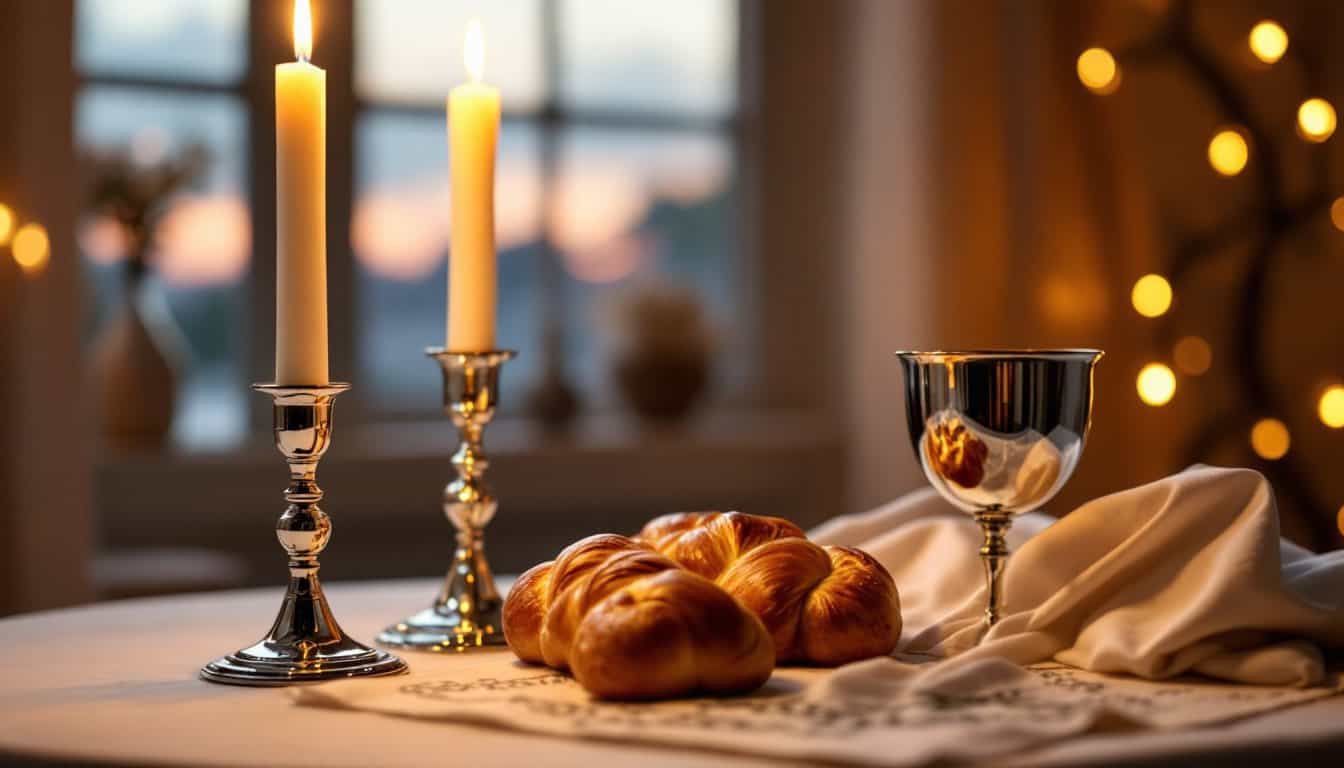
Every Friday, shortly before sunset, millions of Jewish homes light two candles, set two braided loaves on a white tablecloth and switch off their phones until the following evening. Why does this day begin on Friday night? Why not turn on a light, drive or write? And above all, what are people looking for in this “rest” which, seen from the outside, looks like a long list of prohibitions? Here is a complete answer: the verses of the Torah, the teaching of the Talmud, the deeper reasons, today’s practice and the history of a day that has come down through three thousand years.
Shabbat (from the Hebrew shavat, “to cease”) is the seventh day of the Jewish week, from Friday at sunset until nightfall on Saturday evening, about twenty-five hours in all. The Torah establishes it in remembrance of the creation of the world, at the end of which G-d “ceased” His work, and in remembrance of the Exodus from Egypt, when a nation of slaves became free. On this day, one refrains from the thirty-nine categories of “creative work” (melakhot) that were used to build the Sanctuary in the desert, such as lighting a fire, writing, cooking or carrying an object in a public space. Yet Shabbat is not first and foremost a day of prohibitions: it is a day of holiness, prayer, study, family meals and joy, which tradition calls a “queen” and a “bride”. It is one of the Ten Commandments and stands at the heart of all Jewish life.
What the Torah says: from Creation to the Ten Commandments
Shabbat appears on the very first page of the Torah. At the end of the six days of Creation, the text says: “The heavens and the earth were completed, and all their host. On the seventh day G-d completed the work that He had made, and He ceased (vayishbot) on the seventh day from all the work that He had made. G-d blessed the seventh day and sanctified it, for on it He ceased from all His work” (Bereshit [Genesis] 2:1-3). The word Shabbat comes from this verb: it does not primarily mean “to rest” but “to cease”, “to stop”. Rashi, quoting the Midrash, raises a surprising question: what was the world still missing on the evening of the sixth day? It was missing rest, menuchah. Shabbat came, and rest came with it: Shabbat is not a break after Creation, it is its completion (Rashi on Bereshit 2:2).
Shabbat then becomes a commandment. In the Ten Commandments given at Sinai, it is linked to Creation: “Remember (zakhor) the Shabbat day to keep it holy. Six days you shall labor and do all your work, but the seventh day is Shabbat to the L-rd your G-d; you shall do no work, neither you, nor your son, nor your daughter, nor your servant […]. For in six days the L-rd made the heavens and the earth […] and He rested on the seventh day” (Shemot [Exodus] 20:8-11).
Forty years later, when Moshe repeats the Ten Commandments before the entry into the Land of Israel, the wording changes: “Keep (shamor) the Shabbat day to keep it holy […] so that your manservant and your maidservant may rest as you do. You shall remember that you were a slave in the land of Egypt, and that the L-rd your G-d brought you out from there […]; therefore the L-rd your G-d has commanded you to observe the Shabbat day” (Devarim [Deuteronomy] 5:12-15). The first version looks back to the origin of the world; the second looks toward human freedom. The Talmud teaches that “remember” and “keep” were spoken by G-d in a single utterance, something the human ear cannot grasp (Shevuot 20b). The song Lekha Dodi, sung every Friday night, recalls it: “Shamor ve-zakhor be-dibbur echad”, “keep and remember, in a single utterance”. Hence the two dimensions of the day: zakhor, what one does to sanctify it, and shamor, what one refrains from.
Other passages complete the picture. In the desert, the manna does not fall on the seventh day, and on Friday everyone gathers a double portion: “See, the L-rd has given you the Shabbat” (Shemot 16:29). Further on, Shabbat is called a sign of the covenant: “The children of Israel shall keep the Shabbat, observing the Shabbat throughout their generations as an everlasting covenant. Between Me and the children of Israel it is a sign forever” (Shemot 31:16-17). Finally, just before the construction of the Sanctuary, Moshe reminds the people of Shabbat and specifies: “You shall not kindle a fire in any of your dwellings on the Shabbat day” (Shemot 35:3).
The prophets, for their part, emphasize the spirit of the day. Yeshayahu (Isaiah) promises: “If you call the Shabbat a delight (oneg), […] if you honor it by not following your usual ways, not pursuing your business and not speaking idle words, then you will delight in the L-rd” (Yeshayahu 58:13-14). Two pillars of Shabbat come from this verse: honor (kavod) and delight (oneg).
Why does Shabbat begin on Friday night?
This is one of the most frequently asked questions, and the answer is found in the first chapter of the Bible. At the end of each day of Creation, the Torah says: “There was evening and there was morning: day one” (Bereshit 1:5). Evening comes before morning. In the Jewish calendar, every day therefore begins at sunset the evening before and ends at nightfall the following day. Shabbat, the seventh day, thus begins on Friday at sunset and ends on Saturday night, when three medium-sized stars are visible in the sky.
A little time is even added at each end: this is tosefet Shabbat, “the addition to Shabbat”, which the Talmud derives from the verses (Yoma 81b). In practice, candles are lit about eighteen minutes before sunset (forty minutes in Jerusalem, according to a long-standing custom), and Shabbat ends a little after the stars come out. Shabbat therefore lasts about twenty-five hours. The times change every week and from one city to another.
The thirty-nine forbidden labors: what is a melakha?
The Torah forbids doing “any work” on Shabbat, but it does not list what that work is. The Hebrew word it uses is not avoda, effort, but melakha, a word that refers to creative work, the kind that transforms material and gives it a new form. It is the same word the text uses for G-d’s work in Creation (Bereshit 2:2) and for the construction of the Mishkan, the Sanctuary in the desert (Shemot 35-36).
The Oral Tradition, set down in writing in the Mishna, provides the list: there are “forty labors less one”, thirty-nine avot melakhot, “principal categories of labor” (Mishna Shabbat 7:2). The Talmud explains where this number comes from: the Torah places the commandment of Shabbat right before the construction of the Sanctuary, to teach that all the labors used to build it are forbidden on that day (Shabbat 49b). Even the building of G-d’s house stops for Shabbat.
These thirty-nine labors fall into broad groups:
- Preparing food: plowing, sowing, reaping, threshing, grinding, kneading, baking… (eleven steps, from seed to bread).
- Making clothing: shearing, washing, combing, dyeing, spinning, weaving, tying, sewing… (thirteen steps, from wool to garment).
- Working leather and writing: slaughtering, tanning, marking out, cutting, writing, erasing.
- Building: building, demolishing, putting the finishing touch on an object (makeh be-patish, “the final hammer blow”).
- Fire: kindling, extinguishing.
- Carrying: moving an object from a private domain into the public domain, or carrying it within the public domain.
From these categories the Sages derived the rules that apply today. Writing, cooking, lighting or putting out a fire, sewing, building, and carrying objects in the street are forbidden. Contemporary halakhic authorities have examined electricity, cars and telephones in the light of these categories (fire, completing a circuit, finishing an object…): this is why observant Jews do not drive, switch on appliances or use their phones on Shabbat. The Sages also added protective “fences”, such as muktzeh: one does not handle objects used for forbidden labors, such as a pen or money.
It is not about being tired
A persistent misconception holds that Shabbat forbids whatever is tiring. That is not accurate. Moving a heavy object inside the house is not in itself a melakha; switching on a light bulb, which takes no effort at all, is forbidden. The criterion is not effort but creation: on this day, man gives up imposing his mark on the world. For six days he is a creator, master of nature; on the seventh, he acknowledges that he is not the Creator. As the Sefer Ha-Chinukh writes, the purpose of the mitzvah of Shabbat is to anchor in our hearts the conviction that the world was created and that it has a Master (mitzvot 31 and 32).
Shabbat, a delight: what people do on this day
Shabbat has two sides. The “keep” side (shamor) consists of refraining from labor. The “remember” side (zakhor) consists of filling the day with holiness and joy. The Rambam devotes an entire chapter to honoring Shabbat and taking delight in it (Hilkhot Shabbat 30): washing and dressing in fine clothes, preparing the house, eating choice foods, and regarding Shabbat as the arrival of a king.
Friday: getting ready
The Talmud relates that the greatest Sages put their own hands to the work: one chopped vegetables, another salted the fish, another lit the fire, in order to honor Shabbat in person (Shabbat 119a). Friday is a day of shopping, cooking and cleaning. Everything is prepared in advance; hot dishes stay on a hotplate switched on before Shabbat. This is the origin of the traditional slow-cooked dishes: the dafina or skhina of North African Jews and the cholent of Ashkenazi Jews, cooked all night long.
Lighting the candles
A little before sunset, the woman of the house (or, if she cannot, another member of the household) lights at least two candles, saying the blessing “…lehadlik ner shel Shabbat”. According to the widespread custom, the two candles correspond to “remember” and “keep”. The Talmud explains that the light of Shabbat brings peace into the home, shalom bayit (Shabbat 23b): one does not eat in the dark. The Rambam makes it an obligation, not merely a custom (Hilkhot Shabbat 5:1). From that moment on, Shabbat has begun for the family.
Prayer and welcoming the “queen”
In the synagogue, the congregation sings Kabbalat Shabbat, “welcoming Shabbat”. The Talmud relates that Rabbi Chanina would wrap himself in his garments and say at sunset: “Come, let us go out to greet Shabbat the queen!”; Rabbi Yannai would say: “Come, O bride! Come, O bride!” (Shabbat 119a). In the sixteenth century, in Safed, the kabbalist Rabbi Shlomo Alkabetz drew on these words to compose the song Lekha Dodi, “Come, my beloved, to greet the bride”, which every community in the world sings today.
Why a bride? The Midrash relates that Shabbat complained before G-d: every day of the week has a partner, and I have none. G-d answered: the Congregation of Israel will be your partner (Bereshit Rabba 11:8).
Kiddush and the meals
Back home, the children are often blessed, and then Kiddush, the “sanctification” of the day, is recited over a cup of wine. The Talmud derives from “Remember the Shabbat day to keep it holy” that it must be proclaimed over wine (Pesachim 106a). The text of Kiddush opens with the verses of Creation, “Vayekhulu, the heavens and the earth were completed” (Bereshit 2:1-3), and also mentions the Exodus from Egypt: the two reasons for Shabbat are thus brought together in the same cup.
Next comes the blessing over two loaves, the challot, in remembrance of the double portion of manna that fell on Fridays in the desert (Shabbat 117b). The Talmud calls for three meals over Shabbat: Friday night, Saturday lunch and seuda shlishit, the third meal in the afternoon (Shabbat 117b). People sing zemirot, table songs, and share words of Torah.
Saturday: prayer, Torah reading, study
On Saturday morning, the weekly parasha, the week’s portion of the Torah, is read in the synagogue. The afternoon is often devoted to study, rest, walks and visits. The Sages even ask that one’s speech change: “your Shabbat speech shall not be like your weekday speech” (Shabbat 113a-b, based on Yeshayahu 58:13).
Havdalah: the separation
On Saturday night, once the stars have come out, Havdalah is recited, the “separation” between the holy and the ordinary, over a cup of wine, fragrant spices and a braided candle with several wicks. One smells the spices for comfort at the departure of the neshama yetera, the “additional soul” which, according to the Talmud, G-d gives a person on the eve of Shabbat and takes back when it ends (Beitza 16a). Then the lights go on: the week can begin.
Why Shabbat? The reasons, from the simplest to the deepest
A testimony to Creation
The first reason is given by the Torah itself: “For in six days the L-rd made the heavens and the earth, and on the seventh day He ceased” (Shemot 20:11). By stopping every week, the Jew bears witness that the world is not the product of chance and that it has a Creator. This is why the Rambam writes that Shabbat, like the prohibition of idolatry, is equal to all the other mitzvot of the Torah combined (Hilkhot Shabbat 30:15): whoever keeps Shabbat affirms through deeds what faith affirms in words.
A day of freedom
The second reason is the Exodus from Egypt (Devarim 5:15). A slave never stops; his time belongs to someone else. Shabbat is the day when no one is anyone’s master: the Torah explicitly includes the servant, the stranger and even animals, “so that your ox and your donkey may rest, and the son of your maidservant and the stranger may be refreshed” (Shemot 23:12). For the ancient world, this was a social law of astonishing boldness. But it is also an inner freedom: a person breaks free of his own chains, of constant urgency, of work that never stops, of the logic of productivity.
A sign of the covenant
The third reason is the bond between G-d and Israel: “it is a sign between Me and you” (Shemot 31:13). The Talmud reports that G-d said to Moshe: “I have a precious gift in My treasure house, and Shabbat is its name; I wish to give it to Israel” (Shabbat 10b).
A foretaste of the World to Come
The Talmud says that Shabbat is “one sixtieth of the World to Come” (Berakhot 57b). The kabbalists, following the Zohar, teach that Shabbat is the source of blessing for the six days that follow it: the week does not merely lead up to Shabbat, it lives from it. This is also the meaning of Rabbi Shimon bar Yochai’s teaching: “If Israel kept two Shabbatot properly, they would be redeemed immediately” (Shabbat 118b).
A rule above Shabbat: human life
Shabbat is strict, but it is never cruel. The Torah says: “You shall keep My statutes […] which a person shall do and live by them” (Vayikra [Leviticus] 18:5). The Talmud deduces that one must live by the mitzvot, not die because of them (Yoma 85b). As soon as a life is in danger, or even when there is doubt, Shabbat is set aside without hesitation: one calls an ambulance, drives to the hospital, turns on the light. The Talmud cites another principle: “Shabbat was given over to you, not you to Shabbat” (Yoma 85b).
The Rambam insists that these acts must be performed not by non-Jews or by children, but by the leaders of Israel and the Sages themselves, to show that the laws of the Torah are not vengeance in the world but “mercy, kindness and peace” (Hilkhot Shabbat 2:3). In cases of illness, pregnancy or caring for vulnerable people, a competent rabbi should be consulted.
Shabbat in history: the day that kept a people
The prophets already made it a national concern. Yirmeyahu (Jeremiah) warns the inhabitants of Jerusalem not to carry burdens on the Shabbat day (Yirmeyahu 17:21-22). After the return from the Babylonian exile, in the fifth century BCE, Nechemia (Nehemiah) has the gates of Jerusalem shut on Friday evening to keep the merchants out (Nechemia 13:15-22). Inscribed potsherds found in the Jewish colony of Elephantine in Egypt, from the same period, already mention Shabbat in messages about everyday life.
The philosopher Seneca held that the Jews wasted a seventh of their lives in idleness, and the historian Tacitus saw it as laziness. Yet the Jewish historian Flavius Josephus, in the first century, could already write that there was hardly a city, Greek or barbarian, to which the custom of the seventh day had not spread (Against Apion II, 282). The idea of a weekly day of rest, which we now take for granted, is a direct legacy of the biblical Shabbat.
Shabbat was also the setting for tragic dilemmas. In the time of the Maccabees, in the second century BCE, a group of a thousand faithful who had taken refuge in the desert let themselves be massacred rather than fight on Shabbat. The priest Mattathias and his companions then decided that from then on they would defend themselves if attacked on that day (I Maccabees 2:29-41).
Throughout the exile, Shabbat was the backbone of the Jewish people. At the end of the nineteenth century, the thinker Ahad Ha’am summed this up in a phrase that has become famous: “More than the Jews have kept Shabbat, Shabbat has kept the Jews.” And the philosopher Abraham Joshua Heschel, in his book The Sabbath (1951), spoke of an “architecture of time” and called the Sabbaths “our great cathedrals”: where other civilizations sanctified places, Judaism first sanctified a day.
What Rav Raphaël Benizri teaches
Rav Benizri has returned to the subject of Shabbat in several lectures. Here are the main ideas.
A meeting place and a meeting time
In his lecture Vayakhel: The Tabernacle Beyond Space, devoted to the parasha of that name, the Rav asks why the Torah mentions Shabbat just before the construction of the Sanctuary. His answer: what G-d sought was a time of meeting with man and a place of meeting with him. The time is Shabbat; the place is the Sanctuary. But the Sanctuary cannot take the place of Shabbat: Shabbat may not be set aside in order to build the Sanctuary. Shabbat is, he says, “a time beyond time, which preceded Creation and became its goal”.
The Rav distinguishes here between melakha, which transforms a thing and gives it its own form, and avoda, the mere moving of objects within a space.
The forbidden labors and the structure of the world
In the same lecture, the Rav offers a reading of the number thirty-nine: the ten utterances of Creation, and the twenty-two letters of the Hebrew alphabet through which the world was brought into being, seven of which are “doubled”. The labors are also divided according to the elements of the universe: to earth correspond building and demolishing; to fire, kindling and extinguishing; to water, writing and erasing; to air, tying and untying.
And since G-d Himself suspended His action, man cannot accomplish anything all at once: “six days you shall labor”. Shabbat gathers together, says the Rav, those moments of elevation lasting a minute or a second that are lived during the week: we celebrate Shabbat with the holiness of the actions carried out each day.
Why does the Torah single out fire?
If all labors are already forbidden, why specify “you shall not kindle a fire”? The Rav answers that all of G-d’s revelations to man took place through fire: the torch passing between the divided animals at the covenant with Avraham, the burning bush, the fire on the summit of Sinai, the fire descending into the Sanctuary. The danger is to substitute a human fire for the divine fire, like Nadav and Avihu, who brought “a strange fire”. Shabbat is a time when man’s own initiative steps aside to make room for the encounter.
A Shabbat for all of humanity
In Bereshit: The Beginning of Creation, the Rav points out that the first Shabbat, the Shabbat of Creation, did not belong to the Jewish people alone: Adam was not Jewish, he was the prototype of all humanity. Shabbat “became the property of the Jewish people; it was not so in the original plan”. Israel, he says, is humanity’s center of gravity, just as Shabbat is the center of gravity of Creation. He also notes that in the word Shabbat one hears the verb shuv, “to return”, the root of teshuvah: the holiness of this day involves a return and a renewal. In this connection he cites the account of the Sages according to which Adam, realizing that return was possible, immediately recited the Psalm for the Shabbat day (Tehillim [Psalms] 92).
Time that man no longer endures
In Mishpatim: The Hebrew Servant and the Price of Freedom, the Rav describes Shabbat as the time when man is no longer dependent on time: no sooner was he created than Adam was placed in Shabbat, a “time that generates time” in which he himself sets the agenda of his life. It is this freedom, he says, that takes root through Shabbat after Shabbat, to the point that even the weekdays are lived in relation to Shabbat. And he concludes: “Shabbat is offered to him; the festivals, he is the one who offers them.”
Frequently asked questions about Shabbat
What does “Shabbat shalom” mean?
It is the traditional Shabbat greeting: “a Shabbat of peace”. Many people also say “good Shabbat”, or “Gut Shabbes” in Yiddish. When Shabbat ends, people wish each other “Shavua tov”, “a good week”.
Shabbat, Sabbath or Chabbat: which spelling?
It is the same Hebrew word, transliterated in different ways. “Shabbat” is the usual English transliteration, “Chabbat” is the French transliteration (where “ch” is pronounced as in “shop”), and “Sabbath” is the traditional English form, which came through Greek and Latin. The French edition of Pensées Juives uses “Chabbat”.
Can a non-Jew take part in a Shabbat meal?
Yes, and it is a lovely way to discover Judaism. Welcoming guests is a great mitzvah, and many families and communities open their tables. Out of respect, a guest will avoid using a phone or taking photos at the table.
Can one take on Shabbat gradually?
Yes. Many people start by lighting candles, reciting Kiddush and sharing the Friday night meal with their family, then gradually add other rules. Every mitzvah performed has its own value; a rabbi can accompany this journey.
What happens if one breaks Shabbat unintentionally?
Someone who transgressed by mistake or out of ignorance is not judged like someone who does so deliberately: in Temple times, he brought a simple sin offering (Vayikra 4:27-28). Today, he does teshuvah, a “return”, and makes an effort to learn the laws better. The Jerusalem Talmud teaches that if Israel kept a single Shabbat properly, the son of David would come (Taanit 1:1): every Shabbat is a new chance.
Further reading
- Vayakhel: The Tabernacle Beyond Space (lecture by Rav Benizri)
- Bereshit: The Beginning of Creation
- Mishpatim: The Hebrew Servant and the Price of Freedom
- “Parfums de Shabbat” (Fragrances of Shabbat): Rav Benizri’s book
- Free booklets: questions to ask at the Shabbat table
- What do the Ten Commandments say?
- How does the Jewish calendar work?
- Glossary of Hebrew terms in Judaism
Sources and references
- Bereshit (Genesis) 1:5; 2:1-3
- Shemot (Exodus) 16:29; 20:8-11; 23:12; 31:13-17; 35:3
- Vayikra (Leviticus) 4:27-28; 18:5
- Devarim (Deuteronomy) 5:12-15
- Yeshayahu (Isaiah) 58:13-14
- Yirmeyahu (Jeremiah) 17:21-22
- Nechemia (Nehemiah) 13:15-22
- Tehillim (Psalms) 92
- Rashi on Bereshit 2:2
- Mishna Shabbat 7:2
- Babylonian Talmud, Shabbat 10b, 23b, 49b, 113a-b, 117b, 118b, 119a
- Babylonian Talmud, Berakhot 57b
- Babylonian Talmud, Pesachim 106a
- Babylonian Talmud, Yoma 81b, 85b
- Babylonian Talmud, Beitza 16a
- Babylonian Talmud, Shevuot 20b
- Jerusalem Talmud, Taanit 1:1
- Bereshit Rabba 11:8
- Rambam, Mishneh Torah, Hilkhot Shabbat 2:3; 5:1; 30 (especially 30:15)
- Sefer Ha-Chinukh, mitzvot 31 and 32
- Rabbi Shlomo Alkabetz, Lekha Dodi (Safed, 16th century)
- I Maccabees 2:29-41
- Flavius Josephus, Against Apion II, 282
- Seneca (fragment preserved by Saint Augustine); Tacitus, Histories V, 4
- Papyri and ostraca from Elephantine (Egypt, 5th century BCE)
- Ahad Ha’am, essay on Shabbat (1898)
- Abraham Joshua Heschel, The Sabbath (1951)
- Rav Raphaël Benizri, Vayakhel: The Tabernacle Beyond Space
- Rav Raphaël Benizri, Bereshit: The Beginning of Creation
- Rav Raphaël Benizri, Mishpatim: The Hebrew Servant and the Price of Freedom
Article by the Pensées Juives editorial team. Passages attributed to Rav Raphaël Benizri are taken from his lectures published on this site.