
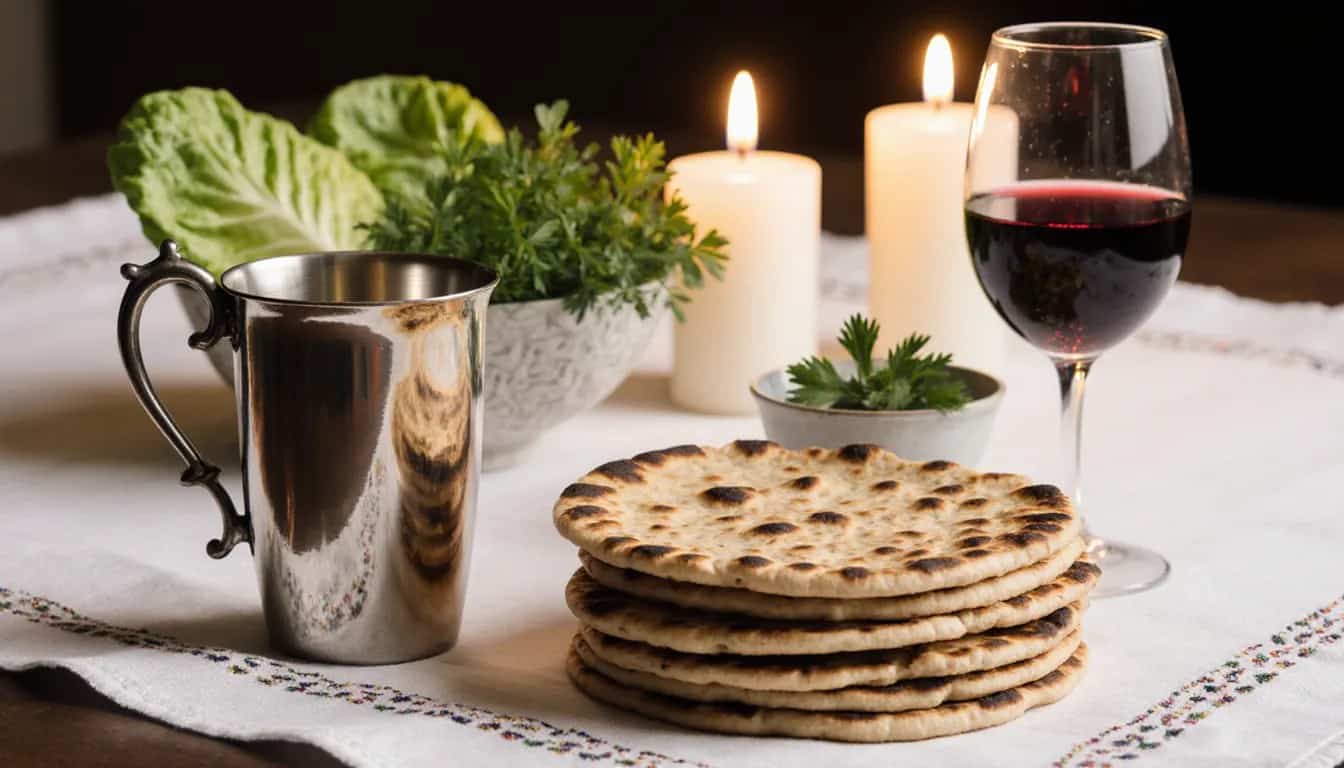
For the entire festival, bread disappears from Jewish homes and gives way to a flat, crisp wafer. Why matzah, and what does this unleavened bread tell us about the Exodus from Egypt?
In 5787 (2027), the first Pesach Seder takes place on Wednesday evening, April 21, the eve of 15 Nisan. The first day of the festival is Thursday, April 22. Outside Israel, a second Seder is held on Thursday evening. Pesach lasts seven days in Israel, until Wednesday, April 28, and eight days outside Israel, until Thursday, April 29. The search for chametz takes place on Tuesday evening, April 20.
What the Torah Says
The Torah itself gives the historical reason: “They baked the dough they had brought out of Egypt into unleavened cakes, for it had not risen: they had been driven out of Egypt and could not delay” (Shemot 12:39). The Hebrews left in such haste that their bread had no time to rise.
The commandment is set down in the same chapter: “In the first month, on the fourteenth day of the month, in the evening, you shall eat matzot” (Shemot 12:18). And again: “For seven days you shall eat matzot; on the very first day you shall remove leaven from your houses” (Shemot 12:15).
This is why the Torah also calls the festival Chag HaMatzot, the Festival of Unleavened Bread (Vayikra 23:6).
Bread of Affliction or Bread of Freedom?
Matzah has two faces. The Book of Devarim calls it the “bread of affliction” (lechem oni): “You shall eat matzot, the bread of affliction, for in haste you went out of the land of Egypt” (Devarim 16:3). The Haggadah, too, says so at the opening of its narrative: “This is the bread of affliction that our fathers ate in the land of Egypt.”
But further on, the Haggadah gives another reason: we eat matzah because the dough of our fathers had no time to rise before G-d revealed Himself to them and redeemed them. The same wafer is thus both the bread of the slave and the bread of the freed man.
The Talmud (Pesachim 115b) plays on the words lechem oni: it is also “bread over which many things are answered.” Matzah is a bread that gets people talking, that prompts the telling of the story.
What Is Matzah?
Matzah is made only of flour and water. It must come from one of the five grains: wheat, barley, spelt, rye or oats. The dough must never be left to rest: from the moment it comes into contact with water until it is baked, no more than about eighteen minutes may pass. Beyond that, it risks becoming chametz.
For the Seder, many use shmurah matzah, “guarded” matzah: the wheat is watched from the time of harvest so that it does not come into contact with moisture.
Matzah at the Seder
- Three matzot are placed on the Seder table.
- Yachatz: early in the evening, the middle matzah is broken. The larger half is set aside: this is the afikoman.
- Motzi-Matzah: two blessings are recited, “hamotzi” and “al achilat matzah,” and then the matzah is eaten while reclining.
- Korech: matzah is eaten together with maror, as Hillel did in the time of the Temple.
- Tzafun: at the end of the meal, the afikoman is eaten. After that, nothing more is eaten, so as to keep the taste of the matzah.
Eating matzah on the first night is a Torah obligation. On the other days there is no obligation to eat it, but eating chametz is forbidden (Pesachim 120a). For the quantities to be eaten, the time allowed, and special cases (the elderly, the sick, children), consult a competent rabbi.
What Rav Raphaël Benizri Teaches
In his lecture Pesach: Peh-Sach, the Mouth That Speaks, Rav Benizri teaches that matzah is both the bread of affliction and the bread of freedom. The poor bread is the one that gives rise to dialogue: the person who takes the measure of what he lacks seeks what completes him in others. It is then that he says: “Let all who are hungry come and eat.”
In Pesach: The Mystery of the Number Four, he recalls the four names of the festival, among them Chag HaMatzot. Matzah, he says, is the bread of slavery and the bread of freedom: a freedom incubated within servitude, then projected outward.
In Pesach: Time Is Not Continuous, he sums it up: between matzah and bread, there is nothing but time. The time to let the dough rise. Not letting chametz form means refusing to give our spiritual impulse the time to be rationalized and distorted.
In Pesach: The Four Questions of Ma Nishtana, he notes that chametz arises from idleness. As long as the dough is being kneaded, there is no chametz; it appears when the dough is left to rest. He adds: every bread we make is first of all a matzah.
Finally, in Pesach: Searching for the Chametz Within, he explains that leaven is not a foreign body in the dough. The point is not to eliminate chametz forever, but to restore it to its proper measure. For seven days a year, we neutralize the competitive spirit, desire and self-assertion, only to take them up again afterward with new perspectives.
Further Reading
- Pesach: All of Rav Benizri’s Lectures
- Pesach: Where Should the Haggadah Begin?
- Pesach: Searching for the Chametz Within
- Pesach: Peh-Sach, the Mouth That Speaks
- Pesach: The Four Questions of Ma Nishtana
- Pesach: The Mystery of the Number Four
- Pesach: Time Is Not Continuous
- Booklet “Questions for the Pesach Table” (PDF)
- All the Jewish Holidays
Article by the Pensées Juives editorial team. The passages attributed to Rav Raphaël Benizri are drawn from his lectures published on this site.