
No ham, no salami, no shrimp or mussels, and no rabbit or horse meat either. For many people, the ban on pork is the best-known thing about Judaism, and also the most misunderstood: it is often explained by hygiene or by the climate of the Middle East. What does the Torah really say? Which animals are permitted, which are forbidden, and why? Here is a complete answer, with the verses, the Talmud, the great commentators, the history, and an insight from Rav Raphaël Benizri.
In short: Jews do not eat pork because the Torah explicitly forbids it: “And the pig, because it has a split hoof […] but does not chew the cud: it is unclean for you” (Vayikra [Leviticus] 11:7). A mammal is permitted only if it has both signs: a split hoof and chewing the cud. The pig, the rabbit, the hare, the horse and the camel do not have both. For water creatures, the rule is just as simple: only what has fins and scales is permitted (Vayikra 11:9). Shrimp, lobster, crab, mussels, oysters, squid and eels are therefore excluded. The Torah gives no medical reason: it links these laws to holiness, “Be holy, for I am holy” (Vayikra 11:44).
What the Torah says: two chapters and a few signs
The laws of permitted and forbidden animals are set out twice in the Torah: in the parasha of Shemini (Vayikra 11) and in the parasha of Re’eh (Devarim [Deuteronomy] 14:3-21). These laws are part of kashrut, the body of rules that define what a Jew may eat. The word kosher (kasher) means “fit” or “proper.”
The Torah does not draw up an endless list of every animal in the world. It gives signs (in Hebrew, simanim), criteria that make it possible to recognize a permitted animal. For four-footed animals, the verse says: “Every animal that has a split hoof, whose hoof is completely divided in two, and that chews the cud, among the beasts, that you may eat” (Vayikra 11:3).
Both signs are needed together. The Torah then names four animals that have only one of them: the camel, the shafan (often identified as the rock hyrax) and the arnevet (the hare), which chew the cud but do not have a split hoof; and the pig, which has a split hoof but does not chew the cud. The verse concludes: “You shall not eat of their flesh, and you shall not touch their carcasses; they are unclean for you” (Vayikra 11:8).
In Devarim, the Torah also lists the ten permitted animals: the ox, the sheep, the goat, and seven wild animals, among them the deer and the gazelle (Devarim 14:4-5). It then repeats the ban on the pig in almost identical terms (Devarim 14:8).
For animals that live in water, the criterion follows right after: “This you may eat of all that is in the waters: whatever has fins and scales, in the waters, in the seas and in the rivers, that you may eat” (Vayikra 11:9). Everything else is called sheketz, a word translated as “abomination” or “detestable thing” (Vayikra 11:10-12).
For birds, the Torah gives no signs, but a list of about twenty names of forbidden birds (twenty-four species according to the Talmud’s count, Chullin 63b), almost all of them birds of prey and scavengers: the eagle, the vulture, the raven, the owl, the heron, and even the bat (Vayikra 11:13-19). As for insects, almost all are forbidden, except for four species of locust (Vayikra 11:20-23). Small creeping animals, such as the mouse, the lizard or the snake, are forbidden (Vayikra 11:29-30 and 41-42).
Finally, the chapter ends with its purpose: “For I am the L-rd your G-d; sanctify yourselves and be holy, for I am holy” (Vayikra 11:44), and “to distinguish between the unclean and the clean” (11:47).
The pig: why it, more than all the others?
Taken literally, the pig is neither more nor less forbidden than the rabbit or the camel. Eating a piece of horse meat is exactly as serious a transgression as eating a piece of pork. And yet, in the Jewish consciousness, the pig holds a place of its own. There are several reasons for this.
The only animal with a split hoof that does not chew the cud
The Talmud makes a surprising remark (Chullin 59a). When the Torah lists the animals that have only one of the two signs, it names every one of them. Yet the world has thousands of species. The school of Rabbi Yishmael concludes: “The Master of His world knows that there is no animal with a split hoof that is unclean, apart from the pig.” In other words, the Torah states that the pig is the only animal with a split hoof that does not chew the cud. According to the Talmud, someone who finds an unknown animal with a split hoof in the desert can check that it is not a pig, and it is then permitted.
For the tradition, this is one of the marks of the Torah’s divine origin: a text written in one corner of the ancient Middle East lays down a rule about the wildlife of the entire globe.
The animal that shows off its hooves
The midrash (ancient rabbinic commentary) sees the pig as the very image of hypocrisy. When it lies down, it stretches out its legs and displays its split hooves, as if to say: “Look, I am clean!” But the other sign, chewing the cud, is hidden inside, and that is what it lacks. Midrash Bereshit Rabba (65:1) applies this image to Esav, who gave himself the appearance of an upright man while living a life of violence; it draws on the verse in Tehillim [Psalms]: “The boar of the forest ravages it” (Tehillim 80:14).
This image says something profound. Judaism is not satisfied with outward signs. An animal is clean when what can be seen and what cannot be seen go together; and so is a person.
The pig, symbol of Rome and of persecution
In Midrash Vayikra Rabba (13:5), the four animals that have only one sign represent the four empires that subjugated Israel: Babylon, Persia and Media, Greece, and finally Rome, represented by the pig. The midrash plays on the Hebrew name of the pig, chazir, which recalls the verb “to give back,” “to return”: one day, Rome will return the kingship to its rightful owner.
From this midrash a popular idea was born: that the pig would become permitted in the time of the Messiah. This reading is rejected by the overwhelming majority of the sages. The midrash is speaking about the Roman Empire, not about the animal, and the Rambam lays down as a principle that the commandments of the Torah will never be abrogated (Hilkhot Yesodei HaTorah 9:1).
Above all, over the course of history the pig became an instrument of persecution. We will come back to this below: for centuries, people tried to break Jews by forcing them to eat pork. That is why the Talmud sometimes refers to it by a simple euphemism, davar acher, “the other thing,” and why the Mishnah even forbids raising pigs (Bava Kamma 7:7).
Shellfish and fish: fins and scales
The rule for water creatures is very simple: they must have fins and scales. The Mishnah adds a valuable observation: “Everything that has scales has fins; but there are fish that have fins and no scales” (Niddah 6:9). In practice, then, it is enough to check for scales, provided they can be removed from the skin without tearing it.
This rule first of all excludes all “seafood,” which are not fish:
- crustaceans: shrimp, prawns, langoustines, lobsters, spiny lobsters, crabs;
- mollusks: mussels, oysters, scallops, whelks, snails;
- cephalopods: squid, cuttlefish, octopus;
- sea urchins and other marine creatures.
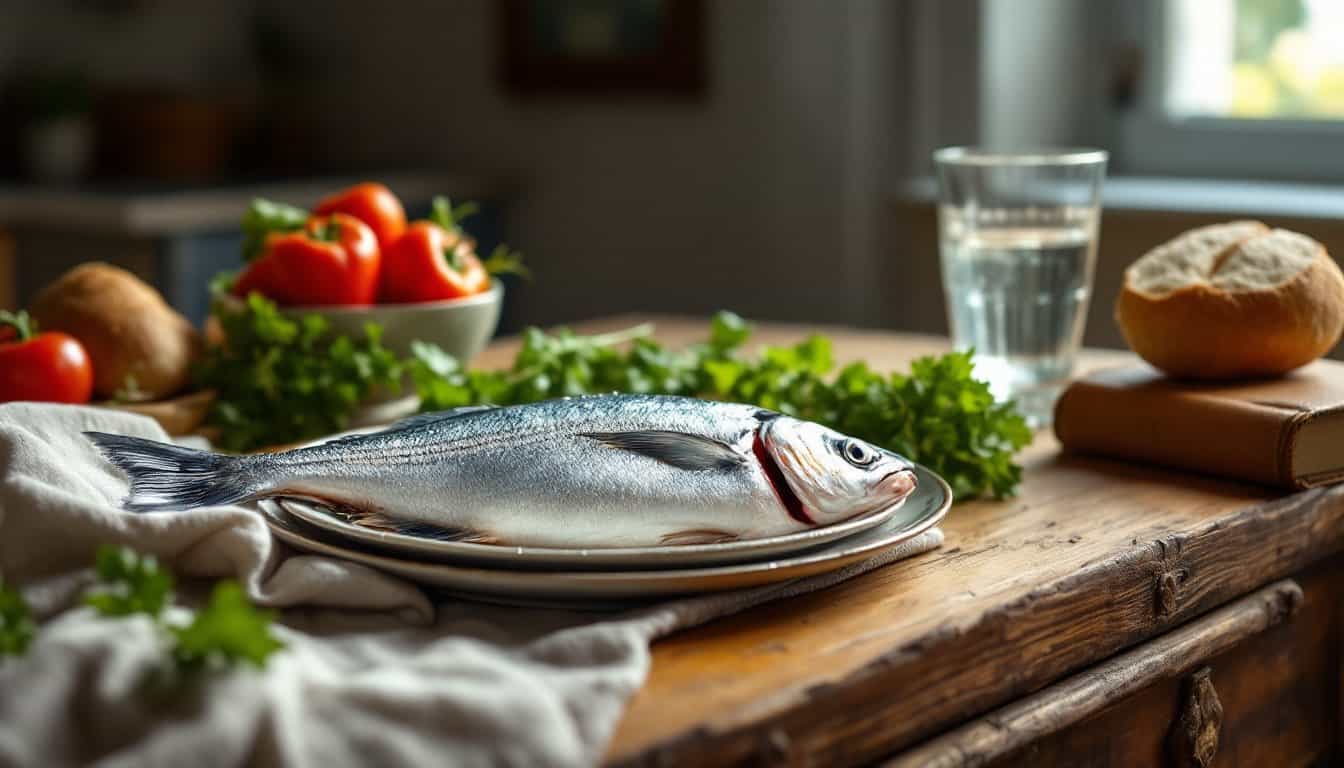
It also excludes certain true fish that have no scales: eel, catfish, monkfish, sharks and rays. The sturgeon, whose scales are of a particular type, is not considered kosher by the great majority of authorities: its caviar is therefore forbidden. On the other hand, salmon, tuna, sole, cod, sardines, sea bream, sea bass and carp are permitted. The fish in the image at the top of this article, with its shiny scales and its fins, is the textbook example of a kosher fish.
An important difference separates fish from meat: fish does not require ritual slaughter, shechita. It only needs to be of a permitted species. That is why fish is often the simplest option for a Jew eating away from home, provided the cooking and the utensils are suitable.
Rabbit, horse, camel, game: the complete list
The most frequent questions people search for concern specific animals. Here are the answers, applying the Torah’s two signs.
- Rabbit and hare are forbidden. The hare (arnevet) is named explicitly by the Torah (Vayikra 11:6); it does not have a split hoof. The rabbit is in the same situation. Some people wonder how the Torah can say that the hare “chews the cud”: these animals re-ingest part of their already digested food, a behavior zoologists call caecotrophy. Either way, the prohibition is not in doubt: the hoof is not split, and both signs are required.
- Horse and donkey are forbidden: they have neither a split hoof nor do they chew the cud.
- The camel is forbidden, as the Torah states expressly (Vayikra 11:4).
- Beef, veal, mutton, lamb and goat are permitted, provided the animals are slaughtered by shechita and prepared according to the rules.
- Deer, roe deer and gazelle have both signs and are therefore permitted in principle. In practice, they must be ritually slaughtered, which rules out game killed by a bullet or an arrow.
- Wild boar is a wild pig: it is forbidden.
For poultry, the tradition is more cautious. The Sages of the Mishnah gave signs for recognizing permitted birds: a bird of prey is forbidden, and a permitted bird generally has an extra hind toe, a crop, and a gizzard whose inner lining peels off (Mishnah Chullin 3:6). But because the twenty-four species of the Torah can no longer be identified with certainty, the custom is to eat only birds for which there is an established tradition (masoret): chicken, turkey, duck, goose, pigeon and a few others (Rema, Yoreh De’ah 82:3).
As for insects, a few Jewish communities in Yemen and North Africa have preserved a tradition identifying certain permitted species of locust. Other communities refrain from eating them. This is also why vegetables and fruit are carefully checked: a tiny insect swallowed with a salad is a Torah prohibition.
Finally, whatever comes from a forbidden animal is itself forbidden: donkey’s or mare’s milk, ostrich or raven eggs. This is the rule “what comes from the unclean is unclean” (Mishnah Bekhorot 1:2). Honey is the exception: the Talmud explains that the bee does not produce it from its own body, it merely carries the nectar of the flowers (Bekhorot 7b).
The reasons: hygiene, morality or holiness?
The Torah gives no detailed explanation for these prohibitions. It classes them among the chukim, decrees whose reason is not stated. The sages of Israel have nevertheless offered several levels of understanding, which must be presented honestly, with their limits.
A health reason? The Rambam
The Rambam (Maimonides, 1138-1204), who was also a physician, writes in his Guide for the Perplexed that the foods forbidden by the Torah are bad for the body (Moreh Nevukhim III, 48). For the pig, he adds a reason of public hygiene: this animal feeds on refuse, and if pigs were raised, the streets and houses would become filthier than latrines.
But other sages firmly disputed that health is the real reason. Don Yitzchak Abarbanel (1437-1508), in his commentary on the parasha of Shemini, points out that the peoples who eat pork and seafood are no worse off in health than anyone else. The Torah, he writes in essence, is not a medical book; it heals the soul, not primarily the body. One might add that if the reason were only a sanitary one, it would be enough today to cook pork thoroughly to make it permitted, which is not the case.
A moral reason: you become what you eat
The Ramban (Nachmanides, 1194-1270) proposes another reading, regarding the forbidden birds (commentary on Vayikra 11:13). Almost all of them are birds of prey, which live by hunting and by blood. Now, what a person eats becomes part of him. Someone who feeds on cruel animals risks absorbing something of that cruelty. By contrast, the permitted animals are peaceful herbivores that chew the cud and do not hunt: the ox, the sheep, the goat.
This idea is found in many commentators: food is not neutral. It acts on the body, but also on character, on sensitivity, on the soul. Eating is a moral act.
The Torah’s own reason: holiness
The only reason the Torah states clearly is holiness (kedushah). “Do not make yourselves abominable […], for I am the L-rd your G-d; sanctify yourselves and be holy, for I am holy” (Vayikra 11:43-44). And further on: “You shall distinguish between the clean animal and the unclean […]; you shall be holy to Me, for I the L-rd am holy, and I have set you apart from the peoples to be Mine” (Vayikra 20:25-26).
Holiness, in Hebrew, means first of all separation: to be holy is to know how to set a limit. Man is the only living being capable of saying “no” to a food in front of him that he likes and that does him no harm. At every meal, a Jew thus affirms that his appetite is not his master.
“Do not say: I don’t like pork”
A famous teaching sheds light on this dimension. Rabbi Elazar ben Azaria says: “How do we know that a person should not say: I cannot stand pork, I do not want to wear a garment that mixes wool and linen? He should say: I would like to, but what can I do, my Father in Heaven has forbidden it to me” (Sifra on Vayikra 20:26, quoted by Rashi).
In other words, a Jew does not abstain from pork because he finds it repulsive or dangerous. He abstains out of faithfulness. The prohibition is not a matter of taste; it is a relationship: one accepts a limit out of love and trust toward the One who sets it. That is precisely the meaning of a chok, a decree.
The history: when pork becomes a test of faithfulness
The ban on pork took on historical significance very early. Archaeologists have observed that pig bones are almost absent from the Iron Age villages of the Canaanite highlands attributed to the first Israelites, while they are common in the neighboring Philistine cities. Researchers still debate this, but many see in it a very ancient sign of this difference. These findings nevertheless remain disputed and are not enough, on their own, to date the prohibition.
The Tanakh, for its part, makes eating pork a symbol of distance from G-d. The prophet Yeshayahu [Isaiah] rebukes part of the people for “eating the flesh of swine” (Yeshayahu 65:4; 66:17).
The decisive moment came in the 2nd century before the Common Era. The Greek king Antiochus IV wanted to Hellenize Judea. He ordered pigs to be offered as sacrifices (1 Maccabees 1:47), desecrated the Temple in Jerusalem, and sought to force Jews to eat pork (2 Maccabees 6:18). The second book of Maccabees tells the story of the old scribe Eleazar, who chose to die rather than eat pork or even pretend to eat it, so as not to set a bad example for the young (2 Maccabees 6:18-31), and then that of a mother and her seven sons, tortured for the same reason (2 Maccabees 7). These books are not part of the Hebrew Bible, but they are a valuable historical testimony. It was this crisis that led to the revolt of the Hasmoneans and to the miracle of Hanukkah.
The Talmud recounts another episode, from the time of the civil war between two Hasmonean princes. Those besieged in Jerusalem would lower a basket of money over the wall every day, in exchange for animals for the sacrifices. One day, on the advice of a traitor, the besiegers sent up a pig. When it reached halfway up the wall, it dug its hooves into it, and the land of Israel shook. It was then that the Sages declared: “Cursed be the man who raises pigs” (Bava Kamma 82b; Sotah 49b; Menachot 64b).
Greek and Latin authors were greatly puzzled by this prohibition. The philosopher Philo of Alexandria relates that when he came to plead the cause of the Jews before the emperor Caligula, around the year 40, the emperor’s first question, asked with a sneer, was: “Why do you not eat pork?” (Legatio ad Gaium, 361). Plutarch and the poet Juvenal also mention it. Later, in Spain at the time of the Inquisition, Jews who had been forcibly converted were kept under watch: refusing pork could be enough to denounce them. They were in fact called, contemptuously, marranos, a word most often linked to the pig.
Over the centuries, the pig thus became much more than a forbidden food: the symbol of a faithfulness that people tried to break, and which held firm.
What Rav Raphaël Benizri teaches
Rav Benizri did not devote a specific lecture to the forbidden animals. But on two occasions he gave valuable insights into the place of the dietary laws in Jewish life.
In his lecture on Bereshit Rabba 40, on the beauty of Sarah, he puts each commandment in its proper place. Putting up a mezuzah, laying tefillin, eating kosher “for a few euros more”: all of this, he says, is not enough to make a person. The mezuzah gives the home a direction, tefillin give content to this way of being, and the dietary laws “predispose the mind to a state of purity.” But the real work begins afterward: it is far harder to master one’s anger. The Sages, the Rav recalls, said of someone who loses his temper that he is like one who worships an idol, something they said not of any commandment but of a character trait.
The lesson matters for our subject. Kashrut is not an end in itself, nor a certificate of holiness. It prepares the ground. Not eating pork does not make us righteous; but it puts the mind in a disposition of purity, from which one can work on what is hardest: one’s traits, one’s anger, one’s way of being with others. That is exactly the logic of Vayikra 11: food is not the goal, holiness is.
In his lecture on Purim and the war against Amalek, the Rav makes a complementary remark about the feast of King Achashverosh, in which the Jews of Persia took part. The sin, he says, was not a dietary one: the meal was served kosher to anyone who wished to eat kosher. The sin was to go along with the atmosphere, to want to blend into a world where good and evil are confused. Keeping the rules of the table is not enough if, around that table, one loses the sense of who one is.
Misconceptions to correct
“It’s a matter of hygiene, now outdated”
This is the most widespread idea, and it is inaccurate. The Torah never speaks of disease in connection with the pig; it speaks of holiness. The Rambam proposed a health reason, but as one explanation among others, and without ever making it the condition of the prohibition. Observant Jews do not eat pork even when it is perfectly cooked and inspected.
“Only pork is forbidden”
No. Pork is the best known, but it is not “more forbidden” than rabbit, horse, shrimp or eel. A Jew who keeps kashrut abstains from all of these foods, and also does not eat the meat of a permitted animal unless it has been slaughtered and prepared according to the rules.
“Jews consider the pig a cursed animal”
The pig is not a cursed animal: it is part of creation, and Judaism forbids causing it suffering, as with any other animal. It is “unclean for you” (Vayikra 11:7), meaning forbidden as food for Israel. Non-Jews, who are bound only by the Noahide laws, are not subject to this prohibition.
The practice today
In concrete terms, a Jew who observes kashrut abstains from all pork meat, cold cuts or fat, as well as from all products that contain them. Many industrial products raise questions: gelatin (often of pork origin), lard, flavorings, certain additives. That is why people rely on products bearing a kosher certification issued by a rabbinate or a recognized organization.
The same precautions apply to seafood, often hidden in surimi, Asian sauces or certain stocks. For particular cases (medicines, food supplements, utensils, eating out), one should consult a rabbi. The detailed rules are found in the Rambam (Hilkhot Ma’akhalot Asurot, chapters 1 and 2) and in the Shulchan Aruch (Yoreh De’ah, chapters 79 to 85).
One rule overrides all others: life comes first. If a vital medicine can only be obtained in a non-kosher form, or if there is a danger to health, the Torah requires that life be preserved. Here too, one should consult a rabbi and a doctor.
Not eating pork or shellfish is not a culinary curiosity. It is a way of saying, at every meal, that a human being is not just an appetite, and that he can sanctify even what is on his plate. “Be holy, for I am holy”: holiness sometimes begins with what one chooses not to eat.
Frequently asked questions about pork and shellfish
Can Jews eat rabbit?
No. The rabbit does not have a split hoof, and the Torah explicitly forbids the hare (Vayikra 11:6). Rabbit, hare meat and all dishes containing them are therefore excluded from kosher cooking.
Can Jews eat horse meat?
No. The horse has no split hoof and does not chew the cud. It is forbidden, as are the donkey and the mule, and mare’s or donkey’s milk.
Is shrimp forbidden?
Yes. Like all crustaceans and mollusks, shrimp have neither fins nor scales (Vayikra 11:9-12). Today there are kosher “shrimp” and “crab” made from permitted fish: they imitate the look and taste, but contain no seafood at all.
Are salmon and tuna kosher?
Yes, they are fish with fins and scales. The only requirement is that the finished product (canned or smoked fish) has been prepared without forbidden ingredients and under supervised conditions, hence the value of a certification.
Why do some non-observant Jews still refuse pork?
Because, over the centuries, pork became a symbol of identity. Many Jews who do not keep all of kashrut still keep at least this prohibition, out of attachment to their parents, to their history, and to the memory of those who chose to die rather than eat it.
Will pork become permitted in the time of the Messiah?
This is a popular idea drawn from a midrash on the name of the pig, chazir. But that midrash is speaking about the Roman Empire, not about the animal. The Rambam teaches that the commandments of the Torah will never be abrogated (Hilkhot Yesodei HaTorah 9:1). The prohibition of pork remains.
Should a non-Jew avoid pork?
No. The laws of kashrut concern only the Jewish people. Non-Jews are bound by the seven Noahide laws, which include the prohibition of eating a limb torn from a living animal, but not the prohibition of pork.
Further reading
- What does “kosher” mean? Kashrut explained
- Why don’t Jews mix meat and milk?
- Why do Jews fast?
- Bereshit Rabba 40: the beauty of Sarah and character traits
- Purim: the war against Amalek
- Hanukkah in history
- Weekly parasha: Rav Benizri’s lectures
- Glossary of Hebrew terms in Judaism
Sources and references
- Vayikra (Leviticus) 11:1-47; in particular 11:3-8 (four-footed animals), 11:9-12 (water creatures), 11:13-23 (birds and insects), 11:29-30 and 41-47
- Vayikra 20:25-26
- Devarim (Deuteronomy) 14:3-21
- Tehillim (Psalms) 80:14
- Yeshayahu (Isaiah) 65:4; 66:17
- Mishnah Chullin 3:6; Mishnah Niddah 6:9; Mishnah Bekhorot 1:2; Mishnah Bava Kamma 7:7
- Babylonian Talmud, Chullin 59a and 63b; Bekhorot 7b; Bava Kamma 82b; Sotah 49b; Menachot 64b
- Sifra, Kedoshim, on Vayikra 20:26 (quoted by Rashi on this verse)
- Midrash Bereshit Rabba 65:1; Midrash Vayikra Rabba 13:5
- Rambam, Moreh Nevukhim (Guide for the Perplexed) III, 48
- Rambam, Mishneh Torah, Hilkhot Yesodei HaTorah 9:1; Hilkhot Ma’akhalot Asurot, chapters 1-2
- Ramban, commentary on Vayikra 11:13
- Don Yitzchak Abarbanel, commentary on the parasha of Shemini
- Shulchan Aruch, Yoreh De’ah 79-85; Rema, Yoreh De’ah 82:3
- 1 Maccabees 1:47; 2 Maccabees 6:18-31 and chapter 7
- Philo of Alexandria, Legatio ad Gaium (Embassy to Gaius), 361
- Rav Raphaël Benizri, Bereshit Rabba 40: the beauty of Sarah
- Rav Raphaël Benizri, Purim: the war against Amalek
Article by the Pensées Juives editorial team. Passages attributed to Rav Raphaël Benizri are taken from his lectures published on this site.