
No matzah, no sukkah, no shofar: Shavuot cannot be contained in any object. It is the fiftieth day after the Exodus from Egypt, the day on which tradition places the giving of the Torah at Sinai. Why does this festival have no date of its own in the Torah, why do we stay up all night, why do we eat dairy foods, and what is the story of Ruth the Moabite doing here?
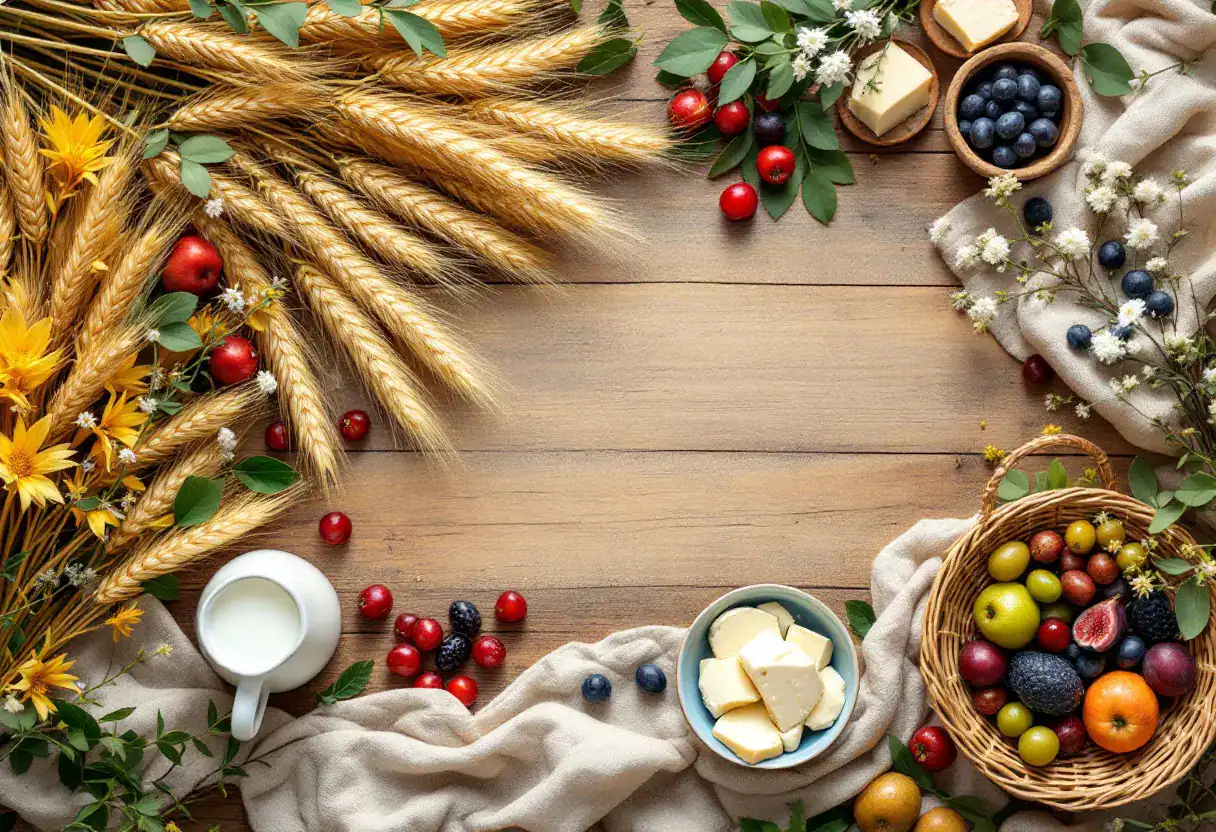
Shavuot, “weeks,” is the festival that closes the seven weeks counted from Pesach. It celebrates at once the wheat harvest, the offering of the first fruits at the Temple and, according to tradition, the giving of the Torah at Mount Sinai. It falls on the 6th of Sivan and lasts one day in Israel and two days in the Diaspora. We read the Ten Commandments, often spend the first night studying, eat dairy foods and read the Book of Ruth.
In 5787, Shavuot begins on the evening of Thursday, June 10, 2027. The festival falls on Friday, June 11 in Israel; in the Diaspora it continues on Saturday, June 12. Since Shavuot runs directly into Shabbat, an eruv tavshilin is prepared the day before (a dish set aside before the festival, which makes it permissible to cook on Friday for Shabbat). Consult your rabbi for the practical details.
Yet Shavuot is the most understated of the major festivals. Rav Raphaël Benizri makes this the starting point of his reflection: the distinctive feature of Shavuot, he says, is that it has none. This article goes through the sources, the rituals and the meaning of the festival, then dwells at length on what the Rav says about it in his four lectures devoted to Shavuot.
A Festival with Three Names
The Torah never gives Shavuot a single name. It refers to it in three ways, and each one expresses a facet of the festival.
- Chag haShavuot, the Festival of Weeks (Shemot 34:22; Devarim 16:10): the name comes from the count of seven weeks that precedes it.
- Chag haKatzir, the Festival of the Harvest (Shemot 23:16): in the Land of Israel, it marks the beginning of the wheat harvest.
- Yom haBikkurim, the Day of the First Fruits (Bamidbar 28:26): from this day on, the first fruits of the land are brought to the Temple.
Two further names come from the tradition. The Mishnah and the Talmud call it Atzeret, “the assembly” or “the conclusion”: Shavuot is seen as the close of Pesach, just as Shemini Atzeret closes Sukkot. And the liturgy names it zeman matan Toratenu, “the season of the giving of our Torah.” It is this last meaning that has taken hold in Jewish consciousness.
Remarkably, however, the Torah itself nowhere says that Shavuot is the day the Torah was given. Rav Benizri stresses this silence in his lecture The Fiftieth Day, Beyond the Count: if we connect the Torah to this festival, it is because our Sages taught that the fiftieth day of the count is the one that completes our creation. And in his lecture on the chapter of Pirkei Avot read before Shavuot, he cites the explanation of the Maharal of Prague: since the Torah was received at Sinai with an element of coercion, the festival could not be designated as the day of revelation. It is called the day of first fruits, the day on which a person is able to give the very best of himself.
The Counting of the Omer: Forty-Nine Days to Reach the Fiftieth
Shavuot is the only festival in the Torah that has no date written in the text. It is defined solely by a count: “You shall count from the day after the day of rest, from the day you bring the Omer of the waving, seven complete weeks; until the day after the seventh week you shall count fifty days” (Vayikra 23:15-16, in Parashat Emor). Deuteronomy says it again: “You shall count seven weeks… then you shall celebrate the Festival of Weeks” (Devarim 16:9-10).
The Omer is a measure of grain. On the day after the first day of Pesach, the 16th of Nissan, a sheaf of new barley was offered at the Temple; only after this offering was it permitted to eat from that year’s harvest. From that day on, we count every evening, with a blessing: “today is such-and-such a day of the Omer,” also specifying the weeks. Someone who forgot to count for an entire day continues on the following evenings, but without a blessing (Shulchan Aruch, Orach Chaim 489:8).
According to the Talmud, the Torah was given on the 6th of Sivan in the view of the Sages, and on the 7th in the view of Rabbi Yossi (Shabbat 86b). Since the calendar was fixed, Shavuot always falls on the 6th of Sivan. But the Rav points out that in the era when the months were proclaimed on the basis of witnesses, the festival could fall on the 5th, 6th or 7th of Sivan depending on the length of the preceding months: it had no date other than the end of the count.
The Omer period is also marked by mourning: the twenty-four thousand disciples of Rabbi Akiva died between Pesach and Shavuot because they did not treat one another with respect (Yevamot 62b). The Rav devotes his lecture The Month of the Omer: Counting in Order to Count Oneself to this subject. He sharpens the diagnosis: it was not a lack of love for one’s fellow, but a refusal to recognize the particular dignity of each person, his difference, his nuance. The word sefirah (counting), he notes, is close to sapir, sapphire: to count is to make things transparent. And the blessing is not over the counting of days, but over the counting “of the Omer”: the ration of food whose value is restored. The thirty-third day, Lag BaOmer, marks the end of that plague.
From Barley to Wheat
At the beginning of the count, barley is offered; at the end, wheat. On the day of Shavuot, the Temple received two loaves made from the flour of the new wheat, the shtei halechem (Vayikra 23:17). A surprising detail: these loaves were leavened, whereas on Pesach leaven is forbidden.
The Rav reads in this passage the entire journey of the forty-nine days. Barley was regarded as animal fodder, wheat as human food. Between Pesach and Shavuot, a people barely out of slavery learns to nourish itself as human beings do. He also recalls that the Omer was the ration of manna each person received in the desert (Shemot 16:16): the offering thus links the bread that came from heaven and the bread drawn from the earth, for “man does not live by bread alone” (Devarim 8:3).
At the Foot of Sinai: The Account of the Giving of the Torah
The account is found in the Book of Shemot, chapters 19 and 20 (Parashat Yitro). “In the third month after the Exodus from Egypt, on that very day, they came to the wilderness of Sinai” (Shemot 19:1). The people encamp facing the mountain. The verse says “he encamped” in the singular, and Rashi comments: “as one man, with one heart”; elsewhere, the camp was divided.
G-d proposes a covenant: “You shall be to Me a kingdom of priests and a holy nation” (Shemot 19:6). The people answer: “All that the L-rd has spoken, we will do” (Shemot 19:8). Three days of preparation follow. The people purify themselves, wash their garments and keep away from the mountain. Then, on the morning of the third day, come the thunder, the lightning, the thick cloud and the sound of the shofar growing ever louder (Shemot 19:16-19). G-d then pronounces the Ten Commandments (Shemot 20:1-14), later repeated in Devarim 5.
At the moment the covenant is sealed, the people say: na’aseh venishma, “we will do and we will hear” (Shemot 24:7). The Talmud marvels at this order: committing to do before even understanding. It relates that at that instant six hundred thousand angels came and placed two crowns on the head of every Jew, one for “we will do,” the other for “we will hear” (Shabbat 88a).
The same passage of the Talmud relates a more troubling midrash: G-d is said to have held the mountain over the people like an overturned vat, saying “if you accept the Torah, well and good; if not, there will be your grave” (Shabbat 88a). It is from here that the Maharal derives the idea of an element of coercion. The Talmud adds that the people accepted the Torah again, this time freely, in the days of Esther and Mordechai.
Why in the Desert?
The Sages reflected at length on the place of the giving. The Torah was given in the desert, a place that belongs to no one, so that no tribe and no people could say “it is mine” (Mekhilta, Yitro). Another midrash draws a moral lesson from it: whoever does not make himself free and open like the desert cannot acquire the Torah (Bamidbar Rabbah 1:7). The midrash also relates that the Torah was first offered to the other nations, who refused it (Sifrei, Devarim 343).
The Rav takes up this theme in his lecture on the Book of Ruth. The desert, he explains, is the place of the word, where a person communes with the absolute. The Torah is linked to a land, but it is the product neither of a land nor of a social condition: one need only be free to have access to it. That is the foundation of its universality. He draws a second teaching from this: the Torah was given to a community, not to an individual nor to a sum of individuals. Each person holds one letter of it, and the letter that one person puts into practice joins with the letter that his neighbor brings to light.

Given at Sinai, Received on Yom Kippur
Forty days after Sinai, the people make the golden calf; Moshe breaks the tablets (Shemot 32:19). He then goes back up the mountain and comes down with the second tablets on the 10th of Tishrei, the day that would become Yom Kippur. The Rav draws a powerful formula from this: the Torah was given at Sinai, but it was only received on Yom Kippur. The people had received it without yet having integrated it. They first had to clear away everything that distanced them from their fellow and from their Creator.
In his lecture on Pirkei Avot, he also explains why there are two sets of tablets: those that G-d fashions, and those that Moshe fashions. If the tablets can break, he says, it is because the human share in them is fragile. What breaks is whatever in me has not yet wrapped itself around the divine teaching.
The First Fruits: Shavuot at the Temple
From Shavuot on, every farmer would bring to the Temple the first fruits of the seven species for which the Land of Israel is praised: wheat, barley, grapes, figs, pomegranates, olives and dates (Devarim 8:8). The Mishnah specifies that they are not brought before Atzeret (Bikkurim 1:3).
The Mishnah describes the ascent to Jerusalem (Bikkurim 3). As soon as a farmer saw the first fruit ripening, he tied a reed around it and declared: “these are first fruits.” The villagers would gather and go up together; an ox with gilded horns crowned with olive leaves walked at the head, to the sound of the flute. The craftsmen of Jerusalem would rise to greet them. At the Temple, each one recited the text of Devarim 26: “My father was a wandering Aramean…” He would recount the whole history of the people, from Egypt to the land, before setting his basket down before the altar.
This ritual sheds light on the festival. The first fruit is not a mere sample: it already contains the entire harvest. The Rav develops this idea in The Festival of Oaths. The reshit, the beginning, is not counted, because it is a totality in itself: the rest is merely its unfolding, as the embryo contains the whole being. The Torah, Israel, creation and the bikkurim are all called reshit. What matters on the day of Shavuot is to attach oneself to that beginning.
Judged on the Fruit of the Tree
The Mishnah teaches that at four times of the year the world is judged: on Pesach for grain, on Atzeret for the fruit of the tree, on Rosh Hashanah all human beings, and on Sukkot for water (Rosh Hashanah 16a). Shavuot is therefore, in a sense, a day of judgment.
The Rav builds a profound reading on this text. According to the view of Rabbi Yehudah in the Talmud, the tree of knowledge was wheat (Berakhot 40a; Sanhedrin 70b). The Rav adds that in Adam’s time wheat grew tall like a palm tree: it was the tree of da’at, of knowledge. After Adam’s sin it lost its stature and became no more than a seed. For the Rav, this is the difference between capital and income. From a tree, one picks the fruit and the capital remains: it will produce again next year. A plant, once eaten, must be sown again. To rediscover the dimension of the tree on Shavuot is to rediscover a knowledge that takes root and bears fruit. He also connects etz, tree, with etzah, counsel: the Torah is “a tree of life to those who hold fast to it” (Mishlei 3:18).
The Customs of Shavuot
The Night of Study: Tikkun Leil Shavuot
In many communities, the first night of Shavuot is spent studying until dawn. A midrash gives the reason. On the morning of the giving of the Torah, the people were still asleep, and Moshe had to wake them (Shir haShirim Rabbah 1:12). By staying awake all night, we repair that sleep: this is the meaning of the word tikkun, repair. The Zohar already speaks of those who stay awake that night to “adorn the bride” before her union with the King.
The custom spread widely from the time of the sixteenth-century kabbalists. A letter of Rabbi Shlomo Alkabetz, cited by the Shelah, describes a Shavuot night spent studying with Rabbi Yosef Karo, the author of the Shulchan Aruch. People often read a compilation also called Tikkun: the beginning and end of each book of the Tanakh and of each tractate of the Mishnah, followed by passages from the Zohar. Others prefer to study a single subject in depth. In the morning, the dawn prayer is recited, and then people go to rest.
Rav Benizri does not comment on the night vigil itself in his lectures, but he offers a key that illuminates it. Shavuot, he says, is not the anniversary of a past event. If we do not know with certainty whether the giving took place on the 5th, 6th or 7th of Sivan, it is because the words of the Torah must be each day as if newly acquired: from Egypt we were freed, but from the Torah we are never freed. It is not a matter of celebrating an anniversary, he concludes, but of taking up again the breath of the Torah in its original purity, and sharing it with others. A night of study together is a beautiful expression of this.
Dairy Foods
The custom of eating dairy foods on Shavuot is mentioned by the Rema (Orach Chaim 494:3). Several reasons are given.
- Kashrut: in receiving the Torah, the people also received the laws of ritual slaughter and of separating milk and meat. On that day they had no way of preparing meat according to the rules, so they ate dairy foods (Mishnah Berurah 494).
- The verse: “honey and milk are under your tongue” (Shir haShirim 4:11), which the Sages apply to the words of the Torah.
- A reminder of the two loaves: according to the Rema, a dairy meal is served and then a meat meal, which requires two different breads. They recall the two loaves offered at the Temple.
- Gematria: the word chalav, milk, has the numerical value of forty, like the forty days Moshe spent on the mountain.
Many families serve cheesecakes, cheese pastries or blintzes filled with soft cheese. Depending on the custom, a meat meal is also eaten during the festival, since the joy of the festival is traditionally expressed through meat. Between dairy and meat, the usual rules of separation are observed.
Greenery and Flowers
The Rema records the custom of decorating the synagogue and homes with greenery, in memory of the joy of the giving of the Torah (Orach Chaim 494:3). It is often recalled that Mount Sinai, according to the midrash, was covered with greenery; the Magen Avraham adds that on this day the world is judged on the fruit of the tree. Some halachic authorities, including the Vilna Gaon, opposed the use of trees because it resembled a non-Jewish custom. Each community follows its own tradition.
In the Synagogue
- On the first day, we read the account of Sinai and the Ten Commandments (Shemot 19-20). The haftarah is Ezekiel’s vision of the divine chariot (Yechezkel 1).
- On the second day (in the Diaspora), we read the passage on the pilgrimage festivals (Devarim 15:19 – 16:17; when this day falls on Shabbat, as in 5787, the reading begins earlier, at Devarim 14:22). The haftarah is the prayer of Habakkuk (Chavakuk 3).
- The complete Hallel is recited on each day of the festival, and the Musaf prayer is added.
- Ashkenazim read, before the Torah reading, the Aramaic poem Akdamut, composed by Rabbi Meir ben Yitzchak of Worms. They recite the memorial prayer for the departed, Yizkor, on the last day.
- Sephardim often read the Azharot, poems that enumerate the commandments. Many also recite, when the ark is opened, a poetic ketubah: in it Shavuot is described as the marriage of G-d and Israel, with the Torah as the marriage contract.
The Week Before
On the Shabbat before Shavuot, we read the chapter “Kinyan Torah,” “the acquisition of the Torah,” added to Pirkei Avot as a sixth chapter. In his lecture given the week before Shavuot, the Rav comments on the mishnah of Rabbi Meir about one who occupies himself with Torah for its own sake. He stresses that the text does not say “one who studies” Torah, but “one who occupies himself” with it. The Torah is not studied like a science. It is discovered in the way one lives, which is why serving the sages is worth more than the learning itself.
In addition, on the Shabbat before the festival, Parashat Bamidbar is often read. A little earlier, we read Parashat Bechukotai and its curses. The Rav notes that they number forty-nine, like the days of the count, whereas Ki Tavo, read before Rosh Hashanah, contains ninety-eight, that is, twice forty-nine.
The Book of Ruth: Why Do We Read It on Shavuot?
Five scrolls, the megillot, accompany the Jewish year. The Song of Songs is read on Pesach, Kohelet on Sukkot, Esther on Purim, Lamentations on the 9th of Av, and Ruth on Shavuot. The Rav points out that for the first four, the connection with the festival is obvious. For Ruth, it is much less so.
The Story in Brief
“In the days when the judges judged, there was a famine in the land” (Ruth 1:1). Elimelech leaves Beit Lechem with his wife Naomi and his two sons to settle in the fields of Moav. There the sons marry two Moabite women, Orpah and Ruth. Then Elimelech and his two sons die. Naomi, left alone, decides to return. She urges her daughters-in-law to go back to their mothers’ homes. Orpah kisses her and leaves. Ruth clings to her: “Where you go I will go, where you lodge I will lodge; your people shall be my people, and your G-d my G-d” (Ruth 1:16).
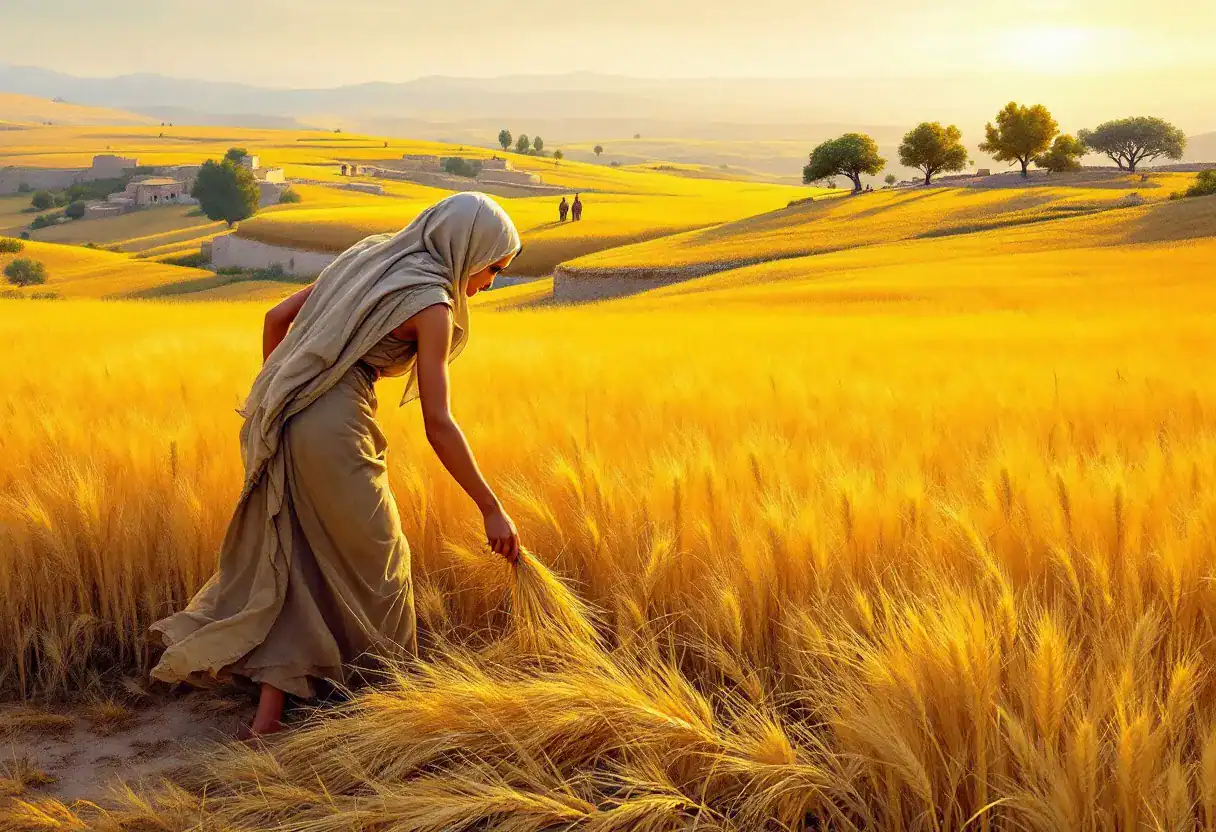
The two women arrive in Beit Lechem “at the beginning of the barley harvest” (Ruth 1:22). Being poor, Ruth goes to glean in the fields behind the reapers. She comes to the field of Boaz, a relative of Elimelech. Boaz notices her, protects her and tells his workers to let stalks fall for her. At the end of the harvest, on Naomi’s advice, Ruth goes to Boaz at night on the threshing floor and asks him to redeem her, according to the law of ge’ulah, which allowed a close relative to take back the field of a deceased man and perpetuate his name. Boaz marries her before the elders of the town. From their union Oved is born, father of Yishai, father of David (Ruth 4:13-22).
The Classic Reasons
The commentators give several reasons for reading Ruth on Shavuot.
- The harvest: the story takes place between the barley harvest and the wheat harvest, that is, precisely during the period from Pesach to Shavuot.
- Conversion: Ruth enters the covenant of Israel, just as the entire people entered it at Sinai. According to the Talmud, our ancestors entered the covenant through circumcision, immersion and a sacrifice, the same steps required of a convert (Keritot 9a).
- David: the book ends with the birth of David’s line. According to a tradition cited in the Jerusalem Talmud (Chagigah 2:3), King David died on Shavuot.
- Hesed: the midrash teaches that this book was written to show the greatness of kindness.
This last point is central. Rabbi Ze’ira teaches that this megillah contains neither purity nor impurity, neither prohibition nor permission. It was written only to teach how great is the reward of those who practice kindness (Ruth Rabbah 2:14). The word hesed, usually translated as “kindness,” denotes a generosity that goes beyond what one owes.
Gleaning: A Bridge Between Law and Kindness
The Torah requires the reaper to leave for the poor the corner of the field (pe’ah), the fallen stalks (leket) and the forgotten sheaves (shikchah) (Vayikra 19:9-10; Devarim 24:19). It is precisely these laws that allow Ruth to survive.
Now, in the chapter on the festivals in Leviticus, the law of the corner of the field and the fallen stalks is repeated right after Shavuot (Vayikra 23:22), in the middle of the festivals. Rashi, citing the midrash, explains that whoever leaves his portion to the poor is considered as though he had built the Temple and offered his sacrifices in it. The link between the festival of the harvest and the Book of Ruth is thus already written in the Torah.
Rav Benizri shows how Boaz embodies this spirit. When he greets his workers with “The L-rd be with you” (Ruth 2:4), it is not a form of supervision: he regards them as partners. If he comes to his fields, it is to make sure that the rights of the poor are respected. Hence the order he gives to let stalks fall on purpose so that they can be gathered.
Ruth the Moabite: The Open Door
Ruth’s origin raises a serious question. The Torah declares: “An Ammonite or a Moabite shall not enter the assembly of the L-rd” (Devarim 23:4). The reason is given in the next verse: they did not meet Israel with bread and water on its journey through the desert (Devarim 23:5). The Talmud rules that the prohibition applies only to men: “a Moabite man, not a Moabite woman” (Yevamot 76b-77a). That is how Ruth was able to enter the people.
The Rav emphasizes the depth of this reason. Moav is excluded for having refused bread: it is the anti-hesed, the exact opposite of Avraham, who opened his tent to all. And Moav descends from Lot, Avraham’s nephew, who had preserved his uncle’s hospitality even in the heart of Sodom (Bereshit 19). The Rav goes further: Lot’s daughters pushed kindness beyond every limit, to the point of the abominable act from which Moav and Ammon were born; yet their intention of founding a family was not lost. No act that is good in itself, he says, is ever entirely lost: it eventually finds a stock onto which it is grafted. Through Ruth, the kindness inherited from Avraham returns to the heart of Israel.
What Rav Raphaël Benizri Teaches About Shavuot
The Rav devoted four lectures to Shavuot. They do not repeat the same ideas: each one opens a different door onto the festival.
The Festival of Oaths
In Shavuot: The Festival of Oaths, the Rav starts from an observation: tradition has kept the name “weeks” rather than “the festival of the harvest,” “of the first fruits,” or even “of the giving of the Torah.” The name of the festival is the name of a count. Now the word sheva, seven, gave rise to shevuah, oath. He cites the covenant between Avraham and Avimelech: seven ewes are set apart, and the place is called Be’er Sheva “because there the two of them swore an oath” (Bereshit 21:31). Shavuot would thus also be the festival of oaths.
Two oaths answer each other on this day, he explains. G-d commits never to exchange this people for another, and Israel commits to remain attached to its Creator through the Torah. The Rav notes that in Hebrew one does not say “I swear,” but nishba, in the passive form: “I am sworn.” This means that I am carried by a truth that precedes me. I did not choose to come into the world, but I can take in hand the reality that has been given to me.
He also observes that the week is the only rhythm of time that depends on neither the sun nor the moon. The day comes from the sun, the month from the moon, the year from the seasons. The week, however, is governed by no natural phenomenon. The counting of the Omer does not begin on a Sunday, like the week of creation, but on the day after Pesach, whatever day that may be. For the Rav, this is the proof that this time is ours: the time of discovering our own reality.
He then connects Shavuot to the Oral Law. He cites the midrash according to which G-d, in order to create man despite the opposition of the angels, cast truth down to the ground. He wanted truth not to be imposed from above, but for man to extract it himself from the darkness of this world. The Written Law is fixed and cannot be touched; the Oral Law, by contrast, is debated. That is where man finds his share. Shavuot thus becomes the day on which man brings about his own creation.
The Fiftieth Day
In Shavuot: The Fiftieth Day, Beyond the Count, the Rav situates the festival between the other two pilgrimage festivals. Pesach celebrates the past, our roots rediscovered in the Exodus from Egypt. Sukkot heralds the future, the time when all peoples will be gathered under a single sukkah. Shavuot celebrates the present. That is why, he says, it has no fixed date in the Torah: the present cannot be locked into a calendar.
Why do we count only forty-nine days, and not fifty? The Talmud’s teaching is well known: there are fifty gates of understanding, and all were given to Moshe except one (Rosh Hashanah 21b). For the Rav, the fiftieth goes beyond safar, the limit, the calculation. It lies beyond the square of seven: there one reaches a transparency in which one sees through things. The Rav further connects the number forty-nine, in Hebrew mem-tet, with the word tamé, impure, which is written with the same letters plus an alef. And that alef, he says, is the fiftieth.
From there, he develops the notion of ani, the irreducible self. No one accepts being reduced to a figure or a serial number. He cites Hillel: “if I am here, everything is here” (Sukkah 53a). But he clarifies the meaning of “as one man, with one heart”: it is not about dissolving into the crowd. It means that each person steps back a little to make room for the other, and that the people becomes a true tzibbur, a gathered whole.
The Rav also speaks of the shofar heard at Sinai. It is not a musical instrument, he says: one does not put it in an orchestra. It is a sound that stands alone, like the self that dissolves into no collective. And he links this shofar to that of the jubilee, the yovel: after seven times seven years, the fiftieth restores to each person his land and his freedom (Vayikra 25:10). The fiftieth day and the fiftieth year say the same thing: each person’s return to his source.
The Book of Ruth and Hesed
In Shavuot: The Book of Ruth and Hesed, the Rav begins with Elimelech’s departure. He notes that the book of kindness begins with an absence of kindness. Elimelech was wealthy, and his house was the one where bread was distributed. He leaves during the famine, without the text even naming him at first. The Rav compares this departure to those of Avraham and Yaakov, who also went down to Egypt during a famine. The difference lies in the awareness of the descent: whoever knows he is going down will do everything to come back up. Elimelech, by contrast, settles there for good. And what befalls his family, the foreign marriages and then death, is the consequence of that choice.
He then dwells on the way the Torah treats the convert: as a new being, not as a repaired one. Renewal is not a touching-up of the old; it is a re-creation. This experience, he says, could only be lived fully by someone who came from outside: that is Ruth. If Naomi merited such a daughter-in-law, it is because she was gentle and pleasant in her conduct. Two princesses, daughters of kings according to the midrash, had remained attached to their mother-in-law after the death of their husbands.
The Rav highlights the boldness of Boaz, whose name contains the word oz, strength. Boaz does not cling to the letter of the law: he seeks its spirit. He is, moreover, a descendant of Peretz, son of Tamar, who had likewise forced her way into the family of Yehudah (Bereshit 38). From an irregular birth came the line of the Messiah.
Finally, he puts forward a bold idea about the fiftieth level. According to the Talmud, Moshe, transported into the study hall of Rabbi Akiva, could no longer understand the teaching being given there (Menachot 29b). For the Rav, Moshe had reached forty-nine levels; Rabbi Akiva, a descendant of converts who came from a foreign world, reached the fiftieth. He concludes that the fiftieth dimension is that of universality, and that without the contribution of the outside world, no messianism is possible. He also recalls that the Tanakh closes with a word of ascent, “let him go up” (Divrei haYamim II 36:23).
Asked about conversion, the Rav recalls that a teacher is judged by his love of his fellow, following the words of Rabbi Akiva: this is a great principle of the Torah. As long as the door can be left open, he says, it must be kept open. He adds an image: the incense of the Temple included an ingredient that, on its own, smelled foul, and that, mixed with the others, strengthened the fragrance.
Ruth, Woman of Valor
In Shavuot: Ruth, the Eshet Chayil, and Hesed, the Rav rereads the Book of Ruth in the light of the poem Eshet Chayil, “the woman of valor” (Mishlei 31:10-31), which is sung on Friday night. The Rav points out three mentions of the woman of valor in the Bible. The third is Ruth herself, whom Boaz calls by that name (Ruth 3:11).
He begins by distinguishing two ways of looking at the forgotten stalks. The reaper leaves them because he considers that he has enough; he is in control of everything. The poor person comes to gather them diligently and lives on them. It is perhaps the latter, says the Rav, who deserves the title of woman of valor. What characterizes the Eshet Chayil is self-giving: everything she does, she turns toward others. And she is a zerizah, a woman who acts with zeal.
The decisive moment of the story, for the Rav, is the dialogue between Naomi and Ruth on the road. Naomi did everything to dissuade her: you will not be integrated, people will look at you askance; stay home, you can be counted among the righteous of the nations. Ruth answers that this is not a calculation, that it is her heart that is following. Judaism is a mountain, and Ruth chooses to climb it, like Avraham. She does not say “it is too hard.” She says: it is hard, but every day I will advance a little. When Naomi hears this, she stops discouraging her.
The Rav also recalls that there is no such thing as individual holiness. “You shall be holy” (Vayikra 19:2) is in the plural: holiness is belonging to a whole, with each person responsible for the other. Religious practice must never become a shell for the ego.
David, the King of Prayer
In several of these lectures, the Rav connects Shavuot to King David, Ruth’s great-grandson. According to tradition, Shavuot is the day of his death, and therefore also of his birth, for the life of the righteous forms a complete cycle. According to the midrash, David was destined to live only a few hours; Adam gave him seventy of his own years.
The Talmud explains Ruth’s name: from her came David, “who saturated the Holy One, blessed be He, with songs and praises” (Berakhot 7b). The Rav takes up this idea: Ruth watered G-d not with words of Torah, but with prayer. David, who says of himself “and I am prayer” (Tehillim 109:4), composed the five books of Psalms, which correspond to the five books of the Torah. For the Rav, prayer is what opens access to the Torah: without G-d’s help, we would remain closed to its teaching.
Finally, he stresses that David suffered because of his ancestry: it goes back to Lot’s daughters and to Moav. The midrash relates that he was long kept at a distance by his own family, until the prophet Shmuel asked that he be fetched from the flock (Shmuel I 16:11). His kingship was born of this re-creation. And his reign, says the Rav, consisted in gathering the lost sheep.
Frequently Asked Questions About Shavuot
When is Shavuot in 2027?
Shavuot 5787 begins on the evening of Thursday, June 10, 2027. The festival is on Friday, June 11 in Israel, and on Friday, June 11 and Saturday, June 12 in the Diaspora. Since the festival precedes Shabbat, an eruv tavshilin is prepared the day before.
Why does Shavuot last two days in the Diaspora?
In earlier times, the court in Jerusalem proclaimed the start of each month on the basis of witnesses, and distant communities did not always learn in time which day had been chosen. They therefore celebrated two days out of doubt. The calendar has long since been fixed, but the Sages asked that the Diaspora custom be maintained (Beitzah 4b). In Israel, Shavuot lasts one day.
Is one obliged to stay up all night?
No. Tikkun Leil Shavuot is a very widespread custom, not an obligation. Whoever stays up should take care to remain able to pray attentively in the morning. For practical questions, such as the morning blessings after a sleepless night, consult a rabbi.
Why do we eat dairy foods on Shavuot?
The best-known reason is that after receiving the laws of kashrut at Sinai, the people could not prepare meat that day. The verse “honey and milk are under your tongue” (Shir haShirim 4:11), applied to the Torah, is also cited. The Rema further sees in it a reminder of the two loaves offered at the Temple.
Why does Shavuot not celebrate the harvest alone?
The Torah first presents the festival as an agricultural one. But tradition, drawing on the account in Shemot 19 and on the Talmud (Shabbat 86b; Pesachim 68b), identified it with the day of the giving of the Torah. The two meanings converge: the first fruits of the land and the first fruits of the people. For the Rav, Pesach forms the body of the people, and Shavuot breathes into it its breath of life, the Torah.
Why does the Book of Ruth speak so little about laws?
That is precisely what the midrash emphasizes: Ruth contains neither permitted nor forbidden, neither pure nor impure, and it was written only to teach the greatness of hesed (Ruth Rabbah 2:14). For the Rav, this is a message for the day of the giving of the Torah: whoever seeks in the Torah only the strict rule has not penetrated its deeper meaning. Its heart, he says, is kindness.
In Conclusion: A Present That Never Ends
Shavuot has no date of its own, no ritual object, no spectacular gesture. That is perhaps what makes it the most demanding of the festivals. It can be marked only by giving of oneself: by counting the days in order to count oneself, by bringing one’s first fruits, by staying up to study, by leaving the corner of the field to the poor. Ruth the Moabite, who chose to climb the mountain step by step, is its finest image.
As Rav Benizri says, it is not a matter of celebrating an anniversary, but of taking up again each year the breath of the Torah in its original purity, and sharing it. To go deeper, listen to his lectures on Shavuot and on the month of the Omer. You will also find booklets to read with the family in the booklets section, and explanations of Hebrew words in our glossary.
Further Reading
- Shavuot: all of Rav Benizri’s lectures
- Shavuot: The Festival of Oaths
- Shavuot: The Fiftieth Day, Beyond the Count
- Shavuot: The Book of Ruth and Hesed
- Shavuot: Ruth, the Eshet Chayil, and Hesed
- The Month of the Omer: Counting in Order to Count Oneself
- Pirkei Avot: Acquiring the Torah Before Shavuot
- Eshet Chayil, the Woman of Valor
- Why Do We Eat Matzah on Pesach?
- All the Jewish holidays
Article by the Pensées Juives editorial team. The passages attributed to Rav Raphaël Benizri are drawn from his lectures published on this site.