
No cheeseburgers, no chicken in cream sauce, no butter on a steak, and in the kitchen two sets of dishes, sometimes two sinks. For anyone discovering Jewish cooking, the separation of meat and milk is often the most puzzling rule of all. Where does it come from, what exactly does the Torah say, and why have Jews observed it so carefully for more than two thousand years? Here are the verses, the Talmud, the practical laws, the reasons and the history of this mitzvah (commandment).
In short: the Torah repeats the same commandment three times, “you shall not cook a kid in its mother’s milk” (Shemot [Exodus] 23:19; Shemot 34:26; Devarim [Deuteronomy] 14:21). The oral tradition, recorded in the Mishna and the Talmud, teaches that this verse in fact forbids any mixture of meat and milk: they are not cooked together, not eaten together, and no benefit may be derived from such a mixture (Chullin 115b). The Sages added safeguards: poultry is treated like meat, one waits several hours between a meat meal and dairy food, and separate utensils are used. Butter, cream and cheese are therefore excluded from any meat dish, while fish, eggs, fruit and vegetables, called pareve, remain neutral. As for the reasons, the Torah does not give them: the commentators see in it a lesson of tenderness toward life, a discipline of holiness and the separation of two worlds, the world of life and the world of death.
What the Torah says: a verse repeated three times
The commandment first appears in the parasha (weekly Torah portion) of Mishpatim, in the middle of the laws on the pilgrimage festivals: “The first of the first fruits of your land you shall bring to the house of the L-rd your G-d. You shall not cook a kid in its mother’s milk” (Shemot 23:19). It reappears word for word in the account of the renewed covenant, after the sin of the golden calf (Shemot 34:26). It comes back a third time in Deuteronomy, this time at the heart of the dietary laws, right after the prohibition of an animal that died of itself: “for you are a holy people to the L-rd your G-d. You shall not cook a kid in its mother’s milk” (Devarim 14:21).
In Hebrew, the sentence is just four words: lo tevashel gedi ba-chalev imo. Read on its own, it seems very narrow: a kid, a specific milk, that of its own mother, and a single action, cooking. Taken literally, a beef steak with cheese would be permitted, as long as the cow is not the calf’s mother. That is not how Judaism has understood it: this is where the Oral Torah comes in.
The placement of the verse already speaks volumes: twice next to the laws of the festivals and the first fruits, once at the end of the list of forbidden foods, explicitly tied to holiness. It is not a culinary curiosity, but a dietary law in its own right.
How the Oral Torah reads it: three prohibitions in one
In Judaism, the Written Torah is never read on its own. It was given together with an oral explanation, passed down from teacher to student and written down in the Mishna (around 200 CE), then in the Talmud. It is this explanation that gives the verse its practical meaning.
Why three times?
The Talmud asks the question: why does the Torah repeat exactly the same sentence three times? It answers, in the name of the school of Rabbi Yishmael: “once for the prohibition of eating, once for the prohibition of deriving benefit, and once for the prohibition of cooking” (Chullin 115b). Rashi adopts this explanation in his commentary on Shemot 23:19. Three distinct rules follow from it:
- Bishul, cooking: it is forbidden to cook meat and milk together, even with no intention of eating them.
- Akhila, eating: it is forbidden to eat such a mixture.
- Hana’a, benefit: it is forbidden to derive any advantage from it, for example by selling it or feeding it to a pet.
This third rule is remarkable. Most forbidden foods, such as pork, may be sold or given to a non-Jew. A mixture of meat and milk cooked together, however, is forbidden even for benefit. The Torah treats it as something to be removed from one’s life entirely.
“Kid” does not mean only a young goat
The word gedi in biblical Hebrew refers to the young of a goat, but, Rashi explains, it is also used for the young of a sheep or a cow. The Mishna teaches that the prohibition applies to the meat of any permitted domestic animal, beef, lamb and goat, and to the milk of any permitted animal (Mishna Chullin 8:4). “Its mother’s milk” is therefore not understood as the milk of the biological mother, but as any kind of milk. Likewise, “cooking” does not mean only boiling: the Torah has in mind the normal way of preparing food with heat.
Poultry and game: a safeguard of the Sages
The Mishna records a debate. According to Rabbi Akiva, the meat of wild animals (deer, gazelle) and poultry are not forbidden with milk by the Torah itself: the word “kid”, repeated three times, refers to domestic animals and excludes game and poultry. Rabbi Yossi the Galilean includes game but excludes poultry, since a bird has no “mother’s milk”: it does not nurse its young (Mishna Chullin 8:4). The Talmud even relates that in the town of Rabbi Yossi the Galilean, who held that poultry with milk was permitted by Torah law, people ate it (Shabbat 130a; Chullin 116a). The halakha (Jewish law) rules that, according to the Torah, only the meat of domestic animals is included, but that the Sages forbade eating game and poultry with milk: the Rambam writes that they did so “so that people would not come to transgress the Torah prohibition” (Hilkhot Ma’akhalot Asurot 9:4). Chicken looks so much like meat on the plate that people would end up confusing the two and mixing beef itself with milk.
Fish, on the other hand, is not included. The Mishna explicitly excludes it, as well as permitted locusts (Mishna Chullin 8:1). Salmon in cream sauce therefore does not violate the prohibition of meat and milk. Some communities, mainly Sephardic, nevertheless avoid eating fish cooked with milk, following a remark of the Beit Yosef (on Yoreh De’ah 87); many others do not keep this custom, and most in any case allow butter with fish. Each person follows the custom of his or her community.
The “fences”: why the rules go further than the verse
The Mishna (Avot 1:1) asks the Sages to “make a fence around the Torah”. For meat and milk, these fences are many, and they are what give Jewish cooking its distinctive character.
Even cold, even without cooking
According to the Torah, the prohibition concerns meat and milk cooked together. The Sages extended it to cold mixtures: one does not put cheese on a slice of cold meat, even without heating it (Shulchan Aruch, Yoreh De’ah 87:1 and 91). The prohibition of benefit, however, remains limited to what the Torah forbids, that is, a cooked mixture of milk and the meat of a domestic animal.
Not on the same table
The Mishna forbids placing cheese on the table where meat is being eaten, for fear of taking some by mistake (Mishna Chullin 8:1). Two people who know each other and are eating at the same table, one meat and the other cheese, must place a distinguishing sign between them, for example a different tablecloth or an unusual object set between the two plates (Shulchan Aruch, Yoreh De’ah 88:2).
Waiting between meat and milk
This is probably the best-known rule. The Talmud records a personal admission by Mar Ukva: “In this matter, I am like vinegar, the son of wine, compared with my father. My father, if he ate meat, would not eat cheese until twenty-four hours later; as for me, I do not eat it in the same meal, but I do eat it at the next meal” (Chullin 105a).
The Rambam derives a precise rule from this: after meat, one waits “about six hours”, the time that usually separates two meals (Hilkhot Ma’akhalot Asurot 9:28). He gives the reason: shreds of meat remain stuck between the teeth. Rashi, for his part, explains that meat leaves a fatty taste in the mouth that lingers for a long time. The Shulchan Aruch rules six hours (Yoreh De’ah 89:1), and that is the custom of Sephardic communities and of most Ashkenazim.
Other customs exist. The Rema reports that in his time and region, people waited one hour after reciting birkat hamazon (the blessing after the meal), while adding that some wait six hours “and that is the proper thing to do” (Rema, Yoreh De’ah 89:1). The one-hour custom has survived in particular among Jews of Dutch origin, and the three-hour custom among some Jews of German origin. One follows the custom of one’s family, and in case of doubt consults a rabbi.
And the other way round?
After dairy, the rule is much lighter. The Talmud permits eating meat after cheese, provided one cleans the mouth by eating a neutral food, such as bread, and rinses it by drinking (Chullin 104b-105a; Shulchan Aruch, Yoreh De’ah 89:2). Many also wait half an hour or an hour, following customs inspired by the Zohar. After a hard, aged cheese such as Parmesan, the Rema reports the custom, which he too bases on the Zohar, of waiting as one does after meat, even before eating poultry (Rema, Yoreh De’ah 89:2).
In the kitchen: two sets of dishes, and why
Why are two sets of dishes needed, and not just two well-washed plates? The answer lies in a principle of the Talmud: ta’am ke-ikar, “taste is equivalent to substance” (Pesachim 44b). A food that has passed on its taste to another is considered present in it. Now, cooking utensils absorb the taste of what is cooked in them, then release it the next time they are used for cooking. A pot in which milk has been boiled would therefore pass on a taste of milk to meat simmered in it afterward.
That is why a kosher kitchen distinguishes between:
- besari dishes (in Yiddish fleishig), reserved for meat and poultry;
- chalavi dishes (in Yiddish milchig), reserved for dairy;
- and pareve (neutral) foods or utensils, which are neither one nor the other.
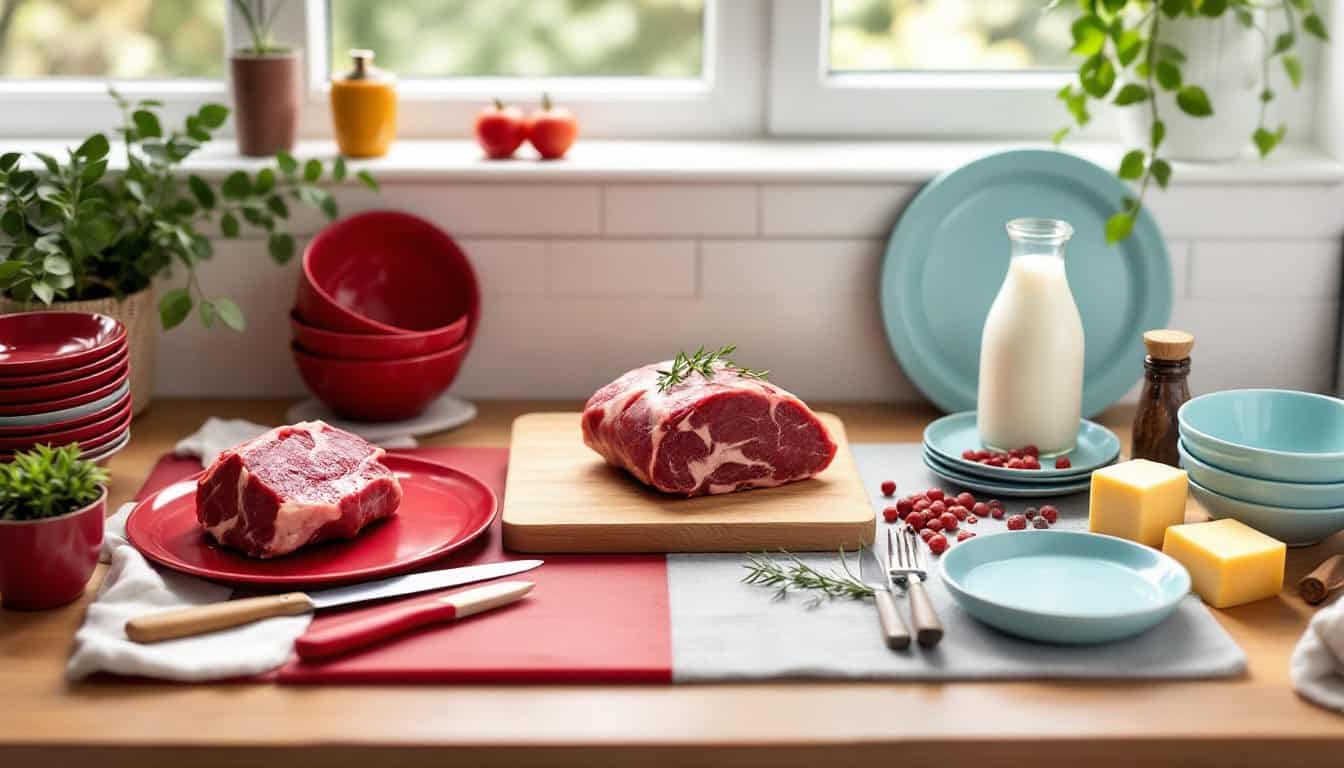
In many homes, different colors are chosen, often red for meat and blue for dairy, to avoid mistakes. Dish towels, sponges and cutting boards are also kept separate, and sometimes sinks or stovetops as well. For accidental mixtures, the law provides detailed rules: for example, a drop of milk that falls into a large pot of meat may be nullified if it makes up less than one sixtieth of the dish (Shulchan Aruch, Yoreh De’ah 98). In case of doubt, one asks a rabbi.
The same applies in the food industry: a cookie made on a dairy production line or a sauce containing whey explains why certified products are labeled “dairy”, “meat” or “pareve”.
The reasons: why does the Torah forbid this mixture?
The Torah does not give the reason for this commandment. It belongs to the category of chukim, decrees whose meaning is not stated, like the prohibition of mixing wool and linen. A Jew observes it first and foremost because G-d commanded it. But the Sages and the commentators have never stopped searching for what this commandment teaches. Several levels of explanation complement one another.
Tenderness toward life
The oldest explanation is a moral one. Philo of Alexandria, in the 1st century, already saw in it a lesson in gentleness: it would be monstrous to use the milk that was meant to nourish a young animal to season its flesh (De virtutibus 142-144). In the Middle Ages, Avraham ibn Ezra writes in his commentary on Shemot 23:19 that this commandment aims to keep man away from cruelty, and he links it to two other mitzvot: not slaughtering an animal and its young on the same day (Vayikra [Leviticus] 22:28), and sending away the mother bird before taking the eggs from a nest (Devarim 22:6-7).
The Rashbam, Rashi’s grandson, takes the same line: cooking the young in its mother’s milk is an act of crude gluttony, unworthy of a holy people.
Separating life and death
Another widespread reading deepens the previous one. Milk is the food of life at its very beginning: it comes from the living mother to nourish a growing creature. Meat, by contrast, presupposes the death of the animal. Judaism takes care not to confuse these two realms, just as elsewhere it separates pure and impure, Shabbat and the weekdays, the holy and the ordinary.
Against a pagan practice
The Rambam offers a historical explanation. In the Guide for the Perplexed, he first writes that meat cooked in milk is a very heavy food that makes one overly full; he then adds that it is plausible that this mixture was linked to an idolatrous rite, perhaps practiced at festivals, and that the Torah wanted to keep Israel away from it (Moreh Nevukhim III, 48). He notes that the verse appears twice next to the laws of the pilgrimage festivals, which supports his hypothesis.
A decree beyond reason
The Sefer Ha-Chinukh, which devotes two separate mitzvot to cooking (mitzvah 92) and to eating (mitzvah 113), suggests a direction with great caution. There are things in the world, it writes, whose combination is forbidden to us for a hidden reason, as it explained regarding sorcery; the same logic is found in the other prohibitions of mixtures, the kilayim (not crossbreeding species, not wearing wool and linen together). The proof is that the Torah forbids the very act of cooking them together, even if one does not eat the dish: it is therefore not the food that is harmful, but the combination. It concludes honestly: “we say this out of necessity, and we still need those who know the received tradition.” It adds that the Rambam’s explanation, that of an idolatrous rite, does not convince it.
The Kabbalists’ reading
The masters of Kabbalah see in milk, white and nourishing, an expression of chesed, the divine kindness that gives without measure, and in meat, red and linked to blood, an expression of gevura or din, strict judgment. Both of these forces must act in the world, but each in its proper place. Mixing them indiscriminately means upsetting the balance that G-d established. The Zohar, in parashat Mishpatim, is also the source of the custom of waiting a little after dairy before eating meat.
A discipline of holiness
Finally, there is the reason the Torah itself suggests in Deuteronomy: “for you are a holy people” (Devarim 14:21). The Midrash teaches that the mitzvot were given “to refine people” (Bereshit Rabba 44:1). Waiting six hours before a latte, giving up cheese on a hamburger, checking the label on a cookie: these are small acts of self-restraint, but repeated every day, they teach a person not to be led by appetite alone.
What Rav Raphaël Benizri teaches
Rav Benizri did not devote a lecture specifically to the mixing of meat and milk, but he returns several times to the meaning of the dietary laws, of which this separation is one of the most visible.
Eating kosher means learning to distinguish
In his lecture Purim: the war against Amalek, answering a question from a listener, the Rav explains that when we seek to eat kosher, we are seeking “a spiritual hygiene” in our food. We want to draw a distinction between the Tree of Life and the Tree of Knowledge of Good and Evil. These distinctions are made on a modest scale, that of the plate, but they give meaning to what we do. He also warns: eating kosher without a blessing before and after, without acknowledging or sanctifying what we eat, “is slippery ground”. The dietary law is not a label; it is a path of awareness.
A code for ourselves, not for G-d
In Pirkey Avot 5: serving without reward, the Rav takes up the question: does G-d need our mitzvot? He answers that He needs nothing. Whether we eat kosher or not does not concern Him for His own sake; it concerns us, insofar as we are looking for a way to overcome our weaknesses, and a code has been given to us to help us do so. This is exactly the idea of the Midrash according to which the mitzvot serve to “refine” the human being.
What the dietary laws do, and what they do not do
The Rav also warns against a practice that believes it has done its duty on the cheap. In Bereshit Rabba 40, part 1: the beauty of Sarah, he remarks that putting up a mezuzah or eating kosher “for a few euros more” hardly commits us to anything: the box is ticked, but what are we deep down inside? The dietary laws, he says, “predispose the mind to a state of purity”; they do not replace working on oneself. It is far harder to master one’s anger. Separating meat and milk prepares the ground; it is then up to each person to make something grow in it.
A little history
The prohibition is attested very early. Philo of Alexandria, in the 1st century, already comments on it as a known and observed law. The Mishna, compiled around 200, devotes the eighth chapter of tractate Chullin to the subject, which shows that in the Second Temple period the practical rules (poultry, a shared table, cheese) were already the subject of precise debates between the schools of Shammai and Hillel.
In the 20th century, the discovery of the texts of Ugarit, in Syria, revived the discussion. A Canaanite poem from the 14th or 13th century BCE was long read as mentioning a kid cooked in milk during a rite, which seemed to confirm the Rambam’s intuition about a pagan practice. This reading is now strongly disputed by specialists, because the passage is damaged and its words are uncertain.
The Karaites, a Jewish movement that emerged in the 8th century and rejects the Oral Torah, often proposed different readings of the verse, closer to its literal wording. By contrast, the rabbinic tradition, followed by all Jewish communities, has always read this commandment with its three prohibitions and its fences. Throughout the exile, whole cuisines were born of this rule: Ashkenazic cooking, deprived of butter with meat, developed goose fat and schmaltz; Sephardic cuisines rely heavily on olive oil.
One last fact sheds light on the tradition: on Shavuot, many have the custom of eating dairy foods (Rema, Orach Chaim 494:3). Among the reasons given, the Mishna Berura (494:12) reports in the name of a great master that when they came down from Sinai, the people, who had just received the Torah, could not prepare meat on the spot: they had to slaughter according to the law, salt the meat, and cook in new utensils, since the old ones had become forbidden. So they ate dairy foods, and this is remembered to this day.
Common misconceptions
“It’s a hygiene rule from before refrigerators.” No ancient Jewish source presents this prohibition as a health measure. The Rambam does mention how heavy this mixture is, but he places it alongside other reasons, and the Torah itself links it to holiness.
“It’s only about the kid and its mother.” The oral tradition, handed down with the Written Torah, has always understood the verse as referring to the meat of any domestic animal and to the milk of any permitted animal.
“Chicken isn’t meat.” In Jewish law, poultry is treated as meat. Chicken in cream sauce is not kosher.
“Plant-based butter is forbidden too.” Pareve margarine, almond milk or plant-based cream are not milk. They may be used with meat. The Rema (Yoreh De’ah 87:3) reports the custom of preparing “almond milk” for poultry and asks only, with the meat of a domestic animal, that almonds be placed next to it, so that no one thinks a forbidden mixture is being eaten: this is the concept of mar’it ayin, “what the eye sees”.
Frequently asked questions about meat and milk
Can butter or cream be added to a meat dish?
No. Butter and cream are dairy products, and cooking them with meat or poultry is precisely what the Torah forbids. In Jewish cooking, they are replaced with pareve margarine, oil or plant-based creams.
How long do you have to wait between meat and dairy?
The most widespread custom, that of the Shulchan Aruch, is six hours after meat (Yoreh De’ah 89:1). Some Ashkenazic communities wait three hours, others one hour, according to their tradition. After dairy, it is generally enough to eat a neutral food and rinse one’s mouth, with some waiting an additional half hour or hour.
Is a cheeseburger with a plant-based patty allowed?
If the patty is genuinely plant-based and certified pareve, and the cheese is kosher, the combination is not forbidden. Out of concern for mar’it ayin, care is taken that the packaging or presentation makes it clear that it is a plant-based product.
Why does the cheese itself have to be kosher?
Because most cheeses are made with rennet, an enzyme traditionally extracted from a calf’s stomach. The Sages forbade cheese made by non-Jews (Mishna Avoda Zara 2:5; Avoda Zara 35a), so only cheeses produced under rabbinic supervision are used.
Can meat and a cheese gratin be cooked in the same oven at the same time?
This is a technical question that depends on the type of oven, the presence of steam and how the dishes are covered. Many kosher homes reserve their oven for either meat or dairy, or take specific precautions. Consult a rabbi about your own kitchen.
Do non-Jews have to keep this rule?
No. The laws of kashrut, including the law of meat and milk, were given to the Jewish people. Non-Jews are bound only by the seven Noahide laws, which include the prohibition of eating a limb torn from a living animal (Sanhedrin 56a), but not the separation of meat and milk.
Further reading
- What does “kosher” mean? Kashrut explained
- Why don’t Jews eat pork or seafood?
- What is Shabbat?
- Purim: the war against Amalek
- Pirkey Avot 5: serving without reward
- Bereshit Rabba 40, part 1: the beauty of Sarah
- Shavuot: the giving of the Torah and the Book of Ruth
- Glossary of Hebrew terms in Judaism
Sources and references
- Shemot (Exodus) 23:19; Shemot 34:26; Devarim (Deuteronomy) 14:21 (the verse of the kid)
- Vayikra (Leviticus) 22:28; Devarim 22:6-7 (an animal and its young, the bird’s nest)
- Mishna, Avot 1:1 (“make a fence around the Torah”)
- Mishna, Chullin 8:1 and 8:4
- Mishna, Avoda Zara 2:5
- Babylonian Talmud, Chullin 104b-105a; 115b; 116a
- Babylonian Talmud, Shabbat 130a
- Babylonian Talmud, Pesachim 44b (ta’am ke-ikar)
- Babylonian Talmud, Avoda Zara 35a
- Babylonian Talmud, Sanhedrin 56a (the Noahide laws)
- Bereshit Rabba 44:1
- Rashi on Shemot 23:19; Ibn Ezra on Shemot 23:19; Rashbam on Shemot 23:19
- Rambam, Mishneh Torah, Hilkhot Ma’akhalot Asurot 9:4 and 9:28
- Rambam, Moreh Nevukhim (Guide for the Perplexed) III, 48
- Sefer Ha-Chinukh, mitzvot 92 and 113
- Zohar, parashat Mishpatim
- Beit Yosef, Yoreh De’ah 87
- Shulchan Aruch, Yoreh De’ah 87:1; 88:2; 89:1-2; 91; 98, with the glosses of the Rema (87:3; 89:1-2)
- Rema, Orach Chaim 494:3; Mishna Berura 494:12
- Philo of Alexandria, De virtutibus 142-144
- Rav Raphaël Benizri, Purim: the war against Amalek
- Rav Raphaël Benizri, Pirkey Avot 5: serving without reward
- Rav Raphaël Benizri, Bereshit Rabba 40, part 1: the beauty of Sarah
Article by the Pensées Juives editorial team. Passages attributed to Rav Raphaël Benizri are taken from his lectures published on this site.