
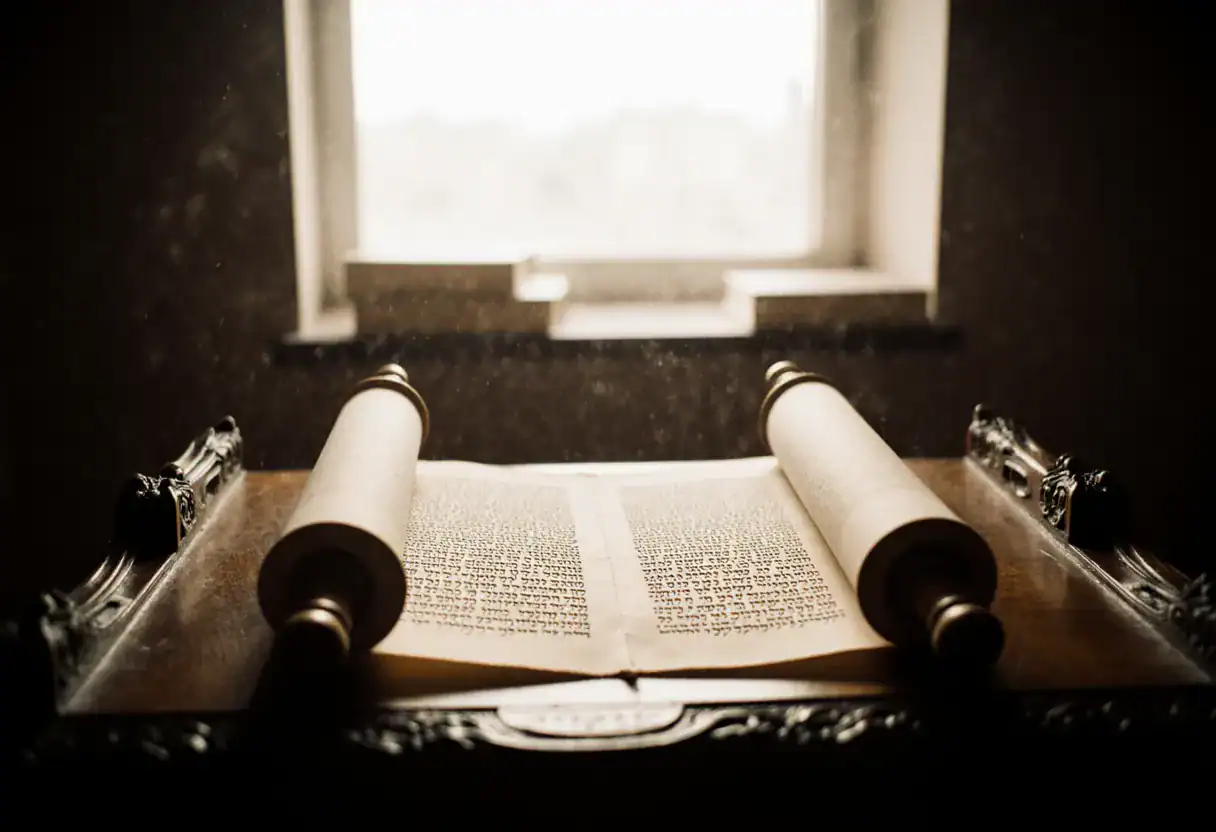
After seven days in the sukkah comes an eighth day with neither hut nor lulav, and a festival on which we dance with the Torah before immediately rereading its first verse. What does this “day of closing” mean, why does it not fall on the same day in Israel and in the Diaspora, and why finish the Torah only to begin it again within the same hour?
Shemini Atzeret is the festival of the eighth day that follows the seven days of Sukkot; Simchat Torah is the celebration of the end and the new beginning of the annual Torah reading. In Israel, the two merge into a single day, the 22nd of Tishrei. In the Diaspora, where a second festival day is observed, Shemini Atzeret falls on the 22nd of Tishrei and Simchat Torah on the 23rd. The day before, the seventh day of Sukkot, is called Hoshana Rabbah: it is the day of the seven circuits with the lulav and of the willow branches beaten on the ground.
In 5787, Hoshana Rabbah falls on Friday, October 2, 2026. Shemini Atzeret begins on Friday evening, October 2, and is celebrated on Saturday, October 3. In Israel, Simchat Torah is celebrated on the same day, which this year is Shabbat. In the Diaspora, Simchat Torah begins on Saturday evening, October 3, at the end of Shabbat, and is celebrated on Sunday, October 4. On the following Shabbat, October 10, the parasha Bereshit is read everywhere: the cycle begins again.
This article sets out the sources of these days, their meaning and their customs. It also draws on the lectures of Rav Raphaël Benizri devoted to Sukkot, to the Torah and to beginnings. In his teaching, joy, the circle, solidarity and the perpetual renewal of study form one and the same lesson.
An eighth day: what the Torah says
The Torah mentions this day twice. In Leviticus: “For seven days you shall bring an offering to Hashem; on the eighth day you shall have a holy convocation […] it is an atzeret, you shall do no servile work” (Vayikra 23:36). And in Numbers: “On the eighth day you shall have an atzeret” (Bamidbar 29:35). This is where the festival’s name comes from: shemini means “eighth,” and atzeret, from the root atzar, “to hold back, to stop,” denotes a closing assembly, a moment when one stops and stays.
The Torah gives this day no commandment of its own. The four species are not taken, and one is no longer obliged to dwell in the sukkah. It is a bare festival day, with no object or rite to characterize it. Its entire content lies in being there, in staying.
This is what Rashi emphasizes in a celebrated comment on Vayikra 23:36. Atzeret, he writes, means: “I have held you back with Me.” He offers this image: a king invited his children to a feast for a certain number of days. When the time came to leave, he said to them: “My children, I beg you, stay one more day with me; your parting is hard for me.”
Seventy bulls, then just one
The list of offerings in Bamidbar 29 sheds light on this day in another way. During the seven days of Sukkot, bulls were offered in decreasing numbers: thirteen on the first day, twelve on the second, and so on down to seven on the seventh, seventy in all. On the eighth day, only a single bull and a single ram are offered (Bamidbar 29:36).
The Talmud (Sukkah 55b) explains that the seventy bulls correspond to the seventy nations that make up humanity. During Sukkot, Israel brings offerings for the whole world. The single bull of the eighth day corresponds to the “unique nation.” The Talmud also expresses this through a parable: a king told his servants to prepare a great feast for him; on the last day, he said to his friend: “Prepare me a small meal, so that I may enjoy your company.” After the festival open to all comes an intimate moment, face to face.
Rav Benizri places great emphasis on the first part of this structure. In his lecture Sukkot: The Festival of Joy, he describes Sukkot as “the festival of the universal.” It is the festival on which the Jewish people offers seventy sacrifices on behalf of the seventy nations. It is also the only festival that the nations will be called upon to celebrate in the future, as the prophet Zechariah announces (14:16): not Pesach, not Shavuot, says the Rav, but Sukkot, because it is the one within their reach. The same lecture opens with a remark that illuminates the second part, the “small meal” of the eighth day. In a relationship of love, says the Rav, what matters is not the gifts exchanged but the intimacy shared. The Rav is not speaking here of Shemini Atzeret, but his remark offers a key to it: the eighth day is a festival without gifts, without objects, without a ritual of its own, where nothing remains but closeness.
A festival in its own right
Is Shemini Atzeret merely an extension of Sukkot? The Talmud says no. It teaches that “the eighth day is a festival in itself” (Sukkah 48a; Rosh Hashanah 4b) and gives six marks of this, summed up in a mnemonic. The eighth day has its own lottery among the priestly families for the service. The blessing shehecheyanu (“Who has kept us alive until this moment”) is recited on it. It bears its own festival name. It has its own offerings and its own song. Finally, it has its own blessing.
That is why, in prayer, we do not say “this festival of Sukkot” but “this eighth day, the festival of closing” (yom hashemini chag ha’atzeret hazeh according to the Shulchan Aruch; the Ashkenazi rite says simply yom hashemini atzeret hazeh, Orach Chaim 668:1). And in the evening, at kiddush, shehecheyanu is said again, as at the start of a new festival.
There is a paradox here: the festival closest in time to Sukkot is also the one most distinct from it. It keeps the joy of Sukkot but removes all its supports. It keeps the presence, but without the hut.
Israel and the Diaspora: why a one-day difference?
In antiquity, the start of the month was fixed by the court in Jerusalem on the testimony of witnesses who had seen the new moon. Messengers then went out to announce it to the communities. Those too far away to be informed in time did not know with certainty which day was the first of the month. They therefore celebrated each festival for two days. When the calendar came to be fixed by calculation, the Talmud asked that this practice be maintained: “Be careful to keep the custom of your fathers” (Beitzah 4b). This is the origin of yom tov sheni shel galuyot, the second festival day of the Diaspora.
For Sukkot, this produces a particular shift:
- In Israel, the 22nd of Tishrei is both Shemini Atzeret and Simchat Torah. On the same day, the prayer for rain is said, the Torah is completed, and people dance.
- In the Diaspora, the 22nd of Tishrei is Shemini Atzeret and the 23rd of Tishrei is Simchat Torah. The prayer for rain is said on the first day, and the end of the Torah is read on the second.
The first day in the Diaspora raises a question: should one still sit in the sukkah? Since it could in theory be the seventh day of Sukkot, the Talmud (Sukkah 47a) concludes that one sits in it, but without reciting the blessing over the sukkah. This is also the ruling of the Shulchan Aruch (Orach Chaim 668:1). Customs vary, however: in some Hasidic communities, only some of the meals are eaten in the sukkah, or none at all. In Israel, the question does not arise: on the eighth day, one returns home. For their own practice, each person should follow the custom of their community and ask their rabbi.
Hoshana Rabbah: the last day of Sukkot
The day before Shemini Atzeret, the 21st of Tishrei, is called Hoshana Rabbah, the “great Hoshana.” The word hoshana comes from the verse “Please, Hashem, save us!” (ana Hashem hoshia na, Tehillim 118:25). It refers to the rhythmic supplications recited each day of Sukkot while circling the bimah, the reading platform, lulav in hand.
The seven circuits and the willow
This custom goes back to the Temple. The Mishnah (Sukkah 4:5) relates that large willow branches were gathered at a place called Motza, near Jerusalem. They were set upright around the altar, their tops bending over it. Each day of the festival, one circuit was made around the altar while saying “Please, Hashem, save us!” On the seventh day, seven were made. In the synagogue today, the same is done: one circuit a day around the bimah, and seven circuits on Hoshana Rabbah, with the Torah scrolls taken out of the ark.
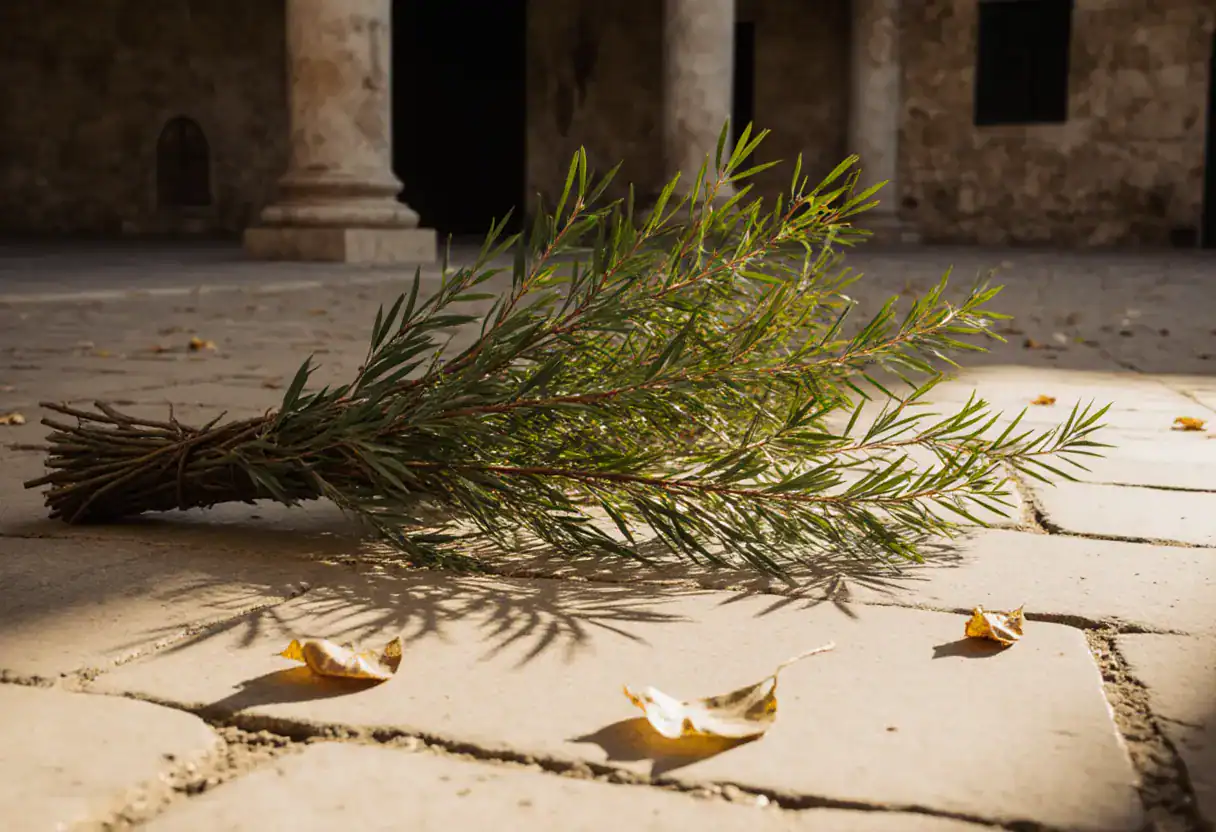
At the end of the service, a small bundle of willow branches (often five), the aravot, is taken and beaten on the ground. The Talmud reports this practice as a custom instituted by the prophets (Sukkah 44a). It is often understood as a gesture of stripping away: one beats until a few leaves fall, as though shedding what remains of our sins.
The seal of judgment
Tradition, especially from the Zohar onward, sees Hoshana Rabbah as the very end of the period of judgment opened on Rosh Hashanah and sealed on Yom Kippur. The decrees “go out” on that day. Several practices stem from this. Many stay awake all night reading the book of Devarim and Tehillim (Psalms). Some communities wear the white garment of Kippur, and the service takes on a more solemn tone than on the other days of Sukkot. People also wish one another pitka tava, “a good note,” as though the verdict signed on Kippur only became final at that moment.
Rav Benizri gives this custom a very concrete meaning. In his lecture Sukkot: From Kippur to the Sukkah of Peace, he asks why “it still drags on until Hoshana Rabbah.” The note was obtained on Kippur: why keep asking for it? His answer is that Kippur was a day of elevation, but an elevation can collapse as soon as the fast is over. Prayer, he explains, distinguishes geulah, redemption, from shemirah, the protection that preserves it: there is no point in reaching a state if one does not know how to sustain it. As a sign of this he points to the evening prayer, where, after the blessing of redemption, a blessing of protection is added, Hashkiveinu, which on Shabbat and festival evenings concludes with “Who spreads over us His sukkah of peace.” Sukkot is therefore the time of proof: coming out of Kippur, says the Rav, we must prove that we remain faithful to the solidarity and unity lived on the day of forgiveness, when all the streams of the people met in the same synagogue, with the same prayer book. And only once this proof has been given, on Hoshana Rabbah, as the festival closes, do we earn the “good note” attesting that the resolve of Kippur was sincere.
In Sukkot: The Festival of Joy, the Rav points out another detail: on this last day, only the aravah, the willow, is taken. Of the four species, it is the one with neither taste nor fragrance. The Rav compares it to the son in the Haggadah “who does not know how to ask.” And yet, he says, it is there and it has its say. What unites us is first of all the will to form a community, a people, a humanity. The festival thus closes on the humblest, the one who has nothing to show but its presence. This is precisely the logic of Shemini Atzeret. On the meaning of each species, see also The Four Species of Sukkot.
The prayer for rain
Shemini Atzeret also marks a turning point in daily prayer. From the Musaf service (the additional service of festival days) of that day, we begin to mention in the Amidah the power of G-d who “causes the wind to blow and the rain to fall,” mashiv haruach umorid hagashem. This mention continues until Pesach (Shulchan Aruch, Orach Chaim 114:1). In many communities, it is introduced by a solemn prayer, tefillat geshem. In its Ashkenazi version (Zechor av), it recalls Avraham, Yitzchak, Yaakov, Moshe, Aharon and the twelve tribes, and the connection of each to water.
The Mishnah (Taanit 1:1) discusses when this mention should begin. One view proposes the first day of the festival, another the last. The law follows the second, and Rabbi Yehoshua gives the reason, taken up by the Talmud (Taanit 2b): during Sukkot, rain is merely a “sign of curse,” since it prevents one from dwelling in the sukkah. Another mishnah (Sukkah 2:9) compares rain falling during the festival to a servant who brings his master a cup and has its contents thrown in his face. So we wait until we have left the sukkah before asking for rain. The request proper, “grant dew and rain,” only begins later: on the 7th of Cheshvan in Israel, and in early December in the Diaspora.
Sukkot is, moreover, the time when, according to the Mishnah (Rosh Hashanah 1:2), the world is judged for water. In the Temple, water was poured on the altar throughout the festival. This was the nissuch hamayim, which gave rise to the great rejoicing of Simchat Beit HaSho’evah, “the joy of the water-drawing.” Rav Benizri dwells on it at length in Sukkot: The Festival of Joy. Ordinarily, he says, it was wine that was poured on the altar; on Sukkot, one returned to water, which does not appear in the account of creation because it is already present there when the divine spirit “hovers over the face of the waters.” And he concludes: what was drawn was not water, it was the divine spirit through it.
The rain requested on Shemini Atzeret is therefore not merely a matter of agriculture. In his lecture on Noah, Noah: The Loosening of Morals, the Rav recalls that the Torah itself is called “rains of blessing” (gishmei berachah) and “dew of life.” Just as rain gives life to the earth, the Torah is called to bring spiritual revival. But the ground must be able to absorb it: on rock, rain accumulates and becomes a flood. On the very day we begin to ask for rain, we complete the Torah reading and begin it anew.
The Rav also dwells on a verse that speaks of the rain of the Land of Israel. In Rosh Hashanah: The Month of Elul and the Cry of the Shofar, he quotes this verse: it is “a land that Hashem your G-d looks after constantly, from the beginning of the year to the end of the year” (Devarim 11:12). This land, he says, does not live by irrigation like Egypt: it drinks the rain of heaven, and this depends on G-d’s direct providence. With our Sages, he also reads in it a teaching about time: just as we approached the beginning of the year, so we will find ourselves at its end. One may see in Shemini Atzeret, where the end of the Torah touches its beginning, the most visible illustration of this link.
Simchat Torah: finishing in order to begin again
The name Simchat Torah, “the joy of the Torah,” appears neither in the Bible nor in the Talmud. The festival itself was born of a custom. In the time of the Talmud, the Land of Israel read the Torah in a cycle of about three years (Megillah 29b). The communities of Babylonia, for their part, read it in one year. It is this annual cycle that prevailed everywhere, and it ends after Sukkot.
The Talmud (Megillah 31a) already prescribes that on the second day of Shemini Atzeret in the Diaspora, “Vezot Haberachah,” the last parasha of the Torah (Devarim 33–34), is read. Over the centuries, this day became a festival of the Torah, with its honors, its songs and its dances. In Israel, all of this takes place on Shemini Atzeret itself.
The order of the day
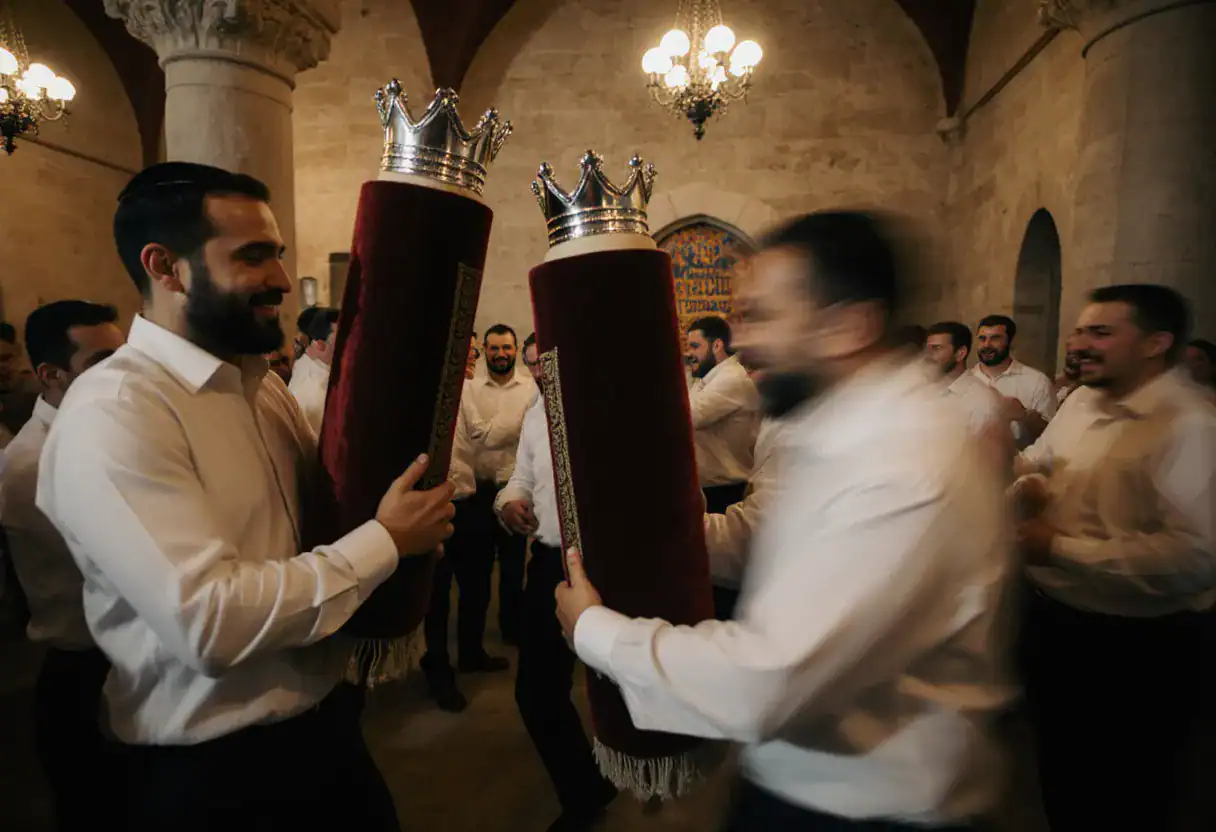
- The hakafot: in the evening, and in many communities in the morning as well, all the scrolls are taken out of the ark. Seven circuits are made around the bimah with singing and dancing, each circuit opened with verses. Some communities also hold hakafot the night before, on the evening of Shemini Atzeret.
- The reading of the end of the Torah: in the morning, Vezot Haberachah is read, Moshe’s blessing to the tribes and the account of his death. In many synagogues, this passage is read several times so that every man present can be called up to the Torah.
- All the children (kol hane’arim): all the children are called up together, gathered beneath a large tallit spread over them. They are blessed with Yaakov’s verse: “The angel who redeemed me from all evil, may he bless these children” (Bereshit 48:16).
- The “bridegroom of the Torah” (chatan Torah): this is the honor of being called up to the Torah for the last verses of Deuteronomy. Immediately afterward, the “bridegroom of Bereshit” (chatan Bereshit) is called up for the account of creation, from “In the beginning” through Shabbat (Bereshit 1:1 – 2:3).
- The maftir and the haftarah: from a third scroll, the passage of the offerings of the eighth day is then read (Bamidbar 29:35 – 30:1). The Talmud (Megillah 31a) designated as haftarah Shlomo’s prayer at the dedication of the Temple; today, most communities read the first chapter of the book of Yehoshua, which opens on the day after Moshe’s death: the leadership of the people passes to his disciple, just as the Torah passes from one year to the next.
These customs vary from one community to another. In Israel, it is common to hold in the evening, after the festival ends, hakafot sheniyot, “second hakafot,” often outdoors and with music. They make it possible to dance once more with the scrolls, even though the festival is over.
Why we do not stop at the last line
The ritual leaves no moment in which the Torah would be “finished.” The last word of Deuteronomy has barely been spoken when another scroll is opened to the first verse of Genesis. A traditional explanation says that we do not want to give the impression that we have finished and have had enough. Study is a circle that has no end.
It is often noted that the Torah ends with the letter lamed, the last letter of the word “Israel,” and begins with the letter bet, the first letter of Bereshit. Joined together, these two letters form the word lev, “heart.” The end and the beginning of the book, sewn to one another on Simchat Torah, trace the heart.
The end of the text also has something striking about it. The last words of the Torah are “before the eyes of all Israel” (Devarim 34:12). Rashi relates them to Moshe’s act of breaking the first Tablets before the eyes of the people. The book ends with broken Tablets, and the festival that concludes it is the most joyful of the year. This is precisely what Rav Benizri explains.
What Rav Raphaël Benizri teaches: the circle, joy and beginning
Why joy: the second Tablets
In Sukkot: The Festival of Joy, the Rav asks why joy bursts forth precisely at this time of year. He answers: because on Kippur we received the second Tablets of the Law, after having broken the first. He recalls the scandal of the golden calf, the threat to make a new people out of Moshe, and then the forgiveness. We have overcome the stumbling block, he says: that is why we are joyful. He then quotes a saying that the Talmud places precisely at the heart of the joy of the water-drawing of Sukkot (Sukkah 53a): the pious, the hasidim, would sing “Happy is our youth, which has not shamed our old age,” and those who had done teshuvah, returning, would answer “Happy is our old age, which has atoned for our youth.” The Rav draws the lesson: “Happy is the one who makes no mistake, but happier still is the one who has managed to be forgiven for his wanderings.”
The Torah with which we dance on Simchat Torah is that of the second Tablets, the one that has passed through sin. The Rav explains the immense light of Sukkot in the same way: even to our wanderings we have given a positive meaning, and we have integrated them into the curve of life. That is why the Torah can end on the broken Tablets and immediately begin again in joy.
The circle: turning around the Torah
Rav Benizri sees in the hakafot the very figure of Sukkot. “What will characterize Sukkot,” he says, “are the hakafot that we make around the Torah.” They are made around the Torah because we no longer have a sanctuary: in the past, one circled the altar. Now the circle is, for him, the “ideal geometric figure.” Everyone in it stands at an equal distance from the center. The different conceptions of G-d that each person forms, at his own level, meet at their root. And all join hands.
He connects this idea to the very name of the festival. Sukkot is simply called chag, “the festival.” The Rav links this word to the circle drawn with a compass: each festival brings its own cycle of light, and that of Sukkot is the widest. He also notes that the Torah never placed so much emphasis on joy: the word appears only once for Shavuot, and three times for Sukkot.
Today’s dances, he continues, seek to reproduce the joy of the water-drawing in the Temple. They always form this circle in which the Jewish people takes its place, and even the whole of humanity, of which Israel is the representative. And he adds this formula: “To dance is to lift one’s foot.” One must stop scraping the ground, stop remaining confined in one’s matter and in one’s shoes. The round dance is an effort at levitation. Here is one way of understanding what happens when an entire synagogue turns in circles, Torah scrolls in their arms: each person tears himself away, for an instant, from his own weight.
Finally, speaking of the sukkah that “surrounds” and “clothes” a person, the Rav evokes the circles the bride traces around her groom under the chuppah, the wedding canopy: the feminine, he says, is the wall of the man. The image applies well to Simchat Torah, where tradition speaks of the “bridegrooms” of the Torah and of Bereshit. There, the relationship with the Torah is lived as a wedding renewed each year.
The Torah, the cement of a people
Why does this day, more than any other, bring together an entire community, including those who rarely attend synagogue? In Sukkot: From Kippur to the Sukkah of Peace, the Rav starts from a linguistic remark. Pesach and Chanukah are in the singular, because liberation and education pass from person to person. But commitment to the Torah is that of the whole people, “as one man, with one heart.” The Torah, he says, is the basic cement of the entire Jewish people: take it away, and nothing remains that could make its unity. The Jewish people counts for nothing numerically, and yet it is still here.
Simchat Torah makes this idea visible. No one dances with “his” Torah: all the scrolls come out, pass from arm to arm, and the scholar dances beside the child. The Rav said as much of the willow of Hoshana Rabbah: even the one with neither taste nor fragrance has its place in the circle.
Beginning again: the lesson of Bereshit
When the scroll is reopened at the first verse, we reread the text the Rav comments on in Bereshit: The Beginning of Creation. This lecture gives depth to the gesture of Simchat Torah. In it, the Rav sets aside the question of the age of the world to ask another: what does it mean to affirm that there is a beginning? If there is a beginning (reshit), he explains, there is a purpose (tachlit). History has a meaning; there is a creative will, and therefore free will. To begin the Torah again each year is to reaffirm this: nothing is left to chance, and man has a task.
The Rav also dwells on the first letter, the bet. Why does the Torah not begin with an aleph? Because the bet is duality, and Hebrew moves from duality toward unity: it is the two that leads to the one. The bet is also the principle of the bayit, the house. G-d refuses to give us a finished world, the Rav explains, for in a perfect world we would have no merit. The world is left to man with this task.
The same lecture recalls that the Torah preceded creation: it is its blueprint, as the architect’s plan precedes the house. It is also the tool for reading it. The Rav notes that mikra, Scripture, is a “call” to read, and that the initial mem makes it a kli, an instrument. One may begin with a rough reading; by going deeper, one discovers a treasure. This is exactly what the annual cycle offers: we reread the same text, but we are no longer the same reader. Among the things that preceded creation, the Rav also counts teshuvah, return: the possibility of correction was foreseen even before there was a human being to go astray.
In Elul: The Role of Man, the Rav says something about Rosh Hashanah that applies just as well to the scroll rewound on Simchat Torah. It is “the beginning of a new cycle,” but one that does not break with the past. On the contrary, it gives the past another meaning, another dimension. We do not take up Bereshit again by erasing the year gone by: we reread it with everything that year has taught us.
Between two times
Finally, the Rav describes the month of Tishrei as a “bubble of time,” similar to bein hashmashot, that twilight moment of which one cannot tell whether it belongs to the day that is ending or to the one that is coming. This moment hangs in the balance between the two, bearing at once on the past and on the future. In space, he says, it is the sukkah, at once inside and outside the house. One might add that Shemini Atzeret and Simchat Torah are the last moment of this bubble. The last verse of Deuteronomy touches the first of Genesis, judgment closes and the rainy season opens. In the same lecture, the Rav speaks of this fleeting present that stands at the crossroads of what has been (our parents, our grandparents) and what is coming (our children, our grandchildren): “that is where I stand,” he says, “and that is my well of joy.”
Shemini Atzeret and Simchat Torah in practice
- Hoshana Rabbah (Friday, October 2, 2026): many stay up during the night. In the morning, seven circuits are made around the bimah with the lulav, and then the aravot are beaten. This year, one also prepares for Shabbat, which is also a festival day.
- The evening of Shemini Atzeret: the Shabbat and festival candles are lit. At kiddush, Shabbat and “the eighth day, the festival of closing” are mentioned, and shehecheyanu is said.
- The day of Shemini Atzeret: at Musaf, the prayer for rain is recited, and one begins to say mashiv haruach umorid hagashem. In Ashkenazi communities, the memorial prayer for the departed, Yizkor, is also said.
- In the Diaspora, on the 22nd of Tishrei, meals are eaten in the sukkah without reciting its blessing, according to each person’s custom. This year, the second day begins at the end of Shabbat: candles are lit only after nightfall, from an existing flame, and nothing is prepared on Shabbat for the next day.
- Simchat Torah: hakafot in the evening and in the morning. In the morning, Vezot Haberachah and the beginning of Bereshit are read, and then all the children, the chatan Torah and the chatan Bereshit are called up.
For any specific question (travel between Israel and the Diaspora, food, times), consult a competent rabbi.
Frequently asked questions
What is the difference between Shemini Atzeret and Simchat Torah?
Shemini Atzeret is the festival ordained by the Torah (Vayikra 23:36), the eighth day that closes Sukkot. Simchat Torah is a later custom: the celebration of the end and the new beginning of the annual Torah reading. In Israel, both take place on the same day. In the Diaspora, Simchat Torah is the second day of Shemini Atzeret.
Is Shemini Atzeret part of Sukkot?
No. It immediately follows Sukkot, but the Talmud considers it “a festival in itself” (Sukkah 48a). The lulav is no longer taken, shehecheyanu is said at kiddush, and the prayer calls it “the eighth day, the festival of closing.” Only in the Diaspora does one continue to sit in the sukkah on the first day, without a blessing.
Why is it called “atzeret”?
Atzeret comes from a root meaning “to hold back.” Rashi explains it with the parable of the king who, at the end of a long feast, asks his children to stay one more day, because their parting is hard for him. After the seventy offerings of Sukkot brought for the nations, the eighth day has only one bull: it is a festival of intimacy between G-d and Israel.
What is done on Hoshana Rabbah?
Seven circuits are made around the bimah with the four species while reciting the hoshanot, and then a bundle of willow branches is beaten on the ground, following a custom of the prophets (Sukkah 44a). Tradition sees it as the conclusion of the judgment opened on Rosh Hashanah. Many stay awake the night before and wish one another pitka tava, “a good note.”
Why do we begin praying for rain on Shemini Atzeret and not before?
Because during Sukkot, rain would prevent one from dwelling in the sukkah: it is even seen as a bad sign there (Mishnah Sukkah 2:9; Mishnah Taanit 1:1; Taanit 2b). So we wait until we have left the sukkah before mentioning rain, starting from Musaf of Shemini Atzeret. The explicit request for rain begins a little later, on the 7th of Cheshvan in Israel.
Why do we begin the Torah again on the very day we finish it?
To show that the study of Torah has no end: we never “finish” it, we take it up again. Rav Benizri adds a deeper reason. To say that there is a beginning is to say that the world has a purpose, and each new start of the reading is like Rosh Hashanah, a new beginning that does not break with the past but gives it a new meaning.
Conclusion: staying, circling, beginning again
The last days of Tishrei come down to three gestures. Staying: Shemini Atzeret is the day when the King asks us to stay a little longer, with nothing to bring but ourselves. Circling: from Hoshana Rabbah to the hakafot, we form the circle around the Torah, the circle in which, says Rav Benizri, everyone stands at an equal distance from the center and all join hands. Beginning again: the last word of the Torah barely read, we reread its first, because a beginning announces a purpose and man still has his part to accomplish.
To extend the festival, you can listen to the Rav’s lectures on Sukkot. You can also take up the reading cycle with him from the weekly parasha, beginning, as is fitting, with Bereshit.
Further reading
- Sukkot: all of Rav Benizri’s lectures
- Sukkot: The Festival of Joy
- Sukkot: From Kippur to the Sukkah of Peace
- Bereshit: The Beginning of Creation
- Parasha Bereshit and Parasha Vezot Haberachah
- Why do we live in the sukkah?
- The Four Species of Sukkot
- Printable booklets, including “Questions for the Table” for Sukkot
- Glossary of Hebrew words
- All the Jewish holidays
Article by the Pensées Juives editorial team. The passages attributed to Rav Raphaël Benizri are drawn from his lectures published on this site.