
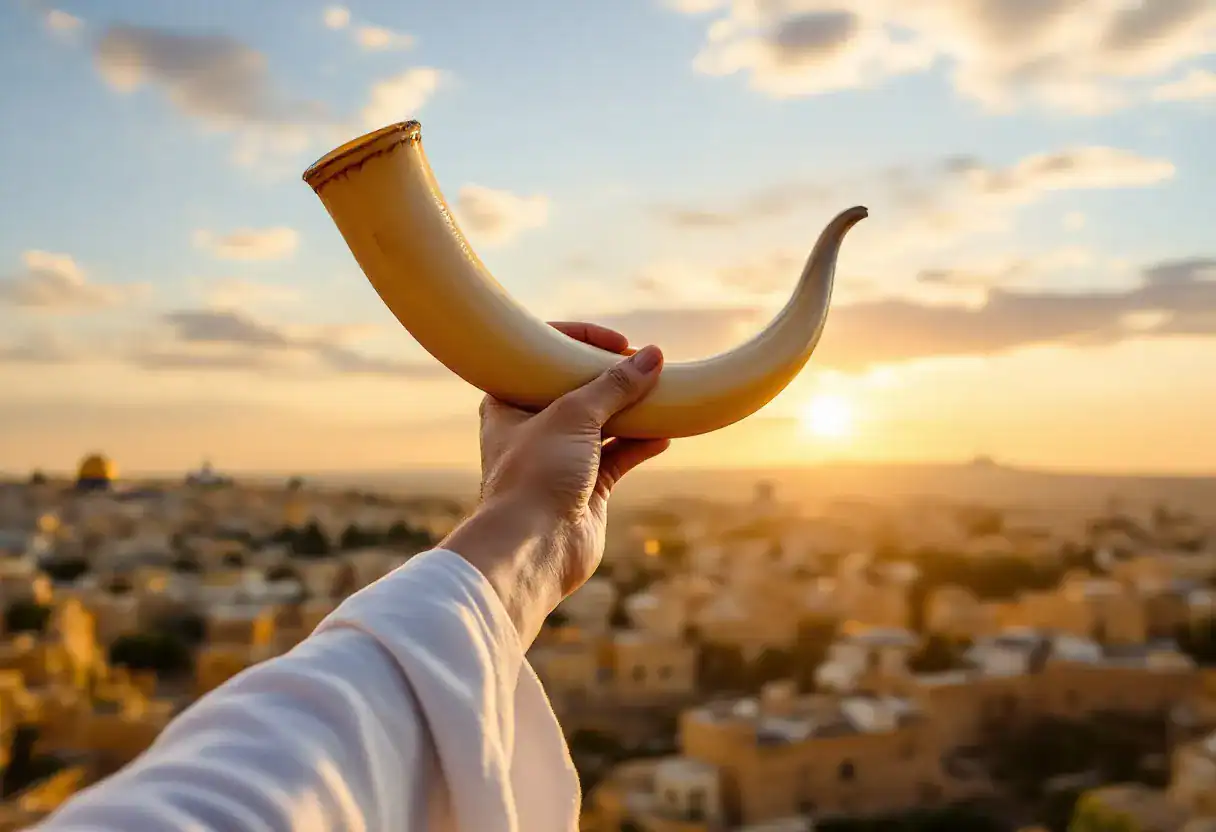
No fireworks, no countdown: the Jewish New Year opens with a judgment, a crown, and the cry of a ram’s horn. What do we really celebrate on Rosh Hashanah, why do we blow the shofar, and what do the apple in honey and the fish head mean? A complete tour of the sources, the prayers and the customs, illuminated by the teaching of Rav Raphaël Benizri.
Rosh Hashanah, literally “the head of the year,” is the Jewish New Year. It falls on the 1st and 2nd of the month of Tishrei, in the autumn. It is not first and foremost a festival of worldly celebration: it is the day on which, according to tradition, all of humanity is judged; the day on which we proclaim G-d King of the world; the day of the shofar, the ram’s horn sounded in synagogues. It is also the anniversary of the creation of man. Rosh Hashanah opens the ten days of teshuvah, of return and repentance, which end on Yom Kippur.
The next Rosh Hashanah, that of the year 5788, begins on the evening of Friday, October 1, 2027 and continues through Saturday the 2nd and Sunday the 3rd of October. Since the first day falls on Shabbat, the shofar will not be sounded that day: it will be heard only on Sunday. Yom Kippur follows, from the evening of Sunday, October 10, to Monday, October 11, 2027.
What the Torah says: a “day of sounding”
The Torah never uses the name “Rosh Hashanah.” It speaks of a day set on the first day of the seventh month, counting from Nissan, the month of the Exodus from Egypt: “In the seventh month, on the first of the month, there shall be a day of rest for you, a zikhron teru’ah, a remembrance by sounding, a holy convocation” (Vayikra 23:24). And again: “it shall be for you a yom teru’ah, a day of sounding” (Bamidbar 29:1). The teru’ah is the broken, staccato sound of the shofar. The biblical text does not say why we sound it, nor what we commemorate. The entire meaning of the day was unfolded by the Oral Tradition: the Mishnah, the Talmud, the liturgy.
The name “Rosh Hashanah” comes from the Mishnah, which opens the tractate bearing this title by listing four “new years” (Rosh Hashanah 1:1): the 1st of Nissan for kings and festivals, the 1st of Elul for the tithe of animals, the 1st of Tishrei for the counting of years, sabbatical years and jubilees, and the 15th of Shevat for trees (see our article on Tu BiShvat, the New Year of the Trees). The 1st of Tishrei is thus the starting point of the Jewish civil year: it is on this day that the count of years changes.
Another verse sheds light on the festival: “Sound the shofar at the new moon, at the time when the moon is concealed, for the day of our festival” (Tehillim 81:4). The Talmud (Rosh Hashanah 8a-b) asks: which festival falls when the moon is still concealed, at the very start of the month? Only Rosh Hashanah. It is the only festival of the year that begins with the month itself, while the moon is still invisible, as if this day were meant to be lived with a certain discretion.
Why the 1st of Tishrei? The birthday of man
The Talmud (Rosh Hashanah 10b-11a) records a debate between Rabbi Eliezer and Rabbi Yehoshua: was the world created in Tishrei or in Nissan? Liturgical practice follows Rabbi Eliezer. In the Musaf prayer we say: “This day is the beginning of Your works, a remembrance of the first day.” According to the Midrash (Vayikra Rabbah 29:1), creation began on the 25th of Elul, and the sixth day, on which man was formed, fell on the 1st of Tishrei. Rosh Hashanah is therefore not the birthday of the universe in general, but that of man, of his responsibility and of his first sin. The same Midrash adds that Adam was judged on that day and was pardoned: what happened to the first man becomes a promise to his descendants.
Rav Raphaël Benizri starts from this date in his lecture Elul: Returning to One’s Sources. The world begins on the 25th of Elul, but our Sages teach that 974 generations were created and then erased before it, because they did not answer to the original plan. Imperfection is thus written into creation itself. That is why, he explains, the possibility of correcting and re-creating, teshuvah, had to exist before the world. Rosh Hashanah does not celebrate a finished universe: it celebrates the chance given to man to set himself right.
“Shanah”: the year that repeats
The Hebrew word shanah, “year,” comes from a root that also means “to repeat.” The Rav draws from it a lesson that recurs in several of his lectures. In Elul: The Role of Man, he notes that Rosh Hashanah is not a “new” year: it is the repetition of a cycle to which we have given a different content. He compares it to the book of Devarim, called Mishneh Torah, the “repetition of the Torah”: Moshe goes over the teaching again there, and yet everything in it is different, with its own nuances and its own laws. Rosh Hashanah is a new beginning that does not break with the past; it gives the past a new meaning.
In The Month of Elul and the Cry of the Shofar, he takes the reflection further. Shanah, the year, and yashen, asleep, share the same root. He reads the verse “when you have begotten children and grandchildren and have grown old in the land” (Devarim 4:25), where “to grow old” is venoshantem. For him, growing old is not a matter of age: it means entering a system where everything is daily, repetitive, natural, where there is nothing new anymore. The danger of the year is that it lulls us to sleep.
Hence an image that runs through this lecture. Life, says the Rav, is leased to us for one year, “from the beginning of the year to the end of the year,” in the Torah’s expression about the Land of Israel (Devarim 11:12). It is we who renew this lease, as one moves house. When we change apartments, we keep what fits into the new setting and get rid of what no longer belongs there. Rosh Hashanah thus becomes the rosh of shinuy: the head of change.
The Day of Judgment
The Mishnah says it plainly: “On Rosh Hashanah, all who come into the world pass before Him like benei maron” (Rosh Hashanah 1:2). The Talmud (Rosh Hashanah 18a) offers several explanations of this expression: like lambs made to pass one by one through a narrow gate to be counted; like travelers on a mountain path so narrow that one can walk on it only in single file; like the soldiers of an army passing in review. In all three images, each person is seen individually. No one hides in the crowd.
The Talmud (Rosh Hashanah 16b) also describes three books opened on that day. The completely righteous are immediately inscribed and sealed for life. The completely wicked are inscribed for death. The “intermediate,” the beinonim, remain in suspense until Yom Kippur: if they are worthy, they are inscribed for life. Since most of us recognize ourselves in this intermediate category, the days between Rosh Hashanah and Yom Kippur take on decisive importance. Hence the wish exchanged on the first evening: ketivah vachatimah tovah, “a good inscription and a good sealing.”
Yet this judgment has nothing of a gloomy courtroom about it. The book of Nechemiah relates that on the 1st of Tishrei, when the people wept on hearing the reading of the Torah, Ezra and Nechemiah told them: “Go, eat rich foods, drink sweet drinks, and send portions to those who have nothing prepared, for this day is holy to our L-rd; do not be sad, for the joy of Hashem is your strength” (Nechemiah 8:10). Rosh Hashanah is a festival: we dress well, we hold festive meals, we recite Kiddush. Solemnity and confidence coexist.
“Inscribe us in the Book of Life”
In his lecture Inscribe Us in the Book of Life, given on the eve of the festival, Rav Benizri starts from a simple observation. The additions specific to the Rosh Hashanah Amidah (the central prayer, recited standing) all come back to a single request. In the first blessing: “Remember us for life, King who desires life, inscribe us in the Book of Life, for Your sake, G-d of life.” He recalls that this blessing is that of Avraham, marked by chesed, kindness. In the second, that of Yitzchak, marked by gevurah, rigor: “Who is like You, merciful Father, who remembers Your creatures for life.” Then toward the end: “Inscribe all the children of Your covenant for a good life.” And finally: “In the book of life, blessing and peace.”
The Rav points out a nuance. At the beginning, we ask for life, simply. At the end, we ask for a “good” life. Is there, then, a good life and a life that is not? He answers with a passage from the Talmud (Bava Kamma 54b-55a). Rabbi Chanina ben Agil asks why, in the first version of the Ten Commandments, the commandment to honor one’s parents promises only “that your days may be prolonged,” whereas the second, in Devarim, adds “and that it may go well with you” (Devarim 5:16). The answer, finally obtained from a master of aggadah: the first Tablets were destined to be broken; had the word “good” been written on them, goodness would have ceased from Israel.
For the Rav, the key lies elsewhere. Life is a blessing in itself, and it needs no qualifier. It is we who are incapable of grasping this. A people that, after the revelation at Sinai, found a way to bow down before a golden calf needed to be promised a reward, as one promises something to a child so that he will do his duty. By asking for a “good life,” we humbly acknowledge this need. He adds that in Hebrew chaim, life, is a word in the dual form: we always lead a double life, inner and outer, here below and beyond. “The angels ascending and descending Yaakov’s ladder are us.” One must know how to rise, but also how to come back down, and to take life as a gift.
The day of kingship
The second theme of Rosh Hashanah, perhaps the most central in the prayers, is the kingship of G-d. The Talmud (Rosh Hashanah 16a) places these words in the mouth of the Creator: “Recite before Me malkhuyot, verses of kingship, to make Me King over you; zikhronot, verses of remembrance, so that your remembrance may rise before Me for good. And by what means? By the shofar.” The entire structure of the Musaf prayer derives from this sentence.
During the ten days from Rosh Hashanah to Yom Kippur, we change the ending of the third blessing of the Amidah: instead of “the holy G-d,” we say HaMelekh hakadosh, “the holy King.” And in the blessing for justice, we conclude with “the King of judgment.” Before the sounding of the shofar, many communities recite Psalm 47 seven times: “G-d has ascended with the teru’ah, Hashem with the sound of the shofar… for G-d is King of all the earth.”
Why do judgment and kingship go together? Because a king is king only if he has a people that acknowledges him. On the day man was created, he could for the first time proclaim the kingship of his Creator. By proclaiming it every year, we declare anew what we want our lives to serve. The judgment concerns less a tally of sins than this question: what place does this person wish to hold in the world that G-d governs?
Rav Benizri links this theme to an inner demand. In Elul: The Uniqueness of Each Person, he explains that it is not G-d who needs to examine our hearts: it is we who must analyze ourselves and check whether we are honest with ourselves. This self-discovery, he says, is the condition for recognizing the Creator as King of the universe. And in The Month of Elul and the Cry of the Shofar, he defines the attitude of the servant: it is not for us to demand wages. We carry out our mission, with a sense of responsibility toward the whole world, and what we receive is tzedakah, a free gift from the Holy One, blessed be He. Here he draws on a kabbalistic tradition: each of the twelve months corresponds to a combination of the letters of the Tetragrammaton, taken from a verse; that of Elul is taken from “and it shall be righteousness for us,” utzedakah tihyeh lanu (Devarim 6:25). Everything we receive, even when we have done our duty, remains tzedakah.
The shofar: the mitzvah of the day
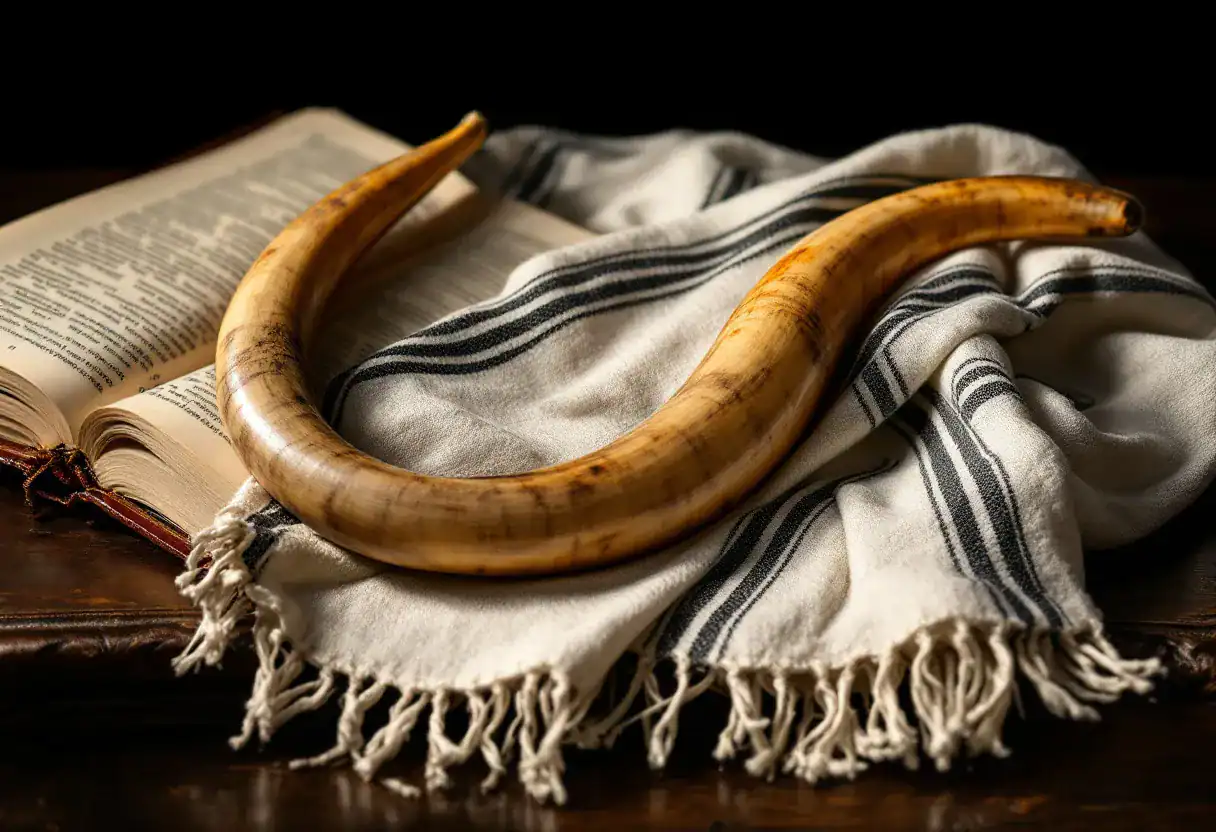
The principal mitzvah of Rosh Hashanah is to hear the sound of the shofar. Not to blow it oneself, but to hear it: the blessing says lishmoa kol shofar, “to hear the sound of the shofar.” A ram’s horn is preferred (Shulchan Arukh, Orach Chaim 586:1). The Talmud (Rosh Hashanah 16a) gives the reason: “Sound before Me with a ram’s horn, says the Holy One, blessed be He, so that I may remember for you the binding of Yitzchak son of Avraham, and I will account it to you as though you had bound yourselves before Me.”
The sounds of the shofar
- Tekiah: one long, continuous sound.
- Shevarim: three medium sounds, as if broken.
- Teru’ah: a series of nine very short, staccato sounds.
The Torah speaks of teru’ah, but its exact nature was questioned: is it a moan, a sob, or both? To resolve the doubt, Rabbi Abahu instituted in Caesarea the sounding of every combination (Rosh Hashanah 34a). That is why we sound series of tekiah-shevarim-teru’ah-tekiah, tekiah-shevarim-tekiah and tekiah-teru’ah-tekiah (Shulchan Arukh, Orach Chaim 590). The custom is to reach one hundred sounds over the course of the service. The first sounds, blown before Musaf, are called tekiot dimeyushav, “seated soundings”; the later ones, blown during or around the Musaf Amidah, tekiot dime’umad, “standing soundings.” The Talmud (Rosh Hashanah 16b) explains that we sound twice “to confound the Satan.”
Why no shofar on Shabbat?
In the time of the Temple, the shofar was sounded even on Shabbat (Mishnah Rosh Hashanah 4:1). The Sages later forbade doing so outside the Temple: they feared that someone wishing to learn how to blow might carry the shofar to an expert through the public domain, which is forbidden on Shabbat (Rosh Hashanah 29b). Everyone is obligated to hear the shofar, and not everyone is an expert: the risk was real. This is exactly what will happen in 5788, on Saturday, October 2, 2027. The shofar will be heard only on Sunday, October 3. On the first day, the prayer mentions a “remembrance of teru’ah” instead of a “day of teru’ah.”
“Awake, you sleepers!”
Maimonides (the Rambam) writes in his Laws of Repentance (Hilkhot Teshuvah 3:4): “Although the sounding of the shofar on Rosh Hashanah is a decree of Scripture, there is an allusion in it: Awake, you sleepers, from your sleep! You who slumber, rouse yourselves from your torpor! Examine your deeds, return in teshuvah and remember your Creator.” The shofar is not explained by its function: we sound it because it is a commandment. But it speaks to the one who hears it.
Rav Benizri makes this text the heart of his lecture The Month of Elul and the Cry of the Shofar. He brings together two mitzvot which, according to the Rambam, keep a person awake: the shofar in time, the mezuzah in space. We pass through a doorway bearing a mezuzah, we move from the public domain to the private one, and this calls for a change of attitude. The shofar does the same thing in time. And since yashan (old) and yashen (asleep) come from the same root, the shofar is the cry that pulls us out of growing old. The Rav describes this cry as that of someone who suddenly can no longer make sense of the situation he finds himself in: “as if one were coming out of a dream and wondering where the reality of things lies.”
The shofar, breath before speech
In Elul: When the Curse Is a Blessing, the Rav goes deeper still. He cites the prophet Amos: “Shall the shofar be sounded in a city and the people not tremble?” (Amos 3:6). The verb used, charad, first appears when Yitzchak discovers that it was Yaakov, dressed in Esav’s clothes, who took the blessing: “Yitzchak trembled an exceedingly great trembling” (Bereshit 27:33). It returns when Yosef’s brothers discover their money in their sacks of grain. For the Rav, charadah is not fear: it is the jolt that halts the course of an event and forces one to rethink it. We thought we were following the right current of history, and we discover that we were mistaken. That is the power of the shofar.
He adds a reading of the sound itself. Human speech manifests itself in several stages, and it begins with neshimah, simple breath. The small child who cannot yet speak expresses his needs only through his cries. The shofar, says the Rav, is that primal breath, speech still in gestation: a sound that does not translate into words and follows no melody, the raw expression of the soul. He regrets that this sound has been emptied of its resonance, that contests are organized for the best shofar blower, when the shofar is “the outpouring of the soul.”
Even the verb “to sound” is telling. Tekiah comes from taka, “to drive in,” as one drives in a stake. Why this word? Because we have adopted, says the Rav, a formal language that allows us to disguise situations, to seduce, to lie. Against this language that has grown out of all proportion, a new sound is needed. At Sinai, he recalls, “the sound of the shofar grew ever stronger” (Shemot 19:19), and all of creation fell silent. The forty days of Elul and Tishrei, he concludes, serve to restore healthy communication between G-d and man, to give back to speech its creative power.
As for the Satan whom the shofar is meant to “confound,” the Rav describes him with two faces. On one side, boundless pride, which charges at man like a bull. On the other, the resignation of one who has chosen to submit and bear burdens, indifferent to everything, like the donkey. The sound of the shofar throws both of these tendencies, the one active, the other passive, into confusion.
The prayers of Rosh Hashanah
The Rosh Hashanah prayers are long and very rich. A special prayer book is used, the machzor. Here are its main elements.
- The additions to the Amidah: “Remember us for life,” “Who is like You,” “Inscribe for a good life,” “In the book of life,” and “the holy King.” These additions remain until Yom Kippur.
- The Musaf of nine blessings: instead of the usual seven blessings of a festival, the Musaf Amidah has nine. The three central blessings are Malkhuyot (kingship), Zikhronot (remembrance) and Shofarot (shofar). Each contains ten verses: three from the Torah, three from Psalms, three from the Prophets, and a final one from the Torah (Rosh Hashanah 32a).
- Hayom harat olam: after the soundings of each section, we say “Today the world was conceived; today He brings all creatures to stand in judgment, as children or as servants.”
- Avinu Malkenu: “Our Father, our King.” This litany goes back to Rabbi Akiva (Taanit 25b). In two words it captures the whole tension of the day: the closeness of a father, the majesty of a king.
- The piyyutim: liturgical poems, which differ between the Sephardic and Ashkenazic rites, among them the famous Unetaneh tokef in the Ashkenazic rite and in many other communities.
Rav Benizri stresses, in Elul: The Uniqueness of Each Person, that prayer has a function of its own, distinct from study. Study fills a gap and compels us to delve deeper into the Law. Prayer, by contrast, establishes direct contact with the infinite. In the Torah, he says, there are several possible interpretations; in prayer, there are not several ways: one prays. And he warns against prayer reduced to folklore: true prayer is found in the silence of the Amidah, the “still, small voice” of the prophet Eliyahu (Melakhim I 19:12).
The Torah readings: Sarah, Channah and the Akedah
On the first day, we read of the birth of Yitzchak (Bereshit 21). The haftarah, the passage from the Prophets, tells of Channah’s prayer and the birth of Shmuel (Shmuel I 1 to 2:10). The Talmud (Rosh Hashanah 11a) teaches that it was on Rosh Hashanah that G-d remembered Sarah, Rachel and Channah, three barren women who bore a child. Rosh Hashanah is the day of remembrance, and the readings speak of births.
On the second day, we read the Akedah, the binding of Yitzchak (Bereshit 22), and the haftarah from Yirmeyahu (31:1-19), in which G-d says of Ephraim: “Is he a son so dear to Me?” In the Zikhronot we ask: “And the binding of Yitzchak, remember it today in mercy for his descendants.”
Rav Benizri raises a sharp question on this subject in Vayera: The Promises to Avraham (Part 2). It was Avraham who was put to the test; why does the prayer speak of the binding of Yitzchak and attribute all the merit to him? He first points out that the usual word “sacrifice” is a mistranslation: akedah means “binding.” Then he answers: Avraham is wholly chesed, kindness. Yitzchak, for his part, is carried by rigor, the sense of justice. Now the world was created by Elokim, the Name that expresses justice, and it could not endure through rigor alone. At the moment Avraham’s hand is stopped, it is no longer Elokim who speaks, but an angel of Hashem, the Name of kindness. On Rosh Hashanah, the day of justice, we therefore invoke Yitzchak, because he alone, being justice itself, could defend us.
The Rav supports this idea with a story from the Talmud (Shabbat 89b). In time to come, G-d will tell Avraham that his children have sinned; Avraham will answer that they may be wiped out, and Yaakov likewise. Only Yitzchak will take up their defense: they are Your children as much as mine. He then reckons up a life of seventy years, subtracts the first twenty years, which Heaven does not punish, then the nights, then the time spent on prayer, meals and bodily needs; he proposes to share the remainder with G-d and, if need be, to bear it all himself. The Rav underlines on what Yitzchak bases this right: he let himself be bound without saying a word, when he could have answered his father that he had dreamed it. And in the three “here I am”s of the narrative he reads the synthesis being sought: the first, from Avraham to G-d, wholly kindness; the second, from Avraham to his son; the third, when the angel stops his hand. What was “bound” that day, he concludes, was the attribute of justice itself: the world will be governed by justice, but by a justice overflowing with kindness.
In Elul: The Uniqueness of Each Person, the Rav qualifies this point: we do not summon Yitzchak as naked rigor, for “pure rigor is deadly.” What we seek is the generosity of Avraham. And in Inscribe Us in the Book of Life, he gives the Akedah a collective meaning: “we are Yitzchak,” a people placed on the altar of the nations for the salvation of humanity, but one that also knows it is not perfect.
The symbols of the meal: eating our wishes
On the evening of Rosh Hashanah, we begin the meal with symbolic foods called simanim, “signs.” The source is a passage in the Talmud (Keritot 6a and Horayot 12a) where Abaye says: “since a sign is significant, one should make a habit of seeing at the beginning of the year” (or, according to another version, of eating) gourd, fenugreek, leeks, chard and dates. The Shulchan Arukh (Orach Chaim 583:1) records this custom. Over each food, a short prayer is recited beginning with Yehi ratzon, “May it be Your will.”
Most often, the wish rests on a play on words between the Aramaic or Hebrew name of the food and a word in the prayer:
- The date (tamar): may our enemies be brought to an end (yitamu).
- The leek (karti): may they be cut off (yikaretu).
- The chard (silka): may they depart (yistalku).
- The gourd (kara): may the evil decree be torn up (kara) and may our merits be proclaimed (kara, to read).
- Fenugreek or beans (rubia): may our merits multiply (yirbu).
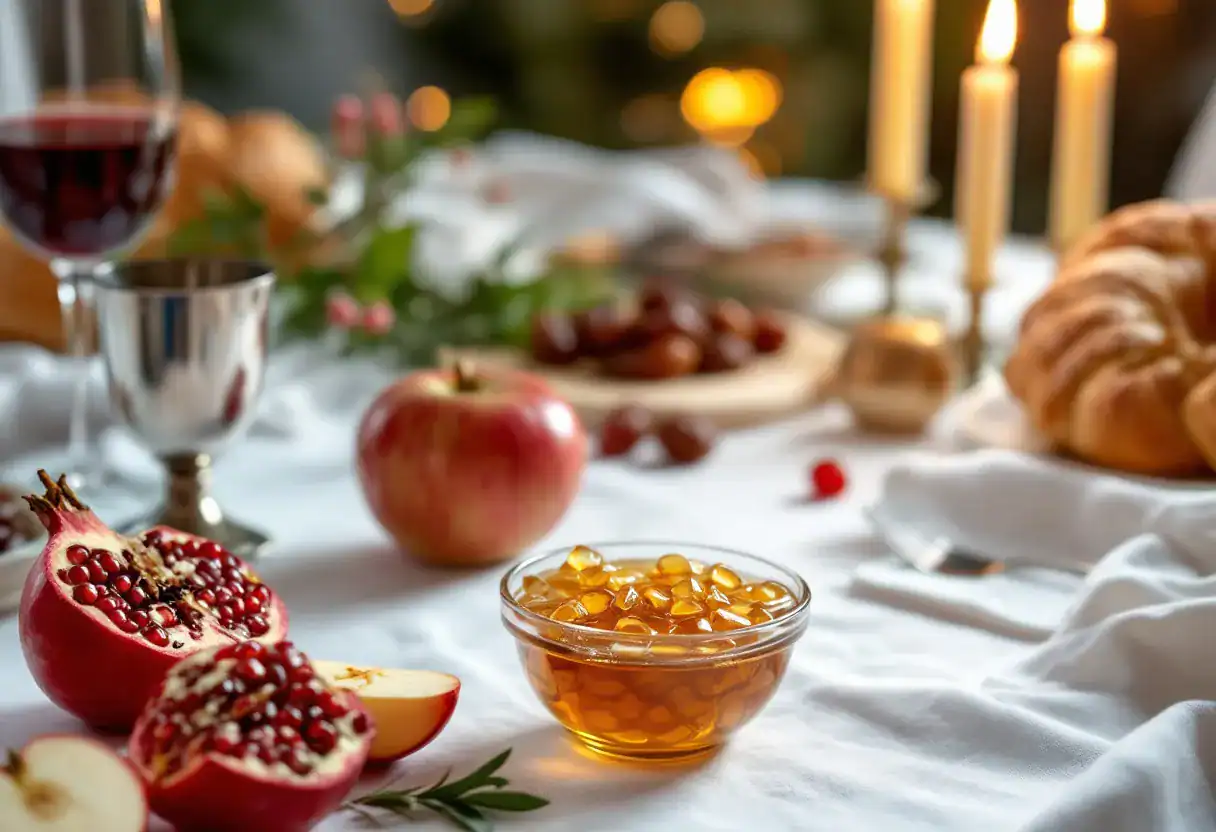
- The apple dipped in honey: may the year be good and sweet (a custom recorded by the Rema, Orach Chaim 583:1).
- The pomegranate: may our merits be as numerous as its seeds.
- The head of a fish or a ram: may we be “the head and not the tail” (Devarim 28:13). The ram’s head also recalls the ram of the Akedah.
We also dip the bread in honey, and many prepare round challot, an image of a year that comes full circle and of a crown for the King. The Rema (Orach Chaim 583:2) mentions the custom of not eating nuts on this day: in Hebrew, egoz has the same numerical value as chet, sin. On the second evening, we eat a new fruit, one not yet tasted this season, in order to recite the shehecheyanu blessing. The Rema also records the custom of not sleeping during the day on Rosh Hashanah.
This is not magic. The festive meal translates into the body and the family what prayer expresses in the synagogue. We do not eat to force destiny, but to voice our wishes at the table, with our children, and to begin the year in sweetness rather than in fear. Rav Benizri says it in his own way in Inscribe Us in the Book of Life: Judaism does not call us to renounce the world and its pleasures, but to enjoy life to the full, provided we unite heaven and earth within it.
Tashlikh: casting our sins into the water
On the afternoon of the first day, many communities go to the bank of a river, the seashore or a pool where fish live to recite Tashlikh, “You will cast.” The name comes from the prophet Mikhah: “Who is a G-d like You, who pardons iniquity… You will cast all their sins into the depths of the sea” (Mikhah 7:18-19). We recite these verses and other passages, and some symbolically shake out the hems of their garments.
The custom is not mentioned in the Talmud. It appears among the Ashkenazic Sages of the Middle Ages, notably the Maharil (Rabbi Yaakov Moelin), and the Rema records it (Orach Chaim 583:2). The kabbalists of Safed also adopted it, and it spread to Sephardic communities. Several explanations are given: fish, whose eyes never close, evoke the Eye that watches ceaselessly; water recalls the creation of the world, of which Rosh Hashanah is the anniversary; and a Midrash relates that the Satan, to prevent Avraham from going to the Akedah, turned himself into a river, which Avraham crossed with the water up to his neck.
When the first day falls on Shabbat, as in 5788, many postpone Tashlikh to the second day. And as with everything else, the gesture has value only through what accompanies it. Throwing bread to the fish does not make a sin disappear. Tashlikh is an act of trust: we tell G-d that we want to separate ourselves from what weighs us down, and we commit ourselves not to go fishing it back out.
Elul: the path that leads to Rosh Hashanah
Rosh Hashanah cannot be understood without the month that precedes it. Elul is the month of preparation. The shofar is sounded in it every morning after prayers (Rema, Orach Chaim 581:1). Sephardim recite selichot, prayers for forgiveness, from Rosh Chodesh Elul; Ashkenazim begin a few days before Rosh Hashanah (Shulchan Arukh and Rema, Orach Chaim 581:1). For all the Rav’s lectures on this month, see the page The Month of Elul.
For Rav Benizri, Elul replays a specific episode every year. Moshe ascended Sinai on the 1st of Elul to receive the second Tablets of the Law, and he came down on Yom Kippur. The first Tablets had been broken after the sin of the golden calf. In Elul: The Reckoning of the Year, he highlights an essential difference: the second Tablets were hewn by man, only the writing on them is divine. The forgiveness granted presupposes that the people take part in building up the Torah. In Elul: The Uniqueness of Each Person, he goes so far as to say that the first yasher ko’ach, the first “well done” in history, was addressed to Moshe for having broken the Tablets: the Law was not to be imposed entirely from outside; man’s participation was required.
The sin of the golden calf, for its part, does not belong to the past. In Elul: The Reckoning of the Year, the Rav describes it as a cyclical sin, one that returns like that of Adam, and links egel, the calf, to agulah, the circle: it is routine, in which mitzvot are performed without intention, without being absorbed into the depths of one’s being. In The Month of Elul and the Cry of the Shofar, he gives a reading of it aimed at our own time: to commit the sin of the calf is to take one aspect of the divine manifestation and cling to it, to settle into a frozen ideology. A thought that no longer moves places us on the side of nature, which grows old and dies.
The name hidden in the verses
Our Sages found the name Elul as an acrostic, formed by the initials of the words, in several verses. The Rav comments on them in Elul: Returning to One’s Sources, Elul: The Role of Man, Elul: When the Curse Is a Blessing and The Month of Elul and the Cry of the Shofar:
- Teshuvah: “Hashem your G-d will circumcise your heart and the heart of your offspring” (Devarim 30:6). For the Rav, to circumcise the heart is to go beyond one’s natural givens: not to leave evil in its raw natural state, to stop constantly comparing oneself to others.
- Prayer: “I am my beloved’s and my beloved is mine” (Shir HaShirim 6:3). The Rav reads it as a mirror: G-d reflects back to me the image I give Him, in equal proportion.
- Tzedakah: “sending portions to one another, and gifts to the poor” (Esther 9:22). A person is measured first by his generosity, and the one who gives, says the Rav, is in reality the one who receives.
These three pillars, teshuvah, prayer and tzedakah, are the ones the Rosh Hashanah liturgy presents as able to avert the severity of the decree. The Rav adds a fourth acrostic, drawn from the law of the accidental killer (Shemot 21:13), and yet another in Psalm 27: lulei, “had I not believed,” which is spelled with the letters of Elul in reverse.
Two movements of love
In Elul: The Role of Man and Elul: The Uniqueness of Each Person, the Rav contrasts two verses from the Song of Songs. In Nissan, at the time of Pesach, the rule is “my beloved is mine and I am his” (Shir HaShirim 2:16): everything is given to us from above, and we respond. In Elul, the order is reversed: “I am my beloved’s” comes first. The impulse starts from below. I have received everything; what have I done with it? And one receives only in the measure of this giving of oneself.
He also describes the progression of the Tishrei festivals as three different relationships. On Rosh Hashanah, the relationship of a couple. On Yom Kippur, that of a father and son, “as a father has compassion on his children” (Tehillim 103:13). Finally on Sukkot, the house is built, but one stands at the threshold, near the mezuzah, and the Divine Presence settles in like a member of the household (see Why Do We Live in the Sukkah?).
The ten days of teshuvah
The days from Rosh Hashanah to Yom Kippur are called Aseret yemei teshuvah, the ten days of return. The Talmud (Rosh Hashanah 18a) connects them to the verse “Seek Hashem while He may be found, call upon Him while He is near” (Yeshayahu 55:6). The Rambam writes that although teshuvah is always possible, it is even more beautiful and more immediately accepted during these days (Hilkhot Teshuvah 2:6).
- The Fast of Gedaliah, on the 3rd of Tishrei (Monday, October 4, 2027), commemorates the assassination of Gedaliah ben Achikam, governor of Judea after the destruction of the First Temple.
- Shabbat Shuvah, the Shabbat between Rosh Hashanah and Yom Kippur, takes its name from the haftarah: “Return, O Israel, to Hashem your G-d” (Hoshea 14:2).
- The selichot continue every morning, with the Thirteen Attributes of Mercy.
- Asking forgiveness of one’s fellow: the Mishnah (Yoma 8:9) teaches that Yom Kippur atones for sins between man and G-d, but not for those between man and his fellow, until one has appeased him. These days are the time to go to those we have hurt.
Rav Benizri insists on the nature of this forgiveness. In Elul: The Role of Man, he distinguishes between kapparah and teshuvah. Kapparah covers over, as one repaints a dirty wall to hide the stain. Teshuvah, by contrast, truly erases. This is possible because sin does not reach the essence of Israel: it stains only its garment. He also recalls the teaching of the Sages that through teshuvah, intentional sins can become merits, through the lesson they have taught us.
In Elul: Returning to One’s Sources, he distinguishes two qualities of forgiveness. One can be forgiven and never again be entrusted with anything: “it’s fine, but I no longer count on you.” And there is the other kind of forgiveness: “you committed a serious wrong, I forgive you, and I give you the opportunity to assert yourself even more.” It is to this teshuvah, he says, that we aspire. He specifies that this return is tested on three levels: toward oneself, by shedding fashions and conditioning to rediscover one’s own mission; toward the Creator, through prayer; and toward one’s fellow, for the same spark of light has been placed in him and in me.
Finally, the Rav rejects the idea of an austere Yom Kippur. In The Month of Elul and the Cry of the Shofar, he cites the Mishnah (Taanit 4:8): there were no festive days in Israel like the 15th of Av and Yom Kippur. Yom Kippur is a day of joy, because it opens a new door for man: like the freed slave, he attains his own freedom. For the continuation of this path, see his lecture Yom Kippur: The Book of Yonah and the Mission of Israel.
What Rav Raphaël Benizri teaches: renewing the covenant
Beyond the themes already mentioned, the lecture Inscribe Us in the Book of Life offers an overall key to Rosh Hashanah: it is the day on which a covenant is renewed.
The Rav recalls that there have been three covenants between G-d and man. With Noach, G-d commits never again to destroy the world, on condition that the seven Noahide laws are observed; Noach has no choice, for the world cannot stand without them. With Avraham, the covenant is inscribed in the flesh, through circumcision. At Sinai, for the first time, the people are asked to consent, and they answer: “All that Hashem has spoken, we will do.”
Now the parashah read just before Rosh Hashanah, Nitzavim, opens with “You are standing today, all of you, before Hashem your G-d… to enter into the covenant” (Devarim 29:9-11), and the Rav recalls that our Sages understood this “today” as the day of Rosh Hashanah. But this time, he observes, it is no longer G-d who calls for the covenant: it is Moshe who feels the need to renew it. The people, after forty years in the desert, have matured. Their faith no longer consists in waiting for G-d to act to satisfy their needs, but in answering what G-d expects of them. That is what it means to stand before Him on Rosh Hashanah.
The Rav then confronts a real difficulty. In every covenant there remains “a root that does not follow the movement,” in the words of the verse “a root that bears gall and wormwood” (Devarim 29:17). This is true of a people, in which the righteous sometimes pay for those who neglected their mission. It is also true of an individual: even if I do everything, even if I make good resolutions, I know that tomorrow I will not change from one extreme to the other. There remains in me a part that I do not control. “I am never sure of myself. I always question myself, even as I speak to you,” the Rav confides.
Hence the true meaning of the Rosh Hashanah prayer. We do not ask for a reward. We ask for G-d’s help in integrating this uncontrollable part rather than letting it drag us down. And the Rav ends on a symmetrical hope: if a small flaw left unchecked can destroy a life, as a tiny microbe can destroy a body, then a single righteous act can, in the same way, rebuild a person, a family, a society. In this connection he recalls the saying of a Hasidic master, known in the tradition as that of Rabbi Nachman of Breslov (Likutei Moharan II, 112): if you believe that one can destroy, believe also that one can repair. Rosh Hashanah, he concludes, is the head of the year: everything that follows depends on this decision taken at the beginning.
The same idea returns in Elul: The Role of Man: each person is like a letter in a Sefer Torah. If a single letter is missing, the entire scroll becomes unfit. The world is “out of circuit,” says the Rav, when a person does not fulfill his role. Each of us is a little Avraham, and Avraham was alone.
Finally, in Elul: When the Curse Is a Blessing, the Rav sheds light on the phrase sung on the first evening, tikhleh shanah vekileloteha, “let the year end together with its curses.” Parashat Ki Tavo, read before Rosh Hashanah, ends with curses and no consolation. The question was put to Rabbi Shimon bar Yochai, who at first did not know what to answer. The answer was revealed to him: these curses contain the blessings in seed form. The Rav illustrates this secret with the image of a ball thrown hard against a wall: it bounces back, less forcefully, because the wall cannot be destroyed. In the same way, the promise made to Israel, never to separate its destiny from the very being of creation, pushes back the movement of decline that began with the golden calf and compels the people to recover themselves. In The Month of Elul and the Cry of the Shofar, he grounds the same idea in a single word of the verse, ya’lem (Devarim 28:61): not “He will bring them upon you,” but “He will eclipse them.” When a point of no return is reached, the promise made to the people prevails, and the curses turn into blessings.
Frequently asked questions about Rosh Hashanah
Why does Rosh Hashanah last two days, even in Israel?
In former times, the beginning of the month was fixed by the court on the testimony of those who had seen the new moon. Since Rosh Hashanah falls on the first day of the month, it was not always known in time which day would be declared, even in Jerusalem. Two days were therefore observed. Unlike the other festivals, where the second day exists only in the Diaspora, Rosh Hashanah lasts two days everywhere, and tradition regards these two days as “one long day.”
What greetings are exchanged on Rosh Hashanah?
We say Shanah tovah, “a good year,” or Shanah tovah umetukah, “a good and sweet year.” On the first evening we add Ketivah vachatimah tovah, “a good inscription and a good sealing” (to a man, tikatev vetechatem). Until Yom Kippur, we wish Gmar chatimah tovah, “a good final sealing.”
Do you have to go to synagogue to hear the shofar?
The mitzvah is to hear the shofar directly, not through a microphone or a broadcast. Men and women customarily hear it, and many communities organize additional soundings for the sick, the elderly or mothers of young children. For a particular case, consult a competent rabbi.
Is Rosh Hashanah a sad festival?
No. It is a day of judgment, but also a festival, with Kiddush, festive meals and fine clothes. The book of Nechemiah (8:10) expressly asks us not to be sad on this day. The solemnity comes from the awareness of being judged; the joy, from trust in a Judge who is also a Father. As Rav Benizri says, the aim is not to tremble with fear, but to wake up.
What is the link between Rosh Hashanah and Yom Kippur?
Rosh Hashanah opens the judgment, Yom Kippur seals it. In between, the ten days of teshuvah make it possible to change the decree. According to the Rav’s reading, the forty days from the 1st of Elul to Yom Kippur reproduce those during which Moshe remained on Sinai to receive the second Tablets: Rosh Hashanah lies at the heart of this path of return.
What if you don’t understand the Hebrew of the prayers?
You can pray from a bilingual machzor, read the translation before the service, or concentrate on a few essential passages: the additions to the Amidah, Avinu Malkenu, and above all hearing the shofar. Rav Benizri reminds us that true prayer is found in the silence of the Amidah: intention counts for more than the number of words spoken.
In conclusion: the day we renew the lease
Rosh Hashanah brings together several things we usually keep apart: a judgment and a festival, a crown and a family meal, a wordless cry and long prayers. The thread that ties them together is awakening. Man was created on this day; every year, he is called to become once again the person he was meant to be, to acknowledge G-d as King and to take up his place in the world again. Rav Raphaël Benizri sums it up in an image: every year, we ourselves renew the lease on our life. The shofar asks us what we want to take with us into the new home, and what it is time to leave behind.
To go deeper, listen to the Rav’s lectures on Rosh Hashanah and on the month of Elul, and download the booklet to read with the family. The Hebrew words in this article are explained in our glossary.
Further reading
- Rosh Hashanah: all of Rav Benizri’s lectures
- The Month of Elul and the Cry of the Shofar
- Inscribe Us in the Book of Life
- Elul: The Reckoning of the Year
- Elul: The Role of Man
- Elul: The Uniqueness of Each Person
- Elul: When the Curse Is a Blessing
- Elul: Returning to One’s Sources
- Vayera: The Akedah and Rosh Hashanah
- Yom Kippur: the Rav’s lectures
- Rosh Hashanah booklet: topics for study and discussion at the festive table (PDF)
- Month of Elul booklet: topics for study and discussion (PDF)
- All the Jewish holidays
Article by the Pensées Juives editorial team. Passages attributed to Rav Raphaël Benizri are drawn from his lectures published on this site.