
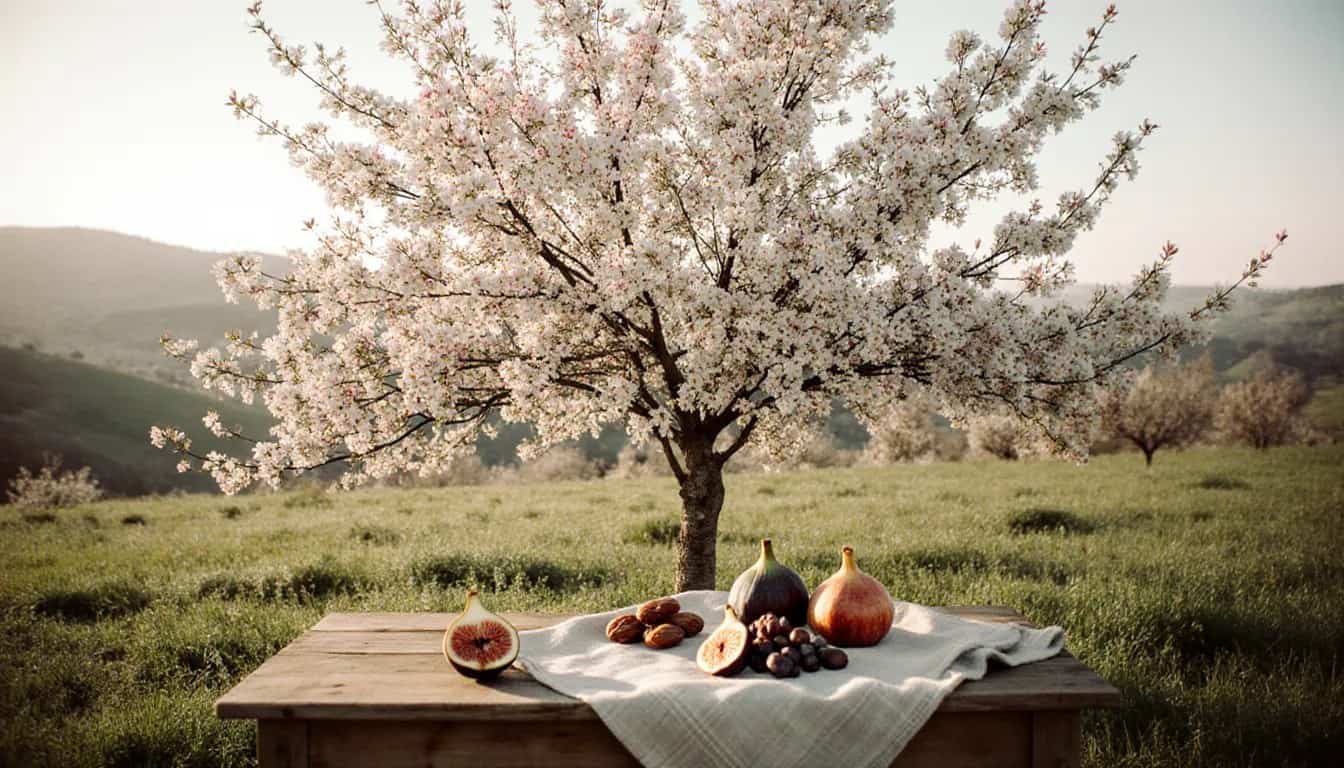
In the depths of winter, when the trees seem dead, the Jewish calendar celebrates their birthday. Where does this New Year of the Trees come from, and why is man compared to a tree of the field?
In 5787, Tu BiShvat falls on Saturday, January 23, 2027, the 15th of the month of Shevat. Like every day of the Jewish calendar, it begins the evening before, on Friday, January 22. This year, then, the New Year of the Trees coincides with Shabbat, and indeed with the Shabbat of the Torah portion of Beshalach, the Shabbat of the Song at the Sea. A meal of fruit naturally finds its place at the Shabbat table.
Four New Years in the Year
The source of Tu BiShvat is a single sentence of the Mishnah (Rosh Hashanah 1:1). It lists four “heads of the year.” The 1st of Nissan is the new year for kings and for festivals. The 1st of Elul is the new year for the tithe of animals. The 1st of Tishrei is the new year for years, for the shemitah and for the jubilee. And for the tree, Beit Shammai says the 1st of Shevat, Beit Hillel the 15th of Shevat. The halakhah follows Beit Hillel: this is Tu BiShvat, “the 15th of Shevat.”
Why this date? The Talmud (Rosh Hashanah 14a) answers: by this time, most of the year’s rains have fallen. In the Land of Israel, the sap begins to rise. The almond trees are the first to blossom. The fruits that form from then on belong to a new year.
A Date That Began as a Legal One
Originally, this new year was not a festival. It was a date of agricultural accounting, indispensable for several laws of the Torah.
- Orlah: “When you come into the land and plant any fruit tree, […] for three years its fruit shall be to you as uncircumcised; it shall not be eaten” (Vayikra 19:23). In the fourth year, the fruit is consecrated; in the fifth, one may enjoy it freely (Vayikra 19:24-25). To count these years, a starting date is needed.
- Tithes: in the Land of Israel, tithes are separated year by year. One may not separate from the fruit of one year on behalf of the fruit of another. So one must know to which year each fruit belongs.
These laws concern mainly the Land of Israel. For their practical application, consult a competent rabbi.
Man Is a Tree of the Field
The Torah forbids destroying fruit trees, even in wartime, during the siege of a city. It adds: “for man is a tree of the field” (Devarim 20:19). From this verse, the Sages derived the prohibition of bal tashchit: not to destroy anything needlessly.
The Midrash (Kohelet Rabbah 7:13) relates that G-d led Adam around the trees of the Garden of Eden. He said to him: “See how beautiful My works are. Take care not to ruin My world, for if you ruin it, there will be no one to repair it after you.”
The Psalms take up the image. The righteous man is “like a tree planted by streams of water, which yields its fruit in its season” (Tehillim 1:3). And again: “The righteous will flourish like the palm tree, he will grow like a cedar in Lebanon” (Tehillim 92:13).
How Is Tu BiShvat Celebrated?
Over time, this legal date became a day of joy. The supplications of Tachanun are not recited, and one does not fast.
- Eating fruit, especially the seven species for which the Land of Israel is praised: “a land of wheat and barley, of vines, figs and pomegranates, a land of olive oil and honey” (Devarim 8:8). The honey here is date honey.
- The blessings: “borei peri ha’etz” over the fruit of the tree. Over a new fruit of the season, one often adds “shehecheyanu“.
- The Tu BiShvat seder: the kabbalists composed an order of fruits and readings, accompanied by four cups of wine, from white to red. It is gathered in the collection Peri Etz Hadar.
- Planting: in Israel, it has become the day on which trees are planted.
What Rav Raphaël Benizri Says
On the page Tu BiShvat: The New Year of the Trees, Rav Benizri starts from the Mishnah of the four heads of the year. He points out that it is the only reference: it speaks neither of a festival, nor of fruit, nor of four cups. All of that came much later, over the course of history.
For him, ecology is not a recent concern. He cites the midrash in which G-d leads man around His universe, and the saying of the Sages: when someone takes the life of a tree, its cry is heard from one end of the earth to the other.
The tree, he says, is the portrait of man. A vertical line rooted in the earth, with branches reaching out to the four corners, which one seeks to gather back into a single trunk. The Rav also notes a detail of the Creation (Bereshit 1:11-12): the earth had been asked to bring forth a “fruit-tree,” entirely edible. It brought forth a “tree yielding fruit.” This disobedience, on the third day, prefigures that of man, created on the sixth.
He also turns a saying on its head: one should not only eat to live, one should live to eat. For food makes it possible to take in the elements of creation and raise them to the level of the human. That is why, he says, the only blessing of biblical origin is the one recited after the meal.
On orlah, he draws a parallel with education: three years without eating the fruit, a fourth year in holiness, and only in the fifth does one enjoy it. In the same way, a child is first a receiver before becoming a giver.
Finally, he opens up a messianic dimension: if you are holding a sapling in your hand and you are told that the Messiah has come, first plant your tree, then go out to greet him. For planting contributes to his coming.
Further Reading
- Tu BiShvat: Rav Benizri’s lecture
- “Questions for the Tu BiShvat Table” booklet (PDF)
- All the Jewish holidays
An article by the Pensées Juives editorial team. Passages attributed to Rav Raphaël Benizri are drawn from his lectures published on this site.