

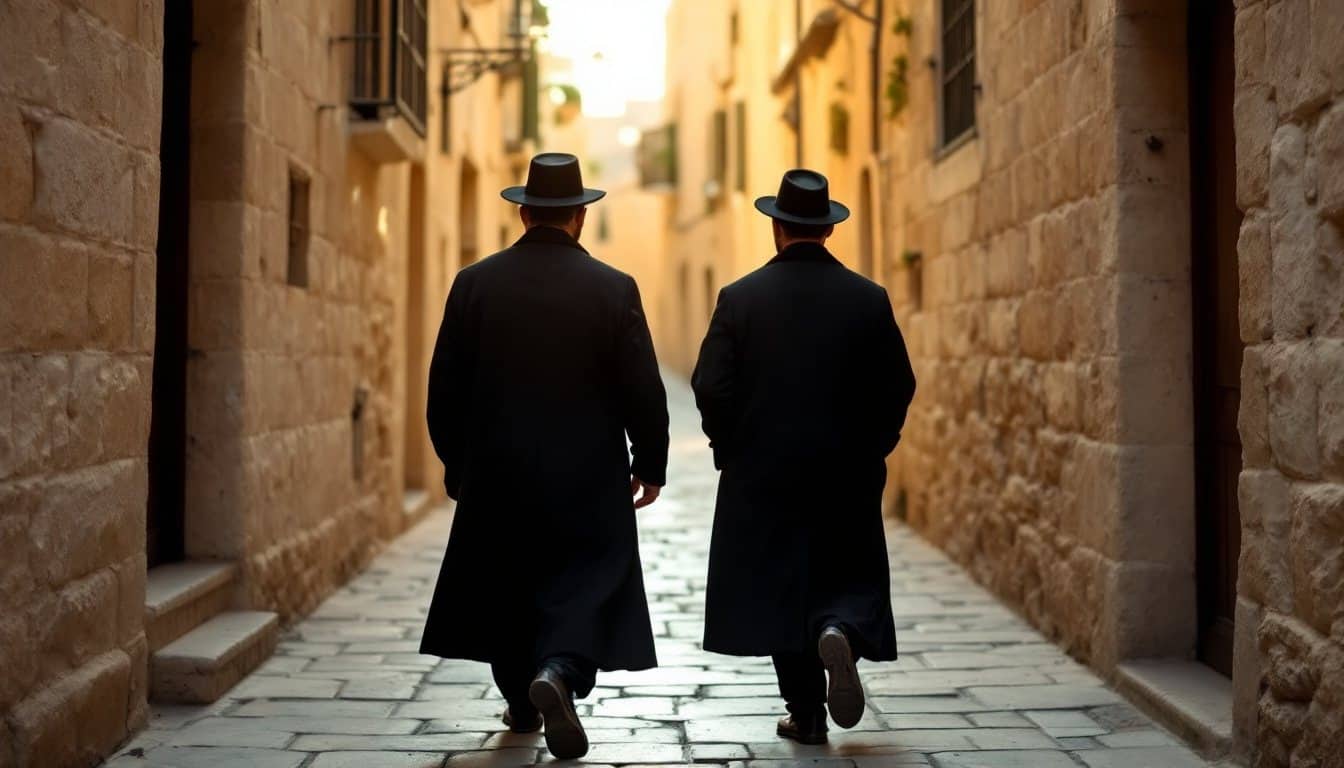
In the Jewish neighborhoods of Paris, Antwerp, New York or Jerusalem, you can spot them from a distance: a black suit or long black coat, a white shirt, a wide-brimmed black hat, sometimes a silk belt or a large fur hat on Shabbat. A religious uniform, a sign of mourning, an obligation from the Torah? No verse commands anyone to dress in black and white, yet behind this attire lie very ancient principles and a long history. Here they are.
In short: the Torah prescribes no color of clothing. What it does ask is that a Jew not copy the customs of the peoples around him (Vayikra 18:3), that he dress modestly and with dignity, and that he present himself before G-d in respectful attire, as before a king. The black suit, the white shirt and the hat are the form these principles took among the Orthodox Jews of Eastern Europe in the 19th and 20th centuries, and later throughout the world: sober clothing that does not draw the eye and that reminds the person wearing it who he is. The hat, worn over the kippah, comes from a rule of prayer: one stands before G-d dressed as one would stand before an important person (Mishnah Berurah 91:12). The Hasidim (followers of the mystical, popular movement born in the 18th century) added garments inherited from their own history, such as the long coat and the shtreimel. So it is neither a required sign of mourning nor a condition for being Jewish, but a custom (minhag) that those who keep it hold dear.
What the Torah really asks: not a color, but principles
Let us say it from the outset: among the 613 commandments, there is no “commandment of black and white.” The Torah speaks about the color of clothing only in connection with the priests of the Temple, and with the blue thread of the tzitzit, the ritual fringes (Bamidbar [Numbers] 15:38). A Jew in biblical or Talmudic times wore the clothes of his era and his region.
What the Torah does ask for, on the other hand, are three things that concern clothing.
- Not imitating the customs of the nations. “You shall not copy the practices of the land of Egypt where you dwelt, nor the practices of the land of Canaan to which I am bringing you, and you shall not follow their customs” (Vayikra [Leviticus] 18:3).
- Modesty, tzniut, which calls for covering the body and not turning one’s appearance into a display. The prophet sums it up in one phrase: “to walk humbly with your G-d” (Michah [Micah] 6:8).
- Dignity, especially before G-d: at prayer, on Shabbat, on festivals.
The black suit and the white shirt are just one way, rooted in a particular period of history, of living out these three principles. Other communities live them differently, and they are no less faithful.
“You shall not follow their customs”: standing apart
The Sages understood the verse in Vayikra 18:3 as a prohibition against adopting the practices specific to idolatrous peoples. The Rambam (Maimonides, 12th century) puts it this way: “One does not follow the customs of idolaters, nor resemble them, neither in dress, nor in hairstyle, nor in other such things.” And he gives the reason: “The Jew must be distinct from them, recognizable by his dress and by his other deeds, just as he is distinct from them in his knowledge and his ideas” (Mishneh Torah, Hilchot Avodah Zarah 11:1). The same rule appears in the Shulchan Aruch, the great code of Jewish law (Yoreh De’ah 178:1).
The Rambam does not require any particular costume: he forbids wearing a garment “specific to them,” linked to their worship or their religious identity. The Ashkenazi halachic authorities clarified where the line lies. The Rema (Rabbi Moshe Isserles, 16th century), relying on the Maharik, explains that the prohibition targets what non-Jews wear purely out of custom with no apparent reason, or out of immodesty, or what is connected to idolatry; a garment worn for its usefulness or simply as a matter of propriety is not affected (Rema on Yoreh De’ah 178:1). That is why most observant Jews dress normally, in the fashion of their country, as long as their clothing is modest.
The Talmud nevertheless shows how far a detail of dress can become a question of identity. In times of persecution, when a ruling power seeks to force Jews to abandon their religion, it is forbidden to give way on anything at all, “even to change the strap of a sandal” (Sanhedrin 74a-b). Rashi explains: if non-Jews tied their straps one way, and Jews another, out of modesty, then even this simple custom, which is not a mitzvah, becomes a matter of loyalty. When someone sets out to erase a people’s identity, clothing stops being a detail.
The midrash about the Hebrews in Egypt
You often hear that the Hebrews were redeemed from Egypt because they “did not change their names, their language or their clothing.” The ancient source is somewhat different. The Midrash (Vayikra Rabbah 32:5; Mechilta on Shemot [Exodus] 12:6) reports in the name of Rav Huna that Israel was redeemed in the merit of four things: they did not change their names, they did not change their language, they did not speak slander, and they remained morally upright. Clothing does not appear in the list. It appears later, notably in the Midrash Lekach Tov (11th century, on Shemot 6:6), which lists language, clothing, discretion and circumcision; and the formula “names, language, clothing” was made famous in the 19th century by the Chatam Sofer in Hungary, who saw it as a bulwark against assimilation.
This detail matters: it shows that attachment to traditional dress is a response of the last few centuries to a specific situation, the fear of seeing Jews dissolve into modern society. It is a serious and respectable response, but it is not a law from Sinai.
Clothing, a matter of dignity
Judaism does not look down on clothing. The very first garment in history was a gift from G-d: “Hashem G-d made garments of skin for the man and his wife, and He clothed them” (Bereshit [Genesis] 3:21). And the Torah devotes an entire chapter to the garments of the priests, made “for honor and for splendor” (Shemot 28:2).
The Talmud tells that Rabbi Yochanan called his clothes “those that honor me” (Shabbat 113a; Bava Kamma 91b). He meant that clothing expresses the dignity of man, created in the image of G-d. The Sages go further for the Torah scholar, the talmid chacham: he must keep his clothes clean, because a stain on his garment is an affront to the honor of the Torah he represents (Shabbat 114a).
The Rambam describes the scholar’s attire precisely. His clothing must be “fine and clean.” He should wear “neither the garments of kings, of gold and purple, at which everyone stares, nor the garments of the poor, which shame the one who wears them, but ordinary, fine garments.” His clothes must not expose his body, nor trail on the ground like those of the haughty (Hilchot De’ot 5:9). The whole spirit of black-and-white attire is already there: clean, dignified, sober, neither luxurious nor careless.
Honoring Shabbat
Shabbat gives this idea its full force. The prophet asks us to “honor” the holy day (Yeshayahu [Isaiah] 58:13), and the Talmud infers from this: “let your Shabbat clothing not be like your weekday clothing” (Shabbat 113a). The Shulchan Aruch makes it a rule: everyone should make an effort to have fine clothes for Shabbat (Orach Chaim 262:2). That is why many Jews, even among those who do not wear a suit during the week, put on a white shirt on Friday night, and why Hasidim bring out their most formal clothes on that day.
Why black?
No text prescribes black. The explanations given are of several kinds, and it is best to present them honestly.
Sobriety. Black is the color that draws the least attention. It matches the Rambam’s ideal: neither luxury nor poverty. In a community where everyone wears the same dark clothing, no one competes through dress, the rich man does not stand out from the poor one, and attention turns to study, prayer and conduct rather than appearance.
Gravity and humility. In the culture of the Talmud, black is the color of self-effacement. Rabbi Ilai teaches that a person who feels his evil inclination overpowering him should go somewhere no one knows him, “dress in black and wrap himself in black,” that is, make himself humble and sorrowful, in order to break its momentum (Chagigah 16a; Kiddushin 40a). And Rabbi Yannai asked his sons to bury him neither in white nor in black, since he did not know whether he would be judged among the righteous or among the others (Shabbat 114a). These texts create no obligation, but they show that colors have always carried meaning for the Sages.
European history. This is probably the simplest explanation. In the 18th and 19th centuries in Europe, black was the color of formal, respectable dress: that of notables, magistrates, scholars, and clergy of every denomination. Pious Jews adopted it, then kept it when fashions changed around them: what had been every respectable man’s attire became, through faithfulness, that of the traditional Jew.
A widespread explanation: mourning for the Temple. You sometimes hear that Jews wear black as a sign of mourning for the Temple in Jerusalem, destroyed in the year 70. It is a beautiful idea, and the memory of the Temple does shape many Jewish customs, but it is not the historical source of this attire. It should be presented as an interpretation, not as the official reason.
Why the white shirt?
White, unlike black, is in Jewish tradition the color of purity and forgiveness: “Though your sins be like scarlet, they shall become white as snow” (Yeshayahu 1:18). On Yom Kippur, the High Priest set aside his golden garments to enter the Holy of Holies dressed in white linen (Vayikra 16:4). That is why many men wear the kittel, a white robe, on Yom Kippur, and why people often dress in white on that day (see the article on Yom Kippur).
In Kabbalah, white is associated with chesed, divine kindness, and with Shabbat; in several Jerusalem communities and among certain kabbalists, white is worn on the holy day. More simply, since the 19th century the white shirt has been the dress shirt par excellence, the shirt of Shabbat and festivals. Paired with a dark suit, it makes for a neat, clean outfit without ornament.
Under the shirt, most of these men wear a tallit katan, a small fringed shawl, whose strings often hang out at the waist: these are the tzitzit, which, for their part, are a genuine commandment of the Torah (Bamidbar 15:37-41).
The hat: a “second head covering” for prayer
Observant men keep their heads covered at all times, usually with a kippah: this is an ancient practice that expresses the fear of Heaven (see the article on the kippah). But why add a hat on top?
The main reason comes from the laws of prayer. The prophet Amos says: “Prepare to meet your G-d, O Israel” (Amos 4:12). The Talmud infers from this that one must come to prayer properly dressed; it reports that some Sages put on a fine garment or fine shoes to pray (Shabbat 10a). Accordingly, the Shulchan Aruch requires wearing a belt during prayer, to separate the heart from the lower part of the body (Orach Chaim 91:2), and not standing in prayer with the head or feet uncovered in a place where one would not appear that way before important people (Orach Chaim 91:5).
At the beginning of the 20th century, Rav Yisrael Meir HaKohen (the Chafetz Chaim) wrote in his commentary, the Mishnah Berurah: “Nowadays, one must put a hat on one’s head during prayer, as one goes out in the street, and not only the small cap that is under the hat, for it is not customary to stand that way before important people” (Mishnah Berurah 91:12). The reasoning is clear: in his day, no respectable man would have appeared before a minister or a dignitary in a mere skullcap. So one does not appear that way before the King of kings.
The hat, then, is not a sacred object in itself. It is the expression of a broader rule: attire for prayer follows society’s codes of respect. Some halachic authorities conclude that where no one wears a hat anymore to show respect to someone, the obligation is less binding; others maintain the custom in all circumstances. In many communities, the hat has become the sign that a young man has reached adulthood or has married. For one’s own practice, each person should follow the custom of his community and the guidance of his rabbi.
Not all hats are alike
To the attentive eye, a hat says a great deal. In the Lithuanian yeshivot (Talmudic academies of the Lithuanian tradition), men wear a black felt hat with a medium brim, often an Italian brand. Lubavitch Hasidim wear a felt hat with a center crease. Other Hasidic groups have rounder, wide-brimmed hats, or velvet hats. On Shabbat and festivals, many married Hasidim wear the shtreimel, a large round fur-trimmed hat of Polish and Galician origin, or the spodik, taller and narrower, from central Poland. These differences carry the memory of a community, of a master, of a European town that has often vanished.
Hasidic dress: a memory of the 18th century
Hasidism is a movement of spiritual renewal born in the 18th century in Podolia (present-day Ukraine) around Rabbi Yisrael Baal Shem Tov. Its followers have largely kept the clothing of the time and region where the movement was born, in particular garments worn in Eastern Europe back then by people of standing.
- The long coat, called a kapote or bekishe: black on weekdays, often silk or satin on Shabbat. Its length also reflects the concern for modesty described by the Rambam.
- The gartel, a black cloth belt tied over the coat for prayer. It puts into practice the Shulchan Aruch’s rule about the belt (Orach Chaim 91:2), and Hasidim see in it a symbol of the separation between the heart and the instincts.
- The shtreimel on Shabbat. A popular tradition tells that a decree sought to ridicule Jews by forcing them to wear animal tails on their heads, and that they turned them into a Shabbat crown. It is a legend that is hard to verify; it is more likely that this hat simply comes from the regional fashion of former times.
- White socks and knee breeches worn on Shabbat by some groups, or the gold-striped coat of certain Jerusalem communities.
Each group thus keeps a detail that ties it to its origins. Sephardic communities, for their part, had no traditional black attire (see the frequently asked questions below).
A little history: from imposed dress to chosen dress
The history of Jewish dress is also a painful one. For centuries, it was often others who forced Jews to stand out. In 1215, the Fourth Lateran Council required Jews and Muslims in Christian lands to wear distinctive clothing; depending on the country, this led to the rouelle (a circle of yellow or red cloth sewn onto the garment) or the pointed Jewish hat, the Judenhut. In Muslim lands, the rules imposed on dhimmis, non-Muslims who were protected but subjugated, often obliged Jews to wear dark colors; in Morocco, for example, black was imposed on them for a long time.
In the modern era, the trend reversed: now it was states that wanted to make Jewish dress disappear. In the Russian Empire under Tsar Nicholas I, a series of measures taken in the 1840s and 1850s first taxed and then banned traditional Jewish dress, and even sidelocks. For many pious Jews, keeping the long coat then became an act of faithfulness, in the spirit of the Talmud’s “sandal strap.”
In the 20th century, the great yeshivot of Lithuania adopted the dark city suit and the felt hat, which were then the normal attire of a serious man. After the Holocaust, the survivors who rebuilt the world of Torah in Israel, the United States and Europe kept this attire as a link with the world that had been destroyed. That is how black and white became, for the general public, the very image of the religious Jew, even though it is recent on the scale of Jewish history.
What Rav Raphaël Benizri teaches
Rav Benizri has not devoted a lecture to black-and-white attire, but several of his teachings shed light on the question of clothing and identity.
Clothing, which conceals and reveals
In his first lecture on Pirkei Avot, the Rav points out that man, at his creation, was not created with clothing. Clothing, he says, is “the mask of the essence,” an artifice that obscured the original light. He recalls that in Hebrew a garment is called beged, a word that shares its root with bagad, “to betray”: clothing can become a betrayal of what we are, a form of hypocrisy. True clothing, the levush, must on the contrary fit the measure of the person. He gives as an example the belt of the priest, which encircled his chest at the level of the heart: a limit one imposes on oneself so as not to give free rein to every inclination without measure or restraint. This is a key to understanding the sober attire of the pious Jew: it only has meaning if it expresses an inner life, not if it replaces it.
Keeping one’s name and language, without standing still
In his lecture on parashat Shemot, Naming: the meaning of names, the Rav cites the teaching that in Egypt the children of Israel did not change their names or their language: they preserved their own identity and their power of communication. But he immediately adds that those who came up out of Egypt were no longer exactly the same as those who had gone down there. Generations move forward, he explains, not by curling up around what one is in order to remain at all costs in an initial state, but by giving life, which requires being transformed.
Clothing must not become a barrier
During an exchange at the end of a lecture on Eshet Chayil, the “woman of valor” of the Book of Proverbs, the discussion turns to streams of Judaism that do not tolerate one another. There the Rav laments the lack of openness among those who think that the best way to preserve the law is “not to yield an inch of the text, and not only of the text, even of the garment.” Without reading it as a rejection of traditional dress, one can take from this a word of caution: clothing is meant to serve identity, not to judge those who dress differently.
Misconceptions to correct
“All Jews dress in black.” No. The great majority of Jews, including many strictly observant ones, dress like their contemporaries, in modest clothing and a kippah. Black and white is characteristic mainly of the Haredi (ultra-Orthodox) world, Hasidic or Lithuanian.
“It is a commandment of the Torah.” No. It is a minhag, a custom. The Torah requires modesty, dignity and not imitating foreign forms of worship; it sets no color.
“It is a sign of mourning.” Not originally. Black was the color of formal dress in Europe; the link with mourning for the Temple is a later interpretation.
“The women dress in black too.” Not necessarily. Women in these communities follow rules of modesty (sleeves, skirt length, hair covered after marriage), but they wear a variety of colors, often understated ones.
“It is an imposed uniform.” For those who wear it, this attire is most often a choice and a source of pride: that of belonging to a chain of transmission, and of showing, even in the street, that one is Jewish.
Frequently asked questions about Jews’ black clothing
What is the difference between a Hasidic Jew and a Lithuanian Jew?
Both often wear black and white, but the details differ. A Hasid generally wears a long coat, a gartel for prayer, and the shtreimel or spodik on Shabbat if he is married. A “Lithuanian” Jew (of the Lithuanian yeshiva tradition) tends to wear a city suit with a short jacket and a felt hat. Hasidism emphasizes fervor and the bond with the Rebbe; the Lithuanian world emphasizes in-depth study of the Talmud.
Why wear a hat over the kippah?
Because, according to the Mishnah Berurah (91:12), one prays in the attire in which one would appear before an important person, which in the past meant a hat. Some wear it only for prayer, others all day long.
Why do some wear a fur hat?
That is the shtreimel (or the spodik), worn mainly by married Hasidim on Shabbat and festivals. It comes from the Eastern European fashion of past centuries, and for those who wear it, it has become a crown reserved for the holy day.
Do Sephardic Jews also dress in black?
Traditionally, no: the Jews of North Africa, the Middle East and the Ottoman Empire wore the clothing of their region, and their rabbis wore robes along with turbans or chechias (soft felt caps). Today, many Sephardic students and rabbis have adopted the black suit and hat of the Lithuanian yeshivot, while others keep ordinary city clothes with a kippah. Both customs are respectable.
Is a Jew who does not dress in black less religious?
No. Religious practice is measured by the observance of the mitzvot, by one’s conduct toward others and by study, not by the color of a suit. Many great rabbis, particularly Sephardic ones or in Israel, never wore this attire.
Further reading
The black suit and the white shirt are neither a law from Sinai nor mere folklore. They are a way, born out of history, of living three very ancient requirements: remaining oneself among the nations, dressing modestly, and standing before G-d with dignity. Clothes do not make the Jew; but they can remind the one who wears them who he wants to be.
- Why do Jews wear a kippah?
- What are tzitzit, the “fringes” Jews wear?
- Why do some Jews wear sidelocks and a beard?
- Why do married Jewish women cover their hair?
- Pirkei Avot, part 1: introduction
- Shemot: naming, the meaning of names
- Yom Kippur: the meaning of the Day of Atonement
- Glossary of Hebrew terms in Judaism
Sources and references
- Bereshit (Genesis) 3:21 (the garments of skin)
- Shemot (Exodus) 28:2 (the priestly garments, “for honor and for splendor”)
- Vayikra (Leviticus) 16:4 (the High Priest in white linen on Yom Kippur)
- Vayikra (Leviticus) 18:3 (“you shall not follow their customs”)
- Bamidbar (Numbers) 15:37-41 (tzitzit)
- Yeshayahu (Isaiah) 1:18; Yeshayahu (Isaiah) 58:13
- Amos 4:12 (“Prepare to meet your G-d, O Israel”)
- Michah (Micah) 6:8
- Babylonian Talmud, Shabbat 10a (attire for prayer)
- Babylonian Talmud, Shabbat 113a (Shabbat clothing; Rabbi Yochanan, “those that honor me”)
- Babylonian Talmud, Shabbat 114a (the stain on the scholar’s garment; Rabbi Yannai)
- Babylonian Talmud, Bava Kamma 91b
- Babylonian Talmud, Chagigah 16a; Kiddushin 40a (Rabbi Ilai, “let him dress in black”)
- Babylonian Talmud, Sanhedrin 74a-b, and Rashi ad loc. (“even the strap of a sandal”)
- Midrash Vayikra Rabbah 32:5; Mechilta de-Rabbi Yishmael on Shemot (Exodus) 12:6 (names and language in Egypt)
- Midrash Lekach Tov (Pesikta Zutarta) on Shemot (Exodus) 6:6 (version mentioning clothing); Chatam Sofer (popularization of the formula)
- Rambam, Mishneh Torah, Hilchot Avodah Zarah 11:1
- Rambam, Mishneh Torah, Hilchot De’ot 5:9
- Shulchan Aruch, Yoreh De’ah 178:1, and Rema ad loc. (quoting the Maharik)
- Shulchan Aruch, Orach Chaim 91:2 (the belt during prayer) and 91:5 (attire before important people)
- Shulchan Aruch, Orach Chaim 262:2 (fine clothes for Shabbat)
- Mishnah Berurah 91:12 (the hat during prayer)
- Fourth Lateran Council (1215), canon 68 (distinctive dress imposed on Jews)
- Legislation of the Russian Empire under Nicholas I (1840s-1850s) on Jewish dress
- Rav Raphaël Benizri, Pirkei Avot, part 1
- Rav Raphaël Benizri, Naming: the meaning of names
- Rav Raphaël Benizri, Eshet Chayil, part 1
Article by the Pensées Juives editorial team. Passages attributed to Rav Raphaël Benizri are taken from his lectures published on this site.