

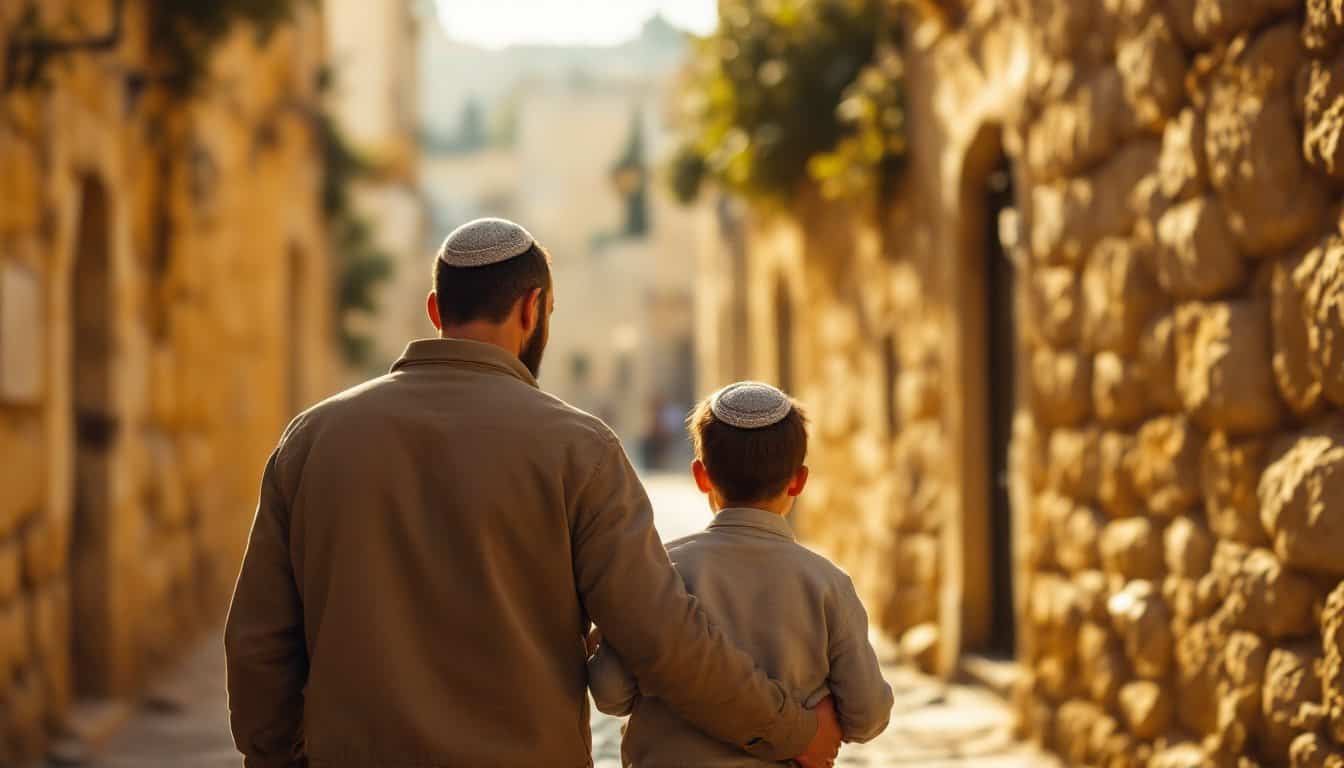
A small round cap resting on the crown of the head: the kippah is probably the most visible sign of Judaism. You see it in the synagogue, in the street, at the Western Wall, sometimes under a black hat, sometimes knitted in every color imaginable. But where does it come from? Is it a commandment of the Torah, a custom, a sign of belonging? Here is a complete answer, with the sources, the history and the deeper meaning of this small piece of fabric.
In short: the kippah (a Hebrew word meaning “dome” or “vault”) is the cap Jewish men wear to keep their heads covered. It is not a commandment written in the Torah, but a very ancient practice, already described in the Talmud, which over the centuries became a rule recognized by every code of Jewish law (Shulchan Aruch, Orach Chaim 2:6). Its main reason is given by the Talmud: “Cover your head, so that the fear of Heaven may be upon you” (Shabbat 156b). To cover one’s head is to acknowledge that there is something above oneself. The kippah is therefore at once a gesture of humility before G-d, a constant reminder of His presence and, over time, a sign of Jewish identity.
What does the word “kippah” mean?
In Hebrew, kippah (כִּפָּה) means a vault, a cupola, a dome. One speaks, for example, of the kippat hashamayim, the “vault of heaven.” The word thus evokes a rounded shape that covers and protects. Its use for a head covering is relatively recent: the Talmud does not speak of a “kippah,” but simply of “covering the head” (kisuy harosh) or of not walking “bareheaded” (giluy harosh). The object itself did not matter: a hat, a turban, the corner of a shawl.
In Yiddish, the language of the Jews of Eastern Europe, the kippah is called a yarmulke. The word probably comes from the Polish jarmułka, a kind of cap. A folk etymology, more charming than accurate, breaks it down into Aramaic: yarei malka, “one who fears the King.” It has no linguistic basis, but it captures well what the kippah is meant to express.
In French it is also called a calotte (“skullcap”); in North African communities, you still sometimes hear the older generation use that word. Whatever the name, the object is the same: a head covering, worn as a sign of respect.
What the Written Torah says
Let us be clear from the outset: no verse of the Torah commands Jews to cover their heads. The kippah is not one of the 613 commandments. And yet the Torah is well acquainted with the idea of covering the head in a sacred setting.
The first example is that of the priests, the Kohanim, who served in the Sanctuary. Among the garments of the High Priest, the Torah mentions the mitznefet, a kind of turban (Shemot [Exodus] 28:4 and 28:39). Fastened to this turban was the tzitz, a gold plate bearing the inscription “Holy to the L-rd” (Shemot 28:36-37). The ordinary priests, the sons of Aharon, also wore a head covering, the migba’ot: “And for the sons of Aharon you shall make tunics, sashes and headdresses, for honor and for splendor” (Shemot 28:40). In the holiest place in Israel, the one who stood before G-d had his head covered.
The Tanakh, the Hebrew Bible, also knows the covered head as a sign of grave emotion and humility. When King David flees Jerusalem before the revolt of his son Avshalom, he climbs the Mount of Olives “weeping, with his head covered” (Shmuel II [2 Samuel] 15:30). And when Haman is humiliated before Mordechai, he returns home “mourning, with his head covered” (Esther 6:12). In biblical culture, covering one’s head means withdrawing, effacing oneself, acknowledging that one is not master of the situation.
These verses do not create an obligation to wear a kippah. But they show that the idea has very deep roots: the covered head expresses respect before what is greater than us.
What the Talmud says
It is in the Talmud, compiled between the 3rd and 6th centuries, that we find the direct sources of the kippah. Three passages are essential.
The story of Rav Nachman bar Yitzchak
The most famous text is found at the end of tractate Shabbat (156b). Chaldean astrologers had told the mother of Rav Nachman bar Yitzchak that her son would become a thief. So she never let him go bareheaded, and would tell him: “Cover your head, so that the fear of Heaven may be upon you, and pray for mercy.” The boy did not know why she insisted so much.
One day, as an adult, he was sitting and studying under a palm tree that did not belong to him. The cloth covering his head slipped off. He looked up, saw the dates, and his inclination got the better of him: he climbed up and bit off a cluster with his teeth. The Talmud tells this story to teach that, for Israel, fate is not written in advance: a real inclination can be mastered. But along the way it hands down the very reason for the kippah. A covered head keeps alive in a person the awareness that he is being seen, and that awareness protects him from his own weaknesses.
The Aramaic phrase, kassi reishakh kei heikhi d’tehevei alakh eimta dishmaya, “cover your head so that the fear of Heaven may be upon you,” has become the classic statement on the subject. The Kitzur Shulchan Aruch (3:6) still quotes it in the 19th century to explain why young children should be accustomed to covering their heads.
“The Divine Presence is above my head”
The second passage is in tractate Kiddushin (31a). It relates that Rav Huna, son of Rav Yehoshua, never walked four cubits (about two meters) bareheaded. He explained: “The Shechinah, the Divine Presence, is above my head.” The same master says elsewhere, looking back over his life: “May I be rewarded for never having walked four cubits with my head uncovered” (Shabbat 118b).
The logic is clear: someone who knows he is constantly in G-d’s presence does not stand before Him as he would before just anyone. Just as you would not appear unkempt before a person you respect, you cover your head because you are standing, at every moment, before the King.
A custom, not yet a law
The third passage shows that in the time of the Talmud, covering the head was not yet a general obligation. In tractate Nedarim (30b), discussing an expression used in vows, the Talmud simply observes that “men sometimes cover their heads and sometimes uncover them; women always have their heads covered; children always have their heads uncovered.”
In other words, among the Sages, keeping the head covered at all times was a mark of special piety, that of Rav Huna or of the great scholars, and not yet a universal practice. This explains the debates that followed.
From the halachic authorities to the Shulchan Aruch: from piety to rule
The Rambam (Maimonides, 12th century) mentions the covered head in two places. In his Laws of Prayer, he teaches that before praying one arranges one’s clothing and presents oneself with dignity, and that one does not stand in prayer “with the head uncovered” (Hilchot Tefillah 5:5). In his Laws of Character Traits, he describes the great modesty of Torah scholars: they uncover neither their heads nor their bodies (Hilchot De’ot 5:6). For the Rambam, then, the covered head is required for prayer and expected of a man of learning.
In the 16th century, the Shulchan Aruch of Rabbi Yosef Karo, the great code of Jewish law, takes a further step: “It is forbidden to walk with an upright, haughty bearing, and one should not walk four cubits with the head uncovered” (Orach Chaim 2:6). It also records that, according to some opinions, it is forbidden to utter the Name of G-d with the head uncovered, and, according to others, that people should be prevented from entering the synagogue bareheaded (Orach Chaim 91:3).
One question remained: is this a strict obligation or a “measure of piety” (middat chassidut)? Opinions are divided. The Maharshal (Rabbi Shlomo Luria, 16th century), quoted by the Taz, held that outside of prayer there is no prohibition in the strict sense, only an act of piety, while still recommending that people keep to it, since going bareheaded was seen as a lack of seriousness. The Vilna Gaon also leaned toward seeing it as a measure of piety.
The Taz (Rabbi David HaLevi, 17th century) put forward an argument that became decisive (Taz on Orach Chaim 8:3). In his time, he explains, non-Jews had made it their habit to uncover their heads as a sign of respect, especially when sitting down and in their places of worship. Remaining bareheaded therefore amounted to imitating their religious customs, which the Torah forbids: “You shall not follow their practices” (Vayikra [Leviticus] 18:3). All the more so, he adds, since the covered head expresses the fear of Heaven, as taught at the end of tractate Shabbat. For him, then, this is a genuine prohibition.
In the 20th century, Rav Moshe Feinstein, one of the great American halachic authorities, concluded in his responsa (Igrot Moshe) that even if it was originally an act of piety, the practice has become so widespread among the Jewish people that it has acquired the force of an obligation. This is today the accepted position in the Orthodox world, among Ashkenazim and Sephardim alike: a Jewish man keeps his head covered at all times, and at the very least during prayer, blessings, Torah study and in the synagogue.
The reasons for the kippah: three levels of explanation
Why has such a simple gesture taken on such importance? The explanations build on one another, from the simplest to the deepest.
The simple level: respect
In almost every culture, respect is shown by a gesture of the head. Judaism chose to cover the head before G-d, like the priest in the Sanctuary. The kippah says: “I know before Whom I stand.” It turns every moment of the day, and not only the hours of prayer, into a moment lived in the presence of G-d.
The moral level: humility and self-control
The Shulchan Aruch links the covered head to the prohibition of “walking with an upright bearing” out of arrogance (Orach Chaim 2:6). The head is the seat of intelligence, of will, and of pride as well. Covering it is a reminder that human reason has a limit, that there is something greater above it. The story of Rav Nachman bar Yitzchak also shows the practical dimension: the kippah is a safeguard. Someone who wears a visible sign of his relationship with G-d keeps a closer watch on himself. He knows that his actions involve more than just himself.
The inner level: the fear of Heaven
The key term remains the Talmud’s: yirat shamayim, the “fear of Heaven.” This is not about being afraid, but about awareness: the awareness of living under G-d’s gaze. The kippah does not create this awareness, but it keeps it alive, like a knot tied in a handkerchief. In the mystical tradition, it is often pointed out that the head is the part of a person closest to Heaven: covering it marks the separation between what man can grasp and what lies beyond him, and accepts that limit as a form of respect, not as a humiliation.
What Rav Raphaël Benizri teaches
Rav Benizri did not devote an entire lecture to the kippah, but he spoke about it directly in a Pesach lecture, and he often taught about the very notion the Talmud places at the heart of this practice: the fear of Heaven, which the kippah is meant to “place” on the head of the one who wears it.
A small vault beneath the vault of heaven
In his lecture on the four questions of the Ma Nishtana, the Rav warns against an illusion: believing that everything is clear and transparent, when in fact “there is no knowledge that does not leave a shadow,” however faint. It is here that he speaks of the head covering: “man should be able to wear this head covering with humility,” which places him “in a state of openness and listening.” And he plays on the very meaning of the word kippah: “For this vault of heaven, I substitute another vault on my head, which demands a certain humility of me.”
The image is striking: the kippah is a small dome that recalls the great one. It does not claim to explain everything; on the contrary, it says that man, however learned, always keeps above him a part he does not master, and that he must remain attentive and listening.
Fearing is not being afraid
In his lecture Elul: taking stock of the year, the Rav draws a sharp distinction between the two notions. “To fear is not to be afraid. Being afraid is a response to an external threat.” Fear in this sense, he explains, lies in realizing that not everything depends on us, that we are partners in an undertaking and a purpose, but that above man there is a Creator who guides the world. He recalls that, according to our Sages, the world was created to teach man to fear.
In the same lecture, he warns against a pitfall: by constantly embellishing our Judaism, we risk falling into “the trap of beautiful forms” while neglecting the content. The remark applies to the kippah: it only has meaning if it truly carries this awareness. A beautiful kippah on a head that never thinks of Heaven remains an accessory.
The degrees of fear
In the lecture Eshet Chayil, part 4, the Rav describes a ladder. First there is the fear of punishment, the dread that something will come crashing down on our heads; then the fear of sin, of a misstep; then the fear of Heaven, of what is higher than us, which can still leave us at a loss. And beyond that, the fear of G-d in the full sense, which no longer paralyzes: one has assurance, one acts with care, “one breaks nothing along the way,” yet one remains aware of what is still lacking in one’s own development.
Fear of the sublime, a source of joy
In Pirkei Avot 5: serving without reward, commenting on the maxim of Antigonos of Sokho, “let the fear of Heaven be upon you” (Pirkei Avot 1:3), the Rav calls this dimension “the fear of the sublime.” However much we may want to reduce everything to the rational, he says, the person who is aware of G-d’s omnipresence and of His closeness becomes the recipient of a revelation. And this awareness does not make one sad: it translates into a constant joy, not the kind that drowns itself in pleasures, but the kind that makes one feel a presence and a providence all along the way.
Notice that the maxim of Antigonos uses almost the same words as Rav Nachman’s mother: “let the fear of Heaven be upon you.” The kippah is a very concrete way of putting this sentence into practice.
A bit of history
In antiquity, customs varied. The Talmud shows that the sages of Babylonia set particular store by covering the head, as a sign of piety and dignity; scholars often wore a sudar, a cloth wound around the head.
In the Middle Ages, practices still differed from region to region. In Christian Europe, some rabbis in France apparently recited blessings bareheaded, which other authorities in Germany criticized. In the Muslim world, on the other hand, a covered head was the norm for everyone, and the Jews of the Middle East and North Africa always wore a turban, a chechia or a skullcap. In German-speaking lands, Jews wore for centuries a distinctive hat, often pointed, which was later imposed by the authorities as a distinguishing badge.
Only gradually did the small skullcap, worn on its own or under a hat, become the standard. In 19th-century Germany, part of the Reform movement abolished the requirement to cover the head in the synagogue, in order to resemble the surrounding customs more closely. In reaction, the kippah also became a marker of loyalty to tradition.
In the 20th century, in Israel, the knitted kippah (kippah sruga) became the emblem of religious Zionism, while the black velvet kippah is associated with the so-called “ultra-Orthodox” or Haredi world. The Jews of Bukhara and Yemen have their embroidered kippot, the Breslov Hasidim their large white kippot. So in Israel, the kippah often also signals which stream one belongs to. But all these styles express the same fundamental gesture.
The kippah in practice today
Who wears it? In traditional Judaism, the kippah is worn by men and boys. In many families, little boys are accustomed to wearing it very early; among many Ashkenazim and Hasidim, the custom is to begin on the day of the first haircut, at age three, often celebrated on Lag BaOmer. Married women cover their hair for a different reason, connected with marital modesty, using a scarf, a hat or a wig; this is not a kippah. In some liberal movements, women have chosen to wear a kippah; this is not the traditional practice.
When? Ideally, according to the Shulchan Aruch, it is worn at all times. At the very least, tradition requires a covered head for prayer, blessings (including before and after meals), Torah study, and in the synagogue or a cemetery.
What shape? No particular shape is required. What matters is that the head be covered: a hat, a cap or a beanie serves the same purpose. Indeed, many religious men wear a hat over their kippah for prayer. For questions of detail, such as the minimum size, or covering one’s head with one’s hand for an occasional blessing, the halachic authorities discuss them, and one should consult a rabbi.
And in public? Some Jews wear the kippah in the street, while others replace it with a cap or a hat, for reasons of discretion or caution. From the standpoint of Jewish law, the essential point, a covered head, is respected in both cases.
And non-Jews? A non-Jewish visitor entering a synagogue or approaching the Western Wall is invited to cover his head out of respect for the place. He is often lent a cardboard or cloth kippah. This courtesy commits him to nothing in religious terms.
Common misconceptions about the kippah
“The kippah is a commandment of the Torah.” No. It is a practice of Talmudic origin that became a rule of Jewish law over the centuries. Its force comes from tradition and from the rulings of the Sages, which, in Judaism, is no small thing.
“The kippah is a sacred object.” No again. Unlike a Torah scroll, tefillin or a mezuzah, the kippah has no holiness of its own: nothing is written on it, and it is simply a means of covering the head. It can be washed, replaced, and discarded when it is worn out.
“Only rabbis wear a kippah.” False: every Jewish man is concerned, from the small child to the old man. On this point, a rabbi has no special obligation.
“Wearing a kippah means claiming to be more religious than others.” That is not the point of the practice. The kippah is not a diploma of piety, but a reminder addressed first and foremost to the one who wears it. As the Talmud says, it serves to place the fear of Heaven upon him, not to put him on display.
“The color or material of the kippah has religious significance.” Not in Jewish law. These are community customs, which sometimes express a sense of belonging, but all kippot have the same value.
Frequently asked questions about the kippah
What is the difference between kippah, kipa, yarmulke and skullcap?
They are the same object. Kippah (often spelled kipa or kippa) is the Hebrew word, meaning “dome.” Yarmulke is the Yiddish word used by Ashkenazi Jews. Calotte is the traditional French term, the equivalent of the English “skullcap.”
Why don’t women wear a kippah?
The kippah is a men’s practice. The Talmud already observes that women always had their heads covered (Nedarim 30b), but for a different reason, connected with modesty. Today, married women cover their hair with a scarf, a hat or a wig. Some liberal movements have adopted the kippah for women, but this is not the traditional practice.
Can a cap be worn instead of a kippah?
Yes. What Jewish law requires is that the head be covered, not that a specific object be worn. A cap, a hat or a beanie is fine. For prayer, however, dignified attire is preferred.
Can a non-Jew wear a kippah?
Yes, for example when visiting a synagogue, attending a wedding or a bar mitzvah, or at the Western Wall. It is a sign of respect, warmly welcomed, which does not make him Jewish and commits him to nothing.
How does a kippah stay on without falling off?
Often with a simple hair clip. Some kippot, larger or made of velvet, stay on by themselves. The Talmud tells precisely what happened to Rav Nachman bar Yitzchak the day his head covering slipped: a good reason to fasten it well.
Should you sleep with a kippah on?
Many religious men do, or cover their heads at night, since the custom is never to remain bareheaded. Others are less strict during sleep. For the precise rule, one should consult a rabbi.
At what age does a boy start wearing a kippah?
There is no mandatory age. The Kitzur Shulchan Aruch (3:6) recommends accustoming children from their earliest years, based on the story of Rav Nachman bar Yitzchak. In many families, a little boy wears it as soon as he can keep it on his head, and among many Ashkenazim and Hasidim, from the age of three.
Further reading
The kippah weighs only a few grams, but it carries an immense idea: man does not live alone facing himself; he lives before G-d. Keeping it on one’s head means keeping that awareness within reach, from morning to night.
- Elul: taking stock of the year, rediscovering the fear of Heaven
- Eshet Chayil, part 4: the fear of G-d
- Pirkei Avot 5: serving without reward
- Lag BaOmer: why do we celebrate the 33rd day of the Omer?
- What are tzitzit, the “fringes” Jews wear?
- Why do married Jewish women cover their hair?
- Why do some Jews dress in black and white, with a hat?
- Glossary of Hebrew terms in Judaism
Sources and references
- Shemot (Exodus) 28:4; 28:36-40 (the mitznefet, the tzitz and the migba’ot of the priests)
- Shmuel II (2 Samuel) 15:30; Esther 6:12 (the covered head, a sign of mourning and humility)
- Vayikra (Leviticus) 18:3 (“You shall not follow their practices”)
- Babylonian Talmud, Shabbat 156b (Rav Nachman bar Yitzchak: “Cover your head…”)
- Babylonian Talmud, Kiddushin 31a and Shabbat 118b (Rav Huna son of Rav Yehoshua)
- Babylonian Talmud, Nedarim 30b (the customs of men, women and children)
- Mishnah, Pirkei Avot 1:3 (Antigonos of Sokho)
- Rambam, Mishneh Torah, Hilchot Tefillah 5:5 and Hilchot De’ot 5:6
- Shulchan Aruch, Orach Chaim 2:6 and 91:3
- Taz on Shulchan Aruch, Orach Chaim 8:3 (quoting the responsa of the Maharshal)
- Rav Moshe Feinstein, Igrot Moshe, responsa on covering the head
- Kitzur Shulchan Aruch 3:6
- Rav Raphaël Benizri, Pesach: the four questions of the Ma Nishtana
- Rav Raphaël Benizri, Elul: taking stock of the year
- Rav Raphaël Benizri, Mishlei: Eshet Chayil, part 4
- Rav Raphaël Benizri, Pirkei Avot, part 5
Article by the Pensées Juives editorial team. Passages attributed to Rav Raphaël Benizri are taken from his lectures published on this site.