
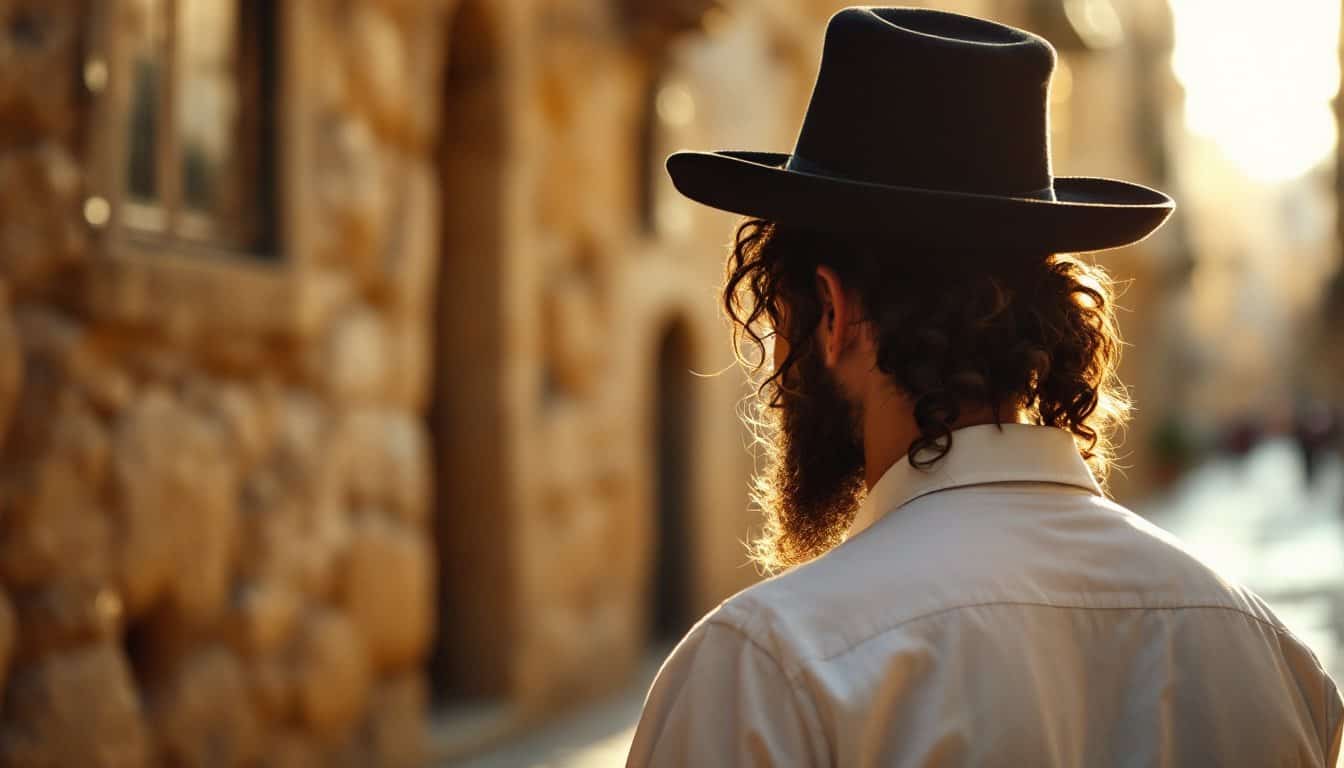
In the streets of Jerusalem, Antwerp or the Marais district of Paris, you notice them right away: long curly locks hanging down along the cheeks, sometimes tucked behind the ear, and a beard that is never shaved. Is it a fashion, a sign of belonging, a vow? In fact, these sidelocks and this beard come from a single verse of the Torah, more than three thousand years old. Here is what it says, how the Sages understood it, and why the practice varies so much from one community to another.
In Hebrew, sidelocks are called peot (singular: peah), a word meaning “corners” or “edges”; Ashkenazi Jews say peyes, and in French, when they are curled, they are also called “anglaises” (literally “English curls”). Their source is an explicit commandment: “You shall not round off the corners of your head, and you shall not destroy the corners of your beard” (Vayikra [Leviticus] 19:27). Jewish law derives two prohibitions from it: it is forbidden to shave the temples completely, and it is forbidden to shave the beard with a bladed razor. Every Jewish man must therefore keep a little hair at his temples, but the length of the sidelocks is a custom, not an obligation: some keep a few millimeters, others long curls. Likewise, the Torah does not require a long beard, but many let it grow out of piety and for reasons rooted in the mystical tradition.
What the Torah says: one verse, two prohibitions
The verse is found in the parasha of Kedoshim, the great chapter on holiness that opens with “You shall be holy, for I, the L-rd your G-d, am holy” (Vayikra 19:2). This chapter brings together laws that seem unrelated to one another: loving your neighbor as yourself, honoring your parents, not stealing, leaving a corner of the field for the poor, not practicing divination. And in the middle comes this sentence: “You shall not round off the corners of your head (lo takifu peat roshchem), and you shall not destroy the corners of your beard (velo tashchit et peat zekanecha)” (Vayikra 19:27).
The immediate context is illuminating. The preceding verse forbids divination and sorcery, and the following verse forbids cutting the flesh for the dead and tattooing (Vayikra 19:26 and 28). All these laws target practices of the neighboring peoples, linked to idol worship or to pagan mourning. The Torah asks the people of Israel to stand apart, even in their appearance.
Notice that the same word, peah, “corner,” also refers to the corner of the field left for the poor (Vayikra 19:9). In both cases, one does not go all the way to the edge: you do not harvest your whole field, you do not shave your whole head. You leave a portion that does not entirely belong to you.
The Torah repeats the prohibition for the Kohanim, the priests descended from Aharon: “They shall not make a bald patch on their head, they shall not shave the corner of their beard, and they shall not make cuts in their flesh” (Vayikra 21:5). A related law forbids the whole people from making a bald patch as a sign of mourning: “You are children of the L-rd your G-d: you shall not cut yourselves, nor make a bald patch between your eyes for the dead” (Devarim [Deuteronomy] 14:1).
How the Sages read this verse
As is almost always the case, the verse of the Written Torah is not enough on its own to know what to do. What does “round off” mean? What are the “corners” of the beard? It is the Oral Torah, recorded in the Mishnah and the Talmud, that provides the answer.
The corners of the head
The Mishnah teaches that someone who “rounds off” his head commits two transgressions: “one on this side and one on that side,” that is, one for each side (Mishnah Makkot 3:5). The Talmud explains what this rounding off is: shaving the temples so as to make the hairline even from behind the ears to the forehead (Babylonian Talmud, Makkot 20b). In other words, the result is a “round” cut, with no hair at all on the side of the head, like a regular skullcap.
What must be kept, then, is the area of the temples, where the skull meets the jaw, on each side (Shulchan Aruch, Yoreh De’ah 181:1): in width, from the hairline of the forehead down to below the ear, where the jawbone begins (Shulchan Aruch, Yoreh De’ah 181:9). The Rambam notes that the Sages did not set a minimum length for this hair, but he adds that he heard from the elders that at least forty hairs must be left (Mishneh Torah, Hilchot Avodah Zarah 12:6). So long curls are not required: a simple short lock, left unshaved, is enough to keep the law.
The corners of the beard
For the beard, the Mishnah counts five “corners”: “two on this side, two on that side, and one below” (Mishnah Makkot 3:5). The Rambam and the Sefer HaChinuch describe them as follows: the upper and lower part of the right cheek, the upper and lower part of the left cheek, and the point of the chin (Hilchot Avodah Zarah 12:7; Sefer HaChinuch, mitzvah 252). But opinions differ on their exact location; this is why the Shulchan Aruch concludes that one who fears Heaven will not pass a razor over any part of his beard (Shulchan Aruch, Yoreh De’ah 181:11).
Above all, the Mishnah specifies that one is liable only for shaving “with a razor” (Mishnah Makkot 3:5). The Talmud learns this by comparing two verses. The first, addressed to the priests, says “they shall not shave” (Vayikra 21:5); the second, addressed to everyone, says “you shall not destroy” (Vayikra 19:27). The prohibition therefore applies to something that both shaves and destroys the hair at the root: that is, a blade cutting flush with the skin. Scissors, which cut without shaving, are not included; tweezers, which pluck without shaving, are not forbidden by the Torah either (Babylonian Talmud, Makkot 21a).
The Shulchan Aruch rules accordingly: one is liable for the beard only with a razor, and it is permitted to cut it with scissors, even very short (Shulchan Aruch, Yoreh De’ah 181:10). For the hair of the head, the Shulchan Aruch also records a stricter opinion forbidding scissors that cut “like a razor,” and recommends taking it into account (Shulchan Aruch, Yoreh De’ah 181:3). As for the mustache, the Rambam states that it is not counted among the five corners and that it may be shaved, even though Jewish custom is not to remove it entirely (Hilchot Avodah Zarah 12:8).
Men and women
These two prohibitions apply only to men. The Mishnah lists the few prohibitions of the Torah from which women are exempt, and the corners of the head and of the beard are among them (Mishnah Kiddushin 1:7; Babylonian Talmud, Kiddushin 35b). The Talmud explains it simply: the Torah links the two prohibitions in the same verse, and the one about the beard cannot apply to women. The Rambam adds that a woman, however, must not shave the temples of a man (Hilchot Avodah Zarah 12:5).
Why this law? The reasons given by the Sages
The Torah rarely gives the reason for its commandments. This one belongs to what are called chukim, “decrees” whose logic is not self-evident. The Sages nevertheless offered several levels of explanation, which complement one another.
Standing apart from idolatrous cults
The first reason is historical. The Rambam writes that idolatrous priests used to shave the corners of their head and beard in this way, and that this is why the Torah forbade it (Hilchot Avodah Zarah 12:1 and 12:7). He returns to this point in his Guide for the Perplexed: many mitzvot aim to keep Israel away from the practices of the cults of its time, and this is one of them (Moreh Nevuchim III:37).
The Sefer HaChinuch develops the same idea. The root of the commandment, he writes, is to distance from us anything connected with idolatry, and to erase these practices from our sight and from our deeds (Sefer HaChinuch, mitzvah 251).
This explanation is confirmed by ancient sources. The prophet Yirmiyahu [Jeremiah] several times speaks of peoples neighboring Israel whom he calls “those with clipped corners” (ketzutzei peah), as though it were their distinguishing mark (Yirmiyahu 9:25; 25:23; 49:32). And the Greek historian Herodotus, in the 5th century BCE, reports that certain Arab tribes cut their hair in a round shape by shaving the temples, in honor of their deity (Herodotus, Histories III, 8). What the Torah forbids is precisely this haircut.
The body is not a blank page
A second, more moral reading connects this prohibition with its immediate neighbors: the prohibition of cutting the flesh and of tattooing (Vayikra 19:28). In all three cases, the Torah reminds us that the body is not a surface we may freely use to inscribe any message we like. It is entrusted to man, and it bears the image of G-d. It is not to be shaped according to idols or the fashions of the moment.
This is also the meaning of its closeness to the “corner of the field” left for the poor. Man is not the absolute owner of what he has. Even on his own head, he leaves a portion untouched, like a discreet signature of his Creator.
A mark of identity
Finally, many commentators see the peot as a visible sign of belonging, like the kippah or the tzitzit. The verse addresses “you” in the plural, the entire people, and it appears in a chapter that begins with the call to holiness. To be holy, kadosh in Hebrew, first of all means “to be set apart.” The peot remind the one who wears them, every time he looks in a mirror, that he does not look quite like everyone else, and that this difference has meaning.

The beard: “the splendor of the face”
Although the Torah does not require a long beard, Jewish tradition grants it great dignity. The Talmud records a discussion in which Rabbi Yehoshua ben Korcha declares: “The splendor of the face is the beard” (Babylonian Talmud, Shabbat 152a).
In the Bible, the beard is a sign of honor. The psalm compares harmony between brothers to “the precious oil on the head, running down upon the beard, the beard of Aharon” (Tehillim [Psalms] 133:2). Conversely, having it shaved off by force was a humiliation. When Hanun, king of Ammon, had half the beards of the envoys sent by King David shaved off, they were so ashamed that David told them to stay in Jericho “until your beards have grown back” (Shmuel II [2 Samuel] 10:4-5).
The mystical dimension
It was above all the Kabbalah that gave the beard particular importance. The Zohar, in the passage known as the Idra Rabba (in the section of Naso), describes in symbolic terms a “beard” of the upper world, divided into thirteen parts, which it links to thirteen attributes of mercy that it reads in the verses of the prophet Michah: “Who is a G-d like You, who pardons iniquity…” (Michah [Micah] 7:18-20). Tradition associates these thirteen attributes with those revealed to Moshe (Shemot [Exodus] 34:6-7). The beard thus becomes the image of a flow of kindness descending from above into the world, like the oil running down upon the beard of Aharon.
Following this tradition, the great kabbalist of Safed, Rabbi Yitzchak Luria, known as the Arizal (1534-1572), did not cut his beard at all, not even with scissors. His disciples passed on this practice, and it was widely adopted in the Hasidic world and by many Sephardi kabbalists. This is why today you see men who let their beards grow freely, without ever trimming them: it is not neglect, but piety.
What about the electric shaver?
The question arose in the 20th century with the invention of the electric shaver. Since the Torah forbids only a blade that shaves flush with the skin, many halachic authorities permitted electric shavers whose screen separates the blade from the skin, and which therefore cut the way scissors do. Others were stricter, particularly regarding models that lift the hair before cutting it, since they come close to shaving flush with the skin. When choosing a device, consult a rabbi.
Long or short sidelocks: a diversity of customs
Since the law sets only a minimum, each community has developed its own customs. Sidelocks are thus an excellent example of how one and the same mitzvah can take on different faces.
- In many Sephardi communities and among many observant Jews, the hair at the temples is simply kept a little longer than the rest of the haircut, which is hardly noticeable.
- Among Yemenite Jews, long peot are an ancient tradition. They are called simanim, “signs,” because they served precisely to identify a Jew.
- In the Hasidic world, inspired by the Kabbalah, the peot are often allowed to grow without ever being cut. Depending on the group, they are twisted into long curls (the “anglaises”), left hanging, or tucked behind the ear, sometimes under the kippah.
- Among Chabad Hasidim, for example, the custom is not to cut the beard, but the peot are often more discreet and tucked behind the ear.
None of these ways is “more Jewish” than another. All of them keep the same verse; they differ in the measure of zeal they add to it, and in the history of each community.
The first haircut at age three
In many families, the peot appear for the first time at a ceremony: a little boy’s first haircut at the age of three. In Yiddish it is called an opsherin (or upsherin, “shearing”), and in Israeli Hebrew a chalaka. Until then, the child’s hair is allowed to grow; on that day it is cut for the first time, taking great care to leave the peot.
This custom rests on an analogy with a law in the same chapter of the Torah: the fruit of a tree may not be picked during its first three years (Vayikra 19:23). The child is compared to a tree, according to the verse “for man is the tree of the field” (Devarim 20:19). After three years of growth, he enters the life of Torah: he begins to wear a kippah and tzitzit, he is taught the first letters of the Hebrew alphabet, and his peot are left in place.
Many families hold this first haircut on Lag BaOmer, in particular at the tomb of Rabbi Shimon bar Yochai in Meron, in northern Israel. Rabbi Chaim Vital, the disciple of the Arizal, reports that the Arizal himself had his young son’s hair cut there, and this is the origin of the custom (Shaar HaKavanot, on the counting of the Omer). Rav Benizri mentions this in his lecture on Lag BaOmer. Every year, thousands of little boys can be seen there receiving their first peot amid joy and song.
What Rav Raphaël Benizri teaches
In his lecture on Avraham’s journey, Rav Benizri speaks precisely about this first haircut at age three. He recalls the teaching that Avraham began his search for G-d at the age of three, a midrash quoted by the Ramban. It is no coincidence, he explains, that this is also the age of the first haircut.
For the Rav, this moment is like an initiation given to the child. In a sense, we are telling him: when you wipe the slate clean, keep your peot. Keep this corner of the head, this portion of spirituality, and tend it, because it is from there that a new seed will be able to sprout. The peot are therefore not mere ornament: they are what you keep when you wipe the slate clean.
The Rav places this idea within Avraham’s journey. Avraham, he explains, “goes to war alone, and he holds firm”: he is scorned, rejected, expected to fall in line with the majority. He is called to leave only at the age of seventy-five; in the meantime, he has led the struggle against the three forms of avodah zarah (idolatry) of his time, which, says the Rav, “were common then, are common today and will be common tomorrow.” The three-year-old child whose peot are left in place thus enters, in his own measure, into the lineage of that struggle.
A bit of history: curls that survived persecution
Peot appear very early in Jewish iconography. But the long curly sidelocks we know today spread mainly in Eastern Europe from the 18th century onward, with the rise of Hasidism and the influence of the Kabbalah of the Arizal.
They quickly became such a strong sign of identity that governments seeking to “modernize” or assimilate the Jews targeted them. In the Russian Empire, under Tsar Nicholas I, a series of decrees in the 1840s and 1850s forbade Jews to wear traditional dress, and in particular long peot. These laws were enforced very unevenly, but many Jews resisted, seeing in their sidelocks far more than a hairstyle.
Later, during the Holocaust, forcibly cutting off the beards and peot of religious Jews was one of the humiliations inflicted in the streets of occupied cities, and photographs from the period bear witness to it. This is also why, in many families today, the beard and the peot carry the memory of a faithfulness that endured.
Some common misconceptions
“All Jews must have long sidelocks.” No. The Torah only forbids shaving the temples completely. Keeping a short length of hair is enough; long curls are a custom, a respectable one, but not an obligation.
“Shaving is forbidden in Judaism.” Not exactly. What is forbidden is a bladed razor on the five corners of the beard. Scissors are permitted, and many halachic authorities allow certain electric shavers. A long beard is a pious custom, not a law of the Torah.
“Sidelocks are a sign of mourning or of a vow.” No. They have nothing to do with the nazir, who vows to let all his hair grow for a period of time (Bamidbar [Numbers] 6:5). Peot are worn for life, by all men, whatever their situation.
“It’s a fashion that came from Poland.” The curly shape and the length are indeed tied to the history of Eastern Europe and of Hasidism. But the obligation to keep the corners of the head goes back to the Torah itself, and the Jews of Yemen, who never knew Poland, also wore long peot.
Frequently asked questions about sidelocks and the beard
What are sidelocks called in Hebrew?
They are called peot (singular: peah), which means “corners.” Ashkenazi Jews pronounce it peyes or peyos, and Yemenite Jews call them simanim, “signs.” In French they are called papillotes or anglaises.
How long must peot be?
The Torah does not set a precise length; the Rambam notes that the Sages gave no measure, while recording the tradition of the elders to leave at least forty hairs (Hilchot Avodah Zarah 12:6). It is enough not to shave the temples with a razor. Anything beyond that is a matter of family or community custom.
Can a Jew shave his beard?
It is forbidden to shave the beard with a bladed razor. It is permitted to cut it with scissors, even very short (Shulchan Aruch, Yoreh De’ah 181:10). As for electric shavers, many rabbis permit certain models and forbid others: consult a rabbi.
Why do some tuck their sidelocks behind their ears?
Out of discretion, for convenience, or according to the custom of their community. Among some Hasidim, they are left hanging in full view; among others, they are tucked behind the ear or under the kippah. In every case, what matters for the law is that they are not shaved.
Do women have sidelocks?
No. The Talmud teaches that women are exempt from the prohibitions concerning the corners of the head and of the beard (Kiddushin 35b). Married women, on the other hand, have the custom of covering their hair, for a different reason, related to modesty.
Why are sidelocks curled?
It is not a rule. Many twist them around a finger to keep them neat and out of the way, and this curled shape has become characteristic of many Hasidic groups. Others leave them straight, or short.
Is a Jew without sidelocks any less Jewish?
No. Being Jewish does not depend on a hairstyle. Someone who does not shave his temples completely is already keeping the commandment, even if it does not show. And someone who does not keep it yet remains fully Jewish: every mitzvah is a door that can be opened at any time.
Further reading
A lock of hair at the temple, a beard left unshaved: these are small gestures, but they say something great. Man does not shape his body solely according to fashion or the gaze of others; he leaves a corner of it for G-d, just as one leaves a corner of the field for the poor.
- Avraham’s journey: the search begins at age three
- Lag BaOmer: why do we celebrate the 33rd day of the Omer?
- Lag BaOmer: the bonfires and the light of the Zohar
- Why do Jews wear a kippah?
- Why do some Jews dress in black and white, with a hat?
- Why are tattoos forbidden in Judaism?
- Why do married Jewish women cover their hair?
- Glossary of Hebrew terms in Judaism
Sources and references
- Vayikra (Leviticus) 19:2; 19:9; 19:23; 19:26-28 (parasha Kedoshim)
- Vayikra (Leviticus) 21:5 (the Kohanim)
- Devarim (Deuteronomy) 14:1; Devarim 20:19
- Bamidbar (Numbers) 6:5 (the nazir)
- Shemot (Exodus) 34:6-7 (the thirteen attributes of mercy); Michah (Micah) 7:18-20
- Shmuel II (2 Samuel) 10:4-5 (David’s envoys)
- Tehillim (Psalms) 133:2
- Yirmiyahu (Jeremiah) 9:25; 25:23; 49:32 (“those with clipped corners”)
- Mishnah Makkot 3:5
- Mishnah Kiddushin 1:7
- Babylonian Talmud, Makkot 20b and 21a
- Babylonian Talmud, Kiddushin 35b
- Babylonian Talmud, Shabbat 152a (“the splendor of the face is the beard”)
- Rambam, Mishneh Torah, Hilchot Avodah Zarah 12:1-8
- Rambam, Moreh Nevuchim (Guide for the Perplexed) III:37
- Sefer HaChinuch, mitzvot 251 and 252
- Shulchan Aruch, Yoreh De’ah 181:1; 181:3; 181:9; 181:10; 181:11
- Zohar, Idra Rabba (section Naso), on the thirteen parts of the beard
- Custom of the Arizal (Rabbi Yitzchak Luria) not to cut his beard, handed down by his disciples
- Rabbi Chaim Vital, Shaar HaKavanot (the first haircut in Meron)
- Herodotus, Histories III, 8
- Rav Raphaël Benizri, Avraham’s journey
- Rav Raphaël Benizri, Lag BaOmer: why do we celebrate the 33rd day of the Omer?
Article by the Pensées Juives editorial team. Passages attributed to Rav Raphaël Benizri are taken from his lectures published on this site.