
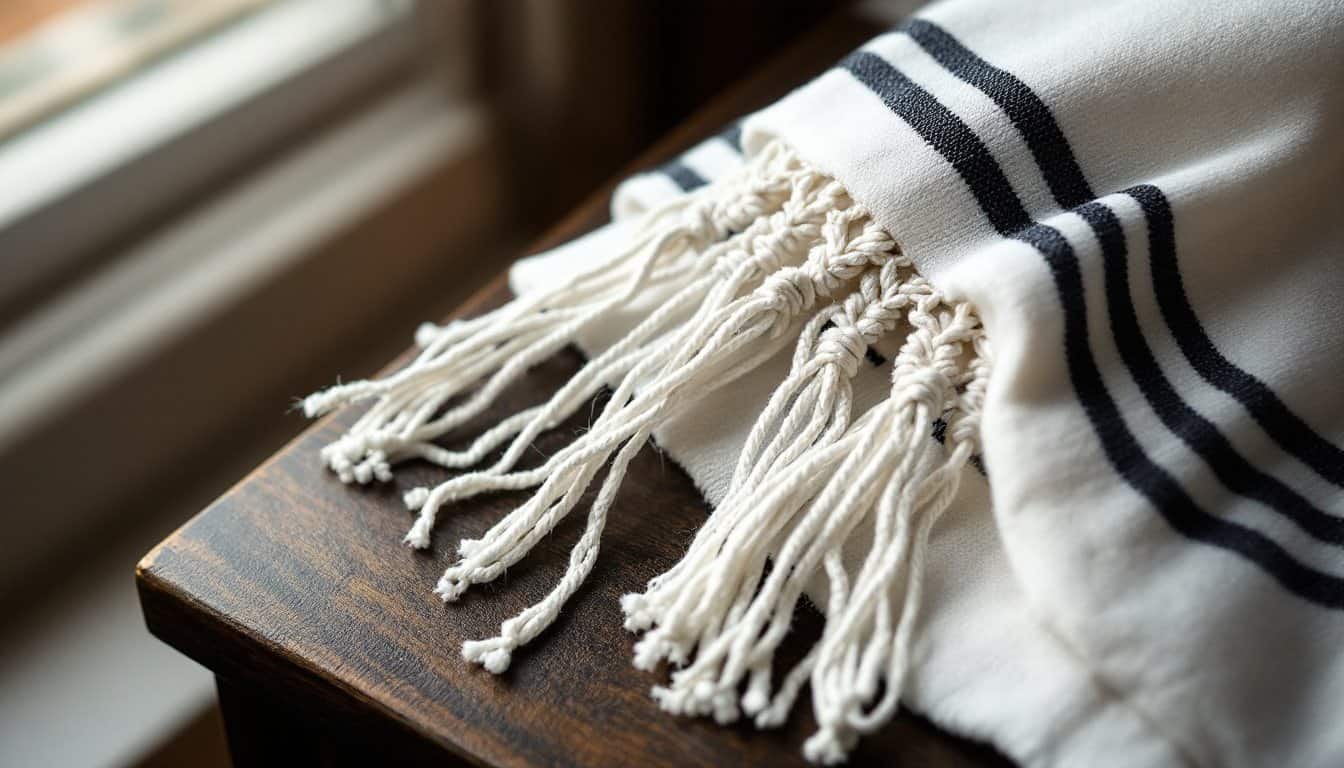
On the street or at the office, you sometimes notice long white strings hanging out from under a Jewish man’s shirt; in the synagogue, the same strings hang from the corners of a large prayer shawl. They are neither loose threads nor a fashion accessory, but one of the oldest commandments of the Torah. Where do these “fringes” come from, why are they worn, and what do they mean? Here is a complete answer: the verses, the Talmud, the history and the deeper meaning of these few strings.
In short: tzitzit (a Hebrew word meaning “fringes” or “tassels”) are knotted strings that the Torah commands to be attached to each corner of a four-cornered garment: “they shall make for themselves fringes on the corners of their garments” (Bamidbar (Numbers) 15:38). Their purpose is stated by the verse itself: “you shall see it, and remember all the commandments of Hashem” (Bamidbar 15:39). Since four-cornered garments are no longer worn today, Jewish men voluntarily put on a tallit (prayer shawl) during the morning prayer and, in many cases, a small tallit under their shirt all day long, which is why the strings show. Tzitzit are a constant reminder, worn on the body, of the covenant with G-d; the Talmud says that this mitzvah (commandment) “is equal to all the mitzvot” (Menachot 43b).
What does the word “tzitzit” mean?
In Hebrew, tzitzit (צִיצִית) means a lock, a fringe, something that hangs down or sticks out. The word appears elsewhere in the Bible for a lock of hair: the prophet Yechezkel (Ezekiel) recounts that he was seized “by a lock (tzitzit) of [his] head” (Yechezkel 8:3).
The garment to which the tzitzit are attached is called a tallit (also spelled talit or tallis; plural tallitot or talleisim, depending on pronunciation). There are two kinds:
- the tallit gadol (“large tallit”), the white prayer shawl, often with black or blue stripes, in which one wraps oneself for the morning prayer;
- the tallit katan (“small tallit”), also called arba kanfot (“four corners”), a kind of small rectangular poncho with an opening for the head, worn under or over the shirt all day long.
The Torah also uses another word, gedilim, “twisted cords” (Devarim (Deuteronomy) 22:12), which describes the way these strings are twisted and knotted.
What the Written Torah says
The commandment of tzitzit takes up an entire passage of the Torah, at the end of parashat Shelach, in the book of Bamidbar (Numbers):
“Hashem spoke to Moshe, saying: Speak to the children of Israel and tell them to make for themselves fringes on the corners of their garments, throughout their generations, and to put on the fringe of each corner a thread of blue. It shall be a fringe for you: you shall see it, and remember all the commandments of Hashem and do them; and you shall not stray after your heart and after your eyes, which lead you astray. So that you may remember and do all My commandments, and be holy to your G-d. I am Hashem your G-d, who brought you out of the land of Egypt to be your G-d: I am Hashem your G-d” (Bamidbar 15:37-41).
This text forms the third paragraph of the Shema Yisrael, the prayer recited morning and evening. The Talmud explains why it was chosen: it contains at once the mitzvah of tzitzit, the remembrance of the Exodus from Egypt, the acceptance of the yoke of the commandments and the warning against the straying of the heart and the eyes (Berachot 12b).
A second verse, in the book of Devarim, repeats the commandment and specifies the number of corners: “You shall make for yourself twisted cords on the four corners of the garment with which you cover yourself” (Devarim 22:12). It is from this verse that tradition derives that only a garment with four corners (or more) is subject to the obligation.
The context: the story of the spies
The passage on tzitzit closes parashat Shelach, which tells the episode of the twelve spies sent by Moshe to “scout out” (latur) the land of Canaan, ten of whom came back with a discouraging report (Bamidbar 13-14). Now the verse on tzitzit uses exactly the same verb: “you shall not stray (lo taturu) after your heart and after your eyes.” Rashi points out the link: “the heart and the eyes are the spies of the body; the eye sees, the heart desires, and the body commits the sin” (Rashi on Bamidbar 15:39). Tzitzit are the answer to the spies’ mistake: learning to look at the world without being carried away by what one sees.
How are tzitzit made?
The Torah gives the principle; the Oral Tradition, recorded in tractate Menachot of the Talmud (chapter 4, “HaTechelet”) and later codified by the Rambam (Hilchot Tzitzit, chapter 1) and the Shulchan Aruch (Orach Chaim 11), gives the exact form.
At each corner of the garment, a hole is made a short distance from the edge. Four strings are passed through it and folded in half, so that eight strings hang from each corner. One of the four strings is longer than the others; it is used to make the windings. Then five double knots are tied, and between these knots come four sets of windings of the long string around the others. The upper third of the fringe is thus wound and knotted; the lower two-thirds hang freely. It is this free part that the Torah calls tzitzit in the strict sense, and the windings at the top correspond to the gedilim, the “cords.”
The number of windings varies according to custom. The most widespread Ashkenazi custom is to make 7, 8, 11 and 13 turns (the Shulchan Aruch, Orach Chaim 11:14, mentions 7, 9, 11 and 13): the total, 39, corresponds to the numerical value of the words Hashem Echad, “Hashem is One” (26 + 13), which conclude the first verse of the Shema. Many Sephardim and Chassidim, following the Kabbalah of the Arizal (Rabbi Yitzchak Luria), make 10, 5, 6 and 5 turns, the values of the four letters of the Divine Name. Either way, the string tells, in its own way, of the oneness of G-d.
A few important rules:
- The strings must be spun and tied with the intention of the mitzvah (lishmah); this is why people buy tzitzit made under rabbinic supervision (Shulchan Aruch, Orach Chaim 11:1).
- They are generally made of wool, which is suitable for any garment, or of the same material as the garment (Shulchan Aruch, Orach Chaim 9).
- A broken or too-short string can make the tzitzit invalid; they should then be checked or replaced.
The blue thread: the mystery of techelet
The Torah asks that “a thread of blue,” petil techelet, be put on each fringe. Techelet is a precious blue dye, the same one that colored some of the hangings of the Sanctuary and the garments of the High Priest (Shemot (Exodus) 26:1; 28:31). Why this color? The Talmud answers with a famous chain of images, attributed to Rabbi Meir: “Techelet resembles the sea, the sea resembles the sky, and the sky resembles the Throne of Glory” (Menachot 43b; see also Sotah 17a). A blue thread attached to the garment draws the eye upward, step by step, all the way to G-d.
The Talmud specifies that this dye was taken from a sea creature called the chilazon, whose “body resembles the sea and whose shape resembles a fish,” and that it was rare and costly (Menachot 44a). People were all the more wary because there was a plant-based counterfeit, indigo (kala ilan), that looked the same: the Talmud sternly warns anyone who passes off indigo as techelet (Bava Metzia 61b).
The Mishnah sets down a rule that would prove decisive for what came later: “the absence of the techelet does not prevent [the mitzvah with] the white, and the absence of the white does not prevent [the mitzvah with] the techelet” (Mishnah Menachot 4:1). The mitzvah can therefore be fulfilled with entirely white strings. And that is what happened. After the Talmudic period, the secret of the dye was lost, probably between the end of Antiquity and the Arab conquest of the Land of Israel. The Midrash already observes: “today we have only the white, for the techelet has been hidden away” (Bamidbar Rabbah, parashat Shelach). For more than a thousand years, Jews all over the world wore entirely white tzitzit.
In modern times, people have tried to recover it. In 1887, the Rebbe of Radzin, Rabbi Gershon Chanoch Leiner, believed he had identified it in the cuttlefish. In 1913, the future Ashkenazi Chief Rabbi of the Land of Israel, Yitzchak HaLevi Herzog, devoted his doctoral thesis to the dyes of ancient Israel and proposed a shellfish of the murex family. Since the 1990s, an Israeli association, Ptil Techelet, has been distributing a thread dyed from the murex (Hexaplex trunculus), a Mediterranean sea snail. Some religious Jews wear a blue thread today; many others, relying on the tradition of their teachers, keep entirely white tzitzit. On this question, everyone follows his own rabbi.
What the Talmud and the Sages say
“Equal to all the mitzvot”
The Talmud gives tzitzit a surprising importance for a few strings. “The mitzvah of tzitzit is equal to all the mitzvot” (Menachot 43b; Nedarim 25a). The reason lies in the verse: “you shall see it and remember all the commandments.” The Talmud describes the sequence: “seeing leads to remembering, and remembering leads to doing” (Menachot 43b).
Rashi, drawing on the Midrash, gives an illustration that has become classic: the numerical value of the word tzitzit is 600; add the eight strings and the five knots, and you get 613, the total number of commandments in the Torah (Rashi on Bamidbar 15:39). The Rambam concludes his laws of tzitzit with this advice: “a person should always be careful with the mitzvah of tzitzit, for Scripture has considered it equal to all the mitzvot” (Mishneh Torah, Hilchot Tzitzit 3:12).
The Talmud also promises a special reward: “Whoever is careful with the mitzvah of tzitzit merits to receive the face of the Shechinah,” the Divine Presence (Menachot 43b). The verse indeed says “u-re’item oto,” which can be read “you shall see it,” but also “you shall see Him.”
The man saved by his fringes
The Talmud tells a remarkable story (Menachot 44a). A man who was very scrupulous about the mitzvah of tzitzit went to a famous courtesan in a distant city, to whom he had sent a fortune. Just as he was about to sin, his four fringes came and struck him in the face, and he let himself drop to the ground. To the astonished woman, he explained that these strings reminded him before Whom he stood. Deeply shaken, she converted to Judaism and later married him in holiness. This is exactly what the verse says: “you shall not stray after your heart and after your eyes.”
David at the bathhouse
Another story from the same passage (Menachot 43b) relates that King David, entering the bathhouse and seeing himself naked, cried out: “Woe is me, I stand naked, without any mitzvah!” Then he saw on his flesh the sign of circumcision, and he was comforted. The anecdote says implicitly what tzitzit are: a way of never being “naked of mitzvot,” of having on oneself, at every moment, a sign of the covenant.
From Avraham to Shem: the roots of the thread
The Sages connect tzitzit to the patriarchs. After his victory over the four kings, Avraham refused any spoils from the king of Sodom: “not even a thread, not even a sandal strap” (Bereshit (Genesis) 14:23). The Talmud teaches that as a reward for that refused “thread,” his descendants received the thread of techelet of the tzitzit (Sotah 17a; Chullin 89a). And Rashi relates that after Noach’s drunkenness, his sons Shem and Yefet covered their father with a garment without looking at him; Shem, who did so more eagerly, earned for his descendants the mitzvah of the fringed tallit (Rashi on Bereshit 9:23). From the very beginning, the fringed garment is linked to modesty and respect.
Why strings? The reasons for the mitzvah
As with all the mitzvot, tzitzit are observed first and foremost because G-d commanded them. But the Torah itself gives the reason, and the commentators have explored it on several levels.
The simple level: a reminder you wear
The verse says it plainly: “you shall see it and remember.” Tzitzit work like the knot you tie in a handkerchief so as not to forget something. The Sefer HaChinuch (mitzvah no. 386) explains that G-d wanted to give His people a sign attached to their clothing, which a person wears at all times, so that the remembrance of the commandments would accompany him wherever he goes.
The moral level: mastering one’s gaze
The second part of the verse concerns the gaze: “you shall not stray after your heart and after your eyes.” The Sages saw in this phrase a prohibition against letting one’s thoughts drift toward what leads away from G-d (Berachot 12b). Tzitzit teach that one can look without being carried away, and look instead at what uplifts: a white thread, a blue thread, and behind them a whole sky.
The symbolic and mystical level
The numbers of the tzitzit have inspired a rich body of reflection. The five knots recall the five books of the Torah. The four corners refer to the “four corners of the earth”: every morning, while reciting the prayer that precedes the Shema, one gathers the four fringes in one’s hand at the moment one asks G-d to “bring us in peace from the four corners of the earth.” And it is often noted that the four fringes together have thirty-two strings, the numerical value of the word lev, the heart: the very heart that, according to the verse, must not be followed blindly, and that tzitzit come to educate.

What Rav Raphaël Benizri teaches
Rav Benizri did not devote an entire lecture to tzitzit, but he mentions them in two lectures on parashat Bereshit, in connection with an essential question: what does it mean for a human being to get dressed?
A garment that lets the light through
In his lecture Bereshit: the beginning of Creation, the Rav starts from a principle: all light needs a container. A light without a keli, without a “vessel,” without a film or membrane to hold it in, scatters. The world was designed so that the envelope adheres to the fruit, to the body, to the light, and itself contributes to its intensity. Animals, he remarks, feel no need to clothe themselves; man does, and even when he chooses total nudity, he keeps a cord, a ribbon, some symbol of clothing.
This, the Rav explains, is what underlies the wearing of tzitzit: that our clothes should shine, that they should not be opaque, that they should not hide our own light or become a “hypocrite’s cloak.” He recalls that clothing is the first thing Adam added to his nature, after the sin, when he took leaves to cover himself. Clothing can be used to hide; with tzitzit, it becomes instead the place where one’s inner self shows through.
Repairing the garment with a “point”
In the following lecture, Bereshit: the foundations of the human being, the Rav develops the same idea starting from the smallest letter of the alphabet, the yud. The yud, he says, is an invisible point of balance, and it is enough to restore a whole: an object stands only thanks to its center of gravity, a point over which we have no control and which is nonetheless there. Every person has such a point, and it is from it that he can fulfill himself.
He applies this principle to several mitzvot. Clothing bears the mark of the sin, since man uses it to cover what he hides; and G-d gave him the means to restore it through tzitzit. Likewise, man damaged his relationship with food, and he received the mitzvah of challah, in which a “yud” of the dough is set aside. The same is true of circumcision, of the Land of Israel, which is the yud of space, and of Shabbat, which is the yud of time: Shabbat alone justifies the work of the six days.
The fringe at the corner of the garment is that small point, almost nothing, which is enough to transform the whole: the garment that served to hide becomes a reminder of what is highest in man.
Tallit gadol and tallit katan: tzitzit in practice
An obligation tied to the garment
Strictly speaking, the obligation of tzitzit applies only to someone who puts on a four-cornered garment. Since modern clothes have no such corners, one could do without. But tradition considers that it would be a pity to let such a precious mitzvah slip by: the Shulchan Aruch writes that it is good and proper to wear a small tallit all day long, so as to remember the commandments at every moment (Orach Chaim 24:1). This is the origin of the tallit katan, which observant men put on as soon as they wake up.
By day, not by night
The Talmud derives from the words “you shall see it” that the mitzvah applies by day, when one can see (Menachot 43a). The Shulchan Aruch draws the rule from this: the time for tzitzit is the daytime (Orach Chaim 18:1). That is why the large tallit is not worn at the evening prayer, with one exception: the eve of Yom Kippur, when one wraps oneself in it before Kol Nidrei.
Who wears tzitzit?
Because it is a time-bound mitzvah (daytime), the Talmud exempts women from it (Menachot 43a; Rambam, Hilchot Tzitzit 3:9). The same Talmudic passage nonetheless reports that Rav Yehudah attached tzitzit to the aprons of the women of his household. The Rema, the Ashkenazi halachic authority, allows that a woman may wear them, but he advises against it, the custom being that women do not (Orach Chaim 17:2). In traditional Judaism, tzitzit therefore remain a male practice.
Little boys often start wearing a tallit katan as soon as they can dress themselves, around the age of three in many families. For the large tallit, customs differ: among most Ashkenazim, it is worn from marriage onward; among Sephardim and in some Ashkenazi communities of German origin, from bar mitzvah, or even earlier.
How one wraps oneself in it
For the large tallit, one first checks the fringes, then recites the blessing: “Blessed are You, Hashem our G-d, King of the universe, who has sanctified us with His commandments and commanded us to wrap ourselves in tzitzit” (lehitatef ba-tzitzit). One then covers one’s head with it for a moment, like a cloak, before placing it on the shoulders (Shulchan Aruch, Orach Chaim 8). Over the tallit katan, depending on custom, one says “al mitzvat tzitzit,” or relies on the blessing said over the large tallit.
During the reading of the Shema, at the third paragraph, many have the custom of taking the fringes in hand and kissing them each time the word tzitzit is said, and again at the end of the passage.
A little history
In the ancient Near East, fringed garments were nothing unusual: reliefs from Mesopotamia show kings and dignitaries wearing fringed hems, a sign of rank. The Torah takes up this familiar form and gives it a new meaning: the fringe no longer speaks of the prestige of the one who wears it, but of the Master he serves, and every Israelite, without distinction, wears the thread of blue, the color of the High Priest’s garments.
In the “Cave of Letters,” in the Judean Desert, where refugees from the Bar Kochba revolt (132-135) hid, the archaeologist Yigael Yadin discovered in the early 1960s garments from that period and skeins of dyed wool, which some scholars have linked to threads intended for fringes.
When four-cornered garments went out of fashion, Jews adopted the two forms we know today: a shawl for prayer, the heir of the old rectangular cloak, and a small garment worn under one’s clothes. The stripes are not an obligation; some see in them a memory of the lost techelet. It was in fact this striped tallit that inspired, at the end of the 19th century, the flag of the Zionist movement, which later became the flag of the State of Israel.
Misconceptions about tzitzit
“They’re just strings hanging out through carelessness”
No. The strings that come out from under a Jewish man’s shirt are a ritual garment worn on purpose. They are made with care, knotted according to precise rules, and checked regularly.
“The blue thread is a recent invention”
On the contrary, it is the oldest part of the commandment, written in the verse itself. What is recent is its rediscovery; and those who do not wear it are not neglecting anything, since white alone is enough (Mishnah Menachot 4:1).
Frequently asked questions about tzitzit
What is the difference between tzitzit and a tallit?
Tzitzit are the fringes; the tallit is the four-cornered garment to which they are attached. The tallit gadol is the large prayer shawl, the tallit katan the small garment worn all day long. By extension, the tallit katan itself is often called “tzitzit.”
Do you have to wear tzitzit to sleep?
No. The mitzvah applies by day, and one is not required to keep one’s tzitzit on at night. Some nevertheless have the custom of sleeping in their tallit katan, so as to have it on as soon as they wake up. For the precise rule, consult a rabbi.
Can women wear tzitzit?
They are exempt, because it is a mitzvah bound to the time of day. The Rema advises women not to wear them, and it is not the custom in traditional Judaism. Some liberal movements have adopted the tallit for women.
Why are tzitzit kissed during the Shema?
The third paragraph of the Shema is precisely the passage on tzitzit (Bamidbar 15:37-41). By taking them in hand and kissing them each time the word is said, one expresses love for the mitzvah and does what the verse asks: look at them in order to remember.
What should be done with worn or torn tzitzit?
Out of respect for the mitzvah, they are not simply thrown away: the custom is to place them in a genizah (a place where worn-out holy objects are collected). A tallit still in good condition can be repaired by replacing the fringes.
Further reading
- Bereshit: the beginning of Creation
- Bereshit: the foundations of the human being
- Weekly parasha: 42 video lectures by Rav Benizri
- What does the Shema Yisrael mean?
- Why do Jews wear a kippah?
- What are tefillin?
- What are the 613 commandments (mitzvot)?
- Glossary of Hebrew terms in Judaism
Sources and references
- Bamidbar (Numbers) 15:37-41 (the passage on tzitzit, third paragraph of the Shema)
- Bamidbar 13-14 (the story of the spies)
- Devarim (Deuteronomy) 22:12
- Bereshit (Genesis) 9:23; Bereshit 14:23
- Shemot (Exodus) 26:1; Shemot 28:31
- Yechezkel (Ezekiel) 8:3
- Mishnah Menachot 4:1
- Babylonian Talmud, Menachot 43a, 43b and 44a
- Babylonian Talmud, Berachot 12b
- Babylonian Talmud, Nedarim 25a
- Babylonian Talmud, Sotah 17a; Chullin 89a
- Babylonian Talmud, Bava Metzia 61b
- Midrash Bamidbar Rabbah, parashat Shelach
- Rashi on Bereshit 9:23; on Bamidbar 15:39
- Rambam, Mishneh Torah, Hilchot Tzitzit 1; 3:9; 3:12
- Sefer HaChinuch, mitzvah no. 386
- Shulchan Aruch, Orach Chaim 8; 9; 11:1; 11:14; 17:2 (Rema); 18:1; 24:1
- Rabbi Gershon Chanoch Leiner of Radzin, Sefunei Temunei Chol (1887)
- Yitzchak HaLevi Herzog, thesis on the dyes of ancient Israel (1913)
- Yigael Yadin, excavations of the Cave of Letters (Judean Desert, 1960-1961)
- Rav Raphaël Benizri, Bereshit: the beginning of Creation
- Rav Raphaël Benizri, Bereshit: the foundations of the human being
Article by the Pensées Juives editorial team. Passages attributed to Rav Raphaël Benizri are taken from his lectures published on this site.