
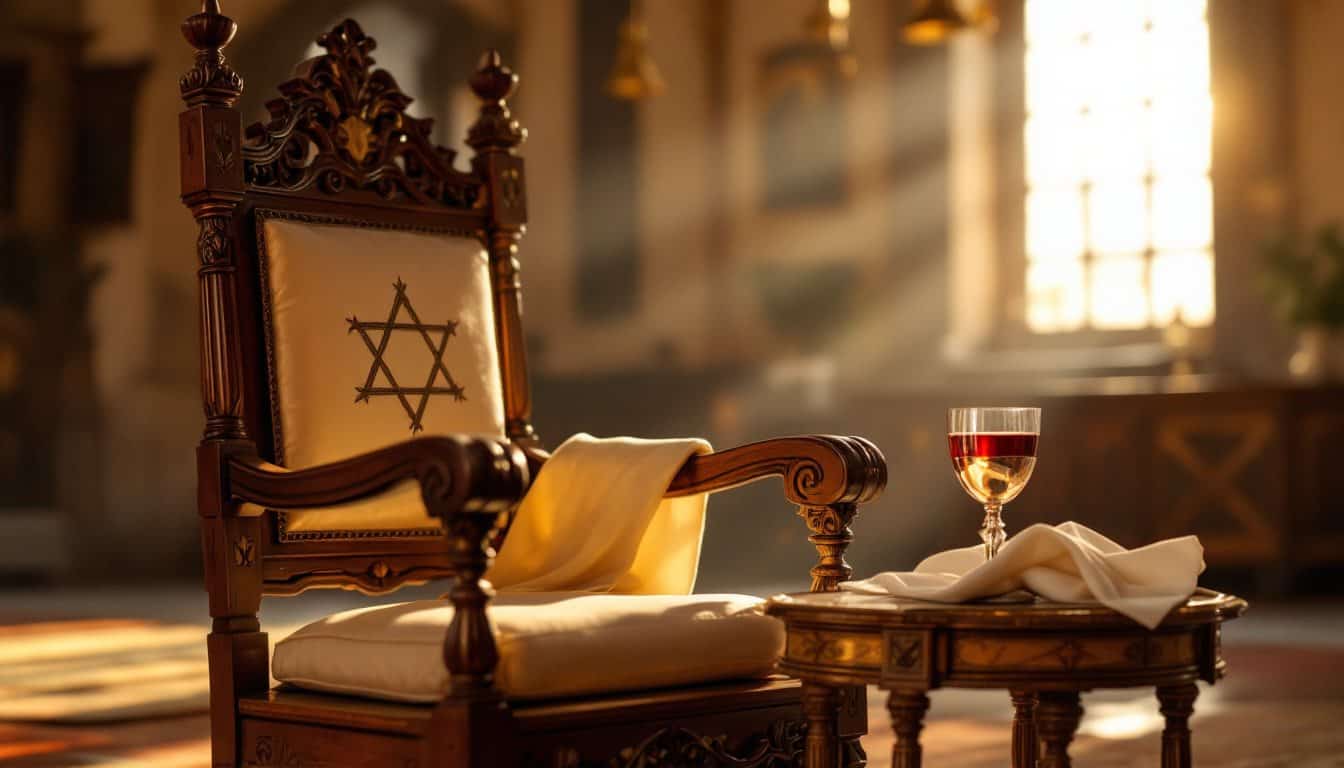
Eight days after a baby boy is born, the family gathers, often in the synagogue, around an empty chair, a cup of wine and a man called the mohel. In a few moments, the child enters “the covenant of Avraham” and receives his name. Why have Jews practiced circumcision for thousands of years, even under persecution, and why on the eighth day precisely? Here are the texts, the reasons, the history and the deeper meaning of this act.
In short: the brit milah (Hebrew for “covenant of circumcision”) is the commandment, given by G-d to Avraham, to circumcise every Jewish boy on the eighth day of his life (Bereshit 17:10-12; Vayikra 12:3). It is not primarily a hygienic practice or a mere custom: the Torah calls it a “sign of the covenant” and an “everlasting covenant.” It inscribes in the child’s very flesh his belonging to the people of Israel and the bond that unites this people to G-d. The Talmud considers it so important that it is performed even on Shabbat, but never at the expense of the child’s health: a sick or fragile baby is circumcised later. The Sages saw several meanings in it: completing what nature left unfinished, mastering desire, and going beyond the natural order, symbolized by the number eight.
What the Torah says: the covenant with Avraham
It all begins in the book of Bereshit (Genesis), chapter 17. Avram is ninety-nine years old. G-d appears to him and says: “Walk before Me and be perfect” (Bereshit 17:1). He changes his name to Avraham, “father of a multitude of nations,” and gives him a commandment that concerns his own flesh:
“This is My covenant which you shall keep, between Me and you and your descendants after you: every male among you shall be circumcised. You shall circumcise the flesh of your foreskin, and it shall be a sign of the covenant between Me and you. At the age of eight days, every male among you shall be circumcised, throughout your generations” (Bereshit 17:10-12).
The text adds: “My covenant shall be in your flesh as an everlasting covenant” (17:13). And it specifies that the uncircumcised male “shall be cut off from his people: he has broken My covenant” (17:14). This cutting off, karet, one of the gravest sanctions in the Torah, is not a penalty imposed by human beings: it is a severance between a person and the source of his spiritual life.
Avraham obeys that very day. He circumcises himself and his son Yishmael, then thirteen years old, as well as all the men of his household (Bereshit 17:23-27). A year later Yitzchak is born, the first Jewish child circumcised on the eighth day: “Avraham circumcised his son Yitzchak at the age of eight days, as G-d had commanded him” (Bereshit 21:4).
The commandment is repeated in the book of Vayikra (Leviticus), among the laws concerning childbirth: “And on the eighth day, the flesh of his foreskin shall be circumcised” (Vayikra 12:3). Tradition counts it among the 613 commandments of the Torah; it is even the second mitzvah in the Sefer HaChinuch, right after the commandment to have children.
What does “brit milah” mean?
The word brit means “covenant,” a mutual commitment. In the Bible, covenants are “cut”: the Hebrew literally says “to cut a covenant” (karat brit). Circumcision is the covenant cut into the body itself.
The word milah means “cutting,” “circumcision.” In Hebrew, the same word also means “word,” “speech.” We will come back to this double meaning with the teaching of Rav Benizri.
People also say simply “the brit” or, among Ashkenazim, “the bris.” The foreskin is called orlah in Hebrew, a word that more broadly designates a covering, a closure, an obstacle. The Torah thus speaks of “uncircumcised lips” (Shemot 6:12), that is, of impeded speech.
The circumcision of the heart
The prophets and the Torah itself show that circumcision does not concern the body alone. “Circumcise the foreskin of your heart, and stiffen your neck no more” (Devarim 10:16), Moshe tells the people. And further on: “The L-rd your G-d will circumcise your heart and the heart of your descendants, so that you will love the L-rd your G-d with all your heart” (Devarim 30:6). The prophet Yirmiyahu (Jeremiah) takes up the same image (Yirmiyahu 4:4).
In Jewish tradition, the circumcision of the heart does not replace that of the flesh: it completes it. The physical act is the starting point; it calls for a whole inner work of removing whatever blocks the heart, the ear and speech.
Why the eighth day?
Why wait eight days, no more and no less? The Sages offered several complementary answers.
A reason of family joy
The Talmud reports a question that the students of Rabbi Shimon bar Yochai asked him: why did the Torah say to circumcise on the eighth day? He answered: “So that everyone should not be rejoicing while the father and mother are sad” (Niddah 31b). According to the Torah, during the first seven days the mother is in a state of ritual impurity connected with the birth (Vayikra 12:2). On the eighth day, she can take full part in her son’s celebration.
A number beyond nature
A deeper explanation, developed in particular by the Maharal of Prague, focuses on the number itself. The world was created in seven days, and the week returns endlessly: seven is the number of nature, of the cycle, of what repeats itself. Eight is what goes beyond that cycle. The child has lived through one Shabbat, one complete week of creation; on the eighth day, he is made to cross a boundary that nature alone does not cross. It is no coincidence that Chanukah lasts eight days.
A child who chose nothing
People often object that an eight-day-old child has not chosen anything. The Midrash knows this objection. It relates that Yishmael boasted to Yitzchak: “I was circumcised at thirteen, I could have refused; you were only eight days old.” Yitzchak replied: “If G-d asked me for all my limbs, I would not refuse.” (Talmud, Sanhedrin 89b; Bereshit Rabbah 55). Circumcision on the eighth day is not an adult’s adherence to an idea, but a child’s entry into a story that precedes him, just as one receives a mother tongue or a name; it is then up to him to make this covenant his own.
The reasons for circumcision according to the Sages
The Torah gives no explanation beyond the “sign of the covenant.” Jewish masters have nevertheless reflected on the ta’amei hamitzvot, the reasons for the commandments, while recalling that one performs a mitzvah first and foremost because G-d commanded it.
Completing what G-d left unfinished
The Midrash Tanchuma (Tazria 5) reports a famous dialogue between Rabbi Akiva and the Roman governor Turnus Rufus. The Roman asks whose works are more beautiful, G-d’s or man’s. Man’s, answers Rabbi Akiva, showing him ears of wheat and loaves of bread. Turnus Rufus then asks: “If He wants people to be circumcised, why isn’t the child born circumcised?” And Rabbi Akiva answers that G-d gave the mitzvot to Israel so that they would be refined through them.
The idea is taken up by the Sefer HaChinuch (mitzvah 2). G-d wanted man not to be born complete, to show him that just as the perfection of his body depends on his own hand, the perfection of his soul depends on his deeds. Man is called to become the Creator’s partner.
Mastering desire
The Rambam (Maimonides), in his Guide for the Perplexed (Moreh Nevuchim III, 49), gives two reasons. The first is moral: circumcision moderates sexual desire, without abolishing it, and helps a man remain master of his impulses rather than their slave. The organ through which life is passed on bears the mark of a limit. The second reason is collective: it is a sign shared by all who believe in the unity of G-d, uniting them into a single people. No one inflicts such a mark on himself for a belief he does not hold dear, he points out.
A sign in the body
The Talmud relates that King David, on entering a bathhouse, was distressed to find himself “naked of every mitzvah.” Then he saw his circumcision, and his mind was set at ease (Menachot 43b). Tefillin are put on and then taken off; the brit milah, by contrast, accompanies a man at every moment, until his death.
A covenant that cannot be broken
The Mishnah teaches: “Great is circumcision, for thirteen covenants were made over it” (Nedarim 3:11), an allusion to the thirteen times the word brit appears in chapter 17 of Bereshit. It adds that Avraham, despite all his mitzvot, was called “perfect” only after his circumcision, according to the verse “Walk before Me and be perfect.”
How a brit milah takes place today
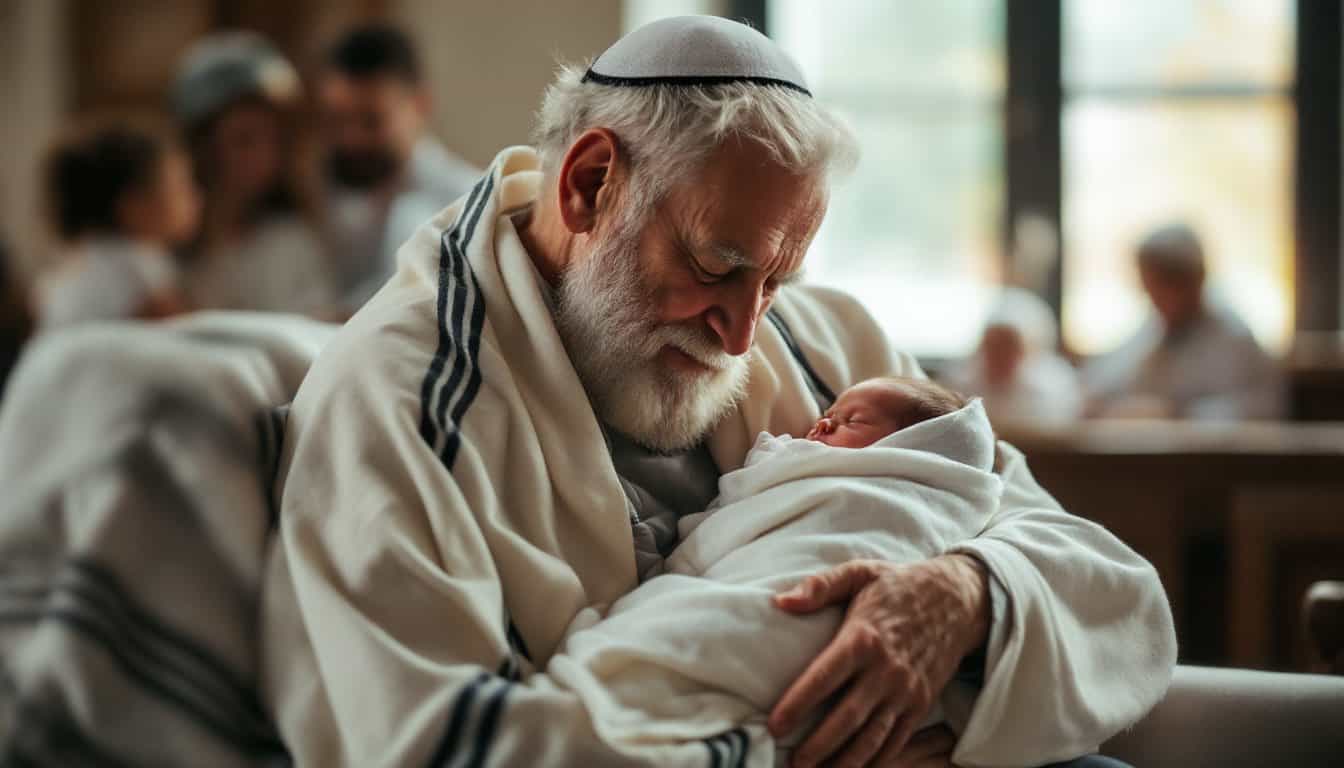
The brit normally takes place on the morning of the eighth day, counting the day of birth (a child born on a Monday is circumcised the following Monday). Since the Jewish day begins at sunset, a child born in the evening after nightfall is counted as born the next day. The Sages teach that it is done in the morning, with eagerness, following the example of Avraham, who “rose early in the morning” (Bereshit 22:3; Talmud, Pesachim 4a).
The participants
- The father is the one primarily bound by the mitzvah. Most often he delegates it to the mohel, while remaining present.
- The mohel is the specialist, trained in Jewish law as well as in hygiene and in the procedure itself.
- The sandak is the person who holds the child on his knees during the circumcision; it is a great honor, often given to a grandfather or a rabbi.
Eliyahu’s chair
In the room, a special chair is prepared, often richly decorated, called the kisei shel Eliyahu, the “chair of the prophet Elijah.” According to Pirkei deRabbi Eliezer (chapter 29), the prophet, who had complained to G-d that the children of Israel had “forsaken Your covenant” (Melachim I 19:10), was told in reply that from then on he would attend every circumcision to witness their faithfulness for himself. He is therefore symbolically welcomed, and the child is placed on this chair for a moment.
The act and the blessings
The act itself lasts only a few moments. It has three stages described in the Mishnah (Shabbat 19:2): the milah, the removal of the foreskin; the periah, which uncovers the glans; and the metzitzah, which consists of drawing a little blood from the wound, originally as a health measure. The way it is performed varies between communities (many mohalim today use a sterile tube); everyone should follow the opinion of their own rabbi.
The mohel recites the blessing “al hamilah,” “on circumcision.” The father says: “Blessed are You… who has commanded us to bring him into the covenant of Avraham our father.” The assembly answers with one voice: “Just as he has entered the covenant, so may he enter into Torah, the wedding canopy and good deeds” (Shabbat 137b). The whole program of a Jewish life is there: study, marriage, kindness.
The name
It is during the brit that the child’s Hebrew name is announced, in a prayer recited over a cup of wine. The connection is an ancient one: it was at the moment of his covenant that Avram became Avraham. At this point the verse from Yechezkel (Ezekiel) is quoted: “I said to you: in your blood, live!” (Yechezkel 16:6).
Shabbat, health and special cases
The brit milah on the eighth day is so important that it is performed even on Shabbat (Mishnah Shabbat 19:1-2), and even on Yom Kippur: the Talmud derives this from the words “and on the eighth day” (Shabbat 132a), which make no exception. It is one of the few mitzvot that override the prohibitions of Shabbat. There are limits, however: a child born by Caesarean section, for example, is circumcised on the eighth day, but not if that day falls on Shabbat (Shabbat 135a).
Above all, Jewish law is categorical: a child’s life or health is never put at risk for the sake of circumcision. “Danger to life overrides everything”; one can always circumcise later, but one cannot give back a life (Rambam, Hilchot Milah 1:18). A premature baby, a sick baby or one with significant jaundice waits until he has recovered, and seven full days are then counted after his complete recovery before the brit. The Talmud goes so far as to exempt from circumcision a child whose two older brothers died as a result of theirs (Yevamot 64b). The laws of circumcision are gathered in the Shulchan Aruch, Yoreh De’ah 260 to 266; for any particular case, one should consult a rabbi and a doctor.
If the father does not have his son circumcised, the obligation passes to the rabbinical court, that is, to the community, and failing that, the man, once an adult, must have himself circumcised (Rambam, Hilchot Milah 1:1-2). A child born without a foreskin, or a convert who is already circumcised, receives a hatafat dam brit, a single drop of blood drawn as a sign of the covenant (Shabbat 135a). For a man converting to Judaism, circumcision is one of the conditions of conversion, together with immersion in the mikveh (Keritot 9a).
A faithfulness that has spanned history
Circumcision is very ancient. Other peoples of the Near East practiced it: the Greek historian Herodotus, in the 5th century BCE, mentions the Egyptians (Histories II, 104), and Egyptian depictions bear witness to it. But among them it was most often a rite of passage into adolescence or a custom of a particular caste. Among the Hebrews it took on an entirely different meaning: it is performed on the eighth day, on the newborn, as the sign of a covenant with the one G-d.
The Bible recounts several moments when this covenant is at stake. On the way to Egypt, Tzipporah, Moshe’s wife, circumcises their son herself to ward off a mortal danger (Shemot 4:24-26). Before the Exodus, the Torah forbids any uncircumcised man to eat the Passover lamb (Shemot 12:48); the Midrash says that Israel was saved by two bloods, the blood of the Pesach offering and the blood of the milah. During the forty years in the desert, there was no circumcision, because of the dangers of the journey; Yehoshua (Joshua) circumcised the whole people on entering the Land of Israel, at Gilgal (Yehoshua 5:2-9).
Jewish history is also the history of attempts to ban the brit. Around 167 BCE, the Greek king Antiochus IV Epiphanes outlawed it in Judea; the First Book of Maccabees reports that mothers were put to death with their circumcised infants (1 Maccabees 1:60-61). This is the background of the Hasmonean revolt, which Chanukah commemorates. Three centuries later, the emperor Hadrian in turn banned circumcision, which, according to many historians, contributed to the Bar Kochba revolt (132-135). The Jews of the Inquisition, and later those of the Soviet Union, practiced it in secret, at the risk of their freedom. And, as Rav Benizri points out, persecutors had only to check whether a man was circumcised to know whether he was a Jew.
This is why the brit is spoken of as a mitzvah for which the Jewish people gave their lives. The Talmud teaches that the mitzvot for which Israel sacrificed itself, such as circumcision, have remained firmly rooted in it (Shabbat 130a). Even today, the vast majority of Jewish families, even those who are not very observant, make a point of holding a brit for their sons.
Misconceptions about circumcision
“It’s a hygiene measure.” Medical studies have shown certain benefits of male circumcision, and the World Health Organization recommends it in some regions to reduce the transmission of HIV. But that is not the reason given by the Torah, and the Rambam does not present it as a medical measure: it is a covenant, not a preventive operation.
“Someone who is not circumcised is not Jewish.” That is false. A Jew is someone born to a Jewish mother or who has converted according to Jewish law. An uncircumcised Jew is failing to fulfill an important mitzvah, but he remains fully Jewish. The brit is a sign of belonging, not its condition.
“Girls are circumcised too.” No. Judaism has never practiced any form of female “circumcision.” The birth of a girl is celebrated by giving her name in the synagogue during the Torah reading and, among many Sephardim, by a celebration called zeved habat, “the gift of the daughter.”
What Rav Raphaël Benizri teaches
Rav Benizri devoted several lectures to chapter 17 of Bereshit. Here are their main ideas.
Do not believe that nature is perfect
In Lech Lecha: the dialogue of revelation, the Rav starts from the command given to Avraham: “Walk before Me and be perfect.” One must not wait for revelation: one must go out to meet it. That, he explains, is the whole difference between someone who practices circumcision and someone who refrains from it. To refrain from it amounts to considering that nature, as it is made, is perfect, and that nothing in it should be touched. Yet perfection within the order of nature is impossible.
A re-creation of the being
In the same lecture, the Rav links the word brit, covenant, to the word beriah, creature, creation. One must not think, he says, that a circumcised man is simply someone who has undergone a minor operation: true circumcision brings about a re-creation of the being. That is why, performed on the eighth day, it represents a going beyond the order of nature and even overrides Shabbat. But he immediately stresses the limit: if the child is not fit for it, it is postponed, for we will not deprive him of the possibility of keeping other Shabbatot.
Three covenants, one of them everlasting
The Rav distinguishes three covenants. The covenant of the rainbow, the covenant of space, binds all of humanity. The Jewish people is concerned by two others: that of Shabbat, the covenant of time, and that of circumcision, the covenant of being. The latter is called an “everlasting covenant”: nothing can annul it. That is why, he explains, a Jew who does not perform it remains Jewish: he is at fault, but he does not cease to belong. And if a child has no one to have him circumcised, the community bears that responsibility, because belonging precedes the act.
To those who object that this covenant concerns only men, the Rav answers with the expression of the prophet Malachi, “the wife of your covenant” (Malachi 2:14): man and woman form a single entity, and the circumcision a man performs, he performs for two.
Cutting away four excrescences
In Vayera: the promises to Avraham (part 1), the Rav explains that true kindness, chesed, unconditional love, is possible only after the milah. Unconditional love requires that it first be cut free of its excrescences, of which there are four: that of the flesh, that of the heart and of desire, that of speech that oversteps its limits, and that of the ear that lends itself to every kind of conditioning. They correspond to the four planes of human life: physical, psychological, intellectual and spiritual. Creation, he recalls, is contained in seven days; the milah is situated on the eighth, outside that framework.
Spiritual life is not a compromise
Avraham had three friends, Aner, Eshkol and Mamre. According to the Midrash the Rav comments on, two of them tried to dissuade him: your morality is very beautiful, but this amputation in your flesh serves no purpose. They did not see, says the Rav, that the support of all spirit is the flesh. Only Mamre encouraged him, and it was at the oaks of Mamre that G-d then revealed Himself. For the Rav, circumcision must teach the world that spiritual life is not a compromise.
The cut in the flesh and in speech
Finally, in Lech Lecha: Avraham against Pharaoh, the Rav returns to the double meaning of the word milah: the cut and the word. There are two ways of having descendants, he says: through the body and through the word, that is, through education. The cut must therefore be made both in the flesh and in language. And he warns: to reduce the brit to a mere sign of identity, a practice of convenience, is to miss what it is. It only has meaning if it is accompanied by a living transmission of the Torah.
Frequently asked questions about brit milah
Why do Jews practice circumcision?
Because G-d commanded it to Avraham as a “sign of the covenant” between Himself and his descendants (Bereshit 17:10-11), and the Torah repeats it for every generation (Vayikra 12:3). The Sages also see in it a call to perfect nature, to master one’s desires and to bear in one’s body the sign of belonging.
Why exactly the eighth day?
Because the Torah sets it that way. The Talmud sees in it a concern that the parents be able to rejoice fully (Niddah 31b). The masters also read in it the symbolism of the number eight, which goes beyond the seven-day cycle of creation and of nature.
What happens if the eighth day falls on Shabbat?
The brit takes place on Shabbat, and even on Yom Kippur, because it overrides those prohibitions (Shabbat 132a). There are, however, exceptions, for example for a child born by Caesarean section. The details are a matter for a rabbi.
Is circumcision dangerous?
Performed by a competent mohel on a healthy child, it is a brief procedure. Jewish law absolutely forbids circumcising a child whose health could suffer from it: one then waits for his complete recovery.
Can an adult have a brit milah?
Yes. A Jew who was not circumcised in childhood, for example in the Soviet Union, can have it done at any age, under anesthesia and in good medical conditions.
Further reading
- Lech Lecha: the dialogue of revelation
- Vayera: the promises to Avraham (part 1)
- Lech Lecha: Avraham against Pharaoh
- Lech Lecha: Avraham’s journey
- Why eight candles on Chanukah? The meaning of the 8 lights
- Who is a Jew? And how does one become Jewish?
- What is a bar mitzvah and a bat mitzvah?
- What is Shabbat?
- Glossary of Hebrew terms in Judaism
Sources and references
- Torah: Bereshit (Genesis) 17:1-14 and 17:23-27; Bereshit 21:4; Bereshit 22:3; Vayikra (Leviticus) 12:2-3; Shemot (Exodus) 4:24-26; Shemot 6:12; Shemot 12:48; Devarim (Deuteronomy) 10:16; Devarim 30:6
- Prophets: Yehoshua (Joshua) 5:2-9; Melachim I (1 Kings) 19:10; Yirmiyahu (Jeremiah) 4:4; Yechezkel (Ezekiel) 16:6; Malachi 2:14
- Mishnah Shabbat 19:1-2; Mishnah Nedarim 3:11
- Babylonian Talmud: Shabbat 130a, 132a, 135a, 137b; Pesachim 4a; Niddah 31b; Menachot 43b; Sanhedrin 89b; Yevamot 64b; Keritot 9a
- Midrash: Bereshit Rabbah 55; Midrash Tanchuma, Tazria 5; Pirkei deRabbi Eliezer, chapter 29
- Rambam, Moreh Nevuchim (Guide for the Perplexed) III, 49; Mishneh Torah, Hilchot Milah 1:1-2 and 1:18
- Sefer HaChinuch, mitzvah 2
- Shulchan Aruch, Yoreh De’ah 260 to 266
- Maharal of Prague, on the symbolism of the numbers seven and eight
- Herodotus, Histories II, 104; First Book of Maccabees 1:60-61
- Lectures by Rav Raphaël Benizri: Lech Lecha: the dialogue of revelation; Vayera: the promises to Avraham (part 1); Lech Lecha: Avraham against Pharaoh
Article by the Pensées Juives editorial team. Passages attributed to Rav Raphaël Benizri are taken from his lectures published on this site.