
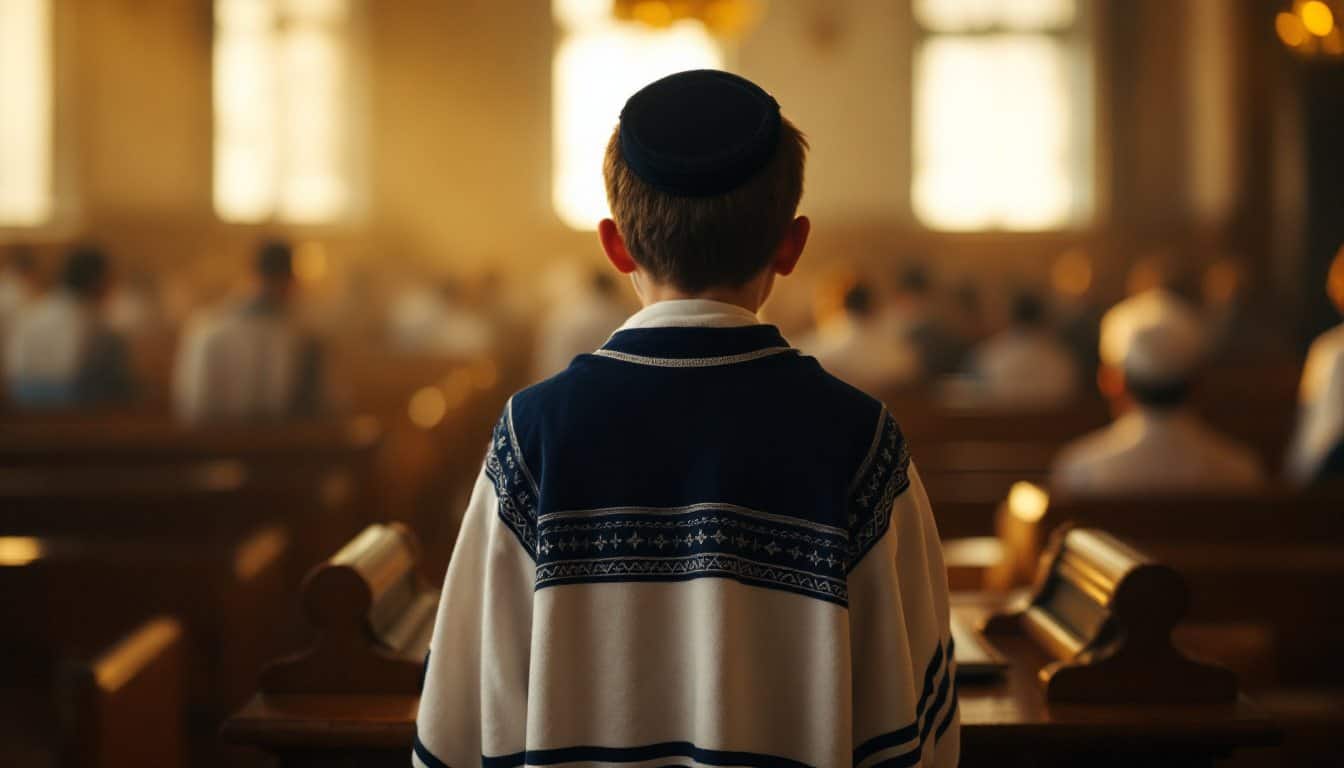
You hear about it through an invitation, a film or a family photo: a thirteen-year-old boy goes up to the Torah, surrounded by his family, and the congregation showers him with candies. But what really happens on that day? Why thirteen for a boy and twelve for a girl? Is it a ceremony, an exam, a rite of passage? Here is a complete answer: the meaning of the words, the sources in the Torah and the Talmud, the history of the celebration, today’s practice, and what this milestone means at its deepest level.
In short: bar mitzvah (for a boy) and bat mitzvah (for a girl) mean “son of the commandment” and “daughter of the commandment”. It is not first and foremost a celebration but a status: the age from which a young Jew becomes fully responsible for the mitzvot, the commandments of the Torah. According to tradition, a boy becomes bar mitzvah on completing 13 years and a girl becomes bat mitzvah on completing 12 years, counted according to the Hebrew calendar (Mishnah Avot 5:21; Mishnah Niddah 5:6). On that day, he or she becomes an adult in the eyes of Jewish law, even if nothing is celebrated: the party comes afterwards to mark the transition. For a boy, it usually includes putting on tefillin for the first time and being called up to the Torah; for a girl, customs vary from one community to another.
What do “bar mitzvah” and “bat mitzvah” mean?
The word bar is Aramaic and means “son”; bat is Hebrew and means “daughter”. The word mitzvah (plural mitzvot) means “commandment”. But in Hebrew, “son of” does not only express parentage: it is also a way of saying that someone belongs to a category. A ben chayil, a “son of strength”, is a valiant man; a ben Torah, a “son of Torah”, is a man who lives according to the Torah. A bar mitzvah is therefore “one who falls under the commandments”, the one to whom they are addressed.
The expression is an old one. The Talmud already uses it, not for a thirteen-year-old boy, but for anyone who is subject to the commandments (Bava Metzia 96a). Only in the Middle Ages did it take on its present meaning: the age at which a child becomes obligated, and then the celebration that marks that moment.
It is also spelled “bar mitzva” or “bar mitsvah”. People say a boy “has his bar mitzvah”, but it would be more accurate to say that he becomes bar mitzvah: this nuance lies at the heart of the subject.
At what age? Thirteen for boys, twelve for girls
The Mishnah
The best-known source is found in the Ethics of the Fathers. There, Yehudah ben Tema describes the stages of a life: “At five, the study of Scripture; at ten, the Mishnah; at thirteen, the mitzvot; at fifteen, the Talmud; at eighteen, marriage…” (Pirkei Avot 5:21). Thirteen is therefore the age at which one moves from learning to responsibility.
The Mishnah in tractate Niddah spells this out with regard to vows, that is, the capacity to bind oneself by one’s word (Niddah 5:6). When a girl is eleven years and one day old, her vows are examined to see whether she understands what she is promising; at twelve years and one day, her vows are valid. For a boy, the same pattern applies one year later: he is examined at twelve years and one day, and at thirteen years and one day his vows are fully valid. The halachic authorities set the rule on this basis: a girl becomes bat mitzvah at the beginning of her thirteenth year, a boy at the beginning of his fourteenth (Rambam, Mishneh Torah, Hilchot Ishut, chapter 2).
Why these ages?
The Written Torah does not explicitly set the age of religious majority. The great medieval authorities, such as the Rosh (Rabbeinu Asher, 13th-14th century), explain that ages and measurements of this kind belong to the shiurim, measures handed down orally from Sinai together with the Torah (Responsa of the Rosh, klal 16). It is the Oral Torah that preserved them.
The commentators nonetheless looked for support in the text. Rashi (Nazir 29b, and on Pirkei Avot 5:21) finds it in the episode of Shechem: the Torah says that Shimon and Levi, the sons of Yaakov, took “each man his sword” (Bereshit (Genesis) 34:25). The Hebrew word used is ish, “man”. Now, according to the traditional chronology, Levi was thirteen at the time: so it is at this age that the Torah calls someone a “man”.
Why a year earlier for girls? The Talmud explains it this way: “G-d gave woman additional understanding (binah) compared to man” (Niddah 45b). It derives this from the verse describing the creation of woman, “vayiven”, “He built” (Bereshit 2:22), a word that shares its root with binah. Maturity comes earlier in girls, and Jewish law takes this into account.
Thirteen years, and not only thirteen years
In theory, religious majority depends on two conditions: age, and the appearance of the first physical signs of puberty (Niddah 52a). In practice, these signs are presumed to be present at that age, and the young person is treated as an adult. For certain very specific legal questions, the authorities are stricter; for everyday religious life, age is enough.
The count follows the Hebrew calendar, not the civil calendar. A boy born on 5 Cheshvan becomes bar mitzvah on 5 Cheshvan of the year he turns thirteen, starting from nightfall the evening before, since the Jewish day begins in the evening. Because the Hebrew calendar is both lunar and solar, the civil date changes from year to year. For a child born in Adar, or around sunset, a precise calculation is needed: consult a rabbi.
A status, not a ceremony
This is the most widespread misconception: people think one becomes Jewish, or an adult, through the ceremony. In reality, a boy becomes bar mitzvah on his thirteenth birthday automatically, whether or not there is a party, whether or not he goes up to the Torah, whether or not he can read Hebrew. A Jew who never had a bar mitzvah ceremony has been bar mitzvah since the age of thirteen: he is bound by the commandments like anyone else.
Conversely, the ceremony confers nothing: it is not a sacrament, an exam, or a “confirmation” that would bring the child into Judaism. One is born Jewish to a Jewish mother, or becomes Jewish through conversion. What changes at the bar mitzvah is not identity: it is responsibility.
In practical terms, from that day on:
- the young person is bound by all the mitzvot of the Torah, and is responsible for his or her actions before G-d;
- the boy puts on tefillin every weekday morning, and he counts towards the minyan, the quorum of ten men required for public prayer (Shulchan Aruch, Orach Chaim 55);
- he can be called up to the Torah and recite the blessings over the reading, and he can perform a mitzvah on behalf of others, for example by saying kiddush;
- he fasts on Yom Kippur and on the other fast days, and a girl does the same from the age of twelve (Shulchan Aruch, Orach Chaim 616:2);
- his vows and commitments have legal force, and he can serve as a witness in certain cases.
Before the bar mitzvah: the time of education
The fact that a child is not obligated in the mitzvot before thirteen does not mean that he does not practise them. The Sages require parents to prepare the child for them: this is the mitzvah of chinuch, “education” or “training”. The Mishnah teaches that a small child who no longer needs his mother must already be accustomed to the sukkah (Sukkah 2:8), and the Talmud adds that a child who knows how to shake the lulav must do so (Sukkah 42a). In the same way, children are taught to pray, to say blessings, and to fast for a few hours on Yom Kippur before they are obligated to (Shulchan Aruch, Orach Chaim 616:2).
King Shlomo sums up this principle in an often-quoted verse: “Train the youth according to his way; even when he grows old, he will not depart from it” (Mishlei (Proverbs) 22:6). Jewish education does not mean forcing a child into a mould, but guiding each child according to who he is, so that on the day he comes of age he is ready to carry for himself what has been passed on to him.
This is why the Midrash records a striking statement by Rabbi Elazar. Until the age of thirteen, he says, a father must take care of his son; from then on, he must say: “Blessed is He who has freed me from the punishment of this one” (Bereshit Rabbah 63:10). Until the bar mitzvah, the child’s misdeeds fall, so to speak, on his parents, who are responsible for his education. After that, each answers for himself. This blessing, Baruch shepetarani, is recited by the father when his son goes up to the Torah for the first time (Rema, Shulchan Aruch, Orach Chaim 225:2); according to Ashkenazi custom it is said without mentioning the Divine Name, and many Sephardim say it as well, without the Name.
Why thirteen? The deeper reasons
The simple level: the maturity of reason
At thirteen, a child begins to grasp for himself the consequences of his actions and the weight of his word, hence the link the Mishnah makes with vows (Niddah 5:6). Jewish law waits for the moment when reason can answer for what the body does.
The moral level: choice becomes personal
The Midrash relates that Yaakov and Esav, the two brothers, grew up together without anyone being able to tell their paths apart; but at thirteen, one turned to the houses of study and the other to idolatry (Bereshit Rabbah 63:10; Rashi on Bereshit 25:27). Thirteen is the age at which paths diverge, because each person begins to choose. Before, the child follows; from then on, he decides.
Another story in the Torah illustrates this passage from the child who undergoes to the adult who consents. Avraham circumcised his son Yishmael when he was thirteen (Bereshit 17:25), whereas Yitzchak would be circumcised at eight days old. The Midrash relates that Yishmael boasted about it: he had consented, whereas his brother had chosen nothing (Bereshit Rabbah 55:4). We will see below how Rav Benizri reads this dialogue.
The inner level: the arrival of the good inclination
Jewish tradition describes man as inhabited by two forces: the yetzer hara, the evil inclination, or more precisely the inclination of desires and instincts, and the yetzer hatov, the good inclination. According to Avot deRabbi Natan (chapter 16), the yetzer hara is present from birth, whereas the yetzer hatov only fully awakens at thirteen. The Midrash on the book of Kohelet (Ecclesiastes) expresses this through an image: “the old and foolish king” mentioned in the verse (Kohelet 4:13) is the evil inclination, thirteen years older than the good one (Kohelet Rabbah 4:13).
The bar mitzvah therefore marks the moment when a person finally has both forces at his disposal, and when free will truly begins. The point is not to suppress desires, but to govern them. With the arrival of the good inclination, the child becomes capable of choosing between what he wants and what he must do.
“Greater is one who is commanded”
One might think it is better to do good freely, without being obliged to. The Talmud says the opposite: “Greater is one who is commanded and performs than one who is not commanded and performs” (Kiddushin 31a). Tosafot, the school of French commentators on the Talmud, explains it this way: one who is commanded is more anxious and more attentive, because he fears failing in his obligation, whereas one who is not commanded can always stop whenever he likes. Others add that the inclination rebels against what is imposed: fulfilling a commandment means winning a victory over oneself. The bar mitzvah therefore takes nothing away from the child’s freedom: it gives his actions new weight. That is what makes it a joy, and not a burden.
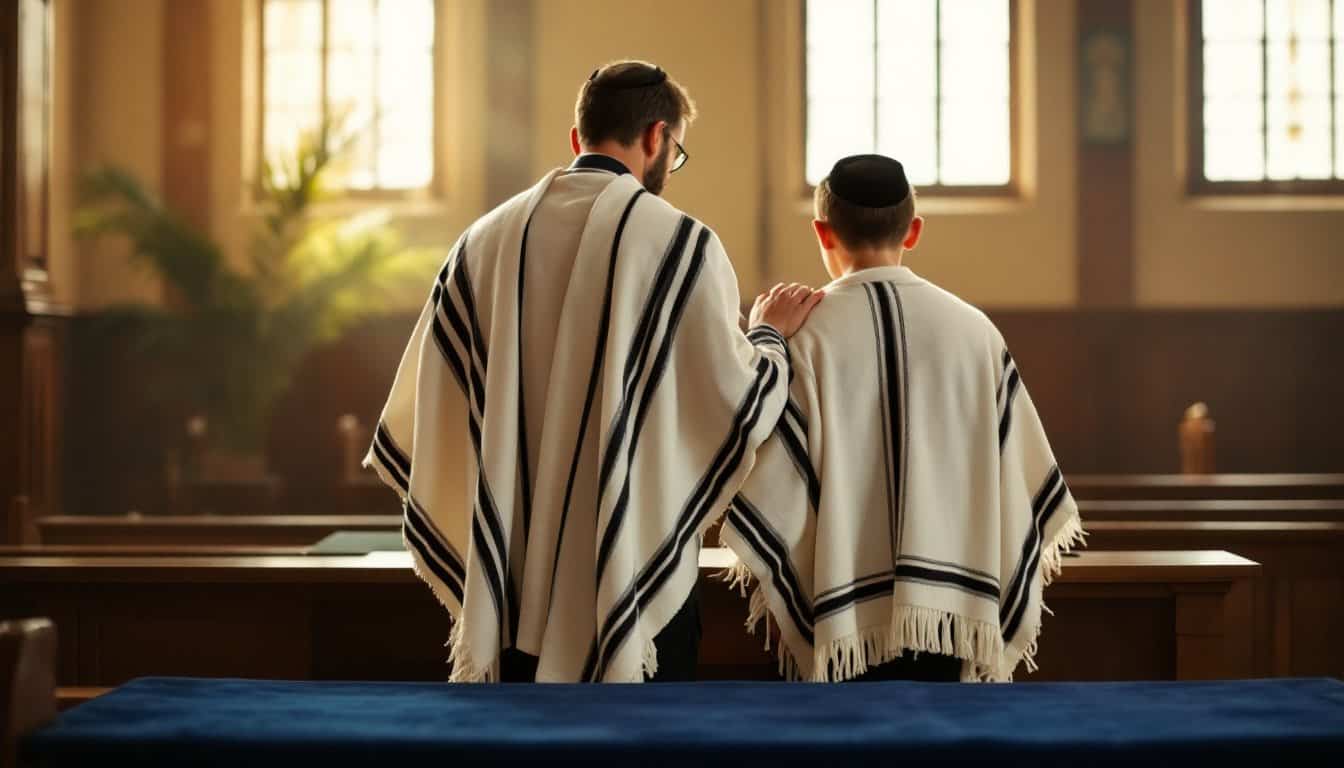
How does a bar mitzvah take place today?
Customs vary greatly from one community to another, whether Ashkenazi, Sephardi, Chassidic or Moroccan. Here are the most common elements.
Tefillin
For a boy, the most important act is putting on tefillin, the two black leather boxes containing verses from the Torah, worn on the arm and on the head during morning prayer. According to the Shulchan Aruch, a child who knows how to keep them in purity may already put them on (Orach Chaim 37:3); the Rema, however, records the custom of waiting until thirteen (ibid.), and today many begin shortly before the bar mitzvah, a few weeks or a few months depending on the community, in order to get used to them. In many Sephardi families, especially Moroccan ones, putting on tefillin for the first time is a real celebration, often on a Monday or a Thursday, the weekdays on which the Torah is read, with songs and piyutim, liturgical poems.
Going up to the Torah
On the first Shabbat, or the first day of Torah reading after his date, the young man is called up to the Torah: this is the aliyah, the “going up”. He recites the blessings before and after the reading. Depending on his abilities and on custom, he himself reads part of the parashah, the weekly portion, with its cantillation, or the haftarah, the passage from the Prophets. It is often the fruit of many months of preparation. It is at this moment that the father says “Baruch shepetarani”. In many synagogues, the congregation then throws candies at the young man, to wish him a sweet life.
The Torah speech
The young man often delivers a speech on the weekly parashah or on a mitzvah, called a drashah in Yiddish-speaking circles and a dersha among Sephardim. The custom is an old one: in the 16th century, the Maharshal, Rabbi Shlomo Luria, mentions the boy who “gives a discourse” at his bar mitzvah meal (Yam Shel Shlomo, Bava Kamma 7:37). What matters is not oratorical performance, but showing that one is beginning to study on one’s own.
The festive meal
The same Maharshal writes that the meal held for a bar mitzvah is a seudat mitzvah, a meal that is part of the mitzvah itself, and he adds that there is no greater seudat mitzvah than this one (Yam Shel Shlomo, Bava Kamma 7:37). The Magen Avraham, in the 17th century, teaches that it is a mitzvah for a father to hold a meal on the day his son becomes bar mitzvah, as on the day of his wedding (Magen Avraham on Orach Chaim 225:4). The Sages have always stressed that the joy of this meal must remain the joy of a mitzvah, and not a display of wealth.
What about the bat mitzvah?
A girl becomes bat mitzvah on completing twelve years, exactly as a boy becomes bar mitzvah at thirteen: no ceremony is needed, it happens simply by virtue of age. From then on, she is bound by the mitzvot that apply to women: prayer, Shabbat and its laws, the rules of kashrut, the Yom Kippur fast, lighting candles in families where young girls light, and all the moral laws of the Torah.
For a long time, the bat mitzvah was not marked by any particular celebration. Things changed in modern times, and the great rabbis turned their attention to it. In Baghdad, in the 19th century, the Ben Ish Chai, Rabbi Yosef Chaim, already recommended that a girl on the day of her bat mitzvah should rejoice, put on a new garment and recite the Shehecheyanu blessing (Ben Ish Chai, first year, parashat Re’eh, 17). Rav Ovadia Yosef wrote that a meal held on this occasion, accompanied by words of Torah, is a seudat mitzvah (Yechaveh Da’at II, 29). Other authorities, such as Rav Moshe Feinstein, warned against a synagogue ceremony modelled on that of the boys (Igrot Moshe, Orach Chaim I, 104), while accepting a family celebration.
Today, depending on the community, the bat mitzvah is celebrated with a family meal, a Torah speech given by the girl, a chesed project (acts of kindness towards others), the study of a theme connected to the women of the Bible, or an evening with her friends. In liberal communities, girls go up to the Torah just like boys; in Orthodox communities, this is not the custom. Each person will follow the tradition of his or her community.
A little history
The Talmudic sources set the age of majority, but they describe no ceremony. The earliest evidence of any form of celebration is found in the minor tractate Soferim, written in the period of the Geonim: in Jerusalem, children were trained to fast on Yom Kippur, and then brought before the elders so that they would bless them and pray that they merit Torah and good deeds (Masechet Soferim 18:7).
The bar mitzvah as we know it took shape in the Middle Ages, first in the communities of Germany and Central Europe. There we see the appearance of the “Baruch shepetarani” blessing, quoted by several masters of the period, and then the boy going up to the Torah on the very first Shabbat of his majority. In the 16th century, the Maharshal in Poland describes the festive meal and the speech, and in the 17th century the Magen Avraham makes it an obligation for the father. The historian Michael Hilton traced this development in detail in his book Bar Mitzvah, a History (2014).
The first known public bat mitzvah in a synagogue was that of Judith Kaplan, in New York, on 18 March 1922, organised by her father, Rabbi Mordecai Kaplan. Since then, bat mitzvah celebrations have spread across all movements, in forms that reflect the sensibilities of each.
Finally, there is a touching custom: some men celebrate a “second bar mitzvah” at the age of 83. The psalm says that “the days of our years are seventy years” (Tehillim (Psalms) 90:10); having reached that age, one is considered to begin a new life, and thirteen years later, one celebrates one’s entry into the mitzvot once again.
What Rav Raphaël Benizri teaches
Rav Benizri did not devote an entire lecture to the bar mitzvah, but he speaks about it on several occasions in his lectures, always to shed light on what it means to become responsible.
Until the bar mitzvah, ethics before law
In his lecture Pirkey Avot, part 2: all Israel have a share in the World to Come, the Rav explains why the tractate of the Fathers is the tractate of education. Socrates, he recalls, said that he “delivered ideas” just as his mother delivered babies: this is maieutics, a way of teaching that leads the student to discover the truth for himself. That, says the Rav, is exactly what we do with a boy until he reaches the age of maturity at which he can understand things by himself, integrate them and go beyond the foundations he has been given. For us, that threshold is the bar mitzvah, and until then it is ethics, more than law, that we pass on to the child.
The lesson is an important one for parents. The bar mitzvah is not the day on which a child is filled with rules he did not know. It is the culmination of years in which his moral sensitivity was formed first, so that on the day the law becomes binding on him, he can receive it as his own.
Educating each child according to his way
In Sukkot: from Yom Kippur to the sukkah of peace, the Rav notes that almost all the Jewish festivals have plural names, except Pesach and Chanukah. Chanukah (a word that shares its root with chinuch, education) is in the singular, he explains, because education is never given to a collective: “to train the child according to his way, says King Shlomo in Proverbs, is to adapt the teaching to the sensitivity and capacity of each one” (Mishlei 22:6). Preparation for a bar mitzvah or a bat mitzvah therefore cannot be the same for everyone: each child must be led to his or her mitzvot by the path that suits him or her.
Two inclinations to govern
In Vayishlach: avoiding the confrontation with Esav, the Rav returns to the two brothers who were already struggling in their mother’s womb. He sees in them the image of the two inclinations that each of us carries within: we are drawn both to the house of study and to the world of technology, we would like to combine the yeshivah and the university. We cannot separate ourselves from either one; the question is how to manage them. And the Rav makes a profound remark: what drives us forward is generally not the good inclination, but the inclination of drives, passions and desires. It must be put at the service of the other one, “which only begins to manifest itself at thirteen for boys and twelve for girls”.
The bar mitzvah, then, is not the day on which the energy of youth is silenced. It is the day on which that energy receives a master, and a direction.
Consenting to one’s covenant
In Vayera: the promises to Avraham (part 2), the Rav comments on the dialogue between Yishmael and Yitzchak recorded in the Midrash. Yishmael argues that he accepted circumcision at thirteen, whereas Yitzchak received it at eight days old, without even feeling it or consenting to it: so the merit would be his, and his brother would merely have undergone a rite. Yitzchak replies that if he were asked for his entire life, he would give it. It is immediately afterwards, the Rav notes, that the trial of the Akedah, the Binding of Yitzchak, comes.
This dialogue sheds light on the bar mitzvah. A Jewish child entered the covenant at eight days old without having chosen it. At thirteen, the point is not to start again, but to make this received covenant his own, to move from a rite undergone to a commitment desired.
Misconceptions about the bar mitzvah
- “The bar mitzvah makes the child Jewish.” No. A child born to a Jewish mother is Jewish from birth. The bar mitzvah changes his obligations, not his identity.
- “It is the Jewish equivalent of First Communion or confirmation.” The comparison is misleading. The bar mitzvah is neither a sacrament nor a profession of faith: it is the entry into responsibility for the commandments.
- “After the bar mitzvah, it’s over, you’ve done your Judaism.” It is exactly the opposite: the bar mitzvah is a beginning. After thirteen, the Ethics of the Fathers go on to the study of Talmud at fifteen and the whole of adult life (Pirkei Avot 5:21).
Frequently asked questions about the bar mitzvah and the bat mitzvah
At exactly what age does one have a bar mitzvah?
A boy becomes bar mitzvah on his thirteenth birthday according to the Hebrew calendar, from nightfall at the start of that day. A girl becomes bat mitzvah on her twelfth birthday. The civil date changes every year; a rabbi or a Hebrew calendar can help you find it. The celebration can take place on the day itself or in the days that follow.
Do you need to read Hebrew to have a bar mitzvah?
To become bar mitzvah, no: it happens automatically. For the ceremony, the young person is generally asked to be able to recite the Torah blessings, and often to read part of the text. If that is not possible, the Torah reader reads in his place and the young man says only the blessings.
Can one have a bar mitzvah as an adult?
A Jewish man has been bar mitzvah since the age of thirteen, even without a celebration. But many adults who never had a ceremony choose to put on tefillin and go up to the Torah for the first time, sometimes at forty or sixty. It is a very beautiful step, which can be arranged with the rabbi of one’s community.
Why do people throw candies?
It is a widespread custom in many synagogues: when the young man finishes his reading or his blessings, the congregation throws candies at him. It expresses the wish that his life in the Torah be sweet, and it delights the children present. It is not a religious obligation.
What do you say to a bar mitzvah boy?
You simply say “Mazal tov!”, “congratulations”. You also wish the parents much joy from their child. It is customary to give a gift, often a Torah book, a pair of tefillin or an item useful for religious practice.
Can a non-Jew attend a bar mitzvah?
Yes. Non-Jewish friends of the family are often invited to the synagogue and to the celebration. In the synagogue, men cover their heads with a kippah, and people dress respectfully. Just follow what the others do.
Further reading
- Pirkey Avot, part 2: all Israel have a share in the World to Come
- Sukkot: from Yom Kippur to the sukkah of peace
- Vayishlach: avoiding the confrontation with Esav
- Vayera: the promises to Avraham (part 2)
- Chanukah: Jewish re-education
- What are tefillin?
- What are the 613 commandments (mitzvot)?
- Why do Jews circumcise? The meaning of brit milah
- What is a synagogue?
- Glossary of Hebrew terms in Judaism
Sources and references
- Bereshit (Genesis) 2:22; Bereshit 17:25; Bereshit 25:27 (with Rashi); Bereshit 34:25
- Mishlei (Proverbs) 22:6
- Kohelet (Ecclesiastes) 4:13; Tehillim (Psalms) 90:10
- Mishnah, Pirkei Avot 5:21
- Mishnah, Niddah 5:6
- Mishnah, Sukkah 2:8
- Babylonian Talmud, Niddah 45b and 52a
- Babylonian Talmud, Kiddushin 31a (and Tosafot)
- Babylonian Talmud, Sukkah 42a
- Babylonian Talmud, Bava Metzia 96a
- Rashi on Nazir 29b and on Pirkei Avot 5:21
- Bereshit Rabbah 55:4; 63:10
- Kohelet Rabbah 4:13
- Avot deRabbi Natan, chapter 16
- Masechet Soferim 18:7
- Responsa of the Rosh (Rabbeinu Asher), klal 16
- Rambam, Mishneh Torah, Hilchot Ishut, chapter 2
- Shulchan Aruch, Orach Chaim 37:3 (and Rema); 55; 616:2
- Rema, Shulchan Aruch, Orach Chaim 225:2
- Magen Avraham on Orach Chaim 225:4
- Rabbi Shlomo Luria (Maharshal), Yam Shel Shlomo, Bava Kamma 7:37
- Ben Ish Chai, first year, parashat Re’eh, 17
- Rav Ovadia Yosef, Yechaveh Da’at II, 29
- Rav Moshe Feinstein, Igrot Moshe, Orach Chaim I, 104
- Michael Hilton, Bar Mitzvah, a History, Philadelphia, Jewish Publication Society, 2014
- Rav Raphaël Benizri, Pirkey Avot, part 2
- Rav Raphaël Benizri, Sukkot: from Yom Kippur to the sukkah of peace
- Rav Raphaël Benizri, Avoiding the confrontation with Esav
- Rav Raphaël Benizri, The promises to Avraham (part 2)
Article by the Pensées Juives editorial team. Passages attributed to Rav Raphaël Benizri are taken from his lectures published on this site.