
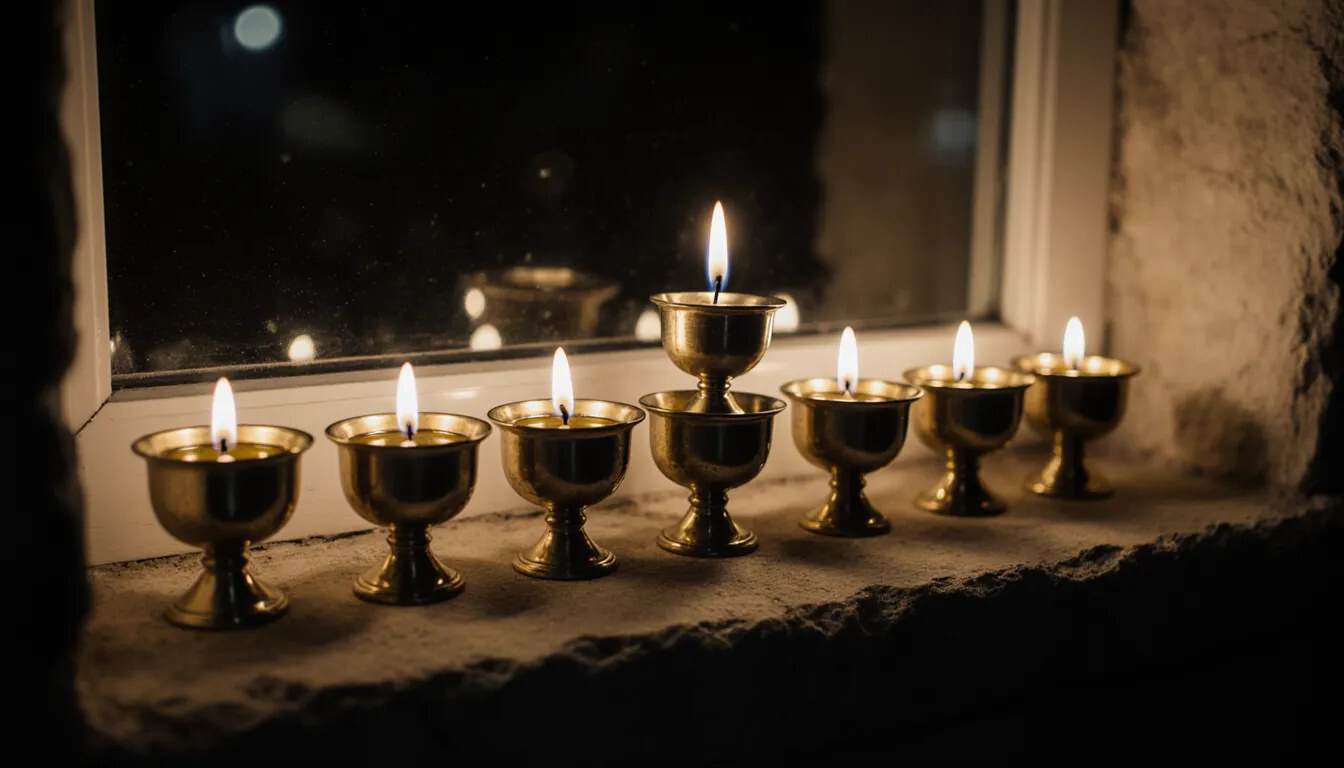
A single flask of oil, enough to burn for just one day, and a light that lasted eight days. Why eight candles, why one more each night, and what do these small flames placed at the threshold of our homes tell us?
In 2026 (5787), Hanukkah begins on the evening of Friday, December 4, the eve of 25 Kislev, with the lighting of the first candle. The festival lasts eight days and ends on Saturday, December 12. What is special this year: the first night falls on a Friday. That evening, the Hanukkah lights are kindled before the Shabbat candles. On Friday, December 11, for the eighth candle, the same thing happens again.
What the Talmud Recounts
Hanukkah is not recorded in the Torah. It is a festival instituted by our Sages, and its main source is a passage of the Talmud (Shabbat 21b). The Greeks had entered the Temple and defiled all the oils. When the Hasmoneans prevailed, they searched and found only a single flask, sealed with the seal of the High Priest. It held only enough to light the Menorah for one day. A miracle occurred: they lit from it for eight days.
The following year, the Talmud notes, the Sages established these eight days as days of festivity, praise and thanksgiving, with the recitation of Hallel.
Why Eight Days, and Not Seven?
The question is famous. It is raised by Rabbi Yosef Karo in the Beit Yosef (Orach Chaim 670). If the flask was enough for one day, the miracle lasted only seven days. Why, then, celebrate eight days?
The answers are many. According to one of them, the oil had been divided into eight portions from the outset, so that it would last until pure oil could arrive: from the very first night, the small quantity burned all night long. According to another, the first day celebrates the very discovery of the intact flask.
Another reading, developed in particular by the Maharal of Prague, focuses on the number itself. Seven is the number of nature: creation was completed in seven days, and the week recurs without end. Eight is what goes beyond that cycle. It is no coincidence that circumcision takes place on the eighth day. The light of Hanukkah declares that Israel cannot be reduced to the laws of nature.
One More Candle Each Night
The same passage of the Talmud (Shabbat 21b) records a debate. According to Beit Shammai, eight lights are kindled on the first night, then one fewer each night. According to Beit Hillel, one lights a single light and adds one each night. The halakhah follows Beit Hillel.
The reason given for Beit Hillel is summed up in a single phrase: “we ascend in holiness, we do not descend.” The light must not gradually fade away. It must grow.
The Talmud also records the most basic level of the mitzvah: “one light for a man and his household” (ner ish u-veito). The widespread custom is to go beyond this, adding one light each night, and in many families everyone lights their own hanukkiah.
Why at the Door?
The purpose of the lighting is to publicize the miracle, pirsumei nissa. The lights are therefore placed where they can be seen from outside: at the door, or at a window facing the street. The Talmud (Shabbat 22a) asks that they be placed to the left of the entrance: the mezuzah is on the right, the Hanukkah light on the left. Whoever enters is thus surrounded by mitzvot.
The light of the Menorah was already described in the Torah: “pure olive oil, crushed, for the light, to keep a lamp burning continually” (Shemot 27:20). And King Shlomo writes: “for the mitzvah is a lamp, and the Torah is light” (Mishlei 6:23).
How to Light in Practice
- The time: generally at nightfall, or at sunset, depending on custom. The lights must burn for at least half an hour after nightfall.
- The blessings: one recites “lehadlik ner Hanukkah” and “she-asah nissim.” On the first night, “shehecheyanu” is added.
- The order: the candles are placed from right to left, and the newest one, on the left, is lit first.
- Friday evening: the Hanukkah lights are lit before the Shabbat candles, with candles or enough oil to last until half an hour after nightfall.
- Saturday evening: one waits for the end of Shabbat. Whether havdalah or the lighting comes first varies from community to community.
For special cases (an apartment, travel), consult a competent rabbi.
What Rav Raphaël Benizri Says
In his lecture Hanukkah in History, Rav Benizri stresses that the miracle of the eight days was not decreed by the rabbis: it was the people who recognized it. At first, Hanukkah was celebrated mainly through Hallel and gratitude. He also notes that any oil could be used for the lighting: the miracle, then, lies elsewhere. This lighting does not belong to the order of nature; it stands beyond creation.
In the same lecture, he concludes: it is through the spreading of light, and not through military victory, that Israel’s destiny is fulfilled. The small flame that keeps increasing is destined to illuminate the entire world.
In Hanukkah: Maoz Tzur, the Song of the Exiles, he comments on the words “they defiled all the oils.” These are not only material oils, but every path to inwardness. What remains is enough to light for one day, and eight were needed. For the Rav, this is the true miracle: something meant to last a moment has endured through the entire exile.
In Hanukkah: Each Person’s Own Light, he starts from the phrase ner ish u-veito. Each person possesses a light of his own that no one can take from him. It is not hidden away: it is displayed outside, because we want to share it. His conclusion: no one can take it from us, and no one can exempt us from lighting it.
Finally, in Hanukkah: A Jewish Re-education, he explains the placement of the hanukkiah to the left of the door, opposite the mezuzah: a person passes between the two and stands in the midst of what he has received.
Further Reading
- Hanukkah: all of Rav Benizri’s lectures
- Hanukkah in History
- Hanukkah: Each Person’s Own Light
- Hanukkah: A Jewish Re-education
- Hanukkah: Maoz Tzur, the Song of the Exiles
- Booklet “Questions for the Hanukkah Table” (PDF)
- All the Jewish holidays
Article by the editorial team of Pensées Juives. The passages attributed to Rav Raphaël Benizri are drawn from his lectures published on this site.