
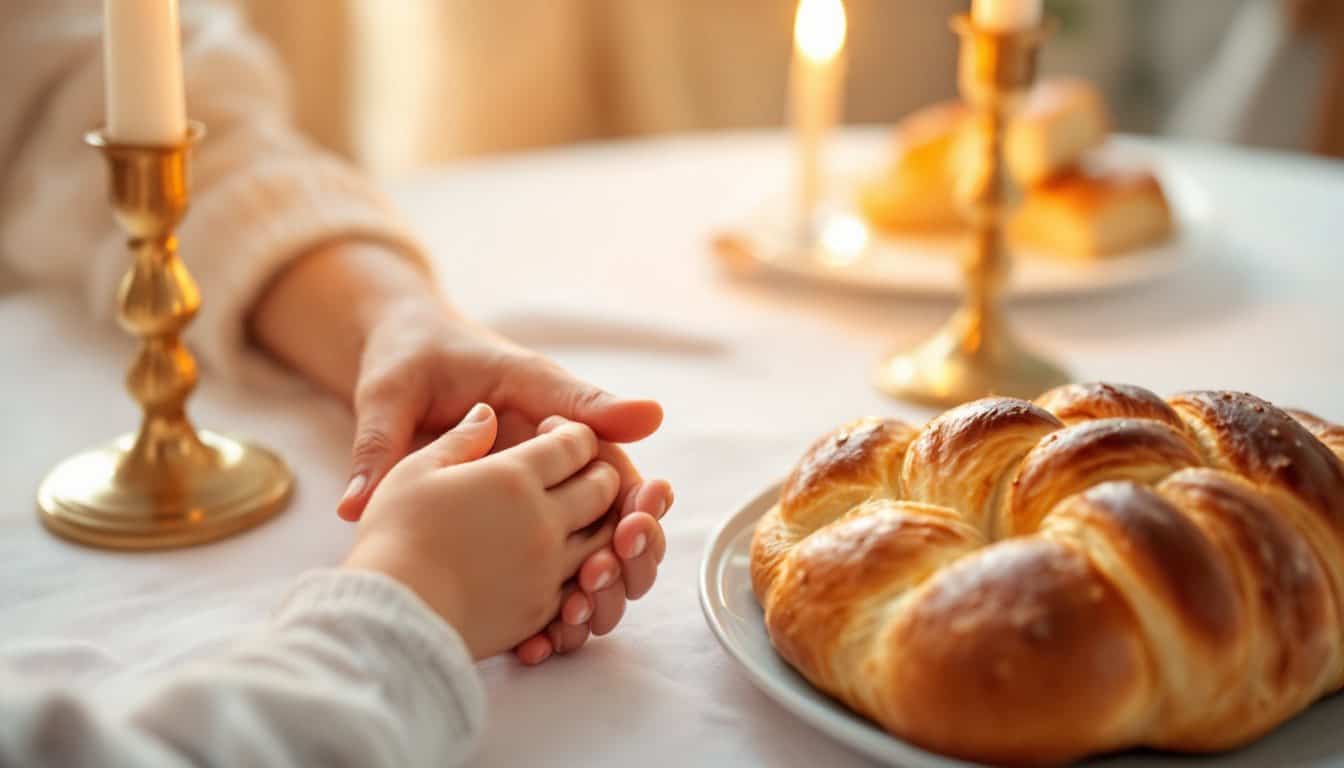
“My mother is Jewish but my father isn’t: am I Jewish?” “Can you convert to Judaism?” “Do you have to believe in G-d to be Jewish?” These questions come up again and again, and the answers found online are often too short or contradictory. Here is a complete answer: what the Torah and the Talmud say, why Jewish identity passes through the mother, how a conversion takes place, and what this identity involves.
According to Jewish law (halakha), a Jew is anyone born to a Jewish mother, or anyone who has converted to Judaism according to the rules, before a rabbinical court. The father passes on membership in a tribe (Kohen, Levi or Yisrael), but not Jewish identity itself (Mishna Kiddushin 3:12; Talmud, Kiddushin 68b). Being Jewish is therefore a matter neither of belief, nor of practice, nor of ethnic origin: a Jew who does not observe remains a Jew (Sanhedrin 44a). Conversion, called giyur, is open to any sincere man or woman; it requires acceptance of the commandments, immersion in a ritual bath and, for a man, circumcision (Yevamot 46a-47b; Rambam, Hilkhot Issurei Bia 13-14). The convert becomes fully Jewish, “like a newborn child” (Yevamot 22a).
Being Jewish: a people, not only a religion
To understand the answer, one widespread idea must first be set aside: Judaism does not work like a church that you join by subscribing to a creed. It is at once a family, a people and a covenant with G-d. The Torah calls the Jews Bnei Yisrael, “the children of Israel”, that is, the descendants of Yaakov, whose second name is Israel (Bereshit (Genesis) 32:29). One enters Judaism first of all the way one enters a family: by birth.
But this family received a mission. At Mount Sinai, the entire people accepted the Torah, saying “We will do and we will understand” (Shemot (Exodus) 24:7). Ever since, being Jewish has meant belonging to a people bound by a covenant, with specific obligations, the mitzvot (commandments). That is why the tradition never entirely separates the people from the religion: one can be born into the covenant or enter it voluntarily, but in both cases one joins the same people.
This dual nature explains a rule that often surprises: a Jew who stops believing or observing does not stop being Jewish. The Talmud states this about a man who had sinned gravely: “Even though he has sinned, he remains Israel” (Sanhedrin 44a). Jewish identity is a status, not an opinion. It creates duties, which one may fulfill or neglect, but it is not erased.
Why is Jewish identity passed down through the mother?
This is the most frequent question, and the best-known answer: a child is Jewish if his mother is Jewish. If the father is Jewish but not the mother, the child is not Jewish according to halakha. Conversely, if the mother is Jewish and the father is not, the child is Jewish.
The verse in the Torah
The source is found in the passage that forbids intermarriage with the peoples of Canaan: “You shall not intermarry with them; you shall not give your daughter to his son, nor take his daughter for your son; for he will turn your son away from Me” (Devarim (Deuteronomy) 7:3-4). The Talmud notes a grammatical detail. The verse speaks of the non-Jewish son-in-law who “will turn your son away”, meaning the child born of your daughter: this child is still called “your son”, so he is Jewish. For the son born of a non-Jewish woman, on the other hand, the verse says nothing of the kind. The Sages conclude: “Your son born of a Jewish woman is called your son; your son born of a non-Jewish woman is not called your son, but her son” (Kiddushin 68b).
The Mishna formulates the general rule: the child of a woman who cannot contract a Jewish marriage, such as a non-Jewish woman, “is like her” (Mishna Kiddushin 3:12). The Babylonian Talmud (Yevamot 45b) confirms that a child born of a non-Jewish father and a Jewish mother is Jewish. These rules are taken up by the Rambam (Maimonides) in his code, the Mishneh Torah, and by the Shulchan Aruch, the standard code of law (section Even HaEzer).
A biblical precedent
A trace of this principle can already be found in the Bible. On the return from Babylon, in the 5th century BCE, Ezra the scribe finds that many Jews have married foreign women. The people then commit to “send away all these wives and those born of them” (Ezra 10:3). The text does not say this about children born of a Jewish mother: it is the mother’s status that decides.
The Torah itself tells the story of “the son of an Israelite woman, who was the son of an Egyptian man” (Vayikra (Leviticus) 24:10). He is in the middle of the camp of Israel, and the text treats him as a member of the people. Rashi, the great commentator, explains that he had come to claim a place in his mother’s tribe, and was refused it, because the tribe, for its part, passes through the father.
The father passes on the tribe, the mother passes on the identity
This point is often forgotten: the father is not without a role. In the Torah, censuses are taken “according to their fathers’ houses” (Bamidbar (Numbers) 1:18). It is through the father that one is a Kohen (a descendant of Aharon, the first High Priest), a Levi or an ordinary Yisrael. The son of a Kohen is a Kohen; the son of a mother who is “the daughter of a Kohen” is not. You can see this in the synagogue, when someone is called up to the Torah as “so-and-so, son of so-and-so”.
But for the first question, “is he Jewish or not?”, it is the mother who decides. The father gives a place within the people; the mother gives membership in the people.
The reasons put forward
Why this choice? The commentators offer several explanations, which complement one another.
- Certainty. It is always known with certainty who a child’s mother is, whereas paternity, before genetic testing, could remain uncertain. An identity passed on through the mother leaves no room for doubt.
- Upbringing. For centuries, it was the mother who shaped a child’s early years: language, gestures, food, bedtime prayers. The verse itself speaks of “influence” (“he will turn your son away”). A Jewish mother almost always passes on something of her Judaism; a father alone, often less so.
- A deeper reading. Many masters see the mother as the source of the child’s very being, what he is before what he does. The Talmud indeed says that the child carried by a woman who converts during her pregnancy does not need an immersion of his own: his mother’s counts for him (Yevamot 78a). Identity passes through the body that carries life.
And history?
Some modern historians, such as Shaye Cohen (The Beginnings of Jewishness, 1999), believe that the rule of transmission through the mother was only formulated explicitly in the period of the Mishna, in the 1st and 2nd centuries. Rabbinic tradition, for its part, reads it in the Torah itself, as we have seen, and in the practice of Ezra. What is certain is that for at least two thousand years, all Jewish communities, Ashkenazi, Sephardi, Mizrahi or Yemenite, have applied the same rule.
In the 20th century, the American Reform movement adopted a different principle in 1983: a child of a Jewish father may be recognized as Jewish if raised in Judaism. This position is accepted neither by Orthodox Judaism nor by the Masorti (Conservative) movement, nor by the Chief Rabbinate of Israel, nor by the French Consistoire. To marry religiously in most communities, proof of the mother’s Jewishness is still required.
The convert: a Jew in every respect
If one is born Jewish through one’s mother, can one also become Jewish? Yes. The Torah knows no closed Jewish identity. From the Exodus from Egypt onward, it provides for a stranger to join the people: “There shall be one law for the native-born and for the stranger who dwells among you” (Shemot 12:49; see also Bamidbar 15:15-16).
The Hebrew word for “convert” is ger. In the Torah, it first refers to the stranger who lives among Israel; the oral tradition most often reads it as the “ger tzedek”, the true convert. Conversion is called giyur.
Loving the convert
The Torah insists with rare force on how the ger must be treated: “You shall love the stranger, for you were strangers in the land of Egypt” (Devarim 10:19). “The stranger who dwells with you shall be to you like one of your native-born, and you shall love him as yourself” (Vayikra 19:34). The Talmud counts that the Torah warns thirty-six times, and according to another opinion forty-six times, against causing the ger to suffer (Bava Metzia 59b). It is forbidden to remind a convert of his past, for example by saying to him “remember what your ancestors used to do” (Bava Metzia 58b).
The Rambam explains that whoever loves the convert fulfills two commandments at once: love of one’s neighbor, and love of the ger (Hilkhot De’ot 6:4). In a famous letter to Ovadia, a convert who asked him whether he could say in his prayers “our G-d and G-d of our fathers”, he answers yes without hesitation: Avraham is his father, just as he is the father of every Jew.
“Like a newborn child”
The Talmud defines the convert’s status with a striking phrase: “A convert is like a newborn child” (Yevamot 22a). He begins a new life. His past sins do not follow him, and he now belongs to the Jewish people with the same rights and the same duties as any Jew by birth. He is as Jewish as any other Jew. Conversion is final: even if a convert later stops observing, he remains Jewish, like a born Jew who drifts away (Yevamot 47b).
A few very limited differences exist. For example, a woman convert may not marry a Kohen, and, according to halakha, a convert is not appointed to certain official positions of authority, such as kingship (Rambam, Hilkhot Melakhim 1:4). But history shows that these rules have never prevented converts and their descendants from rising to the highest positions.
Avraham, the first of the converts
The Talmud calls Avraham “the first of the converts” (Chagiga 3a). Born into an idolatrous family, in Ur of the Chaldeans, he discovered G-d on his own and left everything behind to follow Him (Bereshit 12:1). Judaism therefore begins with a convert. The verse also says that Avraham and Sarah took with them “the souls they had made in Haran” (Bereshit 12:5); Rashi, citing the Midrash, explains: these are the people they had brought close to G-d, Avraham the men and Sarah the women.
What is more, the whole people became Jewish through a kind of collective conversion at Sinai. The Talmud derives the rules of conversion from what the Hebrews did before receiving the Torah: circumcision (in Egypt, before eating the Pesach offering), immersion and a sacrifice (Keritot 9a; Yevamot 46b). Today’s convert retraces, alone, the path the people walked together.

Ruth, the model convert
No story illustrates conversion better than the Book of Ruth, which is read on the festival of Shavuot. Ruth is a Moabite, a princess according to the Midrash, who married a Jew. When her husband dies, her mother-in-law Naomi, also widowed, decides to return to Bethlehem. She urges her two daughters-in-law to go back to their own homes. One of them, Orpah, obeys. Ruth refuses and speaks the words that have become the heart of every conversion: “Where you go, I will go; where you lodge, I will lodge; your people shall be my people, and your G-d my G-d” (Ruth 1:16).
The Sages see in it the two sides of the commitment: “your people shall be my people”, entry into a family; “your G-d my G-d”, acceptance of the covenant and its commandments. The Talmud learns several laws of conversion from this dialogue (Yevamot 47b). And the Midrash explains that Naomi turned Ruth away three times before accepting her: this is the origin of the custom of not welcoming a candidate without testing his sincerity.
Ruth arrives in Bethlehem poor and goes to glean in the fields of Boaz, who marries her. Their great-grandson is King David (Ruth 4:17), from whom the Mashiach, the Messiah, is to descend. The royal line of Israel thus passes through a convert.
How do you convert to Judaism today?
Conversion is not a simple declaration. It takes place before a beit din, a rabbinical court of three judges (Yevamot 46b), and involves three essential elements, codified by the Rambam (Hilkhot Issurei Bia 13-14) and by the Shulchan Aruch (Yoreh De’ah 268).
1. Acceptance of the mitzvot (kabbalat ol mitzvot). The candidate commits to observing all the commandments of the Torah. This is the heart of conversion: the Talmud teaches that a candidate who wants to take on everything “except for one thing” is not accepted (Bekhorot 30b). 2. Circumcision (brit mila) for a man. If he is already circumcised, a symbolic drop of blood is drawn, called hatafat dam brit. 3. Immersion (tevila) in a mikveh, a ritual bath of natural water, for men and women alike. For a woman, the immersion takes place in the presence of women, with the judges standing outside.
In the time of the Temple, the convert also brought a sacrifice; since its destruction, conversion is valid without it.
A long process, and deliberately demanding
The Talmud describes how a candidate is received (Yevamot 47a). He is asked: “Why do you want to convert? Do you not know that Israel, at this time, is suffering, persecuted and rejected?” If he answers, “I know, and I am not worthy”, he is accepted and taught a few light commandments and a few weighty ones. The aim is not to discourage him in order to reject him, but to make sure that his choice is free and sincere.
In practice, a conversion today generally requires one to three years of study and of learning Jewish life: Shabbat, kashrut (dietary laws), prayers, festivals, family life. The candidate is guided by a rabbi and is usually integrated into a community. Rabbinical courts check that the motivation is not merely a planned marriage or a material interest. In France, Orthodox conversions fall under the Beit Din of the Consistoire; in Israel, under the State’s conversion courts. For any practical step, contact a rabbi in your town.
At the end, the convert receives a Hebrew name and is called “son (or daughter) of Avraham our father”, according to widespread custom. An adopted child whose biological mother is not Jewish can also be converted by the beit din; on reaching the age of religious majority, he may confirm or reject this choice (Ketubot 11a).
Why doesn’t Judaism seek converts?
Unlike other religions, Judaism does not proselytize. The reason is theological: according to the tradition, a non-Jew does not need to become Jewish to be righteous before G-d. It is enough for him to observe the seven laws of the children of Noach (Sanhedrin 56a): not to practice idolatry, not to blaspheme, not to murder, not to steal, not to engage in forbidden relations, not to eat a limb torn from a living animal, and to establish just courts. The Rambam writes that the righteous of the nations who observe these laws have a share in the World to Come (Hilkhot Melakhim 8:11).
Becoming Jewish therefore means taking on 613 commandments instead of seven. It is a heavier responsibility, not a salvation that others would lack. That is why the candidate is tested: the door is open, but no one is pushed to walk through it.
Famous converts in Jewish history
Converts and their descendants hold a place of honor in the tradition. The Talmud reports that Shemaya and Avtalion, Hillel’s teachers, were descended from converts (Yoma 71b). Onkelos, a nephew of the emperor Titus according to the Talmud, converted and wrote the Aramaic translation of the Torah that is still studied every week alongside the Hebrew text (Gittin 56b; Avoda Zara 11a; Megillah 3a). The Rambam, in the introduction to his Mishneh Torah, writes that Rabbi Akiva, one of the greatest masters of the Mishna, was the son of a “true convert”.
The Talmud also tells how Hillel welcomed a pagan who wanted to learn the whole Torah “while standing on one foot”: “What is hateful to you, do not do to your neighbor; that is the whole Torah, the rest is commentary. Go and study” (Shabbat 31a). The Talmud relates that converts welcomed by Hillel would later say that his humility had brought them “under the wings of the Divine Presence”.
History has known collective conversions. The historian Flavius Josephus tells of that of Queen Helena of Adiabene and her son King Izates, in the 1st century (Antiquities of the Jews, book XX). Around the 8th century, the elite of the Khazar kingdom, between the Black Sea and the Caspian, adopted Judaism; this is the setting Rabbi Yehuda Halevi chose for his philosophical book, the Kuzari, in the 12th century. Documents from the Cairo Geniza also tell us of Ovadia the Proselyte (not to be confused with the Rambam’s correspondent), a Norman priest who became Jewish around 1100.
Conversely, the tradition rejects forced conversions. When the Hasmonean king John Hyrcanus imposed circumcision on the Idumeans, at the end of the 2nd century BCE (Josephus, Antiquities of the Jews XIII, 9, 1), the result was bitter: from this people came Herod, who, according to the Talmud, had the Sages massacred (Bava Batra 3b). A conversion without sincerity is no conversion.
What Rav Raphaël Benizri teaches
In his lectures, Rav Raphaël Benizri often comes back to the question of Jewish identity and conversion. His teachings shed light on the rule by showing its meaning.
“We are gerim at the source”
In his lecture Pesach: where to begin the Haggadah?, the Rav states: “We are gerim at the source. Avraham is the first ger.” A ger, he explains, is not the continuation of an evolution: he is someone who has broken with what he was and given himself a new life. If Jewish identity was later conferred through the mother, it is because a way of functioning had to be adopted. But to anyone who wishes to take upon himself this creation of being, in the image of the Creator, “the doors are open, provided he is sincere in his approach”.
He adds that converts are “katan shenolad”, like a newborn child, and that they may claim Avraham as their father. But, he says, the goal is not to convert at any cost: one must adapt one’s language to the person listening.
Conversion, a re-creation
In Bereshit Rabba 39, part 7: be a blessing, the Rav comments on “the souls they had made in Haran”. The text does not use a verb of conversion, but a verb of making: to convert is to re-create. Avraham spoke to the men, Sarah to the women, each in their own language; the lesson is that there is no single formula valid for every conversion. This re-creation starts from zero and only develops if it is sincere: what must be sought above all is authenticity, not a radical overnight change, which rarely succeeds.
The Rav draws a clear consequence from this: Israel is not exiled among the nations in order to proselytize, but so that others, of their own accord, seeing its conduct, may gradually draw closer. Of the rest of humanity, only the seven Noahide laws are required: converting people is not the goal.
A new being, not a repaired one
In Shavuot: the Book of Ruth, the Rav explains that the convert is treated as a new being, and not as a repaired one: “Renewal is not a restoration, it is re-creating the being.” This experience, he says, could only be lived to the full by someone from outside the people: that is Ruth. And he concludes, regarding how candidates should be received: as long as the door can be left open, it must be kept open.
In the same spirit, he recalls in Lag BaOmer: the bonfires and the light of the Zohar that Rabbi Akiva reached the “fiftieth level” of understanding, which Moshe himself had not reached, because he was the son of converts: the ger brings to the whole something it was missing. And in Pirkei Avot: judging without setting oneself up as a judge, he stresses that the transmission of the Oral Torah was entrusted to descendants of converts: the proof, he says, that they have their place, and a place of honor.
Born Jewish, and becoming Jewish
Finally, the Rav turns the question around for those born Jewish. In Mishlei: Eshet Chayil, part 3, he declares: “We are not born Jewish.” We are Jewish through our ancestry, but we still have to become Jewish, to affirm it every day, each according to our measure. And in Pirkei Avot 2: the straight path and a trade, he explains that all of Israel underwent a collective conversion at Sinai, with one difference: it did not lose the attributes of its fathers. The Torah was grafted onto a being already formed by the heritage of the Patriarchs.
Misconceptions about Jewish identity
“You have to believe in G-d to be Jewish.” No. An atheist Jew remains Jewish according to halakha (Sanhedrin 44a). Faith and practice are a Jew’s duties, not the conditions of his identity. For a candidate for conversion, on the other hand, commitment to G-d and the mitzvot is indispensable.
“Jews are a race.” No. Anyone can become Jewish through conversion, whatever their origin. There are Jews of every color and from every continent: Ethiopia, Yemen, India, Europe, North Africa. What unites them is a history and a covenant, not a physical type.
“A Jew who converts to another religion stops being Jewish.” According to halakha, he remains Jewish, even though he commits a grave sin, and can return at any time. The State of Israel, for its Law of Return, adopted a different definition: since 1970, a Jew is “a person who was born of a Jewish mother or has become converted to Judaism and who is not a member of another religion”. This administrative definition does not replace the religious one.
“Having a Jewish grandfather is enough.” Not according to halakha. Only the direct maternal line counts: mother, maternal grandmother, and so on. Israel’s Law of Return grants immigration rights to the grandchildren of Jews, but that does not make them Jewish in the religious sense.
“You can’t convert to Judaism.” That is false, but the process is long and demanding. The Talmud even teaches that in the days of the Messiah, converts will no longer be accepted (Yevamot 24b), precisely because it would no longer be possible to verify their sincerity.
Frequently asked questions about Jewish identity and conversion
My father is Jewish but my mother isn’t: am I Jewish?
According to halakha, no. You are not Jewish by birth, but you have a real connection to the Jewish people, and many people in your situation choose to convert. Rabbinical courts often take this “seed of Israel” (zera Israel) into account and receive such candidates with particular care. The best thing is to talk to a rabbi.
My mother is Jewish but I had no Jewish upbringing: am I Jewish?
Yes, fully. You need no conversion and no ceremony. If you wish to marry religiously or have your bar mitzvah, you will simply be asked to prove your mother’s Jewishness: your parents’ or grandparents’ ketubah (religious marriage contract), a rabbi’s certificate, family documents.
How long does a conversion take?
There is no fixed length. In general, expect between one and three years of study and practice, depending on the candidate’s background and the rabbinical court. What matters is not the length of time, but that the candidate truly knows and lives the commandments he is committing to observe.
Can you convert in order to marry a Jew?
The Talmud and the codes are wary of conversions made solely with a view to marriage (Yevamot 24b). Rabbinical courts examine such requests carefully. Yet many conversions begin with a relationship, and are accepted when the candidate shows a sincere and personal commitment to Judaism that does not depend on the marriage.
Is a convert “less Jewish” than a born Jew?
No. He is Jewish in every respect. The Torah commands us to love him, and it is forbidden to remind him of his origins in order to humiliate him (Bava Metzia 58b). King David descends from a convert, and great masters such as Rabbi Akiva, or Shemaya and Avtalion, came from converts.
Are Liberal conversions recognized?
Conversions performed by the Liberal or Reform movements are not recognized by Orthodox Judaism, nor by the Chief Rabbinate of Israel or the Consistoire, because they do not always include the commitment to observe all the mitzvot. They are recognized by the movements that perform them. Anyone considering conversion would do well to know these differences from the outset.
Can a non-Jew observe certain mitzvot without converting?
Yes, to a certain extent. He may study the parts of the Torah that concern him, observe the seven Noahide laws, pray to G-d, give charity. For certain mitzvot specific to Jews, such as full observance of Shabbat, the tradition sets limits; consult a rabbi.
Further reading
Being Jewish means first of all receiving a heritage, through one’s mother, or choosing it, like Ruth. In both cases, it is not an end point but the beginning of a path: as Rav Benizri puts it, we still have to become what we are.
- Pesach: where to begin the Haggadah? “We are gerim at the source”
- Bereshit Rabba 39, part 7: be a blessing
- Shavuot: the Book of Ruth and hesed
- Pirkei Avot: judging without setting oneself up as a judge, and the masters descended from converts
- What does “chosen people” mean in Judaism?
- Why circumcision (brit mila) in Judaism?
- What are the origins of Judaism?
- Glossary of Hebrew terms in Judaism
Sources and references
- Bereshit (Genesis) 12:1 and 12:5; Bereshit 32:29
- Shemot (Exodus) 12:48-49; Shemot 24:7
- Vayikra (Leviticus) 19:33-34; Vayikra 24:10 (and Rashi on this verse)
- Bamidbar (Numbers) 1:18; Bamidbar 15:15-16
- Devarim (Deuteronomy) 7:3-4; Devarim 10:19
- Ruth 1:16; Ruth 4:17
- Ezra 10:3
- Mishna Kiddushin 3:12
- Babylonian Talmud, Kiddushin 68b
- Babylonian Talmud, Yevamot 22a, 24b, 45b, 46a-47b, 78a
- Babylonian Talmud, Keritot 9a; Bekhorot 30b; Ketubot 11a
- Babylonian Talmud, Sanhedrin 44a; Sanhedrin 56a
- Babylonian Talmud, Bava Metzia 58b and 59b; Bava Batra 3b
- Babylonian Talmud, Chagiga 3a; Yoma 71b; Gittin 56b; Avoda Zara 11a; Megillah 3a; Shabbat 31a
- Midrash Ruth Rabba (Naomi turns Ruth away three times)
- Rashi on Bereshit 12:5
- Rambam, Mishneh Torah, introduction (Rabbi Akiva, son of a convert)
- Rambam, Mishneh Torah, Hilkhot Issurei Bia 13-14
- Rambam, Mishneh Torah, Hilkhot De’ot 6:4
- Rambam, Mishneh Torah, Hilkhot Melakhim 1:4 and 8:11
- Rambam, Letter to Ovadia the Convert
- Shulchan Aruch, Yoreh De’ah 268; Shulchan Aruch, Even HaEzer (status of the child)
- Rabbi Yehuda Halevi, The Kuzari
- Flavius Josephus, Antiquities of the Jews XIII, 9, 1 and book XX (Helena and Izates of Adiabene)
- Shaye J. D. Cohen, The Beginnings of Jewishness, University of California Press, 1999
- Law of Return (Israel, 1950), 1970 amendment
- Central Conference of American Rabbis, resolution on patrilineal descent, 1983
- Rav Raphaël Benizri, Pesach: where to begin the Haggadah?
- Rav Raphaël Benizri, Bereshit Rabba 39, part 7
- Rav Raphaël Benizri, Shavuot: the Book of Ruth
- Rav Raphaël Benizri, Lag BaOmer: the bonfires and the light of the Zohar
- Rav Raphaël Benizri, Pirkei Avot: judging without setting oneself up as a judge
- Rav Raphaël Benizri, Mishlei: Eshet Chayil, part 3
- Rav Raphaël Benizri, Pirkei Avot 2: the straight path and a trade
Article by the Pensées Juives editorial team. Passages attributed to Rav Raphaël Benizri are taken from his lectures published on this site.