
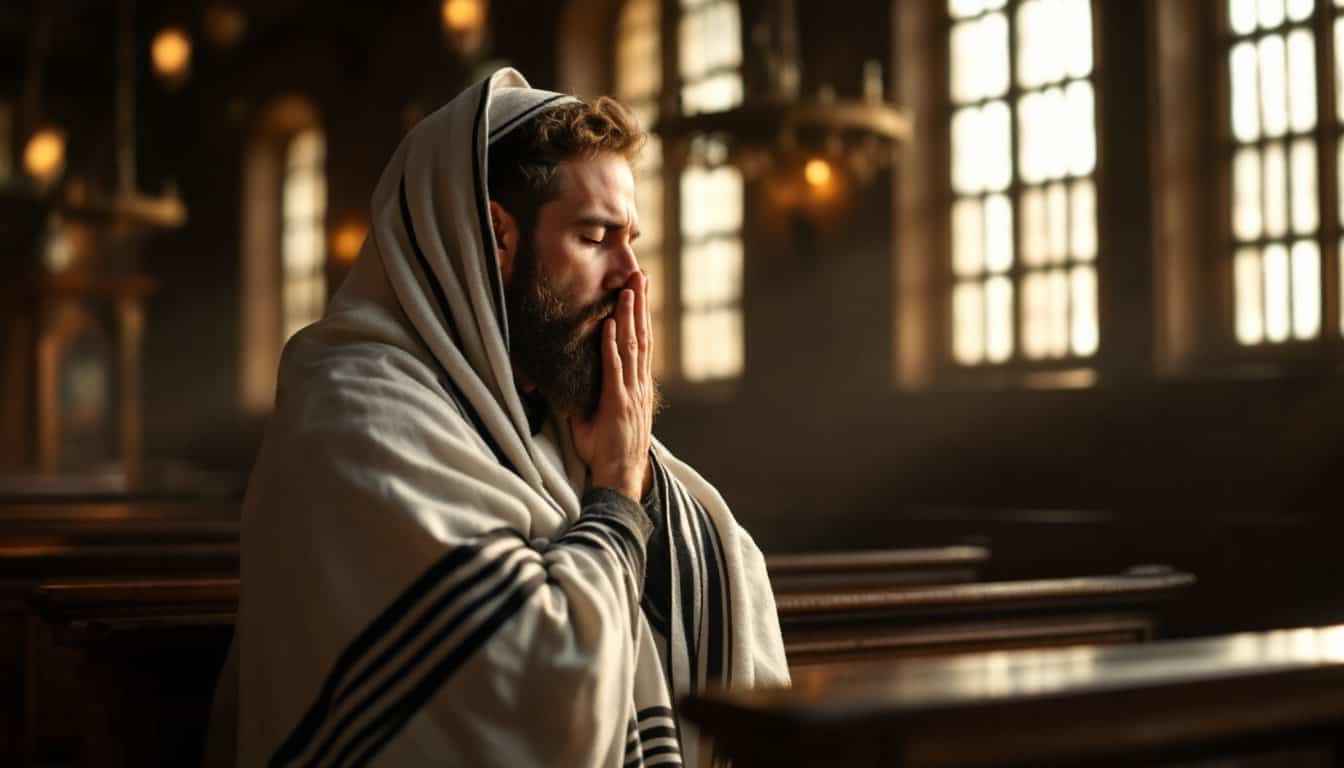
“Shema Yisrael”: these are often the first Hebrew words a Jewish child learns, and the last words a Jew utters before dying. But what do these six words mean, where do they come from, and why do they hold such a central place? Here is a complete answer: the text, its sources in the Torah and the Talmud, how it is recited, its history and its deeper meaning.
In short: the Shema Yisrael (Hebrew for “Hear, O Israel”) is the most famous verse in Judaism: “Hear, O Israel: the L-rd is our G-d, the L-rd is One” (Devarim [Deuteronomy] 6:4). It proclaims that G-d is unique and that He is the G-d of Israel. This verse opens a longer prayer called Keriat Shema (“the reading of the Shema”), made up of three passages from the Torah, which every Jewish man has recited every evening and every morning since antiquity. Strictly speaking, it is not a prayer of request but a declaration of faith: in it one accepts, in the words of the Mishna, “the yoke of the kingship of Heaven” (Berakhot 2:2).
The six words of the Shema, one by one
The verse has six words in Hebrew: שְׁמַע יִשְׂרָאֵל ה׳ אֱלֹקֵינוּ ה׳ אֶחָד, pronounced “Shema Yisrael, Ado-nai Elo-heinu, Ado-nai Echad”. Each of them holds a whole world.
- Shema, “hear” or “listen”. The Torah does not say “see” or “believe”, but “listen”. In Hebrew, to listen also means to understand, to receive and to accept. Judaism is a religion of the word that is heard: at Sinai, Moshe reminds the people, they heard a voice “but saw no form” (Devarim 4:12).
- Yisrael, “Israel”. The verse is addressed to the whole people, and to each person individually. The Talmud also relates that it is addressed to one particular man: Yaakov (Jacob), who was called Israel (Pesachim 56a; we will come back to this).
- Hashem (twice): the four-letter Name, which is not pronounced as it is written and is read “Ado-nai”. It expresses G-d’s eternity and His goodness.
- Elokeinu, “our G-d”. The Name Elokim evokes G-d as master of nature and as judge; the suffix “-einu” expresses a bond of belonging: He is “our” G-d.
- Echad, “One”. The most important word in the verse, and the most discussed.
In Torah scrolls, two letters of this verse are written larger than the others: the final ayin of shema and the final dalet of echad. Together they form the word ed, “witness”. The commentators (notably the Baal Ha-Turim on Devarim 6:4) see in this the very meaning of the verse: by reciting it, a Jew bears witness before the world that G-d is One. It is also explained that the dalet is enlarged so that it will not be mistaken for a resh: one would then read acher, “other”, and the verse would become a proclamation of idolatry.
What the Torah says: three passages
The verse is found in the book of Devarim (Deuteronomy), in the great address that Moshe delivers to the people before his death (parasha Va’etchanan). The morning and evening prayer brings together three passages from the Torah, called parashiyot.
First passage: “Hear, O Israel” (Devarim 6:4-9)
“Hear, O Israel: the L-rd is our G-d, the L-rd is One. You shall love the L-rd your G-d with all your heart, with all your soul and with all your might. These words which I command you today shall be upon your heart. You shall teach them diligently to your children, and you shall speak of them when you sit in your house and when you walk on the way, when you lie down and when you rise up. You shall bind them as a sign upon your hand, and they shall be as frontlets between your eyes. You shall write them on the doorposts of your house and on your gates.”
This passage contains the foundations of Jewish life: the unity of G-d, the love of G-d, the study and transmission of the Torah, tefillin (placed on the arm and on the head), the mezuzah (fixed to the doorposts), and the very commandment to recite the Shema “when you lie down and when you rise up”, in the evening and in the morning.
Second passage: “And it shall be, if you listen” (Devarim 11:13-21)
The second passage, called Vehaya im shamoa, repeats the same commandments, but in the plural and with a new dimension: reward and punishment. If the people follow the mitzvot (the commandments), “I will give the rain of your land in its season […] and you shall eat and be satisfied”; if they turn aside to other gods, the heavens will close up and the land will no longer yield its produce (Devarim 11:14-17). The passage ends with the promise of a long life on the land promised to the Patriarchs.
Third passage: tzitzit (Bamidbar 15:37-41)
The third passage, called Vayomer, comes from the book of Bamidbar (Numbers). It commands that tzitzit, fringes, be placed on the corners of garments, “so that you may see them and remember all the commandments of Hashem […] and not stray after your heart and after your eyes” (Bamidbar 15:39). It concludes by recalling the Exodus from Egypt: “I am the L-rd your G-d, who brought you out of the land of Egypt to be your G-d” (15:41).
Why these three passages, and in this order?
The Mishna itself raises the question: why does the passage “Hear” come before “And it shall be, if you listen”? Rabbi Yehoshua ben Korcha answers: “so that a person may first accept upon himself the yoke of the kingship of Heaven, and afterwards the yoke of the commandments” (Mishna Berakhot 2:2). Before knowing what one must do, one must know before Whom one stands. The passage of tzitzit comes next because tzitzit, the same Mishna explains, is a mitzvah that applies only by day, whereas the second passage applies both day and night.
The Rambam (Maimonides) sums it up: the first passage comes first because it contains the unity of G-d, the love of G-d and the study of His Torah, “the great principle on which everything depends”; the second commands the fulfillment of all the commandments; the third also mentions them, and recalls the Exodus from Egypt (Mishneh Torah, Hilkhot Keriat Shema 1:2).
Why read the passage of tzitzit in the evening, when tzitzit are not worn at night? Because it contains the remembrance of the Exodus from Egypt, which the Torah asks us to recall “all the days of your life”, meaning, according to Ben Zoma, even the nights (Mishna Berakhot 1:5). This is the passage quoted in the Passover Haggadah.
A Torah commandment, twice a day
Reciting the Shema morning and evening is one of the 613 commandments of the Torah. The Rambam counts it as a positive commandment in its own right (Sefer Ha-Mitzvot, positive commandment no. 10), as does the Sefer Ha-Chinukh (mitzvah no. 420). He derives it from the words “when you lie down and when you rise up”: at the time when people go to bed, and at the time when they get up (Hilkhot Keriat Shema 1:1-2).
Indeed, the very first Mishna of the Talmud asks: “From what time may the Shema be read in the evening?” (Mishna Berakhot 1:1). The fact that the Sages opened the entire edifice of the Talmud with the Shema speaks for itself about its importance.
- In the evening, it may be recited from the time the stars come out, and ideally before midnight (Mishna Berakhot 1:1).
- In the morning, it is recited once it is light enough, until the end of the third hour of the day, roughly the first quarter of the day (Mishna Berakhot 1:2; Shulchan Aruch, Orach Chaim 58:1). Jewish calendars give this deadline every day, called sof zman keriat Shema.
The Sages framed these readings with blessings: two before and one after in the morning, two before and two after in the evening (Mishna Berakhot 1:4). The blessings that precede it speak of the light of Creation and of G-d’s love for Israel, to whom He gave the Torah; the one that follows speaks of G-d’s faithfulness and of the deliverance from Egypt. The Shema is thus set between Creation, Revelation and Redemption.
To these two readings is added the bedtime Shema (Keriat Shema al ha-mita). Rabbi Yehoshua ben Levi teaches that even if one has already read the Shema in the synagogue, it is a mitzvah to read it in bed before going to sleep (Berakhot 4b-5a). This is the Shema that parents say with their children at night.
“The L-rd is One”: what does the unity of G-d mean?
The word echad seems simple; it is not. The Rambam makes it the second of the 613 commandments: to know that G-d is One (Sefer Ha-Mitzvot, positive commandment no. 2). And he specifies that this oneness is like no other: “He is One, but not like a species that contains many individuals, nor like a body that can be divided into parts” (Hilkhot Yesodei HaTorah 1:7). To say that G-d is One is not merely to say that there are not two: it is to say that He is made of no parts, that He has neither body nor form, and that nothing resembles Him.
Several levels of reading
The commentators have read this verse on several levels, which complement one another.
- Against idolatry. In its simplest sense, the verse rejects the polytheism of the ancient world: there is not one god of rain, another of war and another of death. It also rejects the idea of two powers, one of good and the other of evil: the same source does everything.
- A promise for the future. Why say “our G-d” and then “One”? Rashi explains: Hashem, who today is our G-d and is not yet recognized by the nations, will one day be the One G-d of all, as the prophet says: “On that day the L-rd will be One and His Name will be One” (Rashi on Devarim 6:4, quoting Zekharia [Zechariah] 14:9). This last verse concludes every prayer service, in the Aleinu prayer.
- The unity of the two Names. The verse brings together two Names: Hashem, the Name of kindness, and Elokim, the Name of justice and of nature. To say “Hashem Elokeinu Hashem echad” is to affirm that what seems harsh to us and what seems good to us come from the same source. The Talmud puts it this way: for good news one says “Blessed is He who is good and does good”, and for misfortune, “Blessed is the true Judge”; but in the World to Come, one will say over everything “Blessed is He who is good” (Pesachim 50a).
- The mystical level. The Talmud already asks that the word echad be drawn out when pronounced, while thinking that G-d reigns over the heavens, the earth and the four directions (Berakhot 13b). The tradition of the Kabbalah deepens this idea: it reads in it the union of all the worlds and all the forces of Creation in their source.
“Baruch shem”: the whispered sentence
Immediately after the first verse, a sentence is added in an undertone that does not appear in this passage of the Torah: “Baruch shem kevod malchuto le’olam va’ed”, “Blessed be the Name of the glory of His kingdom forever and ever”. The Talmud tells its origin (Pesachim 56a). On his deathbed, Yaakov gathered his sons and feared that one of them might not be faithful to his faith. They answered him: “Hear, O Israel” (that is: listen, our father Israel) “the L-rd is our G-d, the L-rd is One. Just as in your heart there is only One, so in our heart there is only One.” Then Yaakov exclaimed: “Baruch shem kevod malchuto le’olam va’ed.” Moshe did not write it in the Torah, but the Sages wanted it to be said, and in an undertone, to reconcile these two traditions. On Yom Kippur, on the other hand, when we liken ourselves to the angels, the custom is to say it aloud.
The Shema thus becomes each generation’s pledge of loyalty to the one before it: your faith is ours.
To love “with all your heart, with all your soul and with all your might”
The second verse commands us to love G-d. Can love be commanded? The Mishna explains each of the three expressions (Mishna Berakhot 9:5).
- With all your heart (levavcha, written with two letters bet): with both your inclinations, the good and the evil. Even our desires, our ambitions and our energy can be put to the service of good.
- With all your soul: “even if He takes your soul”, that is, to the point of giving one’s life, if one is forced to renounce one’s faith.
- With all your might (me’odecha): with all your possessions; and also, through a play on the word middah (“measure”), “for every measure He metes out to you, thank Him”, in happiness as in hardship.
How does one arrive at this love? The Rambam answers that it is born of knowledge: when a person contemplates G-d’s works and His wondrous creatures, and sees in them a wisdom without limit, he is seized with an immense longing to know Him (Hilkhot Yesodei HaTorah 2:2). That is why the next verse continues at once: “These words shall be upon your heart.” Love comes through study.
Rabbi Akiva and the last word
The Talmud tells of the death of Rabbi Akiva, one of the greatest Sages of Israel, executed by the Romans after the Bar Kochba revolt in the 2nd century (Berakhot 61b). While they were tearing his flesh with iron combs, it was the time for the Shema, and he was accepting upon himself the yoke of the kingship of Heaven. His students said to him: “Master, even to this point?” He replied: “All my life I was troubled by this verse: ‘with all your soul’, even if He takes your soul. I would say to myself: when will I have the opportunity to fulfill it? And now that it has come to me, shall I not fulfill it?” He drew out the word echad, and his soul left him on that word.
Ever since, the Shema has been the last word of Jewish martyrs, and the word one hopes to say, or to hear, when leaving this world.

How is the Shema recited today?
The Shema is part of the morning prayer (Shacharit) and of the evening prayer (Arvit). A few gestures and rules accompany it.
- Covering the eyes. At the first verse, one places the right hand over the eyes. The Talmud relates that Rabbi Yehuda Ha-Nasi, the compiler of the Mishna, did so (Berakhot 13b), and the Shulchan Aruch makes it the practice for everyone (Orach Chaim 61:5). One closes one’s eyes to the visible world in order to concentrate entirely on the One.
- Intention. The first verse requires real concentration: whoever said it without paying attention has not fulfilled his obligation (Berakhot 13b; Rambam, Hilkhot Keriat Shema 2:1). It is said slowly, articulating each word, and the word echad is drawn out.
- Audibly. The Shema is read so that one’s own ears hear it, since it begins with “hear”. Rabbi Yossi goes so far as to say that otherwise one has not fulfilled the obligation; the law follows the Sages, for whom one has fulfilled it after the fact, but it should be done this way from the outset (Mishna Berakhot 2:3; Shulchan Aruch, Orach Chaim 62:3).
- Tzitzit and tefillin. In the morning, it is recited wrapped in the tallit and wearing tefillin. Whoever reads the Shema without tefillin, says the Talmud, is like someone bearing false witness against himself, since he says “you shall bind them” without doing so (Berakhot 14b). In the third passage, many kiss the fringes of their tallit at each mention of the word tzitzit.
- Sitting or standing. According to the school of Hillel, which the law follows, it may be said in any position: sitting, standing or walking (Mishna Berakhot 1:3). The custom is to say it seated and still, in order to concentrate better.
According to the Tur (Orach Chaim 61), the three passages contain 245 words; the prayer leader adds three more by repeating “Hashem Elokeichem emet”, to reach 248, the number of positive commandments and of the limbs of the body: each word comes to sanctify a part of the person. Someone praying alone adds, according to Ashkenazi custom, “El melech ne’eman” (“G-d, faithful King”); Sephardim, following the Arizal, do not say this formula.
Who is obligated? Jewish men from the age of 13. The Mishna exempts women from this reading, because it depends on a specific time of day (Mishna Berakhot 3:3; Shulchan Aruch, Orach Chaim 70:1). The custom is for them to say at least the first verse, so that they too accept the kingship of Heaven; many recite it in full. As for children, the Talmud says that as soon as a child can speak, his father teaches him the first verse of the Shema (Sukkah 42a). For any particular case, consult a rabbi.
The Shema in history
In the Temple in Jerusalem
The reading of the Shema is very ancient. The Mishna relates that in the Temple in Jerusalem, the priests recited the Ten Commandments every morning, followed by the three passages of the Shema (Mishna Tamid 5:1). Later, the Ten Commandments were no longer read in the prayers, because of those who claimed that only these ten had been given at Sinai (Berakhot 12a). The Shema, however, remained.
Parchments more than two thousand years old
Archaeology confirms this antiquity. The Nash Papyrus, discovered in Egypt and acquired in 1902 by W. L. Nash, now kept at the University of Cambridge, contains the Ten Commandments followed by the Shema Yisrael; it is generally dated to the 2nd or 1st century BCE. Until the discovery of the Dead Sea Scrolls, it was the oldest known Hebrew biblical manuscript. At Qumran, tefillin and mezuzot from the same period have also been found, containing the passages of the Shema. Already in the Second Temple period, Jews wore these verses on their bodies and placed them on their doors.
In Jewish life through the centuries
The Shema is also said in the Kedusha of Mussaf on Shabbat and on festivals. At the close of Yom Kippur, the whole congregation cries it out with one voice, before proclaiming “Baruch shem” three times and “Hashem Hu HaElokim” seven times. It is among the last words recited at the bedside of a dying person. And through the persecutions, from the Crusades to the Holocaust, countless Jews died saying “Shema Yisrael”, following the example of Rabbi Akiva.
What Rav Raphaël Benizri teaches
Rav Raphaël Benizri returns to the Shema in several of his published lectures. Here are three of his ideas.
Three passages, three ways of serving G-d
In his lecture Elul: the role of man, the Rav reads the three parashiyot of the Shema as three approaches to the service of G-d. The first passage promises no reward to the one who loves G-d from morning to night: this is love with nothing expected in return. How can one check that one truly loves G-d? By what one inspires around oneself, the Rav explains: whether people are won over by our way of acting, of teaching, of applying the law.
The second passage introduces reward and punishment: rain in its season, or its withholding. This, says the Rav, is the approach of those who see in G-d’s law a “lifeline” for their material success; and then, “it is no longer love, it is fear, it is dread”.
The third passage is the one about the tallit and tzitzit. For the Rav, the words “not to stray after your heart and after your eyes” designate the two basic failings: the eyes stand for a person’s own desires, the heart for an inflated view of oneself. Self-esteem is entirely necessary, he specifies, but not to excess. And this passage contains a warning: whoever uses Judaism as a mere garment is still only at the starting point, at the Exodus from Egypt.
Faith comes through listening
In his lecture on parashat Mishpatim, the Hebrew slave and freedom, the Rav explains why the ear of the slave who refuses to be set free is pierced: it is the ear that heard at Sinai that the children of Israel are servants of G-d, and not of other men. The word ozen, ear, is moreover related to moznayim, scales: hearing keeps us in balance.
Now, the Rav stresses, the supreme expression of faith lies in the word “Shema”, “listen”. It is through listening that one reaches the oneness of G-d and accepts the heavenly yoke. The ear, he observes, receives everything and emits nothing: the eye can speak with a wink, while the ear remains impassive; yet it is through the ear that an inner voice perceives G-d’s presence in the world. Whoever has walled himself up in his own understanding of things, he concludes, no longer hears.
Bringing all ideas back to unity
In Lech Lecha: the third attempt, the Rav applies “Hashem echad” to the world of ideas. He explains that Moshe encompassed all philosophical orientations, all the sublime ideals one can imagine: he stripped them of their husk, of what had made them a foreign worship, and integrated them by giving them a single code. “In the same way that we say Shema Yisrael, Hashem Elokeinu, Hashem echad”, currents of thought, however sublime, remain liable to become idolatry as long as they have not been brought back to unity. To avoid this, they must be harmonized with the primordial unity. And the Rav adds that when the Name Elokim is separated from the other Name, it becomes “other gods”.
Misconceptions about the Shema
“It must be said in Hebrew.” The Mishna teaches that the Shema may be recited in any language one understands (Mishna Sota 7:1). Hebrew remains preferable, but someone who cannot yet read it may say it in English, the essential thing being to understand what one is proclaiming.
“The Shema is a talisman.” There is nothing magical about the Shema: it gives direction to the thoughts and the life of the person who says it. The mezuzah and tefillin contain it not as a formula, but as a reminder.
Frequently asked questions about the Shema Yisrael
Is the Shema the most important Jewish prayer?
It is the most important declaration of faith in Judaism, and the best known. But it is not a request: it is a reading from the Torah. Prayer in the strict sense, and the most central prayer of the liturgy, is the Amidah (or Shemoneh Esrei). The two are linked: morning and evening, one says the Shema and then the Amidah.
When is the Shema recited?
Twice a day: in the evening, after nightfall, and in the morning, before the end of the third hour of the day. It is also said before falling asleep, and at other points in the liturgy, such as the Kedusha on Shabbat or the close of Yom Kippur.
Do women say the Shema?
According to the Mishna they are exempt, because it is a commandment tied to a specific time. But the widespread custom is for them to say at least the first verse, and many recite the entire Shema. Consult a rabbi about your own practice.
What is said to a dying person?
If they are able to, one helps them say or hear the Shema Yisrael: these are the words with which a Jew hopes to leave this world.
What do the mezuzah and tefillin contain?
The mezuzah contains the first two passages of the Shema (Devarim 6:4-9 and 11:13-21), handwritten on parchment. Tefillin contain these two passages and two further passages from the book of Shemot [Exodus] (13:1-16).
Further reading
- Elul: the role of man
- Mishpatim: the Hebrew slave and freedom
- Lech Lecha: the third attempt
- Yom Kippur: the meaning of the Day of Atonement
- What are tefillin?
- What is the mezuzah fixed to doorposts?
- What are tzitzit, the “fringes” Jews wear?
- How do Jews refer to G-d? Hashem, the L-rd and “G-d”
- Glossary of Hebrew words in Judaism
Sources and references
- Devarim (Deuteronomy) 6:4-9; Devarim 11:13-21 (especially 11:14-17); Bamidbar (Numbers) 15:37-41
- Devarim 4:12
- Zekharia (Zechariah) 14:9
- Mishna Berakhot 1:1; 1:2; 1:3; 1:4; 1:5; 2:2; 2:3; 3:3; 9:5
- Mishna Tamid 5:1
- Mishna Sota 7:1
- Babylonian Talmud, Berakhot 4b-5a, 12a, 13b, 14b and 61b
- Babylonian Talmud, Pesachim 50a and 56a
- Babylonian Talmud, Sukkah 42a
- Rashi on Devarim 6:4
- Baal Ha-Turim on Devarim 6:4
- Rambam, Sefer Ha-Mitzvot, positive commandments no. 2 and no. 10
- Rambam, Mishneh Torah, Hilkhot Yesodei HaTorah 1:7 and 2:2
- Rambam, Mishneh Torah, Hilkhot Keriat Shema 1:1-2 and 2:1
- Sefer Ha-Chinukh, mitzvah no. 420
- Tur, Orach Chaim 61
- Shulchan Aruch, Orach Chaim 58:1; 61:5; 62:3; 70:1
- Nash Papyrus (Cambridge University Library), 2nd-1st century BCE
- Tefillin and mezuzot from the Dead Sea Scrolls (Qumran)
- Rav Raphaël Benizri, Elul: the role of man
- Rav Raphaël Benizri, Mishpatim: the Hebrew slave and freedom
- Rav Raphaël Benizri, Lech Lecha: the third attempt
Article by the Pensées Juives editorial team. Passages attributed to Rav Raphaël Benizri are taken from his lectures published on this site.