


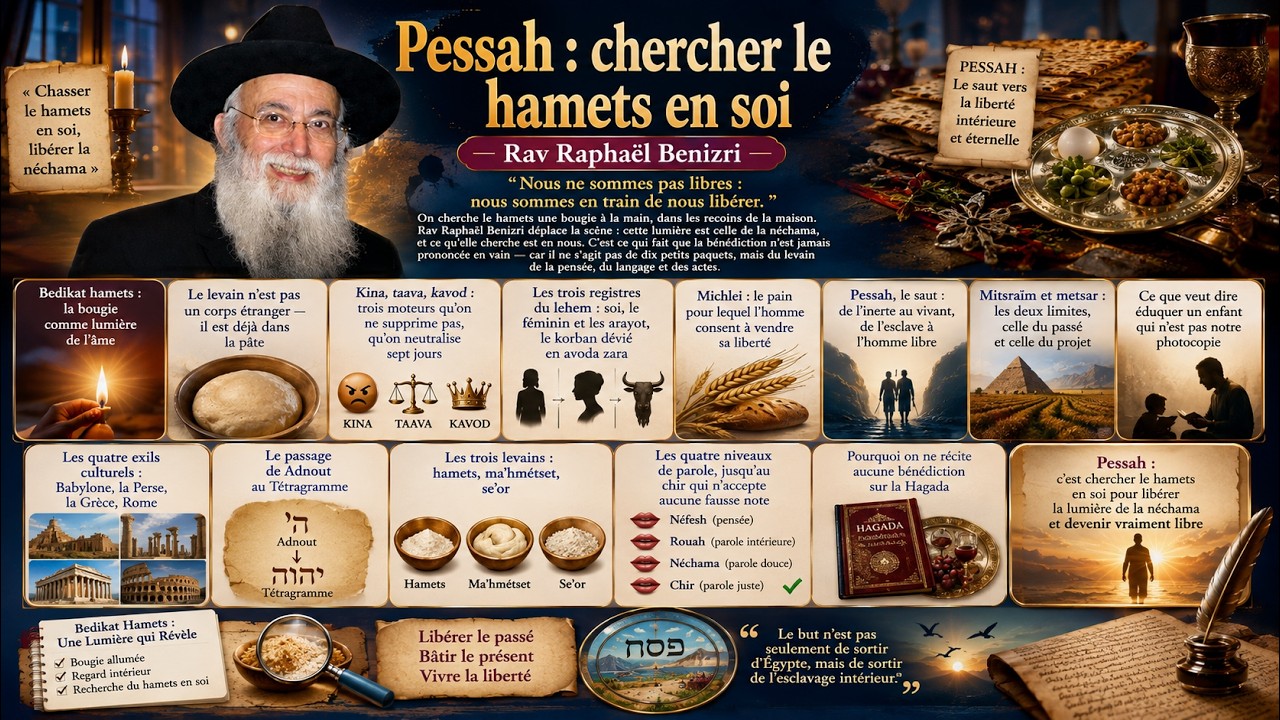
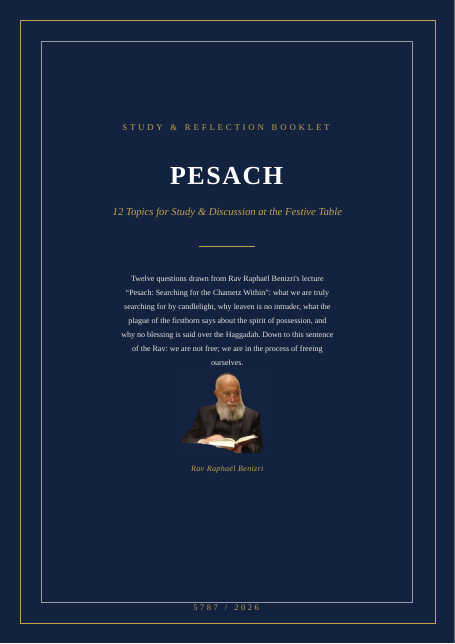
Pesach: Searching for the Chametz Within
Bedikat chametz becomes an inquiry into oneself: the leaven that has outlived its time, kin’ah, ta’avah and kavod, Pesach as a leap, and speech finally set free. Watch the lecture and read the transcript →

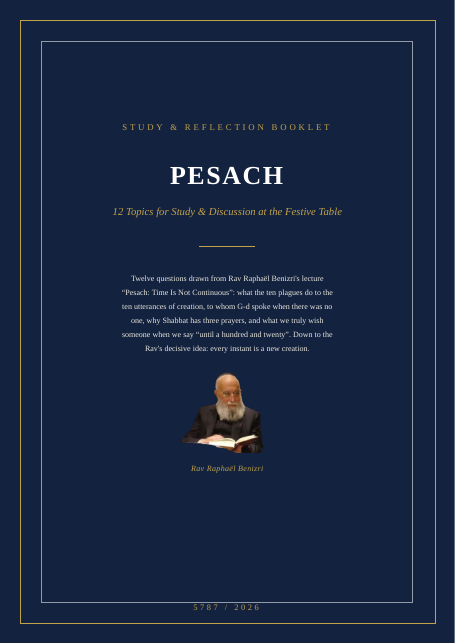
Pesach: Time Is Not Continuous
The ten plagues as the reverse side of the ten utterances of creation, Bereshit and the ayin, the three Shabbatot, Amalek, and the idea that every moment is a creation. Watch the lecture and read the transcript →

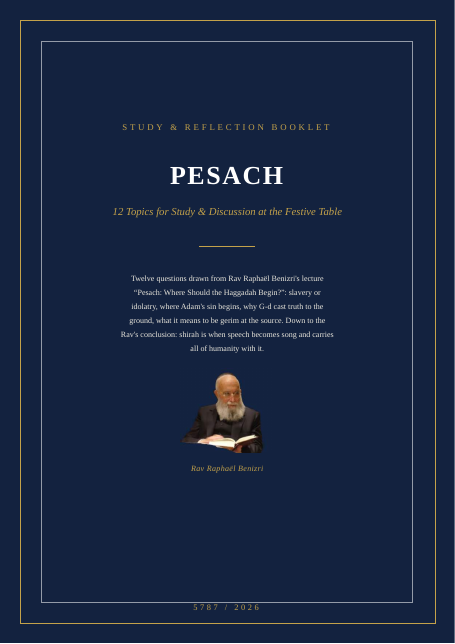
Pesach: Where Should the Haggadah Begin?
Slavery or idolatry: the choice of the Seder’s starting point determines everything that follows. Watch the lecture and read the transcript →

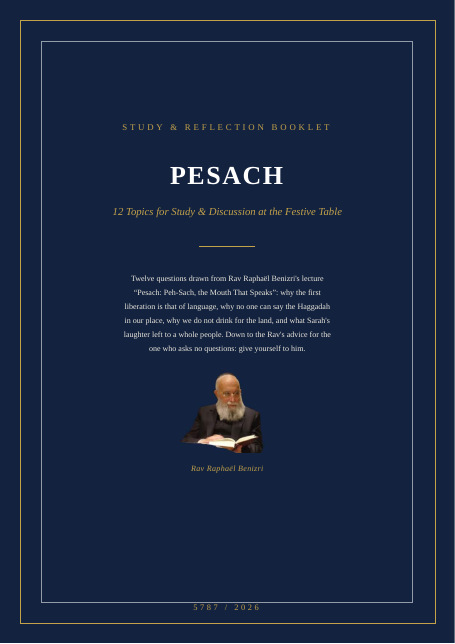
Pesach: Peh-Sach, the Mouth That Speaks
Language in exile, the four cups and the four parts of the Haggadah, the four sons whom no one may exclude, followed by a long exchange with the audience. Watch the lecture and read the transcript →

Pesach: The Mystery of the Number Four
The four worlds, the four exiles, the four emblems of the Throne, the four modes of speech, and all the sets of four that shape the Seder night. Watch the lecture and read the transcript →
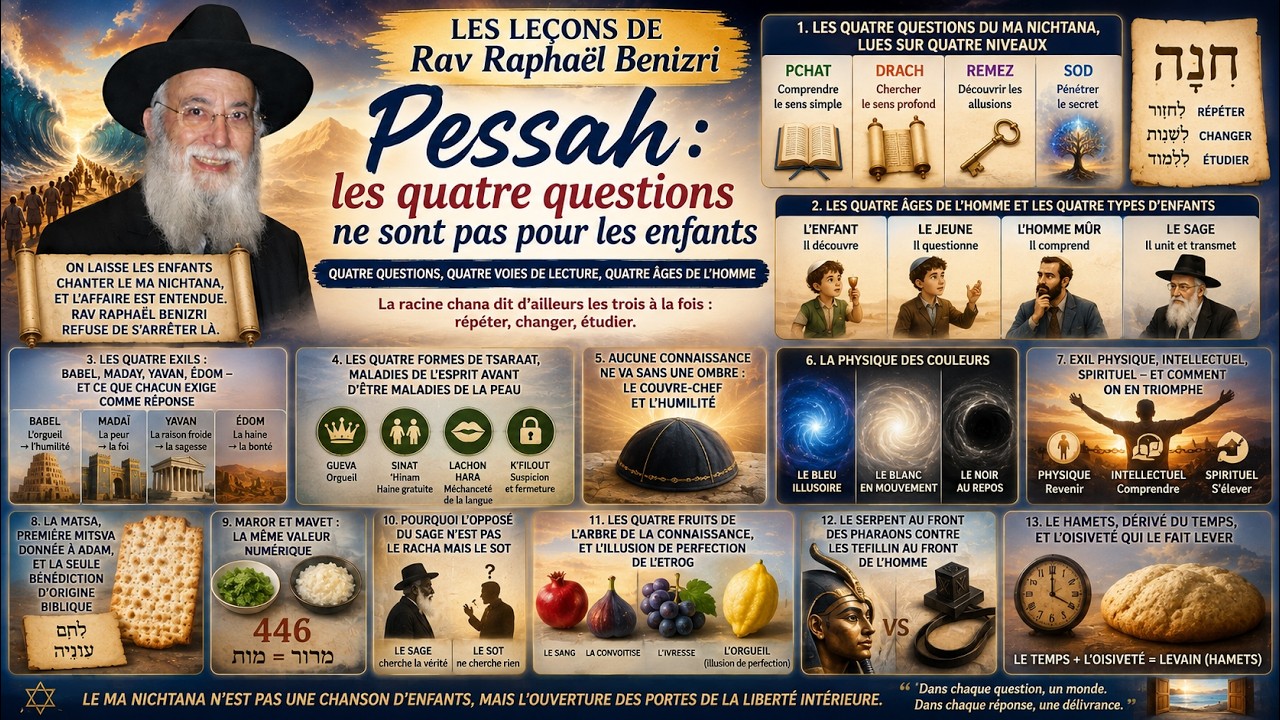
Pesach: The Four Questions of Ma Nishtana
Peshat, derash, remez and sod, the four exiles, the four stages of tzara’at, the four fruits of Adam, and chametz understood as a by-product of time. Watch the lecture and read the transcript →
Study booklets for each lecture: questions to reflect on as a family
There is one sentence, at the heart of the Seder, that determines everything else: each person must see himself as though he himself had come out of Egypt. Not remember that others came out — come out. Pesach is not a commemoration; it is an exercise.
What “Egypt” Means
The Hebrew name for Egypt, Mitzrayim, evokes narrowness, whatever constricts and confines. The Exodus is a historical event, and it is also the name given to every departure from a place that is too narrow: a habit, a fear, a self-image one cannot shake off.
That is why the festival returns every year. One does not leave Egypt once and for all.
An Evening Built for Children
The Seder is perhaps the most finely crafted teaching tool in the tradition. Everything in it is designed to provoke a question: we dip, we change the usual order of things, we hide a piece of unleavened bread, we sing. The youngest asks why this night is different, and the story begins only after that question.
Transmission does not come down from above: it answers. Nothing is said until someone has asked.
The Bread of Haste
Matzah is the bread of people who did not have time to wait for the dough to rise. It is the bread of poverty and, at the same time, the bread of freedom — because freedom came too quickly for anyone to prepare for it comfortably.
We also eat bitter herbs. The story does not hide the slavery; it puts it on the table, literally, beside the wine and the joy. A freedom that had forgotten where it came from would be fragile.
Going Out, Then Receiving
Pesach opens the Counting of the Omer, forty-nine days that lead to Shavuot. The Exodus is not an end: it is the beginning of a journey toward Sinai. Being set free is not enough — one must still know what to do with that freedom.
Continue studying
The Counting of the Omer, which begins the day after the festival; Shavuot, to which it leads; and Sukkot, the third pilgrimage festival.
The Pesach Lectures
Pesach: Where Should the Haggadah Begin?
See also: Why Do We Eat Matzah on Pesach?