

Shavuot: The Festival of Oaths
Why the Festival of Weeks is first of all a festival of oaths: seven and shevuah, the Shema, David HaMelech and Ruth the Moabite. Watch the lecture and read its transcript →

Shavuot: The Fiftieth Day, Beyond the Count
Why the fiftieth day of the Sefirah is not counted: time beyond time, the ani, the fruits of the tree and the shofar of the Yovel. Watch the lecture and read its transcript →

Shavuot: The Book of Ruth and Hesed
Elimelech and Ruth’s Moabite origins, Boaz and the line of David, and the Torah as a Torah of kindness. Watch the lecture and read its transcript →

Shavuot: Ruth, the Eshet Chayil, and Hesed
Ruth, the Eshet Chayil, and a megillah written entirely for the sake of gemilut hasadim: hesed, the giving of oneself. Watch the lecture and read its transcript →
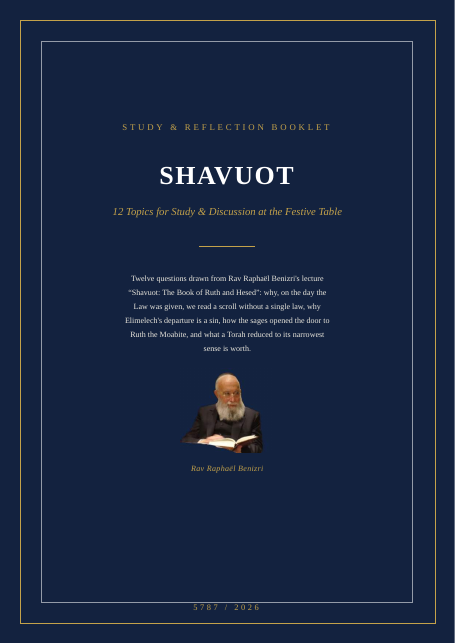
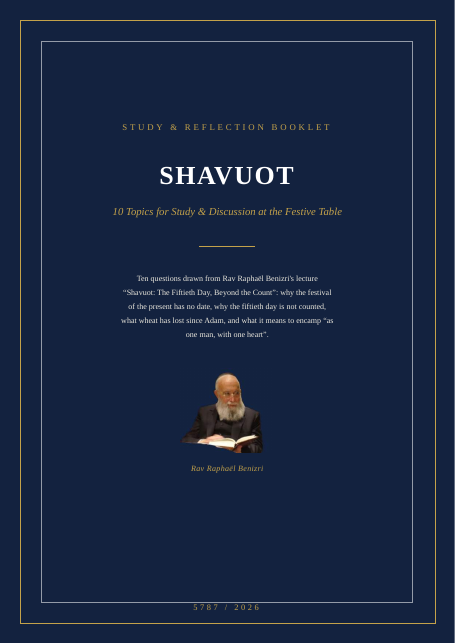
Study booklets for each lecture: questions to reflect on as a family
Shavuot is the most understated of the three great festivals. No sukkah to build, no seder to prepare, no spectacular ritual. One day, one night of study — and the most momentous event in Jewish history: the giving of the Torah at Sinai.
Seven Weeks of Waiting
The festival has no date of its own in the Torah: it falls at the end of the seven weeks counted from Pesach. It exists only as a culmination. That in itself is a lesson: what was received at Sinai could not have been received the day after the Exodus from Egypt. It took forty-nine days for freed slaves to become capable of receiving anything at all.
Giving and Receiving
Tradition speaks of the “giving” of the Torah, and immediately notes that giving is not enough. A gift left on a table belongs to no one until someone takes it. Every generation, and within it every individual, must repeat this act of receiving — otherwise Sinai remains an event of the past instead of becoming a relationship.
The Night of Study
The custom is to stay awake the entire night of Shavuot, studying. The midrash relates that the people had fallen asleep on the morning the Torah was given and had to be woken; the night-long vigil is said to make amends for that sleep.
There is something true in this image. One does not prepare to receive while asleep. And a night spent studying with others produces a kind of understanding that solitary reading never brings.
The Book of Ruth
On Shavuot we read the Book of Ruth — the story of a woman who came from outside, who freely chose to join a people and a covenant, and from whom King David would descend. Placing this story on the day the Torah was given is no accident: it reminds us that the deepest belonging can be a choice, and that faithfulness counts for more than birth.
Continue studying
Pesach and the Counting of the Omer, which lead up to this festival; Sukkot, the third pilgrimage festival.