


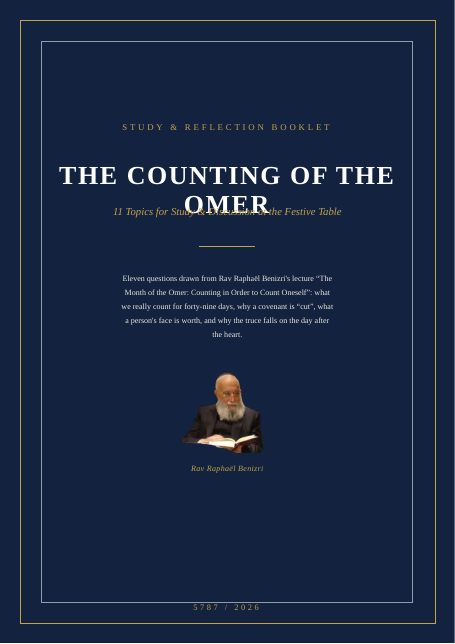
The Month of the Omer: Counting in Order to Count Oneself
Why Rabbi Akiva’s disciples died, what the Omer truly measures, and the arithmetic of “lev tov” that leads to Lag BaOmer. Watch the lecture and read its transcript →

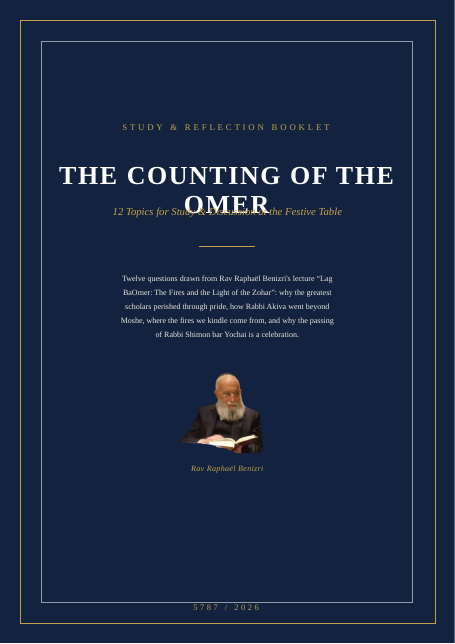
Lag BaOmer: The Fires and the Light of the Zohar
The hilula of Rabbi Shimon bar Yochai, the origin of the fire going back to the Brit bein HaBetarim, and what the Zohar adds to the Torah of Rabbi Akiva. Watch the lecture and read its transcript →
Study booklets for each lecture: questions to reflect on as a family
Between Pesach and Shavuot, we count. Every evening, aloud, we declare the day we have reached: day one, day two, and so on up to forty-nine. It is one of the simplest practices in the tradition, and one of the strangest — for we are counting nothing but the passing of time.
Counting Toward, Not Counting Down
We do not count down the days remaining, the way one waits for a vacation. We count the days completed. The difference is significant: a countdown empties time of its content, while counting forward fills it. Each day adds something, instead of simply bringing a deadline closer.
Seven Weeks of Seven Days
The path is not linear: it is structured as seven weeks of seven days. The kabbalistic tradition associates each week with a quality — kindness, discipline, harmony, perseverance, humility, connection, sovereignty — and each day with a combination of two of them.
This yields forty-nine shades of character to examine one by one. It is methodical work on oneself, without emotional fervor, which assumes that no quality is good in its pure state: kindness without discipline becomes indulgence, and discipline without kindness becomes harshness.
A Time of Restraint
Part of this period is marked by customs of mourning, in memory of the disciples of Rabbi Akiva, who, according to tradition, died because they did not know how to respect one another. The connection is striking: on the path leading to receiving the Torah, we remember those who knew everything and yet missed what matters most.
Perhaps this is the meaning of these forty-nine days. It is not enough to have been freed, and it is not enough to know. One must also become someone who can be entrusted with something.