
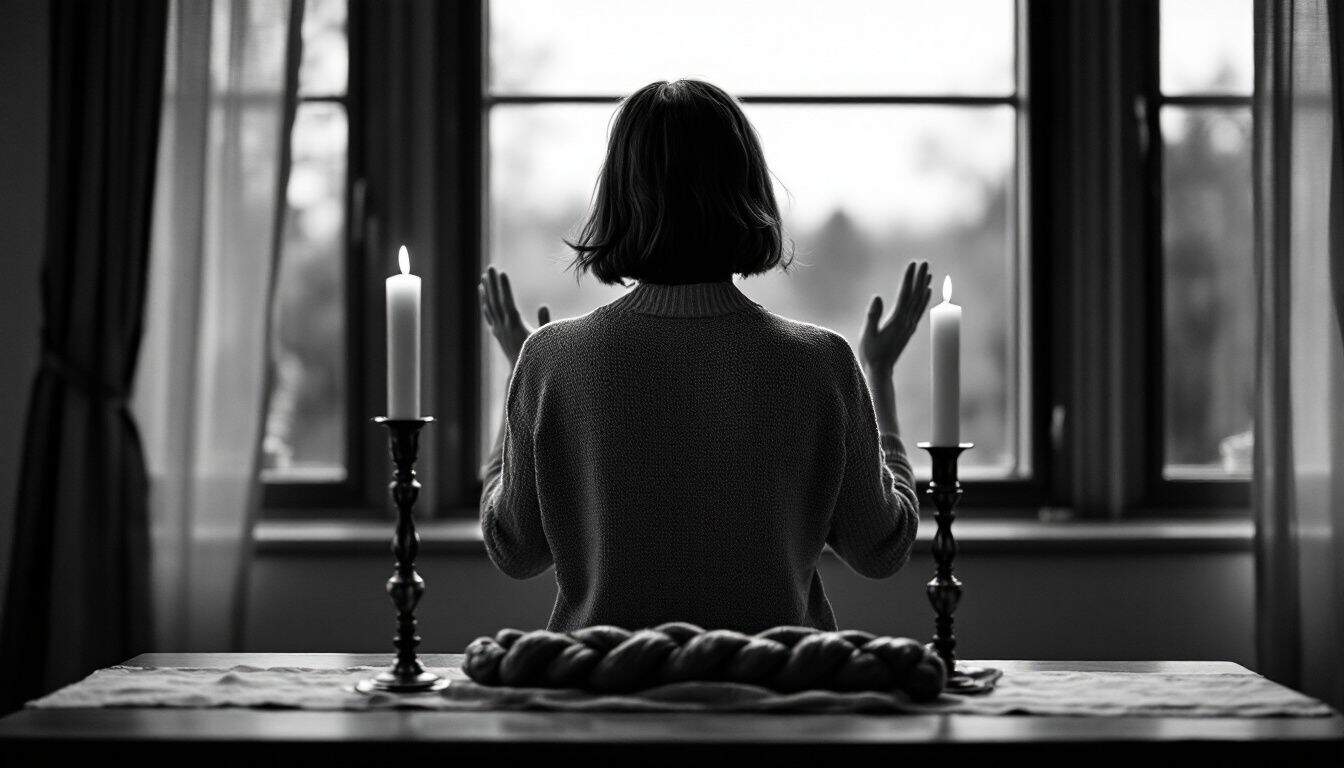
On Friday, a few minutes before sunset, in millions of homes, a woman lights two flames, passes her hands in front of them, closes her eyes and recites a blessing. Why candles, why before sunset, and why, in the tradition, is it mainly the woman of the house who performs this act? This article answers from the Mishna, the Talmud, the midrashim, Maimonides and the Shulchan Aruch, separating practical law (halakha) from moral, mystical and historical readings, and pointing out where customs differ.
Lighting a lamp at home before Shabbat is an obligation of rabbinic origin, regarded by the Talmud as an “obligation” (chova) and not as a mere option; it rests on every member of the household, men and women alike. The Shulchan Aruch specifies that women are “more exhorted” to it, because they are at home and attend to the needs of the household. Several reasons are given: the light keeps people from eating in the dark and ensures peace in the home (shalom bayit); one midrash links the mitzvah to Adam and Eve, and another recalls Sarah’s lamp, which “burned from one Shabbat eve to the next”. One lights before sunset, with a blessing, and the woman who lights thereby enters Shabbat.
1. What the Torah says: a prohibition of fire, not a command to light
The Torah contains no verse commanding us to light candles for Shabbat. On the contrary, it contains a prohibition:
“You shall not kindle fire in any of your dwellings on the Shabbat day.”
(Shemot [Exodus] 35:3) — לֹא־תְבַעֲרוּ אֵשׁ בְּכֹל מֹשְׁבֹֽתֵיכֶם בְּיוֹם הַשַּׁבָּֽת׃
It is precisely because fire cannot be kindled during Shabbat that it must be kindled beforehand. The mitzvah of the candles is therefore an institution of the Sages, whose scriptural basis is indirect: the prophet asks that Shabbat be called a “delight” (Yeshayahu [Isaiah] 58:13), and the Rambam places the lamp “within the delight of Shabbat” (Hilkhot Shabbat 5:1). The Rambam, who includes the kindling of the lamp among the laws of Shabbat, expressly lists it among the obligations “of the words of the scribes”: the blessing is recited “as for all the things that one is obligated to do by the words of the scribes” (Rambam, Mishneh Torah, Hilkhot Shabbat 5:1).
This is an important nuance. A woman who has not lit has not, strictly speaking, transgressed a commandment of the Torah; but that does not make it an optional custom. The Talmud calls it an obligation (chova).
2. The Mishna and the Talmud: a mandatory light
The Mishna: three things to say at nightfall
Chapter 2 of Mishna Shabbat is the great text on this mitzvah. It opens with a practical question: “With what may one light and with what may one not light?” (Mishna Shabbat 2:1). It lists wicks and oils that are excluded, and the later Talmud and the codes have specified what is suitable today; for details, consult a rabbi. It ends with two teachings, one a warning, the other a habit:
“For three transgressions women die in childbirth: because they are not careful with niddah, with challah and with the lighting of the lamp.”
(Mishna Shabbat 2:6) — עַל שָׁלשׁ עֲבֵרוֹת נָשִׁים מֵתוֹת בִּשְׁעַת לֵדָתָן, עַל שֶׁאֵינָן זְהִירוֹת בַּנִּדָּה וּבַחַלָּה וּבְהַדְלָקַת הַנֵּר:
“Three things a person must say in his home on the eve of Shabbat, at nightfall: ‘Have you tithed? Have you made the eruv? Light the lamp.'”
(Mishna Shabbat 2:7) — שְׁלשָׁה דְבָרִים צָרִיךְ אָדָם לוֹמַר בְּתוֹךְ בֵּיתוֹ עֶרֶב שַׁבָּת עִם חֲשֵׁכָה. עִשַּׂרְתֶּם. עֵרַבְתֶּם. הַדְלִיקוּ אֶת הַנֵּר
Two observations. First, the sentence of Mishna 2:6 is harsh, but it is a moral warning: it associates the lamp with two other mitzvot, niddah (family purity) and challah (the portion separated from the dough). A baraita of Rabbi Yose takes up these three mitzvot, speaking of “three things connected with death” (divkei mita, or “accelerators of death” according to another version of the expression), which shows that the Talmud itself discusses the meaning of the term (Shabbat 32a). We shall come back to the reason the Jerusalem Talmud gives for it.
Second, Mishna 2:7 is addressed to “the man”: it is the master of the house who reminds everyone, before nightfall, not to forget the lamp. So, from the Mishna onward, there is a shared responsibility. As for the time, at the doubtful twilight (bein hashemashot), “one does not light the lamps” (Mishna Shabbat 2:7; Shulchan Aruch, Orach Chaim 261:1).
The Talmud: “chova”
The Babylonian Talmud asks why certain fuels are forbidden, and in doing so establishes the status of the lamp:
“Rav Nachman bar Rav Zavda, or according to others Rav Nachman bar Rava, said in the name of Rav: lighting the Shabbat lamp is an obligation (chova); washing one’s hands and feet in hot water in the evening is optional (reshut).”
(Shabbat 25b) — דְּאָמַר רַב נַחְמָן בַּר רַב זַבְדָּא, וְאָמְרִי לַהּ אָמַר רַב נַחְמָן בַּר רָבָא אָמַר רַב: הַדְלָקַת נֵר בְּשַׁבָּת חוֹבָה, רְחִיצַת יָדַיִם וְרַגְלַיִם בְּחַמִּין עַרְבִית, רְשׁוּת
On the same page, the Talmud gives a poignant reading of a verse in Lamentations. “My soul is removed from peace” (Eicha 3:17): Rabbi Abahu sees in it the deprivation of the Shabbat lamp suffered by the exile, who no longer has a home in which to light it (Shabbat 25b). The Shabbat light is here the very sign of peace in the home.
Further on, the Talmud marvels at a reward:
“Rav Huna said: one who is accustomed to the lamp (ner) will have sons who are Torah scholars.”
(Shabbat 23b) — אָמַר רַב הוּנָא: הָרָגִיל בְּנֵר הָוְיִין לֵיהּ בָּנִים תַּלְמִידֵי חֲכָמִים
The Talmud illustrates this teaching: Rav Huna passed by the house of Rabbi Avin the carpenter, saw that he lit many lamps in honor of Shabbat, and said: “Two great men will come out of here”; and indeed from that family came Rav Idi bar Avin and Rav Chiya bar Avin (Shabbat 23b). The Talmud tells the same story of Rav Chisda and Rav Chezvi.
The Rambam: an obligation for everyone
The Rambam specifies that lighting the Shabbat lamp is “not optional”, nor a mitzvah that one need not pursue, like the eruv of courtyards or washing the hands before the meal, “but it is an obligation”; and he adds:
“Men and women alike are obligated to have a lamp burning in their homes on Shabbat.”
(Rambam, Hilkhot Shabbat 5:1) — וְאֶחָד אֲנָשִׁים וְאֶחָד נָשִׁים חַיָּבִין לִהְיוֹת בְּבָתֵּיהֶן נֵר דָּלוּק בְּשַׁבָּת
He adds that even without means, one must borrow: “even one who has nothing to eat begs at the doors, buys oil and lights the lamp, for it is part of the delight of Shabbat (oneg Shabbat)” (Hilkhot Shabbat 5:1; Shulchan Aruch, Orach Chaim 263:2).
3. Why the woman? Several answers, on several levels
The practical answer: the woman is at home
The simplest halakha is given by the Rambam and taken up in substance by the Shulchan Aruch:
“Women are more exhorted about this matter than men, because they are present in the home and are occupied with the work of the home.”
(Rambam, Hilkhot Shabbat 5:3) — וְנָשִׁים מְצֻוּוֹת עַל דָּבָר זֶה יוֹתֵר מִן הָאֲנָשִׁים לְפִי שֶׁהֵן מְצוּיוֹת בַּבָּתִּים וְהֵן הָעֲסוּקוֹת בִּמְלֶאכֶת הַבַּיִת
The same passage specifies that it is nevertheless up to the man to see to it: “he must warn them and check on them, and tell them and the members of his household on the eve of Shabbat before nightfall: light the lamp” (Rambam, Hilkhot Shabbat 5:3, taking up Mishna 2:7). The Shulchan Aruch (Orach Chaim 263:3) takes up the same idea: “Women are more exhorted about it because they are present in the home and attend to the needs of the home.”
In terms of halakha, then, it is a matter of division of roles, not of exclusion: the text expressly says that men too are obligated (Rambam, Hilkhot Shabbat 5:1; Shulchan Aruch, Orach Chaim 263:2). Each person lights in his own home; students who lodge away from their homes light in their rooms and recite the blessing; but “one who is at his wife’s home need not light in his room, for his wife blesses on his behalf” (Shulchan Aruch, Orach Chaim 263:6).
The aggadic answer: Adam, Eve and the light
The Jerusalem Talmud and the Midrash Bereshit Rabbah give a reason of a very different kind. The Yerushalmi reports on the same Mishna:
“Adam the first was the lamp (ner) of the world, as it is said: ‘The lamp of G-d is the soul of man’ (Mishlei 20:27). Eve caused his death; therefore the mitzvah of the lamp was entrusted (massru) to the woman.”
(Jerusalem Talmud, Shabbat 2:6) — אָדָם הָרִאשׁוֹן נֵרוֹ שֶׁלְּעוֹלָם הָיָה. שֶׁנֶּאֱמַר נֵר אֱלֹהִים נִשְׁמַת אָדָם. וְגָרְמָה לוֹ חַוָּה מִיתָה. לְפִיכָךְ מָסְרוּ מִצְוַת הַנֵּר לָאִשָּׁה
The Midrash Bereshit Rabbah (17:8) gives the same series of three mitzvot (niddah, challah, lamp) in the form of questions put to Rabbi Yehoshua:
“And why was the mitzvah of the Shabbat lamp given to her? He said to them: because she extinguished the soul of Adam the first; therefore the mitzvah of the Shabbat lamp was given to her.”
(Bereshit Rabbah 17:8) — וּמִפְּנֵי מָה נִתַּן לָהּ מִצְוַת נֵר שַׁבָּת, אָמַר לָהֶן עַל יְדֵי שֶׁכִּבְּתָה נִשְׁמָתוֹ שֶׁל אָדָם הָרִאשׁוֹן, לְפִיכָךְ נִתַּן לָהּ מִצְוַת נֵר שַׁבָּת
These texts must be read for what they are, midrashim (interpretive narratives) that link the mitzvah to the sin in Genesis: the Shabbat light symbolically “repairs” the extinguished soul. Note the wording: the Yerushalmi says the mitzvah was “entrusted (massru)” to her, a verb of transmission; Bereshit Rabbah says it was “given”. The tradition reads in this a mission rather than a sanction; this is how the text itself phrases the mitzvah. It is an aggadic reading and not the reason for the practical halakha, which the Rambam gives (see above). We flag it as a point whose interpretation should be reviewed with a rabbi.
The answer from the Patriarchs: Sarah and Rebecca
A third midrash links the Shabbat candle to Sarah. The verse says that Yitzchak “brought her [Rivka] into the tent of Sarah his mother” (Bereshit [Genesis] 24:67); Bereshit Rabbah (60:16) draws from it four signs of Sarah’s house, among them:
“All the days that Sarah lived, a lamp burned from one Shabbat eve to the next Shabbat eve; when she died, that lamp went out; when Rivka came, it returned.”
(Bereshit Rabbah 60:16) — כָּל יָמִים שֶׁהָיְתָה שָׂרָה קַיֶּמֶת הָיָה נֵר דּוֹלֵק מִלֵּילֵי שַׁבָּת וְעַד לֵילֵי שַׁבָּת, וְכֵיוָן שֶׁמֵּתָה פָּסַק אוֹתוֹ הַנֵּר, וְכֵיוָן שֶׁבָּאת רִבְקָה חָזַר
Rashi takes up this teaching on the verse: “a lamp burned in the tent from one Shabbat eve to the next, a blessing was in the dough, and a cloud was attached to the tent; when she died these ceased, and when Rivka came they returned” (Rashi on Bereshit 24:67). The Shabbat candle thus becomes one of the signs of the Jewish home, passed down from matriarch to matriarch.
The answer of the home: shalom bayit
The Talmud gives a criterion of priority that sheds light on the spirit of the mitzvah. If one can afford only oil for the lamp of the house or for the Chanukah lamp, the lamp of the house comes first, and the same holds between it and the wine for kiddush:
“Rava said: it is obvious to me that between the lamp of one’s house and the Chanukah lamp, the lamp of one’s house takes precedence, because of the peace of his household (shalom beito).”
(Shabbat 23b) — אָמַר רָבָא: פְּשִׁיטָא לִי, נֵר בֵּיתוֹ וְנֵר חֲנוּכָּה — נֵר בֵּיתוֹ עָדִיף, מִשּׁוּם שְׁלוֹם בֵּיתו
The Rambam draws a famous sentence from this: the lamp of the house comes before that of Chanukah “because of the peace of his household; for the Name [of G-d] is erased to make peace between a man and his wife. Great is peace: the whole Torah was given to make peace in the world” (Rambam, Hilkhot Megillah VeChanukah 4:14). The Shulchan Aruch takes it up in one phrase: “for there is no peace in the home without a lamp” (Orach Chaim 263:3):
“Women are more exhorted about it, because they are present in the home […]; and if one cannot afford [both] a Shabbat lamp and a Chanukah lamp, the Shabbat lamp comes first, because of peace in the home, for there is no peace in the home without a lamp.”
(Shulchan Aruch, Orach Chaim 263:3) — הנשים מוזהרות בו יותר מפני שמצויות בבית ועוסקות בצרכי הבית ואם אין ידו משגת לקנות נר לשבת ולקידוש היום נר שבת קודם וכן אם אין ידו משגת לקנות נר שבת ונר לחנוכה נר שבת קודם משום שלום הבית דאין שלום בית בלא נר
In other words, the light is first of all a very concrete instrument: one sees one’s spouse, one eats by its light, one prevents the Shabbat table from being a dark place. The Talmud preserves a concrete trace of this: Rava explains that one must eat by the light of the Shabbat lamp, and that this is why tar was forbidden as a fuel, since its smell would drive people from the table (Shabbat 25b).
4. How does one light? The practical law
When?
One lights before sunset, at a time set by the local calendars of each community. The Rambam states: “One who lights must light by day, before sunset” (Hilkhot Shabbat 5:3). One must not light too early either: the Shulchan Aruch forbids “advancing the lighting while it is still full daylight”, because it is then not apparent that it is for Shabbat; but one may light earlier if one accepts Shabbat immediately, provided it is from the late afternoon (plag hamincha) onward, that is, “an hour and a quarter [in halakhic hours] before nightfall” (Orach Chaim 263:4).
At the doubtful twilight, one no longer lights (Mishna Shabbat 2:7; Shulchan Aruch, Orach Chaim 261:1). For special cases (travel, hospital, hotel, electric light), consult a rabbi.
How many candles?
The Shulchan Aruch writes: “One should take care to make a beautiful light; and some intend to make two wicks, one corresponding to zachor (‘remember’), the other to shamor (‘keep’)” (Orach Chaim 263:1), referring to the two formulations of the Shabbat commandment (Shemot 20:8; Devarim [Deuteronomy] 5:12). The Rema adds: “One may add and light three or four candles; this is the custom. A woman who forgot to light once lights three candles thereafter for the rest of her life (Maharil)”, for one may add to something meant to symbolize another, provided one does not reduce the number. The most widespread custom is therefore two candles at a minimum, and the additions are customs.
The blessing
“When one lights, one says: ‘Blessed are You, L-rd our G-d, King of the universe, who has sanctified us with His commandments and commanded us to light the Shabbat lamp.'”
(Shulchan Aruch, Orach Chaim 263:5) — כשידליק יברך ברוך אתה ה’ אלהינו מלך העולם אשר קדשנו במצותיו וצונו להדליק נר של שבת אחד האיש ואחד האשה
On the order, the Rambam teaches that “one must bless before lighting” (Hilkhot Shabbat 5:1), as for every mitzvah. The Rema, for his part, reports two opinions, “to bless before, or after the lighting”, and gives the Ashkenazic custom (following the Maharil): so that the blessing is said before the mitzvah is performed, one does not benefit from the light before blessing; therefore one places the hand in front of the flame after lighting, blesses, and then removes the hand (Orach Chaim 263:5). This is the gesture of passing the hands in front of the flames, of which covering the eyes is the common form: once the light is kindled, one benefits from it only after the blessing. Communities vary on these details: follow the custom of your family and your rabbi.
She who lights enters Shabbat
This is a singular rule: the lighting brings the one who lights into Shabbat. The Shulchan Aruch reports the opinion of the Halakhot Gedolot (a work of the Geonim) that, as soon as one has lit, Shabbat “falls upon” the person and forbids all work, and it mentions other opinions according to which entry into Shabbat depends on the evening prayer. The Rema’s conclusion is practical:
“The custom is that the woman who lights accepts Shabbat by the lighting, unless she made a condition beforehand; and even a condition in the heart suffices.”
(Rema on Shulchan Aruch, Orach Chaim 263:10) — והמנהג שאותה אשה המדלקת מקבלת שבת בהדלקה אם לא שהתנה תחלה
The other members of the household remain permitted to work until “Barchu” (Rema, Orach Chaim 263:10). That is why, in practice, she who lights has done everything beforehand, and one makes one’s preparations knowing that the lighting closes the week.
Using the light
The Rambam permits benefiting from the Shabbat light (eating, moving about), except for work that demands great attention (precise reading), lest one bring the lamp closer or tilt it (Hilkhot Shabbat 5:2). The Rema adds that the candles must be left where they were lit, without lighting them here in order to place them elsewhere, and that the essential part of the lighting concerns the candles one puts on the table (Orach Chaim 263:10).
For any particular case, such as children, a vacation spot, a home without a woman, a power outage or some mishap, it is for the community’s rabbi to rule.
5. A little history: Karaite opposition and the practice of the communities
To measure what is original about this mitzvah, one must look at those who rejected it. The Karaites, a Jewish movement that appeared in the Middle Ages and rejects the oral tradition, read “you shall not kindle fire” (Shemot 35:3) literally and held that one must not even leave burning during Shabbat a fire lit beforehand. According to a study by the Jewish Theological Seminary (JTS), “Karaite homes refrained, on Shabbat, from lighting and heating their houses throughout the Middle Ages; the darkness lent itself to mockery”. For the Rabbanites, by contrast, the Shabbat light is an obligation (Shabbat 25b) and part of the delight of Shabbat (Rambam, Hilkhot Shabbat 5:1).
At the end of the Middle Ages, the Rema cites the Maharil for two customs: the gesture of the hand in front of the flames (Orach Chaim 263:5) and the three candles of the woman who forgot (263:1).
In modern times, the Chabad-Lubavitch movement launched, on September 11, 1974, an international campaign so that “every Jewish woman and girl, from the age of three, light the Shabbat candles”, on the initiative of the Lubavitcher Rebbe (according to the Chabad website). This is a contemporary Chasidic initiative, adopted in many circles; the age of three is a particular feature of it.
On the archaeological side, we have no precise source to cite on Shabbat lamps themselves, and we do not settle the point here.
6. Several levels of reading
Halakha. Lighting is an obligation of rabbinic origin (Rambam 5:1), incumbent on everyone (Shulchan Aruch 263:2), with a particular exhortation to the mistress of the house (263:3), before sunset (Rambam 5:3; Shulchan Aruch 261:1; 263:4), with a blessing (263:5).
Aggada and mussar (moral reading). The light is an instrument of peace: “there is no peace in the home without a lamp” (Shulchan Aruch 263:3). The Talmud places it above wine and Chanukah in the order of priorities, because peace in the home comes before the rest (Shabbat 23b). Mishlei (Proverbs) 6:23 says: “For the mitzvah is a lamp, and the Torah a light”; the link between candle and mitzvah is an ancient image, which the tradition develops.
Kabbalah and Chasidut. The kabbalistic tradition associates the two flames with zachor and shamor (Shulchan Aruch 263:1: “some intend”); the image of the soul as a light (Mishlei 20:27, cited in the Yerushalmi) feeds readings in which the woman is the one who kindles the light of the home’s soul. In widespread custom, one also reads the song “Eshet Chayil” (Mishlei 31:10-31) on Friday night, one verse of which says: “Her lamp does not go out at night” (Mishlei 31:18); the plain sense of the verse concerns the activity of the woman of valor, and linking it with the Shabbat candles is a custom of association.
History. See above: Karaite opposition, the tradition of Sarah, the gloss of the Maharil, the campaign of 1974.
Common misconceptions about Shabbat candles
“Only women are obligated.” No: “men and women alike are obligated to have a lamp burning in their homes” (Rambam, Hilkhot Shabbat 5:1; Shulchan Aruch, Orach Chaim 263:2). Women are more exhorted because they are at home (263:3).
“It is a commandment of the Torah.” No: it is an institution of the Sages (Rambam, Hilkhot Shabbat 5:1), even though the Talmud declares it obligatory (Shabbat 25b).
“The Mishna says that women die in childbirth if they do not light.” The text says that women die in childbirth “for three transgressions”, among them neglect of the lamp (Mishna Shabbat 2:6); it is a teaching of warning, discussed in the Talmud (Shabbat 32a), which is not read as a rule of causation. No practice is drawn from it.
“There must be exactly two candles.” Two is the usual minimum (Shulchan Aruch, Orach Chaim 263:1); one may add more (Rema), and the text speaks first of a “beautiful light”.
“Lighting is like lighting any other light; one can keep working afterward.” For the woman who lights, it is the beginning of Shabbat, unless she made a prior condition (Rema, Orach Chaim 263:10).
Frequently asked questions about Shabbat candles
What time should one light?
Before sunset (Rambam, Hilkhot Shabbat 5:3), at the time given by the local calendar of one’s community. One does not light at the doubtful twilight (Shulchan Aruch, Orach Chaim 261:1), and one avoids lighting too early without accepting Shabbat (263:4).
Can a man light?
Yes, and he must if there is no woman in his home; the obligation is the same for everyone (Rambam, Hilkhot Shabbat 5:1; Shulchan Aruch, Orach Chaim 263:2). A man whose wife lights need not light in his room (263:6).
Why does one pass the hand in front of the flames?
So that the blessing precedes the moment when one “benefits” from the light (Rema, Orach Chaim 263:5, following the Maharil); covering the eyes is the common form of this gesture. It is an Ashkenazic custom; the Rambam, for his part, has one bless before lighting (Hilkhot Shabbat 5:1).
What should one do if one forgot to light?
Consult a rabbi about the specific case. The Rema reports the custom (Maharil) that a woman who forgot once lights three candles thereafter for the rest of her life (Orach Chaim 263:1); this is an Ashkenazic custom, not an obligation.
What about young girls?
The sources cited here set no age. The Chabad custom of inviting girls to light from the age of three was launched in 1974. Follow the custom of your family and your rabbi.
Can one use electric candles or tea lights?
The Mishna opens the chapter by distinguishing the wicks and oils that are suitable (Mishna Shabbat 2:1). Modern cases belong to practical halakha: consult a rabbi.
Further reading
- The Jewish holidays: the meaning of each festival in video lessons
- “Perfumes of Shabbat”: Rav Benizri’s book
- Why eight candles on Chanukah? The meaning of the 8 lights
- Free booklets: questions to ask at the Shabbat table
- Glossary of Hebrew words in Judaism
- What is Shabbat?
- What is Havdalah, which closes Shabbat?
- What is Chanukah?
Sources and references (16)
- Bereshit (Genesis) 24:67
- Shemot (Exodus) 20:8; 35:3
- Devarim (Deuteronomy) 5:12
- Yeshayahu (Isaiah) 58:13
- Mishlei (Proverbs) 6:23; 20:27; 31:10-31 (31:18)
- Eicha (Lamentations) 3:17
- Mishna Shabbat 2:1; 2:6; 2:7
- Babylonian Talmud, Shabbat 23b; 25b; 32a
- Jerusalem Talmud, Shabbat 2:6
- Bereshit Rabbah 17:8; 60:16
- Rashi on Bereshit 24:67
- Rambam, Mishneh Torah, Hilkhot Shabbat 5:1-3
- Rambam, Mishneh Torah, Hilkhot Megillah VeChanukah 4:14
- Shulchan Aruch, Orach Chaim 261:1; 263:1-6; 263:10 (with the glosses of the Rema)
- Jewish Theological Seminary, “The Meaning of the Shabbat Candles” (on the Karaites and the darkness of Shabbat)
- Chabad.org, “The Shabbos Candle Lighting Campaign” (campaign launched on September 11, 1974)
Article by the Pensées Juives editorial team.