
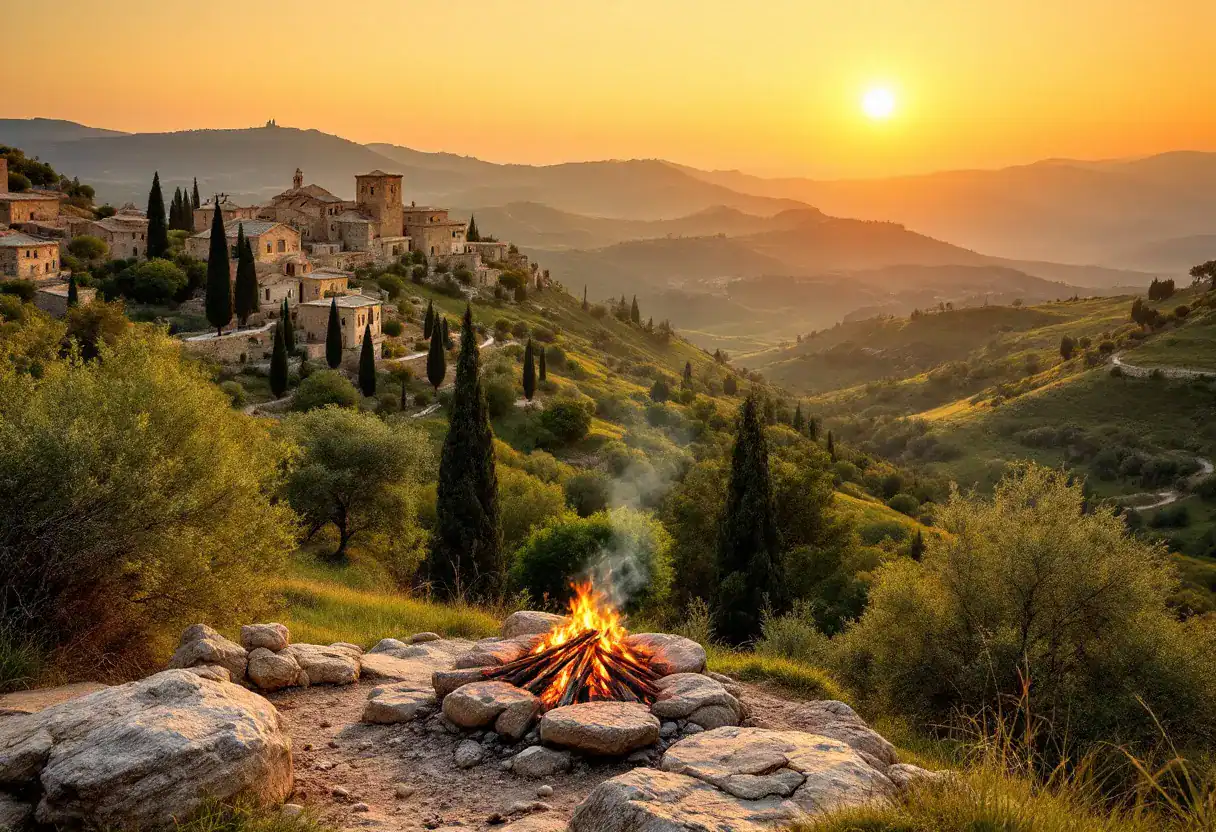
In the middle of a period of mourning, a day of joy: bonfires in the night, thousands of pilgrims in Meron, children carrying bows. Why did the thirty-third day of the Omer become a festival, what does it have to do with Rabbi Akiva and Rabbi Shimon bar Yochai, and what do its flames tell us?
Lag BaOmer is the thirty-third day of the counting of the Omer, the forty-nine days counted between Pesach and Shavuot. It falls on the 18th of Iyar. It is celebrated for two reasons: according to tradition, it is the day on which the plague that took the twenty-four thousand students of Rabbi Akiva came to an end, and it is the hillula, the anniversary of the passing, of Rabbi Shimon bar Yochai, to whom tradition attributes the Zohar. On that day, the mourning of the Omer is suspended: weddings are held again, people cut their hair, great bonfires are lit, and many go up to Meron, in the Galilee, to the tomb of Rabbi Shimon.
In 5787, Lag BaOmer begins on the evening of Monday, May 24, 2027, and continues through Tuesday, May 25. The counting of the Omer itself begins on the evening of Thursday, April 22, 2027, the second night of Pesach, and ends on the eve of Shavuot, which begins on the evening of Thursday, June 10, 2027.
The name itself is a number. In Hebrew, every letter has a numerical value: lamed is thirty and gimel is three. “Lag” is therefore thirty-three, and “Lag BaOmer” simply means “the thirty-third of the Omer.” To understand why this number became a festival, we must first understand what is being counted.
The Counting of the Omer: What the Torah Says
The source is in Leviticus, in the chapter of the festivals read in Parashat Emor: “You shall count for yourselves, from the day after the day of rest, from the day you bring the Omer of the wave offering, seven complete weeks. Until the day after the seventh week you shall count fifty days” (Vayikra 23:15-16). Deuteronomy restates it in its own way: “You shall count seven weeks; from when the sickle begins to cut the standing grain, you shall begin to count seven weeks” (Devarim 16:9).
The Omer is first of all a measure. It is the word the Torah uses for the ration of manna that each person gathered in the desert: “an omer per head” (Shemot 16:16). It is also the name of the offering brought to the Temple on the 16th of Nisan, the day after the first day of Pesach: a measure of new barley, the first sheaf of the harvest. Until this offering had been brought, it was forbidden to eat from the new crop (Vayikra 23:14).
The “day after the day of rest” mentioned in the verse was the subject of an ancient dispute. Sects such as the Boethusians wanted to read it literally: the day after Shabbat, that is, always a Sunday. Our Sages established, through a lengthy demonstration, that “rest” here refers to the first day of the festival of Pesach (Menachot 65a-66a). This is why the count always begins on the evening of the 16th of Nisan, whatever the day of the week.
Counting the Days and the Weeks
The Torah says both “seven weeks” and “fifty days.” The Talmud concludes that both must be counted (Menachot 66a): each evening one announces the number of days and, once the first week is complete, the number of weeks. On the thirty-third evening, one therefore says: “Today is thirty-three days, which are four weeks and five days of the Omer.”
The count is made in the evening, after the stars come out, standing, with the blessing “al sefirat haOmer” (“on the counting of the Omer”). Someone who forgot to count in the evening counts during the day, without a blessing, and then resumes normally on the following evenings. Someone who forgot an entire day continues counting on the following days, but without a blessing (Shulchan Aruch, Orach Chaim 489:7-8). For particular cases, consult a rabbi.
From Barley to Wheat, from Egypt to Sinai
The count links two offerings. At the beginning, barley, brought on the day after Pesach. At the end, wheat: on Shavuot, two loaves of wheat bread were brought to the Temple. Between the Exodus from Egypt and the giving of the Torah, the people travel a road. We do not count down, as one waits for a deadline: we count upward, each day adding something to the one before.
Since the destruction of the Temple there is no longer an offering, but the count remains. And tradition has given these forty-nine days an inner content. The masters of Kabbalah associate each week and each day with one of the seven sefirot, the seven attributes through which G-d conducts the world and which man must reproduce within himself: kindness, rigor, harmony, perseverance, splendor, foundation, and kingship. Seven times seven: forty-nine stages of work on oneself. In this scheme, the thirty-third day corresponds to hod shebehod, the “splendor of splendor.”
A Period of Mourning: The Students of Rabbi Akiva
Why did this time of ascent become a time of sorrow? The Talmud relates: “Rabbi Akiva had twelve thousand pairs of disciples, from Gevat to Antipatris. They all died in a single period, because they did not treat one another with respect. And the world was desolate, until Rabbi Akiva came to our masters in the South and taught them: Rabbi Meir, Rabbi Yehudah, Rabbi Yossi, Rabbi Shimon and Rabbi Elazar ben Shamua. It was they who upheld the Torah at that time.” The Talmud specifies that they all died between Pesach and Shavuot (Yevamot 62b).
Twenty-four thousand students, the disciples of the greatest master of his age. And their failing was not ignorance, nor idolatry, nor immorality: it was a lack of mutual respect. The lesson is all the more powerful because it was Rabbi Akiva himself who taught that “you shall love your neighbor as yourself” is the great principle of the Torah (Sifra on Vayikra 19:18).
In memory of this catastrophe, the custom arose of marking part of the Omer with signs of mourning. Weddings are not held between Pesach and Lag BaOmer, and people do not cut their hair (Shulchan Aruch, Orach Chaim 493:1-2). Many also refrain from listening to music. In Ashkenazi communities, the memory of the massacres committed against the Rhineland communities during the Crusades, in the spring of 1096, was added to this mourning.
Why the Thirty-Third Day?
The Talmud does not say that the plague stopped on the thirty-third day. This detail comes from a tradition of the Geonim, reported notably by the Meiri in his commentary on Yevamot: on that day the students stopped dying. Hence the ruling of the Shulchan Aruch (Orach Chaim 493:2): “The custom is not to cut one’s hair until Lag BaOmer, because it is said that they then stopped dying.”
Communities differ on the details. According to Rabbi Yosef Karo, whom the Sephardi communities follow, the mourning ends on the morning of the thirty-fourth day: one therefore waits until the day after Lag BaOmer to cut one’s hair or marry, unless Lag BaOmer falls on a Friday, in which case one cuts one’s hair that day in honor of Shabbat. The Rema, whom the Ashkenazi communities follow, permits these things from the thirty-third day and adds that one increases one’s joy somewhat on that day and does not recite the supplications of Tachanun. Still other customs shift the period of mourning. Each person should follow the custom of his community and ask his rabbi.
The Historical Background: Rome and Bar Kokhba
Rabbi Akiva lived in one of the darkest periods of Jewish history, between the destruction of the Second Temple in 70 and the Bar Kokhba revolt against Rome, from 132 to 135. Rabbi Akiva supported this revolt: the Jerusalem Talmud reports that he applied to its leader the verse “a star shall come forth from Yaakov” (Bamidbar 24:17), and that another sage, Rabbi Yochanan ben Torta, replied that grass would grow on his cheeks before the Messiah came (Yerushalmi Taanit 4:5). The revolt ended in bloodshed, with the fall of Betar. Rabbi Akiva himself died a martyr, tortured by the Romans, while reciting the Shema (Berachot 61b).
Several authors have connected the death of the disciples with this war. Rav Raphaël Benizri also makes this connection, as we will see below.
Rabbi Shimon bar Yochai, the Man of the Cave
Of the five disciples who received the Torah after the catastrophe, one became, for the people, the very face of Lag BaOmer: Rabbi Shimon bar Yochai, often called by his initials, “Rashbi.” A master of the Mishnah, he is cited hundreds of times in the Talmud simply as “Rabbi Shimon.”
The Talmud recounts his most famous story (Shabbat 33b). One day, three sages were discussing the Roman constructions. Rabbi Yehudah praised them: “How fine are their works! They have established marketplaces, bridges, bathhouses.” Rabbi Yossi remained silent. Rabbi Shimon retorted: “Everything they established, they established only for themselves: marketplaces to place prostitutes in them, bathhouses to pamper themselves, bridges to collect tolls.” His words were reported to the authorities, and he was sentenced to death.
Rabbi Shimon fled with his son, Rabbi Elazar. They hid in a cave. A carob tree and a spring of water miraculously appeared there. For twelve years they studied Torah, buried in the sand up to their necks to preserve their clothes, which they put on only to pray. The prophet Eliyahu came to tell them that the emperor had died and that the decree had been annulled.
When they came out, they saw men plowing and sowing. “They forsake eternal life and busy themselves with transient life!” Rabbi Shimon exclaimed. Everything they set their eyes on burst into flame. A heavenly voice rang out: “Have you come out to destroy My world? Return to your cave!” They remained there another twelve months. When they came out again, it was the eve of Shabbat. They saw an old man running at dusk with two bundles of myrtle. “Why these myrtles?” “In honor of Shabbat.” “Would one not suffice?” “One for ‘Remember,’ the other for ‘Keep.'” Rabbi Shimon said to his son: “See how dear the commandments are to Israel.” And their minds were set at ease.
The story is a lesson in itself. Thirteen years of absolute study can produce a gaze that burns. One must still learn to see holiness in the simplest life, in two sprigs of myrtle carried by an old man.

The Zohar
Tradition attributes to Rabbi Shimon bar Yochai and his circle of disciples the Zohar, “the Book of Splendor,” the foundational text of Kabbalah. It takes the form of a vast commentary on the Torah, in Aramaic, in which Rabbi Shimon and his companions unveil the hidden dimensions of the text. The Zohar began to circulate at the end of the thirteenth century, in Castile, through Rabbi Moshe de León. Its authority grew over the centuries, to the point that it became, alongside the Talmud, one of the pillars of Jewish life.
The Zohar itself describes Rabbi Shimon’s last day, in the section called Idra Zuta, “the Lesser Assembly,” found in Parashat Haazinu. Surrounded by his disciples, he revealed to them that day secrets he had never disclosed. A fire surrounded the house, and no one could approach it. When the fire died down, Rabbi Shimon had left this world.
A Hillula, Not a Day of Mourning
It was in the Galilee of the sixteenth century, in Safed, that Lag BaOmer became the day of Rabbi Shimon. The masters of Kabbalah there taught that the 18th of Iyar was the day of his passing, and the word chosen for this day says it all: hillula, an Aramaic word meaning a wedding celebration. Rabbi Chaim Vital reports that his master, the Arizal, went to Meron with his family for Lag BaOmer, and there cut the hair of his young son, according to an already established custom.
Ordinarily, the day of a righteous man’s death is a day of sorrow. The Shulchan Aruch (Orach Chaim 580:2) thus mentions fasts on the 7th of Adar, the day of Moshe’s death, and on the 1st of Av, the day of Aharon’s death. Why, then, celebrate the passing of Rabbi Shimon? Because this is the day on which his most secret teaching was revealed. The departure of the righteous man is not experienced as a loss, but as the moment when his light spreads forth.
The Customs of Lag BaOmer
The Bonfires
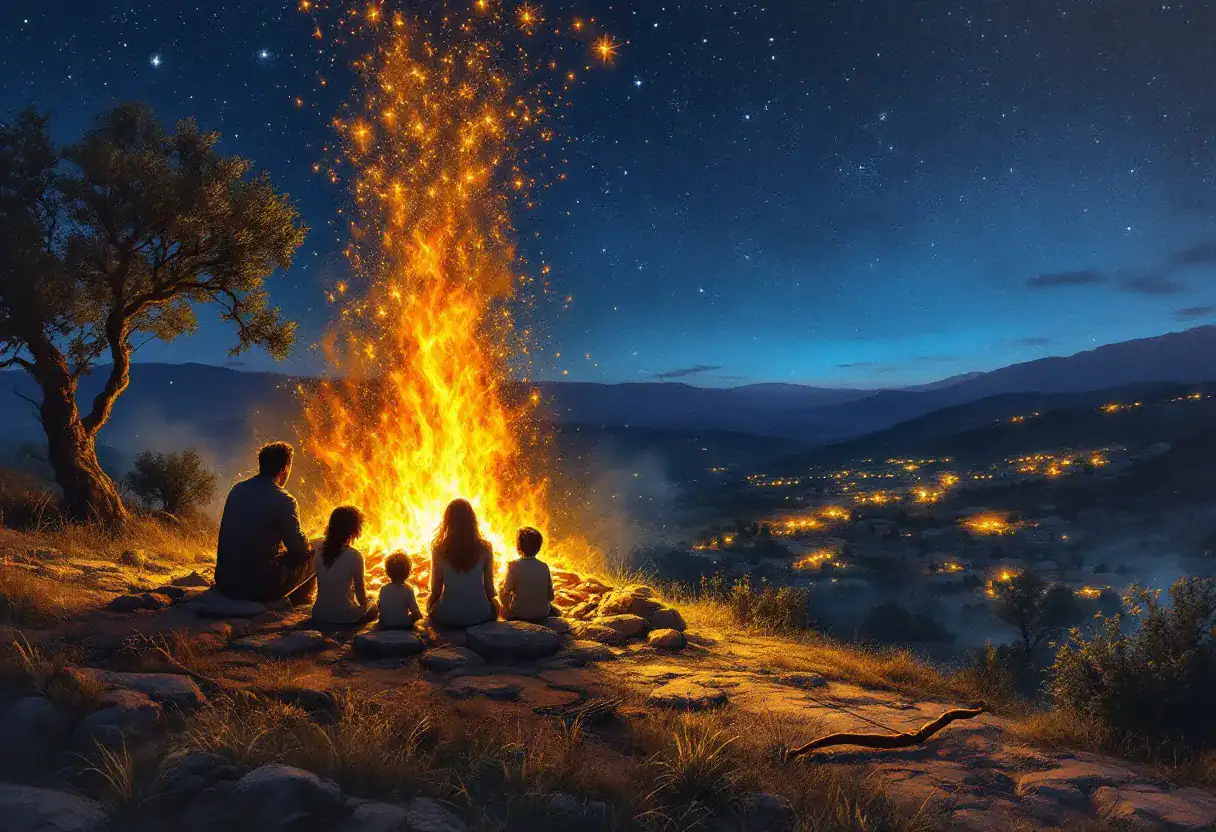
The most visible custom, especially in Israel, is the bonfires. From nightfall, great bonfires are lit in neighborhoods, on vacant lots, in gardens. Children gather wood for weeks. People sing around the fire, roast potatoes in it, and stay up late into the night.
The reason most often given is the fire that surrounded Rabbi Shimon on the day of his death, according to the Zohar, and the light of his teaching. The light of the hidden Torah, it is said, spread through the world on that day. Rav Benizri gives these flames a much broader meaning, which we will see below.
Meron
Rabbi Shimon bar Yochai and his son Rabbi Elazar are buried in Meron, a village in the Upper Galilee, near Safed. On Lag BaOmer this site becomes the largest gathering of the year in Israel: hundreds of thousands of people go up there, immense bonfires are lit, people dance all night long and sing “Bar Yochai nimshachta ashrecha,” the song composed in the sixteenth century by the rabbi and poet Rabbi Shimon Lavi, which is also sung in many Sephardi families on Friday night.
Meron also bears a wound. On the night of Lag BaOmer 5781, April 30, 2021, a crush in a narrow passage cost the lives of forty-five people, among them many children and young men. Since then, access to the site has been regulated and limited by the authorities. The memory of these victims now accompanies the festival.
The First Haircut
Many families wait until Lag BaOmer to give three-year-old boys their first haircut, called chalaké in Israeli Hebrew and upsherin in Yiddish. The sidelocks are left at the temples, and the boy often begins on that day to wear a kippah and tzitzit, the ritual fringes. Many hold this ceremony in Meron, following the custom that Rabbi Chaim Vital reports concerning the Arizal.
The Bow and the Carobs
In many families, children go out into the woods with a bow and arrows. Several reasons are given for this. One, based on the Midrash (Bereshit Rabbah 35:2), relates that as long as Rabbi Shimon lived, the rainbow, in Hebrew keshet, the same word as bow, did not appear: his presence was enough to protect the world, and it had no need of the sign of the covenant with Noach. Another, historical reason connects the bow to the Bar Kokhba revolt. Carobs are also eaten, in memory of the carob tree that nourished Rabbi Shimon and his son in the cave.
Joy, Weddings, and No Tachanun
In communities that follow the Rema, Lag BaOmer is one of the favorite days for weddings, in the heart of a period when none are held; many Sephardi communities, following the Shulchan Aruch, wait for the thirty-fourth day, according to the rules seen above. Tachanun is not said; one does not fast; one rejoices. Schools organize outings, families have picnics.
What Rav Raphaël Benizri Teaches About the Omer and Lag BaOmer
Two lectures by Rav Raphaël Benizri are devoted to this period: The Month of the Omer: Counting in Order to Count Oneself and Lag BaOmer: The Fires and the Light of the Zohar. They give the customs just described a rare depth. Here are their main points.
No One Leaves an Exile Unscathed
The Rav starts from an observation. The period between Pesach and Shavuot, he explains, serves to prepare the people to recover what they lost during the two hundred and ten years of slavery in Egypt. For one survives an exile, but one carries away many husks, the kelipot: the failings of the civilizations among which one has lived. This is why, he adds, even back in our land, we have not yet managed to break down the walls of our differences. The message of Rabbi Shimon bar Yochai, he says, was addressed precisely to the exiles of the future.
Not a Lack of Love, Nor a Lack of Learning: A Lack of Recognition
In his lecture on the month of the Omer, the Rav first imagines what this plague meant: nearly a thousand funerals a day. Then he refines the diagnosis. The students of Rabbi Akiva did not lack love of their fellow: they lacked recognition of the human dignity of each person. They did not seek to accept difference, diversity, nuance in the current of thought each one chooses, provided it comes from the source and returns to it.
And the Rav insists: this is not a problem of ordinary people. On the contrary, it strikes great minds. The disciples of Rabbi Akiva were steeped in Torah, but each remained attached to his own prerogatives and became incapable of considering the other’s current of thought. One becomes, he says, a fanatic of an idea, of a camp.
In his lecture on Lag BaOmer, he adds an even harsher point. People had been taught to keep their distance from the common man, the am haaretz, for fear of losing their substance through contact with him. The scholar then began to speak to the simple man from afar. This arrogance, says the Rav, is intolerable, and it is what brought down the twenty-four thousand students. He also links this division to the Bar Kokhba revolt, which these students supported against the grip of Rome: each one wanted to impose his own authority, and the struggle for liberation did not succeed.
The Omer, the Manna and the Bread of the Earth
Why did this tragedy unfold precisely during the Omer? The Rav cites the Midrash: “Let the commandment of the Omer not be light in your eyes,” for it was through it that Avraham merited the inheritance of the land (Vayikra Rabbah 28:6). The covenant of the land depends on this count, he explains: one does not inherit a country without having learned to make room for the other.
He then returns to the original meaning of the word. The Omer is the measure of the manna that came down in the desert. When the first harvest comes in the Land of Israel, the manna ceases, and man feeds himself from the fruit of his labor. But first he brings a measure of barley before G-d. This offering links two kinds of nourishment: the “bread from heaven” and the bread of the earth. And it is their meeting, says the Rav, that ensures life: “man does not live by bread alone, but by everything that comes from the mouth of G-d” (Devarim 8:3). He recalls that the first commandment given to man in the Garden of Eden was to eat, and to eat generously, in order to maintain the bond between the material and the spiritual. Without a blessing, the Rav explains, man eats “like a dog”: he regards his food as prey that satisfies his instinct. And sharing one’s bread with another, the Rav adds, is the very first element of any recognition of the other.
Counting in Order to Count Oneself
The Rav dwells on the blessing itself. We say “on the counting of the Omer,” and not “on the counting of the days of the Omer.” It is therefore not time that we bless, but the Omer, the measure of food. Now the word sefirah, counting, evokes sapir, sapphire. To count, here, is to restore to the object its transparency, to purify its form, to connect the food to its source.
He further notes that these days are not those of creation: they are those of the formation of the Jewish people and of its march toward the Land of Israel. It is a time that man himself shapes. The Hebrew calendar offers a striking example: the court can add a month to the year to balance the solar year and the lunar year, and thereby postpone Rosh Hashanah, the very anniversary of creation. And the Rav makes a calculation: the word middah, measure, virtue, equals forty-nine (mem 40, dalet 4, hei 5). Forty-nine days to rebuild the seven virtues that govern man as they govern the world, which the Torah calls, in the image of man, Adam gadol, the great Adam, with its navel, its eye, its mouth.
Yesh: Giving Reality to the Other
Another of the Rav’s calculations: the word omer equals three hundred and ten (ayin 70, mem 40, reish 200), exactly like the word yesh, “there is,” which gives things their reality. In the name Israel, he adds, one hears yesh at the beginning and al, negation, at the end. Between the two, it is the reish that decides: either it becomes rosh, the head, kingship, or it becomes rash, the poor man. And this reish, says the Rav, is the face of man, his panim, which reflects his inner life.
Hence the gravity of humiliation. Our Sages teach that making one’s fellow’s face go pale in public is equivalent to shedding his blood, and that it is better to throw oneself into a furnace than to do so (Bava Metzia 58b-59a). This, the Rav concludes, is where the counting of the Omer is concretely played out.
Agreeing to Cut Away Part of Oneself: The Brit and the Example of Aharon
One may well leave Egypt and march toward the land, the Rav says further: if one has not agreed to cut away something of oneself to leave room for the other, one has accomplished nothing. This is why Hebrew speaks of “cutting a covenant” (karat brit): each party cuts off a part of himself and entrusts it to the other. The covenant of the land is grafted onto that of milah, circumcision.
He gives the example of Aharon. The whole book of Bereshit is a history of quarrels between brothers; Aharon is the first brother who rejoices at the other’s success, when his younger brother Moshe receives the mission to free the people. This earns him the priesthood, for himself and his descendants. And the entire people, the Rav recalls, is called to be “a kingdom of priests” (Shemot 19:6): the recognition we receive will be measured by the recognition we grant to others.
Thirty-Two, Thirty-Three, Seventeen: The Heart
Here is the explanation the Rav gives of the thirty-third day. Rabban Yochanan ben Zakkai asked his disciples what is the good path to which a person should cleave. One answered: a good eye; another: a good friend; another: seeing what will come to be. Rabbi Elazar ben Arach answered: a good heart, lev tov. And Rabban Yochanan said: “I prefer his words to yours, for your words are included in his” (Pirkei Avot 2:9).
Now lev, the heart, equals thirty-two (lamed 30, beit 2). The thirty-third day is the one on which the heart has been crossed. The thirty-third day is thus the day after the heart: it is when one has recovered the language of the heart, says the Rav, that a respite from mourning becomes possible. The word kavod, respect, also equals thirty-two (kaf 20, beit 2, vav 6, dalet 4): it is precisely respect that the disciples lacked. And after the heart comes tov, the good, which equals seventeen: exactly the number of days separating Lag BaOmer from Shavuot. The Rav connects this to the morning prayer, which says of G-d: “tov yatzar kavod lishmo,” the Good One created glory for His Name.
“When one has a lev tov, one does not suffer from the other’s success, one does not despise the other, one is not busy analyzing his negative sides.” (Rav Raphaël Benizri, The Month of the Omer)
Rabbi Akiva and the Fiftieth Level
To understand Rabbi Shimon, the Rav goes back to his master. Rabbi Akiva, he says, had attained the fifty levels of understanding, whereas Moshe had stopped at the forty-ninth. And he gives the reason: Rabbi Akiva was descended from converts. The convert brings to the whole an element it was lacking. Here the Rav cites the famous Talmudic story (Menachot 29b): ascending to heaven, Moshe finds G-d busy placing crowns on the letters of the Torah. He asks why. G-d answers that a man will come, Akiva ben Yosef, who will derive from each stroke heaps of laws. Moshe proposes that the Torah be given through him. In the Rav’s reading, G-d refuses: to Moshe belongs the Written Law, which no one disputes; to Akiva, the Oral Law, which is, he says, the Torah according to each person’s perception, and which opens many doors.
Rabbi Akiva’s life, he recalls, followed that of Moshe: forty years as a man of the people, forty years of study, and only then did he teach his twenty-four thousand disciples. One rabbi, the Rav reports, even says that he deliberately remained unlearned until his maturity, so as not to be disappointed by the conduct of the students of the academies and not to have to judge them.
The Death That Is Celebrated
After the catastrophe, the Rav explains, Rabbi Akiva went to seek out five disciples in the South, and it was Rabbi Shimon who shone among them. Heir to his master’s erudition, for the entire Oral Law bears the imprint of Rabbi Akiva, he opened new horizons for the people through the teaching of the Zohar. And why is his death celebrated, unlike the fasts for Moshe and Aharon? Because at the moment this master of mystical thought withdraws, his teaching is sealed: he has finished transmitting, and his students can spread it. The Rav recalls that according to the Zohar, a fire surrounded his whole person on the day he withdrew.
Two Symbols: The Bow and the Fire
The Rav reads the two customs of the festival as two legacies. The children’s bow says that Bar Kokhba’s struggle for the land has not been extinguished. He cites King David, who, mourning Shaul and Yonatan, asks to “teach the children of Yehudah the bow” (II Shmuel 1:18). The fire, for its part, points to a much older story.
The History of Fire, Since Avraham
The first fire of the Torah, the Rav explains, is that of the Covenant Between the Pieces, in Parashat Lech Lecha: “a smoking furnace and a torch of fire” passed between the divided animals (Bereshit 15:17), and thus the land was promised to the descendants of Avram, between Egypt in the south and the Euphrates in the north. This fire, says the Rav, neither the waters of the Nile nor those of the Euphrates could extinguish, nor those of all the pogroms, the baptisms and the forced conversions. It nearly went out in Egypt; G-d withdrew it into the desert, until Moshe found it again in the burning bush and carried it within him all the way to Sinai, where the people rediscover a fire of another nature.
There are therefore two fires, the Rav continues: that of the promise of the land and that of the covenant of the Torah. Both find their place in the Sanctuary. The fire of the altar, which must never go out (Vayikra 6:6), atones for the land and for the people. And the menorah, with its western lamp, the ner maaravi, always lit, turned toward the Holy of Holies: this is the fire of the Torah. On Lag BaOmer, then, three fires come together: the fire of the land, that of Bar Kokhba’s struggle; the fire of the Torah, which the disciples of Rabbi Akiva failed to integrate properly, each regarding it as his exclusive property; and the fire of Rabbi Shimon, which the Rav calls “the fire of transparency,” the one that unites all the elements of the people of Israel through love.
The Secret Is the Assembly
The Rav recalls the four levels of reading the Torah, like the four rivers that flowed out of the Garden of Eden: peshat, the literal meaning; derash, interpretation through imagery; remez, allusion; sod, the secret. To reduce the Torah to the demands of reason alone, he says, is wasted effort.
Then he gives an unexpected definition of sod. Yaakov says of two of his sons: “Let my soul not enter their secret, let my glory not be joined to their assembly” (Bereshit 49:6). The parallelism of the verse shows that the secret, the sod, is an assembly, a kahal: the whole, the sum. Whoever cuts up and separates the teaching, the Rav explains, is left with nothing but his own Torah. Yet “the Torah of G-d is perfect” (Tehillim 19:8): it is not a personal Torah, it is the one that gathers all the currents and unites them. This is what Rabbi Shimon came to bring, after a Torah that, however great, had been able to destroy twenty-four thousand disciples.
The Flame at the Head of the Departed
The Rav also explains the ner, the flame lit for a hillula. In the Garden of Eden, he says, there were two trees. The tree of knowledge still distinguishes between good and evil; in the tree of life, even evil takes part in man’s fulfillment when it submits to a higher will. But we are not there yet: when we lose a loved one, we cannot yet say “Blessed is He who is good and does good”; we say “Blessed is the true Judge.” As soon as the soul leaves a loved one, a flame is placed at his head. Every being carries this flame; the whole question is whether we will give it more substance so that it lasts and becomes a ner tamid, a perpetual light, or whether it will remain flickering, at the mercy of the slightest wind.
Mercy Against Judgment
Rabbi Shimon’s contribution, according to the Rav, is to teach that one can, berachamim, through mercy and love, spare the world from judgment, which is the origin of many ills. He recalls that Rabbi Akiva himself said of the Song of Songs that it is “holy of holies” (Mishnah Yadayim 3:5). And this song ends with these words: “Many waters cannot quench love” (Shir HaShirim 8:7). A love that ripens little by little, says the Rav, and becomes shalhevetyah, “a flame of G-d” (Shir HaShirim 8:6). The dance around the fire on Lag BaOmer, he concludes, is not that of a disenchanted love that would have to be won back through sorcery: it is a dance around a fire of love that unites humanity and assures the exiled people of its return.
A Torah That Renews Itself
Why was this revelation so late? Because, the Rav explains, the Torah of the Zohar carries a will toward hitchadshut, perpetual renewal. Halachah is fixed; it no longer moves. Sod is renewed every day, just as G-d renews His creation every day. Our Sages said that a sage is preferable to a prophet (Bava Batra 12a), but, the Rav specifies, the sage develops the message through his own thought, and that has its limits: the prophetic element is missing. The task is to combine rational thought and prophetic thought. He cites the four sages who entered the Pardes, the orchard of the secrets of the Torah (Chagigah 14b): only Rabbi Akiva came out in peace, because beyond rational knowledge there is emunah, faith, which must be made as solid as marble.
The Gaze That Burns
At the end of the lecture, a listener objects: wasn’t Rabbi Shimon a very uncompromising man, whereas Rabbi Akiva was rather lenient? The Rav answers with the episode of the cave: the gaze that burned the plowmen, the heavenly voice that sends Rabbi Shimon back into the cave, for if he has learned only to condemn others, he has learned nothing. And he offers a historical reading of it: at that time, working the land served only the Roman occupier. Rabbi Shimon was in effect saying that one had to go on strike, to strengthen oneself through study rather than hand over to Rome the yield of our labor and our land. The Rav does not think that Rabbi Shimon excluded the kind of work that expresses the deep bond between the Torah and the Land of Israel, since, he says, “there is no Torah like the Torah of the Land of Israel.”
He adds that access to the teaching of the Zohar is traditionally not granted before the age of forty, because it requires a maturity acquired through study, and that it is the Torah of Rabbi Akiva that gives access to that of Rabbi Shimon.
“As Yourself”
The Rav concludes with the words of Rabbi Akiva: “You shall love your neighbor as yourself, I am G-d” (Vayikra 19:18). He notes that for the love of G-d and for the love of the stranger, the Torah uses the particle et, whereas here it says lereacha, “to your neighbor.” These are three loves of different natures, and love of one’s neighbor is proven by deeds, not by fine words. He connects this to the dispute between Rabbi Akiva and Ben Azzai over the great principle of the Torah, which he develops in Bereshit — The Foundations of the Human Being and in the introduction to Pirkei Avot.
Toward the Fiftieth Day
Finally, in Shavuot: The Fiftieth Day, Beyond the Count, the Rav sheds light on the end of the road. The fiftieth day is not counted, he explains: it lies beyond the square of seven, beyond the safar, the limit. To go beyond it is to find oneself in a state of total transparency, where one looks at things through them. One then understands that the forty-nine days of the count prepare man for this going beyond.
Frequently Asked Questions About Lag BaOmer
What is the date of Lag BaOmer in 2027?
Lag BaOmer 5787 begins on the evening of Monday, May 24, 2027, and continues through Tuesday, May 25. It is the 18th of Iyar, the thirty-third day of the counting of the Omer. The bonfires are lit on Monday evening.
Why is this day called “Lag”?
Because the Hebrew letters lamed (30) and gimel (3) form the number thirty-three. “Lag BaOmer” means “the thirty-third day of the Omer.”
Can one marry and get a haircut on Lag BaOmer?
Yes, but the exact timing varies between communities. According to the Shulchan Aruch, followed by Sephardi communities, one waits until the morning of the thirty-fourth day, unless Lag BaOmer falls on a Friday. According to the Rema, followed by Ashkenazi communities, it is permitted from the thirty-third day. Each person should follow his custom and ask his rabbi.
Did Rabbi Shimon bar Yochai write the Zohar?
Tradition attributes the Zohar to him; it presents his teaching and that of his circle of disciples. The book began to circulate at the end of the thirteenth century in Castile, through Rabbi Moshe de León, and it became the reference work of Kabbalah. The Talmud, for its part, cites him as one of the great masters of the Mishnah.
Why are bonfires lit?
In memory of the fire that, according to the Zohar, surrounded Rabbi Shimon on the day of his death, and of the light of his teaching. Rav Benizri also sees in them the culmination of a history of fire that begins with the covenant made with Avraham, passes through the burning bush and Sinai, and burns in the altar and the menorah of the Temple.
Does the mourning of the Omer end for good on Lag BaOmer?
For many Sephardi communities, yes: the mourning ends on the morning of the thirty-fourth day. Other customs, notably Ashkenazi ones, observe the mourning over a different part of the period, sometimes until the days preceding Shavuot. One should follow the custom of one’s community.
In Conclusion: Crossing the Heart
Lag BaOmer is a strange festival. It is not written in the Torah; it is born of mourning; it celebrates a man’s death. And yet everything about it speaks of light. The students of Rabbi Akiva died for having wanted each to possess the Torah for himself; Rabbi Shimon, coming out of the cave, learned to see holiness in two sprigs of myrtle carried by an old man; and his most hidden teaching was revealed at the very moment he was leaving the world.
Rav Raphaël Benizri sums up this path in a single number: thirty-three is the day after the heart. Before Lag BaOmer, one learns respect, kavod; afterward, seventeen days remain, the value of tov, to reach Sinai. The bonfires lit that evening are not merely a memory: they say that a flame that is nourished can become a perpetual light.
To go deeper, listen to the Rav’s two lectures on this period, browse the pages devoted to Shavuot and to Pirkei Avot, which it is customary to study on Shabbat during these weeks, and consult the glossary for the Hebrew words.
Going Further
- The Month of the Omer: all of Rav Benizri’s lectures
- Lag BaOmer: The Fires and the Light of the Zohar
- The Month of the Omer: Counting in Order to Count Oneself
- Shavuot: The Fiftieth Day, Beyond the Count
- Pirkei Avot: Acquiring the Torah Before Shavuot
- Parashat Emor: The Chapter of the Festivals
- Booklets to download
- All the Jewish holidays
Article by the Pensées Juives editorial team. The passages attributed to Rav Raphaël Benizri are drawn from his lectures published on this site.