
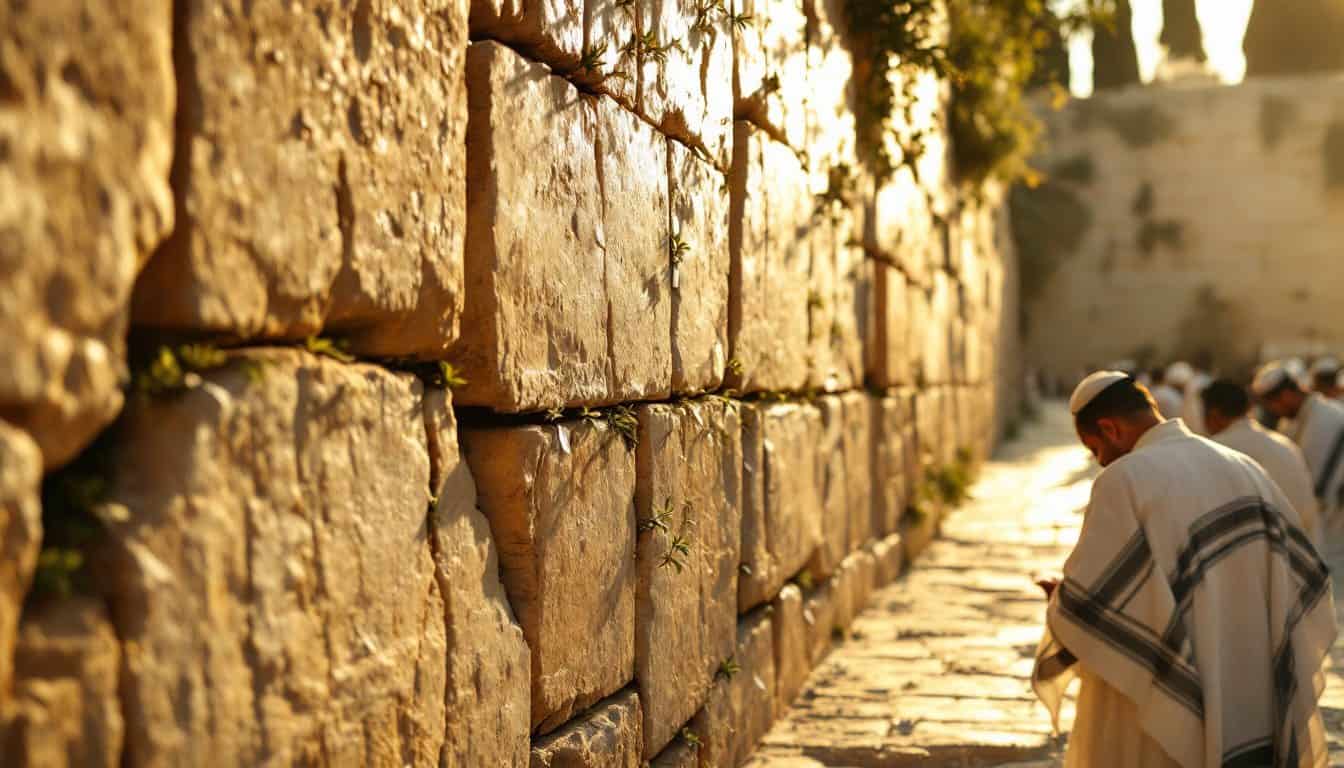
At the Western Wall in Jerusalem, in a synagogue or even on a plane, you see men praying while swaying back and forth, sometimes gently, sometimes with fervor. For someone seeing this gesture for the first time, the scene is puzzling: is it an obligation, a tradition, some kind of trance? Here is a complete answer: what the texts say, the reasons the Sages give for it, and what this movement reveals about Jewish prayer as a whole, down to the simple word “amen”.
In short: swaying during prayer or study (in Yiddish shokeln, “to shake”) is not a commandment of the Torah, but a very ancient custom, attested since the Middle Ages and recognized by Jewish law. The Rema records it in the Shulchan Aruch (Orach Chaim 48:1), quoting the verse “All my bones shall say: Hashem, who is like You?” (Tehillim [Psalms] 35:10): prayer must engage the whole body, not just the lips. The Zohar compares the Jewish soul to the flame of a candle that never stops flickering; the Kuzari offers a historical explanation, linked to the scarcity of books. Swaying is not obligatory: some refrain from it, especially during the Amidah, the silent prayer. What matters most, the halachic authorities remind us, is whatever helps one concentrate.
A puzzling gesture
In a synagogue, everyone seems to pray at their own pace, and many sway: some back and forth, others from left to right, while others stand still. Nothing is choreographed.
This movement has a Yiddish name: shokeln, or shuckeln, “to shake”, “to sway”. In Hebrew, it is called hitnoanut, “moving oneself”. It does not appear as an obligation in any verse of the Torah, and it is not one of the 613 commandments. It is a minhag, a custom, but a venerable one, which the greatest masters have commented on and justified.
To understand this gesture, one must first understand what prayer is in Judaism. For swaying is not an isolated technique: it is the way the body takes part in words that seek to rise toward G-d.
What is Jewish prayer?
In Hebrew, prayer is called tefillah. The word comes from a root meaning “to judge”, “to assess”: to pray is also to judge oneself, to stand before G-d and take stock of who one is. It is not only asking.
A “service of the heart”
The Torah commands us to love G-d and to “serve Him with all your heart” (Devarim [Deuteronomy] 11:13). The Talmud asks: what is this service performed with the heart? And it answers: it is prayer (Taanit 2a). The Rambam deduces from this that praying every day is a Torah commandment (Mishneh Torah, Hilchot Tefillah 1:1). Originally, he explains, each person prayed in his own words and according to his own needs. After the Babylonian exile, when language and clarity of thought had declined, Ezra and the assembly of Sages (the Anshei Knesset HaGedolah, the Men of the Great Assembly) established a common text, the Amidah, so that everyone could pray properly (Hilchot Tefillah 1:4).
Three prayers a day
A Jew prays three times a day: Shacharit in the morning, Minchah in the afternoon, Arvit in the evening. The Talmud (Berachot 26b) gives two explanations. According to the first, the patriarchs instituted these prayers: Avraham the morning prayer (Bereshit [Genesis] 19:27), Yitzchak the afternoon prayer, when he “went out to meditate in the field” (Bereshit 24:63), and Yaakov the evening prayer, when he “encountered the place” while fleeing toward Haran (Bereshit 28:11). According to the second, the prayers correspond to the daily offerings brought in the Temple. The two ideas complement each other: since the destruction of the Temple, prayer has taken the place of sacrifice, as the prophet says, “instead of bulls we will offer [the words of] our lips” (Hoshea [Hosea] 14:3).
The Amidah: the heart of prayer
At the center of every service stands the Amidah (“standing prayer”), also called Shemoneh Esreh, “eighteen”, for its original eighteen blessings (a nineteenth was added later). It is recited standing, feet together, like the angels of whom it is said that “their feet were a straight foot” (Yechezkel [Ezekiel] 1:7; Berachot 10b), facing Jerusalem, in a low voice.
Why in a low voice? The Talmud (Berachot 31a) learns it from Channah, the mother of the prophet Shmuel. She came to pray at the sanctuary in Shiloh for a child, and “she was speaking in her heart; only her lips moved, and her voice was not heard” (Shmuel I [1 Samuel] 1:13). The high priest Eli thought she was drunk. The Sages derived several laws from this: prayer must come from the heart, the lips must articulate the words, and one must not shout, for G-d hears a whispered prayer.
This scene matters for our subject: Jewish prayer is inward, but it is not disembodied. The lips move, the body holds itself in a particular way, it bows at specific moments (Berachot 34a), it takes three steps back at the end (Yoma 53b). Swaying fits into this same logic: making the body pray together with the soul.
Where does swaying come from? The sources
“All my bones shall say…”
The most frequently quoted source is a verse from Psalms: “All my bones shall say: Hashem, who is like You?” (Tehillim 35:10). King David is not content to say that his mouth praises G-d: he wants his whole being, down to his bones, to take part in the praise. Swaying is the concrete expression of this: the entire body moves along with the words.
This is the verse the Rema (Rabbi Moshe Isserles, Kraków, 16th century) quotes in his gloss on the Shulchan Aruch, the code of Jewish law. He writes that the most scrupulous are accustomed to move when they read the words of the Torah, just as the Torah was given “with trembling”, and also during prayer, as it is said: “All my bones shall say…” (Shulchan Aruch, Orach Chaim 48:1). He himself names his source: the Abudarham, a 14th-century commentator on the liturgy in Spain.
The trembling at Sinai
The first reason the Rema gives points to the giving of the Torah. When G-d spoke to the people at Mount Sinai, “the people saw and they trembled (vayanu’u), and they stood at a distance” (Shemot [Exodus] 20:15). The Baal HaTurim (Rabbi Yaakov ben Asher, 14th century), in his commentary on this verse, sees in it the origin of the custom of swaying during study: each time one opens the Torah, one relives Sinai a little, and the body retains its quiver.
This link between study and prayer is telling. In Judaism, people also sway while studying the Talmud, reading Psalms or reciting the Torah. The movement does not signal a religious “trance”: it accompanies the holy word in all its forms.
A custom already old in the Middle Ages
Historical sources show that this custom was already well established in the 12th century. Rabbi Yehudah HaLevi mentions it in the Kuzari, written in Spain around 1140: he presents it as a habit so characteristic of Jews that a foreign king is surprised by it (Kuzari II:79-80). In the 14th century, the Baal HaTurim and the Abudarham mention it in turn. The Maharil (Rabbi Yaakov Moelin, Germany, 15th century), one of the great masters of Ashkenazi customs, swayed during prayer, back and forth, forward and backward, as the Magen Avraham reports (Orach Chaim 48:4).
There is, however, no explicit mention of this swaying in the Talmud. The Talmud does relate that when Rabbi Akiva prayed alone, “one would leave him in one corner and find him in another”, because of his many bows and prostrations (Berachot 31a). This is not exactly today’s swaying, but it shows that fervent prayer already engaged the whole body.
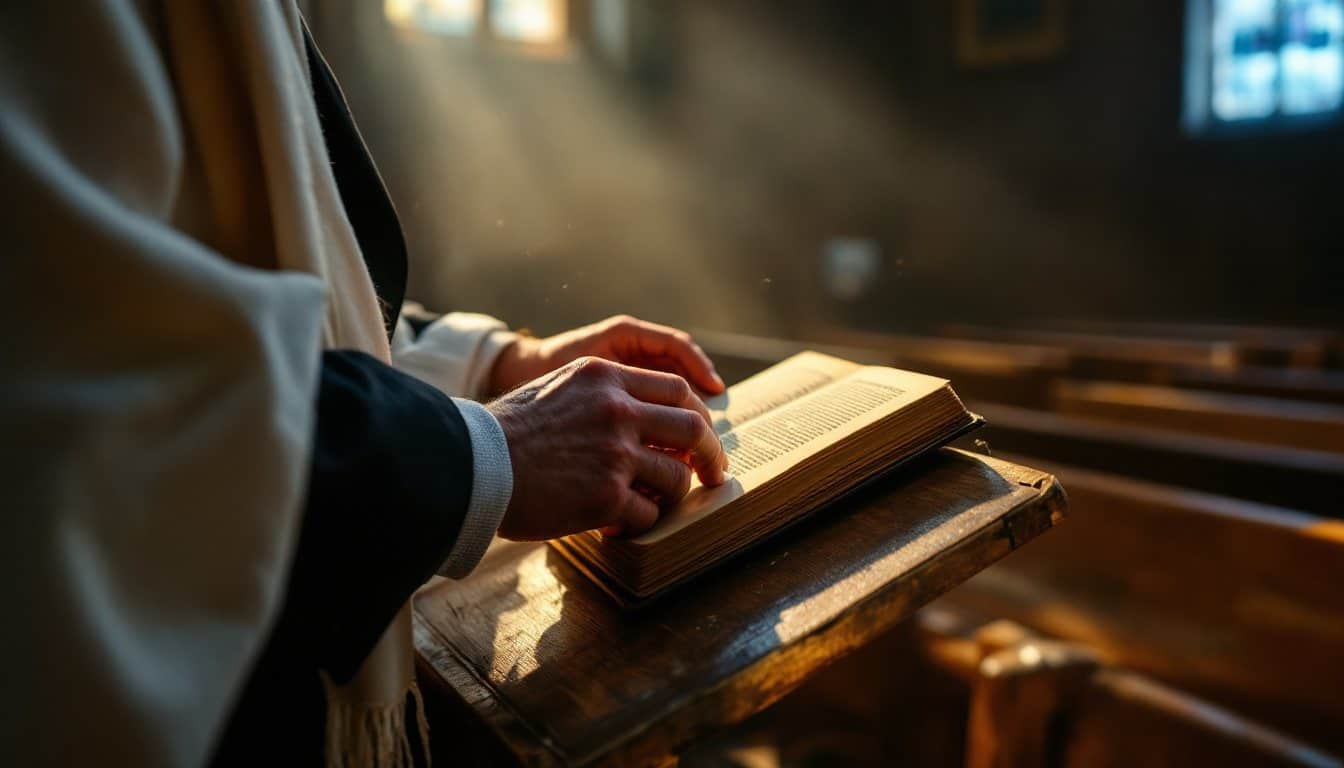
The reasons for swaying
The masters have proposed several explanations, on different levels. They do not exclude one another: each sheds light on one facet of the same gesture.
The historical reason: one book for several readers
The Kuzari, written as a dialogue between a Jewish sage and the king of the Khazars, relates that the king is surprised by this movement. The sage begins by mentioning a common explanation, which he does not adopt: the movement would serve to maintain the body’s “natural heat”. Then he gives his own, far more concrete (Kuzari II:79-80): in the past, books were rare and expensive, copied by hand. Some ten people had to read from the same book, placed in the middle. Each one leaned in turn to read a passage, then straightened up to make room for the next. This back-and-forth became a habit, which remained even once everyone had a book of his own.
This very simple explanation recalls something important: many Jewish customs were born from concrete situations and later received a spiritual meaning. The one does not cancel the other.
The mystical reason: the flame of the soul
The Zohar, the foundational book of Kabbalah, asks the same question as the king of the Khazars: why do Jews, and they alone, sway when they study the Torah? Its answer rests on a verse from Proverbs: “The soul of man is the lamp of Hashem” (Mishlei [Proverbs] 20:27). The Jewish soul, the Zohar explains, is like the flame of a candle. As soon as a word of Torah reaches it, it lights up, and a flame never stays still: it flickers, it rises, it seeks to rejoin its source (Zohar III, 218b-219a, parashah Pinchas).
The image is beautiful and very telling. Watch a candle: even in a room without a draft, the flame quivers. It is attached to the wick, yet it reaches upward. So too the soul, attached to the body, longs to rise toward G-d. Swaying is the visible quivering of this inner flame.
The Hasidic reason: the drowning man
The Baal Shem Tov, founder of Hasidism in the 18th century, offers a more dramatic image. A man who is drowning, he says, struggles with all his strength to get out of the water; no one mocks his movements. In the same way, a person praying struggles against the stray thoughts that threaten to engulf him, and his movements express this effort to stay on the surface, close to G-d (recorded in the Tzava’at HaRivash, a collection of his teachings).
Hasidism thus gave movement an important place. It expresses enthusiasm, hitlahavut (“being set ablaze”), the desire to go beyond oneself. But the Hasidic masters also warned: the gesture must spring from the heart; it must not become a show.
The psychological reason: concentration
Finally, many rabbis note, and anyone can experience it, that rhythmic movement helps concentration. It keeps the mind from wandering, it matches one’s breathing to the rhythm of the sentences, it wakes up someone who is tired. That is why one often sees children learning Torah sway as they recite: the body helps memory and attention. Kavanah, the intention of the heart, is the condition of all prayer (Berachot 31a; Rambam, Hilchot Tefillah 4:15-16). Swaying has value only if it serves it.
What does Jewish law say: obligation or freedom?
Swaying is not obligatory. The Rema presents it as a practice of “the scrupulous”, not as a rule for everyone (Orach Chaim 48:1). And the halachic authorities have discussed its exact place in prayer.
The Magen Avraham (Rabbi Avraham Gombiner, 17th century), in his commentary on this passage (Orach Chaim 48:4), reports an opinion according to which one sways during Pesukei deZimra (the psalms of praise at the beginning of the service), but not during the Amidah. He also cites the opposite practice: the Maharil swayed during prayer, and masters of Kabbalah (the Recanati, the Zohar) gave a mystical reason for it. His conclusion is remarkably open: each person may follow either practice, “provided he has the intention of the heart”.
The Mishnah Berurah (Rabbi Yisrael Meir HaKohen, the Chafetz Chaim, early 20th century) spells out the criterion (Mishnah Berurah 48:5): it all depends on the person. If the movement helps him concentrate well, let him sway; if not, let him stand still, the main thing being to direct his heart. He adds a warning: some make a distorted movement, keeping the body still and turning only the head now to the right, now to the left, out of affectation; this should not be done.
This is why different practices can be observed from one community to another. In many Ashkenazi and Hasidic communities, swaying is very widespread and sometimes vigorous. In many Sephardi and Middle Eastern communities, it is often more restrained, and many pray the Amidah standing still, or nearly so, in an attitude of quiet reverence. Neither way is “more Jewish” than the other.
There is, however, a limit shared by all: the gesture must not become excessive, distract one’s neighbors or look like a performance. Prayer is speech addressed to G-d, not a show put on for people. For specific questions of practice, one should consult a rabbi.
At the Western Wall: why do people pray there?
The best-known image of Jews swaying in prayer is that of the Western Wall in Jerusalem, which English speakers also call the “Wailing Wall”. To understand why so many Jews come to pray there, one needs to know its history.
A remnant of the Temple
The Western Wall, in Hebrew HaKotel HaMa’aravi or simply the Kotel, is not a wall of the Temple itself. It is part of the retaining wall that surrounded the Temple Mount esplanade, enlarged by King Herod from the end of the 1st century BCE. Its enormous blocks of hewn stone, some weighing several dozen tons, date from that period. In the year 70, the Romans destroyed the Second Temple; this wall, the closest point to the site of the former Holy of Holies accessible to Jews, remained standing.
The Midrash teaches that “the Divine Presence (Shechinah) never departed from the Western Wall” (Shemot Rabbah 2:2). That is why, for centuries, Jews have come there to pray, to weep over the destruction and to hope for the rebuilding. The name “Wailing Wall” comes from these tears, observed by European travelers. Jews themselves simply call it “the Kotel”. Since the Six-Day War in June 1967, it has again been accessible to Jews, and today it welcomes millions of visitors a year.
Praying toward Jerusalem
This place carries on an ancient rule: all over the world, Jews pray facing Jerusalem, and in Jerusalem facing the site of the Temple. King Shlomo, when he dedicated the First Temple, already asked G-d to hear the prayer of those who, even in exile, would pray “toward their land… the city You have chosen and the house I have built for Your Name” (Melachim I [1 Kings] 8:48). The prophet Daniel, exiled in Babylon, prayed three times a day with his windows open “toward Jerusalem” (Daniel 6:11). The Talmud makes it a rule (Berachot 30a).
A prayer open to all
Visitors often slip small notes bearing a prayer into the cracks of the Wall: a popular custom, neither obligatory nor magical. Twice a year the notes are removed and respectfully buried on the Mount of Olives, because a written prayer is never thrown away. At the Kotel as elsewhere, there is no single way to pray. Some sway, others simply rest their hand or forehead against the stone, others read Psalms in silence. All visitors, Jewish or not, are welcome; men wear a kippah there, and cardboard kippot are lent at the entrance.
And “amen”: what does the word mean?
Among the questions people ask when they hear a Jewish prayer, the word “amen” comes up often. It is familiar from other religions, but it comes from biblical Hebrew.
A word of faith
Amen comes from the root aman, the same as emunah: faith, trust, faithfulness. To say “amen” is to say: “it is true”, “I believe it”, “I commit to it”. The Talmud teaches that the word amen implies both an oath and an acceptance (Shevuot 36a). It also offers a reading of it: amen is formed from the initials of El Melech Ne’eman, “G-d, faithful King” (Shabbat 119b).
In the Torah, the people answer “amen” at the great covenant proclaimed before Mount Gerizim and Mount Ebal: after each curse pronounced by the Levites, “all the people shall answer and say: amen” (Devarim 27:15-26). On the return from the Babylonian exile, when Ezra read the Torah before the people and blessed G-d, “all the people answered: amen, amen, lifting up their hands” (Nechemiah [Nehemiah] 8:6).
Greater than the one who blesses
In Jewish prayer, one answers “amen” to every blessing one hears. The Talmud stresses its importance in a surprising way: “The one who answers amen is greater than the one who recites the blessing” (Berachot 53b). The one who answers adds his own assent to the other’s blessing; he seals it. It also teaches that whoever answers “amen, yehei shemei rabba mevarach” (“amen, may His great Name be blessed”) with all his strength, in the Kaddish prayer, sees a harsh decree issued against him torn up (Shabbat 119b).
The Talmud further specifies that one must not answer an “orphaned” amen, said without knowing what one is answering, nor a “snatched” amen, thrown in before the blessing is finished, nor a “truncated” amen, half swallowed; on the other hand, “whoever prolongs his amen, his days and years are prolonged” (Berachot 47a). An amen is said with attention: it is a signature.
What Rav Raphaël Benizri teaches
Rav Benizri did not devote a lecture to swaying itself, but he spoke about prayer in a way that sheds deep light on its meaning.
Prayer, a direct contact with the infinite
In his lecture Elul: what makes each person unique, the Rav distinguishes two paths for discovering oneself and the infinite that dwells within us: reason, and what lies beyond reason. Torah study belongs to the first: it obliges us to delve deeply into the Law, and there one remains in a “mirror effect”, with several possible interpretations. Prayer, however, goes beyond study: it establishes a direct contact with the infinite. “In prayer,” he says, “there are not a thousand and one ways to pray”: one prays.
True prayer is found in silence
In the same lecture, a listener asks him at what point the synagogue ritual, with its habits and gestures, becomes a form of idolatry. The Rav answers: when one gives in to folklore. He does not disparage it, he makes clear: we need cantors and melodies to enhance the prayer. But one must be aware of the place it occupies. The best moment, he explains, is the one when everyone falls silent, during the Shemoneh Esreh: that is when one truly stands face to face with oneself. Everything else is merely preparation for that moment. True prayer, the lecture sums up, lies in that silence: the prophet’s “voice of silence”, an allusion to the revelation granted to Eliyahu, to whom G-d appeared not in the storm, nor in the earthquake, nor in the fire, but in “a voice of thin silence” (Melachim I 19:12).
This teaching gives swaying its proper measure: a gesture that can help one pray, but that must never replace prayer itself. The movement prepares and accompanies; the heart of prayer remains that silent face-to-face encounter.
Common misconceptions
- “Swaying is obligatory.” No. It is a custom, recommended by some, debated by others. Many devout Jews pray without moving.
- “It is a form of trance.” No. Swaying accompanies a prayer read or recited word by word, with precise rules. It aims at concentration, not loss of awareness.
- “People sway as a sign of mourning, in front of the Wailing Wall.” No. People sway in exactly the same way in the synagogue, while studying, and even on festivals. The gesture has nothing to do with sadness.
- “Amen is a Christian word.” No. It is a Hebrew word from the Torah (Devarim 27:15), which Christianity and Islam later adopted.
Frequently asked questions about swaying and Jewish prayer
What is the swaying of Jews in prayer called?
In Yiddish it is called shokeln (or shuckeln, shukelen), “to shake”. In Hebrew, it is called hitnoanut, “movement”. It is neither a dance nor a codified rite: each person sways at his own pace, or not at all.
Do women also sway when they pray?
Yes, the custom is not reserved for men. Women who pray or recite Psalms often sway in the same way, according to their own sensibility and their family’s custom. They can also be seen doing so at the Kotel, in the women’s section.
Should one sway during the Amidah?
Opinions differ. Some sway throughout the prayer; others, following an opinion reported by the Magen Avraham (Orach Chaim 48:4), stand still during the Amidah. The Mishnah Berurah (48:5) concludes that each person should do whatever helps him concentrate. One should follow the custom of one’s community, and above all whatever helps one pray attentively.
Why do Jews also sway while studying?
Because the Rema links this movement to the trembling of the people at Sinai, at the giving of the Torah (Shemot 20:15; Orach Chaim 48:1). Torah study is experienced as an encounter with the divine word; the body receives it with the same quiver.
What does the word amen mean?
Amen comes from the same root as emunah, faith. It means “it is true”, “I believe it”, “so be it”. The Talmud teaches that whoever answers amen to a blessing is greater than the one who recites it (Berachot 53b).
Why do Jews pray in a low voice?
The Amidah is prayed in a low voice following the example of Channah, of whom “only her lips moved” (Shmuel I 1:13; Berachot 31a). This teaches that G-d hears the prayer of the heart and that there is no need to shout. Other parts of the service are said aloud, together.
Further reading
Swaying is only a gesture, but it says something profound: in Judaism, one does not pray with the head alone. One’s whole being, down to the bones, turns toward G-d, like a flame seeking to rise.
- Elul: what makes each person unique
- Pekudei: the inner Tabernacle
- “The Fragrances of a Blessing”: the berachot
- What does Shema Yisrael mean?
- What is the Kaddish?
- What is a synagogue?
- Why do Jews wear a kippah?
- Glossary of Hebrew terms in Judaism
Sources and references
- Devarim (Deuteronomy) 11:13; Devarim 27:15-26
- Shemot (Exodus) 20:15
- Bereshit (Genesis) 19:27; 24:63; 28:11
- Shmuel I (1 Samuel) 1:13
- Melachim I (1 Kings) 8:48; Melachim I 19:12
- Yechezkel (Ezekiel) 1:7
- Hoshea (Hosea) 14:3
- Tehillim (Psalms) 35:10
- Mishlei (Proverbs) 20:27
- Daniel 6:11
- Nechemiah (Nehemiah) 8:6
- Babylonian Talmud, Taanit 2a
- Babylonian Talmud, Berachot 10b, 26b, 30a, 31a, 34a, 47a, 53b
- Babylonian Talmud, Yoma 53b
- Babylonian Talmud, Shabbat 119b
- Babylonian Talmud, Shevuot 36a
- Midrash Shemot Rabbah 2:2
- Zohar III, 218b-219a (parashah Pinchas)
- Rabbi Yehudah HaLevi, Kuzari II:79-80
- Baal HaTurim on Shemot 20:15
- Rambam, Mishneh Torah, Hilchot Tefillah 1:1-4 and 4:15-16
- Shulchan Aruch, Orach Chaim 48:1 (Rema)
- Magen Avraham on Orach Chaim 48:4
- Mishnah Berurah 48:5
- Baal Shem Tov, recorded in the Tzava’at HaRivash
- Abudarham (quoted by the Rema)
- Rav Raphaël Benizri, Elul: what makes each person unique
Article by the Pensées Juives editorial team. Passages attributed to Rav Raphaël Benizri are taken from his lectures published on this site.