
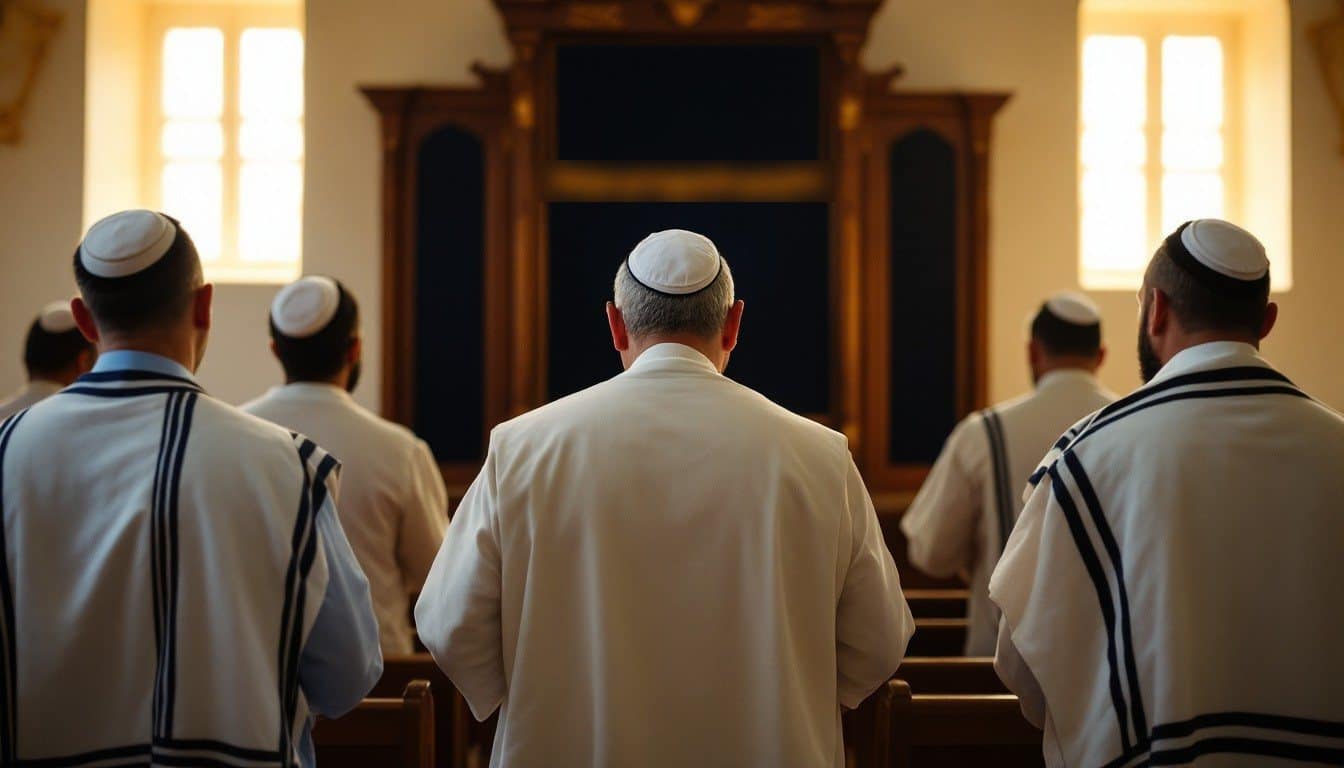
At a Jewish funeral, or in the synagogue during the year after a death, a son stands up and recites, in a clear voice, a text in Aramaic: “Yitgadal veyitkadash shemeh rabba…”. The congregation answers him with one voice: “Amen, yehe shemeh rabba mevarach”. Many people call this text “the prayer for the dead”. And yet the Kaddish does not speak of death, nor of the deceased, nor of mourning. So what does it say, where does it come from, and why did it become the mourners’ prayer? Here is a complete answer, with the verses, the Talmud, the history and the deeper meaning of this text.
In short: the Kaddish (Aramaic for “sanctification”) is a praise that proclaims the greatness and holiness of the Name of G-d and asks that His kingship be revealed in the world. It takes up a prophecy of Yechezkel (Ezekiel): “I will magnify Myself and sanctify Myself, and I will make Myself known in the eyes of many nations” (Yechezkel 38:23). Its heart is the congregation’s response, “May His great Name be blessed forever and for all eternity”, which the Talmud says is of immense value (Berachot 3a; Shabbat 119b). It is recited only in the presence of ten men, the minyan, and it punctuates every service in the synagogue. Since the Middle Ages it has also been recited by bereaved children for eleven months after the death of a father or a mother, and then on every anniversary of the death: by sanctifying the Name of G-d where the deceased can no longer do so, the child extends the parent’s life and brings them merit.
What does the word “Kaddish” mean?
The word Kaddish (קדיש, also spelled “Kadish” or “Kaddich”) is an Aramaic word meaning “holy” or “sanctification”. It comes from the same root as the Hebrew kadosh, “holy”, which is also found in Kiddush (the blessing over wine on Shabbat), in the Kedusha (the proclamation “Holy, holy, holy” in the prayer service) and in the expression Kiddush Hashem, “sanctification of the Name of G-d”.
The name comes from the second word of the text: “Yitgadal veyitkadash”, “may His great Name be magnified and sanctified”. The Kaddish is therefore, in the proper sense, a prayer of sanctification: it asks for nothing for the person who says it; it proclaims, and wishes, that G-d’s holiness be recognized by all.
In Sephardic communities people say “Kaddish” and “Yitgadal veyitkadash”; in many Ashkenazic communities, “Kaddish” and “Yisgadal veyiskadash”. The meaning is the same everywhere.
The text of the Kaddish and its translation
The Kaddish is short. Here is its basic form, the “Half Kaddish”, in English translation. The passages in square brackets are said by the congregation.
“May His great Name be magnified and sanctified [Amen] in the world that He created according to His will. May He establish His kingship in your lifetime and in your days, and in the lifetime of the whole house of Israel, swiftly and soon, and say: Amen.
[Amen. May His great Name be blessed forever and for all eternity.]
Blessed, praised, glorified, exalted, extolled, honored, elevated and lauded be the Name of the Holy One, blessed be He, [blessed be He] beyond all the blessings and songs, praises and consolations that are uttered in the world, and say: Amen.”
In the Sephardic rite and among Chassidim, after the first sentence one adds: “may He cause His redemption to sprout and bring near His Mashiach”. The other forms of the Kaddish then add further paragraphs: a request that our prayers be accepted, a wish for peace (“May there be abundant peace from Heaven”) and a final sentence in Hebrew: “He who makes peace in His heights, may He make peace upon us and upon all Israel, and say: Amen.” This last formula takes up a verse from the book of Iyov (Job): “He makes peace in His heights” (Iyov 25:2).
One notices it on reading: not a single word about death. The Kaddish does not name the deceased and speaks neither of mourning, nor of the grave, nor of consolation in the usual sense. It is a praise of G-d and a prayer for the coming of His kingship. This surprise is the key to everything that follows.
The biblical roots: Yechezkel and Daniel
The Kaddish, as a fixed text, is not in the Bible. But it is woven out of verses.
Its first sentence takes up, almost word for word, the end of Yechezkel’s great prophecy about the war of Gog and Magog, that is, about the end of days. After the upheavals of history, G-d declares: “I will magnify Myself and sanctify Myself, and I will make Myself known in the eyes of many nations, and they shall know that I am Hashem” (Yechezkel 38:23). In Hebrew: “vehitgadalti vehitkadishti”. The Kaddish turns this promise into a wish: “yitgadal veyitkadash”, may His Name be magnified and sanctified. The person who recites it is therefore asking that what the prophet announced for the end of history be fulfilled already now: that all should recognize G-d.
The central response, “Yehe shemeh rabba mevarach”, has two sources. In Hebrew, it echoes the verse from Psalms: “May the Name of the L-rd be blessed, from now and forever” (Tehillim 113:2). In Aramaic, it repeats almost literally the blessing of the prophet Daniel when G-d revealed to him Nebuchadnezzar’s dream: “May the Name of G-d be blessed from eternity to eternity, for wisdom and might are His” (Daniel 2:20). In Temple times, the people already answered blessings with a similar formula: “Blessed be the Name of the glory of His kingdom forever” (Mishna Yoma 6:2; Talmud, Taanit 16b).
Finally, there is a link with the Torah’s commandment: “I shall be sanctified in the midst of the children of Israel” (Vayikra [Leviticus] 22:32). This verse is the source of the mitzvah of Kiddush Hashem, sanctifying the Name of G-d in the world through one’s conduct. The Kaddish is its most direct expression in prayer: an assembled congregation proclaiming this holiness.
Why is the Kaddish in Aramaic?
Almost all Jewish prayers are in Hebrew. The Kaddish, however, is in Aramaic, the language spoken by the Jews of Babylonia and of the Land of Israel in the time of the Second Temple and of the Talmud. The commentators give several reasons for this.
The first is historical. Originally, the Kaddish was linked not to prayer but to study. After the public Shabbat lecture, the preacher concluded his teaching with a prayer of hope for the redemption, and the congregation answered “Yehe shemeh rabba”. Since ordinary people no longer understood Hebrew well, this prayer was recited in the language of the people, Aramaic, so that everyone could understand and respond. This is the explanation reported by the Tosafot (Tosafot on Berachot 3a, “ve’onin”).
The same Tosafot report another, more mysterious explanation: the Kaddish is such a powerful praise that it is said in a language the angels do not “understand”, so that they will not be jealous of it. The Tosafot themselves question this explanation, since other very lofty praises, such as the Kedusha, are said in Hebrew. Yet the idea that emerges from it is a beautiful one: the Kaddish is the praise that only human beings can say, from the earth, in their everyday language.
The Talmud bears witness to this link between Kaddish and study: “On what does the world stand? On the Kedusha of the order of prayer and on the ‘Yehe shemeh rabba’ that is said after the study of aggada” (Sota 49a). To this day, after studying the Oral Law, people recite the “Kaddish de-Rabbanan”, the Kaddish of the Rabbis, which contains a prayer for the Sages, their students and all those who study Torah.
The congregation’s response: the heart of the Kaddish
In the Kaddish, what matters most is not what the person reciting it says, but what the congregation answers. The Talmud returns several times to the power of this response.
It tells that Rabbi Yossi, while praying in a ruin in Jerusalem, met the prophet Eliyahu (Elijah) there. Eliyahu confided to him what he had heard: each time Israel enters the synagogues and houses of study and answers “May His great Name be blessed”, the Holy One, blessed be He, nods His head and says: “Happy is the king who is praised thus in his house! What is there for the father who has exiled his children? And woe to the children who have been exiled from their father’s table!” (Berachot 3a). The Kaddish is thus at once a praise and a cry from exile: G-d is not yet recognized as King in the world, and we express our longing for it.
Elsewhere, Rabbi Yehoshua ben Levi teaches: “Whoever answers ‘Amen, yehe shemeh rabba mevarach’ with all his strength, the evil decree hanging over him is torn up” (Shabbat 119b). And Rabbi Chiya bar Abba, in the name of Rabbi Yochanan, goes so far as to say that even someone who had a trace of idolatry in him is forgiven. “With all his strength” means, according to Rashi, with all his concentration, and not only at the top of one’s voice.
This is why the Shulchan Aruch asks that one answer the Kaddish with concentration and aloud, and hurry to go and hear it; the Rema adds that one stands up to answer it (Shulchan Aruch, Orach Chaim 56:1). The commentators add a play on numbers: the expression “with all his strength”, bechol kocho, contains the word koach, “strength”, written with the letters kaf and chet, whose numerical value is twenty-eight; and the praise beginning with “Yehe shemeh rabba” has twenty-eight words (see Mishna Berura 56:2).
“His great Name”: a Name still incomplete
Why say “His great Name”, shemeh rabba? An explanation quoted by the Tosafot (Berachot 3a) and by the Machzor Vitry relies on a verse of the Torah. After the war against Amalek, the Torah says: “For the hand is upon the throne of Yah” (Shemot [Exodus] 17:16). Rashi points out two anomalies there: the divine Name is written in an abbreviated form, “Yah”, and the word “throne”, kisse, is written without its last letter. He explains: G-d swears that His Name is not complete and His throne is not complete until the name of Amalek, the symbol of gratuitous evil, has been blotted out (Rashi on Shemot 17:16).
In this reading, “yehe shem Yah rabba” means: “May the Name (Yah) become great”, that is, complete. The Kaddish asks that evil disappear from the world and that G-d’s presence be fully revealed in it. It is a prayer for the repair of the world.
Why are ten men (a minyan) required?
The Kaddish is a davar shebikdusha, a “matter of holiness”. According to the Talmud, such words are said only in the presence of ten adult men, the minyan (Berachot 21b; Megilla 23b). The Mishna already states this: certain parts of public prayer are performed only with ten people (Mishna Megilla 4:3).
The source is a reasoning based on the verses. The verse “I shall be sanctified in the midst (betoch) of the children of Israel” (Vayikra 22:32) is linked to the word “midst” in the story of Korach: “Separate yourselves from the midst (mitoch) of this congregation” (Bamidbar [Numbers] 16:21). The word “congregation”, edah, is then linked to the episode of the spies, where G-d speaks of “this evil congregation” (Bamidbar 14:27): there were ten of them. A “congregation” in Israel is therefore ten people, and it is in the midst of a congregation that G-d’s holiness is proclaimed (Megilla 23b).
The Rambam and the Shulchan Aruch set down this rule: the Kaddish is not said with fewer than ten (Rambam, Hilchot Tefilla 8:4-5; Shulchan Aruch, Orach Chaim 55:1). Someone praying alone at home does not say the Kaddish. The meaning is profound: the sanctification of G-d’s Name is not a private affair. It requires a community, a “public”, because the Kaddish speaks of G-d being recognized by the whole world. A mourner is thus obliged, every day, to join a community. One does not remain alone with one’s grief.
The different forms of the Kaddish
There is not one Kaddish but several, which share the same core. They are heard throughout the service.
- The Half Kaddish (chatzi Kaddish): the core alone. It separates the main sections of the prayer service, for example before the Amida (the standing prayer) or after the Torah reading.
- The Full Kaddish (Kaddish titkabal): said by the prayer leader after the Amida. It adds the request: “May our prayers and supplications be accepted before our Father in Heaven.”
- The Mourner’s Kaddish (Kaddish yatom, literally “the orphan’s Kaddish”): the core, followed by the wish for peace. It is said by mourners, in particular at the end of the service and after certain psalms.
- The Rabbis’ Kaddish (Kaddish de-Rabbanan): said after studying the Oral Law, with a prayer for the Sages, their disciples and “all those who occupy themselves with Torah”.
- The Great Kaddish (Kaddish de-itchadeta): said at the cemetery after the burial, and on completing the study of a tractate of the Talmud (siyum). It is the only one that mentions the resurrection of the dead: it speaks of the world “that will be renewed”, where G-d “will bring the dead back to life” and rebuild Jerusalem.
So even the Mourner’s Kaddish does not speak of the deceased. A person grieving for a parent stands before the congregation and says, at the height of their pain: may the Name of G-d be magnified and sanctified.

How did the Kaddish become the mourners’ prayer?
A story about Rabbi Akiva
The link between Kaddish and mourning does not appear in the Talmud. It rests on a famous story, reported in several versions in later rabbinic literature (notably the tractate Kalla Rabbati), and then taken up by the great medieval authors of Germany and France, such as the Machzor Vitry, which came out of Rashi’s school, and the Or Zarua of Rabbi Yitzchak of Vienna (13th century).
Rabbi Akiva, so the story goes, once met a man, black as coal, running while carrying a heavy load of wood. He was a dead man, condemned for his sins to this endless punishment. Rabbi Akiva asked him whether there was any remedy. The man answered: if I had a son who stood before the congregation and said “Barechu” (“bless the L-rd”) and the community answered “Baruch Hashem hamevorach”, or if he said “Yitgadal” and they answered him “Yehe shemeh rabba”, I would be set free. He had left his wife pregnant. Rabbi Akiva found the child, who had grown up without learning anything, and taught him Torah and prayer until he was able to stand up in the synagogue. The dead man then appeared to him in a dream to tell him that he had been delivered.
The rule: eleven months, then every year
On the basis of this story, the custom spread in Europe, in the Middle Ages, that the child of a deceased person recites the Kaddish, or leads the prayer service, during the year of mourning. The Rema, Rabbi Moshe Isserles, sets out its rules for Ashkenazim, and today the custom is universal, among Sephardim and Ashkenazim alike (Rema on Shulchan Aruch, Yoreh De’ah 376:4).
Why eleven months and not twelve? The Mishna teaches that the judgment of the wicked lasts twelve months (Mishna Eduyot 2:10). So as not to imply that his father or mother was among the wicked, the child stops reciting the Kaddish one month earlier (Rema, Yoreh De’ah 376:4). It is then recited every year on the anniversary of the death according to the Hebrew calendar: this is the yahrzeit, or hazkara (nachala among some Sephardim).
Why does the Kaddish help the deceased?
The idea comes from the Talmud: “The son brings merit to the father” (Sanhedrin 104a). The good that a child does, he also does in part on behalf of the one who brought him into the world and raised him. When a son or a daughter sanctifies the Name of G-d, it is proof that the parent’s life continues to bear fruit. The deceased can no longer perform mitzvot; their children can, and every time they lead a congregation to answer “Amen, yehe shemeh rabba”, they add to the parent’s merit.
There is also a more personal reason. Mourning is a moment when one may rebel against G-d, or feel abandoned. To say publicly, at that very moment, “may His great Name be magnified and sanctified” is an act of faith. The Sages compare this attitude to that of Aharon who, after the death of his two sons, “was silent” (Vayikra 10:3), and they teach that one must bless G-d for the bad just as one blesses Him for the good (Mishna Berachot 9:5). The Kaddish is that blessing, said with tears in one’s eyes.
What Rav Raphaël Benizri teaches
Rav Benizri has spoken about the Kaddish in several of his lectures, and always to recall its true meaning.
“The Kaddish is not an amulet”
In his lecture on parashat Chayei Sarah, Chayei Sarah: the source of life, the Rav warns against reciting the Kaddish for a loved one as though it were an amulet, a formula that works by itself. He recalls that the Kaddish was first of all part of prayer: it separated the different levels of the prayer service, like a “dividing sheet” between one mode of prayer and another, and it was the sanctification of the divine Name. It was only later, he explains, around the 12th century in his view, that people adopted the habit of reciting it for a deceased person.
The Rav does not belittle this custom, but he gives it its meaning. The loved one has gone; from now on an energy is missing to bring to completion the work they had undertaken. The person reciting the Kaddish is in essence saying: from today, I will be their substitute, and I will sanctify the Name of G-d as they did. To recite the Kaddish for a loved one, the Rav concludes, is to be there to complete their mission, to fulfil what they can no longer do today. And this happens through the sanctification of the divine Name, which belongs to the World to Come, the world of the memory of the entire universe.
The master who had no children
In his lecture Pirkey Avot: all Israel have a share in the World to Come, the Rav discusses the mishna recited at the end of each chapter of Pirkei Avot, that of Rabbi Chananya ben Akashya: “The Holy One, blessed be He, wished to grant merit to Israel; therefore He gave them much Torah and many mitzvot” (Mishna Makkot 3:16). After this mishna the Kaddish is recited, following the custom of saying it after mentioning a teaching of the Oral Law.
The Rav relates that this master left only one single teaching in the whole Talmud and that he had no children. At the end of his days he turned to the Master of the world: he was going to depart without a single child to recite the Kaddish and sanctify His Name on his behalf. The answer was that it would not be one son, nor two or three people, but the whole people of Israel: each time they concluded a session of study, they would quote his mishna and then recite the Kaddish. This tradition, as the Rav conveys it, shows clearly that the Kaddish is not only a matter for one’s biological children: all of Israel can carry on the sanctification of the Name begun by someone else.
The tenth that consecrates the whole
In his lecture Vayetze: the journey into the unknown, on Yaakov’s vow to give a tithe of everything he would receive (Bereshit [Genesis] 28:22), the Rav recalls that the tithe, the tenth part that is set aside, consecrates all the rest. And he connects it with the minyan: if we are nine, we cannot recite the Kaddish, we cannot solemnly proclaim holiness. Just one more person is enough: the tenth carries the whole group with it.
The Kaddish in history
The Kaddish is one of the oldest texts of the Jewish liturgy. Its core, the response “Yehe shemeh rabba”, is attested in the Talmud, in teachings from the period of the Mishna and the Talmud (2nd to 5th centuries), and the formula “blessed be the Name of the glory of His kingdom” goes back to Temple times. The name “Kaddish” and its liturgical forms appear in the minor tractate Soferim, compiled in the period of the Geonim, and the full text appears in the earliest known prayer book, the Seder of Rav Amram Gaon (Babylonia, 9th century).
The Mourner’s Kaddish, for its part, appears in medieval sources from Germany and northern France in the 12th and 13th centuries (Machzor Vitry, Or Zarua). Many historians link its spread to the period of the Crusade massacres, from 1096 onwards, when entire communities in the Rhineland were left in mourning. The custom then spread to the whole Jewish world.
Scholars have also noted the kinship between the opening sentences of the Kaddish and the Christian prayer “Our Father” (“hallowed be Thy name, Thy kingdom come”): both texts draw on the same language of Jewish prayer from the Second Temple period, nourished by Yechezkel and the Psalms. This is not a borrowing: the two texts draw on a common source, and the Kaddish developed within the synagogue and the house of study.
Finally, the Kaddish has left its mark far beyond the synagogue. In the ghettos and camps of the Holocaust, many testimonies report that deportees recited it for their loved ones who died without burial. Writers and poets have given its name to their works, in tribute to a father or a mother. For many Jews who are far from religious practice, the Kaddish for a parent remains the last living link with the synagogue, and often the first step of a return.
The Kaddish today: who, when, how
In practice, the Mourner’s Kaddish is recited:
- by the sons of the deceased, first and foremost, for a father or a mother;
- for eleven months from the day of the burial, at the three daily services (morning, afternoon, evening), provided there is a minyan;
- every year, on the anniversary of the death according to the Hebrew calendar;
In many communities it is said standing, feet together, bowing at certain words (“Yitgadal”, “Amen”, “Brich hu”). At the end, while saying “He who makes peace in His heights”, one takes three steps back, as at the end of the Amida. Someone who cannot read Hebrew or Aramaic can read it in transliteration: most prayer books provide one.
If the deceased left no son, or if the sons cannot come to the synagogue every day, the custom is that another family member, or a pious person, recites it in their place; some institutions and yeshivot offer this service. The question of the Kaddish recited by a daughter is debated by the halachic authorities: some, as early as the 17th century (Responsa Chavot Yair 222), spoke of it with great sympathy while expressing reservations, and customs vary today from community to community. In any case, a daughter can honor her parents through study, through tzedaka, and through her presence in the synagogue to answer “Amen”. For all particular cases (Kaddish for a brother, a spouse, a convert, or for someone whose parent is still alive), consult a rabbi.
Common misconceptions about the Kaddish
“The Kaddish is a prayer for the dead.” No. The Kaddish is a praise of G-d that mentions neither death nor the deceased. It is recited many times every day in every synagogue, even when no one is in mourning.
“The Kaddish is a magic formula that saves the soul of the deceased.” That is not how the tradition understands it. It brings merit to the deceased because the child sanctifies the Name of G-d and continues what the parent built, in keeping with the principle “the son brings merit to the father” (Sanhedrin 104a). Rav Benizri says it clearly: it is not an amulet.
“You can say the Kaddish alone, at home.” No. The Kaddish requires a minyan of ten men (Megilla 23b; Shulchan Aruch, Orach Chaim 55:1). Alone, one can study, pray and give tzedaka in the merit of the deceased, but not recite the Kaddish.
“The most important thing is to say the Kaddish.” In reality, the congregation’s response, “Amen, yehe shemeh rabba”, is at the heart of this text (Berachot 3a; Shabbat 119b). The person reciting the Kaddish needs the others: it is they who, by answering, accomplish the sanctification.
Frequently asked questions about the Kaddish
What does “Yitgadal veyitkadash shemeh rabba” mean?
It means: “May His great Name be magnified and sanctified.” The sentence takes up G-d’s promise in the book of Yechezkel: “I will magnify Myself and sanctify Myself, and I will make Myself known in the eyes of many nations” (Yechezkel 38:23). It is the wish that G-d be recognized throughout the world.
Why is the Kaddish called the “mourners’ prayer”?
Because, since the Middle Ages, the children of a deceased person have recited it for eleven months and then on every anniversary of the death. This custom rests on a story about Rabbi Akiva, reported in rabbinic literature and by medieval authors, and on the principle that a child brings merit to his parent. But the text itself is a praise, also recited by the prayer leader throughout the service.
How long is the Kaddish said after a death?
For a father or a mother, it is said for eleven months from the burial, at the three daily services, and then every year on the anniversary of the death according to the Hebrew calendar. For other relatives, customs vary: consult a rabbi.
Who can say the Kaddish if the deceased had no son?
The custom is that another relative, or a pious person entrusted with the task, recites it in the merit of the deceased. The question of the Kaddish said by a daughter is debated by the halachic authorities and customs vary between communities: ask your rabbi for guidance.
Do you have to understand Aramaic to say the Kaddish?
No. It can be read in transliteration, and it is good to know its meaning through the translation. What matters is to say it attentively and to grasp what one is proclaiming: the greatness of the Name of G-d.
What do you answer when someone says the Kaddish?
One answers “Amen” at the appointed places and, above all, with full concentration: “Amen, yehe shemeh rabba mevarach le’alam ulalmei almaya”, “Amen, may His great Name be blessed forever and for all eternity”. According to the Talmud, this response, said with all one’s heart, has very great power (Shabbat 119b).
Further reading
- Chayei Sarah: the source of life
- Pirkey Avot: all Israel have a share in the World to Come
- Vayetze: the journey into the unknown
- Chayei Sarah: the death of Sarah (part 1)
- Mourning in Judaism: shiva, covered mirrors, burial
- What happens after death according to Judaism?
- Why do Jews put stones on graves?
- What is a synagogue?
- Glossary of Hebrew terms in Judaism
Sources and references
- Yechezkel (Ezekiel) 38:23 (“I will magnify Myself and sanctify Myself”)
- Daniel 2:20; Tehillim (Psalms) 113:2 (sources of “Yehe shemeh rabba”)
- Vayikra (Leviticus) 22:32 (“I shall be sanctified in the midst of the children of Israel”); Bamidbar (Numbers) 16:21 and 14:27 (source of the minyan)
- Vayikra 10:3 (Aharon’s silence); Bereshit (Genesis) 28:22 (Yaakov’s tithe); Iyov (Job) 25:2 (“He makes peace in His heights”)
- Shemot (Exodus) 17:16 and Rashi on this verse (the incomplete Name and throne)
- Mishna Yoma 6:2; Mishna Megilla 4:3; Mishna Berachot 9:5; Mishna Eduyot 2:10; Mishna Makkot 3:16
- Babylonian Talmud, Berachot 3a (Rabbi Yossi and the prophet Eliyahu); Berachot 21b; Megilla 23b
- Babylonian Talmud, Shabbat 119b (“whoever answers Amen, yehe shemeh rabba with all his strength”)
- Babylonian Talmud, Sota 49a; Taanit 16b; Sanhedrin 104a (“the son brings merit to the father”)
- Tosafot on Berachot 3a, “ve’onin” (the Aramaic of the Kaddish; “shemeh rabba”)
- Tractate Soferim (period of the Geonim); Seder Rav Amram Gaon (9th century)
- Tractate Kalla Rabbati (story of Rabbi Akiva); Machzor Vitry; Or Zarua (Rabbi Yitzchak of Vienna, 13th century)
- Rambam, Mishneh Torah, Hilchot Tefilla 8:4-5
- Shulchan Aruch, Orach Chaim 55:1 and 56:1 (with the Rema); Mishna Berura 56:2; Rema on Shulchan Aruch, Yoreh De’ah 376:4
- Responsa Chavot Yair (Rabbi Yair Chaim Bacharach), no. 222
- Rav Raphaël Benizri, Chayei Sarah: the source of life
- Rav Raphaël Benizri, Pirkey Avot: all Israel have a share in the World to Come
- Rav Raphaël Benizri, Vayetze: the journey into the unknown
Article by the Pensées Juives editorial team. Passages attributed to Rav Raphaël Benizri are taken from his lectures published on this site.