

A torn garment, mirrors veiled with a sheet, a family sitting on low chairs for seven days, a door left open to visitors: when a Jew loses a close relative, the whole household is transformed. Why bury so quickly? Why refuse cremation? What happens during shiva, and what should you say to a mourning family? Here is a complete answer, with the sources in the Torah and the Talmud, the history and the meaning of these customs.
In short: Judaism organizes mourning in clearly defined stages. Before the funeral, the bereaved relative is exempt from almost everything so as to take care of the deceased. Burial takes place as quickly as possible, in the earth itself, in a simple shroud, because the Torah commands: “you shall bury him on that same day” (Devarim (Deuteronomy) 21:23); this is why cremation is refused. Then comes shiva (“seven”), seven days during which the family stays at home, sits low and receives condolence visits; traditionally, the mirrors are covered. These are followed by the thirty days (sheloshim) and, for a father or a mother, a full year. The principle that guides all of this: honor the dead, support the living, and do not let mourning become endless (Moed Katan 27b).
What the Torah says: death, dust and mourning
The Torah does not devote a single chapter to the laws of mourning. It sketches them stroke by stroke, through narratives. The starting point is the word addressed to Adam after the sin: “For dust you are, and to dust you shall return” (Bereshit (Genesis) 3:19). The body comes from the earth; it must return to it.
The first mourning described in detail is Avraham’s mourning for Sarah. “Sarah died in Kiryat Arba, which is Hebron, in the land of Canaan; and Avraham came to eulogize Sarah and to weep for her” (Bereshit 23:2). Two acts are named: the hesped, the eulogy of the deceased, and tears. Then Avraham, who calls himself “a stranger and a resident” among the inhabitants of the land (23:4), insists on buying a burial place, the Cave of Machpelah, and pays the full price for it (23:16-19). The first property acquired by the Jewish people in the Land of Israel is a tomb.
When Yaakov learns of Yosef’s supposed death, he “tore his garments, put sackcloth on his loins and mourned for his son many days”; “he refused to be comforted” (Bereshit 37:34-35). This is the biblical origin of keriah, the tearing of the garment. And at Yaakov’s death, Yosef and his brothers, having reached the place of burial, “made a mourning of seven days for his father” (Bereshit 50:10). This is the first shiva in history.
Finally, the Torah lays down the rule of prompt burial. Concerning even a condemned man who has been executed, it commands: “His body shall not remain all night upon the tree, but you shall bury him on that same day” (Devarim 21:23). If such respect is owed to the body of a criminal, it is owed all the more to every human being. The Torah also names the seven relatives for whom one mourns, through the list of relatives for whom a kohen, a priest, may become ritually impure: father, mother, son, daughter, brother, sister and spouse (Vayikra (Leviticus) 21:2-3; Moed Katan 20b; Shulchan Arukh, Yoreh De’ah 374:4).
Before the funeral: the onen and the tearing of the garment
Between the death and the burial, the bereaved relative bears a special name: onen. The Mishna teaches that “one whose dead lies before him is exempt from the reading of the Shema, from prayer and from tefillin” (Mishna Berakhot 3:1). This is not contempt for the mitzvot. It is the opposite: at that moment, the only mitzvah that counts is caring for the deceased. And Jewish law recognizes that a person in shock cannot pray with the required concentration.
On hearing of the death, one recites the blessing “Baruch Dayan ha-Emet”, “Blessed be the true Judge” (Mishna Berakhot 9:2). It is a hard sentence to say, and that is intentional: at the very moment when everything is collapsing, one affirms that the world is not left to chance.
Then comes keriah, the tearing of the garment, usually done just before the funeral (Shulchan Arukh, Yoreh De’ah 340). It is done standing. The Talmud derives this from the verse about Iyov (Job) who, on learning of his children’s death, “arose and tore his robe” (Iyov 1:20; Moed Katan 20b). For a father or a mother, the tear is made on the left side, the side of the heart. The tear expresses what words cannot say: something has been torn away. It also lets part of the pain escape instead of keeping it locked inside.
Burial: why so quickly, and why in the earth
The same day, whenever possible
The Mishna is explicit: leaving one’s dead overnight without burial is a transgression, unless it is for the deceased’s honor, for example to wait for relatives or to prepare the shroud (Mishna Sanhedrin 6:5). This is why, in the Jewish world, funerals generally take place the same day or the next day. Families who wish to have their loved one buried in Israel accept the delay of transport: this, too, is “for the honor of the deceased.”
The Talmud asks why burial is obligatory: is it to spare the deceased the humiliation of having his body decompose in the open air, or is it to obtain for him kapparah, atonement (Sanhedrin 46b)? The two answers complement each other. Man is created “in the image of G-d” (Bereshit 1:27): his body, even lifeless, retains something sacred. And the return to the earth is part of the soul’s journey.
The Rambam (Maimonides) draws a clear consequence from this: if someone asks before dying that no eulogy be given for him, his wish is respected; but if he asks not to be buried, “he is not listened to, for burial is a mitzvah” (Mishneh Torah, Hilkhot Evel 12:1).
The tahara and the white shroud
Before the funeral, the body is entrusted to the chevra kadisha, the “holy society,” volunteers from the community. They perform the tahara, the ritual washing: the body is washed gently, purified with water poured according to a precise rite, then dressed in tachrichin, a shroud of white linen or cotton, without pockets or ornaments. Women take care of women, men of men. Throughout this time, the deceased is never left alone: a shomer, a “watcher,” stays beside him reciting Tehillim, the Psalms.
Why such a simple shroud? The Talmud relates that at one time the dead were buried in luxurious garments. Poor families, unable to keep up, were humiliated, to the point that some abandoned the body and fled. Rabban Gamliel, the leader of the people, then asked to be buried in simple linen garments, and the whole people followed his example (Moed Katan 27b; Ketubot 8b). Since then, rich or poor, everyone departs dressed the same way. In the face of death, social classes no longer exist.
In many communities, men are buried in their tallit, their prayer shawl, one of whose fringes is made invalid: the deceased is no longer bound by the mitzvot. The coffin, when there is one, is made of plain wood. In Israel, according to the most widespread custom, the body is placed directly in the earth, wrapped in its shroud, to fulfill as closely as possible the verse “to dust you shall return.”
Accompanying the dead: the “kindness of truth”
Accompanying the deceased to the grave, carrying the coffin, helping to cover it with earth: these are among the highest acts of kindness. The Rambam counts them among the gemilut chassadim, acts of loving-kindness, which he connects to the commandment “you shall love your neighbor as yourself” (Hilkhot Evel 14:1). When Yaakov asks Yosef to bury him in the land of Canaan, he asks him to show him “chesed ve-emet,” “kindness and truth” (Bereshit 47:29). Rashi explains: kindness done to the dead is a kindness of truth, because one expects nothing in return (Rashi on Bereshit 47:29, based on Bereshit Rabba 96:5).
At the cemetery, one recites Tziduk ha-Din, “the acceptance of the judgment,” a prayer that takes up the words of Iyov: “The L-rd has given, and the L-rd has taken away; blessed be the name of the L-rd” (Iyov 1:21). The relatives themselves shovel earth onto the coffin, and the sons recite Kaddish for the first time. As they leave the grave, those present form two rows between which the mourners pass, and the first words of comfort are addressed to them.
Why Judaism refuses cremation
This is one of the most frequently asked questions, and the answer is clear: according to Jewish law, across all communities, cremation is forbidden. Several reasons converge.
- The commandment to bury. “You shall bury him” (Devarim 21:23) is a positive mitzvah. Burning the body means failing to fulfill it. The Rambam, as we have seen, even refuses to follow the wish of a deceased person who asked not to be buried (Hilkhot Evel 12:1).
- The return to the earth. “To dust you shall return” (Bereshit 3:19): the body must follow a natural, slow process, not be destroyed all at once.
- Respect for the divine image. The body carried a soul, performed mitzvot, loved, worked. It is not treated as a thing to be disposed of. In the Bible, burning bones is presented as an outrage: the prophet Amos condemns Moav “because he burned the bones of the king of Edom into lime” (Amos 2:1).
- Faith in the resurrection. Techiyat ha-metim, the resurrection of the dead, is a principle of faith in Judaism; it is the last of the Rambam’s thirteen principles, and the second blessing of the Amida, the prayer recited three times a day, affirms it. The Sages teach that G-d can do anything; but burial expresses, through an act, the hope that this body is not finished. The body is laid down, not destroyed, the way one sows a seed.
The Roman historian Tacitus had already noticed it in the 1st century: the Jews, he writes, prefer “to bury bodies rather than burn them” (Histories V, 5). At a time when cremation was common among the Romans, burial was a distinctive mark of the Jewish people.
For Jews today, there is also a wound of memory: six million of them were murdered during the Shoah, and many were reduced to ashes in crematorium ovens. Choosing cremation voluntarily deeply offends that memory.
What should be done if a relative has nevertheless been cremated? The question is delicate and depends on each case (burial of the ashes, laws of mourning, Kaddish). One should consult a rabbi, with kindness: the aim is not to judge, but to accompany.
Shiva: seven days to weep and be comforted
Where do the seven days come from?
The word shiva simply means “seven.” The first example is Yosef, who made for his father “a mourning of seven days” (Bereshit 50:10). The Talmud adds another source, from the prophet Amos: “I will turn your festivals into mourning” (Amos 8:10). Just as a festival lasts seven days, mourning lasts seven days (Moed Katan 20a). The Rambam specifies that, according to the Torah, only the first day of mourning is obligatory; it was Moshe Rabbeinu, Moses our teacher, who instituted the seven days of mourning, like the seven days of feasting after a wedding (Hilkhot Evel 1:1). The parallel is a beautiful one: Jewish life marks with seven days the two great passages of existence, the joy of a wedding and the pain of separation.
Shiva begins on returning from the cemetery and ends on the morning of the seventh day. The day of the funeral counts as the first day.
What the mourner does
During shiva, the avel, the mourner, stays at home or in the house of the deceased. The Shulchan Arukh lists what is forbidden to him: working, bathing for pleasure, applying creams or perfumes, wearing leather shoes, marital relations, studying Torah (except texts connected with mourning), greeting people with “shalom,” washing or ironing clothes, cutting one’s hair (Yoreh De’ah 380:1; Moed Katan 15a-b and 21a). The torn garment is worn. One does not shave.
The mourner sits on a low seat or on the floor. In Talmudic times, the beds were overturned (kefiyat ha-mitah). The Talmud gives a deeply moving reason for this, in the name of Bar Kappara: G-d says, as it were, “I placed My image in man, and because of sins I have overturned it; so overturn your beds” (Moed Katan 15b; Shulchan Arukh, Yoreh De’ah 387:1). The person who lowers himself to the ground symbolically joins the one who has been laid in the earth. Even Iyov’s friends “sat with him on the ground seven days and seven nights” (Iyov 2:13).
The meal of consolation
When he returns from the cemetery, the mourner does not eat his own bread: his neighbors and friends bring him a first meal, the seudat havra’ah, the “meal of comfort” (Moed Katan 27b; Shulchan Arukh, Yoreh De’ah 378:1). The rule is derived from the paradoxical order given to the prophet Yechezkel (Ezekiel), who is forbidden, as a sign, to eat “the bread of men,” that is, the bread brought to mourners (Yechezkel 24:17). The idea is simple and profound: at that moment, the mourner does not have the strength to feed himself; the community carries him.
Traditionally, hard-boiled eggs or lentils are served. The Talmud relates that on the day Avraham died, Yaakov prepared a dish of lentils to comfort his father Yitzchak, and explains: just as the round lentil has no “mouth,” the mourner is left speechless; and just as it rolls, mourning goes around the world and reaches everyone in turn (Bava Batra 16b).
The candle and prayer at home
During the seven days, a candle is kept burning in memory of the deceased. The custom is based on the verse “The soul of man is the lamp of the L-rd” (Mishlei (Proverbs) 20:27). Prayer services are often held in the house of mourning, with a minyan, a quorum of ten men, so that the mourners can recite Kaddish without going out.
Shabbat and festivals
Shabbat counts as one of the seven days, but mourning is not displayed in public on it: the mourner dresses normally, goes to the synagogue and does not sit on the floor (Shulchan Arukh, Yoreh De’ah 400:1). And a major festival (Pesach, Shavuot, Sukkot, Rosh Hashana, Yom Kippur) that falls during shiva interrupts and cancels it (Moed Katan 19a; Yoreh De’ah 399). The collective joy of the calendar has the last word over private grief. For the exact calculation, which depends on many cases, one should consult a rabbi.
Why are mirrors covered?
This is one of the most frequent questions about Jewish mourning, and yet the custom appears neither in the Torah nor in the Talmud. It is a later custom, widespread in almost all communities and recorded in the handbooks of the laws of mourning of recent centuries. Several explanations are given, and they do not exclude one another.
- Prayer in the house of mourning. Services are held at the mourner’s home. Now, the halachic authorities teach that one should not pray facing a mirror, since one would appear to be bowing down to one’s own image. Covering the mirrors makes it possible to pray in every room.
- Giving up concern for appearance. During shiva, one does not shave, does not wear make-up, does not attend to one’s looks. The mirror is the instrument of that attention to oneself. Veiling it is a way of saying: this week, it is not I who matter, but the one who has gone, and the bond that united me to him.
- The diminished divine image. The Talmud explains the overturning of the beds by the image of G-d “overturned” in the deceased (Moed Katan 15b). Man was created “in the image of G-d”; when a human being dies, that image has gone out in the world. It would be strange to gaze at one’s own reflection at the very moment a divine image has disappeared. Covering the mirrors extends, in a way, the ancient gesture of the overturned bed.
- Popular beliefs. One also hears explanations connected with spirits or with the soul of the deceased being reflected. These are folk traditions, which are not among the reasons accepted by the masters of Jewish law.
In practice, the mirrors of the house of mourning are covered with a sheet or a cloth as soon as the family returns from the cemetery, and uncovered at the end of shiva. Some also cover screens and portraits. It is a custom, not a law of the Torah: practices vary from family to family.
After shiva: the thirty days, the year and the anniversary
Jewish mourning does not stop all at once; it withdraws in stages. The Talmud sums it up this way: “Three days for weeping, seven for eulogy, thirty for the prohibition of ironing clothes and cutting the hair. Beyond that, the Holy One, blessed be He, says: you shall not be more merciful toward him than I am” (Moed Katan 27b).
- Sheloshim (thirty days). Until the thirtieth day after the funeral, the mourner does not cut his hair, does not wear new clothes and does not take part in celebrations with music. For a brother, a sister, a spouse or a child, the mourning ends there.
- The year for a father or a mother. For one’s parents, certain restrictions are extended for twelve months, notably abstaining from festivities. This is an expression of the commandment to honor one’s father and mother, which continues beyond death.
- Kaddish. Sons recite Kaddish for eleven months for a parent. This prayer, which does not speak of death but of the sanctification of G-d’s name, is the subject of a separate article in this series.
- The tombstone. The matzevah, the headstone, is set up at the end of the thirty days or of the twelve months, depending on custom. The Hebrew name of the deceased and that of his father (or mother) are engraved on it.
- The azkara or yahrzeit. Every year, on the anniversary of the death according to the Hebrew calendar, a candle is lit, Kaddish is recited, Torah is studied in memory of the deceased, and people often visit the grave.
Why limit mourning? Because Judaism wants us to weep, but not to lose ourselves. The Rambam writes that one who does not mourn as the Sages prescribed is “cruel” (Hilkhot Evel 13:12). But just before, he writes: “One should not grieve excessively over the dead,” for death is “the way of the world”; he quotes Yirmeyahu: “Do not weep for the dead” (Yirmeyahu (Jeremiah) 22:10), which he understands as a prohibition against weeping to excess (Hilkhot Evel 13:11). Mourning is a path with a beginning, stages and an end. It leads back to life.
How to comfort a mourning family
Visiting mourners, nichum avelim, is a mitzvah that the Rambam counts among the acts of kindness (Hilkhot Evel 14:1). A few very ancient rules guide this visit.
- First, be silent. The Talmud teaches that visitors may not speak before the mourner has opened the conversation himself (Moed Katan 28b; Shulchan Arukh, Yoreh De’ah 376:1). It derives this from Iyov’s friends, who sat for seven days “and none spoke a word to him, for they saw that his pain was very great” (Iyov 2:13). A silent presence is worth more than ready-made phrases.
- Talk about the deceased. One comes to listen, to recall the person’s qualities, memories and what he built. This is often what the family wants most.
- Do not stay too long. One does not tire the mourners; one does not turn the visit into a reception.
- The parting words. When leaving the house, one says: “HaMakom yenachem etchem betoch she’ar avelei Tziyon vi-Yerushalayim,” “May G-d comfort you among the mourners of Zion and Jerusalem.” The grief of one family is joined to the great hope for consolation of the entire people.
- Do not greet. During shiva, one does not address the usual greetings to the mourner (“hello,” “how are you?”); one sits down and listens.
A bit of history
Ancient Jewish tombs confirm the attachment to burial. In the Second Temple period, in Jerusalem, the deceased was first placed in a niche cut into the rock; about a year later, the bones were gathered into a small stone chest, the ossuary: this is likkut atzamot, the gathering of the bones, mentioned in the Mishna (tractate Moed Katan). Hundreds of ossuaries have been found around Jerusalem, including the one discovered in 1990 that bears the name of the family of the high priest Caiaphas.
In the Middle Ages, the first thing a Jewish community bought when it settled in a town was often a plot of land for its cemetery, as Avraham did in Hebron. In Hebrew, the cemetery is called beit ha-chaim, “the house of life,” or beit olam, “the house of eternity.” The chevra kadisha became a structured society in 16th- and 17th-century Europe, notably in Prague in 1564; being a member of the society was, and remains, a great honor.
What Rav Raphaël Benizri teaches
Rav Benizri has not devoted a specific lecture to the laws of mourning, but several of his lectures shed light on the deeper meaning of death, burial and consolation.
The cemetery, “house of life”
In his lecture Chayei Sarah: the death of Sarah (part 1), the Rav starts from a paradox: the parasha that tells of Sarah’s death is called “the life of Sarah.” This is because, he explains, the righteous, even in their death, are called living. He compares existence to a duplex whose upper floor is the World to Come; death is an eclipse, necessary in order to climb to another level of life. And the foundation of faith, he stresses, is not so much the Garden of Eden as the resurrection: passing through death is like the decomposition of the seed in the soil.
The Rav points out that taking possession of the Land of Israel begins with the purchase of a cemetery. But the Hebrew word immediately corrects that impression: the cemetery is called beit ha-chaim, the house of life. And Avraham refuses the field that Efron wants to give him, because a field can be taken back or change its status; a cemetery, on the other hand, remains the property of those who rest there and of those who have buried their loved ones there, for that is where their origins lie.
Funerals: for the dead or for the living?
In the same lecture, the Rav asks a question: is a funeral an honor paid to the one who has passed away, or to those who remain? Both, he answers. For the living, because this person, full of energy a few hours ago, has become inert matter, and we must take up the torch by holding him up as an example. For the deceased as well, because we do not always grasp the full reach of a life; we see only samples of it. Hence the lesson of Avraham, who eulogizes his wife before burying her.
Not settling into endless mourning
The Rav also notes that the text announces the birth of Rivka just before telling of Sarah’s death. Every tragedy, he says, carries a new sun within it: a sun only sets once the rising of the next one is already planned. This is why “one must not speak of irreplaceable people, nor settle into endless mourning.” Yitzchak, traumatized by his mother’s death, is comforted only when he brings Rivka into Sarah’s tent: the light of Shabbat is rekindled there. Consolation, here, does not come through a speech, but through a home that comes back to life.
Standing up to bless
In his lecture Tisha BeAv: the Book of Job, the Rav recalls that it is from Iyov that we have the rules of mourning: one recites the blessing of the true Judge standing, as a way of affirming that one will survive despite everything, and then one tears one’s garment. Mourning, he insists, exists so that one can rise up from it. And he reads the true way of comforting in the gesture of holding out one’s hand to someone who has lost everything, to lift him up. Finally, in Tisha BeAv: the Book of Eicha, he stresses, regarding Jerusalem, that consolation is not mere condolence: it is rebuilding.
Misconceptions about Jewish mourning
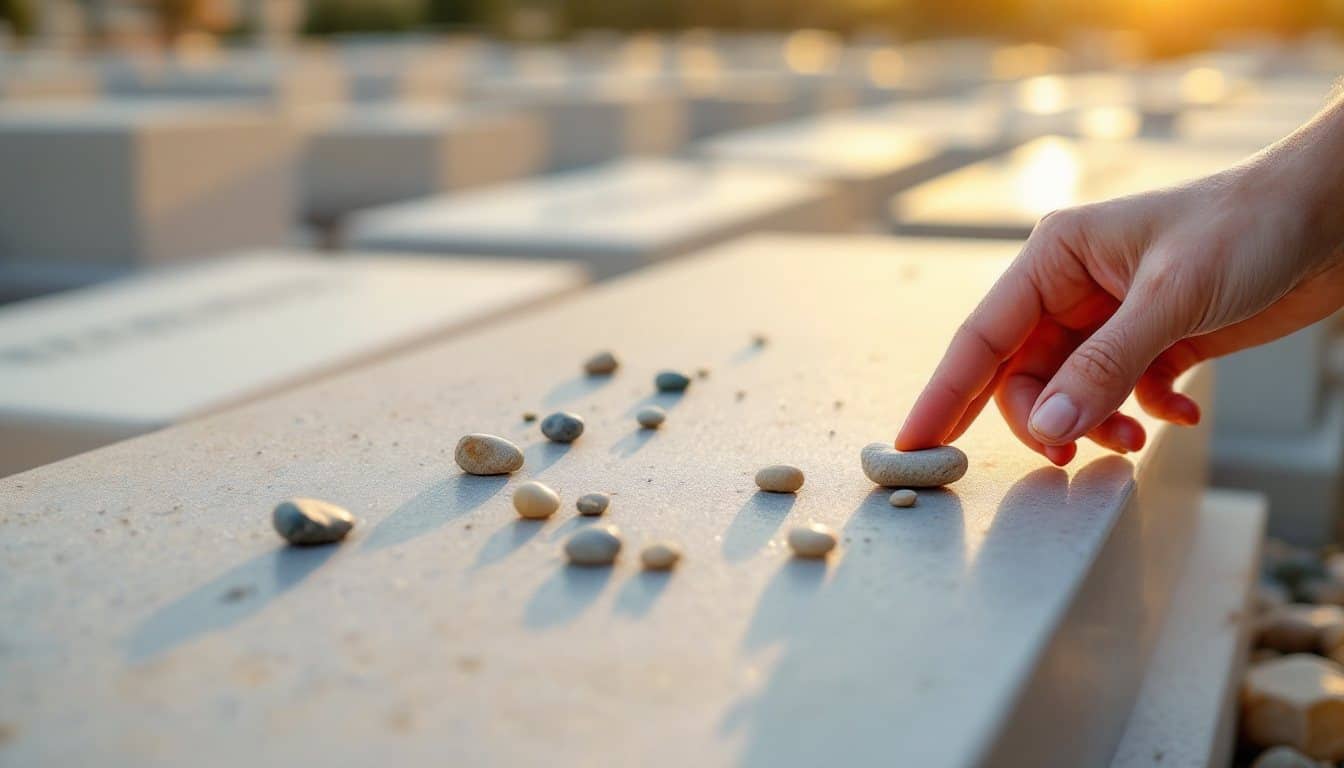
“Jews don’t bring flowers because they are too austere.” The traditional custom is indeed not to bring flowers to funerals or to graves, but not out of austerity. People prefer to give tzedakah, charity, in the merit of the deceased. And on graves, small stones are placed, a custom explained in an article in this series.
“Shiva is a time for entertaining guests.” No. The house is open, but it is not a party. Visitors come to comfort, not to be entertained; it is the community that feeds the family, not the other way around.
“Jewish mourning forbids weeping for long.” Judaism asks us to weep, and considers one who does not mourn to be hard-hearted (Rambam, Hilkhot Evel 13:12). It only sets limits on the duration, so that mourning leads toward life.
“A kohen is not allowed to bury his parents.” A kohen does not go into a cemetery or near a dead body (Vayikra 21:1), but the Torah makes an exception for his seven closest relatives (Vayikra 21:2-3).
Frequently asked questions about Jewish mourning
What does “shiva” mean?
Shiva means “seven” in Hebrew. It is the seven-day period of mourning that follows the burial of a close relative (father, mother, child, brother, sister or spouse). People say “sitting shiva,” because the mourners remain seated on low chairs and receive condolence visits.
Why do Jews cover mirrors during mourning?
It is a custom, not a law of the Torah. Several reasons are given: prayers are held in the house of mourning, and one does not pray facing a mirror; for seven days the mourner gives up concern for his appearance; and the death of a human being, created in the image of G-d, invites us not to gaze at our own image. The mirrors remain covered until the end of shiva.
Why do Jews bury so quickly?
Because the Torah commands: “you shall bury him on that same day” (Devarim 21:23), and leaving a dead person unburied is considered an affront to his dignity. A delay is permitted if it serves the honor of the deceased, for example to wait for relatives or to bury him in Israel.
Is cremation allowed in Judaism?
No. Jewish law requires burial in the earth, based on the commandment to bury (Devarim 21:23), the return of the body to dust (Bereshit 3:19), respect for the body created in the image of G-d, and faith in the resurrection. In a case where cremation has already taken place, one should consult a rabbi.
What do you say to a Jewish family in mourning?
The most important thing is to be present and to listen. Wait for the mourner to speak first, talk about the deceased, and when leaving, say the traditional words: “HaMakom yenachem etchem betoch she’ar avelei Tziyon vi-Yerushalayim,” “May G-d comfort you among the mourners of Zion and Jerusalem.”
Can a non-Jew attend a shiva or a funeral?
Yes, of course. Their presence is a real comfort to the family. Simply dress modestly, discreetly follow what others are doing and, for men, wear a kippah at the cemetery or during prayers if one is offered.
How long does Jewish mourning last?
Shiva lasts seven days, sheloshim thirty days from the funeral, and for a father or a mother certain restrictions last twelve months. After that, the anniversary of the death is commemorated every year according to the Hebrew calendar.
Further reading
- Chayei Sarah: the death of Sarah (part 1)
- Chayei Sarah: the death of Sarah (part 2)
- Tisha BeAv: the Book of Job
- Tisha BeAv: the Book of Eicha
- Tisha BeAv: why the 9th of Av is a day of mourning
- What is Kaddish, the mourner’s prayer?
- Why do Jews put stones on graves?
- What happens after death in Judaism?
- Glossary of Hebrew terms in Judaism
Sources and references
- Bereshit 1:27; 3:19; 23:2-19; 37:34-35; 47:29; 50:10
- Vayikra 21:1-3
- Devarim 21:23
- Amos 2:1; 8:10
- Yirmeyahu 22:10
- Yechezkel 24:17
- Mishlei 20:27
- Iyov 1:20-21; 2:13
- Mishna Berakhot 3:1 and 9:2
- Mishna Sanhedrin 6:5
- Babylonian Talmud, Sanhedrin 46b
- Babylonian Talmud, Moed Katan 15a-b, 19a, 20a, 20b, 21a, 27b, 28b
- Babylonian Talmud, Ketubot 8b
- Babylonian Talmud, Bava Batra 16b
- Bereshit Rabba 96:5
- Rashi on Bereshit 47:29
- Rambam, Mishneh Torah, Hilkhot Evel 1:1; 12:1; 13:11-12; 14:1
- Shulchan Arukh, Yoreh De’ah 340; 374:4; 376:1; 378:1; 380:1; 387:1; 399; 400:1
- Tacitus, Histories V, 5
- Second Temple-period ossuaries from Jerusalem, including the ossuary of the family of Caiaphas (discovered in 1990)
- Rav Raphaël Benizri, Chayei Sarah: the death of Sarah (part 1)
- Rav Raphaël Benizri, Tisha BeAv: the Book of Job
- Rav Raphaël Benizri, Tisha BeAv: the Book of Eicha
Article by the Pensées Juives editorial team. Passages attributed to Rav Raphaël Benizri are taken from his lectures published on this site.