
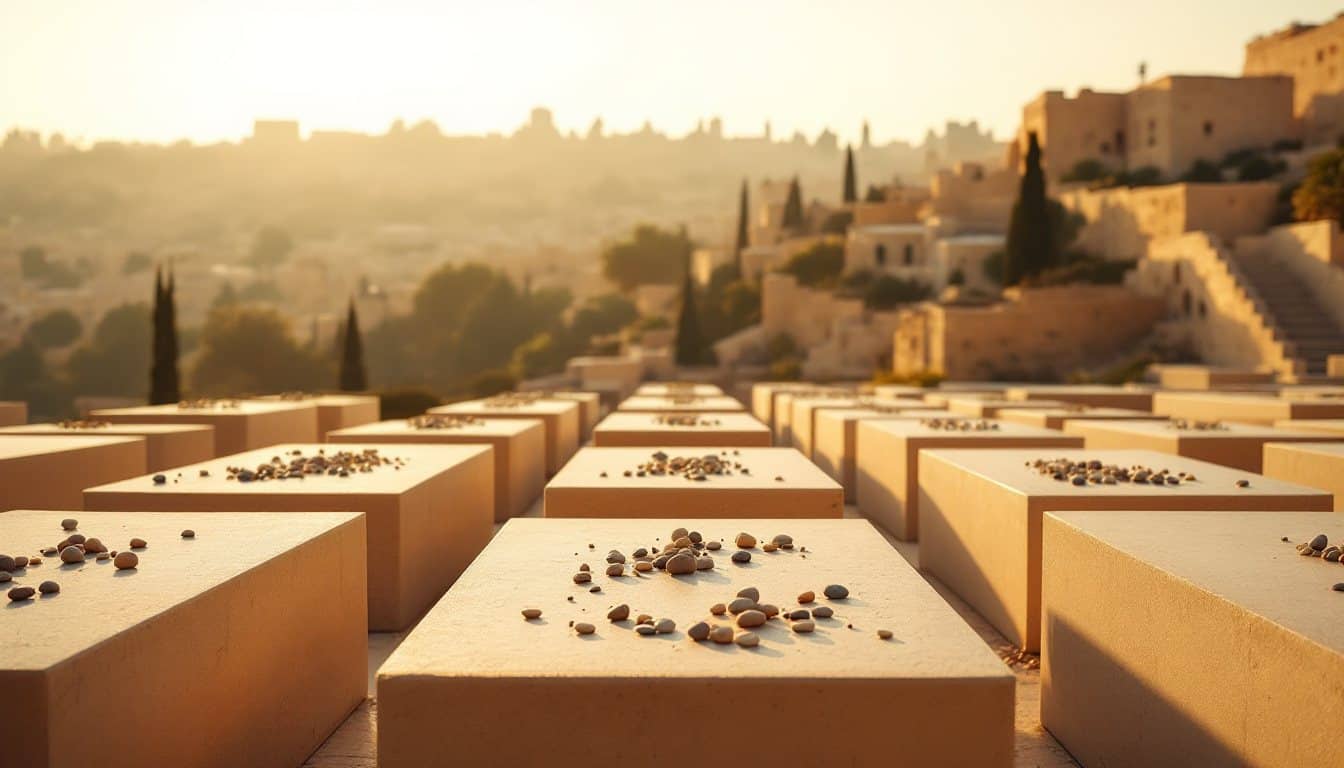
In a Jewish cemetery, one detail quickly catches the eye: there are hardly any flowers, but small pebbles placed on the headstones, sometimes dozens on a single grave. Where does this custom come from, what does it mean, and why do Jews prefer a stone to a bouquet? Here is the complete answer, with its sources in the Torah, the Talmud and the halachic authorities.
Placing a small stone on a grave is a very old Jewish custom, and today a universal one, among Ashkenazim and Sephardim alike. It is not a law of the Torah but a minhag, a custom, which the halachic authorities first explain quite simply: to leave a sign that the grave has been visited, “in honor of the deceased” (Baer Heitev on Orach Chaim 224:8, in the name of the Maharash). The Sages add further meanings: the stone endures, while the flower wilts; it recalls the matzevah, the pillar that Yaakov set up on Rachel’s grave (Bereshit (Genesis) 35:20); it is a silent prayer for the departed. As for flowers, the Talmud does not strictly forbid them, but many rabbis advise against them, because they imitate a foreign custom and say nothing about what remains of a person.
What the Torah says: a stone to mark the grave
Nowhere does the Torah speak of placing pebbles on a grave. But from its very first pages, it gives stone the role of witness and memory. When Yaakov makes a covenant with Lavan, they set up a heap of stones that they call Gal-Ed, “the heap of witness” (Bereshit 31:45-48). The stone testifies that something took place here.
The first grave in the Bible marked with a stone is Rachel’s. She died giving birth to Binyamin on the road to Bethlehem, and was buried by the wayside. The verse says: “Yaakov set up a pillar on her grave; that is the pillar of Rachel’s grave to this day” (Bereshit 35:19-20). The Hebrew word is matzevah, the very word that today designates a headstone. Every time a Jew places a pebble on a grave, he repeats Yaakov’s gesture in miniature.
Rachel’s Tomb has remained a place of prayer to this day. The prophet Yirmeyahu (Jeremiah) describes her weeping for her children gone into exile, and G-d answers her: “Refrain your voice from weeping […] your children shall return to their own border” (Yirmeyahu 31:14-16). From the very beginning, then, the Jewish grave is not a closed-off place: people come to it, pray there, and leave a sign that they have passed by.
The Bible also knows the opposite practice: a heap of stones thrown over the grave of an accursed man, as over Achan (Yehoshua (Joshua) 7:26) or over Avshalom, David’s rebellious son (Shmuel II (2 Samuel) 18:17). A stone can therefore express honor or shame, remembrance or condemnation. Everything depends on the meaning given to it, and this is where the Oral Tradition comes in.
Marking graves: an ancient obligation
There is a very practical reason to mark a grave: the impurity associated with death. The Torah forbids the Kohanim, the priests descended from Aharon, to become impure through contact with the dead (Vayikra (Leviticus) 21:1). So that they would not unknowingly pass over a burial site, every grave had to be visible.
The Mishnah reports that on the 15th of the month of Adar, before the pilgrimages of Pesach, the leaders of the community “marked the graves” (Mishnah Shekalim 1:1). They were whitewashed with lime so they could be seen from afar. The Talmud finds an allusion to this practice in a verse of Yechezkel (Ezekiel): “When anyone sees a human bone, he shall set up a sign beside it” (Yechezkel 39:15; Babylonian Talmud, Moed Katan 5a). The Rambam codifies: “The whole cemetery is marked, and a monument (nefesh) is built over the grave” (Mishneh Torah, Hilchot Evel 4:4).
According to an explanation often put forward, the custom of pebbles may partly come from this: in desert regions, many graves were no more than a mound covered with stones, and each visitor who added one strengthened the grave and kept it recognizable. The practical gesture would then have become a gesture of piety.
The stone on the coffin: a source in the Mishnah
One Mishnah speaks explicitly of a stone placed on a coffin. It concerns a sage who had been placed under a ban (niddui, the exclusion pronounced by the rabbinical court) and died without the ban having been lifted. According to the first opinion in the Mishnah, this was Akavia ben Mahalalel, who had refused to yield to the majority view on four points of law; Rabbi Yehudah protests and asserts that the man under the ban was Elazar ben Chanoch, who had cast doubt on the washing of the hands. The Mishnah concludes: “The court sent and had a large stone placed on his coffin. This teaches that whoever dies while under a ban, the court stones his coffin” (Mishnah Eduyot 5:6; see also Berachot 19a).
In this text, the stone is first of all a sign of censure. But some Sages also read it as the means of bringing the sanction to a close, so that the deceased does not depart with his debt unpaid. Rav Benizri, as we shall see, connects our custom precisely to this story and to the plea for forgiveness on behalf of the departed.
The custom of placing a pebble: what the halachic authorities say
One of the earliest mentions of the custom in halachic literature (Jewish law) is found in a commentary on the Shulchan Aruch, the code of Jewish law compiled in the 16th century by Rabbi Yosef Karo. In the chapter on the blessings recited upon seeing certain places, including Jewish graves (Shulchan Aruch, Orach Chaim 224:12; Berachot 58b), the Baer Heitev (Orach Chaim 224, s.k. 8), a commentary by Rabbi Yehudah Ashkenazi from the early 18th century, reports in the name of an earlier master, the Maharash, the custom of placing grass or a stone on the grave. He gives the reason: it is in honor of the deceased, to show that his grave has been visited.
The dead can no longer receive anything from us except remembrance. The stone says: “You are not forgotten. Someone came.” For a family returning later, finding pebbles on the grave of a father or a mother is a comfort: others have thought of him or her.
A related gesture appears in the laws of burial. After the interment, people pluck up a little earth and grass and throw it behind them (Shulchan Aruch, Yoreh De’ah 376:4); many then say, “He remembers that we are dust” (Tehillim (Psalms) 103:14). The grass that grows back evokes the resurrection; the dust recalls human frailty. The stone, for its part, recalls what endures.
Why a stone and not flowers?
In France, people lay flowers on graves, especially on All Saints’ Day. In a Jewish cemetery, flowers are rare, and many communities discourage them. Several reasons are given.
The flower wilts, the stone endures
The first reason is symbolic. The prophet Yeshayahu (Isaiah) contrasts what passes away with what remains: “The grass withers, the flower fades, but the word of our G-d shall stand forever” (Yeshayahu 40:8). A flower is beautiful but fleeting; a stone does not die. It says that the bond between the living and the departed is not a passing emotion but a lasting faithfulness. It also says that the soul, like the stone, does not disappear.
Not imitating the customs of other peoples
The second reason is halachic. The Torah asks us not to follow the customs specific to other nations: “You shall not walk in their statutes” (Vayikra 18:3), a principle the Sages call chukot hagoyim. In the 19th century, when the Jews of Europe began imitating the funeral customs of their neighbors (wreaths, sprays, plantings), several rabbis opposed it. One of the most outspoken was the Munkatcher Rebbe, Rabbi Chaim Elazar Spira, in his responsa Minchat Elazar (vol. 4, no. 61). Other 20th-century authorities, such as Rabbi Yekutiel Greenwald in his Kol Bo al Aveilut, also advise against this practice.
In all honesty, the Talmud contains no explicit prohibition of flowers. It even speaks of spices and myrtle branches (hadas) accompanying the dead. That is why some communities, notably in Israel’s military cemeteries, tolerate flowers. But the majority practice, especially in religious cemeteries, remains the stone.
Equality in death
A third reason has to do with a principle dear to Judaism: the equality of all in death. The Talmud relates that in earlier times the rich were buried with great pomp and the poor simply, to the point that poor families were ashamed. Rabban Gamliel then instructed that he himself be buried in a simple linen shroud, and the whole people followed his example (Moed Katan 27b; Ketubot 8b). Flowers, which are expensive and vie with one another in abundance, reintroduce a competition that the tradition sought to erase. A pebble picked up from the ground costs nothing: the poorest person can place as many as the richest.
No benefit may be derived from a grave
Finally, it is forbidden to derive any benefit from a grave or from the earth of a grave (Talmud, Sanhedrin 47b; Shulchan Aruch, Yoreh De’ah 364). This is one of the reasons people avoid planting flowers or shrubs on the grave itself: a grave is not turned into a garden.
The deeper meanings of the stone
Beyond these reasons, the Sages and preachers have given the stone a spiritual meaning.
Even: the father and the son
In Hebrew, a stone is called even (אבן). The commentators note that this word combines av (אב), father, and ben (בן), son. Regarding the expression “the stone of Israel” in Yaakov’s blessings, Rashi reports that Targum Onkelos (the Aramaic translation of the Torah) renders it “the father and the sons” (Rashi on Bereshit 49:24). To place a stone on a parent’s grave is to affirm that the chain is unbroken: the children are still here, and they carry on what the father began.
The stone that keeps the soul
An explanation of popular origin, often repeated, sees the stone as a way of “keeping” the soul near the grave. Tradition indeed teaches that the soul retains a connection with the body and with its burial place, especially in the first period after death. That is why people go to pray at the graves of the righteous. The Talmud relates that Kalev, one of the twelve spies sent by Moshe, broke away from the others to go and pray at the tomb of the Patriarchs in Hevron, so as to be saved from their evil plan (Sotah 34b). The stone placed on the grave marks this bond between the visitor, the deceased and the place.
A silent prayer
For many, the stone is quite simply a prayer one does not know how to put into words. One has come, read a psalm or recited Kaddish if there were ten present, spoken quietly to the departed. On leaving, one places a pebble. It is a way of promising to come back.
The Jewish cemetery: the “house of the living”
To understand this gesture, one needs to know how Judaism views the cemetery. In Hebrew it is called beit hakevarot, “the house of graves,” but also beit olam, “the house of eternity,” after the verse “man goes to his eternal home” (Kohelet (Ecclesiastes) 12:5). And above all, out of a kind of reticence full of hope, beit hachaim, “the house of the living.” For Judaism, the cemetery is not a place of nothingness but a place of waiting: the dead rest there until the resurrection of the dead, one of the Rambam’s thirteen principles of faith.
That is why a Jewish grave is not moved, not bought back and not reused. The first property Avraham acquired in the land of Canaan was a tomb: the Cave of Machpelah in Hevron, purchased at full price from Ephron the Hittite to bury Sarah there (Bereshit 23). The Torah devotes an entire chapter to this purchase.
One does not behave there in just any way. The Shulchan Aruch requires that one not eat or drink on the graves nor behave frivolously there, and men who wear tzitzit conceal them out of respect for the dead, who can no longer fulfill the mitzvot (Shulchan Aruch, Yoreh De’ah 367:4 and 368:1; Berachot 18a). On entering, if one has not seen Jewish graves for thirty days, one recites a blessing recalling that G-d “created you in justice […] and will revive you in justice” (Berachot 58b). On leaving, one washes one’s hands.
What Rav Raphaël Benizri teaches
In his published lectures, Rav Raphaël Benizri speaks several times about the stone placed on a grave.
In his lecture on the third chapter of Pirkei Avot, devoted to the mishnah of Akavia ben Mahalalel (“Consider three things: where you come from, where you are going, and before Whom you will have to give an account,” Avot 3:1), the Rav tells the story of this sage who preferred “to be considered a fool in the eyes of men rather than fail the truth of his Creator.” His position was censured, to the point of a ban according to some; others say that, at his death, they merely placed a stone over his coffin. From this the Rav draws the explanation of our custom: placing a stone on a grave is imploring divine mercy for the departed person one is visiting. Despite his being set apart, forgiveness was asked for his sins. The stone is therefore not a mere keepsake: it is a plea for leniency on behalf of someone who can no longer do teshuvah by himself. The Rav adds that Akavia’s words have become “the final message delivered to the person leaving this world,” read first in Ashkenazi communities and today among Sephardim as well (Pirkei Avot 3: where you come from, where you are going).
In a lecture on the parasha Chayei Sarah, devoted to the Cave of Machpelah and to the Jewish conception of death, the Rav goes further. Whoever is aware that “life is worth only what one builds with a view to the World to Come” understands that the stone (even) placed on the grave is not a stone of ending: it is, he says, “a stone for new building.” In Hevron, in the Cave of Machpelah, “the stone placed on the grave is not a stone of abandonment but a stone of construction” (Chayei Sarah: the source of life). And in a lecture on the parasha Vayetze, he sums it up: this stone “is to say that we faithfully keep his remembrance, his memory, and that we take it upon ourselves” (Vayetze: the confrontations of the Patriarchs).
This idea ties in with what he teaches about the name of the cemetery. In Chayei Sarah: the death of Sarah, the Rav stresses that taking possession of the Land of Israel begins with a cemetery, but that the Hebrew word immediately corrects the impression: the cemetery is called Beit HaChaim, “the house of life,” where the presence of a soul hovers. The righteous, even in death, are called living; that is why the parasha that tells of Sarah’s death is called “the life of Sarah.” We live, he says, “in a duplex”: this world on the ground floor, the World to Come upstairs (Chayei Sarah: the death of Sarah, part 1). Placing a stone on a grave is paying a visit to a floor we cannot yet see.
How exactly do you place a stone?
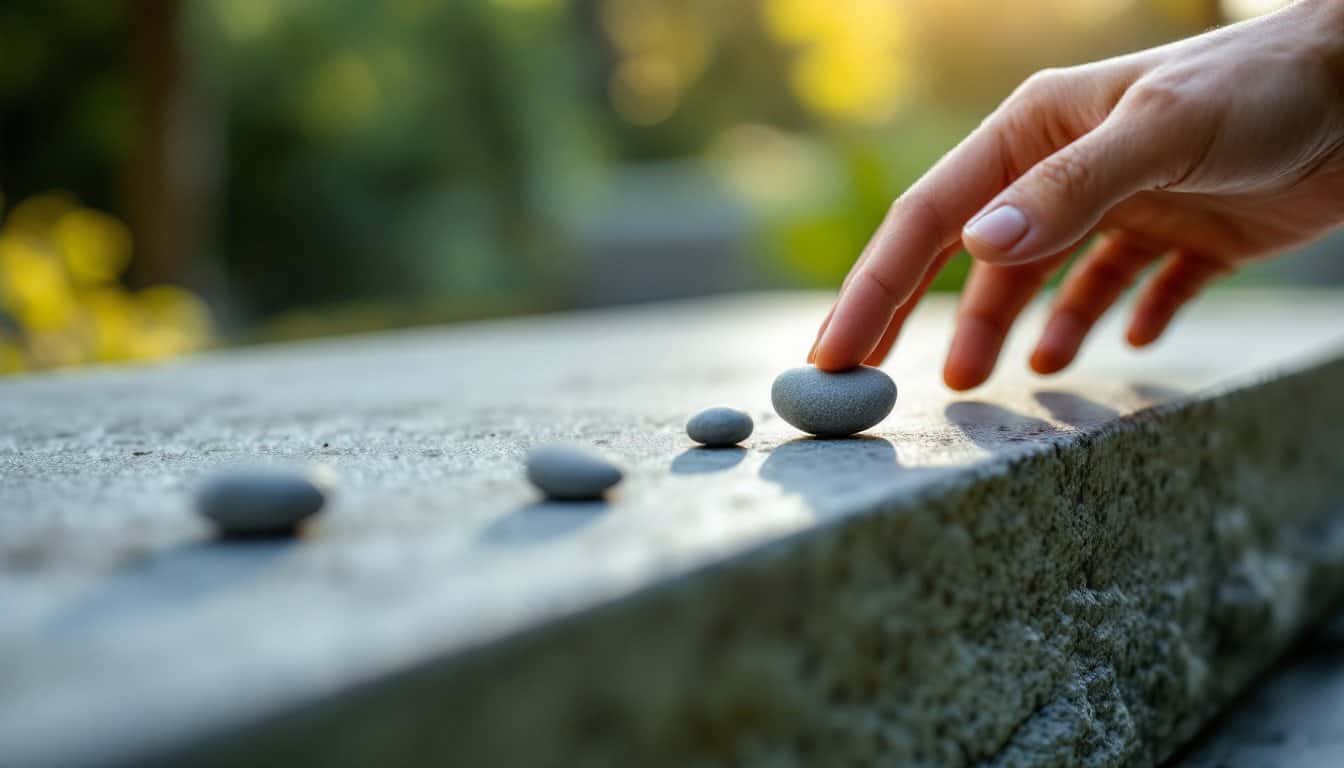
The gesture is simple, and there is no strict rule. Here is the most common practice:
- choose a small pebble, often picked up from the cemetery path or brought from home, sometimes from the Land of Israel;
- after praying or reading a few psalms (many read Psalm 119 according to the letters of the deceased’s name, or Psalm 91), place the stone on the headstone or on the slab;
- each visitor may place his or her own stone;
- do not take any object away from the cemetery, and avoid moving the stones left by others.
When do people visit the cemetery? Traditionally at the end of the seven days of mourning (the shiva), on the thirtieth day (sheloshim), on the first anniversary and then on every anniversary of the death (the hazkarah or yahrzeit), and often during the month of Elul and on the eve of Rosh Hashanah (Rema, Orach Chaim 581:4). One does not go on Shabbat or on festivals. Customs vary from community to community; for particular cases, consult a rabbi.
The Kohanim, for their part, do not enter the cemetery, except for the burial of their close relatives (Vayikra 21:1-3). That is why one sometimes sees men waiting outside the entrance, or cemeteries laid out with paths reserved for them.
A custom that has come down through history
In the old Jewish cemeteries of Europe, such as the one in Prague, where graves have been layered one on top of another since the 15th century, the grave of the Maharal (Rabbi Yehudah Loew, who died in 1609) is always covered with small pebbles and written prayer notes. On the Mount of Olives in Jerusalem, one of the oldest Jewish cemeteries still in use, stones pile up on the graves of prophets and sages. In Hevron, at Rachel’s Tomb near Bethlehem, in Meron at the grave of Rabbi Shimon bar Yochai, the same gesture is repeated.
After the Holocaust, the stone took on an additional meaning. Millions of victims have no grave. On memorials, at Auschwitz, at Yad Vashem, in front of the plaques to the deportees, visitors leave pebbles where there is no body. The stone then says: “We know that you existed.”
In 1993, the final scene of Schindler’s List showed survivors and their descendants filing past the grave of Oskar Schindler, in the Mount Zion cemetery in Jerusalem, each placing a stone on it. For millions of viewers, this was their first encounter with the custom.
Common misconceptions
“It is a law of the Torah.” No. The Torah does not mention pebbles on graves. It is a minhag, an ancient custom, widespread and respected, but it does not have the status of a commandment.
“Flowers are strictly forbidden.” That is not accurate. The Talmud does not explicitly forbid them. Many rabbis strongly advise against them for the reasons set out above, and most religious cemeteries do not accept them, but there are places where they are tolerated.
“The stone keeps the soul from leaving.” This idea circulates, but it belongs to superstition rather than tradition. The sources speak of honoring the deceased, of remembrance, prayer and forgiveness, not of imprisoning a soul.
“It is an Ashkenazi custom.” Today it is practiced in all communities. Sephardim observe it widely, especially in Israel, even though some North African families also have the custom of lighting a candle or washing the headstone during the visit.
Frequently asked questions about stones on graves
Why don’t Jews put flowers on graves?
Because a flower wilts while a stone endures, an image of memory and of the soul, which do not die. Many rabbis also see flowers as the imitation of a foreign custom and a source of inequality between rich and poor families. It is not an explicit prohibition of the Talmud, but it is the majority practice in Jewish cemeteries.
Can a non-Jew place a stone on a Jewish grave?
Yes, nothing prevents it. It is in fact a gesture of respect that families greatly appreciate. It simply needs to be done with the discretion appropriate to the place.
What kind of stone should you choose?
Any small pebble will do: there is no rule about shape or color. Some pick up a stone on the spot, others bring one from home or from the Land of Israel. What matters is the intention.
What do you say when placing the stone?
There is no required formula. People generally read psalms; one can recite the El Malei Rachamim prayer for the elevation of the soul, and Kaddish if there is a minyan, that is, ten men. Many simply speak quietly to the departed.
Can the stones placed on a grave be removed?
People avoid moving them, because they bear witness to other people’s visits. Cemetery staff or the family may nonetheless clean the grave from time to time. Customs differ from place to place.
Why are stones also placed on Holocaust memorials?
Because most of the victims have no grave. Placing a stone in front of a memorial is performing for them the gesture that cannot be made on their grave, and affirming that they are not forgotten.
Further reading
A stone weighs almost nothing, but it says that someone came and that the bond is unbroken. As Rav Benizri teaches, it is a stone of construction, not of abandonment.
- Pirkei Avot 3: where you come from, where you are going
- Chayei Sarah: the source of life
- Chayei Sarah: the death of Sarah (part 1)
- Chayei Sarah: the death of Sarah (part 2)
- How does mourning work in Judaism?
- What is Kaddish?
- What happens after death in Judaism?
- Glossary of Hebrew terms in Judaism
Sources and references
- Bereshit 23 (purchase of the Cave of Machpelah)
- Bereshit 31:45-48 (Gal-Ed, the heap of witness)
- Bereshit 35:19-20 (the pillar on Rachel’s grave)
- Bereshit 49:24, Rashi and Targum Onkelos ad loc. (“the father and the sons”)
- Vayikra 18:3 (not following the statutes of the nations)
- Vayikra 21:1-3 (the Kohanim and the impurity of the dead)
- Yehoshua 7:26; Shmuel II 18:17 (heaps of stones over Achan and Avshalom)
- Yeshayahu 40:8 (“the grass withers, the flower fades”)
- Yirmeyahu 31:14-16 (Rachel weeping for her children)
- Yechezkel 39:15 (setting up a sign beside a human bone)
- Tehillim 103:14
- Kohelet 12:5 (“his eternal home”)
- Mishnah Shekalim 1:1 (marking the graves on 15 Adar)
- Mishnah Eduyot 5:6 (Akavia ben Mahalalel, Elazar ben Chanoch and the stone on the coffin)
- Mishnah Avot 3:1 (Akavia ben Mahalalel)
- Babylonian Talmud, Berachot 18a; 19a; 58b
- Babylonian Talmud, Moed Katan 5a; 27b
- Babylonian Talmud, Ketubot 8b
- Babylonian Talmud, Sotah 34b (Kalev prays at the tomb of the Patriarchs)
- Babylonian Talmud, Sanhedrin 47b
- Rambam, Mishneh Torah, Hilchot Evel 4:4
- Rambam, Commentary on the Mishnah, Sanhedrin, chapter 10 (the thirteen principles of faith)
- Shulchan Aruch, Orach Chaim 224:12 and Baer Heitev 224, s.k. 8 (in the name of the Maharash)
- Rema on Shulchan Aruch, Orach Chaim 581:4
- Shulchan Aruch, Yoreh De’ah 364; 367:4; 368:1; 376:4
- Rabbi Chaim Elazar Spira, Responsa Minchat Elazar, vol. 4, no. 61
- Rabbi Yekutiel Greenwald, Kol Bo al Aveilut
- Rav Raphaël Benizri, Pirkei Avot 3: where you come from, where you are going
- Rav Raphaël Benizri, Chayei Sarah: the source of life
- Rav Raphaël Benizri, Chayei Sarah: the death of Sarah (part 1)
- Rav Raphaël Benizri, Vayetze: the confrontations of the Patriarchs
Article by the Pensées Juives editorial team. Passages attributed to Rav Raphaël Benizri are taken from his lectures published on this site.