
Does Judaism believe in heaven? In hell? In a soul that outlives the body, in the resurrection of the dead? The question often surprises people, because the Written Torah says very little about the afterlife, and one sometimes hears that “Jews don’t believe in life after death”. That is not accurate. Here is a complete answer: what the Bible, the Talmud and the great Sages say, what Gan Eden, Gehinnom and the “World to Come” mean, and why Judaism, for all that, places so much emphasis on life in this world.
In short: according to Judaism, man is made of dust and of a breath that comes from G-d (Bereshit [Genesis] 2:7). At death, the body returns to the earth and the soul “returns to G-d who gave it” (Kohelet [Ecclesiastes] 12:7). The soul is judged, goes if necessary through a purification of limited duration, Gehinnom, and then enjoys closeness to G-d in Gan Eden. Finally, the tradition foretells the resurrection of the dead (techiyat hametim) and the World to Come (olam haba). These beliefs are foundations of the Jewish faith, but Judaism speaks of them with restraint: it is in this life, through deeds, that a person prepares his eternity.
What the Written Torah says: a silence that speaks
Anyone looking for a description of paradise in the five books of Moshe will be disappointed: the Written Torah describes neither heaven nor hell, and the rewards it promises the faithful are very concrete: rain in its season, abundant harvests, peace in the land, long life (Vayikra [Leviticus] 26:3-6; Devarim [Deuteronomy] 11:13-15).
Yet from the very beginning, the Torah lays the foundations of a soul that is not made of the same stuff as the body. “The L-rd G-d formed man of the dust of the ground, and He breathed into his nostrils the breath of life (nishmat chayim), and man became a living being” (Bereshit 2:7). Man is twofold: a body taken from the earth and a breath that comes from above. The book of Kohelet (Ecclesiastes) draws the conclusion: “The dust returns to the earth as it was, and the spirit returns to G-d who gave it” (Kohelet 12:7).
For the death of the Patriarchs, the Torah also uses a striking expression. Avraham “breathed his last and died […], and he was gathered to his people” (Bereshit 25:8). G-d had told him: “You shall go to your fathers in peace” (Bereshit 15:15). Yet Avraham was buried in Hebron, far from his ancestors, who had stayed behind in Mesopotamia. Being “gathered to one’s people” therefore does not mean a family tomb, but the meeting of souls. Likewise, the Torah forbids consulting the dead (Devarim 18:11): one does not forbid something that does not exist. The story of Shaul consulting the necromancer of Ein Dor (Shmuel I [1 Samuel] 28) also presupposes that the soul of the prophet Shmuel had survived.
Why, then, so much reticence? The Sages have offered several answers. The Rambam explains that the Torah speaks to people according to their level, just as one promises sweets to a child before teaching him to love learning for its own sake (Commentary on the Mishna, introduction to chapter Chelek). The Kuzari (I, 104-111) stresses that other religions promise a distant paradise, whereas the Torah describes a relationship with G-d lived out in this very life, in the real history of a people. And the Talmud simply states: “There is no reward for the mitzvot in this world” (Kiddushin 39b); the true reward lies elsewhere, and it goes beyond anything words can express.
The Prophets lift the veil
The Prophets say clearly what the Torah hints at. Yeshayahu proclaims: “Your dead shall live, my corpses shall arise; awake and sing, you who dwell in the dust!” (Yeshayahu [Isaiah] 26:19). Yechezkel sees a valley covered with dry bones that are covered again with sinews, flesh and skin, and receive the breath of life: “I will open your graves and bring you up out of your graves, My people” (Yechezkel [Ezekiel] 37:1-14). Finally, the book of Daniel is the most explicit: “Many of those who sleep in the dust of the earth shall awake, some to everlasting life, and some to shame and everlasting contempt” (Daniel 12:2).
The soul: a breath with many levels
To understand what survives death, one has to know what Judaism calls the soul. Biblical Hebrew uses several words: nefesh, life, the soul that animates the body; ruach, the spirit, the breath; neshama, the higher soul, the part of man that is connected to G-d. The Midrash (Bereshit Rabba 14:9) lists five names of the soul: nefesh, ruach, neshama, chaya and yechida. The Kabbalah turned them into five levels, from the one most bound to the body to the one closest to the divine source.
Every morning, a Jew recites a prayer that sums up this conviction: “My G-d, the soul You have given me is pure. You created it, You formed it, You breathed it into me, You preserve it within me, and You will take it from me, and You will restore it to me in the time to come” (Berakhot 60b). In a single sentence, everything is said: the soul comes from G-d, it is pure at its origin, it will be taken back at death, and it will be restored at the resurrection.
The book of Proverbs compares the soul to a flame: “The soul of man is the lamp of the L-rd” (Mishlei [Proverbs] 20:27). This is why a candle is lit near the deceased, during the week of mourning and on every anniversary of the death (the yahrzeit, or hazkara among Sephardim). The flame, which always rises upward, recalls the soul that longs to return to its source.
The moment of death and the judgment of the soul
Jewish tradition sees death as a passage, not as annihilation. The Talmud teaches that “the righteous, even in their death, are called living; the wicked, even in their lifetime, are called dead” (Berakhot 18a-b).
After death, the soul gives an account of its life. Pirkei Avot (the Ethics of the Fathers) says it soberly: “Know before Whom you will have to give an account: before the King of kings, the Holy One, blessed be He” (Pirkei Avot 3:1). The Talmud records the questions a person is asked at this judgment: “Did you conduct your business honestly? Did you set aside times for Torah study? Did you engage in raising a family? Did you hope for redemption?” (Shabbat 31a). The first question concerns honesty toward others, not ritual.
Gan Eden: the “Garden of Eden”
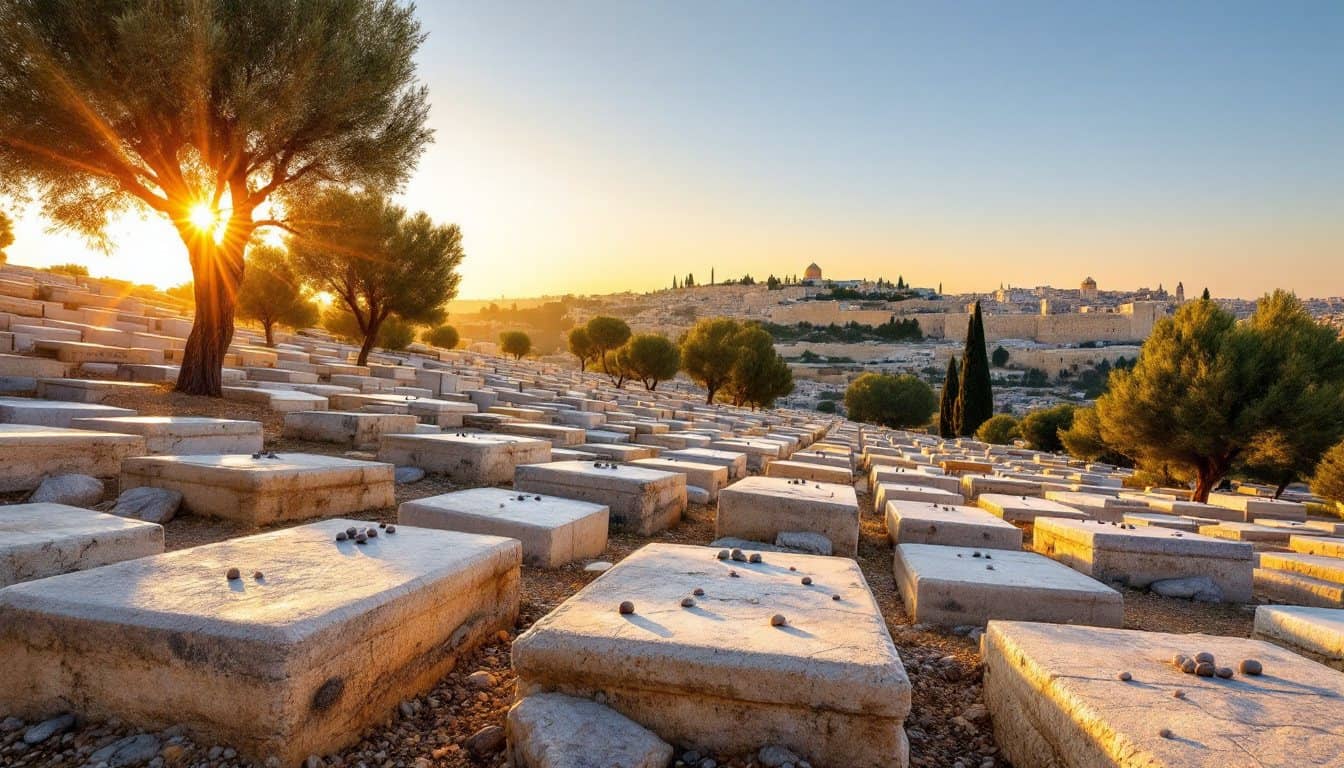
The name of paradise comes from the garden in which G-d placed the first man (Bereshit 2:8). But in rabbinic tradition, Gan Eden refers above all to the spiritual place where the souls of the righteous enjoy the divine light. The Talmud quotes the verse Avigail addressed to David: “The soul of my lord shall be bound up in the bond of life with the L-rd your G-d” (Shmuel I 25:29), and infers from it that the souls of the righteous are “stored beneath the Throne of Glory” (Shabbat 152b). This is the origin of the phrase engraved on almost every Jewish tombstone, abbreviated to five Hebrew letters: “May his soul be bound up in the bond of life”.
What is this bliss like? The Talmud answers with a famous image: “In the World to Come there is no eating or drinking, no procreation, no business, no jealousy, no hatred and no rivalry; rather, the righteous sit with their crowns on their heads and delight in the radiance of the Divine Presence (the Shekhina)” (Berakhot 17a). The Rambam explains that the “crowns” are the knowledge of G-d that each person acquired during his lifetime: up there one does not receive something foreign to oneself, one enjoys what one has become (Hilkhot Teshuva 8:2).
Gehinnom: a purification, not eternal damnation
The word Gehinnom (or Gehenna) comes from a real place: the Valley of Ben Hinnom, south of Jerusalem (Yehoshua [Joshua] 15:8), where, in the time of the idolatrous kings, children were burned in fire (Yirmeyahu [Jeremiah] 7:31), notably in honor of the idol Molekh (Melakhim II [2 Kings] 23:10). This place of horror became the name of the suffering the soul passes through after death.
But the Jewish Gehinnom has almost nothing in common with the eternal hell of popular imagination. The Mishna specifies that “the judgment of the wicked in Gehinnom lasts twelve months” (Eduyot 2:10). It is a purification: there the soul is cleansed of the traces of its sins, the way one washes a stained garment, so that it can enter the light. The Talmud (Rosh Hashana 17a) reserves a longer punishment only for extreme cases, those who did evil deliberately and on a massive scale, leading others astray.
This is why a son recites Kaddish for his father or mother for only eleven months, not twelve: one does not want to imply that the parent needed the full period of purification (Rema, Yoreh De’ah 376:4). Kaddish, tzedaka (charity) and Torah study undertaken in memory of the deceased are considered a help for the soul, which can no longer act for itself.
The World to Come (olam haba)
The expression olam haba, “the world that is coming”, is the most important and the most mysterious of all. The Mishna uses it in a sentence that has become famous and is recited before each chapter of Pirkei Avot: “All Israel has a share in the World to Come, as it is said: ‘Your people are all righteous; they shall inherit the land forever'” (Mishna Sanhedrin 10:1; Yeshayahu 60:21).
What exactly does this “World to Come” refer to? Two major views exist side by side.
- According to the Rambam, the World to Come is the existence of souls without bodies, in the knowledge of G-d. He specifies that it is called “the world that is coming” not because it does not yet exist, but because it comes to a person after the life of this world (Hilkhot Teshuva 8:8). There, souls are like angels, without material needs (8:2).
- According to the Ramban (Nachmanides), in his Shaar Hagemul (“The Gate of Reward”), the World to Come is the world that will follow the resurrection of the dead: people will live in it with a body, but a transformed, purified body, like Moshe, who stayed forty days on Sinai without eating or drinking. The Gan Eden of souls is then only a stage along the way.
The two great masters agree on the essential point: this existence surpasses anything we can imagine. The Talmud puts it this way: “All the prophets prophesied only about the days of the Messiah; but as for the World to Come, ‘no eye has seen it, O G-d, except You'” (Berakhot 34b, quoting Yeshayahu 64:3). The Rambam adds that as long as a person lives in a body, he can no more grasp this spiritual bliss than a blind man can conceive of colors (Commentary on the Mishna, introduction to chapter Chelek).
Who has a share in the World to Come?
The same Mishna then lists those who have no share in it: one who denies that the resurrection of the dead comes from the Torah, one who denies that the Torah comes from Heaven, and the apikoros, one who treats the Torah and its Sages with contempt (Mishna Sanhedrin 10:1). What is meant is a conscious rejection of the foundations, not passing sins. And even then, teshuva, return, always remains possible: the Rambam writes that nothing stands in the way of teshuva, even for someone who denied all his life and returns at the end (Hilkhot Teshuva 3:14).
The World to Come is not reserved for Jews. The Tosefta teaches that “the righteous of the nations of the world have a share in the World to Come” (Tosefta Sanhedrin 13:2). The Rambam specifies: any non-Jew who observes the seven Noahide laws, the fundamental moral laws given to humanity, recognizing them as a divine commandment, is one of the “pious of the nations” and has a share in the World to Come (Hilkhot Melakhim 8:11). So there is no need to become Jewish in order to be “saved”.
The resurrection of the dead (techiyat hametim)
Belief in the resurrection of the dead is one of the pillars of the Jewish faith. The Rambam makes it the thirteenth and last of his Thirteen Principles of Faith, which many synagogues sing in the form of the poem Yigdal: “The dead G-d will bring back to life in His abundant kindness” (Commentary on the Mishna, introduction to chapter Chelek of Sanhedrin).
Above all, it is repeated three times a day. The second blessing of the Amida, the central prayer of Judaism, addresses G-d as the One who “revives the dead” (mechayeh hametim): “You sustain the living with kindness, You revive the dead with great mercy […] and You keep Your faith with those who sleep in the dust.”
Where is it in the Torah?
Since the Mishna requires believing that the resurrection comes “from the Torah”, the Talmud looks for allusions to it in the five books of Moshe (Sanhedrin 90b-92a). A few examples:
- G-d promises the Patriarchs “to give them” the land of Canaan (Shemot [Exodus] 6:4). Yet they did not receive it in their lifetime: this means they will live again to receive it (Sanhedrin 90b).
- “It is I who put to death and I who bring to life” (Devarim 32:39): the very same being who dies is the one who will live again (Sanhedrin 91b).
- “Then Moshe will sing” (Shemot 15:1): the verb is in the future tense, a sign that he will sing again (Sanhedrin 91b).
The Written Torah thus contains in seed form what the Oral Torah develops. The Talmud adds that resurrection is one of the three “keys” G-d keeps in His own hand, together with the key of childbirth and the key of rain (Taanit 2a): three ways of making life spring forth where there was nothing.
How, and why with a body?
Why would the soul need to return to a body if it is already enjoying G-d’s presence? The Talmud answers with a parable (Sanhedrin 91a-b). A king entrusted his orchard to two watchmen, one lame and one blind; the lame man climbed onto the blind man’s shoulders and they stole the fruit. Each one pleaded innocence: “I can’t walk”, “I can’t see”. So the king placed the lame man on the blind man’s shoulders and judged them together. In the same way, the soul and the body acted together; they will be judged and rewarded together. The body is not a prison from which the soul escapes; it is the soul’s partner.
This conviction explains many practices: respect for the body of the deceased, burial in the ground and the refusal of cremation, the prohibition against mutilating the body. The Midrash even speaks of a small bone in the spine, the luz, which never decomposes and from which the body will be rebuilt (Bereshit Rabba 28:3).
When will it take place? The tradition places it at the end of days, after the coming of the Messiah. The exact sequence of these events is debated among the Sages; the Rambam writes that no one knows how they will unfold until they happen, and advises against dwelling on such calculations (Hilkhot Melakhim 12:2). What matters is to live in a way that earns this future.
An old question: what history shows
Belief in the resurrection has not always been unanimous among the Jewish people. In the Second Temple period, two movements were at odds. The Pharisees, forerunners of the rabbis of the Talmud, believed in the immortality of the soul, in reward and punishment, and in the resurrection. The Sadducees, linked to the priestly aristocracy, rejected all of this, as well as the Oral Tradition. The Jewish historian Flavius Josephus, in the 1st century, describes this disagreement (Jewish War II, 8, 14; Jewish Antiquities XVIII, 1, 3-4).
A rabbinic tradition tells how it began. Antigonus of Sokho taught: “Do not be like servants who serve their master in order to receive a reward” (Pirkei Avot 1:3). Two of his disciples, Tzadok and Baitos, are said to have concluded from this that there is neither reward nor World to Come, and to have founded the Sadducee and Boethusian movements (Avot de-Rabbi Natan, version A, chapter 5). It is no doubt against them that the Mishna insists: whoever denies the resurrection will have no share in it. The Talmud adds: “He denied the resurrection, so he will have no share in the resurrection”, measure for measure (Sanhedrin 90a). The Sadducees disappeared with the destruction of the Temple in 70 CE, and the Pharisaic faith became that of all Judaism.
In the Middle Ages, the question resurfaced. The Rambam, who had placed great emphasis on the World to Come of souls, was accused of neglecting the resurrection of the body. Around 1191 he replied with an entire letter, the Treatise on the Resurrection of the Dead (Maamar Techiyat Hametim), in which he reaffirms unambiguously that it is a principle of faith. As early as the 10th century, Rav Saadia Gaon had devoted the seventh treatise of his Emunot veDeot (“Beliefs and Opinions”) to it.
Archaeology offers an echo: in the Second Temple period, the bones of the dead were gathered into ossuaries about a year after death, a practice that some historians link to the expectation of the resurrection.
This world, the antechamber of the World to Come
If Judaism believes so firmly in the hereafter, why does it say so little about it? Because, in its view, the hereafter is prepared here. Rabbi Yaakov teaches it in Pirkei Avot: “This world is like an antechamber before the World to Come. Prepare yourself in the antechamber so that you may enter the banquet hall” (Pirkei Avot 4:16). And he immediately adds a paradox: “Better one hour of teshuva and good deeds in this world than all the life of the World to Come; and better one hour of serenity in the World to Come than all the life of this world” (4:17).
The World to Come is the place of reward; this world is the only place of action. Once dead, a person can no longer perform a single mitzva. The Talmud comments on the verse “the commandments that I command you today, to do them” (Devarim 7:11): “Today to do them, and tomorrow to receive their reward” (Eruvin 22a). This is why Judaism values life so highly: saving a life overrides almost all the commandments, and one never seeks death in order to “reach” paradise.
Rabbi Eliezer taught: “Repent one day before your death.” His disciples asked: “But does a person know when he will die?” He replied: “All the more reason to repent today, for perhaps he will die tomorrow; in this way, his whole life will be spent in teshuva” (Pirkei Avot 2:10; Shabbat 153a).
What the living do for the dead
The relationship with the departed does not end at the burial. Kaddish during the year of mourning, the anniversary candle, the Yizkor prayer (among Ashkenazim) or the Hashkava (among Sephardim), visiting the cemetery, studying the Mishna, whose Hebrew letters are those of the word neshama (soul), and giving charity in memory of the deceased are all ways of elevating the soul.
What Rav Raphaël Benizri teaches
Rav Benizri has addressed death and the World to Come in several of his lectures, in connection with the death of Sarah and with the tractate Pirkei Avot. Here is the gist.
A separation that is not final
In his lecture Chayei Sarah: the source of life, the Rav starts from a paradox: the account of the death of Sarah, on which the Torah dwells at length although it had let earlier deaths pass almost unnoticed, opens a portion entitled “the life of Sarah”. Man is made of two elements: the dust of the earth, which returns to dust, and the breath of life, which belongs to the beyond. Death is the disconnection of these two elements; the whole question is whether the separation is final. If man were meant to live for a while and then vanish, the Rav asks, what game would the Creator be playing? He compares death to dismantling a worn-out device in order to reassemble it differently and give it another dimension of life.
He also points out that Hebrew does not say of a departed person that he is dead, but that he “has withdrawn to the dwelling of his world”, and that the traditional expression is to “lie down with one’s fathers”: to join them and complete the work they began. Death becomes a relay rather than a break. Nothing is erased: everything one does leaves a trace, a reshimu, but this trace condemns no one, because correction, tikkun, always remains possible.
The World to Come, beyond the written word
Why does the Written Torah not speak of the World to Come? Because, the Rav explains, that world, which is able to “put lives back into circulation” through the resurrection of the dead, cannot be confined within a written text: it belongs to the oral dimension, to constant becoming. He distinguishes three notions: olam hazeh, this world, the corridor that leads into the palace; olam haba, the world of truth; and the Garden of Eden, which is yet another stage.
No one is lost
In Pirkei Avot: all Israel has a share in the World to Come, the Rav notes that if the Mishna has to name Bilam explicitly among those excluded, it is precisely because the righteous of the nations can have a share in the World to Come. He cites the teaching of the Ari according to which everyone ultimately has his share: some reach it directly, others only after many twists and turns. But there is no World to Come without this world: its “laboratory” is our present, concrete commitment.
Finally, in Pirkei Avot 5: serving without reward, he returns to Tzadok and Baitos, who, concluding that there was nothing to look forward to, rejected the World to Come and the resurrection. And he explains the saying of the Sages that there is no reward for the mitzvot in this world: a spiritual value cannot be repaid with a fleeting material pleasure.
Common misconceptions
- “Jews don’t believe in life after death.” False. Reward and punishment after death and the resurrection are among the Rambam’s Thirteen Principles of Faith, and the resurrection is mentioned every day in prayer.
- “Judaism has an eternal hell.” No. According to the Mishna, Gehinnom is a purification lasting at most twelve months for the vast majority (Eduyot 2:10); only a few extreme cases are judged for longer (Rosh Hashana 17a).
- “Paradise is a material reward.” No. “There is no eating or drinking”; the reward is closeness to G-d (Berakhot 17a).
- “Judaism despises the body.” On the contrary: the body will be resurrected and will share in the reward, hence the respect owed to it even after death.
Frequently asked questions about life after death in Judaism
Does Judaism believe in heaven?
Yes. Gan Eden is the spiritual place where the souls of the righteous enjoy the divine light after death (Shabbat 152b; Berakhot 17a). But Judaism speaks of it with restraint and declines to describe it in detail, for “no eye has seen it” (Berakhot 34b).
Does Judaism believe in hell?
It speaks of Gehinnom, but as a place of temporary purification rather than eternal punishment. According to the Mishna, it lasts at most twelve months (Eduyot 2:10). That is why Kaddish is recited for eleven months for a parent.
Does Judaism believe in reincarnation?
The Torah and the Talmud do not speak of it explicitly. The idea of gilgul (the “cycling” of souls) appears in the Zohar and was developed extensively by the Kabbalah of the Ari in the 16th century, notably in Shaar Hagilgulim by Rabbi Chaim Vital. Rav Saadia Gaon rejected it. Today it is accepted in a large part of the traditional world, but it is not one of the principles of faith.
Do non-Jews have a share in the World to Come?
Yes. The righteous of the nations, those who observe the seven Noahide laws, have a share in the World to Come (Tosefta Sanhedrin 13:2; Rambam, Hilkhot Melakhim 8:11).
Why do Jews refuse cremation?
Because the Torah commands burying the dead (Devarim 21:23), because the body must “return to the ground” (Bereshit 3:19), and because the tradition awaits the resurrection of the dead.
Can one communicate with the dead?
No. The Torah expressly forbids necromancy and consulting the dead (Devarim 18:10-11). One may, on the other hand, pray for the soul of a departed person, study and give tzedaka in his memory, and pray quietly at his grave.
What happens to children who die young?
The tradition teaches that a child who has died has a share in the World to Come; the Talmud discusses from what point this applies (Sanhedrin 110b). Their soul, still without sin, has no need of purification. In any painful situation, consult a rabbi, who will also know how to offer comfort.
Further reading
- Chayei Sarah: the source of life
- Pirkei Avot: all Israel has a share in the World to Come
- Pirkei Avot 5: serving without reward
- Chayei Sarah: the death of Sarah (part 1)
- Jewish mourning customs: shiva, covered mirrors and burial
- What is the Kaddish?
- The Messiah in Judaism
- Why do Jews put stones on graves?
- Glossary of Hebrew words in Judaism
Sources and references
- Bereshit (Genesis) 2:7-8; 3:19; 15:15; 25:8
- Shemot (Exodus) 6:4; 15:1
- Vayikra (Leviticus) 26:3-6
- Devarim (Deuteronomy) 7:11; 11:13-15; 18:10-11; 21:23; 32:39
- Yehoshua (Joshua) 15:8
- Shmuel I (1 Samuel) 25:29; 28
- Yeshayahu (Isaiah) 26:19; 60:21; 64:3
- Melakhim II (2 Kings) 23:10
- Yirmeyahu (Jeremiah) 7:31
- Yechezkel (Ezekiel) 37:1-14
- Mishlei (Proverbs) 20:27
- Kohelet (Ecclesiastes) 12:7
- Daniel 12:2
- Mishna Sanhedrin 10:1
- Mishna Eduyot 2:10
- Pirkei Avot 1:3; 2:10; 3:1; 4:16-17
- Tosefta Sanhedrin 13:2
- Babylonian Talmud, Berakhot 17a, 18a-b, 34b, 60b
- Babylonian Talmud, Shabbat 31a, 152b, 153a
- Babylonian Talmud, Eruvin 22a
- Babylonian Talmud, Rosh Hashana 17a
- Babylonian Talmud, Taanit 2a
- Babylonian Talmud, Kiddushin 39b
- Babylonian Talmud, Sanhedrin 90a-92a, 110b
- Avot de-Rabbi Natan, version A, chapter 5
- Bereshit Rabba 14:9; 28:3
- Rambam, Commentary on the Mishna, introduction to chapter Chelek (Sanhedrin 10): the Thirteen Principles of Faith
- Rambam, Mishneh Torah, Hilkhot Teshuva 3:14; 8:2 and 8
- Rambam, Mishneh Torah, Hilkhot Melakhim 8:11; 12:2
- Rambam, Maamar Techiyat Hametim (Treatise on the Resurrection of the Dead), c. 1191
- Ramban (Nachmanides), Shaar Hagemul
- Rabbi Yehuda Halevi, The Kuzari I, 104-111
- Rav Saadia Gaon, Emunot veDeot, treatises 6 and 7
- Rabbi Chaim Vital, Shaar Hagilgulim
- Rema on Shulchan Arukh, Yoreh De’ah 376:4
- Flavius Josephus, Jewish War II, 8, 14; Jewish Antiquities XVIII, 1, 3-4
- Jerusalem ossuaries from the Second Temple period
- Rav Raphaël Benizri, Chayei Sarah: the source of life
- Rav Raphaël Benizri, Pirkei Avot: all Israel has a share in the World to Come
- Rav Raphaël Benizri, Pirkei Avot 5: serving without reward
Article by the Pensées Juives editorial team. Passages attributed to Rav Raphaël Benizri are taken from his lectures published on this site.